
Captain Billy's Whiz Bang, January 1922 · page 45 of 68
Captain Billy's Whiz Bang #29 — page 45: what you’re looking at
What you’re looking at
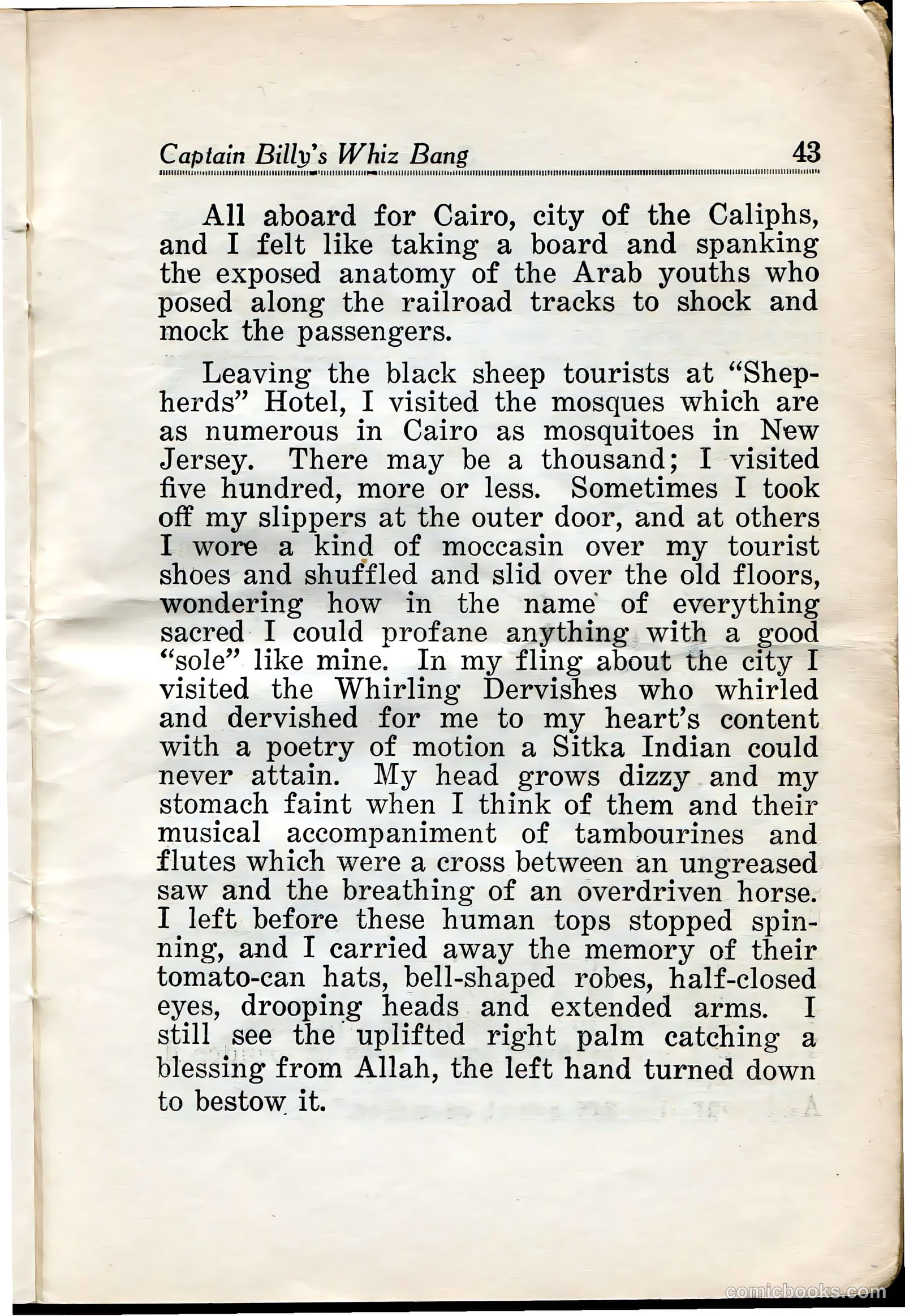
This is a humorous travel narrative mocking both tourist experiences and cultural encounters in Cairo, Egypt. The unnamed narrator describes visiting mosques, the Whirling Dervishes, and encountering Arab youth along railroad tracks. The satire operates on multiple levels: it ridicules American tourists (called "black sheep" tourists at the Shepherds Hotel), pokes fun at the narrator's own awkwardness navigating sacred spaces (the extended "sole" pun about shoe profanation), and offers exaggerated, somewhat derisive descriptions of Egyptian cultural practices—particularly the Dervishes, whose spiritual dance is reduced to "human tops" with unflattering physical descriptions. The humor relies on period-typical travel-writer superiority and cultural stereotyping. Terms like "exposed anatomy" and the mocking tone toward young Egyptians reflect the casual prejudices common in 1920s American satire. The piece appears designed to amuse readers through irreverent, self-aware traveler's observations rather than serious commentary.
📄 Transcribed text from this page (OCR, searchable)
Machine-transcribed from the original scan — historical spelling and the odd misread are preserved.
Captain Billy's Whiz Bang 43 All aboard for Cairo, city of the Caliphs, and I felt like taking a board and spanking the exposed anatomy of the Arab youths who posed along the railroad tracks to shock and mock the passengers. Leaving the black sheep tourists at “Shep-herds” Hotel, I visited the mosques which are as numerous in Cairo as mosquitoes in New Jersey. There may be a thousand; I visited five hundred, more or less. Sometimes I took off my slippers at the outer door, and at others I wore a kind of moccasin over my tourist shoes and shuffled and slid over the old floors, wondering how in the name of everything sacred I could profane anything with a good “sole” like mine. In my fling about the city I visited the Whirling Dervishes who whirled and dervished for me to my heart’s content with a poetry of motion a Sitka Indian could never attain. My head grows dizzy and my stomach faint when I think of them and their musical accompaniment of tambourines and flutes which were a cross between an ungreased saw and the breathing of an overdriven horse. I left before these human tops stopped spin-ning, and I carried away the memory of their tomato-can hats, bell-shaped robes, half-closed eyes, drooping heads and extended arms. I still see the uplifted right palm catching a blessing from Allah, the left hand turned down to bestow it.