
Captain Billy's Whiz Bang, January 1922 · page 34 of 68
Captain Billy's Whiz Bang #29 — page 34: what you’re looking at
What you’re looking at
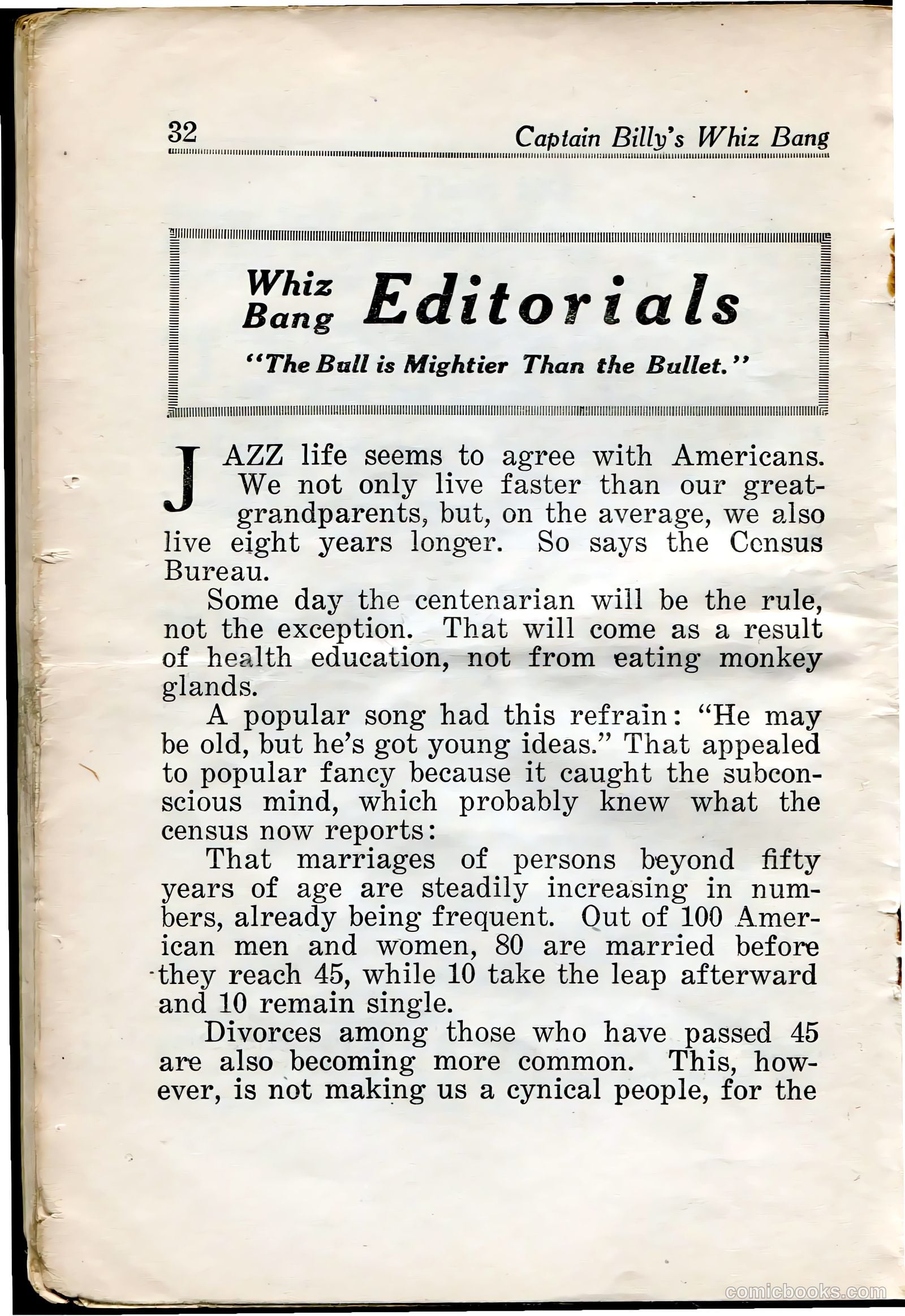
This editorial from *Captain Billy's Whiz Bang* (a 1920s satirical magazine) discusses American longevity and changing social patterns. The text cites Census Bureau data showing Americans live eight years longer than previous generations—a result of health education, not fad treatments like "monkey glands" (a contemporary pseudo-scientific longevity craze). The piece notes that elderly Americans increasingly marry and even divorce. It references a popular song's appeal to the "subconscious mind," suggesting people intuitively knew what statistics confirmed: that older people could have "young ideas" and active romantic lives. The editorial's title—"The Ball is Mightier Than the Bullet"—likely celebrates life force and vitality (the "ball" of energy and social activity) over destructive force, fitting the Jazz Age optimism about modernity improving human life. No specific political figures or caricatures appear visible on this page—it's primarily text-based editorial commentary.
📄 Transcribed text from this page (OCR, searchable)
Machine-transcribed from the original scan — historical spelling and the odd misread are preserved.
32 Captain Billy's Whiz Bang Whiz Bang Editorials “The Bull is Mightier Than the Bullet.” J AZZ life seems to agree with Americans. We not only live faster than our great-grandparents, but, on the average, we also live eight years longer. So says the Census Bureau. Some day the centenarian will be the rule, not the exception. That will come as a result of health education, not from eating monkey glands. A popular song had this refrain: “He may be old, but he’s got young ideas.” That appealed to popular fancy because it caught the subcon-scious mind, which probably knew what the census now reports: That marriages of persons beyond fifty years of age are steadily increasing in num-bers, already being frequent. Out of 100 Amer-ican men and women, 80 are married before they reach 45, while 10 take the leap afterward and 10 remain single. Divorces among those who have passed 45 are also becoming more common. This, how-ever, is not making us a cynical people, for the