
Captain Billy's Whiz Bang, January 1922 · page 47 of 68
Captain Billy's Whiz Bang #29 — page 47: what you’re looking at
What you’re looking at
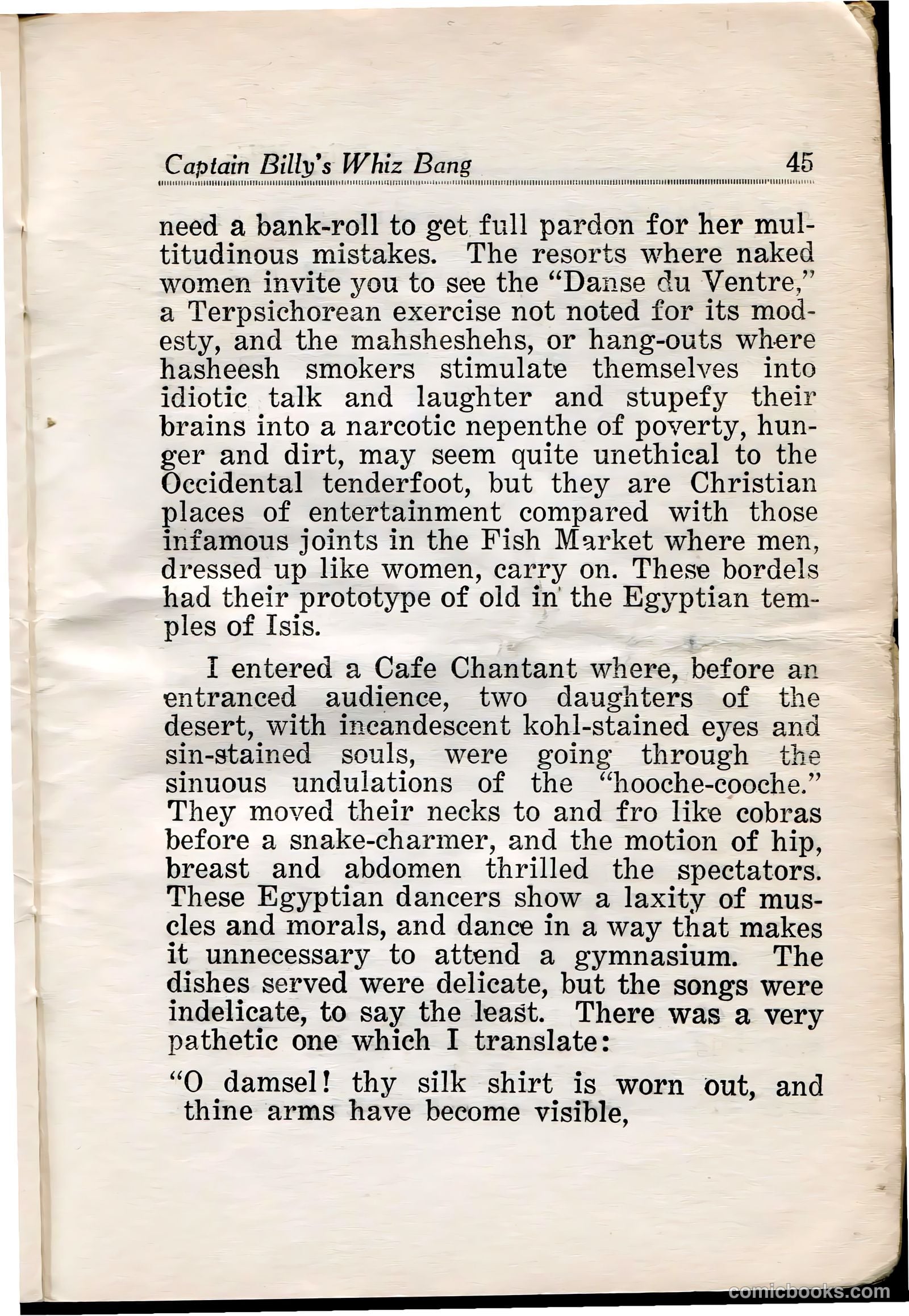
This page from *Captain Billy's Whiz Bang* (a 1920s-era satirical magazine) contains no visible cartoon—it's text only, appearing to be from a serialized article or story. The content is a moralistic travelogue describing exotic entertainment venues, likely in Egypt or the Middle East. The narrator describes belly dancing ("hooche-cooche"), hashish dens, and what appears to be cross-dressing performers in Cairo's Fish Market, presenting them as morally questionable but "Christian" compared to Western establishments. The satire operates through overwrought, judgmental language—the author feigns shock at foreign customs while also finding them somewhat amusing. The translation of a song about a woman's worn clothing suggests ironic humor at the gap between the "delicate" food and "indelicate" entertainment. The underlying joke appears to target both prudish Western attitudes toward non-Western cultures and the hypocrisy of condemning foreign vice while tolerating domestic equivalents. The tone is typical of early 20th-century American male-oriented humor magazines.
📄 Transcribed text from this page (OCR, searchable)
Machine-transcribed from the original scan — historical spelling and the odd misread are preserved.
Captain Billy's Whiz Bang 45 need a bank-roll to get full pardon for her mul- titudinous mistakes. The resorts where naked women invite you to see the “Danse du Ventre,” a Terpsichorean exercise not noted for its mod- esty, and the mahshehehs, or hang-outs where hasheesh smokers stimulate themselves into idiotic talk and laughter and stupefy their brains into a narcotic nepenthe of poverty, hun- ger and dirt, may seem quite unethical to the Occidental tenderfoot, but they are Christian places of entertainment compared with those infamous joints in the Fish Market where men, dressed up like women, carry on. These bordels had their prototype of old in the Egyptian tem- ples of Isis. I entered a Cafe Chantant where, before an entranced audience, two daughters of the desert, with incandescent kohl-stained eyes and sin-stained souls, were going through the sinuous undulations of the “hooche-cooche.” They moved their necks to and fro like cobras before a snake-charmer, and the motion of hip, breast and abdomen thrilled the spectators. These Egyptian dancers show a laxity of mus- cles and morals, and dance in a way that makes it unnecessary to attend a gymnasium. The dishes served were delicate, but the songs were indelicatc, to say the least. There was a very pathetic one which I translate: “O damsel! thy silk shirt is worn out, and thine arms have become visible,