comicbooks.com Join Free

A complete, restored issue of Pulp Fiction from 1946 — all 84 pages of painted-cover fiction magazines that launched science fiction, horror, and hardboiled crime, free to page through at comicbooks.com.

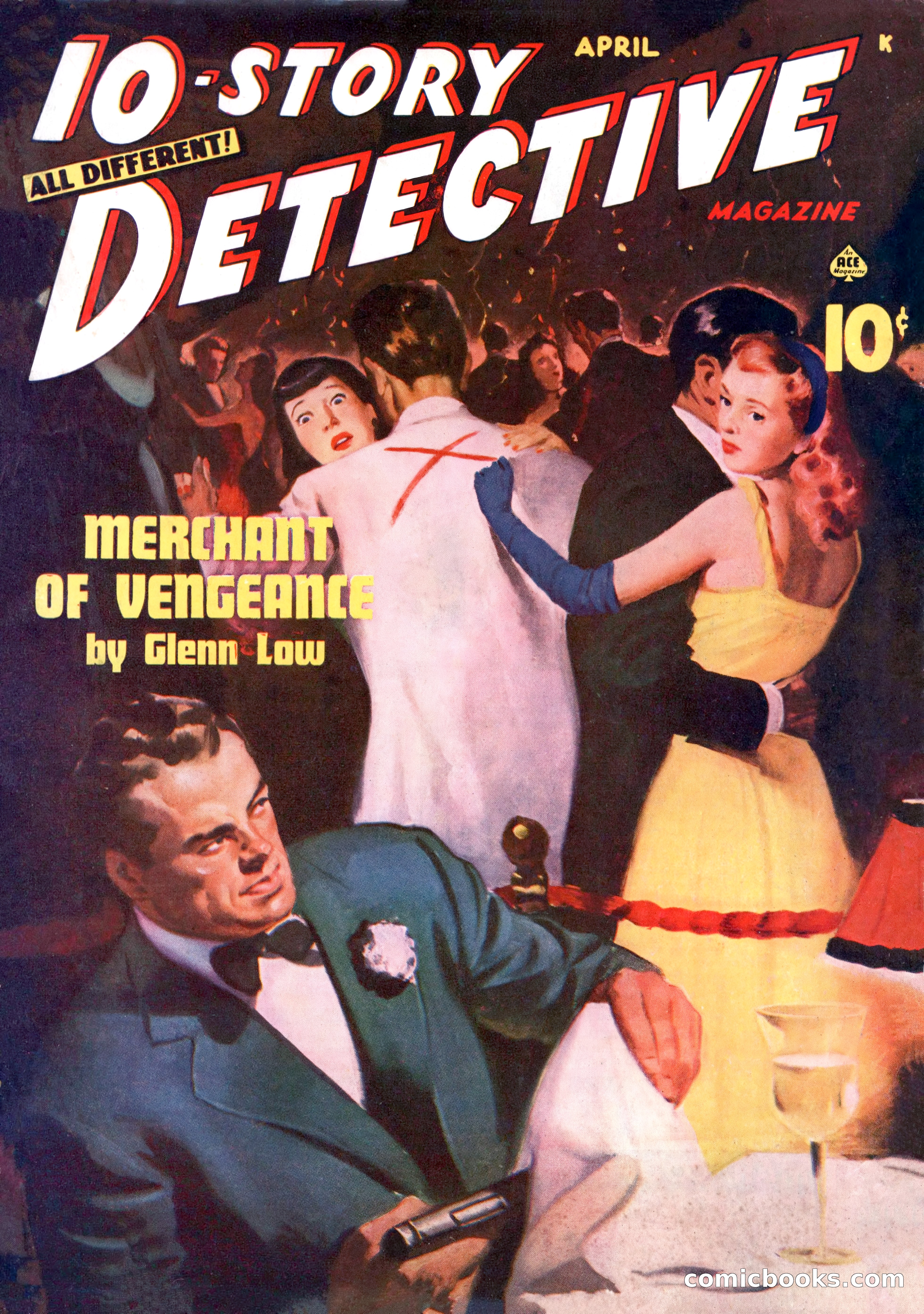
On the cover: This is the front cover of a 10-Story Detective Magazine from April, priced at 10 cents. The cover features an illustration of a glamorous nightclub or party scene with well-dressed men and women. The main story advertised is "Merchant of Vengeance" by Glenn Low. The cover promises "All Different!" stories inside. The illustration depicts what appears to be a dramatic moment at a formal social gathering, with a man in a tuxedo prominently featured in the foreground holding what looks like a gun, while other elegantly dressed figures surround him in the background, suggesting intrigue or conflict at this upscale venue.

🖼️ Every page has a plain-English note on what you’re looking at — the figures, the references, the point of the satire.

← Back to Pulp Fiction All exhibitions

HomeExhibitionPulp FictionRead

A complete issue · 84 pages · 1946

10-Story Detective Magazine, April 1946
1946 · Free to read

10-Story Detective Magazine, April 1946 — page 1 of 84

1 / 84
What you’re looking at · open this page on its own ↗

This is the front cover of a 10-Story Detective Magazine from April, priced at 10 cents. The cover features an illustration of a glamorous nightclub or party scene with well-dressed men and women. The main story advertised is "Merchant of Vengeance" by Glenn Low. The cover promises "All Different!" stories inside. The illustration depicts what appears to be a dramatic moment at a formal social gathering, with a man in a tuxedo prominently featured in the foreground holding what looks like a gun, while other elegantly dressed figures surround him in the background, suggesting intrigue or conflict at this upscale venue.

10-Story Detective Magazine, April 1946 — page 2 of 84
2 / 84
What you’re looking at · open this page on its own ↗

# Advertisement Page This is a full-page advertisement for a Hospitalization Insurance Plan offered by the George Rogers Clark Mutual Casualty Company of Rockford, Illinois. The ad features a black-and-white photograph of medical personnel performing surgery, using the image to promote insurance coverage for hospital and doctor bills. The advertisement details specific benefits: coverage for hospital stays (up to $6.00 daily, maximum $1,080), loss-of-time compensation ($25 weekly up to $300), doctor visit reimbursement ($3-$9 per visit, maximum $135), and accidental death benefits ($1,000). The copy emphasizes protection against unexpected medical expenses. A coupon at the bottom invites readers to mail for free information about the policy.

10-Story Detective Magazine, April 1946 — page 3 of 84
3 / 84
What you’re looking at · open this page on its own ↗

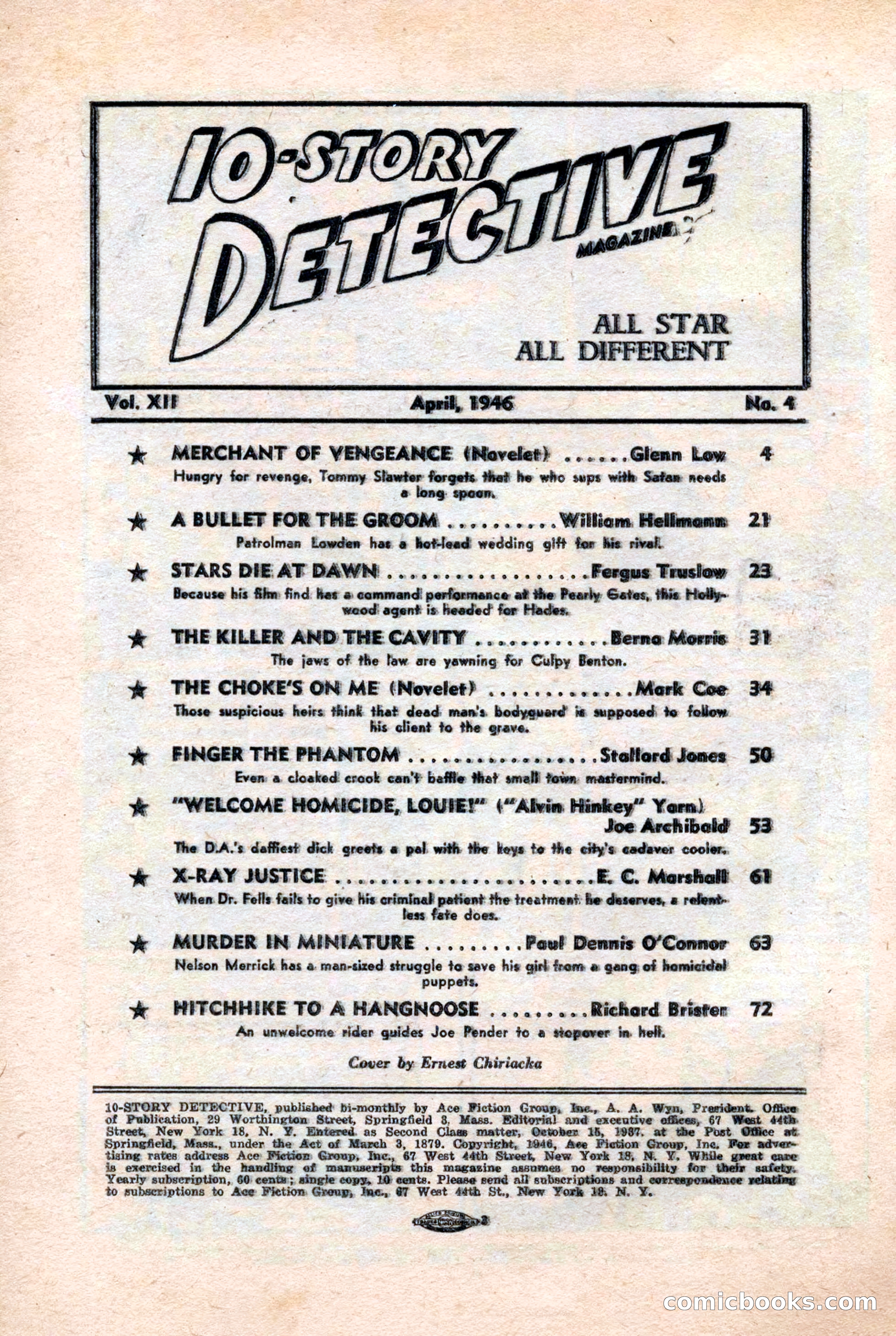
This page is a comic strip advertisement for Gillette razor blades, presented as a humorous narrative titled "Bob Got Out Of The Woods In A Hurry When..." The story depicts actor Bob Allen returning from a hunting trip, becoming excited about appearing on a Broadway television show, then being cleaned up and shaved. The comic uses this scenario to promote Gillette's thin blades, claiming they provide superior shaves that keep men looking handsome and well-groomed. The final panel features a character praising the razor's performance and endorsing the product directly to readers. The advertisement appears designed to associate the product with success, attractiveness, and masculine appeal.

10-Story Detective Magazine, April 1946 — page 4 of 84
4 / 84
What you’re looking at · open this page on its own ↗

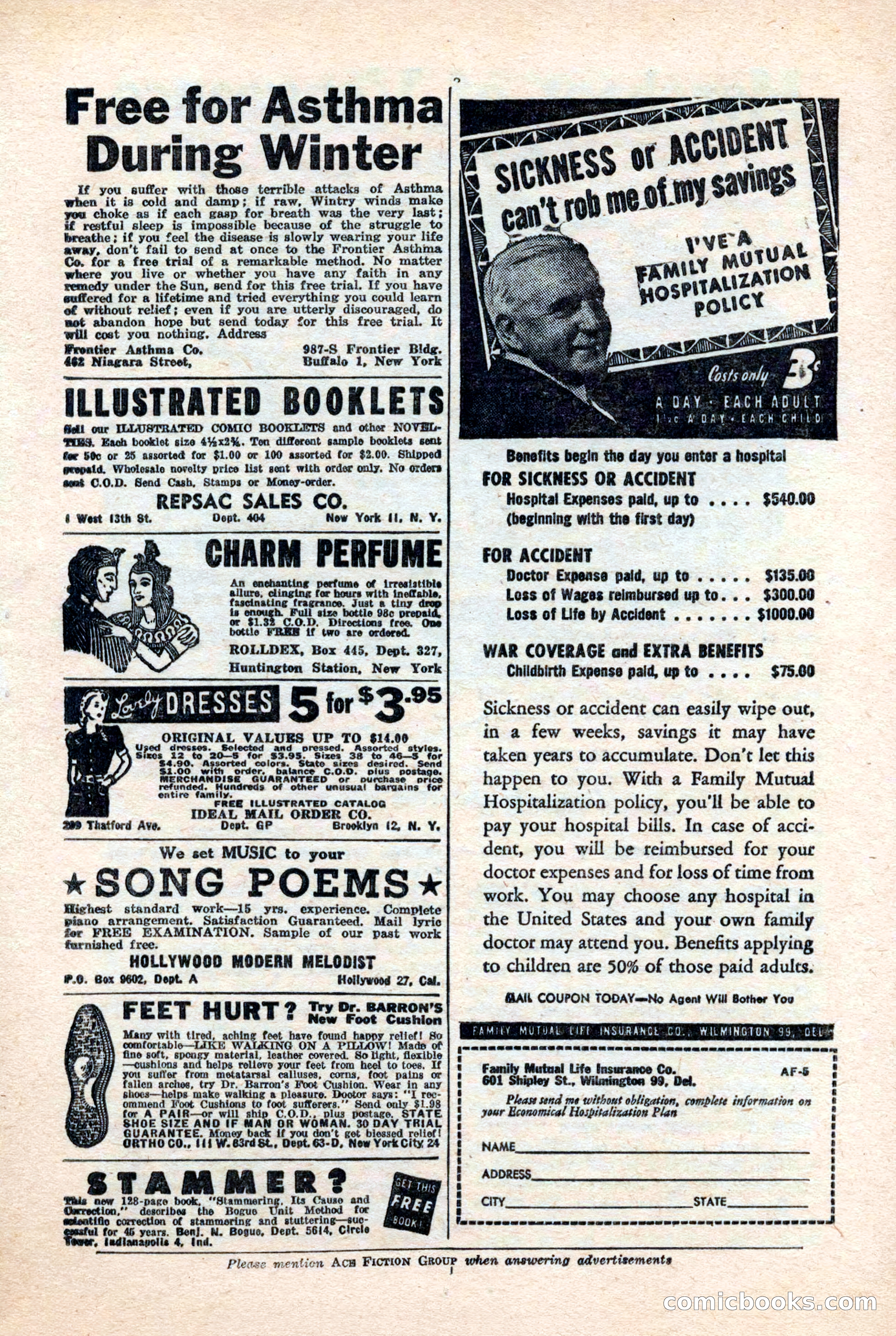
This is a table of contents page from *10-Story Detective Magazine*, Vol. XII, No. 4, April 1946. It lists eleven stories with their authors and page numbers, ranging from a novella titled "Merchant of Vengeance" by Glenn Law to "Hitchhike to a Hangnoose" by Richard Brister. The stories appear to be crime and detective fiction typical of pulp magazines, with titles suggesting murder, revenge, and criminal investigations. At the bottom is publication information for Ace Fiction Group, Inc. The page includes a note that the cover is by Ernest Chiriacka.

10-Story Detective Magazine, April 1946 — page 5 of 84
5 / 84
What you’re looking at · open this page on its own ↗

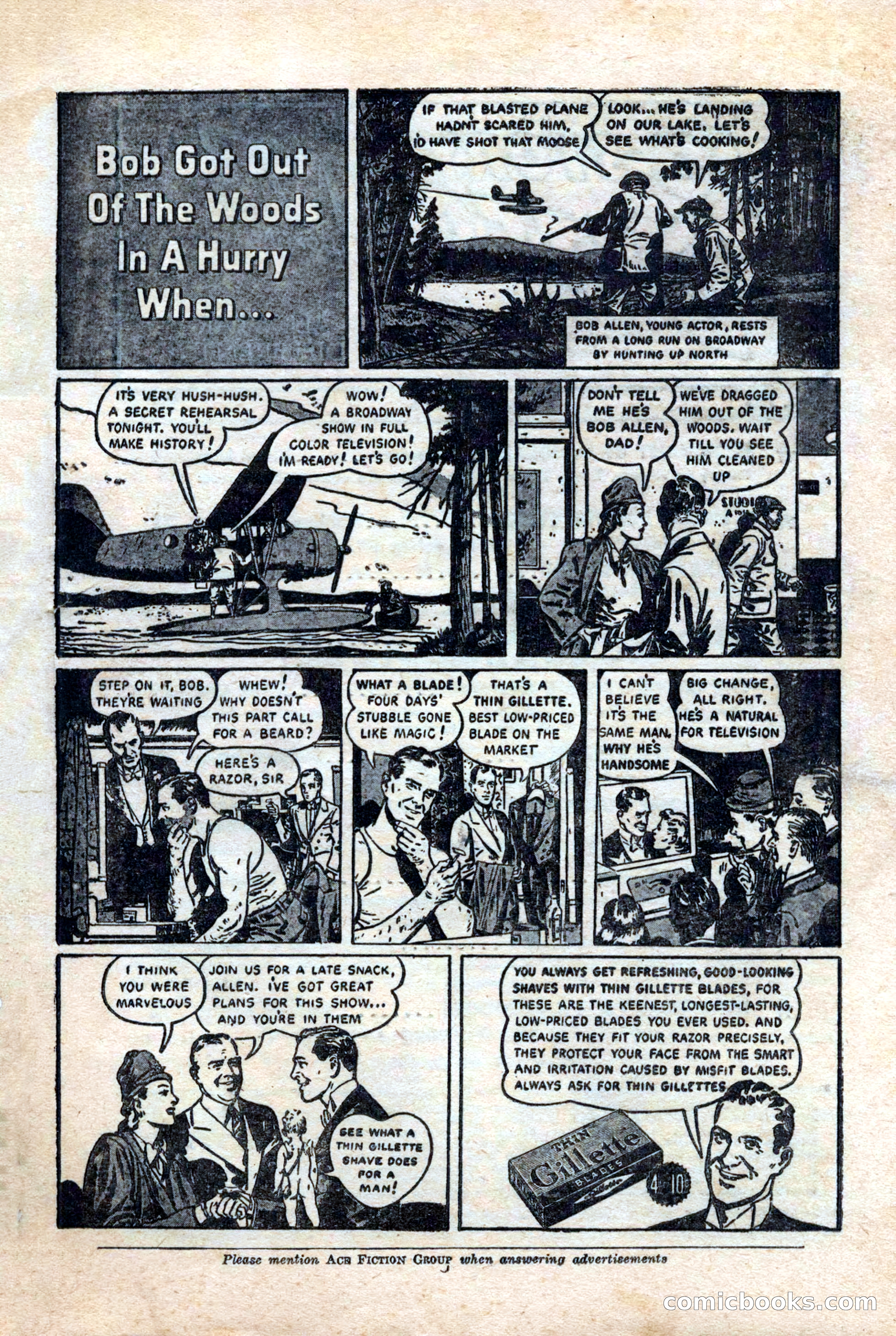
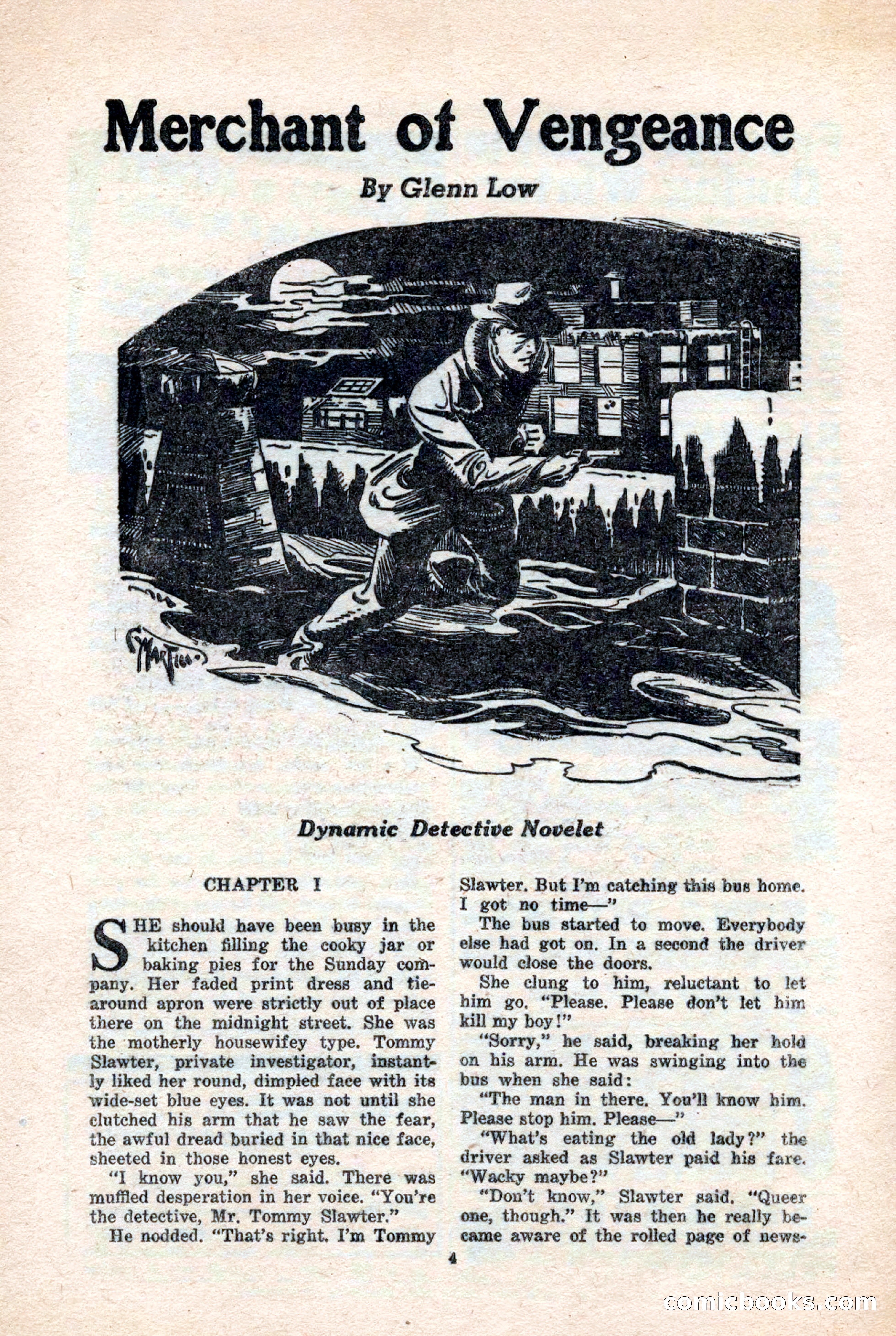
This is a classified advertising page from a pulp magazine. The top features an ad for the Frontier Asthma Company offering free trials for asthma treatment, followed by various mail-order advertisements including illustrated booklets, charm perfume, dresses for $3.95, song poems set to music, foot cushions, and a stammer-correction course. On the right side is a prominent ad for Family Mutual Life Insurance Company's hospitalization policy, detailing benefits for hospital expenses, doctor fees, accident coverage, and childbirth expenses, with a coupon for readers to request more information.

10-Story Detective Magazine, April 1946 — page 6 of 84
6 / 84
What you’re looking at · open this page on its own ↗

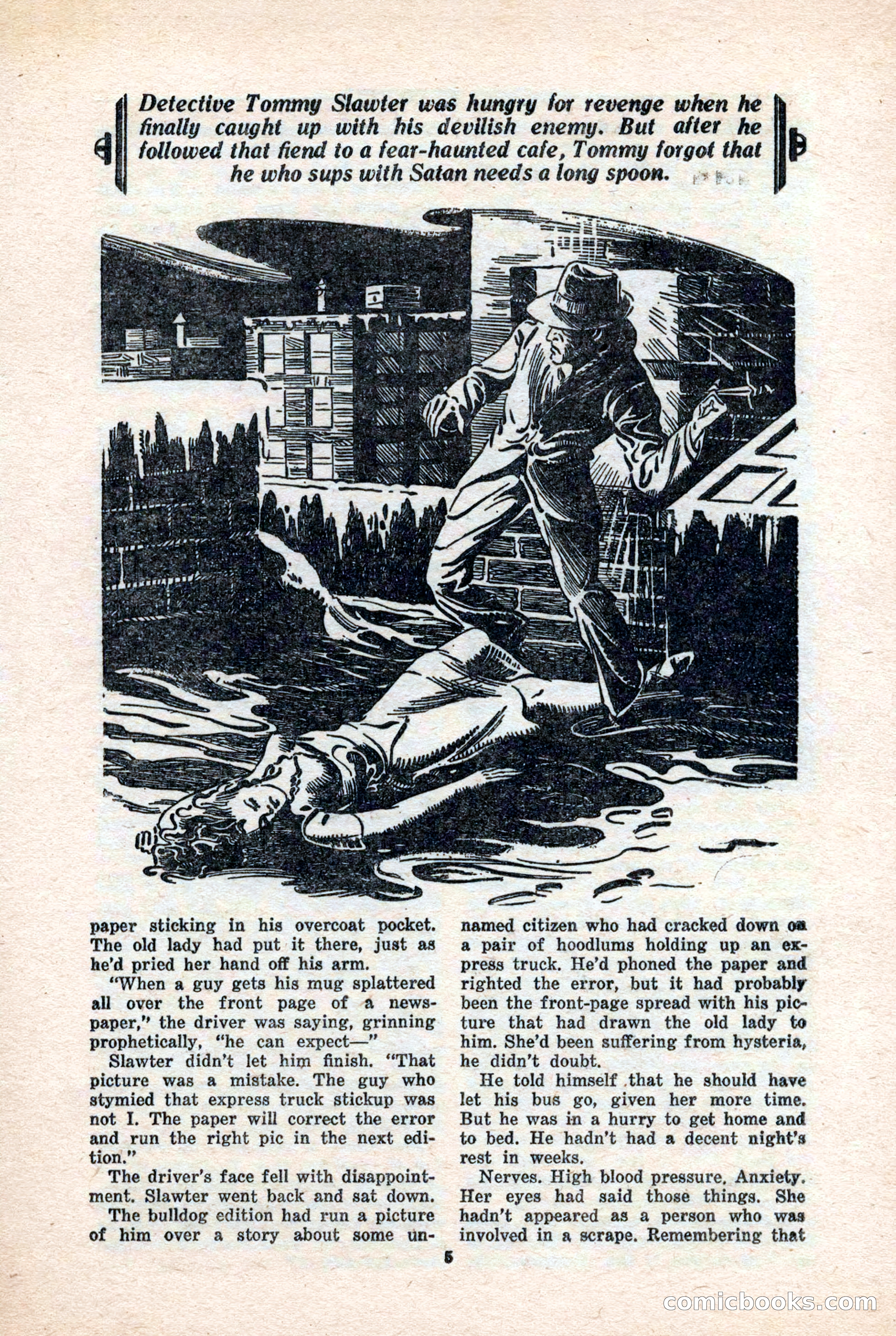
# Page Description This is an interior story page from a pulp fiction magazine featuring "Merchant of Vengeance" by Glenn Low, labeled a "Dynamic Detective Novelet." The page contains Chapter I of the story, beginning with prose narrative. The visible text introduces Tommy Slawter, described as a private investigator, and depicts a scene where a worried woman clutches his arm, desperately trying to stop him from boarding a bus. She pleads with him not to let "him" kill her boy. The driver questions what's eating the old lady, and Slawter cryptically responds about a "queer one" before noticing a rolled page of newspaper. The page includes a dramatic black-and-white illustration at the top showing the scene with the woman and investigator near a bus, with buildings and trees visible in the background.

10-Story Detective Magazine, April 1946 — page 7 of 84
7 / 84
What you’re looking at · open this page on its own ↗

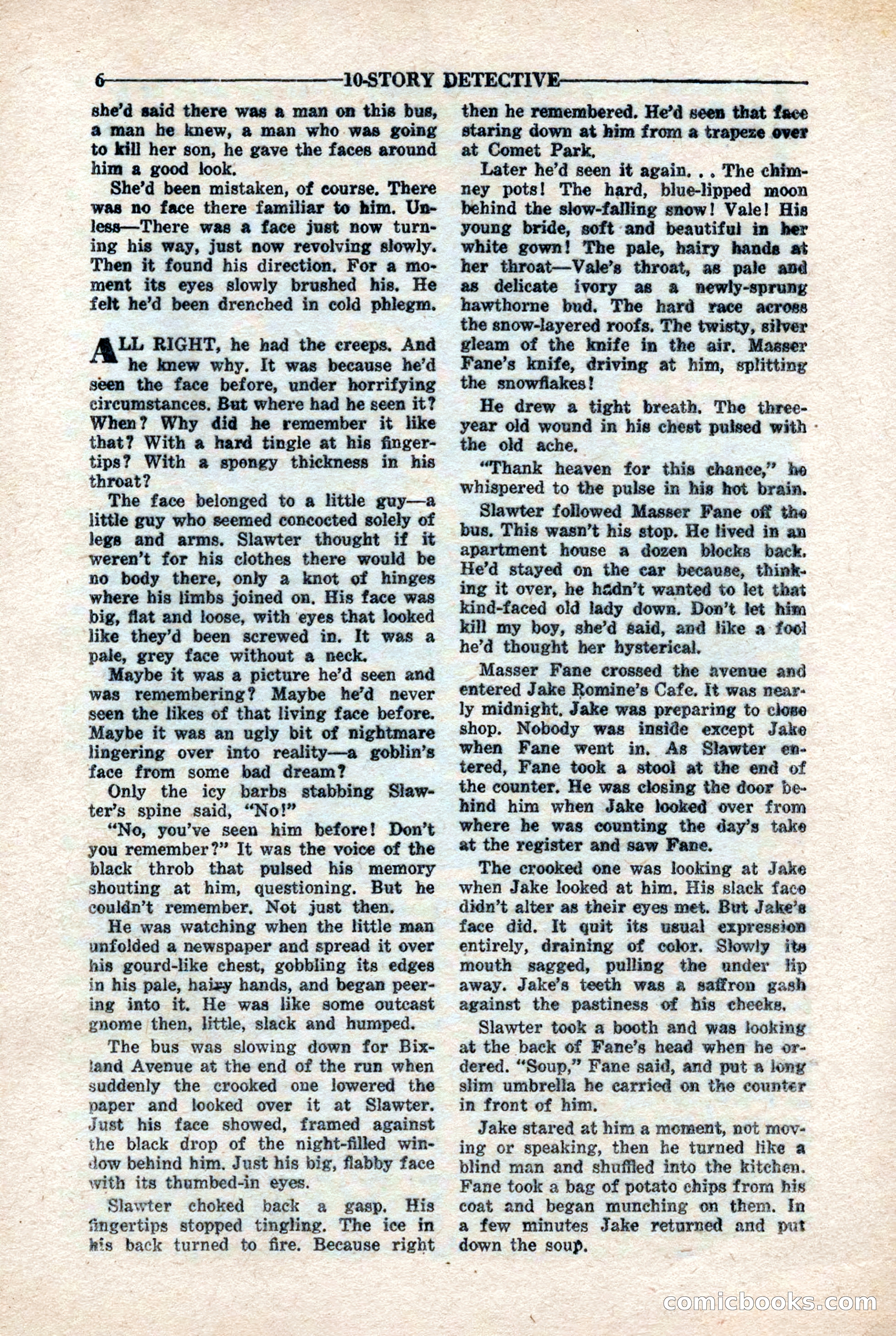
# Page Analysis This is an **interior story page** with both illustration and prose text from a pulp fiction magazine. The dramatic black-and-white illustration depicts Detective Tommy Slawter discovering a dead body outside a nighttime urban setting. The accompanying text describes how Slawter was pursuing his enemy to a "fear-haunted cafe" but became distracted by a newspaper error—a photo of a bus driver was mistakenly published instead of the intended picture. The narrative explores the consequences of this mix-up, involving an elderly woman suffering from hysteria whose image appeared in the paper, leading to complications including her health crisis. The prose focuses on newspaper accountability and the unintended harm caused by editorial mistakes.

10-Story Detective Magazine, April 1946 — page 8 of 84
8 / 84
What you’re looking at · open this page on its own ↗

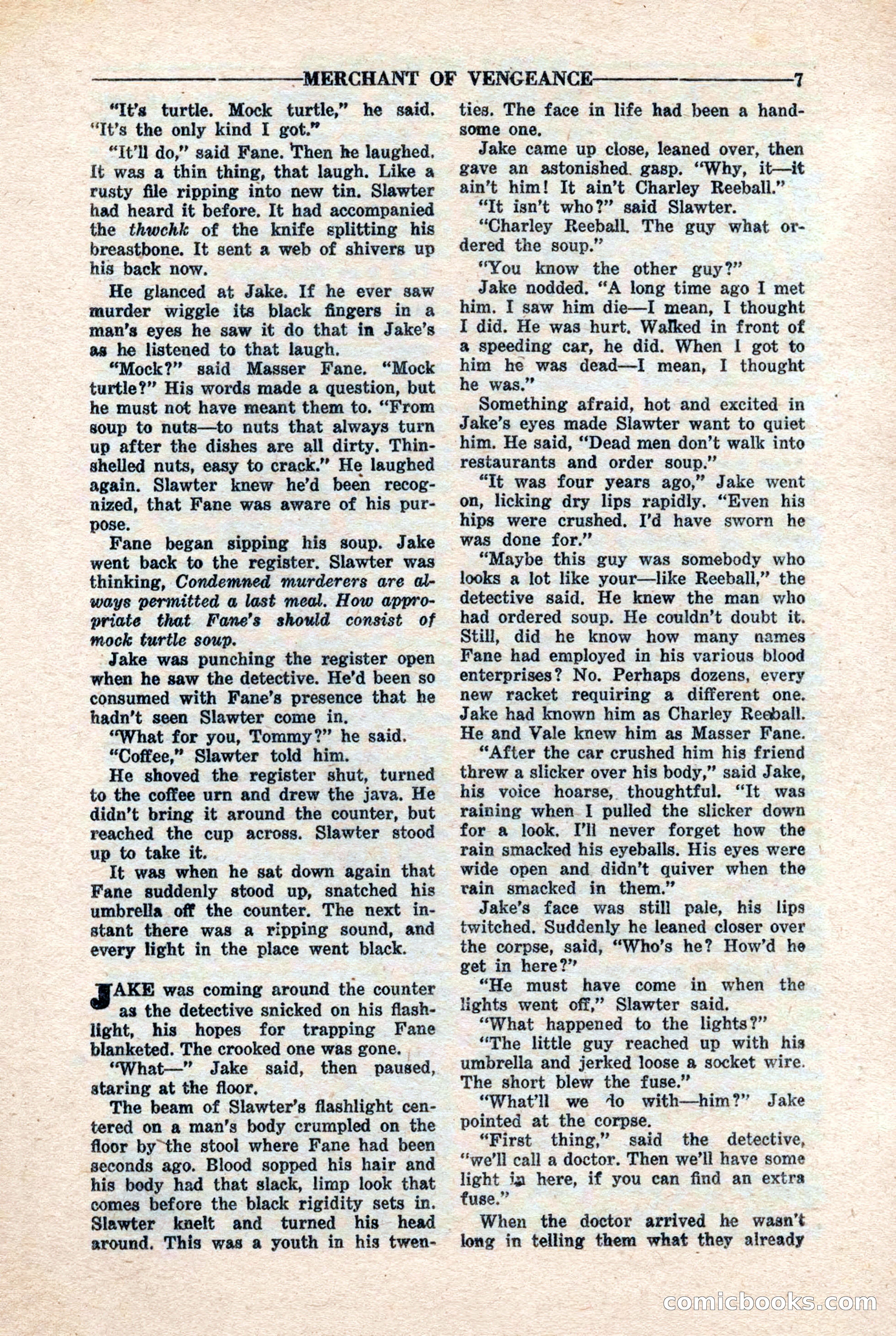
# 10-Story Detective - Page 6 This is a page of story prose from a pulp detective magazine. The text describes a protagonist (Slawter) who recognizes a small, peculiar-looking man's face and experiences an unsettling memory. The narrative follows Slawter as he leaves a bus, pursues the man (Pane) to Jake Rommette's Cafe near midnight, and observes a tense encounter between Pane and the cafe's owner Jake. The passage emphasizes Slawter's psychological discomfort and growing suspicion, with vivid descriptions of the mysterious man's unsettling appearance and behavior. The story appears to be building toward a crime or mystery revelation.

10-Story Detective Magazine, April 1946 — page 9 of 84
9 / 84
What you’re looking at · open this page on its own ↗

This is a page of story prose from a hardboiled crime pulp magazine, titled "Merchant of Vengeance." The text describes a tense scene in what appears to be a restaurant or diner where a detective has discovered a dead body on the floor. A character named Jake witnesses the body of someone he apparently knew—a man he identifies as "Charley Reeball," whom he saw die in a car accident years earlier. The detective and Jake must now decide how to handle the corpse while dealing with the blackout caused by a short circuit. The narrative focuses on their confused reactions to finding this body in the establishment.

10-Story Detective Magazine, April 1946 — page 10 of 84
10 / 84
What you’re looking at · open this page on its own ↗

# Page Analysis This is a **story prose page** from a pulp detective magazine, numbered page 8. The visible text comprises two chapters of what appears to be a hardboiled crime story involving a murder investigation centered around poisoned soup served at a café. The narrative follows detective Tommy Slawter as he investigates a death, with a doctor and a man named Jake discussing whether poison was involved in the victim's meal. The story includes dialogue establishing that Jake may be a suspect, while Slawter works to uncover the truth. The page transitions into Chapter II, which begins discussing the soup's actual poison content and Jake's arrest for murder. The text is dense, two-column layout typical of pulp magazines from the early twentieth century.

10-Story Detective Magazine, April 1946 — page 11 of 84
11 / 84
What you’re looking at · open this page on its own ↗

This is a page of story prose from "Merchant of Vengeance," a pulp fiction narrative. The text depicts a conversation between Tommy Slawter and a woman (apparently named Vale) as they discuss a young man's death by poisoning. Tommy confesses to the murder and explains his motivation, while Vale expresses relief that he escaped and urges him to stop dwelling on the crime. The passage includes Tommy's recollection of the victim's suffering and his internal conflict about the act. The dialogue reveals Tommy's emotional state and Vale's attempts to comfort and reassure him that the matter should be forgotten.

10-Story Detective Magazine, April 1946 — page 12 of 84
12 / 84
What you’re looking at · open this page on its own ↗

This page contains story prose from a hardboiled crime detective story titled "10-STORY DETECTIVE" (visible at the top). The text depicts a conversation between detective Tommy Slawter and Betty Romine, the daughter of a man suspected of murder in a poisoning case at a cafe. Betty attempts to convince Slawter to help her father, while Slawter explains why going to the police would complicate matters. The narrative then shifts to Slawter learning from the city morgue that the dead body has been identified as someone named Rodney Pell, and Betty reveals she knew the victim and is now engaged to him—a revelation that appears to deepen the case's complexity.

10-Story Detective Magazine, April 1946 — page 13 of 84
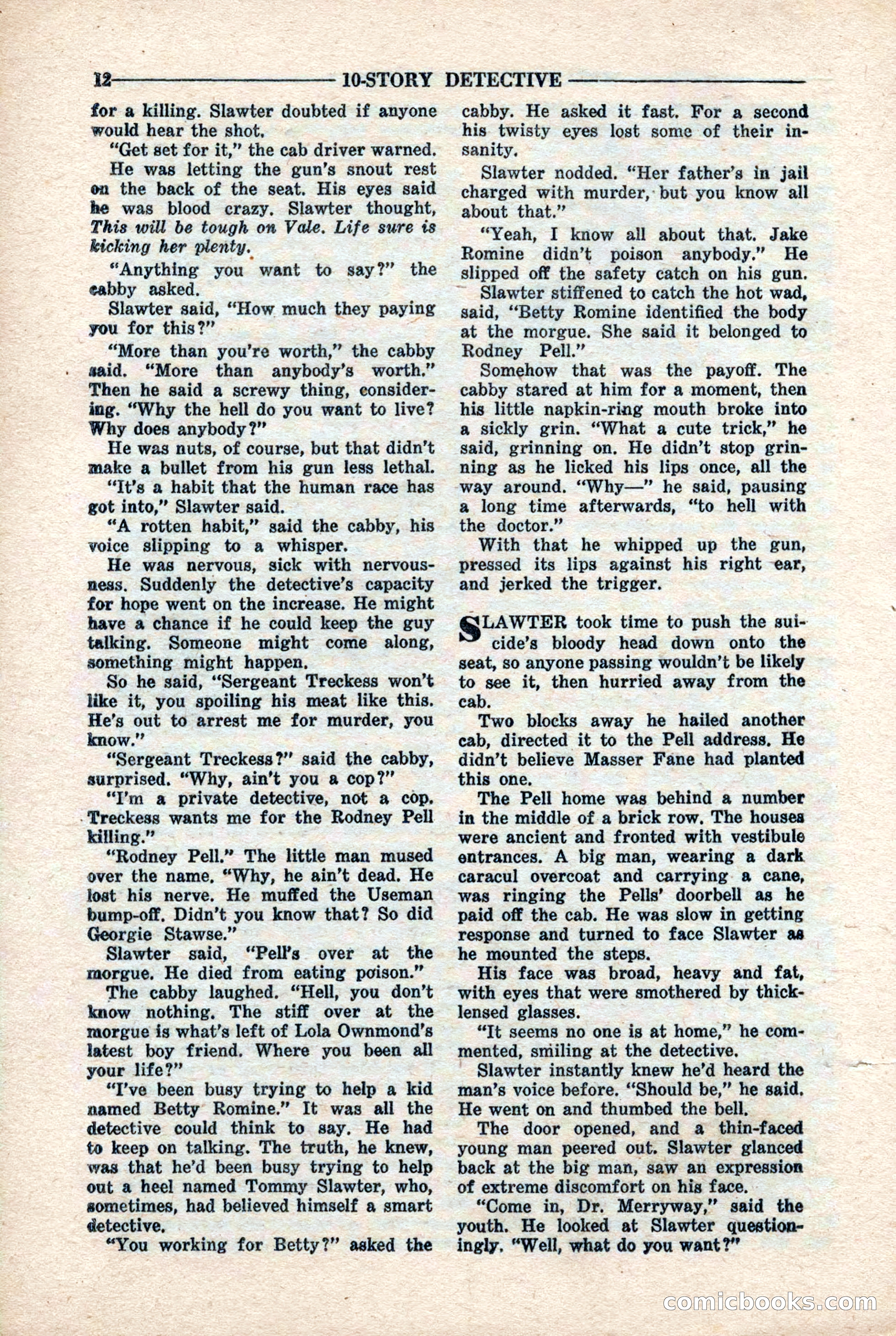
13 / 84
What you’re looking at · open this page on its own ↗

This page contains story prose from what appears to be a hardboiled crime fiction narrative titled "Merchant of Vengeance." The text describes a detective named Slawter pursuing a fugitive murderer named Masker Fane after discovering a classified newspaper advertisement warning "DON'T KILL YOURSELF." Slawter contacts a Dr. Merryway and Mrs. Pell, who provide crucial information about a poisoned vial found at a café and a bus driver's account of events. The passage culminates with Chapter III beginning, describing twilight street scenes and warehouses as the narrative tension escalates. The page is primarily dense text in two columns with standard pulp magazine formatting.

10-Story Detective Magazine, April 1946 — page 14 of 84
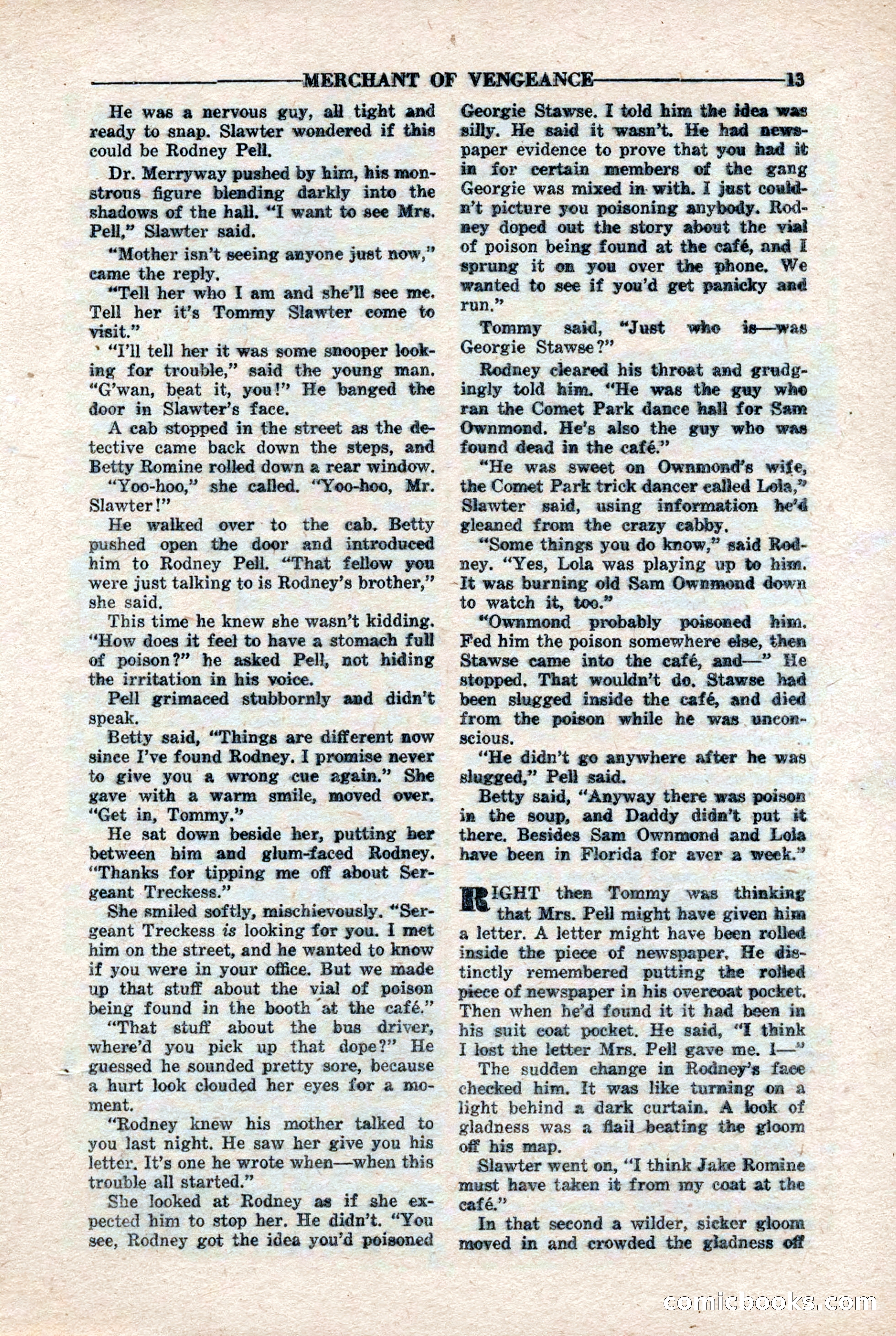
14 / 84
What you’re looking at · open this page on its own ↗

This page contains story prose from a detective fiction narrative titled "10-STORY DETECTIVE" (visible in the header). The text depicts a tense scene where Detective Slawter interrogates a cab driver about a murder case involving someone named Rodney Pell. The driver provides information about Betty Romine identifying a body at the morgue. Slawter then visits the Pell residence, where he encounters a thin-faced young man at the door who addresses him as "Dr. Merryway." The passage emphasizes noir elements—nervous tension, dark motivations, and suspicious circumstances—typical of hardboiled crime fiction from early pulp magazines.

10-Story Detective Magazine, April 1946 — page 15 of 84
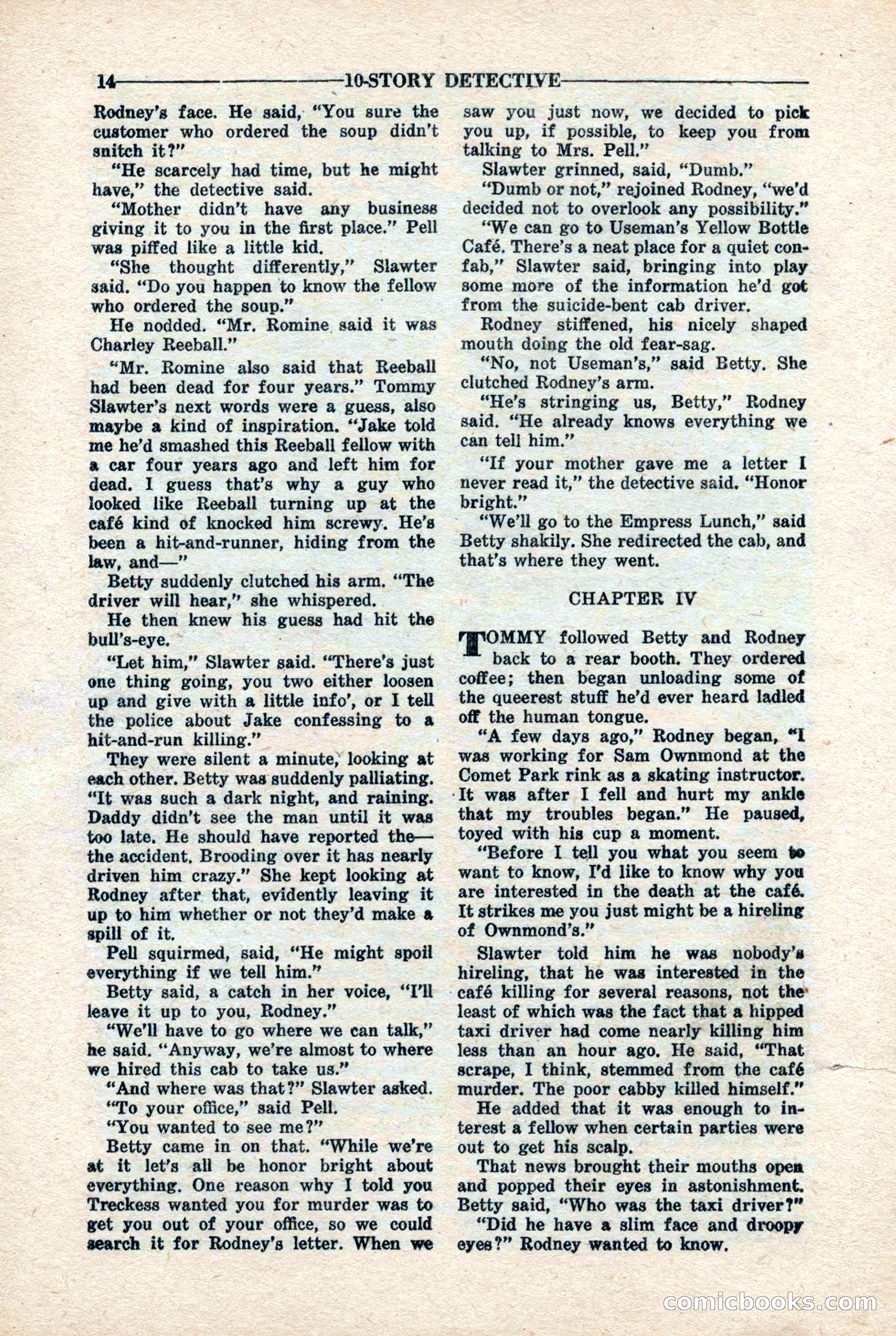
15 / 84
What you’re looking at · open this page on its own ↗

# Page Analysis: "Merchant of Vengeance" This is a **story prose page** (page 13) from a hardboiled crime pulp magazine. The text depicts a scene where detective Tommy Slawter confronts Rodney Pell about a poisoning case. The narrative reveals that George Stawse (apparently a gang member) may have poisoned Sam Ownmond at the Comet Park café, and that Ownmond's wife Lola was present. A key plot point emerges: Tommy realizes Mrs. Pell gave him a letter that may contain evidence—possibly hidden in newspaper and found in his overcoat pocket. The page shows mounting tension as Tommy recognizes this letter's significance to the murder investigation.

10-Story Detective Magazine, April 1946 — page 16 of 84
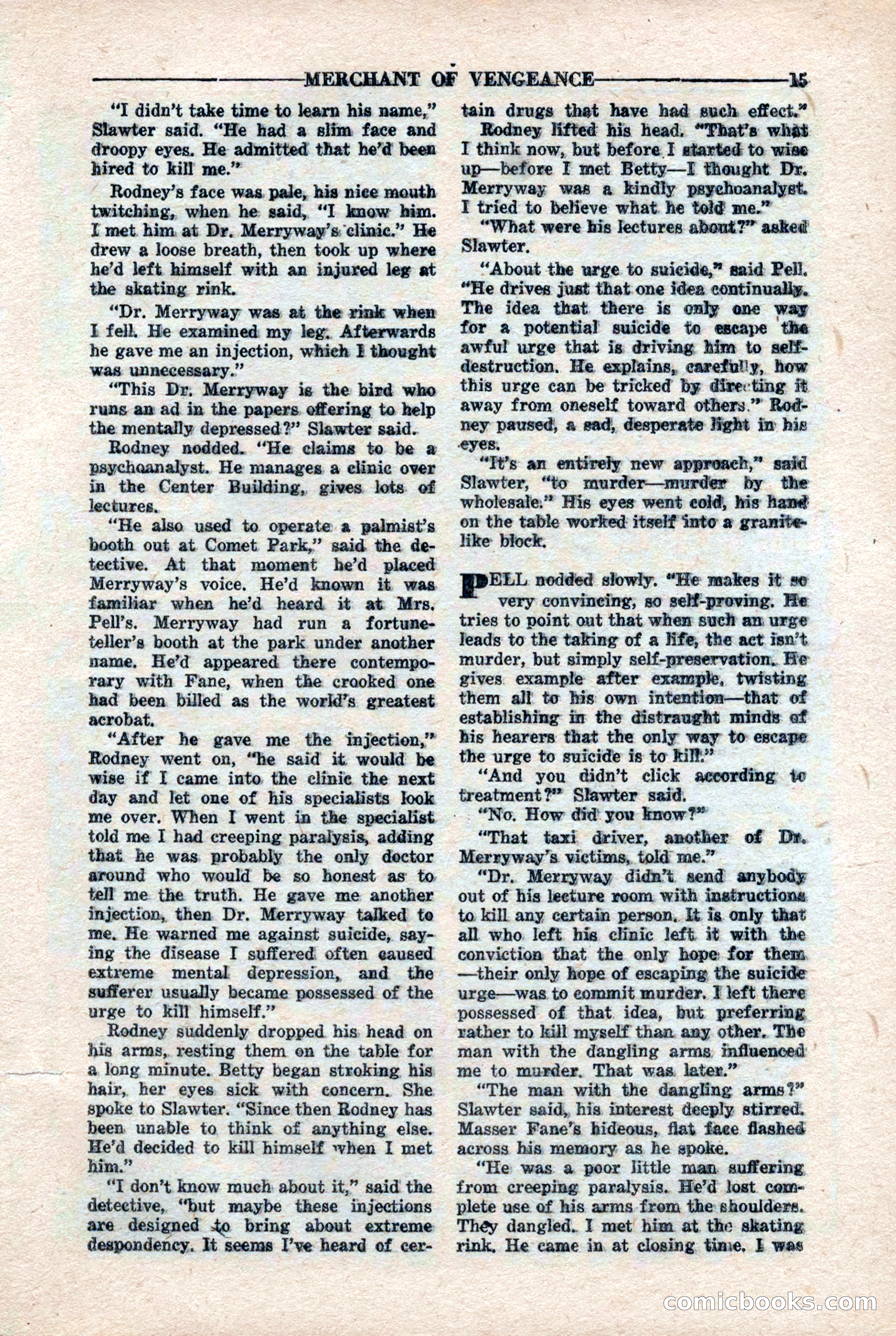
16 / 84
What you’re looking at · open this page on its own ↗

# Page Analysis This page contains story prose from a hardboiled crime detective magazine titled "10-Story Detective" (visible in the header). The text spans two sections: the conclusion of a scene where Detective Slawter pressures Betty and Rodney about a soup-ordering suspect named Charley Reeball, and Chapter IV, which begins with Tommy following Betty and Rodney to discuss Rodney's past employment at a skating rink and his connection to a taxi driver involved in a café murder. The narrative involves investigating a death and uncovering suspicious circumstances around various characters.

10-Story Detective Magazine, April 1946 — page 17 of 84
17 / 84
What you’re looking at · open this page on its own ↗

# Page Analysis This is a page of story prose from "Merchant of Vengeance" (visible in the header). The text appears to be from a hardboiled crime or mystery pulp story, consisting of two columns of dense typography typical of early-20th-century pulp magazines. The visible narrative involves Detective Slawter interrogating a character named Rodney about Dr. Merryway, described as a psychoanalyst running a clinic in the Center Building. The dialogue reveals that Dr. Merryway lectures to the mentally depressed and apparently encourages patients toward suicide through his controversial theories about self-destruction. The passage deals with serious themes including mental illness, psychological manipulation, and murder.

10-Story Detective Magazine, April 1946 — page 18 of 84
18 / 84
What you’re looking at · open this page on its own ↗

This is a page of story prose from a hardboiled detective magazine titled "10-STORY DETECTIVE" (visible in the header). The page shows continued dialogue from what appears to be a murder investigation involving poisoning. A character named Rodney confesses to a detective about how he was instructed to poison someone named Useman at a café called the Yellow Bottle Café, though he claims he ultimately didn't go through with it. The detective questions Rodney's account, and another character named Slawter provides an alternative explanation of events. The page ends with Slawter making a phone call to his apartment building's operator.

10-Story Detective Magazine, April 1946 — page 19 of 84
19 / 84
What you’re looking at · open this page on its own ↗

# Page 17 of "Merchant of Vengeance" This is a prose fiction page from what appears to be a pulp magazine. The text describes a dramatic nighttime scene where a detective pursues a suspect across snowy rooftops during a snowstorm. The protagonist follows footprints in the snow, chases a fleeing figure named Slawter across buildings, and observes acrobatic movements along rooflines. There are references to police involvement and a character named Vale. The passage emphasizes atmospheric details—the falling snow, moonlight, the difficulty of visibility—as the chase intensifies. The narrative style and content suggest this is hardboiled crime or detective fiction typical of early-20th-century pulp magazines.

10-Story Detective Magazine, April 1946 — page 20 of 84
20 / 84
What you’re looking at · open this page on its own ↗

This page contains story prose from Chapter V of what appears to be a hardboiled crime or detective fiction story titled "10-Story Detective" (visible in the header). The narrative describes a dramatic confrontation involving characters named Tommy, Slawter, Vale, and others. The action involves gunfire from a car, a chase sequence, and what appears to be a violent conclusion involving a character named Fane and references to a "Pell boy's letter." The text is densely packed in two columns of typical pulp magazine typography, with no illustrations visible on this page.

10-Story Detective Magazine, April 1946 — page 21 of 84
21 / 84
What you’re looking at · open this page on its own ↗

# Page 19: Story Prose from "Merchant of Vengeance" This is a page of story prose—no illustrations or advertisements visible. The text appears to be from a hardboiled crime narrative titled "Merchant of Vengeance" (visible in the header). The passage depicts a detective named Slawter questioning a sergeant named Treckess about a poisoning death. Slawter explains that a man named Stawse poisoned himself, and theorizes about the involvement of characters including Fane, Merryway, and Useman in a murder-suicide scheme. The dialogue reveals conflicting accounts about who was hired to kill whom, with Slawter ultimately suggesting Stawse poisoned Useman and then himself using poison hidden in beer.

10-Story Detective Magazine, April 1946 — page 22 of 84
22 / 84
What you’re looking at · open this page on its own ↗

# Page 20 of "10-Story Detective" This page contains story prose from a hardboiled crime narrative. The text describes Detective Treckess interrogating a suspect named Slawter about the poisoning death of someone named Fane, who was killed in Jake's café. Treckess explains how Fane was poisoned and then beaten, with the murderer apparently being Useman. The passage concludes with Tommy Slawter and his wife Vale receiving good news—apparently Rodney (likely Slawter's father) has been freed—and they leave the police station together in the snow, described as happy "like a couple of high school ninnies." A small illustration appears at the page bottom showing a man's face in profile.

10-Story Detective Magazine, April 1946 — page 23 of 84
23 / 84
What you’re looking at · open this page on its own ↗

# Page Content Description This is a story page from a pulp magazine containing the narrative text of "A Bullet for the Groom" by William Hellmann. The page features a small illustration in the upper left corner showing what appears to be a man in a patrol uniform, and the story text is arranged in two columns below. The visible prose depicts Corporal Capper Lowden, a patrolman, placing a bomb near a bus station, apparently intending to target a rival in a romantic dispute. The dialogue reveals conflict between Lowden and another man named Joe over a woman named Janie, who has married someone named Eddie. The story explores themes of jealousy and potential violence within a crime/hardboiled fiction context.

10-Story Detective Magazine, April 1946 — page 24 of 84
24 / 84
What you’re looking at · open this page on its own ↗

# Page Content Analysis This is a **story prose page** from a pulp detective magazine (page 22 of "10-Story Detective"). The text presents a hardboiled crime narrative involving police officers Pete and Joe pursuing a fugitive connected to a bank robbery. The story depicts a tense confrontation in a parking lot where Pete shoots a suspect named Eddie, who appears to be involved with Janie and the robbery. The prose emphasizes action and dialogue as Pete decides to apprehend Eddie rather than kill him, ultimately handing off the suspect and gun to Joe with instructions to contact Chief Burke. The narrative style is typical of early-20th-century pulp crime fiction, featuring quick pacing and dramatic violence.

10-Story Detective Magazine, April 1946 — page 25 of 84
25 / 84
What you’re looking at · open this page on its own ↗

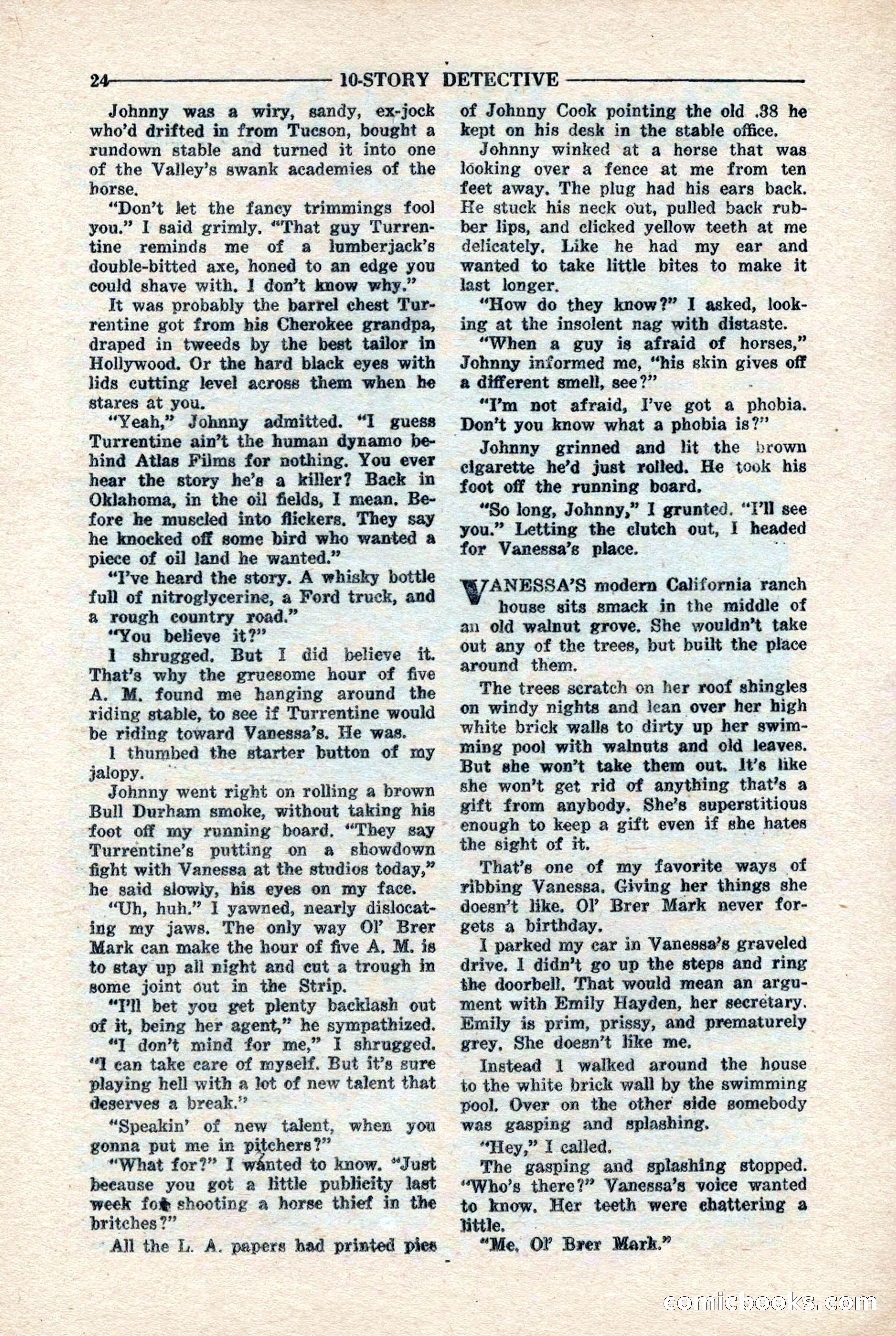
# Page Analysis This is a story page from a pulp magazine featuring "Stars Die at Dawn" by Fergus Truslow. The page includes a dramatic woodcut-style illustration depicting a standing figure with a rifle overlooking a scene with fire and what appears to be a body below. The visible prose describes a Hollywood agent named Mark Reynard dealing with consequences involving his film discovery, a glamorous actress named Vanessa, who apparently made an "unscheduled appearance at the Pearly Gates." The narrator recounts meeting Alec Turrentine at Johnny Cook's riding stables and reflects on Reynard's misfortune, suggesting he should have handled the situation with his talent differently. The text hints at a crime or supernatural scenario with dark implications.

10-Story Detective Magazine, April 1946 — page 26 of 84
26 / 84
What you’re looking at · open this page on its own ↗

# Page 24 of "10-Story Detective" This page contains **story prose** with no illustrations or advertisements visible. The text appears to be a hardboiled detective narrative. The narrator discusses Johnny Cock, a former jockey turned stable operator, and mentions Johnny's reputation and relationship with horses. The story then shifts to the narrator's visit to a California ranch house owned by someone named Vanessa, located near an old walnut grove. The narrator walks around the house and encounters Vanessa swimming in a pool, calling out to her. The passage focuses on character development and establishing setting rather than plot resolution, typical of pulp detective fiction.

10-Story Detective Magazine, April 1946 — page 27 of 84
27 / 84
What you’re looking at · open this page on its own ↗

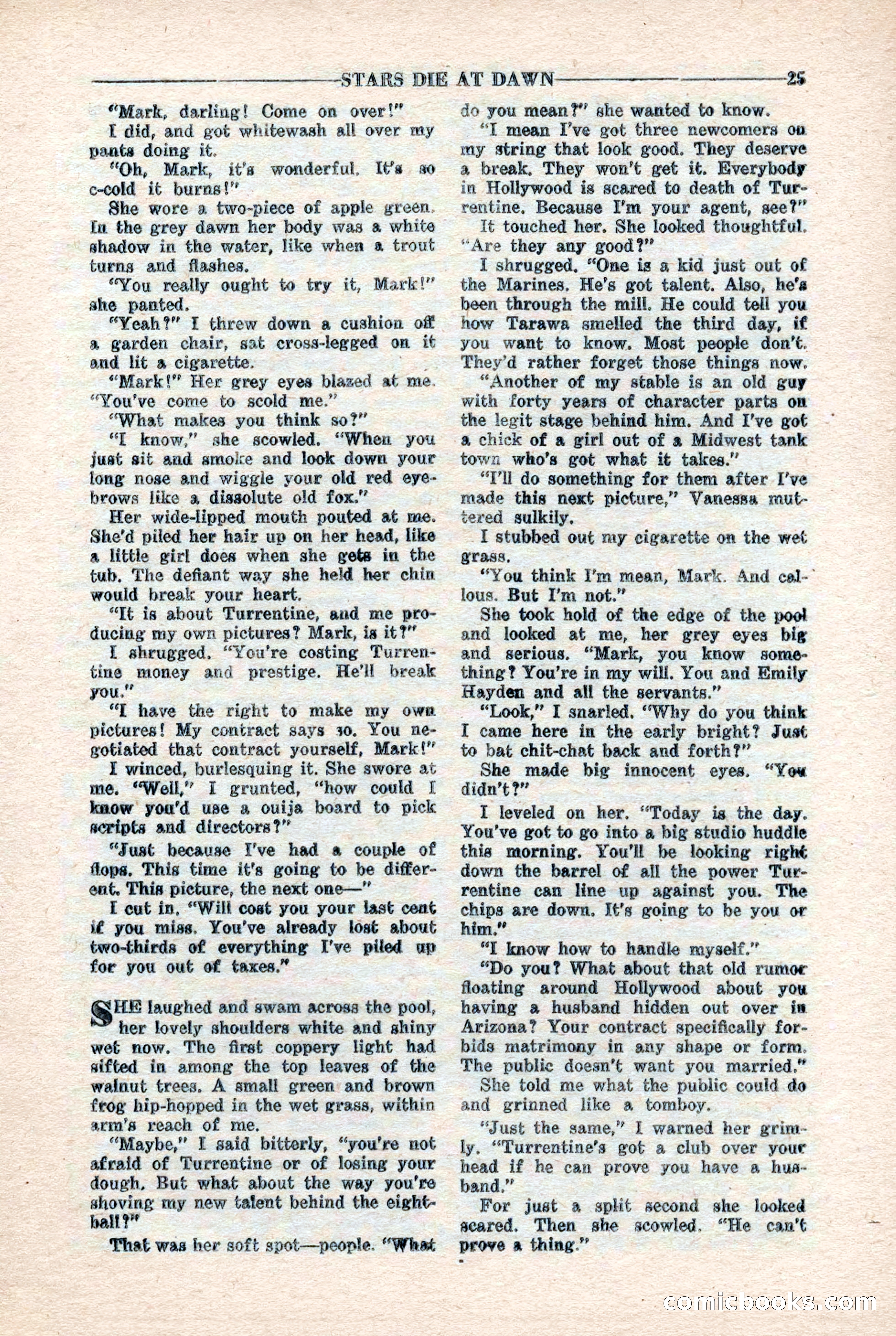
# Page 25 from "Stars Die at Dawn" This is a story prose page from a pulp fiction magazine, containing two columns of text. The narrative depicts a confrontation between two characters—Mark and a woman (possibly named Vanessa)—apparently discussing a film production involving an actor named Turrentine. The woman, who appears to be an actress or producer, defends her professional decisions and right to make her own pictures, while Mark argues about costs, prestige, and rumors regarding Turrentine's personal life, including an alleged hidden husband in Arizona. The dialogue reveals conflicts over career choices, contracts, and Hollywood gossip typical of hardboiled entertainment industry fiction.

10-Story Detective Magazine, April 1946 — page 28 of 84
28 / 84
What you’re looking at · open this page on its own ↗

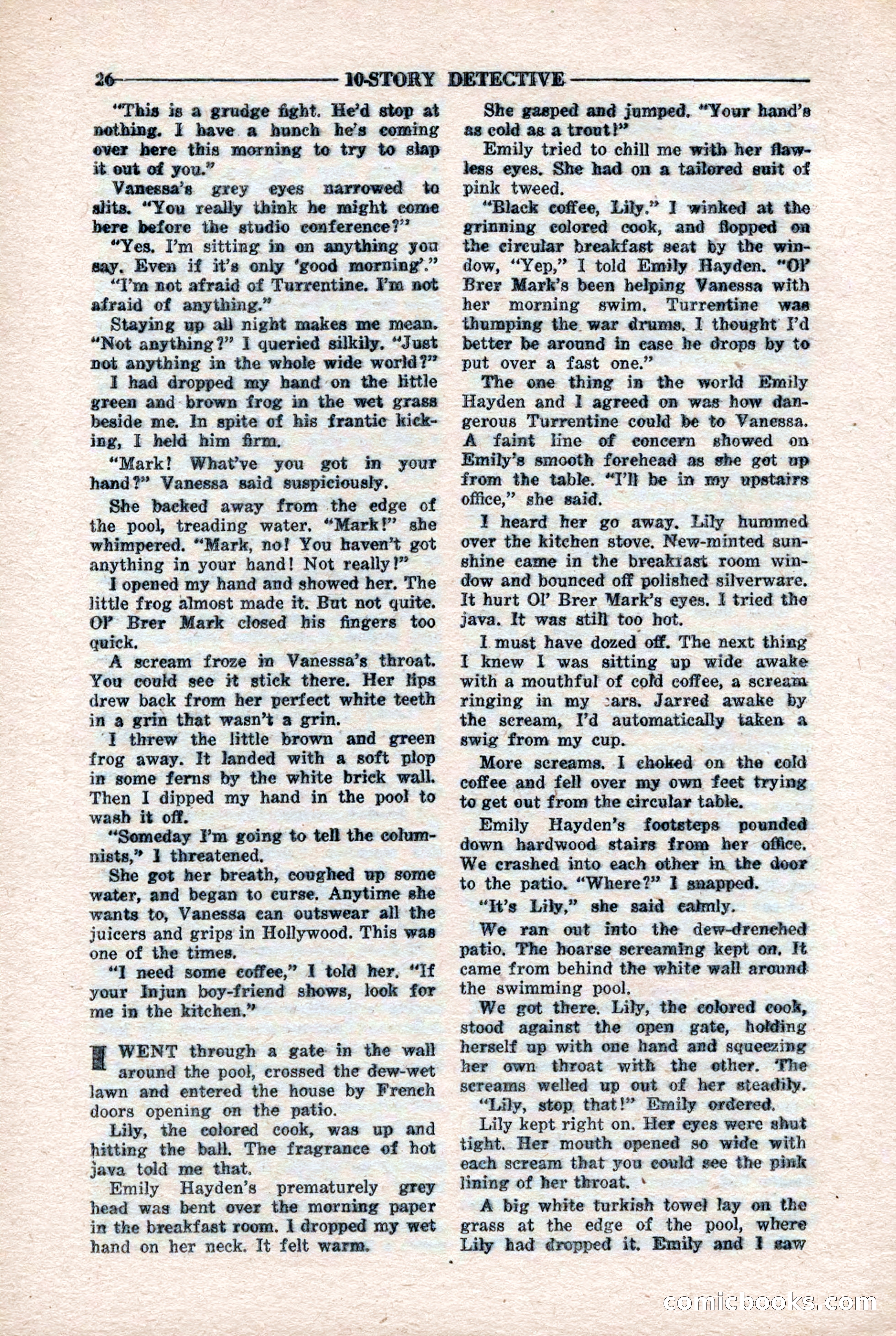
# Page 26: Story Prose from "10-Story Detective" This page contains story prose from a detective fiction magazine. The narrative follows a narrator investigating a situation involving characters named Vanessa, Emily Hayden, and a colored cook named Lily. The plot involves tension over a mysterious visitor named "Turrentine" who may visit the protagonist's studio, escalating into a dramatic incident where Lily the cook screams near a swimming pool. The passage describes physical comedy and suspense as the narrator and Emily rush to investigate Lily's distress. The text is entirely narrative prose with no illustrations, typical of pulp fiction magazine story pages from the early twentieth century.

10-Story Detective Magazine, April 1946 — page 29 of 84
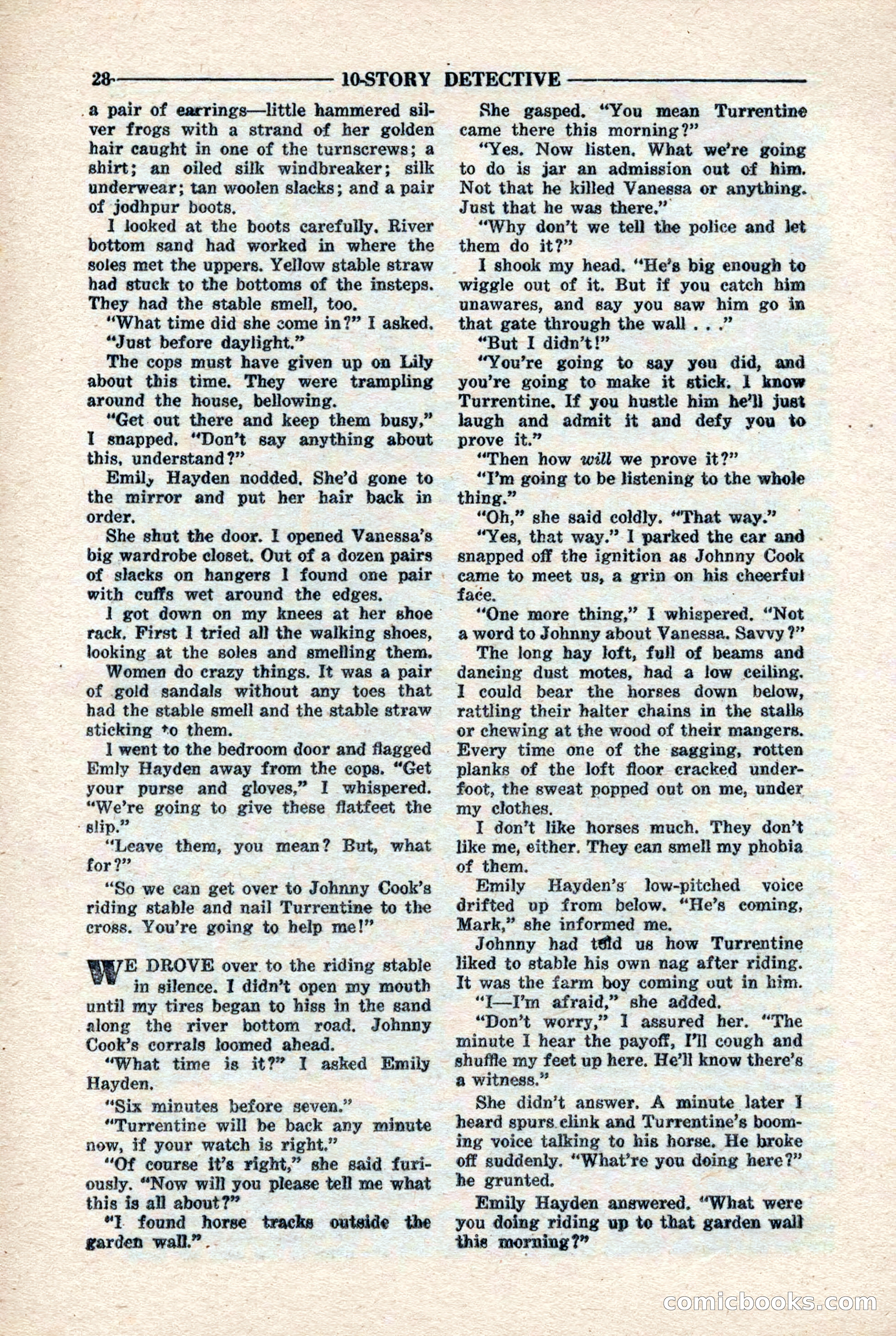
29 / 84
What you’re looking at · open this page on its own ↗

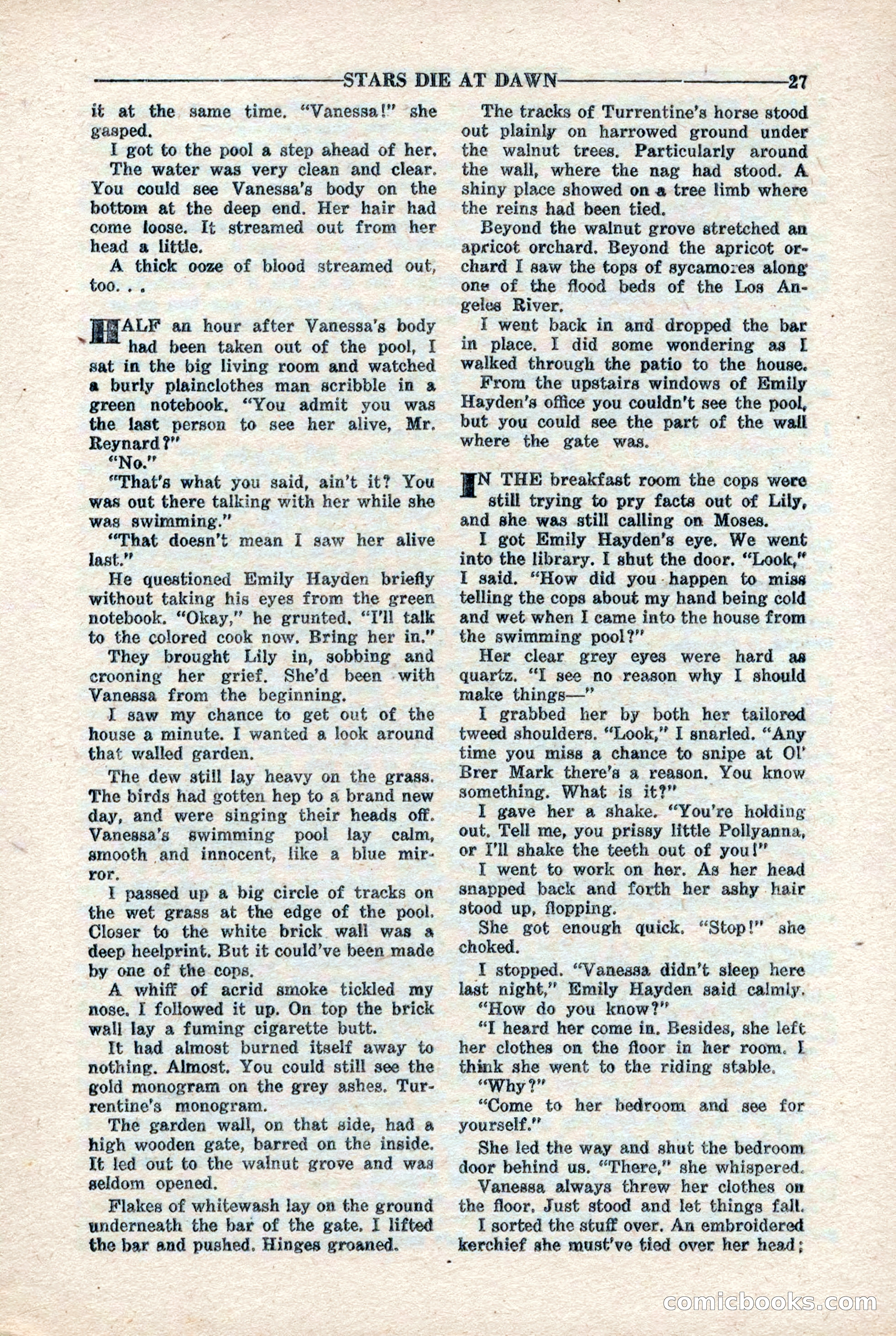
# Page 27: Story Prose from "Stars Die at Dawn" This page contains story prose printed in two columns. The narrative describes the aftermath of a woman named Vanessa's death by drowning in a pool. The protagonist examines the scene—including tracks around the pool and a burned cigarette butt on the garden wall—while questioning Emily Hayden about Vanessa's whereabouts the previous night. Emily insists Vanessa left her clothes in her room and went to the riding stable, though the narrator finds this account suspicious. The passage establishes a mystery surrounding Vanessa's death and suggests foul play may be involved.

10-Story Detective Magazine, April 1946 — page 30 of 84
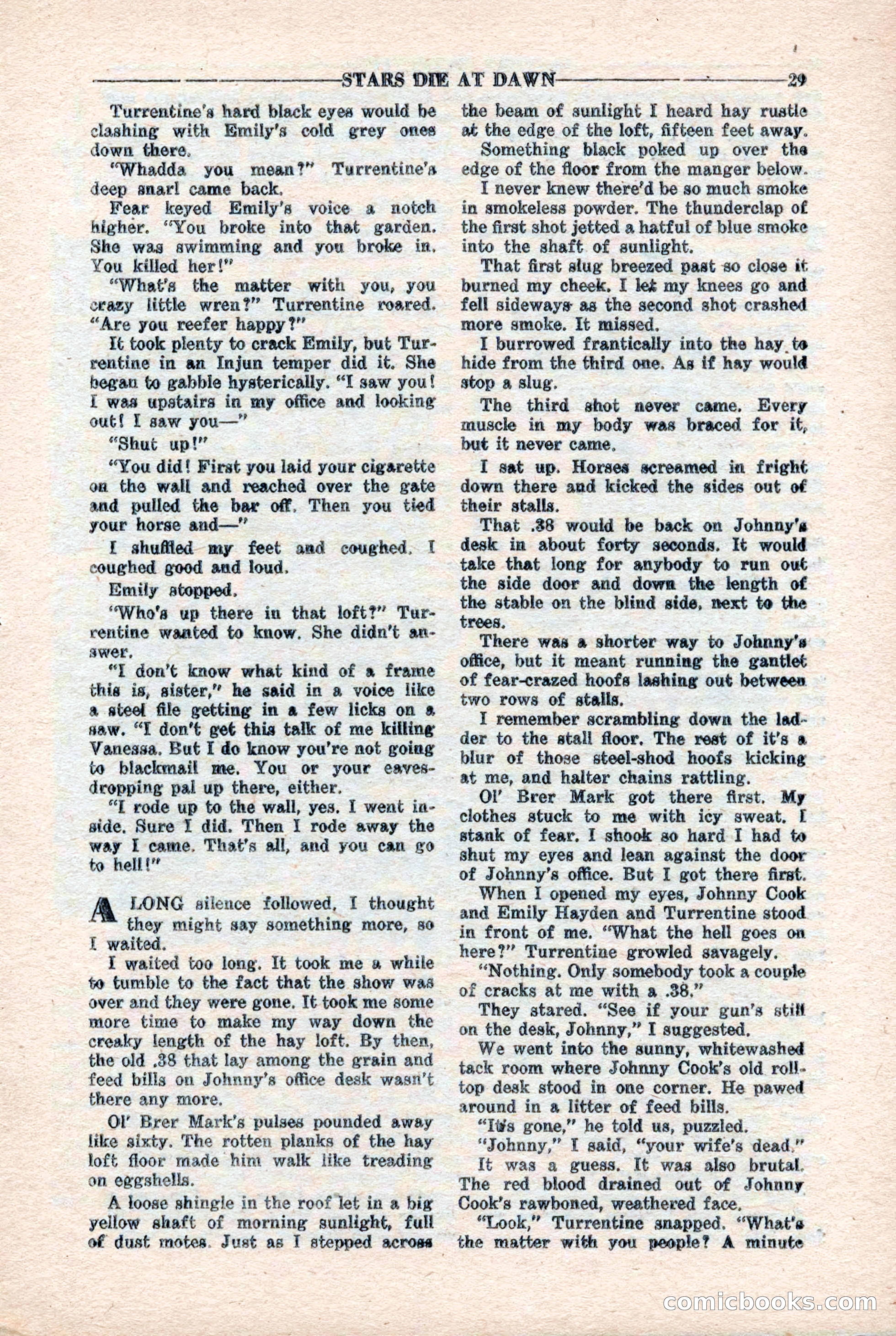
30 / 84
What you’re looking at · open this page on its own ↗

# Page Analysis This is a text-only page (page 28) from a hardboiled detective story titled "10-Story Detective." The narrative describes a detective's investigation into a crime involving a woman named Vanessa and someone called Turrentine. The protagonist searches Vanessa's wardrobe, discovers suspicious evidence (shoes with stable straw and smell), and then drives to a riding stable to confront Turrentine. The dialogue reveals a scheme to frame Turrentine for a murder he didn't commit, with Emily Hayden helping the detective execute the plan. The page ends with Turrentine arriving at the stable, unaware of the trap being set for him.

10-Story Detective Magazine, April 1946 — page 31 of 84
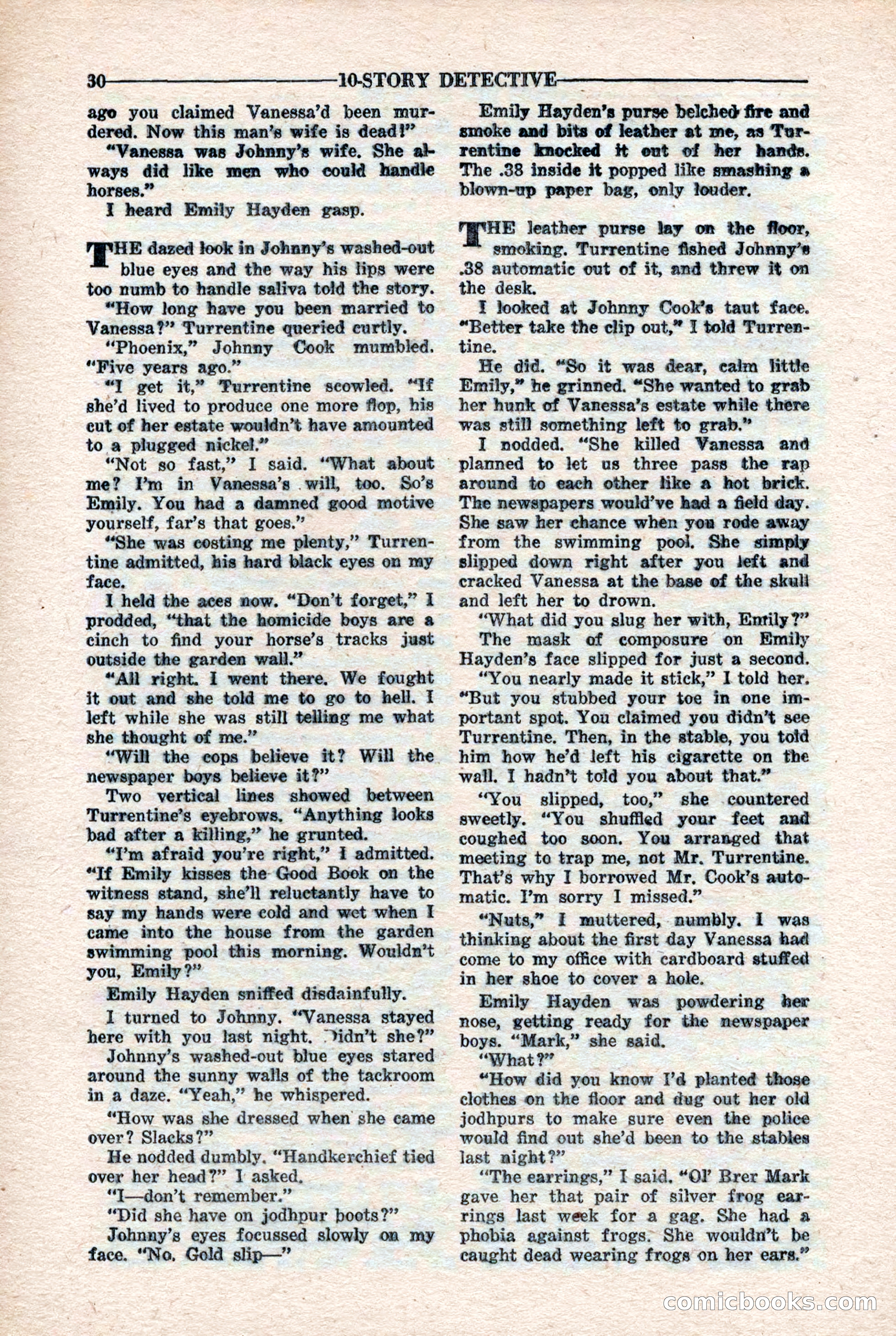
31 / 84
What you’re looking at · open this page on its own ↗

# Page Analysis This is story prose from a pulp magazine, printed in two columns on page 29 of a work titled "Stars Die at Dawn" (visible in the header). The text depicts a tense confrontation between characters named Turrentine, Emily, and Johnny Cook. The narrator describes a dramatic sequence involving gunshots fired in a barn or stable area, with horses panicking. After hiding in hay during the shooting, the narrator discovers Johnny Cook's dead wife (Emily Hayden) in his office, shot through the head. The passage emphasizes the violence and shock of this discovery, with Turrentine's angry response to the narrator's involvement in the events that led to this tragedy. The writing style and content are consistent with hardboiled crime or Western pulp fiction from the early-to-mid 20th century.

10-Story Detective Magazine, April 1946 — page 32 of 84
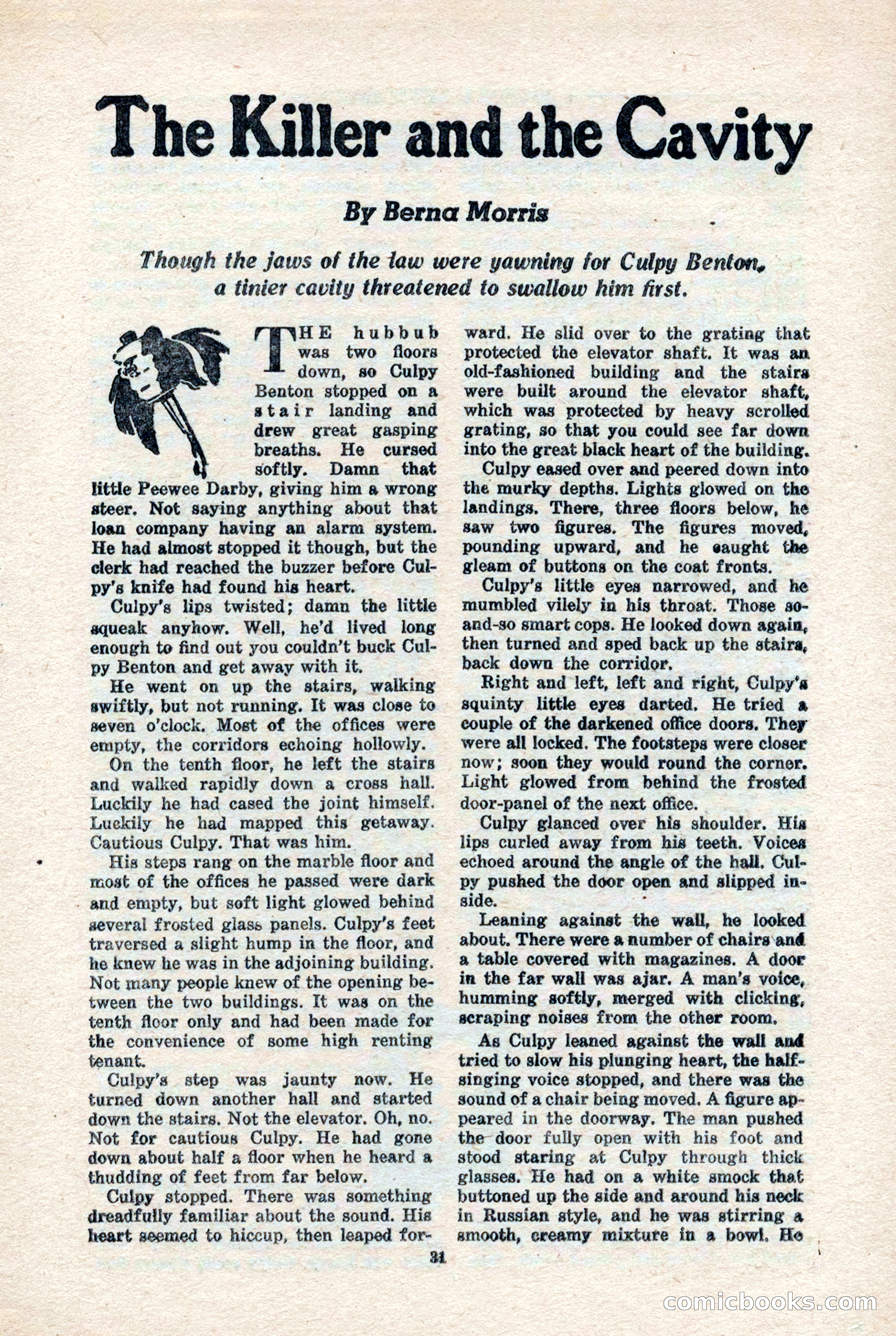
32 / 84
What you’re looking at · open this page on its own ↗

# Page Analysis This is story prose from a hardboiled detective pulp magazine titled "10-STORY DETECTIVE" (visible in the header). The page shows page 30 and contains dialogue-heavy narrative about a murder investigation involving a woman named Vanessa, her husband Johnny Cook, and a character named Emily Hayden. The detective narrator is interrogating Johnny about Vanessa's death, which appears to have occurred near a swimming pool. The conversation reveals potential motives and conflicting testimonies about the night of the crime. The text emphasizes the detective's logical deductions as he challenges the suspects' stories and uncovers inconsistencies in their accounts.

10-Story Detective Magazine, April 1946 — page 33 of 84
33 / 84
What you’re looking at · open this page on its own ↗

# Page Description This is a story prose page from a pulp magazine, containing the continuation of "The Killer and the Cavity" by Berna Morris. The page features a small illustration of a character's face in the upper left corner. The narrative follows Culpy Benton, apparently a criminal evading law enforcement, as he navigates through an office building's stairwells and corridors. The story describes his tense encounter with two figures he spots below in the building's depths, his subsequent escape up the stairs, and his entry into an office where he encounters a man in Russian-style clothing stirring a creamy mixture in a bowl. The text emphasizes suspense and danger throughout Culpy's movements.

10-Story Detective Magazine, April 1946 — page 34 of 84
34 / 84
What you’re looking at · open this page on its own ↗

# Page Analysis This is a text-only page (page 32) from a pulp magazine titled "10-STORY DETECTIVE." The visible prose depicts a scene in a dentist's office where a character named Culpy is having a troubling encounter with Dr. Brecker. The narrative describes Culpy's anxiety in the dental chair, his observation of the dentist's suspicious behavior (including handling a knife), and an interruption when someone arrives at the office door. The text suggests this is a crime or mystery story, given the detective magazine context and the ominous tone surrounding the dentist character's actions and demeanor.

10-Story Detective Magazine, April 1946 — page 35 of 84
35 / 84
What you’re looking at · open this page on its own ↗

# Page Analysis This is a text-only story page (page 33) from a pulp magazine titled "The Killer and the Cavity." The narrative describes a violent confrontation between a character named Culpy and a dentist, Dr. Brecker. Culpy, apparently a dangerous criminal, attacks the dentist in his office with a knife after the dentist picks up a drill. The passage depicts a brutal struggle involving plaster being thrown, suffocation, and blood, written in the vivid, sensational style typical of pulp fiction. A small skull illustration appears at the bottom of the page. The text emphasizes physical violence and danger in explicit detail.

10-Story Detective Magazine, April 1946 — page 36 of 84
36 / 84
What you’re looking at · open this page on its own ↗

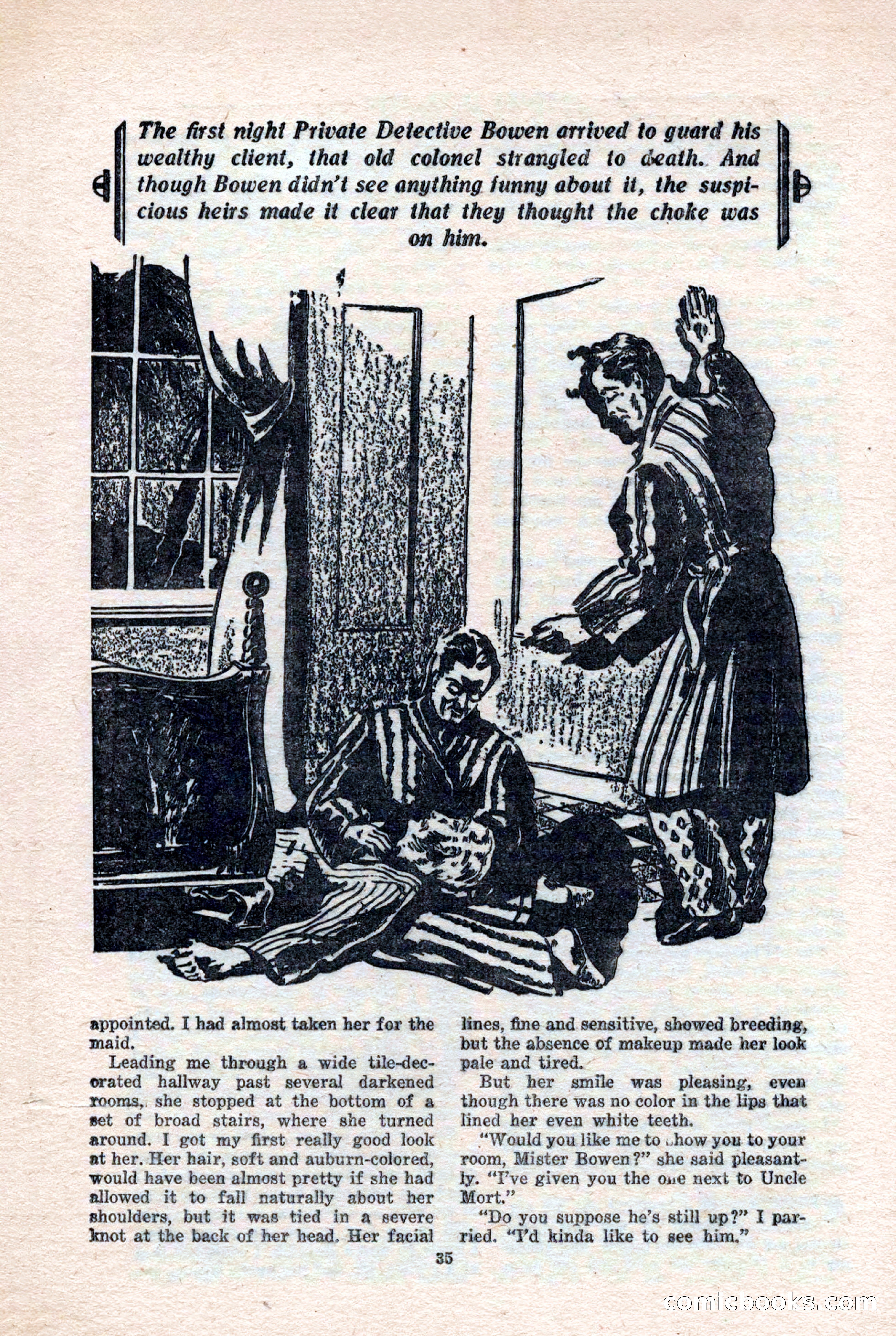
# "The Choke's On Me" by Mark Coe This is the opening page of an "Ace Mystery Novelet," showing Chapter 1 with both an illustration and prose text. The black-and-white illustration depicts two figures in what appears to be an interior scene—a woman in a dark dress and a man in patterned clothing near a window and desk. The story text describes a narrator arriving at the Herrick mansion in Miami during rain, entering through a side entrance, and being greeted by a plain-dressed woman who appears to be the owner's niece. The opening establishes a mystery setup with atmospheric detail about the rainy weather and the protagonist's arrival at this unfamiliar residence.

10-Story Detective Magazine, April 1946 — page 37 of 84
37 / 84
10-Story Detective Magazine, April 1946 — page 38 of 84
38 / 84
What you’re looking at · open this page on its own ↗

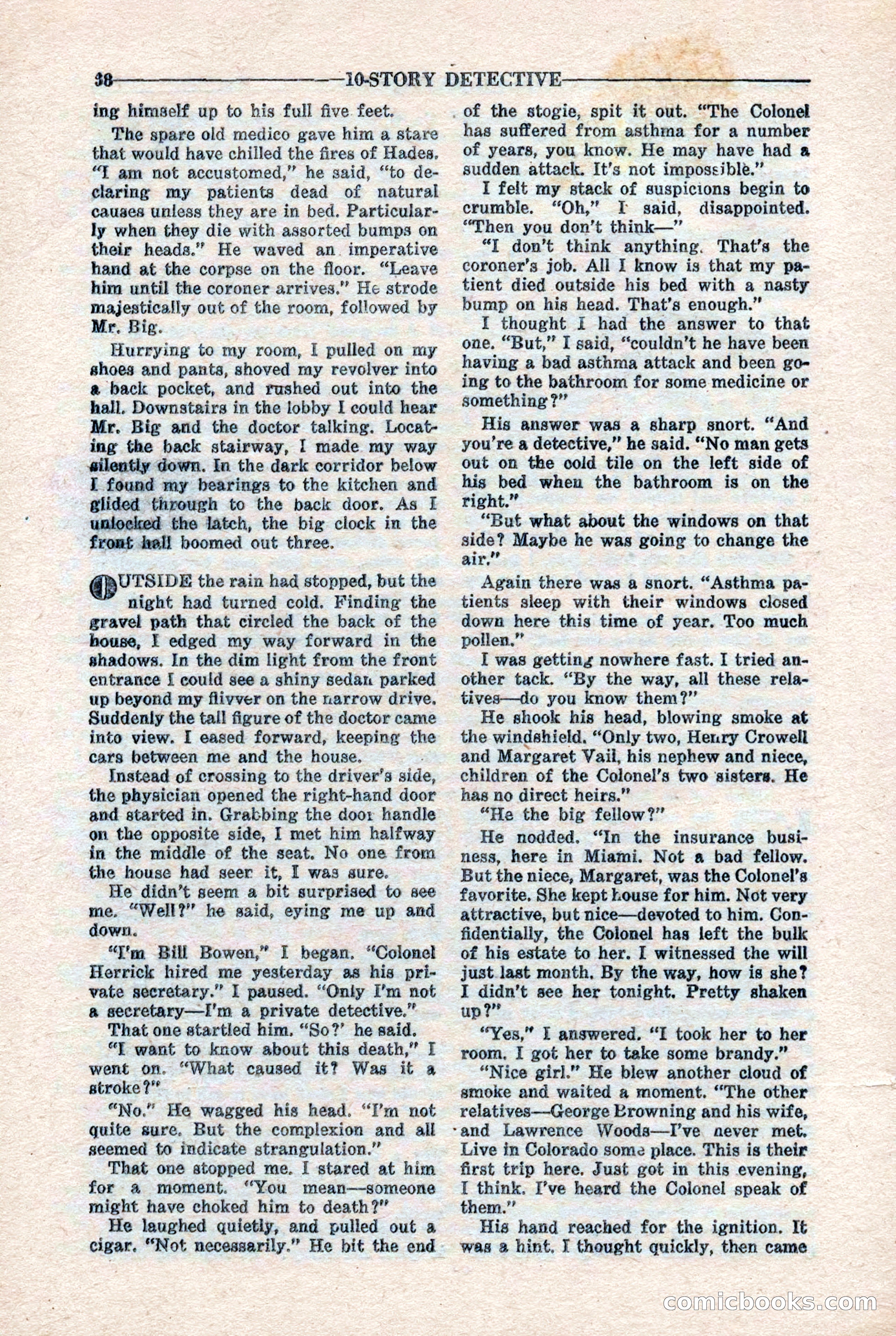
This page contains story prose from a pulp magazine titled "10-STORY DETECTIVE" (visible at the top). The text is a continuous narrative describing a detective's night investigation at a client's house. The narrator, hired by Colonel Herrick to observe his premises, grows increasingly unsettled by mysterious sounds—coughing, footsteps, and whispers—emanating from other rooms. The passage culminates in the narrator encountering an impressively tall man in the hallway whose intimidating appearance and furrowed brow suggest he may be a Herrick family member. The narrative emphasizes the narrator's mounting tension and unease throughout the investigation.

10-Story Detective Magazine, April 1946 — page 39 of 84
39 / 84
What you’re looking at · open this page on its own ↗

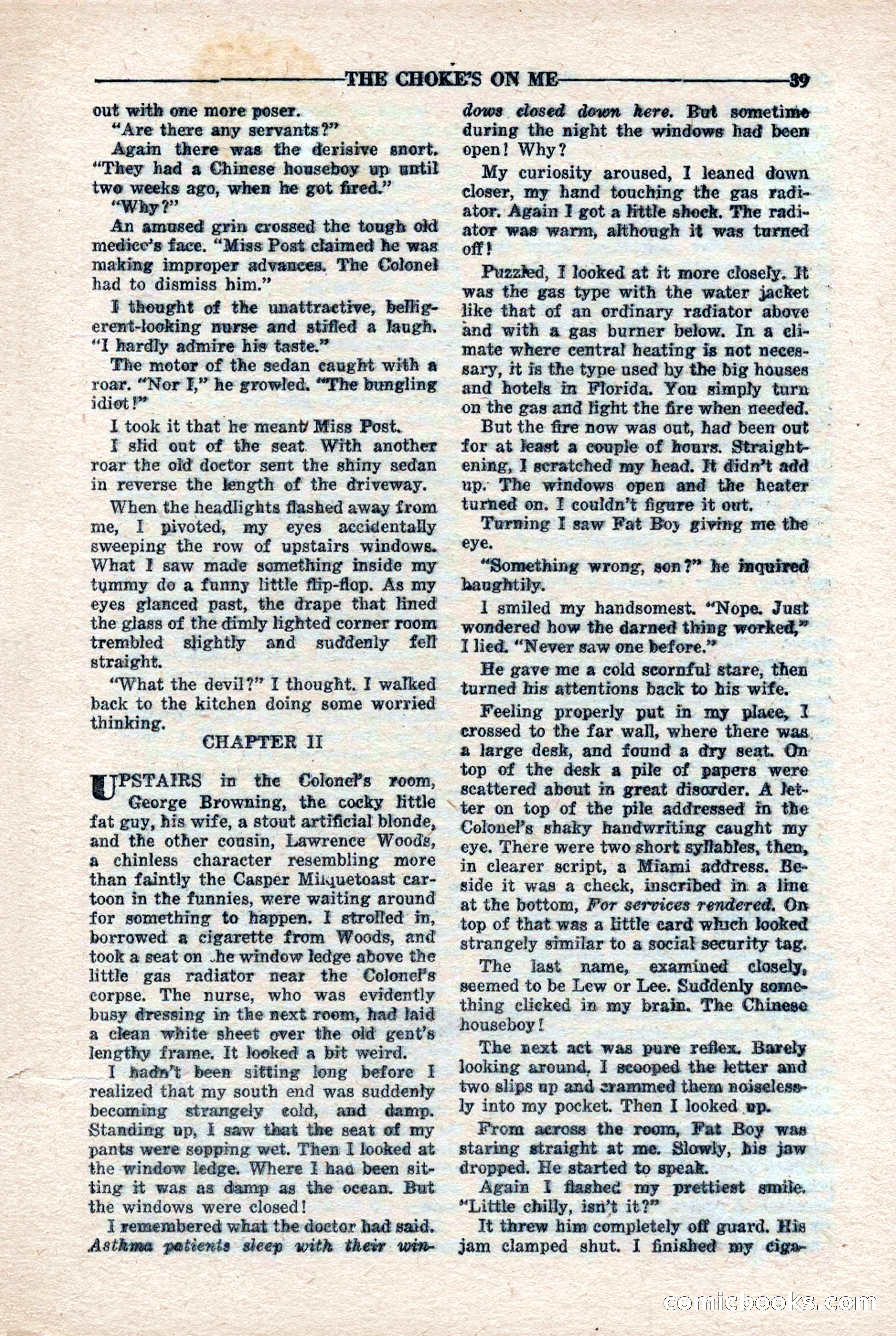
# Page 37: Story Prose from "The Choke's on Me" This page contains printed story prose (no illustration) from a narrative titled "The Choke's on Me." The text describes the narrator discovering an elderly Colonel apparently dead in his bed, with various people—including a nurse, doctor, and the narrator's acquaintances—arriving to investigate. The passage details the reactions of those present, including dialogue about whether the Colonel was already dead when discovered. The scene appears to be a mystery or crime story setup, with tension building around the circumstances of the Colonel's apparent death and conflicting accounts from witnesses present in the room.

10-Story Detective Magazine, April 1946 — page 40 of 84
40 / 84
What you’re looking at · open this page on its own ↗

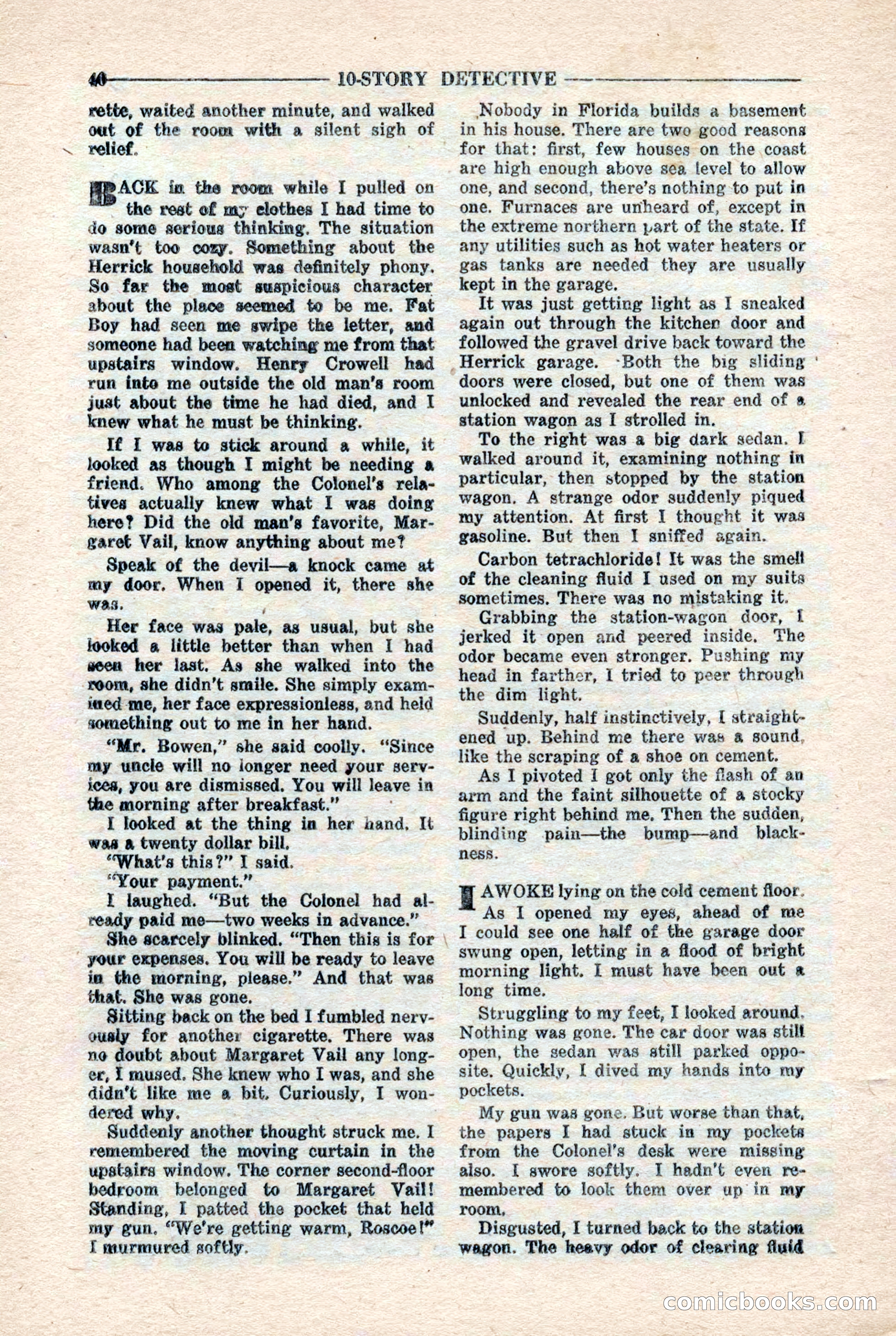
# Page Analysis This is story prose from a pulp detective magazine, specifically page 30 of "10-Story Detective." The text describes a private detective's investigation into the death of Colonel Herrick, who hired him as a secretary. The detective interviews Mr. Bill Bowen outside the Colonel's house at night, learning about the Colonel's relatives—including Henry Crowell, Margaret Vail, and others in the insurance business in Miami. The conversation suggests the Colonel died under suspicious circumstances, possibly related to asthma or strangulation, and hints at inheritance complications involving Margaret Vail, the Colonel's niece and favorite.

10-Story Detective Magazine, April 1946 — page 41 of 84
41 / 84
What you’re looking at · open this page on its own ↗

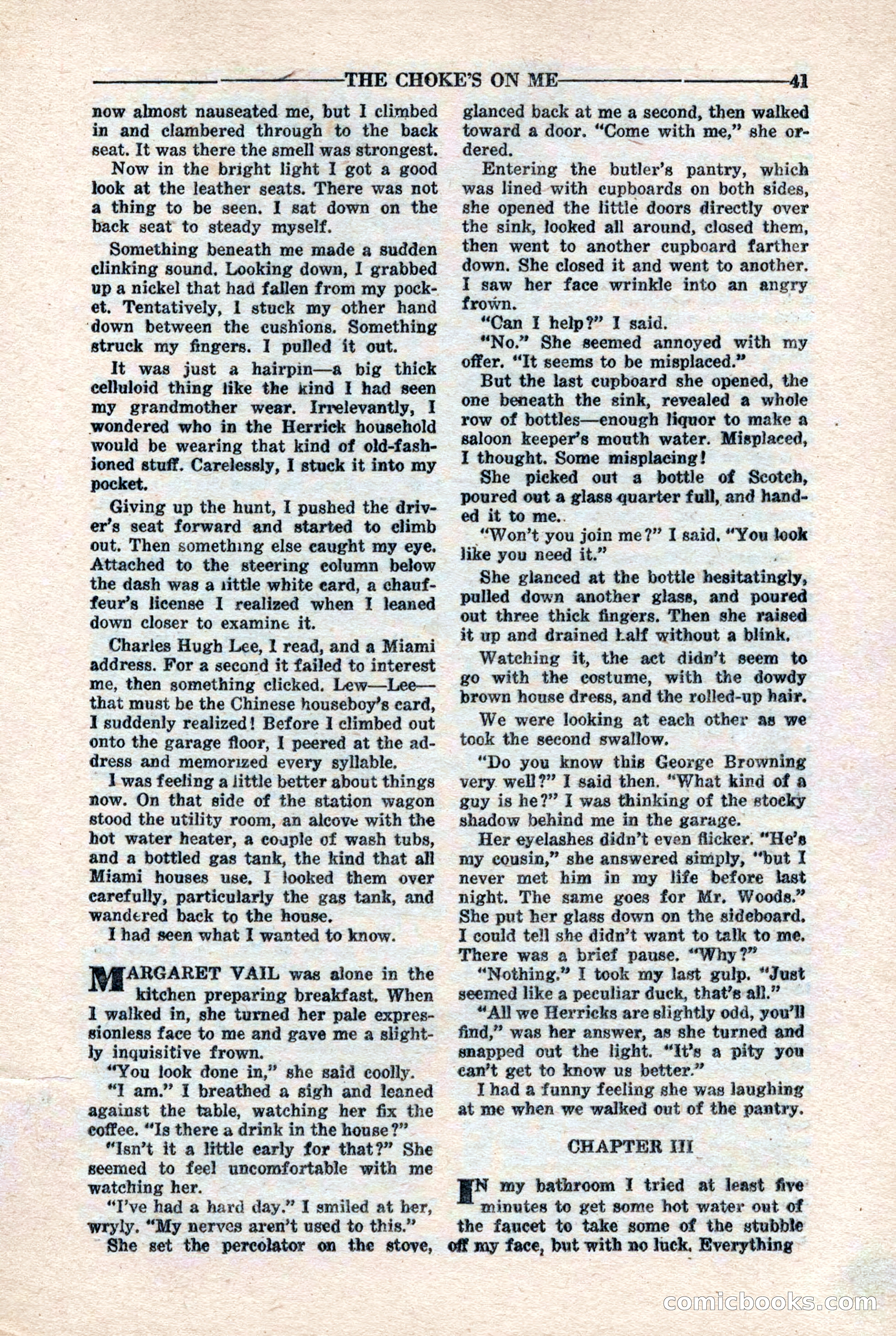
# Page Analysis This is a text page (page 99) from a pulp fiction story titled "The Choke's on Me." The page contains two chapters of prose narrative. Chapter I concludes with the narrator discovering an open window and a gas radiator, then encountering "Fat Boy" who gives him a suspicious look. Chapter II begins with the narrator upstairs in the Colonel's room, where he finds scattered papers including a letter with a Miami address signed by what appears to be "Lew or Lee"—identified as a Chinese houseboy. The narrator impulsively pockets the letter, and Fat Boy notices his suspicious behavior. The story appears to be a hardboiled mystery or crime narrative involving espionage or theft.

10-Story Detective Magazine, April 1946 — page 42 of 84
42 / 84
What you’re looking at · open this page on its own ↗

# 10-STORY DETECTIVE This page contains story prose from what appears to be a detective or mystery pulp magazine. The narrative follows a protagonist investigating suspicious circumstances at a house, including discovering a mysterious odor of carbon tetrachloride near a station wagon in a garage. The narrator then loses consciousness and awakens on a cold cement floor, discovering their gun and important papers are missing from their pockets. The text suggests a crime or theft has occurred while the protagonist was unconscious. The page contains no illustrations, only printed text in two columns on a cream-colored background, typical of early-20th-century pulp magazine formatting.

10-Story Detective Magazine, April 1946 — page 43 of 84
43 / 84
What you’re looking at · open this page on its own ↗

# Page Analysis This is a page of story prose from a pulp fiction magazine, numbered 41. The visible text comprises the end of one chapter and the beginning of Chapter III of what appears to be a mystery or crime story titled "The Choke's on Me." The narrative follows a narrator who discovers a hairpin in a car, identifies a chauffeur's license belonging to someone named Charles Hugh Lee, and then encounters Margaret Vail in a kitchen. Their conversation suggests the narrator is investigating something, possibly related to a character named George Browning or Mr. Woods. The tone is hardboiled detective fiction typical of early-20th-century pulp magazines.

10-Story Detective Magazine, April 1946 — page 44 of 84
44 / 84
What you’re looking at · open this page on its own ↗

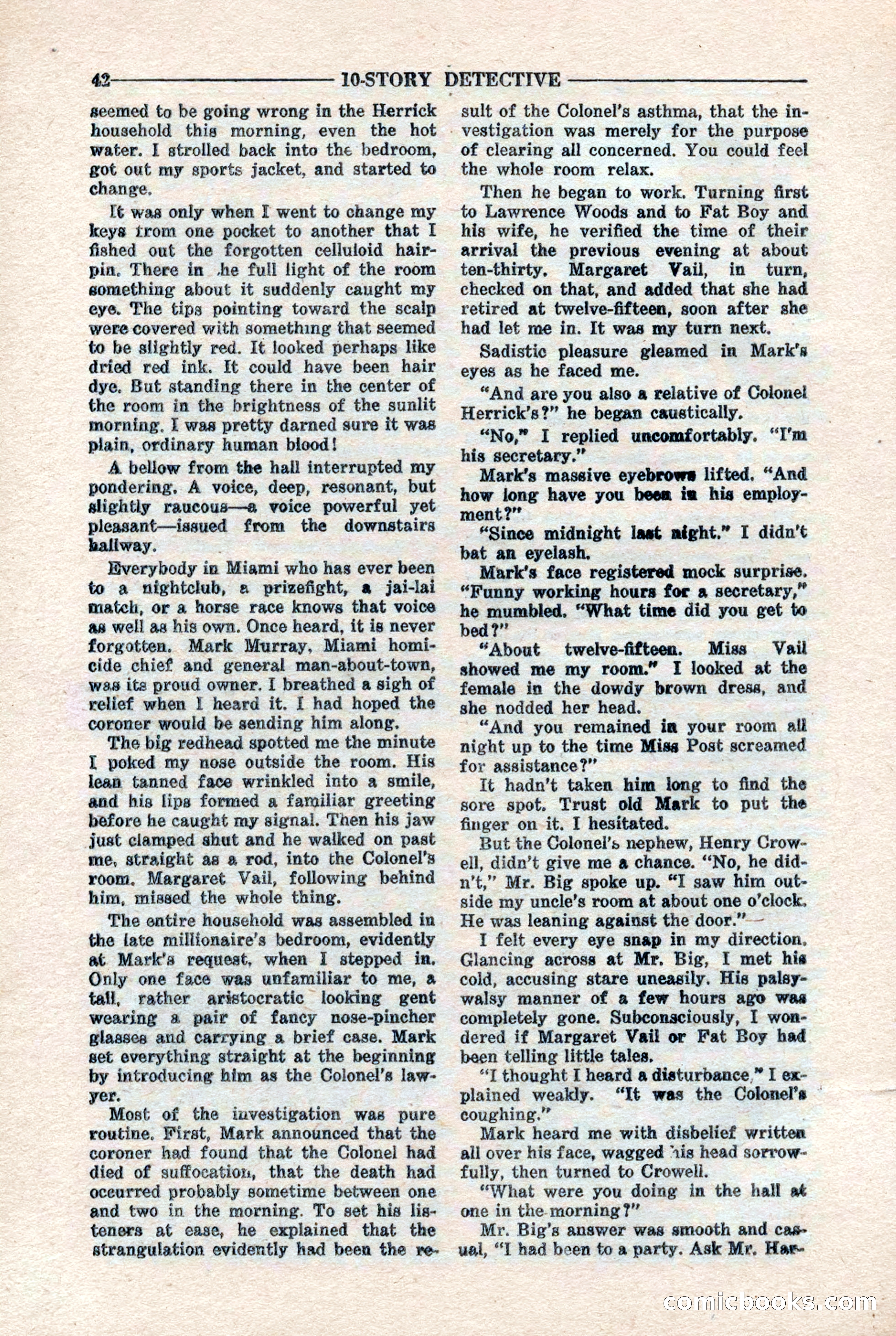
This is a page of story prose from a pulp detective magazine titled "10-STORY DETECTIVE" (visible in the header). The page continues a mystery narrative in which the narrator, apparently a secretary, is being interrogated by Detective Mark Murray about a death at Colonel Herrick's household. The text describes Mark's investigation into the Colonel's death by suffocation, his questioning of the narrator and other household members about their whereabouts the previous night, and the introduction of the Colonel's lawyer—a previously unknown figure wearing nose-pincher glasses. The narrative focuses on dialogue and investigative procedure typical of hardboiled crime fiction.

10-Story Detective Magazine, April 1946 — page 45 of 84
45 / 84
What you’re looking at · open this page on its own ↗

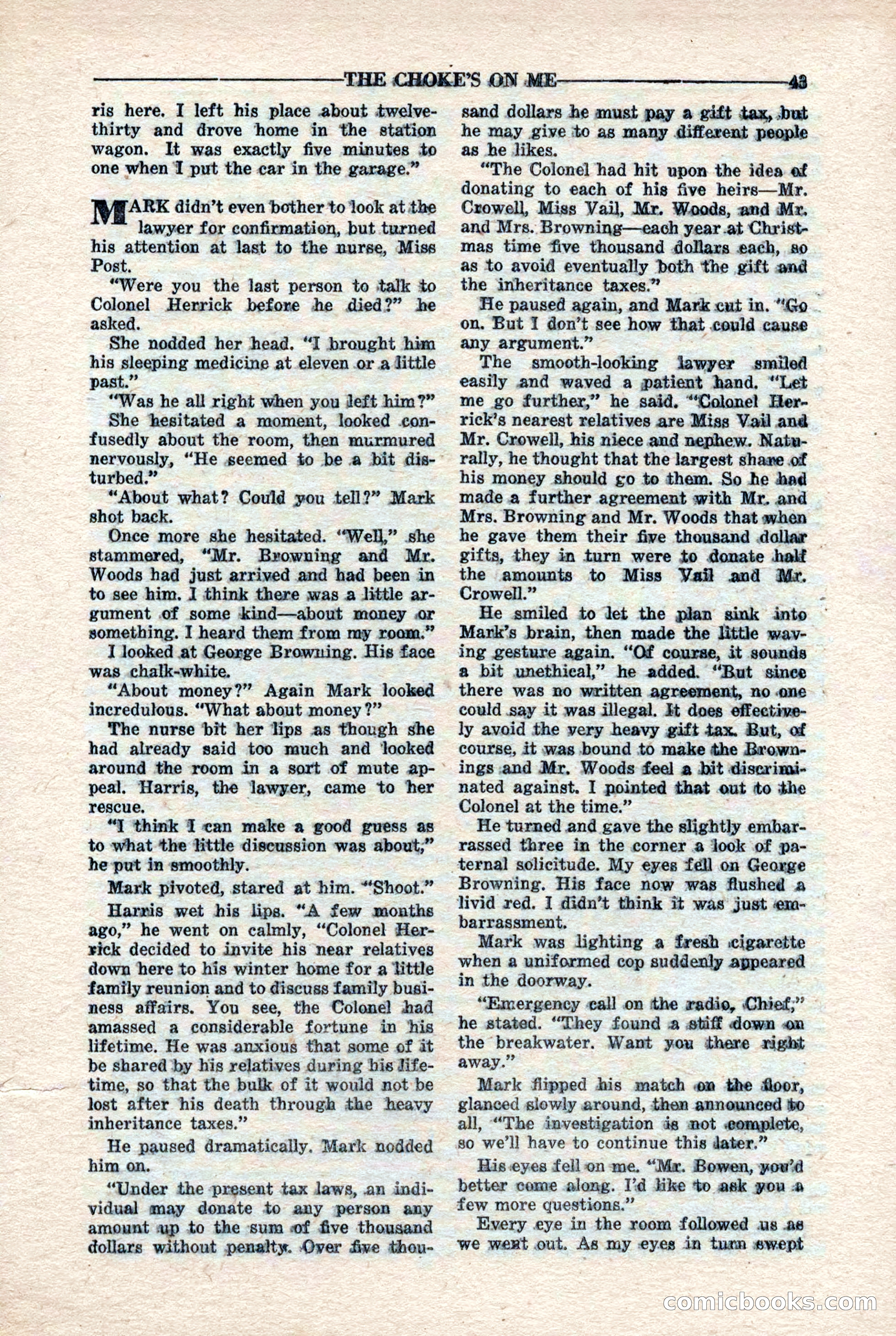
# Page Analysis This is a story prose page from a pulp magazine, numbered 43. The text appears to be from a mystery or crime story titled "The Choke's on Me" (visible at the top). The passage depicts a scene where a lawyer named Harris discusses Colonel Herrick's will and estate matters with various characters, including a nurse named Miss Post and a man named Mark. The discussion centers on the Colonel's plan to distribute monetary gifts to relatives—Miss Vail, Mr. Crowell, Mr. Woods, and Mr. and Mrs. Browning—partly to avoid inheritance taxes. The scene is interrupted by a police officer arriving on an emergency call, suggesting a criminal investigation is underway.

10-Story Detective Magazine, April 1946 — page 46 of 84
46 / 84
What you’re looking at · open this page on its own ↗

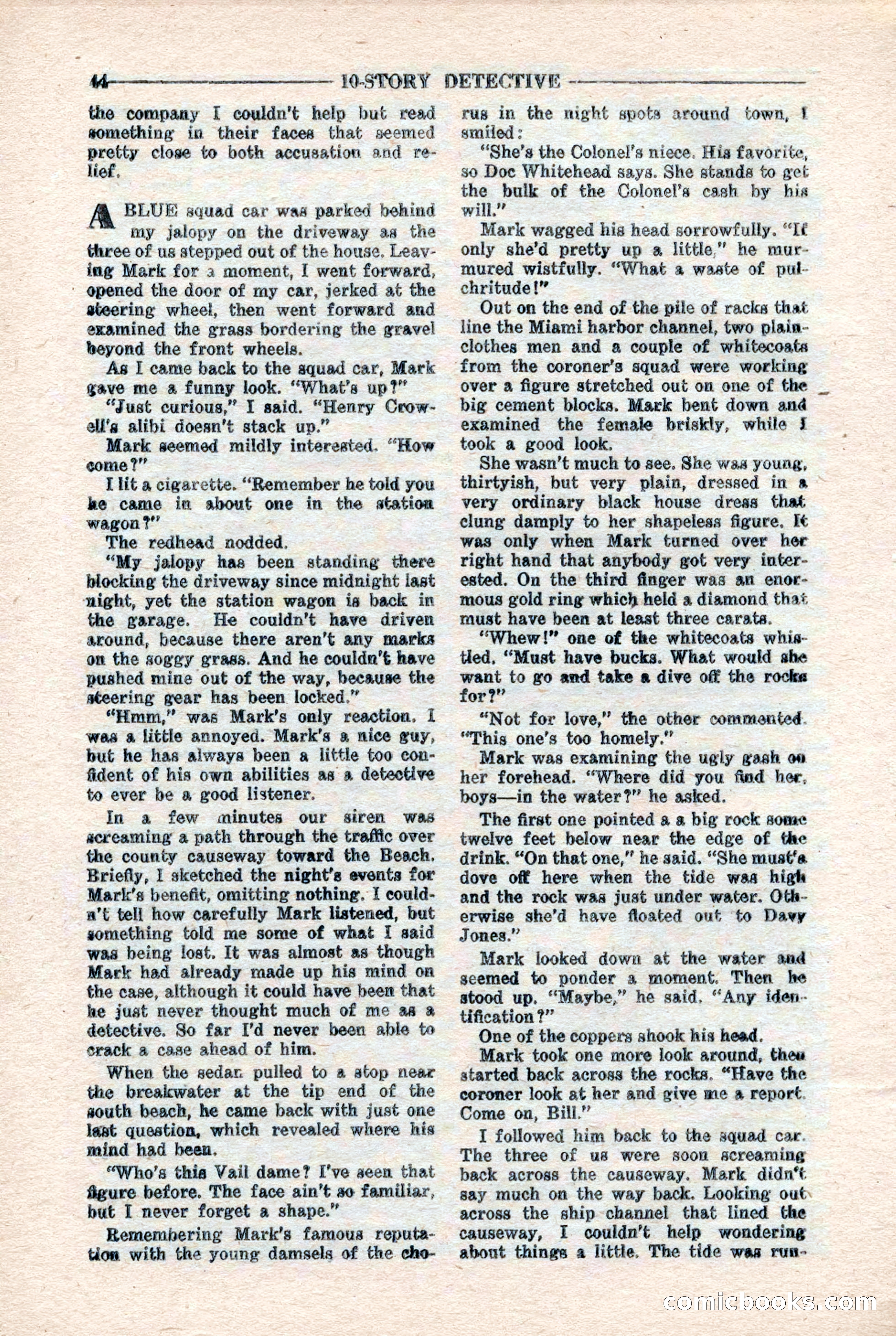
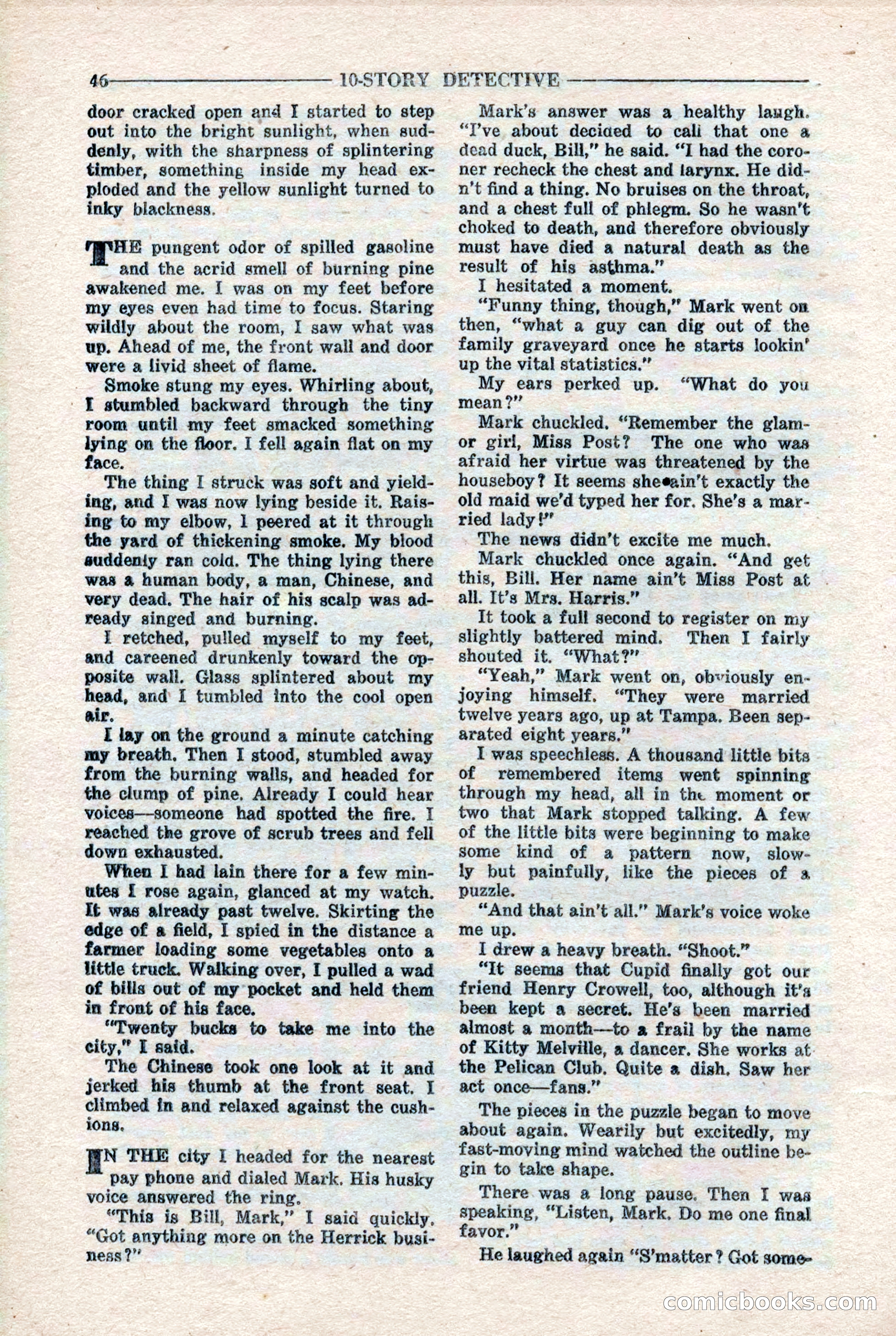
This is a page of prose fiction from a detective story titled "10-STORY DETECTIVE" (visible at the top). The narrative describes a detective investigation involving a suspicious death near Miami Harbor. The protagonist and his partner Mark examine a female body found on rocks, noting her plain appearance and a valuable three-carat diamond ring. They question local workers about how the body reached that location, discovering she allegedly dove from nearby rocks. The passage emphasizes Mark's characteristic overconfidence as a detective and the narrator's internal frustration with this quality, while the investigation proceeds with the discovery of a corpse that requires further examination by the coroner.

10-Story Detective Magazine, April 1946 — page 47 of 84
47 / 84
What you’re looking at · open this page on its own ↗

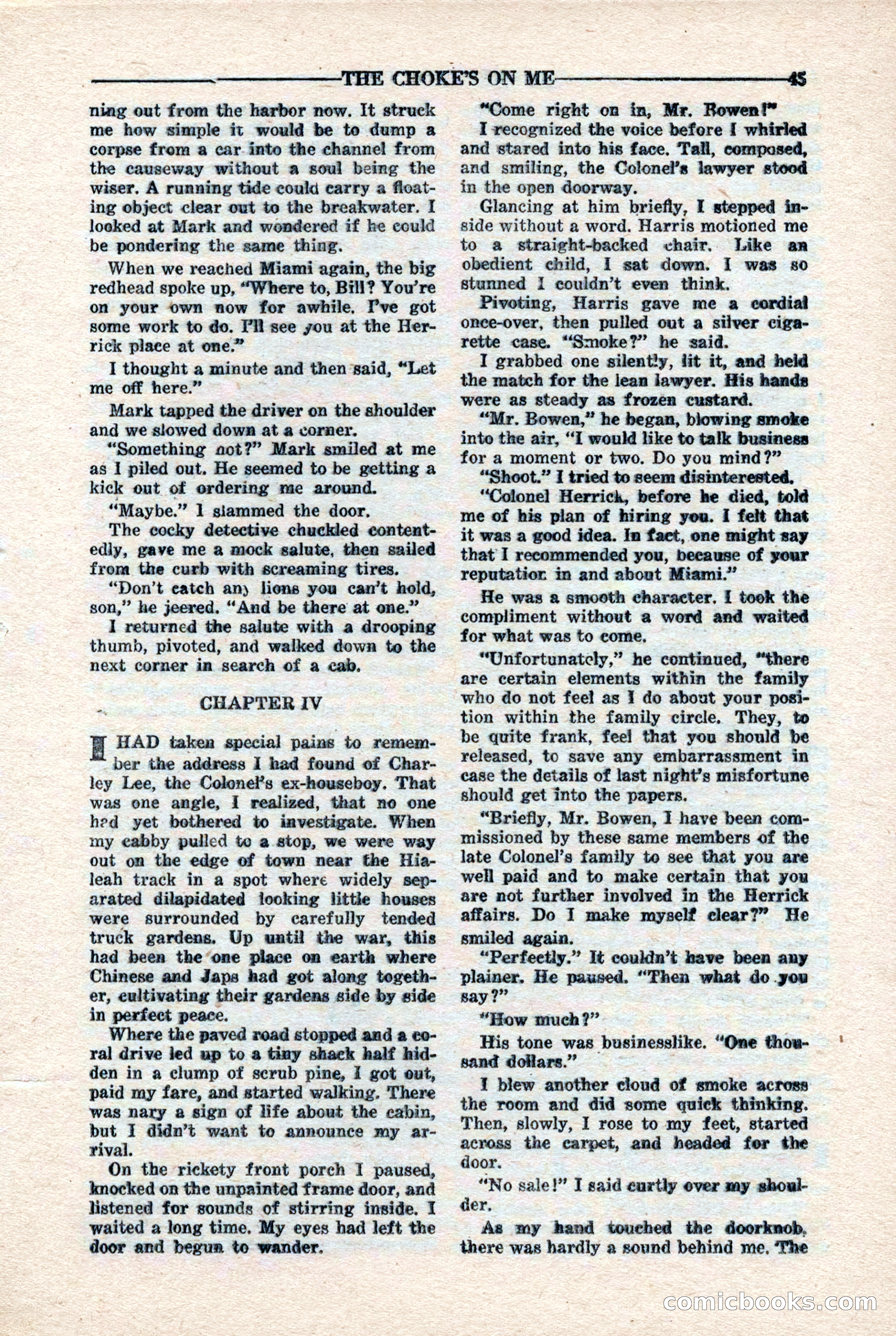
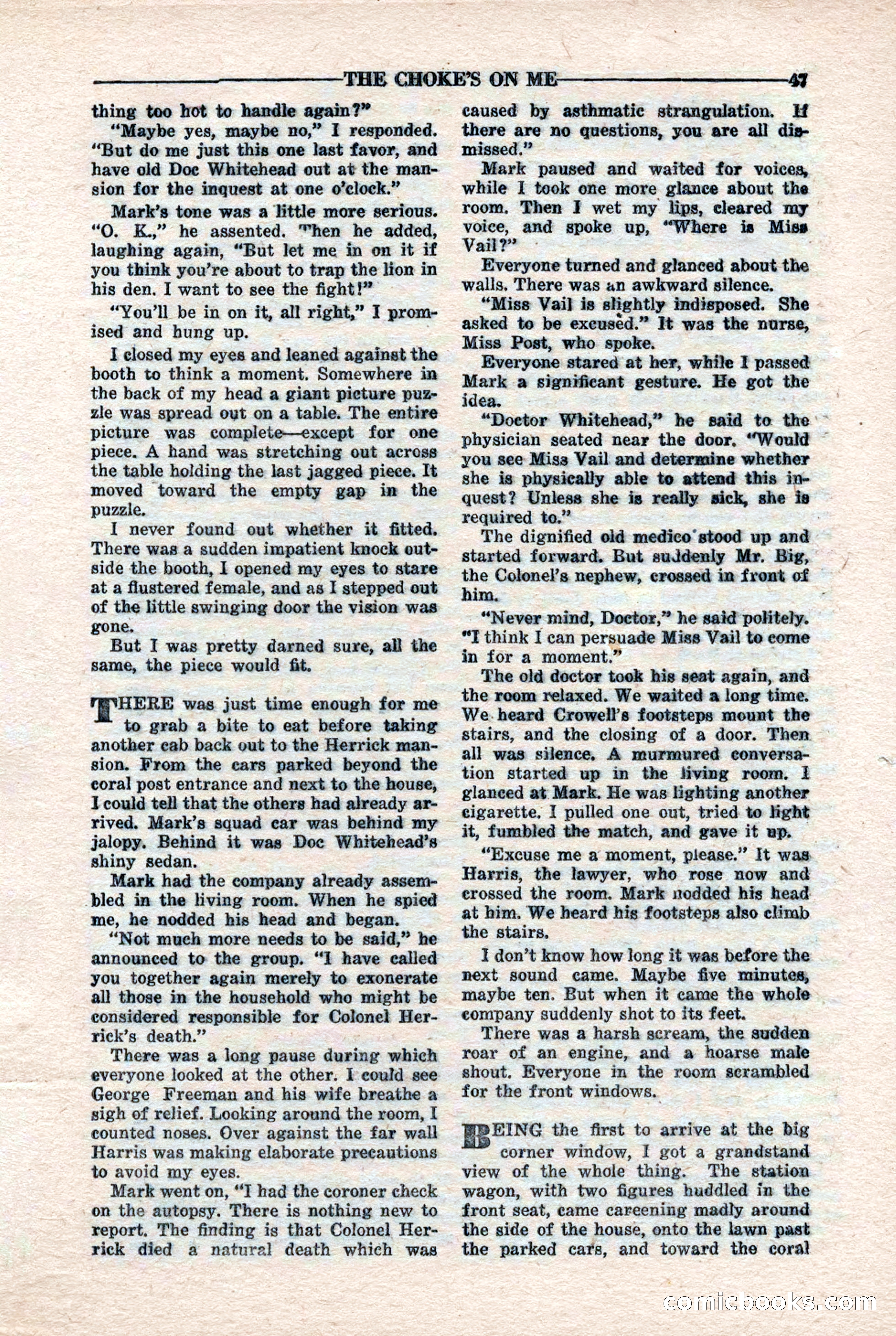
# Page Analysis This is a text-only page of story prose from a pulp fiction magazine, containing the conclusion of Chapter III and the beginning of Chapter IV. The narrative appears to be a hardboiled crime or detective story. The visible text depicts a protagonist meeting with a Colonel's lawyer named Harris in Miami, who offers the protagonist one thousand dollars—apparently to distance himself from some family scandal involving "the Herrick affair." The protagonist initially refuses but then reconsiders. The story involves the protagonist's search for Charley Lee, described as the Colonel's ex-houseboy, in what appears to be a lower-income Miami neighborhood. The tone and setting suggest this is classic 1920s-1940s pulp detective fiction.

10-Story Detective Magazine, April 1946 — page 48 of 84
48 / 84
What you’re looking at · open this page on its own ↗

This is a page of story prose from a pulp detective magazine titled "10-STORY DETECTIVE" (visible in the header). The text describes a narrator who has escaped from a burning building and is now attempting to piece together a mystery involving several characters, including Mark and mentions of Henry Crowell, who is apparently married to a dancer named Kitty Melville. The narrator is calling Mark from a pay phone to discuss what appears to be a criminal case. The prose depicts classic hardboiled detective fiction, with the narrator recounting events and gathering clues in a somewhat disjointed but dramatic fashion typical of pulp crime stories.

10-Story Detective Magazine, April 1946 — page 49 of 84
49 / 84
What you’re looking at · open this page on its own ↗

This is a page of story prose from a pulp magazine titled "The Choke's on Me" (visible in the header). The narrative describes a murder investigation where the narrator has gathered a group of people to announce findings about Colonel Herrick's death, which is determined to be natural causes from asthmatic strangulation. The passage details the tense moments as the group awaits a doctor's examination of someone named Miss Vail to determine if she can attend an inquest, followed by a dramatic interruption when what appears to be a police vehicle arrives at the house with an engine roar and male shout, causing everyone to rush to the windows. The text is dense paragraph prose typical of 1920s-1940s crime fiction pulp magazines.

10-Story Detective Magazine, April 1946 — page 50 of 84
50 / 84
What you’re looking at · open this page on its own ↗

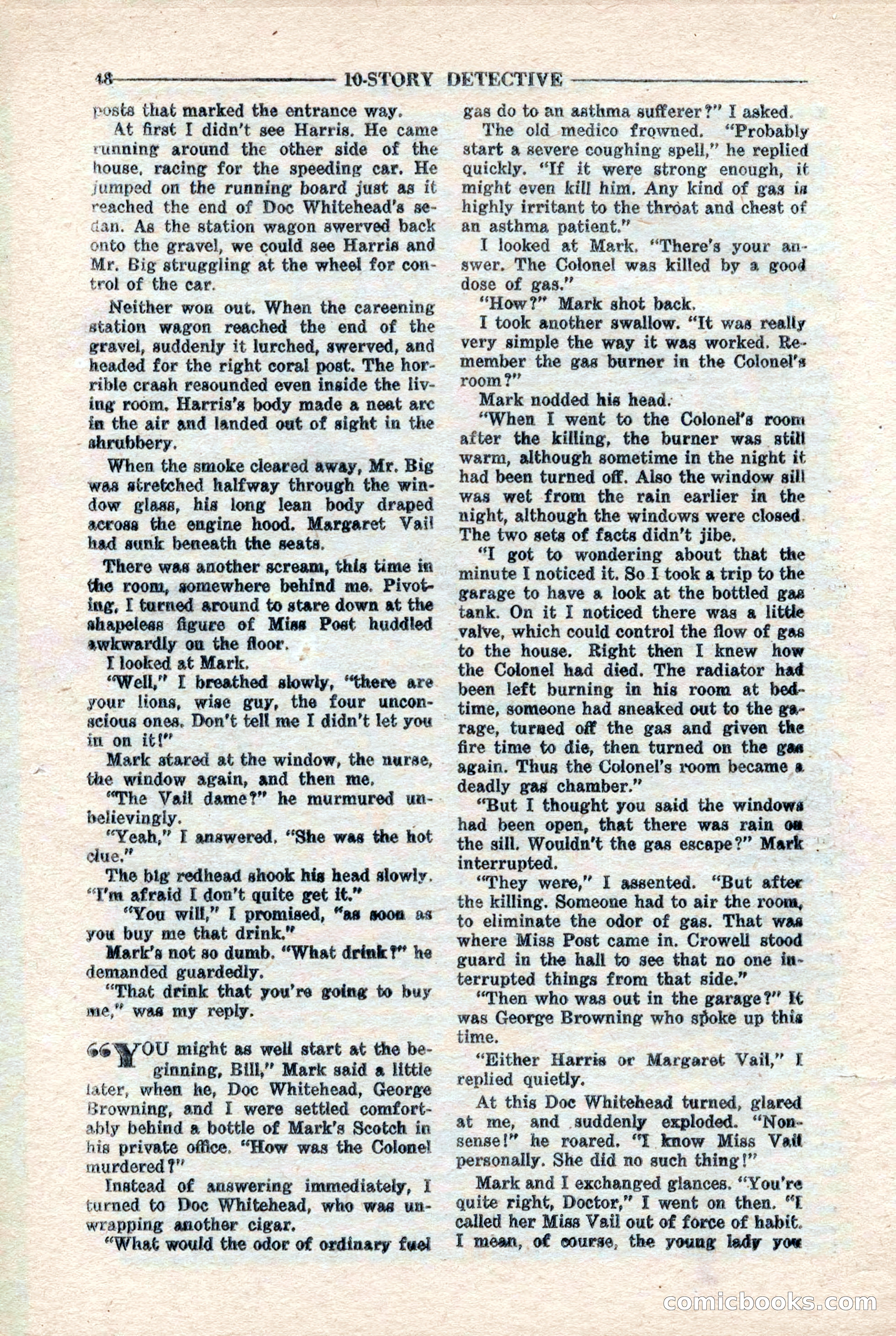
This page contains story prose from a mystery detective narrative titled "10-STORY DETECTIVE" (visible in the header). The text describes a murder investigation involving Colonel's death by gas poisoning in his bedroom. The narrator explains how the murder was accomplished: a gas burner was left on, a window was deliberately kept open to create an alibi (suggesting the gas would escape), and someone sneaked to the garage to turn off the gas before it could dissipate, transforming the room into a deadly gas chamber. The passage includes dialogue between characters including Mark, Doc Whitehead, George Browning, and Miss Vail as they discuss the crime's mechanics.

10-Story Detective Magazine, April 1946 — page 51 of 84
51 / 84
What you’re looking at · open this page on its own ↗

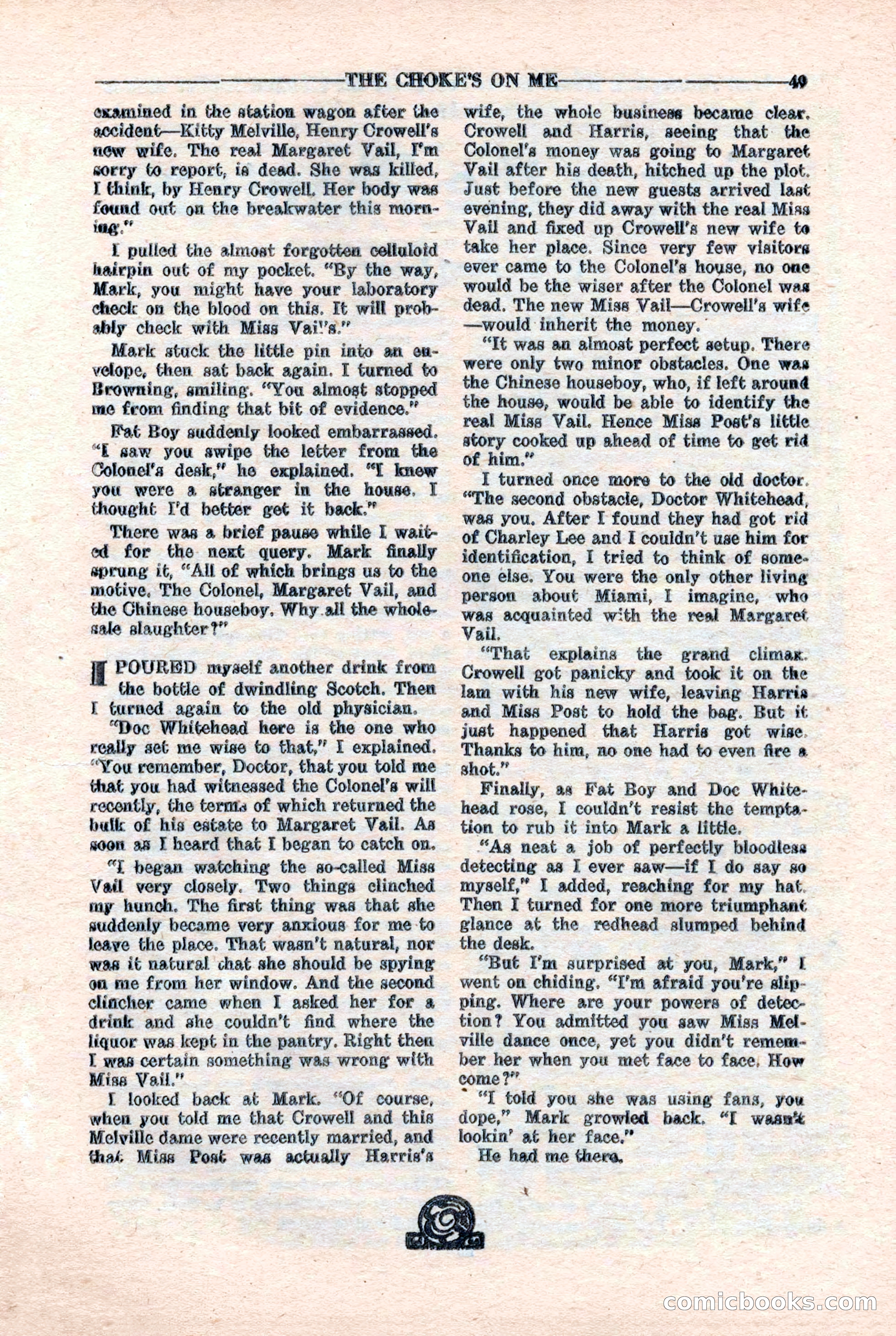
# Page Analysis This is a story prose page (page 40) from a hardboiled crime pulp magazine titled "The Choke's on Me." The visible text depicts a detective narrator explaining a complex murder scheme to an associate named Mark. The plot involves Colonel Crowell's death, a substituted wife (the real Margaret Vail replaced by an impostor named Harris), and a scheme to steal the Colonel's estate. The narrator describes how he uncovered the deception by observing suspicious behavior and gathering evidence. A small publisher's mark appears at the bottom of the page. The narrative style and subject matter are typical of early-20th-century crime fiction pulps.

10-Story Detective Magazine, April 1946 — page 52 of 84
52 / 84
What you’re looking at · open this page on its own ↗

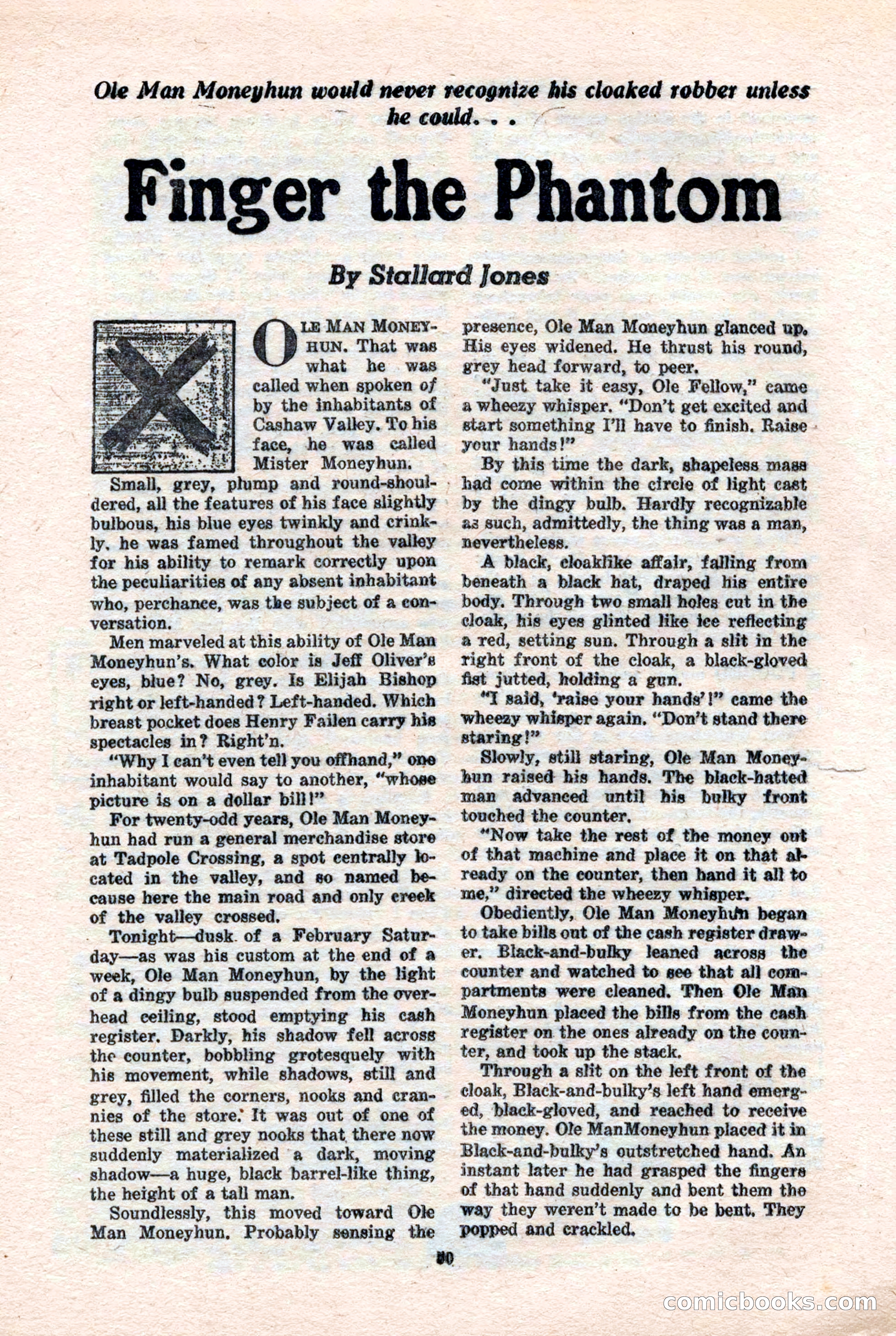
# "Finger the Phantom" by Stallard Jones This is a story prose page from a pulp magazine. The narrative concerns Ole Man Moneyhun, a shopkeeper in Cashaw Valley known for his ability to identify absent people, who confronts a mysterious cloaked robber in his store one February evening. The robber, appearing as a black, shapeless mass with glinting eyes visible through holes in the cloak, demands money from the cash register. When Ole Man Moneyhun places the bills in the robber's outstretched hand, he discovers the fingers are unnaturally bent and cracked—suggesting something supernatural or strange about the intruder's identity.

10-Story Detective Magazine, April 1946 — page 53 of 84
53 / 84
What you’re looking at · open this page on its own ↗

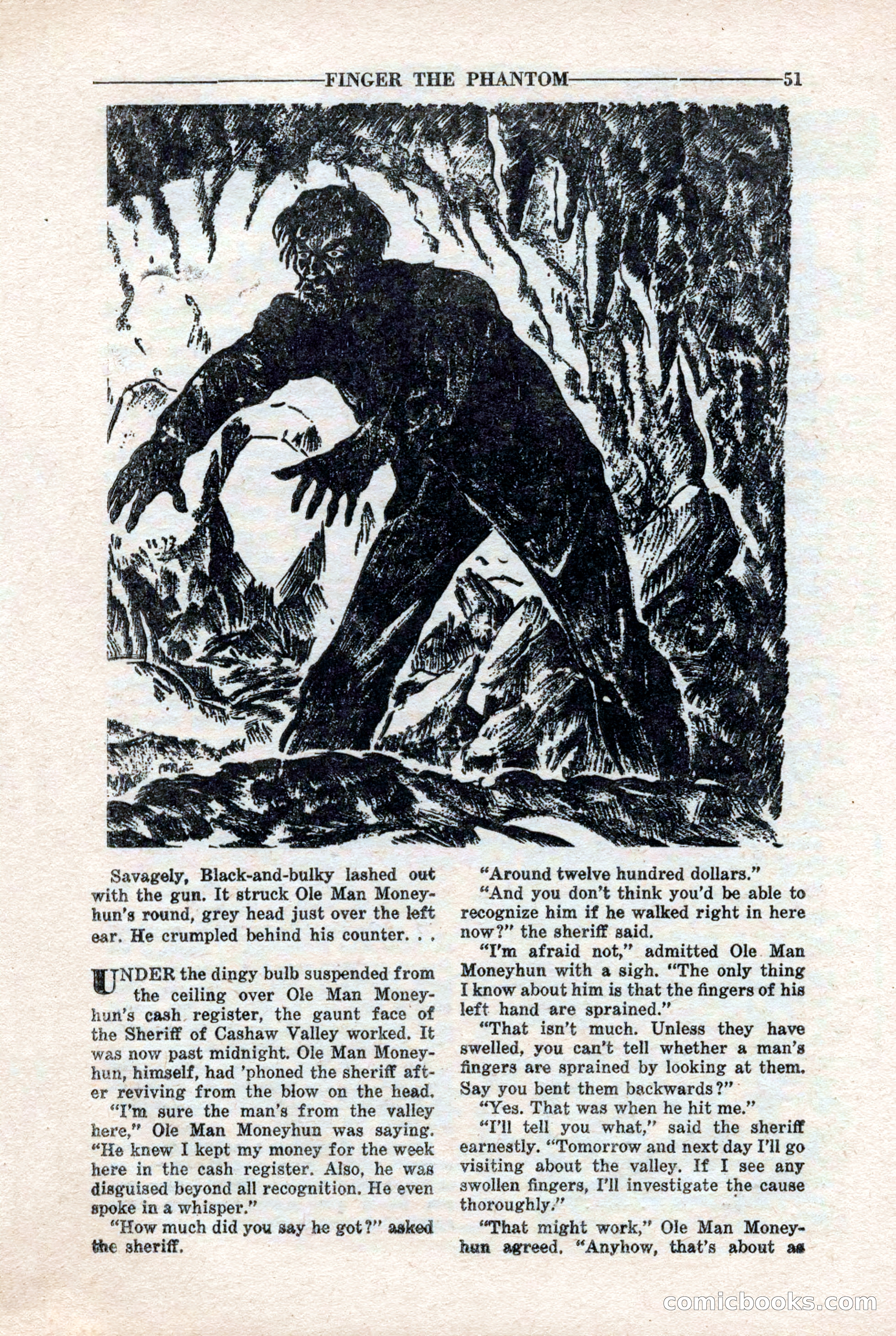
# Page Analysis This is a story page (page 51) from a pulp fiction magazine titled "Finger the Phantom." It contains a dramatic black-and-white illustration showing a figure in dark clothing leaning over what appears to be a counter or desk in a shadowy interior setting. The accompanying prose describes a scene where Ole Man Moneyhun, apparently robbed, speaks with the Sheriff of Cashaw Valley about a theft. The sheriff mentions finding approximately $1,200 missing and notes that the suspect can be identified by having sprained fingers on his left hand. Ole Man Moneyhun confirms the man disguised himself beyond recognition but spoke in a whisper, and agrees the sheriff's plan to investigate the valley for anyone with swollen fingers might help identify the criminal.

10-Story Detective Magazine, April 1946 — page 54 of 84
54 / 84
What you’re looking at · open this page on its own ↗

# Page Analysis This is a text-only story page (page 52) from a pulp detective magazine titled "10-STORY DETECTIVE." The visible prose depicts a scene at Ole Man Moneyhun's general store in what appears to be Cahshaw Valley, where a robbery has occurred. A man named Baleford is accused of stealing from Moneyhun on Saturday night. The store owner examines Baleford's left hand while the sheriff investigates, and Ole Man Moneyhun makes observations about Baleford's wallet-carrying habits. The dialogue suggests Moneyhun is attempting to prove Baleford's guilt through circumstantial evidence about his hands and pocket habits.

10-Story Detective Magazine, April 1946 — page 55 of 84
55 / 84
What you’re looking at · open this page on its own ↗

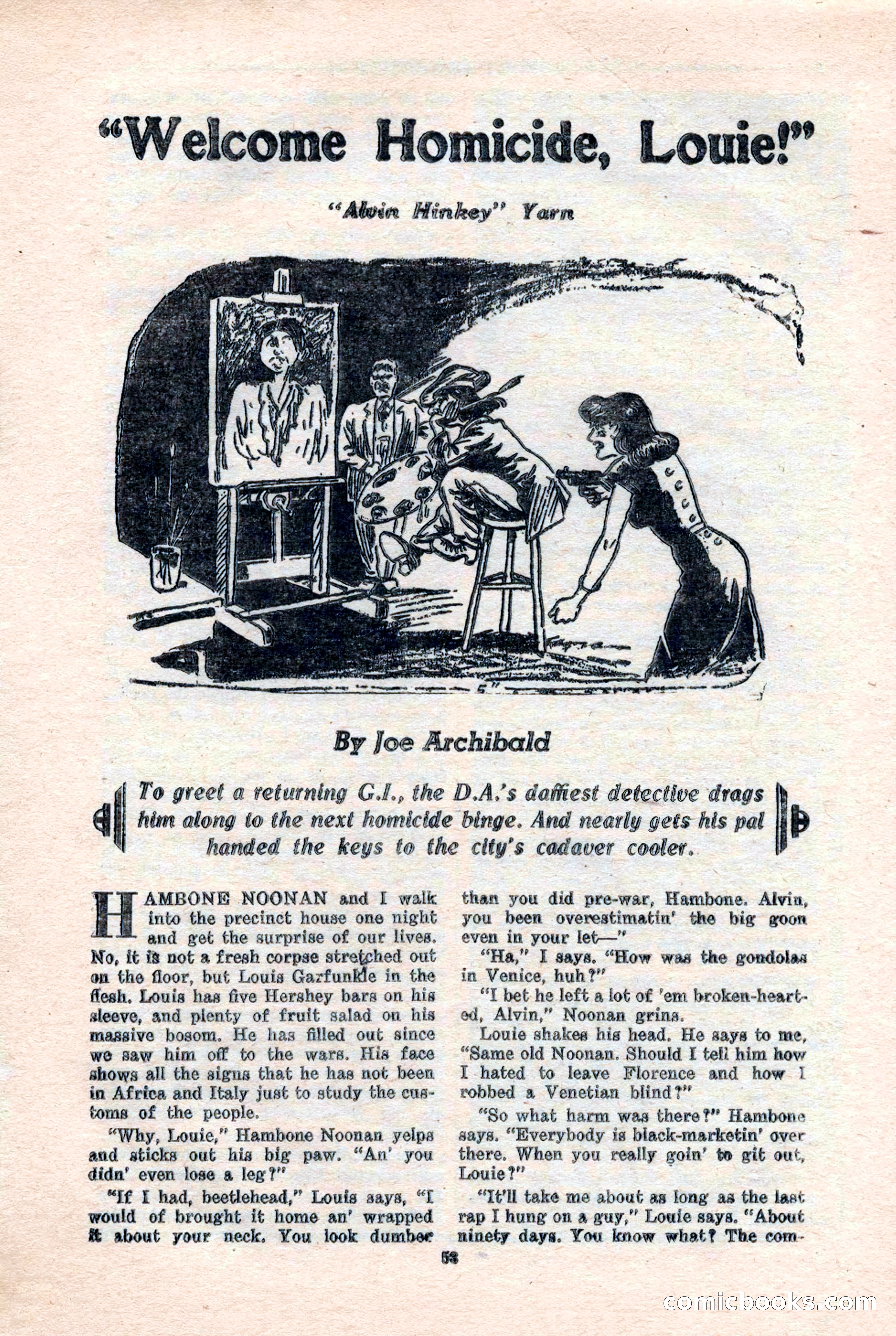
# Page Analysis This page contains story prose and an illustration from a pulp fiction magazine. The illustration depicts what appears to be an artist's studio scene with figures around a canvas or easel. The story, titled "Welcome Homicide, Louie!" by Joe Archibald, is described as an "Alvin Hinkey" yarn. The visible text describes two characters—Hambone Noonan and the narrator—greeting a returning G.I. named Louis Gazfuskie, who has apparently served in World War II. The dialogue centers on Louis's wartime experiences in Africa and Italy, with casual, period-appropriate banter about his adventures and changes since leaving. The tone is lighthearted and conversational throughout the visible excerpt.

10-Story Detective Magazine, April 1946 — page 56 of 84
56 / 84
What you’re looking at · open this page on its own ↗

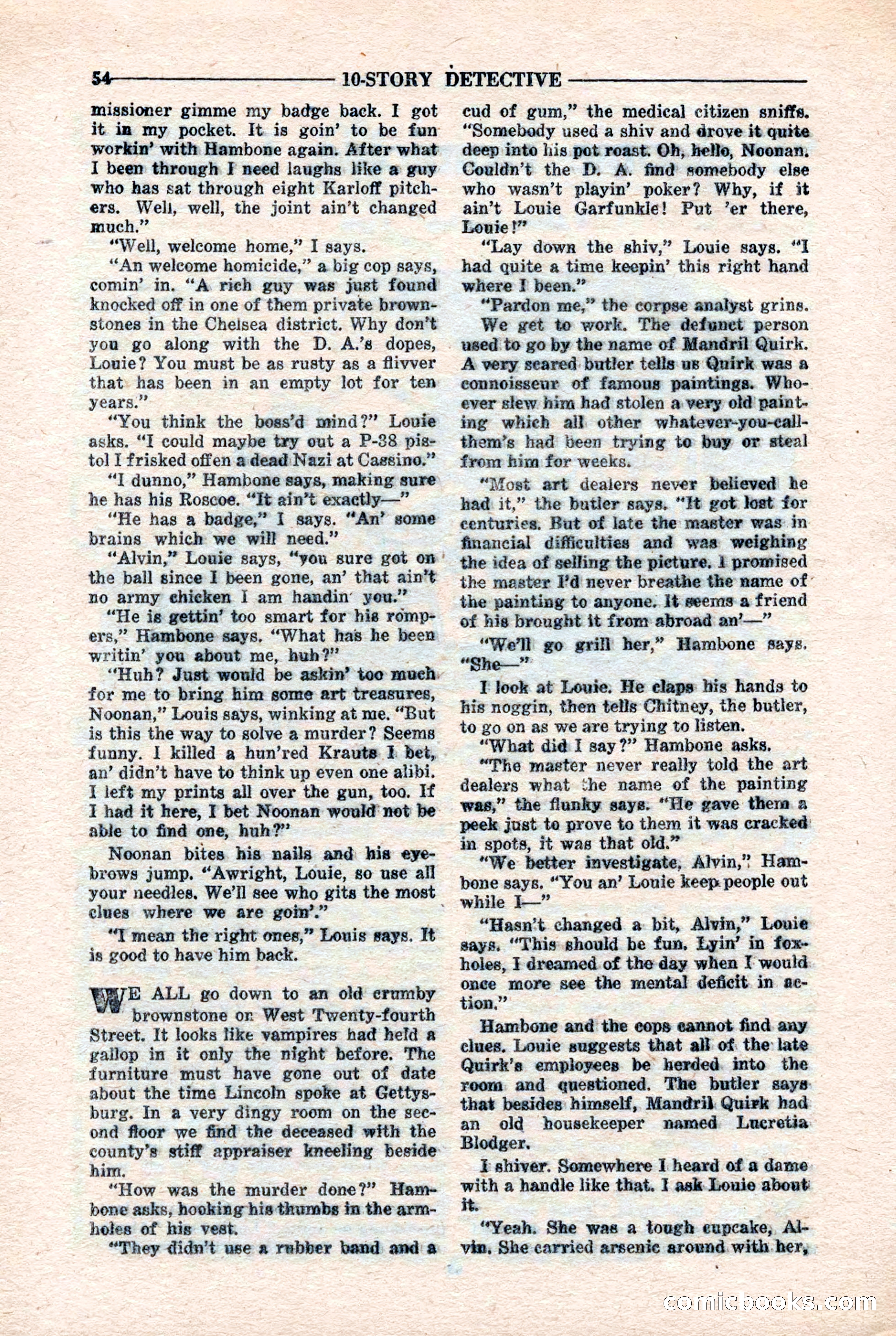
# Page Description This is a prose story page from a pulp detective magazine titled "10-STORY DETECTIVE" (visible in the header). The page contains two columns of text printed in the characteristic small typeface of pulp fiction magazines. The story follows detectives Hambone and Louie investigating a murder case involving a wealthy victim found in a brownstone. The narrative discusses a valuable painting that belonged to someone named Mandril Quirk, apparently stolen or missing for weeks. The detectives debate investigative methods and visit an old, dilapidated brownstone on West Twenty-fourth Street to examine the body. The text references clues, employees to question, and mentions a housekeeper named Lucretia Blodget. This appears to be mid-story, advancing the plot of a hardboiled crime narrative.

10-Story Detective Magazine, April 1946 — page 57 of 84
57 / 84
What you’re looking at · open this page on its own ↗

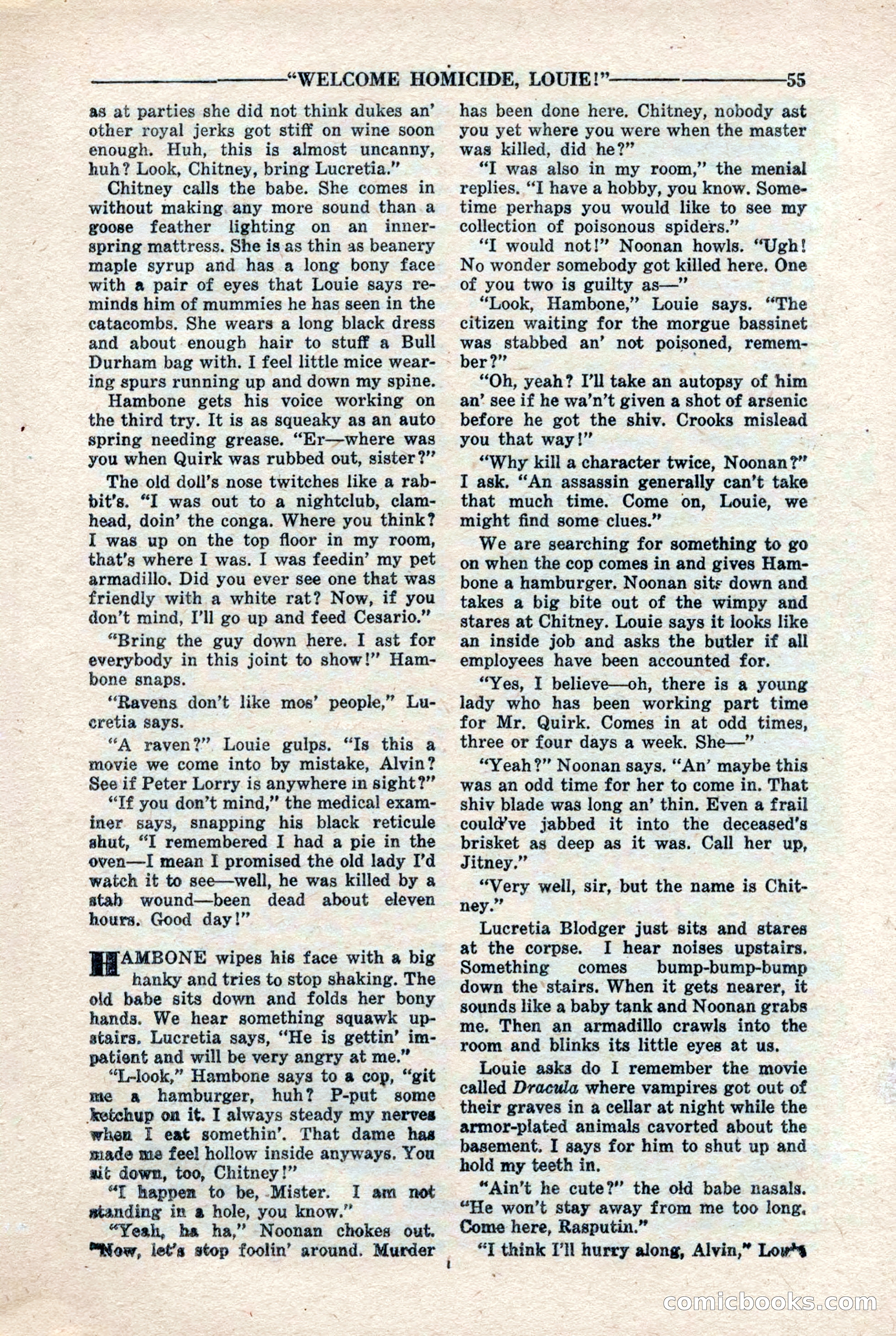
# Page Description This is story prose from a pulp magazine, specifically page 55 of what appears to be a hardboiled crime or mystery narrative titled "Welcome Homicide, Louie!" The visible text depicts characters investigating a murder scene. Hambone, a detective or investigator, questions witnesses including Chitney and Lucretia about a stabbing victim. The dialogue suggests discussion of poisoning, autopsy findings, and potential suspects—including mention of a young woman who worked part-time for someone named Quirk. An armadillo is also mentioned in conversation. The narrative style and subject matter are typical of early pulp detective fiction, mixing noir elements with somewhat colorful, period-specific dialogue and descriptions.

10-Story Detective Magazine, April 1946 — page 58 of 84
58 / 84
What you’re looking at · open this page on its own ↗

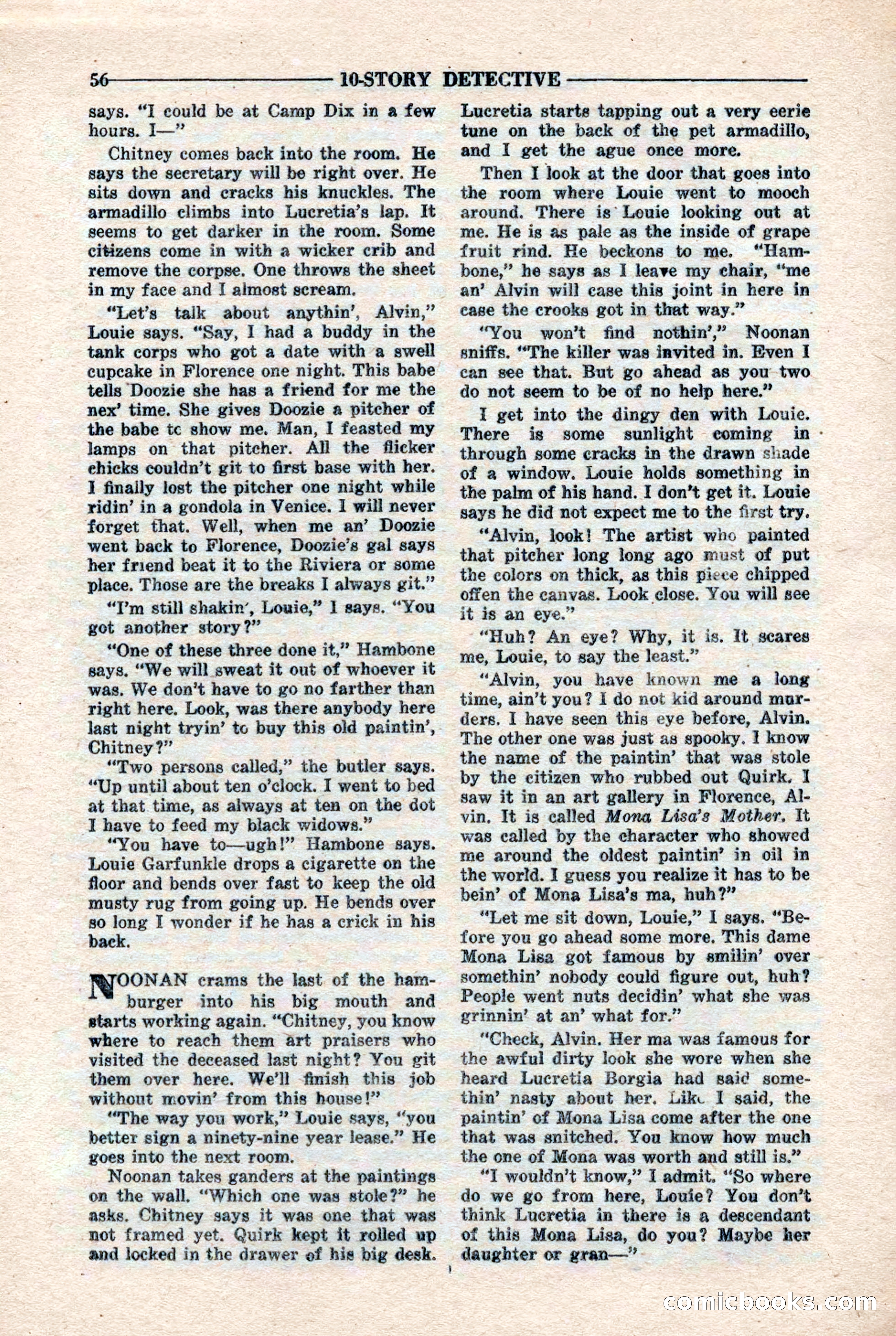
# Page 56 of "10-Story Detective" This page contains story prose from what appears to be a hardboiled detective narrative. The text describes a detective named Alvin interrogating suspects about a stolen painting, specifically "Mona Lisa's Mother" by an artist whose name remains unclear. The conversation involves characters including Louie, Hambone, Noonan, and Chitney discussing their whereabouts the previous night and potential connections to art theft. The passage focuses on establishing alibis and investigating who may have stolen an artwork from a gallery in Florence. No illustrations are visible on this page—it is entirely text-based prose.

10-Story Detective Magazine, April 1946 — page 59 of 84
59 / 84
What you’re looking at · open this page on its own ↗

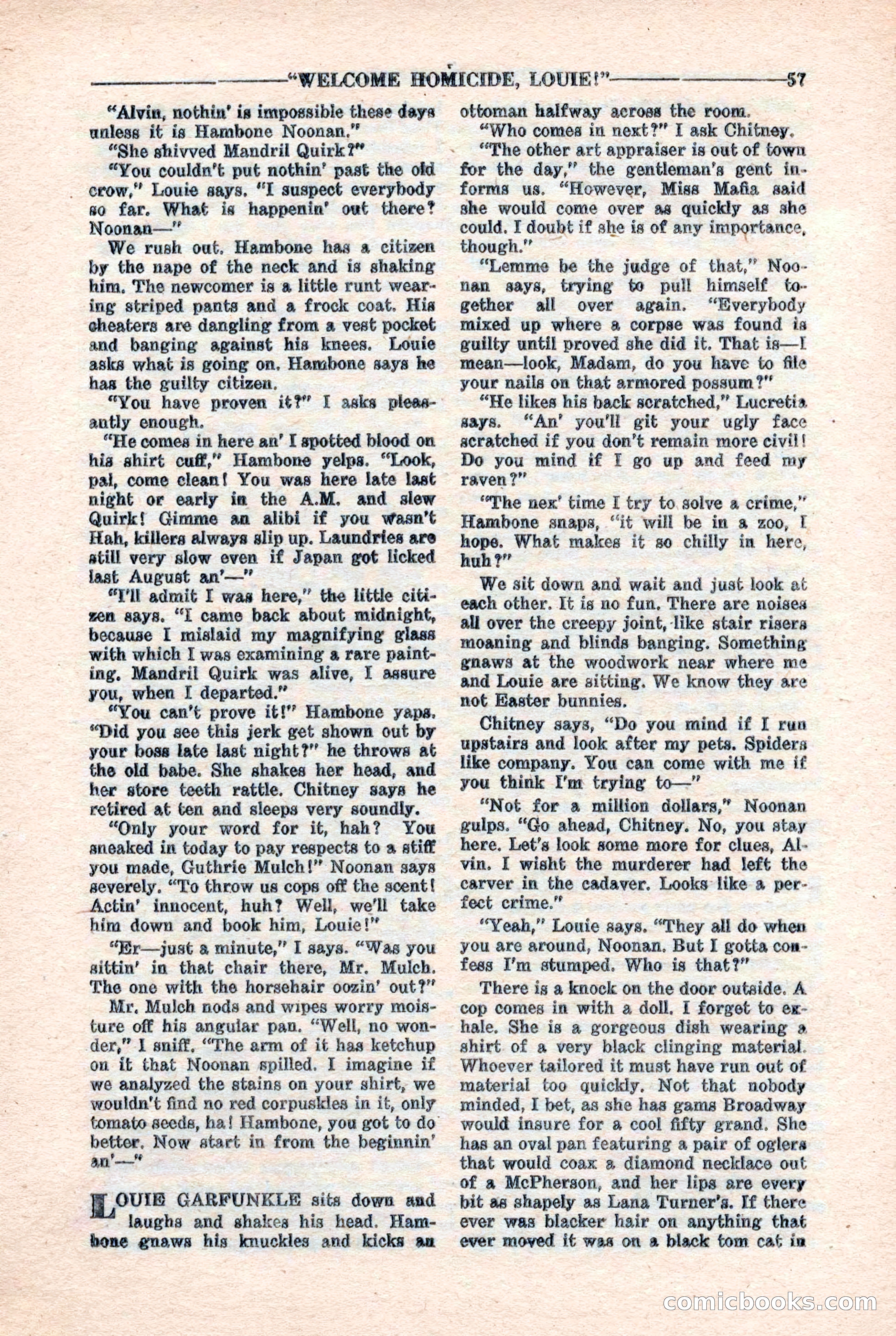
# Page 57: Story Prose This page contains story prose from what appears to be a crime or mystery narrative titled "Welcome Homicide, Louie!" The text depicts a dialogue-heavy scene involving multiple characters—including Noonan, Hambone, Louie, and others—investigating what seems to be a murder or crime scene. The characters discuss evidence (blood on clothing, scratches), alibis, and suspects. A police officer or detective arrives partway through with a woman in a black dress. The prose is written in a hardboiled detective style typical of early pulp crime fiction, with colloquial dialogue and comedic banter interspersed with the mystery plot.

10-Story Detective Magazine, April 1946 — page 60 of 84
60 / 84
What you’re looking at · open this page on its own ↗

# Page Content Analysis This is a **story prose page** (page 53) from a pulp magazine titled "10-Story Detective," featuring a hardboiled crime narrative. The visible text depicts a conversation between characters named Alvin, Louie, and others, discussing a mysterious incident involving "Miss Mafia" and a place called Casino. The narrator describes following Louie Garfunkle through city streets to a brownstone apartment where they stake out an "ordinary-looking" residence. The dialogue reveals references to wartime events (Nazi P-33, rocket ships) and suggests the characters are investigating or surveilling someone, though the exact crime or purpose remains unclear from this excerpt alone. The tone is characteristic of hardboiled detective fiction.

10-Story Detective Magazine, April 1946 — page 61 of 84
61 / 84
What you’re looking at · open this page on its own ↗

# Page 59: Story Prose with Illustration This is a page of story prose with an accompanying illustration. The visible text describes what appears to be a crime or gangster narrative involving characters named Louie, Alvin, and others planning or executing some kind of violent scheme. The dialogue references the Mafia, threats of violence, and mentions of guns and physical confrontation. The illustration shows several figures in what appears to be an interior setting, with one circular inset showing a close-up portrait labeled "Alvin." The overall tone and content suggest this is a hardboiled crime or gangster story typical of early-20th-century pulp fiction magazines.

10-Story Detective Magazine, April 1946 — page 62 of 84
62 / 84
What you’re looking at · open this page on its own ↗

# Page Analysis This is a **text-only story page** from a pulp magazine titled "10-STORY DETECTIVE" (visible in the header). The visible prose is hardboiled crime fiction narrated in first person. The narrator and characters named Louie, Alvin, and Hambone Noonan are dealing with criminals and a stolen painting. The passage includes dialogue about a robbery, a "Cherub" who wielded a shiv, and discussion of returning stolen goods. The narrator expresses frustration at recurring criminal encounters and mentions considering a future military assignment in Japan. The tone is typical pulp detective fiction—cynical, action-focused, with period-appropriate slang and crude humor.

10-Story Detective Magazine, April 1946 — page 63 of 84

63 / 84
What you’re looking at · open this page on its own ↗

# X-Ray Justice This page contains story prose from a pulp fiction narrative by E.C. Marshall. The visible text depicts a tense confrontation in a doctor's office where an escaped convict named Strom confronts Dr. Fells, apparently seeking revenge because Fells failed to provide proper medical treatment to Strom's criminal associate. Strom enters with a gun while Fells is with a patient, creating an atmosphere of threat and moral tension. The dialogue reveals Strom's plan was arranged four days prior and hints at a betrayal involving both men—likely related to a shared crime for which Strom served prison time while Fells remained free.

10-Story Detective Magazine, April 1946 — page 64 of 84
64 / 84
What you’re looking at · open this page on its own ↗

# Page 62: "10-Story Detective" - Story Prose This page contains story prose from what appears to be a detective or crime fiction narrative. The text depicts a tense scene where a character named Strom confronts a doctor named Fells about performing an illegal operation to extract a bullet from Strom's shoulder. Strom holds Fells at gunpoint in what seems to be a medical facility or surgery, threatening him while giving detailed instructions for using X-ray equipment. The narrative involves criminal activity, medical coercion, and considerable tension between the two characters. The page indicates the story continues on page 30.

10-Story Detective Magazine, April 1946 — page 65 of 84
65 / 84
What you’re looking at · open this page on its own ↗

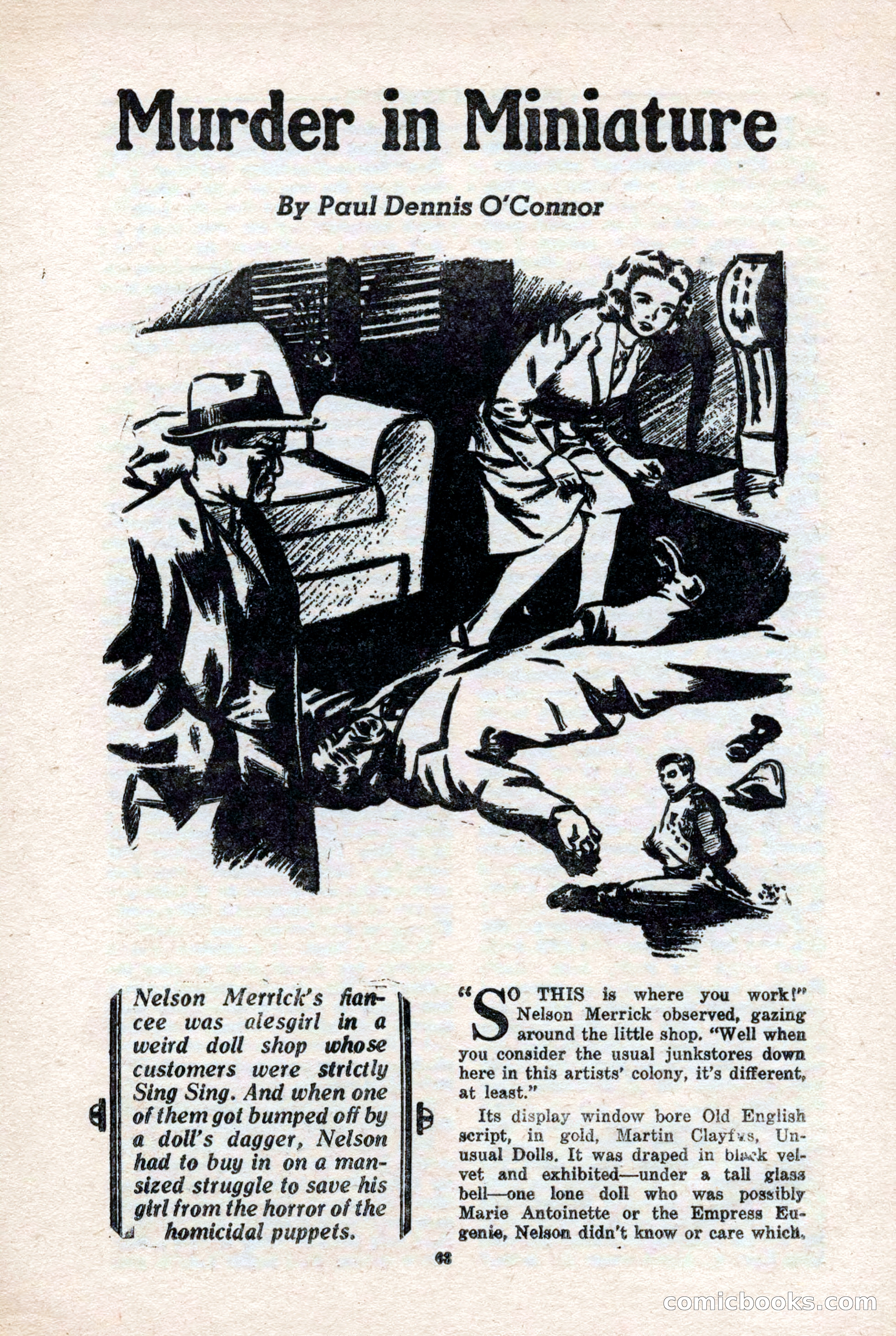
# Analysis This is an interior story page from a pulp magazine featuring "Murder in Miniature" by Paul Dennis O'Connor. The page combines a dramatic black-and-white illustration with prose text below. The illustration depicts a crime scene involving a detective named Nelson Merrick investigating at what appears to be a doll shop. The visible text introduces the setup: Merrick's fiancée worked as a salesgirl in an unusual shop whose customers were "strictly Sing Sing" (a reference to the prison). When one customer was murdered by a doll's dagger, Nelson had to buy his way into a struggle to save his girlfriend from "homicidal puppets"—suggesting the story involves mystery and danger connected to miniature dolls in this peculiar establishment.

10-Story Detective Magazine, April 1946 — page 66 of 84
66 / 84
What you’re looking at · open this page on its own ↗

# Page Analysis This is a text-only story page from a pulp magazine titled "10-STORY DETECTIVE" (visible in the header). The page contains prose fiction—specifically a detective or mystery narrative. The visible text depicts a scene in which a character named Nelson visits Geraldine Jordan's doll shop in an upscale neighborhood. Geraldine, described as a blonde saleswoman, shows Nelson antique dolls and discusses her business. The dialogue reveals tension between the characters, with Nelson making cynical remarks about the shop while Geraldine defends her clientele and eventually mentions a woman named Miss Jacques. The narrative focuses on character interaction and dialogue rather than action.

10-Story Detective Magazine, April 1946 — page 67 of 84
67 / 84
What you’re looking at · open this page on its own ↗

This is a page of story prose from a pulp magazine, specifically page 65 of a story titled "Murder in Miniature." The text depicts a dramatic scene involving characters named Nelson, Geraldine, Gerry, Miss Jacques, Clayfus, and Monfreda. Nelson appears to be involved in a lover's quarrel with Gerry over a ring, and the narrative follows Nelson as he tracks down Monfreda's address and travels to an apartment building on East Twenty-seventh and Lexington Avenue. The prose is typical hardboiled crime fiction, featuring dialogue-heavy narrative with descriptions of character interactions and Nelson's investigative movements.

10-Story Detective Magazine, April 1946 — page 68 of 84
68 / 84
What you’re looking at · open this page on its own ↗

# Page Analysis: 10-Story Detective This is a text page (page 66) from the pulp magazine *10-Story Detective*, containing story prose with no illustrations. The narrative depicts a crime scene investigation. Detective Nelson discovers two bodies: a woman in a grey zoot-suit (identified as Miss Jacques) and a broken Napoleon Bonaparte doll beside her. A bright sliver—apparently a four-inch sword—protrudes from the woman's throat, the murder weapon. As Nelson examines the scene, other characters arrive, including Gerry Jordan, Martin Clayfus, and Jenny Jacques. The passage focuses on their shocked reactions to discovering the victims and establishing the apparent murder scenario.

10-Story Detective Magazine, April 1946 — page 69 of 84
69 / 84
What you’re looking at · open this page on its own ↗

# Page Analysis This is a text-only story page (page 67) from a pulp magazine titled "Murder in Miniature." The page contains prose narrative in a two-column layout with no illustrations. The visible story concerns Jenny Jacques, who appears to be investigating a murder with companions named Nelson and Gerry. Jenny is armed with a gun and initially threatens Ward Taylor, then decides to visit his house to question him. The narrative involves tense dialogue about a potential murderer and includes Jenny's directive to Nelson to drive them to Taylor's residence while she threatens to shoot if necessary. The prose style is characteristic of hardboiled crime fiction.

10-Story Detective Magazine, April 1946 — page 70 of 84
70 / 84
What you’re looking at · open this page on its own ↗

# Page Analysis This page contains story prose from a pulp detective magazine titled "10-STORY DETECTIVE" (visible in the header). The narrative follows detectives Nelson and Gerry as they investigate a murder case involving a victim named Elmo and pursue a suspect connected to a green car. The text depicts action and dialogue as the characters track down leads—including a visit to an apartment and an encounter at what appears to be a suspect's residence. The page is entirely text with no illustrations or advertisements visible, continuing a serialized crime story mid-narrative.

10-Story Detective Magazine, April 1946 — page 71 of 84
71 / 84
What you’re looking at · open this page on its own ↗

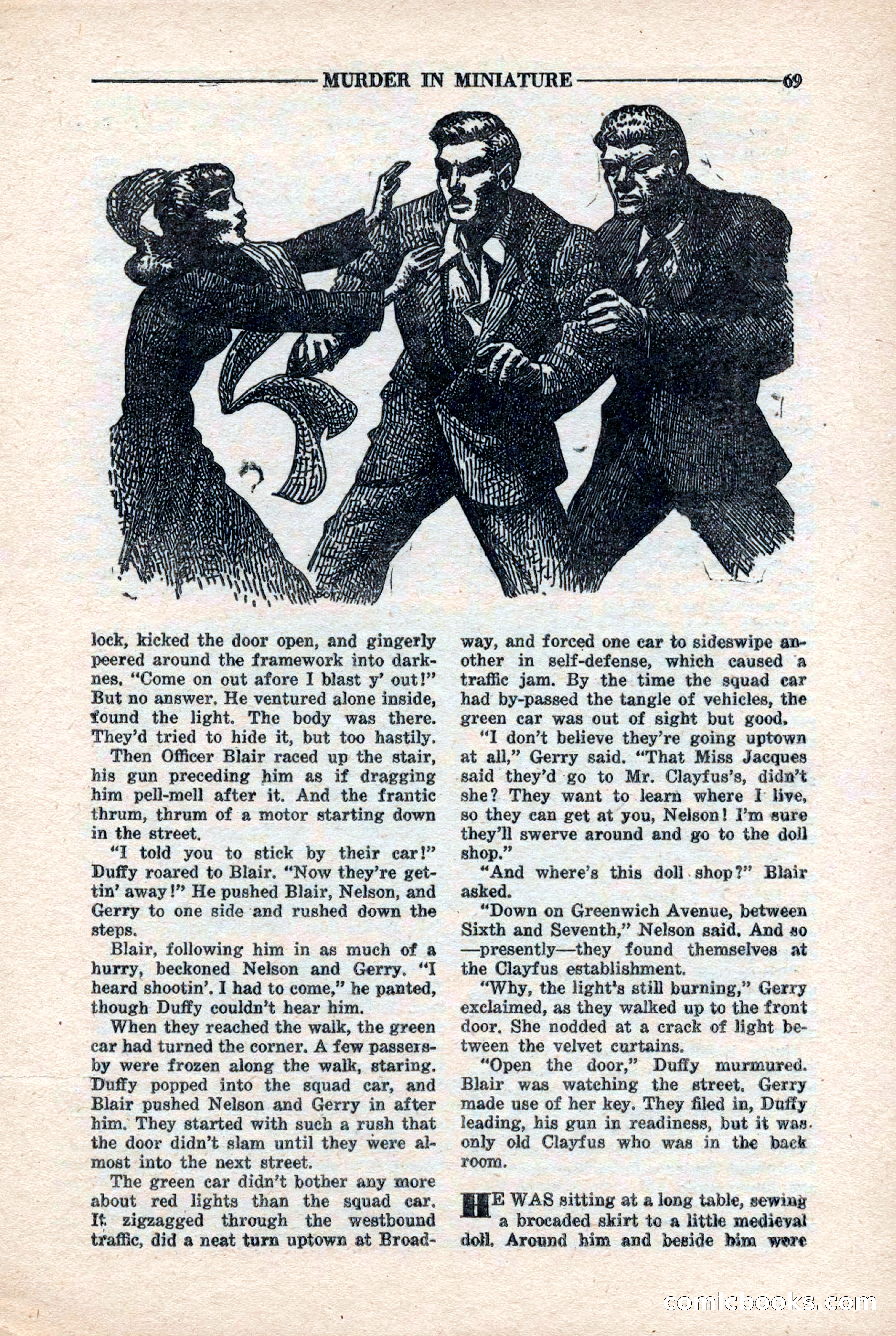
# Page 69: "Murder in Miniature" - Story Prose with Illustration This page contains printed story text with an accompanying illustration at the top. The illustration shows three men in suits appearing to confront or restrain another man in what seems to be a tense confrontation scene. The visible prose describes police officers pursuing suspects through city streets. Officer Blair, Duffy, Nelson, and Gerry pursue a green car after encountering a body and hearing gunshots. The narrative follows their chase through traffic and their eventual arrival at a doll shop on Greenwich Avenue, where they discover a woman (apparently named Clayra) sewing at a table inside. The passage appears to be from a hardboiled detective or crime story.

10-Story Detective Magazine, April 1946 — page 72 of 84
72 / 84
What you’re looking at · open this page on its own ↗

# Page Analysis This is a text page from a detective pulp story titled "10-STORY DETECTIVE" (visible in the header). The page contains prose narrative—no illustrations. The story involves detectives named Nelson, Blair, and Duffy investigating a doll-maker named Clayfus and a character named Gerry. The plot appears to involve a shooting or violent confrontation at a doll shop. Characters are searching for a girl's address connected to someone named Elmo's death. The passage describes a chaotic scene where multiple characters struggle over a gun, dolls are broken, and a necklace is recovered. The prose style and content suggest hardboiled crime fiction typical of early pulp magazines.

10-Story Detective Magazine, April 1946 — page 73 of 84
73 / 84
What you’re looking at · open this page on its own ↗

# Page Analysis This is a page of story prose from a pulp magazine titled "Murder in Miniature" (visible at the top). The page contains two columns of text presenting the resolution of a mystery involving a murder committed using a Napoleon doll as a weapon. The solution is explained by a character named Nelson: Clayfus killed Elmo with a toy sword, made a plaster cast of Elmo's face to reconstruct it complete with a scar, then disguised himself as Elmo to establish an alibi. The text discusses how Clayfus had motivation through a necklace and a woman named Jenny, and how the crime was ultimately discovered through examination of doll fragments and other evidence.

10-Story Detective Magazine, April 1946 — page 74 of 84
74 / 84
What you’re looking at · open this page on its own ↗

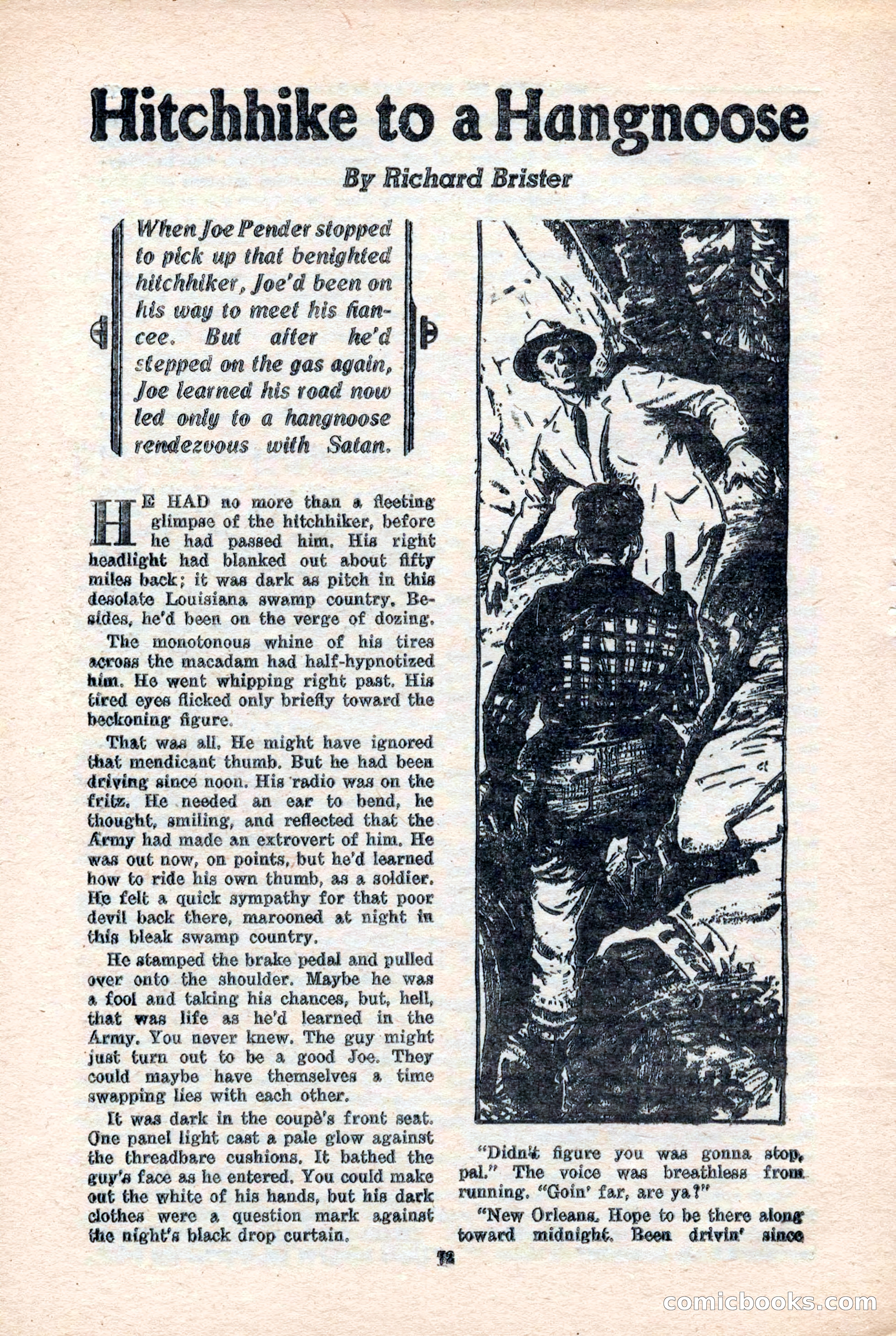
# "Hitchhike to a Hangnoose" by Richard Brister This page contains story prose and an accompanying illustration. The narrative follows Joe Pender, who picks up a hitchhiker but discovers the ride may lead to danger rather than his intended destination. The visible text describes Joe driving through Louisiana swampland at night, exhausted after hours on the road, when he encounters the hitchhiker. The illustration shows two men in what appears to be a vehicle interior. The story's tone suggests a hardboiled crime narrative with ominous undertones, as the opening framing text warns that Joe's road "led only to a hangnoose rendezvous with Satan."

10-Story Detective Magazine, April 1946 — page 75 of 84
75 / 84
What you’re looking at · open this page on its own ↗

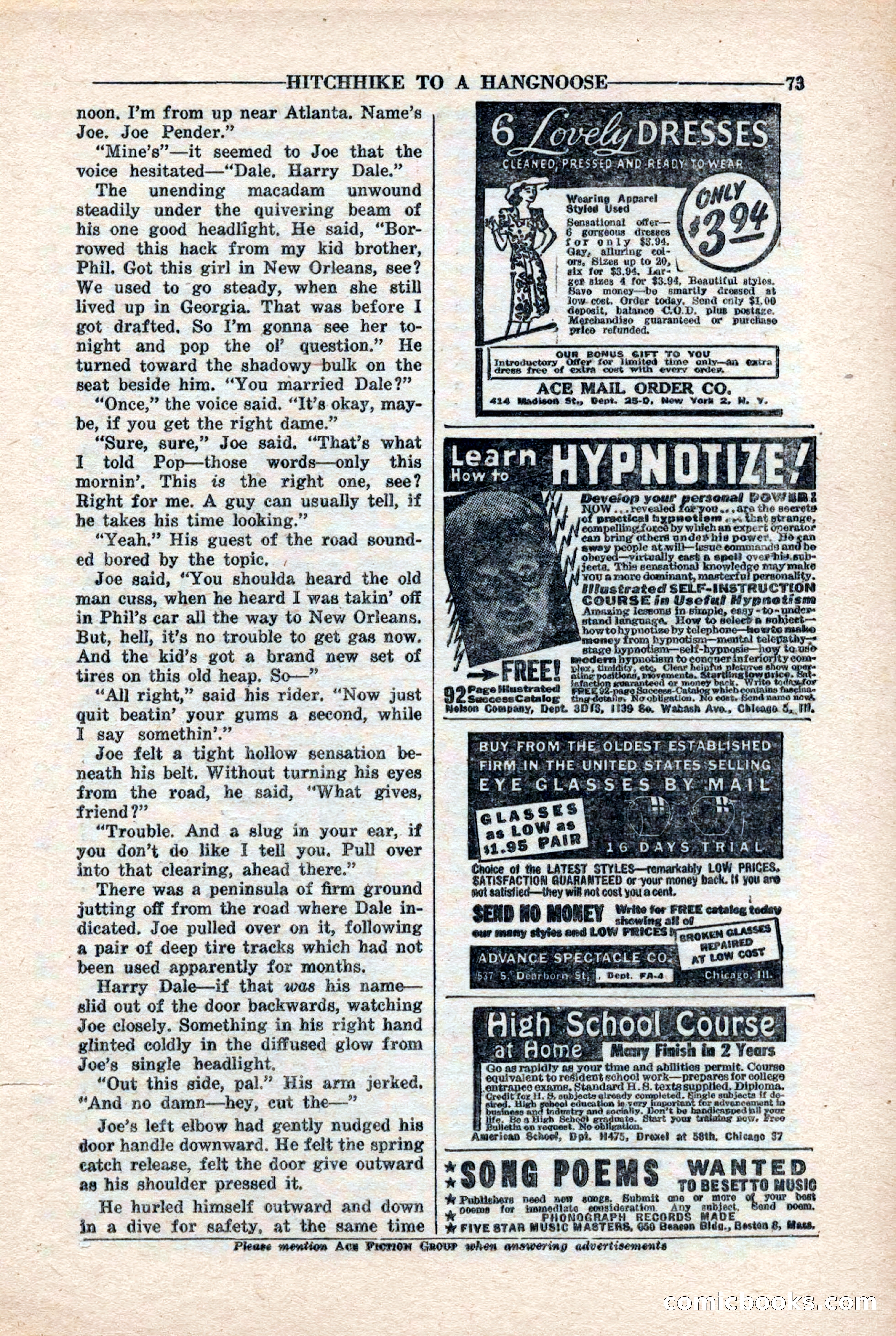
# Page 73: Story Text with Period Advertisements This page contains the continuation of a story titled "Hitchhike to a Hangnoose" (visible in the header). The left column features prose narrative about characters named Joe, Dale, and Harry Dale, involving dialogue about borrowing a car and traveling to New Orleans, with tension building as Joe picks up a mysterious hitchhiker. The right side displays vintage mail-order advertisements typical of early pulp magazines, including offers for dresses ($3.94), hypnosis instruction booklets, eyeglasses by mail, a high school correspondence course, and song poems for musical composition. The page is numbered 73 and represents typical pulp magazine layout mixing serialized fiction with contemporary classified advertising.

10-Story Detective Magazine, April 1946 — page 76 of 84
76 / 84
What you’re looking at · open this page on its own ↗

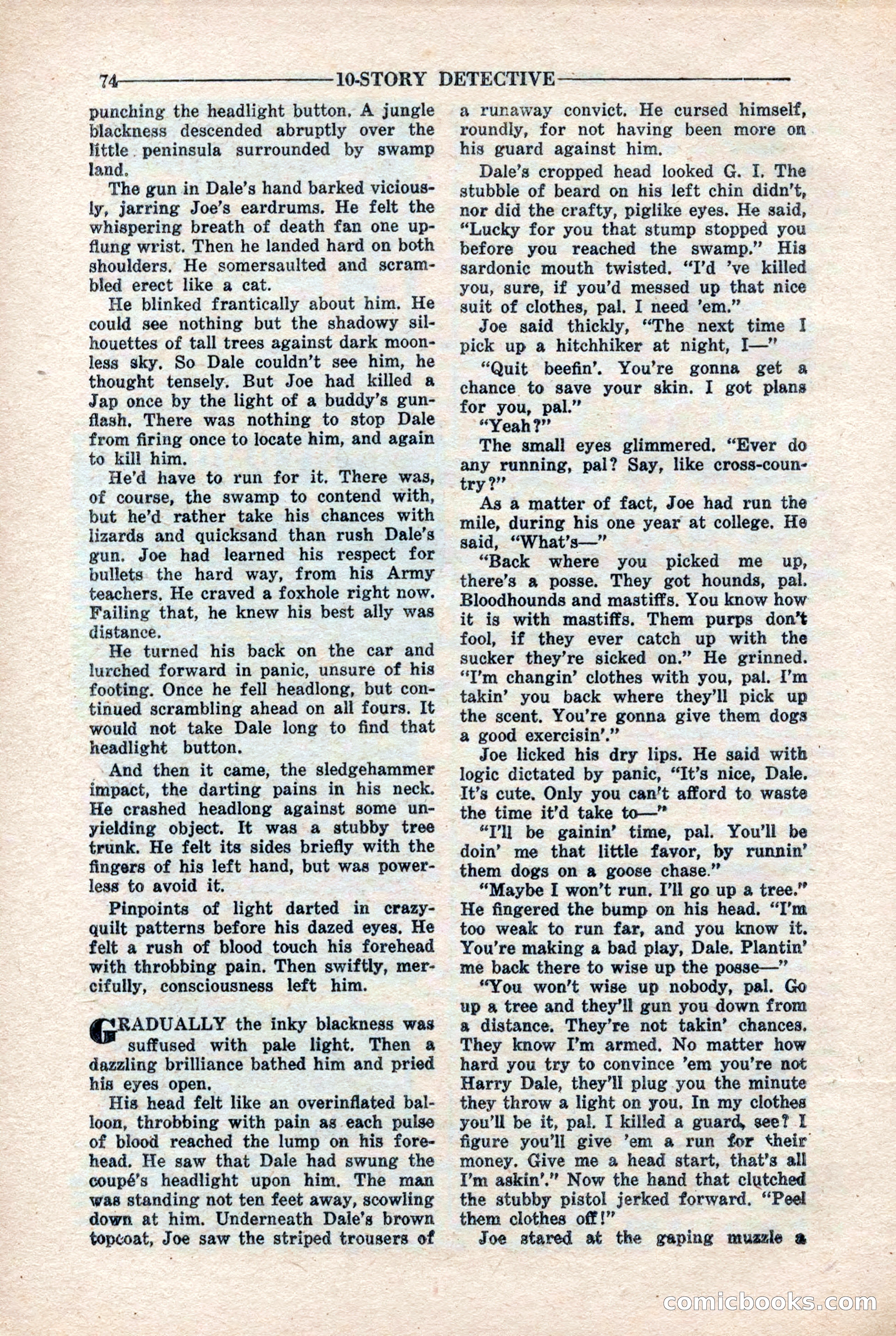
# Page 74: Story Prose from "10-Story Detective" This page contains two columns of story prose from a hardboiled crime narrative. The text depicts an action scene in which a protagonist named Joe, apparently a fugitive or convict, has been struck by a vehicle driven by someone named Dale and is losing consciousness. As Joe drifts toward unconsciousness, he observes Dale standing nearby with a gun. The narrative then shifts to dialogue where Joe, regaining awareness, attempts to negotiate with Dale, proposing they work together and suggesting Joe lead authorities away from their location. The passage is typical pulp-fiction style with dramatic descriptions of violence and tense criminal intrigue.

10-Story Detective Magazine, April 1946 — page 77 of 84
77 / 84
What you’re looking at · open this page on its own ↗

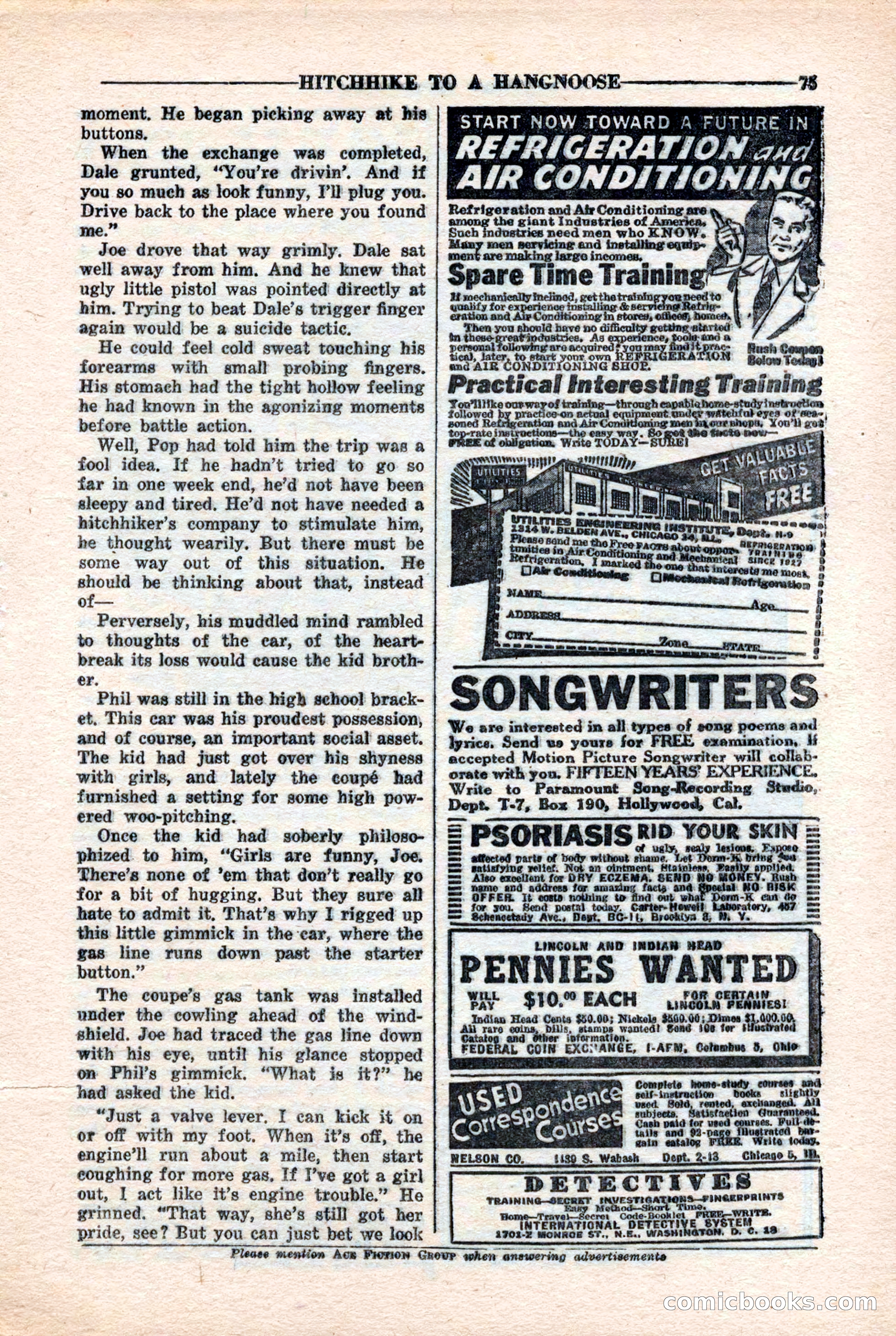
# Page Analysis This is a story prose page (page 75) from a pulp fiction magazine titled "Hitchhike to a Hangnoose." The visible text continues a narrative about characters named Joe, Dale, and Phil involving a tense situation with a gun. The story discusses a car trip and appears to involve conflict between the characters, with dialogue about a gas line and engine trouble. The right side of the page contains period advertisements for various products and services: refrigeration/air conditioning training courses, songwriting opportunities, skin condition remedies, rare penny coin collection, correspondence courses, and detective training services. These ads are typical of pulp magazine monetization from the early-to-mid 20th century.

10-Story Detective Magazine, April 1946 — page 78 of 84
78 / 84
What you’re looking at · open this page on its own ↗

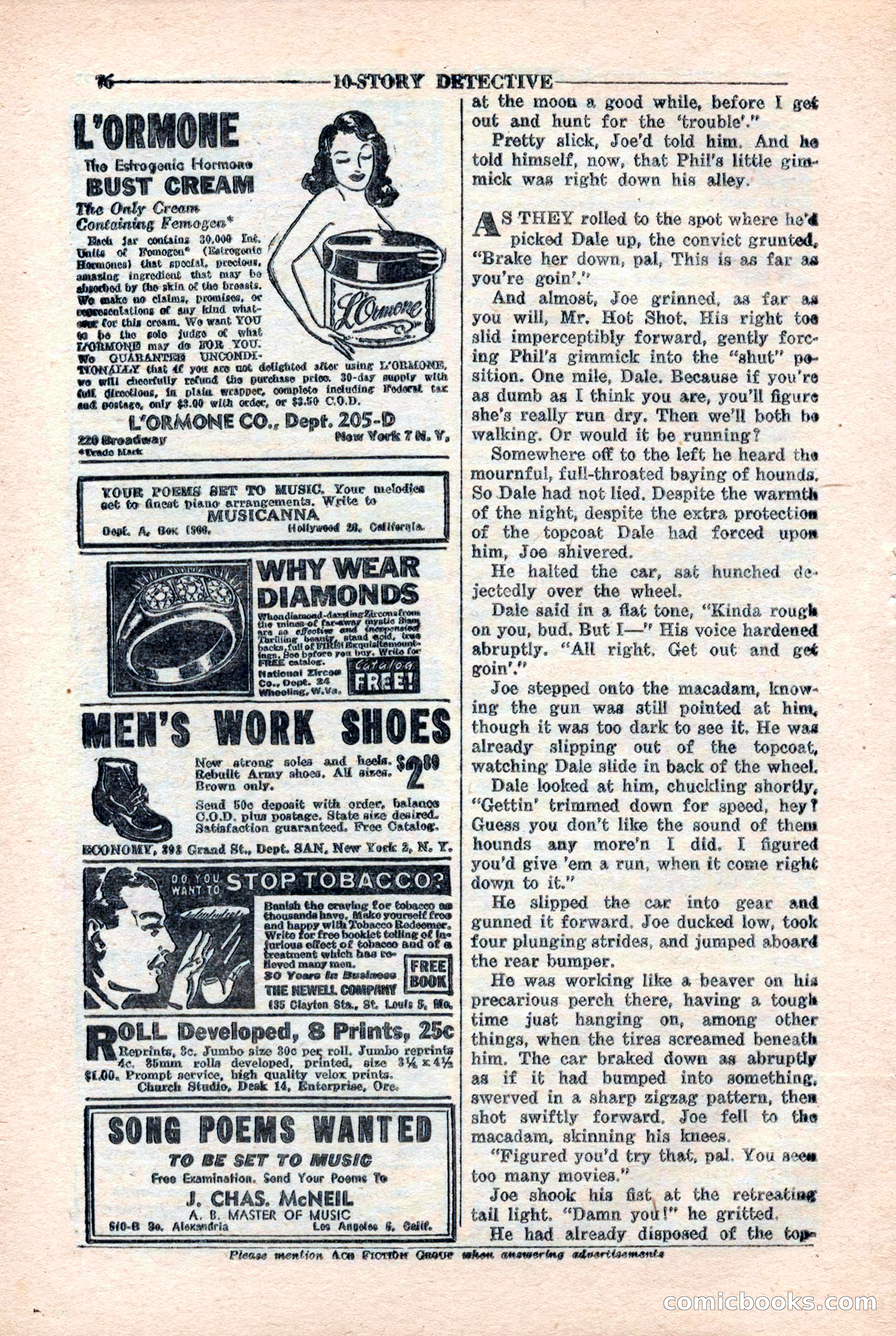
# Page Analysis This is a story prose page from a pulp detective magazine titled "10-STORY DETECTIVE." The visible text continues a hardboiled crime narrative involving characters named Joe, Dale (apparently a convict), and an unnamed antagonist. The scene depicts a tense chase sequence where Joe pursues Dale in a car after Dale escapes, with Joe using a gun to force compliance. The passage emphasizes action and dialogue typical of pulp crime fiction. The page is surrounded by period advertisements for products including L'Ormone bust cream, diamonds, work shoes, tobacco cessation treatment, and a music composition service—typical commercial content padding pulp magazine pages of this era.

10-Story Detective Magazine, April 1946 — page 79 of 84
79 / 84
What you’re looking at · open this page on its own ↗

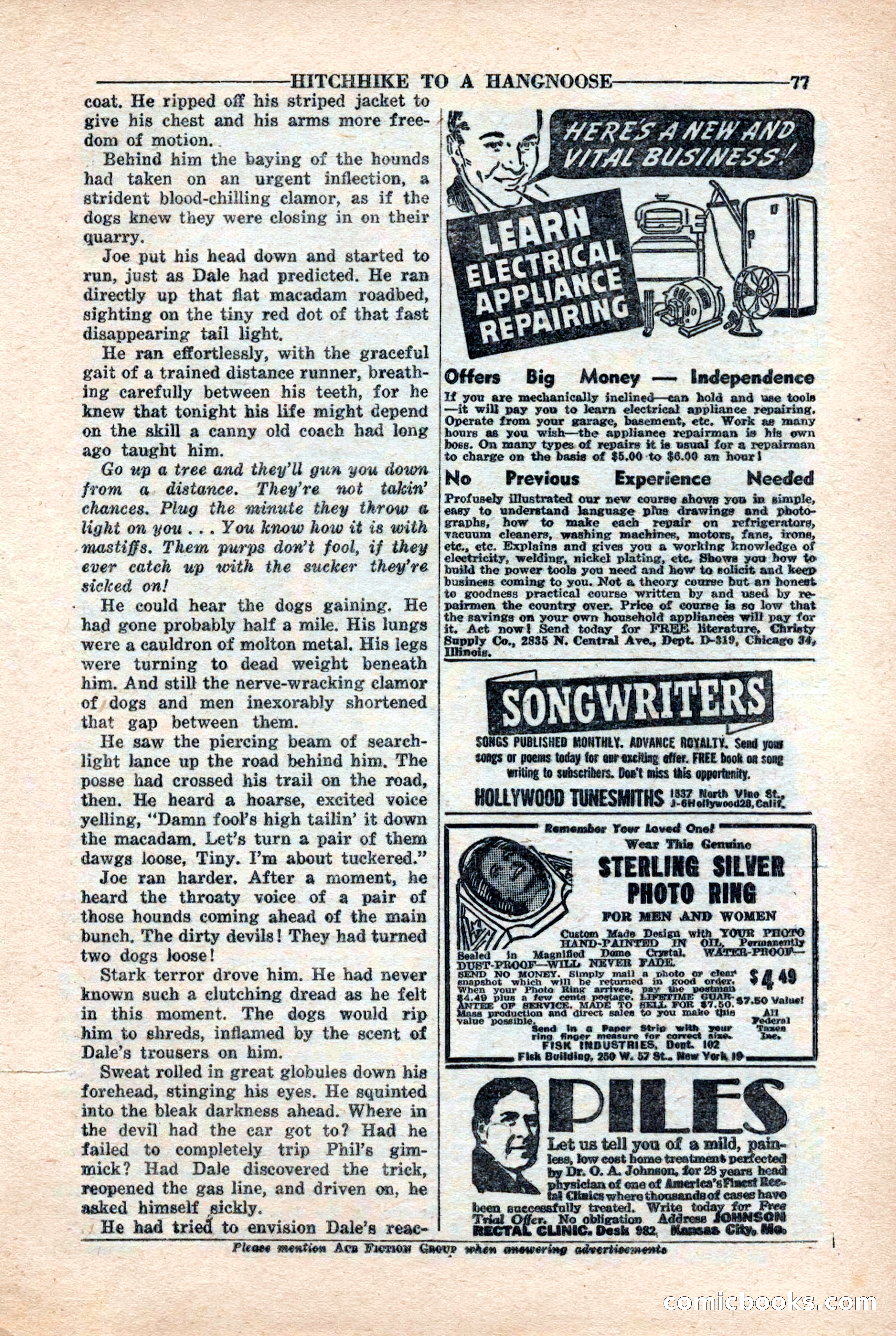
# Page Analysis This is a **story prose page with advertisements**—specifically page 77 of what appears to be a pulp fiction magazine titled "Hitchhike to a Hangnoose." The left column contains narrative text describing a character named Joe running from pursuing hounds and a posse after apparently committing a crime. The prose emphasizes his exhaustion and mounting fear as the dogs close in. The right side features **period advertisements** for electrical appliance repair training, songwriting opportunities, a sterling silver photo ring, and what appears to be a medical treatment ("D.E.O."). The story text uses vivid, dramatic language typical of pulp crime or adventure fiction, though the exact genre and full plot remain unclear from this excerpt alone.

10-Story Detective Magazine, April 1946 — page 80 of 84
80 / 84
What you’re looking at · open this page on its own ↗

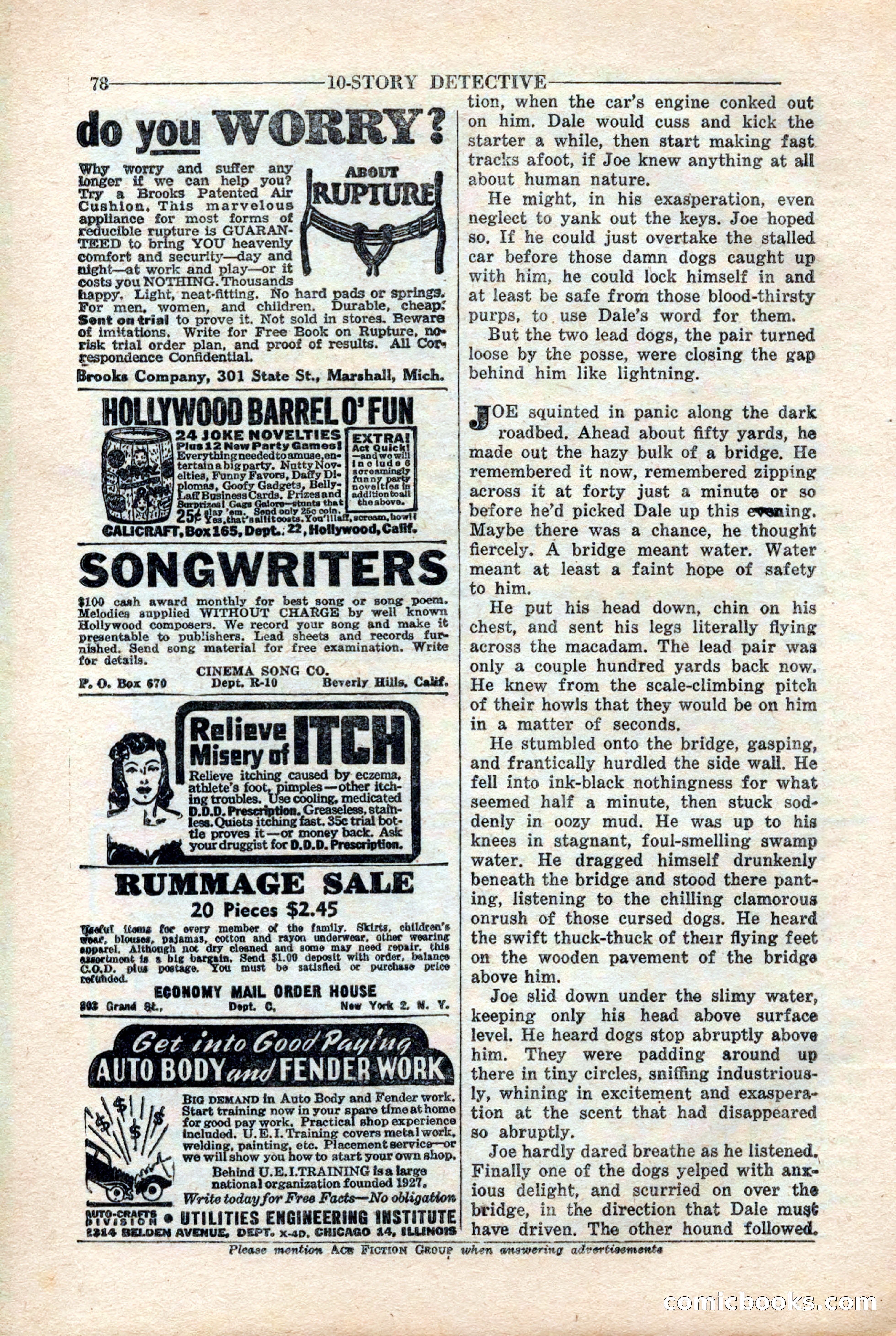
# Page Analysis This is a **story prose page with advertisements** from a pulp magazine titled "10-STORY DETECTIVE" (visible at page top). The main text is a narrative passage from what appears to be a crime or detective story involving a character named Joe who is fleeing from dogs while driving a car. Joe becomes stranded in a swamp beneath a bridge, hiding from pursuing hounds. The page is surrounded by **period advertisements** for various products and services: a rupture support device, song-writing opportunities, an itch relief remedy, a rummage sale, auto body training, and other mail-order items typical of 1920s-30s pulp magazines. The story text dominates the right two-thirds of the page, while advertisements fill the left margin and surrounding space.

10-Story Detective Magazine, April 1946 — page 81 of 84
81 / 84
What you’re looking at · open this page on its own ↗

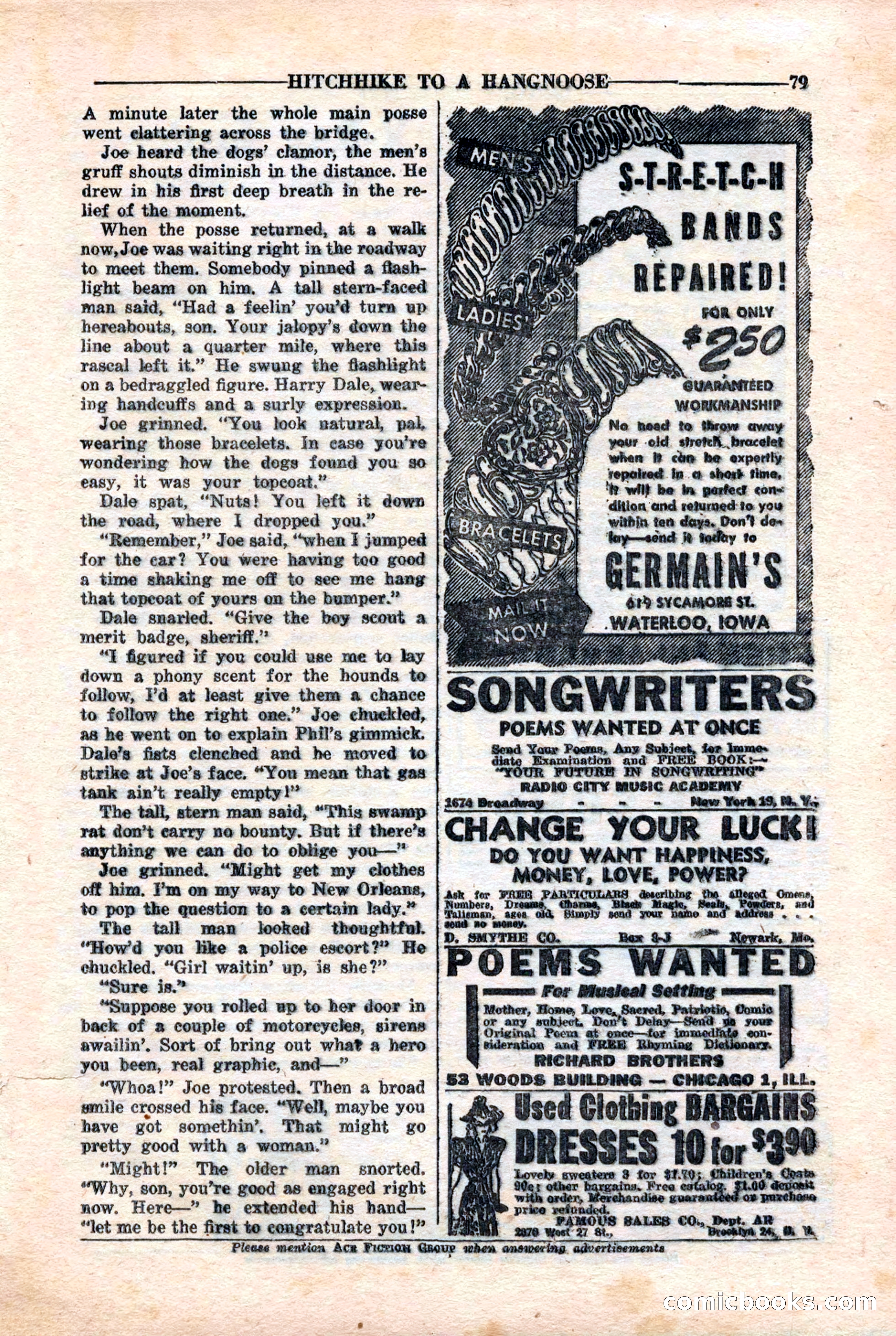
# Page Analysis This is a story page (page 79) from a pulp magazine titled "Hitchhike to a Hangnoose." The page contains prose narrative describing an interaction between a character named Joe and a tall stern-faced man who has stopped him on a roadway. The man references a lost topcoat and implies Joe was involved in some kind of incident, while Joe responds with humor and deflection. The right half of the page is dominated by period advertisements for services including bracelet repair, songwriting opportunities, poetry submission requests, and discounted women's clothing. The story text appears to be from a crime or mystery narrative, though the complete plot context remains unclear from this single page.

10-Story Detective Magazine, April 1946 — page 82 of 84
82 / 84
What you’re looking at · open this page on its own ↗

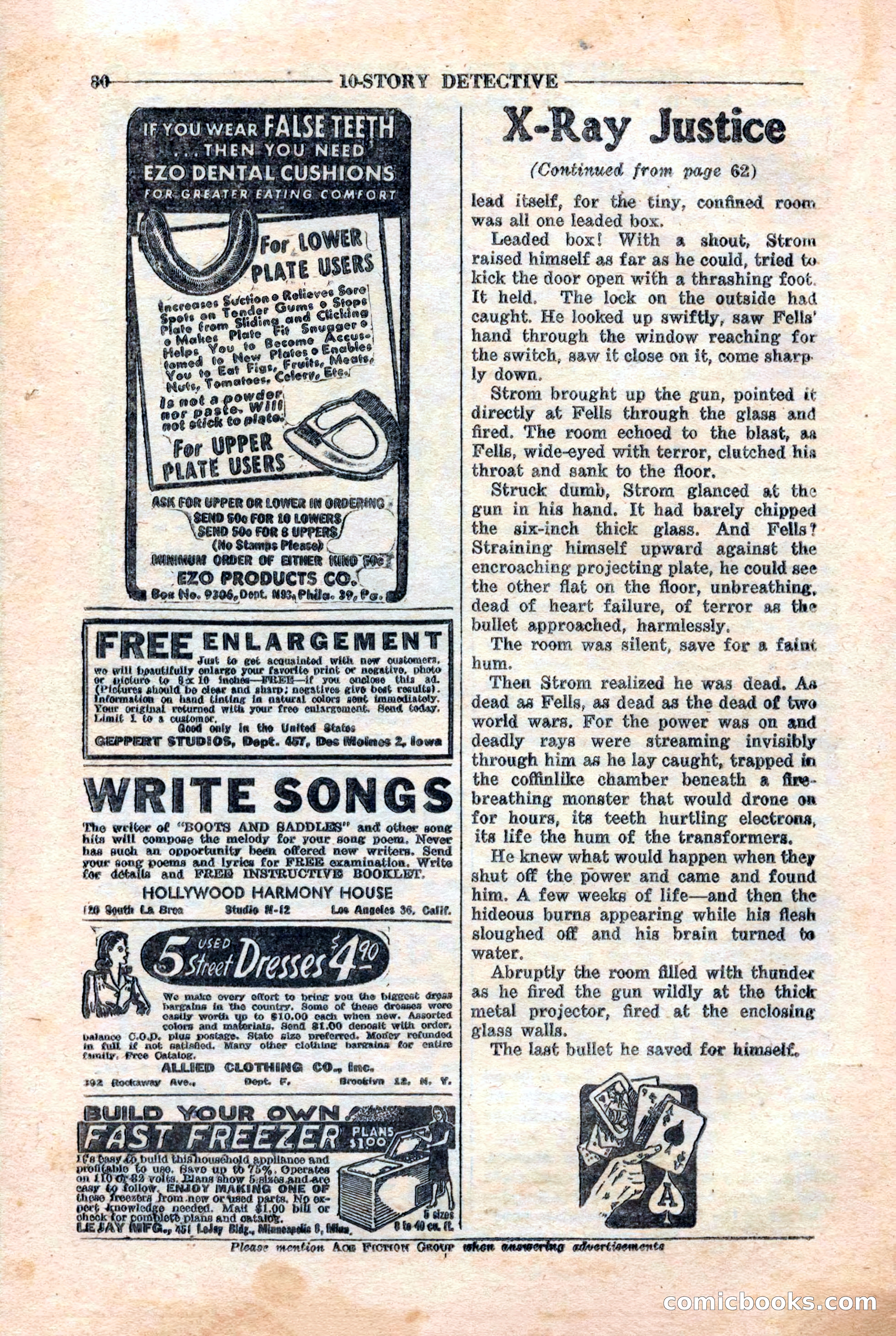
# Page 30: 10-Story Detective Magazine This page contains the continuation of a story titled "X-Ray Justice" (begun on page 62). The prose describes an intense confrontation in a confined room where a character named Strom fires a gun at another character named Fells through reinforced glass. The narrative details the gunshot's ineffectiveness against the thick glass and Strom's realization that Fells is dead, apparently from exposure to X-rays in the sealed chamber. The story concludes with Strom firing a final bullet at himself. The page also contains several period advertisements, including dental cushions, photo enlargement services, songwriting opportunities, used dresses, and a build-your-own freezer kit.

10-Story Detective Magazine, April 1946 — page 83 of 84
83 / 84
What you’re looking at · open this page on its own ↗

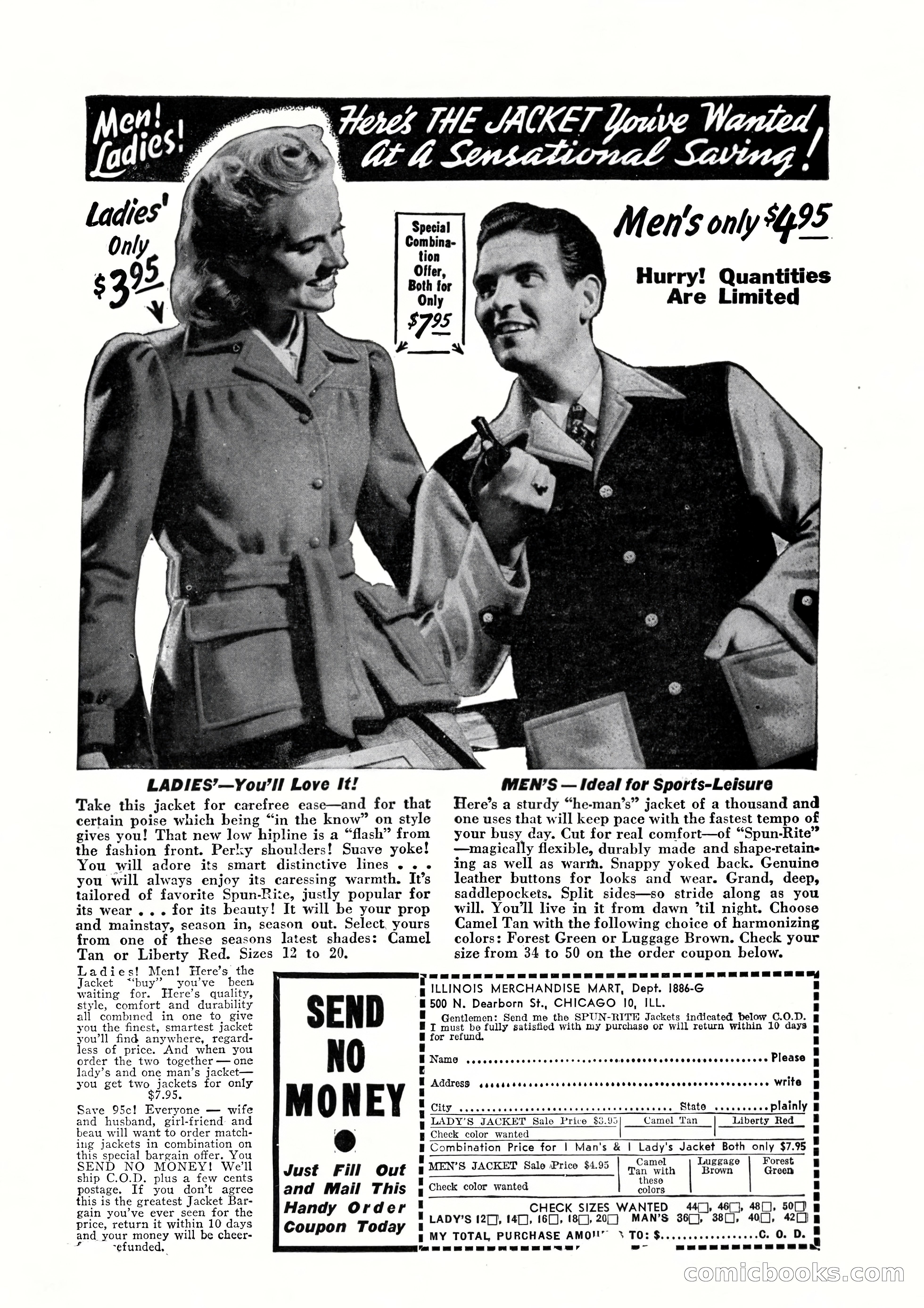
This is an advertisement page, not story content or a cover. It promotes "Spun-Rite" jackets for both men and women through Illinois Merchandise Mart. The ad features photographs of a stylishly dressed woman and man modeling the jackets, with the women's version priced at $3.95 and the men's version at $4.95. The copy emphasizes the jackets' practicality for sports and leisure wear, highlighting features like genuine leather buttons, saddlepockets, and split sides. The page includes a mail-order coupon allowing customers to purchase both jackets combined for $7.95, with C.O.D. payment options available. Color and size selections can be specified on the coupon.

10-Story Detective Magazine, April 1946 — page 84 of 84
84 / 84
What you’re looking at · open this page on its own ↗

# Analysis This page is primarily a **full-page advertisement**, not editorial content from a pulp magazine. The ad promotes the "Gold Seal" insurance policy from Service Life Insurance Company (Omaha, Nebraska). It advertises comprehensive health and accident coverage for just $1 per month, offering cash benefits of up to $6,000 for accumulated illness or accident claims. The ad emphasizes "no medical examination" required and includes a detachable coupon for a free 10-day inspection period. The layout features period-typical imagery: a man in a hospital bed and a woman reviewing documents, designed to appeal to readers concerned about medical expenses and income loss from illness or injury.

Browse this issue page by page

Each page has its own page — the cartoon, who’s in it, and what the satire means.

  1. Page 1 This is the front cover of a 10-Story Detective Magazine from April, priced at 10 cents. The cover features an illustration of a glamorous nightclub or party sc…
  2. Page 2 # Advertisement Page This is a full-page advertisement for a Hospitalization Insurance Plan offered by the George Rogers Clark Mutual Casualty Company of Rockfo…
  3. Page 3 This page is a comic strip advertisement for Gillette razor blades, presented as a humorous narrative titled "Bob Got Out Of The Woods In A Hurry When..." The s…
  4. Page 4 This is a table of contents page from *10-Story Detective Magazine*, Vol. XII, No. 4, April 1946. It lists eleven stories with their authors and page numbers, r…
  5. Page 5 This is a classified advertising page from a pulp magazine. The top features an ad for the Frontier Asthma Company offering free trials for asthma treatment, fo…
  6. Page 6 # Page Description This is an interior story page from a pulp fiction magazine featuring "Merchant of Vengeance" by Glenn Low, labeled a "Dynamic Detective Nove…
  7. Page 7 # Page Analysis This is an **interior story page** with both illustration and prose text from a pulp fiction magazine. The dramatic black-and-white illustration…
  8. Page 8 # 10-Story Detective - Page 6 This is a page of story prose from a pulp detective magazine. The text describes a protagonist (Slawter) who recognizes a small, p…
  9. Page 9 This is a page of story prose from a hardboiled crime pulp magazine, titled "Merchant of Vengeance." The text describes a tense scene in what appears to be a re…
  10. Page 10 # Page Analysis This is a **story prose page** from a pulp detective magazine, numbered page 8. The visible text comprises two chapters of what appears to be a …
  11. Page 11 This is a page of story prose from "Merchant of Vengeance," a pulp fiction narrative. The text depicts a conversation between Tommy Slawter and a woman (apparen…
  12. Page 12 This page contains story prose from a hardboiled crime detective story titled "10-STORY DETECTIVE" (visible at the top). The text depicts a conversation between…
  13. Page 13 This page contains story prose from what appears to be a hardboiled crime fiction narrative titled "Merchant of Vengeance." The text describes a detective named…
  14. Page 14 This page contains story prose from a detective fiction narrative titled "10-STORY DETECTIVE" (visible in the header). The text depicts a tense scene where Dete…
  15. Page 15 # Page Analysis: "Merchant of Vengeance" This is a **story prose page** (page 13) from a hardboiled crime pulp magazine. The text depicts a scene where detectiv…
  16. Page 16 # Page Analysis This page contains story prose from a hardboiled crime detective magazine titled "10-Story Detective" (visible in the header). The text spans tw…
  17. Page 17 # Page Analysis This is a page of story prose from "Merchant of Vengeance" (visible in the header). The text appears to be from a hardboiled crime or mystery pu…
  18. Page 18 This is a page of story prose from a hardboiled detective magazine titled "10-STORY DETECTIVE" (visible in the header). The page shows continued dialogue from w…
  19. Page 19 # Page 17 of "Merchant of Vengeance" This is a prose fiction page from what appears to be a pulp magazine. The text describes a dramatic nighttime scene where a…
  20. Page 20 This page contains story prose from Chapter V of what appears to be a hardboiled crime or detective fiction story titled "10-Story Detective" (visible in the he…
  21. Page 21 # Page 19: Story Prose from "Merchant of Vengeance" This is a page of story prose—no illustrations or advertisements visible. The text appears to be from a hard…
  22. Page 22 # Page 20 of "10-Story Detective" This page contains story prose from a hardboiled crime narrative. The text describes Detective Treckess interrogating a suspec…
  23. Page 23 # Page Content Description This is a story page from a pulp magazine containing the narrative text of "A Bullet for the Groom" by William Hellmann. The page fea…
  24. Page 24 # Page Content Analysis This is a **story prose page** from a pulp detective magazine (page 22 of "10-Story Detective"). The text presents a hardboiled crime na…
  25. Page 25 # Page Analysis This is a story page from a pulp magazine featuring "Stars Die at Dawn" by Fergus Truslow. The page includes a dramatic woodcut-style illustrati…
  26. Page 26 # Page 24 of "10-Story Detective" This page contains **story prose** with no illustrations or advertisements visible. The text appears to be a hardboiled detect…
  27. Page 27 # Page 25 from "Stars Die at Dawn" This is a story prose page from a pulp fiction magazine, containing two columns of text. The narrative depicts a confrontatio…
  28. Page 28 # Page 26: Story Prose from "10-Story Detective" This page contains story prose from a detective fiction magazine. The narrative follows a narrator investigatin…
  29. Page 29 # Page 27: Story Prose from "Stars Die at Dawn" This page contains story prose printed in two columns. The narrative describes the aftermath of a woman named Va…
  30. Page 30 # Page Analysis This is a text-only page (page 28) from a hardboiled detective story titled "10-Story Detective." The narrative describes a detective's investig…
  31. Page 31 # Page Analysis This is story prose from a pulp magazine, printed in two columns on page 29 of a work titled "Stars Die at Dawn" (visible in the header). The te…
  32. Page 32 # Page Analysis This is story prose from a hardboiled detective pulp magazine titled "10-STORY DETECTIVE" (visible in the header). The page shows page 30 and co…
  33. Page 33 # Page Description This is a story prose page from a pulp magazine, containing the continuation of "The Killer and the Cavity" by Berna Morris. The page feature…
  34. Page 34 # Page Analysis This is a text-only page (page 32) from a pulp magazine titled "10-STORY DETECTIVE." The visible prose depicts a scene in a dentist's office whe…
  35. Page 35 # Page Analysis This is a text-only story page (page 33) from a pulp magazine titled "The Killer and the Cavity." The narrative describes a violent confrontatio…
  36. Page 36 # "The Choke's On Me" by Mark Coe This is the opening page of an "Ace Mystery Novelet," showing Chapter 1 with both an illustration and prose text. The black-an…
  37. Page 37 View this page →
  38. Page 38 This page contains story prose from a pulp magazine titled "10-STORY DETECTIVE" (visible at the top). The text is a continuous narrative describing a detective'…
  39. Page 39 # Page 37: Story Prose from "The Choke's on Me" This page contains printed story prose (no illustration) from a narrative titled "The Choke's on Me." The text d…
  40. Page 40 # Page Analysis This is story prose from a pulp detective magazine, specifically page 30 of "10-Story Detective." The text describes a private detective's inves…
  41. Page 41 # Page Analysis This is a text page (page 99) from a pulp fiction story titled "The Choke's on Me." The page contains two chapters of prose narrative. Chapter I…
  42. Page 42 # 10-STORY DETECTIVE This page contains story prose from what appears to be a detective or mystery pulp magazine. The narrative follows a protagonist investigat…
  43. Page 43 # Page Analysis This is a page of story prose from a pulp fiction magazine, numbered 41. The visible text comprises the end of one chapter and the beginning of …
  44. Page 44 This is a page of story prose from a pulp detective magazine titled "10-STORY DETECTIVE" (visible in the header). The page continues a mystery narrative in whic…
  45. Page 45 # Page Analysis This is a story prose page from a pulp magazine, numbered 43. The text appears to be from a mystery or crime story titled "The Choke's on Me" (v…
  46. Page 46 This is a page of prose fiction from a detective story titled "10-STORY DETECTIVE" (visible at the top). The narrative describes a detective investigation invol…
  47. Page 47 # Page Analysis This is a text-only page of story prose from a pulp fiction magazine, containing the conclusion of Chapter III and the beginning of Chapter IV. …
  48. Page 48 This is a page of story prose from a pulp detective magazine titled "10-STORY DETECTIVE" (visible in the header). The text describes a narrator who has escaped …
  49. Page 49 This is a page of story prose from a pulp magazine titled "The Choke's on Me" (visible in the header). The narrative describes a murder investigation where the …
  50. Page 50 This page contains story prose from a mystery detective narrative titled "10-STORY DETECTIVE" (visible in the header). The text describes a murder investigation…
  51. Page 51 # Page Analysis This is a story prose page (page 40) from a hardboiled crime pulp magazine titled "The Choke's on Me." The visible text depicts a detective narr…
  52. Page 52 # "Finger the Phantom" by Stallard Jones This is a story prose page from a pulp magazine. The narrative concerns Ole Man Moneyhun, a shopkeeper in Cashaw Valley…
  53. Page 53 # Page Analysis This is a story page (page 51) from a pulp fiction magazine titled "Finger the Phantom." It contains a dramatic black-and-white illustration sho…
  54. Page 54 # Page Analysis This is a text-only story page (page 52) from a pulp detective magazine titled "10-STORY DETECTIVE." The visible prose depicts a scene at Ole Ma…
  55. Page 55 # Page Analysis This page contains story prose and an illustration from a pulp fiction magazine. The illustration depicts what appears to be an artist's studio …
  56. Page 56 # Page Description This is a prose story page from a pulp detective magazine titled "10-STORY DETECTIVE" (visible in the header). The page contains two columns …
  57. Page 57 # Page Description This is story prose from a pulp magazine, specifically page 55 of what appears to be a hardboiled crime or mystery narrative titled "Welcome …
  58. Page 58 # Page 56 of "10-Story Detective" This page contains story prose from what appears to be a hardboiled detective narrative. The text describes a detective named …
  59. Page 59 # Page 57: Story Prose This page contains story prose from what appears to be a crime or mystery narrative titled "Welcome Homicide, Louie!" The text depicts a …
  60. Page 60 # Page Content Analysis This is a **story prose page** (page 53) from a pulp magazine titled "10-Story Detective," featuring a hardboiled crime narrative. The v…
  61. Page 61 # Page 59: Story Prose with Illustration This is a page of story prose with an accompanying illustration. The visible text describes what appears to be a crime …
  62. Page 62 # Page Analysis This is a **text-only story page** from a pulp magazine titled "10-STORY DETECTIVE" (visible in the header). The visible prose is hardboiled cri…
  63. Page 63 # X-Ray Justice This page contains story prose from a pulp fiction narrative by E.C. Marshall. The visible text depicts a tense confrontation in a doctor's offi…
  64. Page 64 # Page 62: "10-Story Detective" - Story Prose This page contains story prose from what appears to be a detective or crime fiction narrative. The text depicts a …
  65. Page 65 # Analysis This is an interior story page from a pulp magazine featuring "Murder in Miniature" by Paul Dennis O'Connor. The page combines a dramatic black-and-w…
  66. Page 66 # Page Analysis This is a text-only story page from a pulp magazine titled "10-STORY DETECTIVE" (visible in the header). The page contains prose fiction—specifi…
  67. Page 67 This is a page of story prose from a pulp magazine, specifically page 65 of a story titled "Murder in Miniature." The text depicts a dramatic scene involving ch…
  68. Page 68 # Page Analysis: 10-Story Detective This is a text page (page 66) from the pulp magazine *10-Story Detective*, containing story prose with no illustrations. The…
  69. Page 69 # Page Analysis This is a text-only story page (page 67) from a pulp magazine titled "Murder in Miniature." The page contains prose narrative in a two-column la…
  70. Page 70 # Page Analysis This page contains story prose from a pulp detective magazine titled "10-STORY DETECTIVE" (visible in the header). The narrative follows detecti…
  71. Page 71 # Page 69: "Murder in Miniature" - Story Prose with Illustration This page contains printed story text with an accompanying illustration at the top. The illustr…
  72. Page 72 # Page Analysis This is a text page from a detective pulp story titled "10-STORY DETECTIVE" (visible in the header). The page contains prose narrative—no illust…
  73. Page 73 # Page Analysis This is a page of story prose from a pulp magazine titled "Murder in Miniature" (visible at the top). The page contains two columns of text pres…
  74. Page 74 # "Hitchhike to a Hangnoose" by Richard Brister This page contains story prose and an accompanying illustration. The narrative follows Joe Pender, who picks up …
  75. Page 75 # Page 73: Story Text with Period Advertisements This page contains the continuation of a story titled "Hitchhike to a Hangnoose" (visible in the header). The l…
  76. Page 76 # Page 74: Story Prose from "10-Story Detective" This page contains two columns of story prose from a hardboiled crime narrative. The text depicts an action sce…
  77. Page 77 # Page Analysis This is a story prose page (page 75) from a pulp fiction magazine titled "Hitchhike to a Hangnoose." The visible text continues a narrative abou…
  78. Page 78 # Page Analysis This is a story prose page from a pulp detective magazine titled "10-STORY DETECTIVE." The visible text continues a hardboiled crime narrative i…
  79. Page 79 # Page Analysis This is a **story prose page with advertisements**—specifically page 77 of what appears to be a pulp fiction magazine titled "Hitchhike to a Han…
  80. Page 80 # Page Analysis This is a **story prose page with advertisements** from a pulp magazine titled "10-STORY DETECTIVE" (visible at page top). The main text is a na…
  81. Page 81 # Page Analysis This is a story page (page 79) from a pulp magazine titled "Hitchhike to a Hangnoose." The page contains prose narrative describing an interacti…
  82. Page 82 # Page 30: 10-Story Detective Magazine This page contains the continuation of a story titled "X-Ray Justice" (begun on page 62). The prose describes an intense …
  83. Page 83 This is an advertisement page, not story content or a cover. It promotes "Spun-Rite" jackets for both men and women through Illinois Merchandise Mart. The ad fe…
  84. Page 84 # Analysis This page is primarily a **full-page advertisement**, not editorial content from a pulp magazine. The ad promotes the "Gold Seal" insurance policy fr…