
Pulp Fiction, 1946 · page 17 of 84
10-Story Detective Magazine, April 1946 — page 17: what you’re looking at
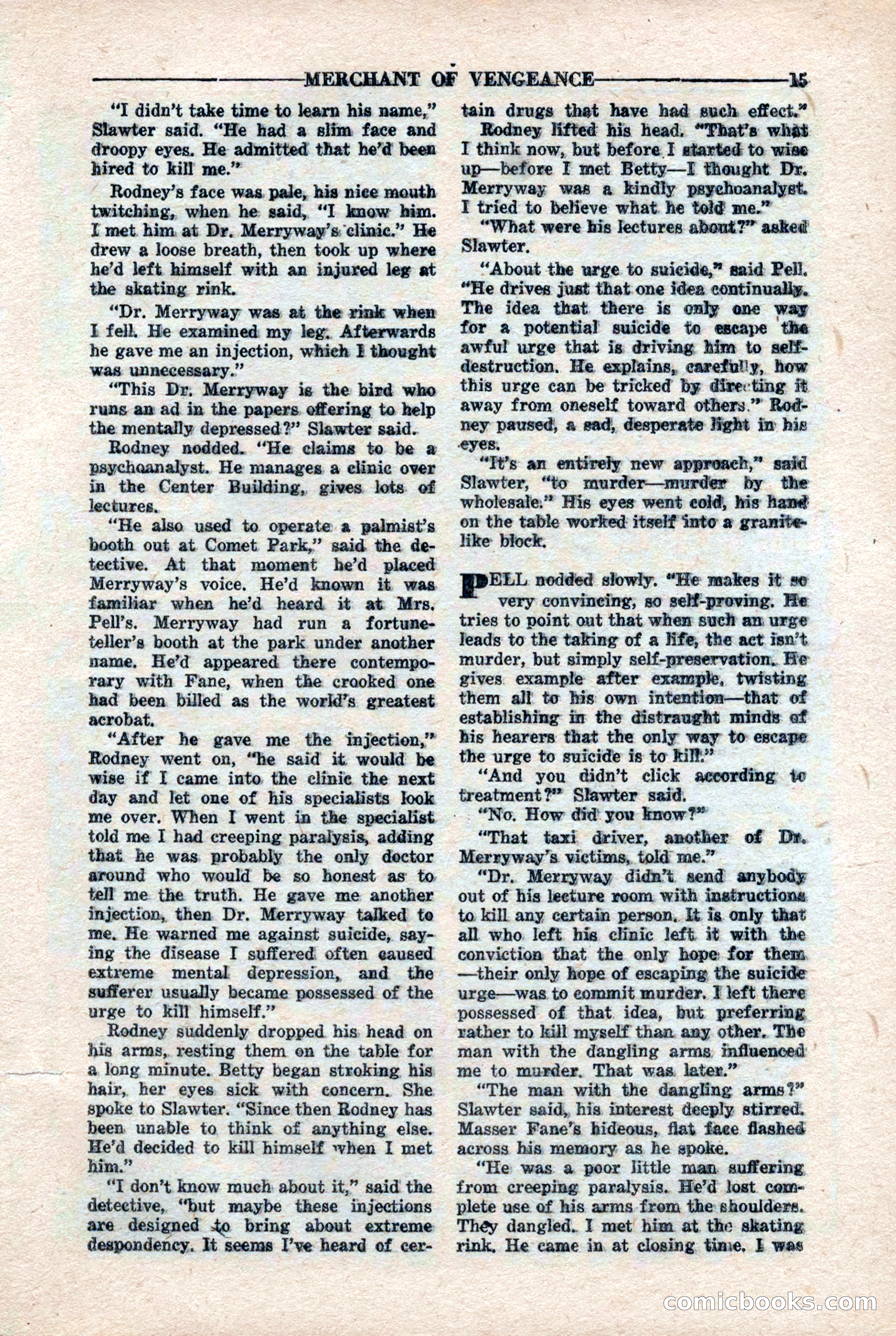
A restored page from Pulp Fiction, 1946. Page through the whole issue in the reader above.
📄 Transcribed text from this page (OCR, searchable)
Machine-transcribed from the original scan — historical spelling and the odd misread are preserved.
—_— MERCHANT OF VENGEANCE—————-———_—__1. “I didn’t take time to learn his name,” Slawter said. “He had a slim face and droopy eyes. He admitted that he’d been hired to kill me.” Rodney’s face was. pale, his niee mouth twitching, when. he said, “I know him. I met. him, at Dr. Merryway’s: clinic.” He drew a loose breath, then took up where he’d left himself with an injured leg at the skating rink. “Dr. Merryway was at the rink when I fell. He examined my leg. Afterwards he gave me an injection, which } thought was unnecessary.” “This Dr, Merryway is the bird who runs an ad in the papers. offering to help the mentally depressed?’ Slawter said. Rodney nodded. “He claims to be a psychaanalyst. He manages a clinic over in the Center Building, gives lots. of lectures. “He also used to operate a palmist’s booth out at Comet Park,” said the de- tective. At that moment he’d placed Merryway’s voice. He’d known it. was familiar when he’d heard it at Mrs, Pell’s. Merryway had run a fortune- teller’s booth at the park under another name, He’d appeared there contempo- rary with Fane, when the crooked one had been billed as the world’s greatest acrobat, “After he gave me the injection,’” Rodney went on, “he said it would be wise if I came into the clinie the next day and let one of his specialists look me over. When I went in the specialist told me I had creeping paralysis, adding that. he was. probably the only doctor around who would be so honest as to tell me the truth. He gave me another injection, then Dr. Merryway talked te me, He warned me against suicide, say- ing the disease I suffered often eaused extreme mental depression, and the sufferer usually became possessed of the urge to kill himself.” Rodney suddenly dropped his: head on his arms, resting them en the table for a long minute. Betty began stroking his hair, her eyes. sick with concern. She spoke to Slawter. “Since then Rodney has been unable to think of anything else. re ig decided to kill himself when I met m.” “T don’t know much about it,” said the detective, “but maybe these injections are designed io bring about extreme despondency. It seems I’ve heard of cer- tain drugs that have had such effect.” Rodney lifted his head. “That's whit I think now, but before I started to wise up—before I met Betty—I — Dr. I tried to believe what. he told me.” “What were his lectures about?” asked Slawter. “About the urge to suicide,” said Pell. “He drives just that. one idea continually, The idea that there is only one way for a potential suicide to escape the awful urge that is driving him to self- destruction. He explains, carefully, how this urge can be tricked by directing it away from oneself toward others.” Rod- ney paused, a sad, desperate light im his pent “Tt’s an entirely new approach,” said Slawter, “to murder—murder by the wholesale.” His eyes went cold, his hand on the table worked itself into a granite like block. RELL nodded slowly. “He makes it se very convineing, so self-proving. Me tries to point out that when such an urge leads to the taking of a life, the act isn’t murder, but simply self-preservation,. He gives. example after example, twisting them all to his own intention—that of establishing in the distraught minds of his hearers that the only way to escape the urge to suicide is to kilt” “And you didn’t click aecording to treatment?” Slawter said. _ “No, How did you know?” “That taxi driver, another of Dn. Merryway’s victims, told me.” “Dr. Merryway didn’t send anybody out of his lecture room with instructions to kill any certain person,. It is only that all who. left his clinic left it with the conviction that the only hope for them. —their only hope of escaping the suicide urge—was to commit murder. I left there possessed of that. idea, but preferring rather to kill myself than any other. The man with the dangling arms influenced: me to murder. That was. later.” “The man with the dangling arms?” Slawter said, his interest deeply stirred. Masser Fane’s hideous, flat faee flashed across his memory. as he spoke. “He was a poor little man suffering from creeping paralysis. He’d lost com- plete use of his arms from the shoulders. Théy dangled. I met him at the skating rink, He came in. at closing time, £ was Comic asoo ES CO AA