
Pulp Fiction, 1946 · page 50 of 84
10-Story Detective Magazine, April 1946 — page 50: what you’re looking at
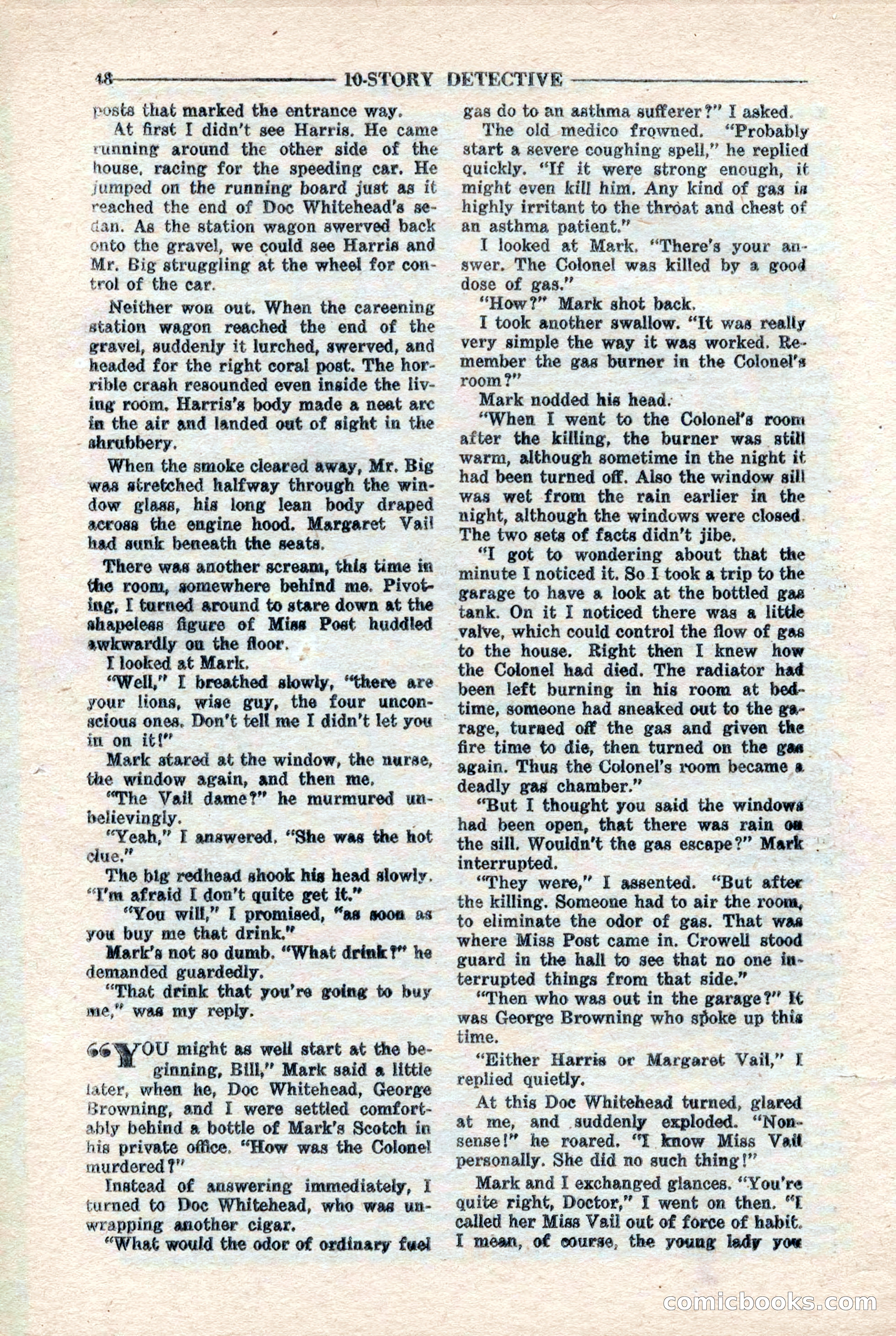
A restored page from Pulp Fiction, 1946. Page through the whole issue in the reader above.
📄 Transcribed text from this page (OCR, searchable)
Machine-transcribed from the original scan — historical spelling and the odd misread are preserved.
0. $$$ nnn 1-STORY DETECTIVE posts that marked the entrance way. At first I didn’t see Harris. He came running around the other side of the house, racing for the speeding car. He jumped on the running board just as it reached the end of Doc Whitehead’s se- dan. As the station wagon swerved back onto the gravel, we could see Harris and Mr. Big struggling at the wheel for con- trol of the car. Neither won out. When the careening station wagon reached the end of the gravel, suddenly it lurched, swerved, and headed for the right coral post. The hor- rible crash resounded even inside the liv- ing room. Harris’s body made a neat arc im the air and landed out of sight in the - shrubbery. When the smoke cleared away, Mr. Big was stretched halfway through the win- dow glass, his long lean body draped across the engine hood. Margaret Vail had sunk beneath the seats. — There was another scream, this time in the room, somewhere behind me. Pivot- ing, I turned around to stare down at the shapelesas figure of Mias Post huddled awkwardly on the floor. Y looked at Maric. “Well,” I breathed slowly, “there are your lions, wise guy, the four uncon- scious ones. Don’t tell me I didn’t let you in on it{” Mark atared at the window, the nurse, the window again, and then me, “The Vail dame?” he murmured un- believingly. “Yeah,” I answered, “She was the hot clue,” , The big redhead shook his head slowly. “‘S'm afraid I don’t quite get it.” “You will,” I promised, “as soon as you buy me that drink.” Mark’s not so dumb. “What drink?” he demanded guardedly. “That drink that you’re going to buy me,” was my reply. oe 0U might as well start at the be- ginning, Bill,’’ Mark said a little later, when he, Doc Whitehead, George Srowning, and I were settled comfort- ably behind a bottle of Mark’s Scotch in his private office. “How was the Colonel murdered 7” Instead of answering immediately, I turned t Doc Whitehead, who was un- wrapping amother cigar. “What would the odor of ordinary fuel | gas do to an asthma sufferer?” I asked. The old medico frowned. “Probably start a severe coughing spell,” he replied quickly. “If it were strong enough, it might even kill him, Any kind of gas ia highly irritant to the throat and chest of an asthma patient.” I looked at Mark, “There’s your an- swer. The Colonel was killed by 3 good dose of gas.” “How?” Mark shot back, I took another swallow. “It waa really very simple the way it was worked. Re- member the gas burner in the Colonel's room?” Mark nodded his head. — “When I went to the Colonel’s room aiter the killing, the burner was still warm, although sometime in the night it had been turned off. Also the window aill was wet from the rain earlier in the night, although the windows were closed. The two seta of facts didn’t jibe. “T got to wondering about that the minute I noticed it. So I took a trip to the garage to have a look at the bottled pas tank. On it I noticed there was a little valve, which could control the flow of gas to the house. Right then I knew how the Colonel had died. The radiator had been left burning in his room at bed- time, someone had sneaked out to the gwa- rage, turned off the gas and given the fire time to die, then turned on the gas— again. Thus the Colonel’s room became @ deadly gas chamber.” “But I thought you said the windows had been open, that there was rain o@ the sill. Wouldn't the gas escape?” Mark | interrupted. “They were,” I assented. “But after the killing. Someone had to air the room, to eliminate the odor of gas. That was where Miss Post came in. Crowell stood guard in the hall to see that no one in- terrupted things from that side.” “Then who was out in the garage?’ it was George Browning who spoke up this time. “Fiither Harris or Margaret Vail,” I replied quietly. At this Doc Whitehead turned, glared at me, and suddenly exploded. “‘Non- sense!” he roared. “I know Miss Vait personally. She did no such thing!” Mark and I exchanged glances. ‘You're quite right, Doctor,” I went on then. “E called her Miss Vail out of force of habit. I mean, of course, the young lady yo Comicbooks (C©