
Pulp Fiction, 1946 · page 42 of 84
10-Story Detective Magazine, April 1946 — page 42: what you’re looking at
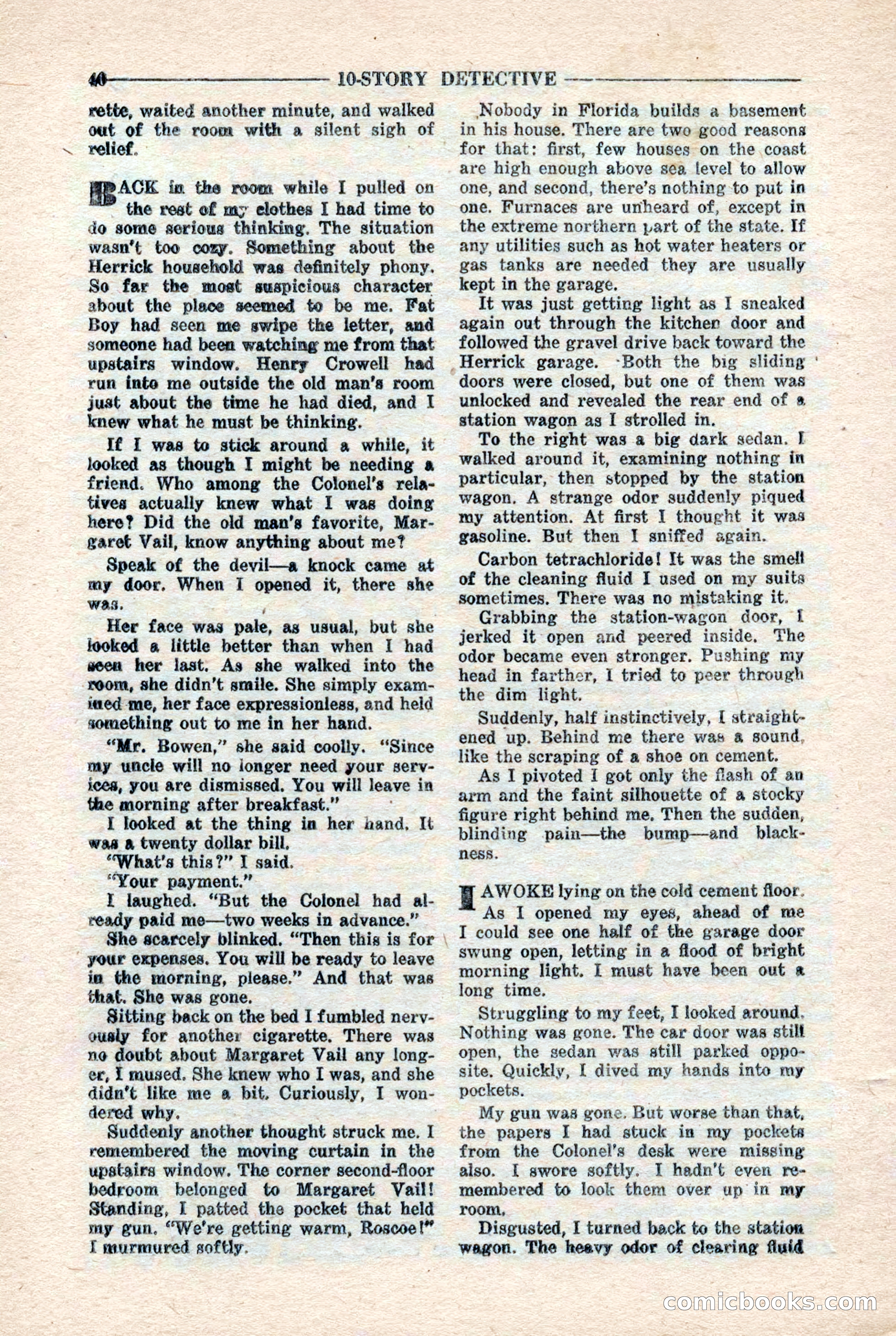
A restored page from Pulp Fiction, 1946. Page through the whole issue in the reader above.
📄 Transcribed text from this page (OCR, searchable)
Machine-transcribed from the original scan — historical spelling and the odd misread are preserved.
$< —— _0STORY DETECTIVE ———— rette, waited another minute, and walked out of the room with a silent sigh of relief, Ap Ack im the room while I pulled on the reat of my elothes I had time to do some serious thinking. The situation wasn’t too cozy. Something about the Herrick household was definitely phony. So far the most suspicious character about the place seemed to be me. Fat Boy had seen me swipe the letter, and someone had been watching me from that upstairs window. Henry Crowell had run inte me outside the old man’s room just about the time he had died, and I knew what he must be thinking. If I was to stick around a while, it looked as though I might be needing a friend. Who among the Colonel’s rela- tives actually knew what I was doing here? Did the old man’s favorite, Mar- garet Vail, know anything about me? Speak of the devil—a knock came at my door. When I opened it, there she Was. Her face was pale, as usual, but she looked a little better than when I had seen her last. As she walked into the xoom, she didn’t smile. She simply exam- ined me, her face expressionless, and held something out to me in her hand. “Mr. Bowen,” she said coolly. “Since my uncle will no longer need your serv- ices, you are dismissed. You will leave in the morning after breakfast.” I looked at the thing in her hand, It was a twenty dollar bill, “What's this?” I said. “Your payment.” Y laughed. “But the Colonel had al- ready paid me—two weeks in advance.” She acarcely blinked. “Then this is for \ your expenses. You will be ready to leave ion the morning, please.” And that was that. She was gone. Sitting back on the bed I fumbled nerv- ously for another cigarette. There was ne@ doubt about Margaret Vail any long- er, 1 mused. She knew who I was, and she didn’t like me a bit. Curiously, I won- dered why. Suddenly another thought struck me. I remembered the moving curtain in the upstairs window. The corner second-floor bedroom belonged to Margaret Vail! Standing, I patted the pocket that held my gun. “We're getting warm, Roscoe!” I murmured softly. Herrick garage. Nobody in Florida builds a basement in his house. There are two good reasons for that: first, few houses on the coast are high enough above séa level to allow one, and second, there’s nothing to put in one. Furnaces are unheard of, except in the extreme northern part of the state. If any utilities such as hot water heaters or gas tanks are needed they are usually kept in the garage. It was just getting light as I sneaked again out through the kitcher door and followed the gravel drive back toward the doors were closed, but one of them was unlocked and revealed the rear end of s station wagon as I strolled in. To the right was a big dark sedan. I walked around it, examining nothing in particular, then stopped by the station wagon. A strange odor suddenly piqued my attention. At first I thought it was gasoline. But then I sniffed again. Carbon tetrachloride! It was the smell of the cleaning fluid I used on my suits sometimes, There was no mistaking it. Grabbing the station-wagon door, IL jerked it open and peered inside, The odor became even stronger. Pushing my head in farther, I tried to peer through the dim light. Suddenly, half instinctively, [ straight- ened up. Behind me there was & sound, like the scraping of a shoe on cement. As I pivoted I got only the flash of an arm and the faint silhouette of a stocky figure right behind me, Then the sudden, blinding pain—the bump—and black- ness. Hq AWOKE lying on the cold cement floor. As I opened my eyes, ahead of me I could see one half of the garage door swung open, letting in a flood of bright morning light. I must have been out a long time. Struggling to my feet, I looked around. Nothing was gone. The car door was still open, the sedan was atill parked oppo- site. Quickly, I dived my hands inte my pockets. My gun was gone. But worse than that, the papers I had stuck in my pockets from the Colonel’s desk were missing also. I swore softly. I hadn’t even re- membered to look them over up in my room, Disgusted, I turned back to the station wagon. The heavy odor of clearing fiuid ComicooOokKks ‘Both the big sliding ' (C@