
Pulp Fiction, 1946 · page 66 of 84
10-Story Detective Magazine, April 1946 — page 66: what you’re looking at
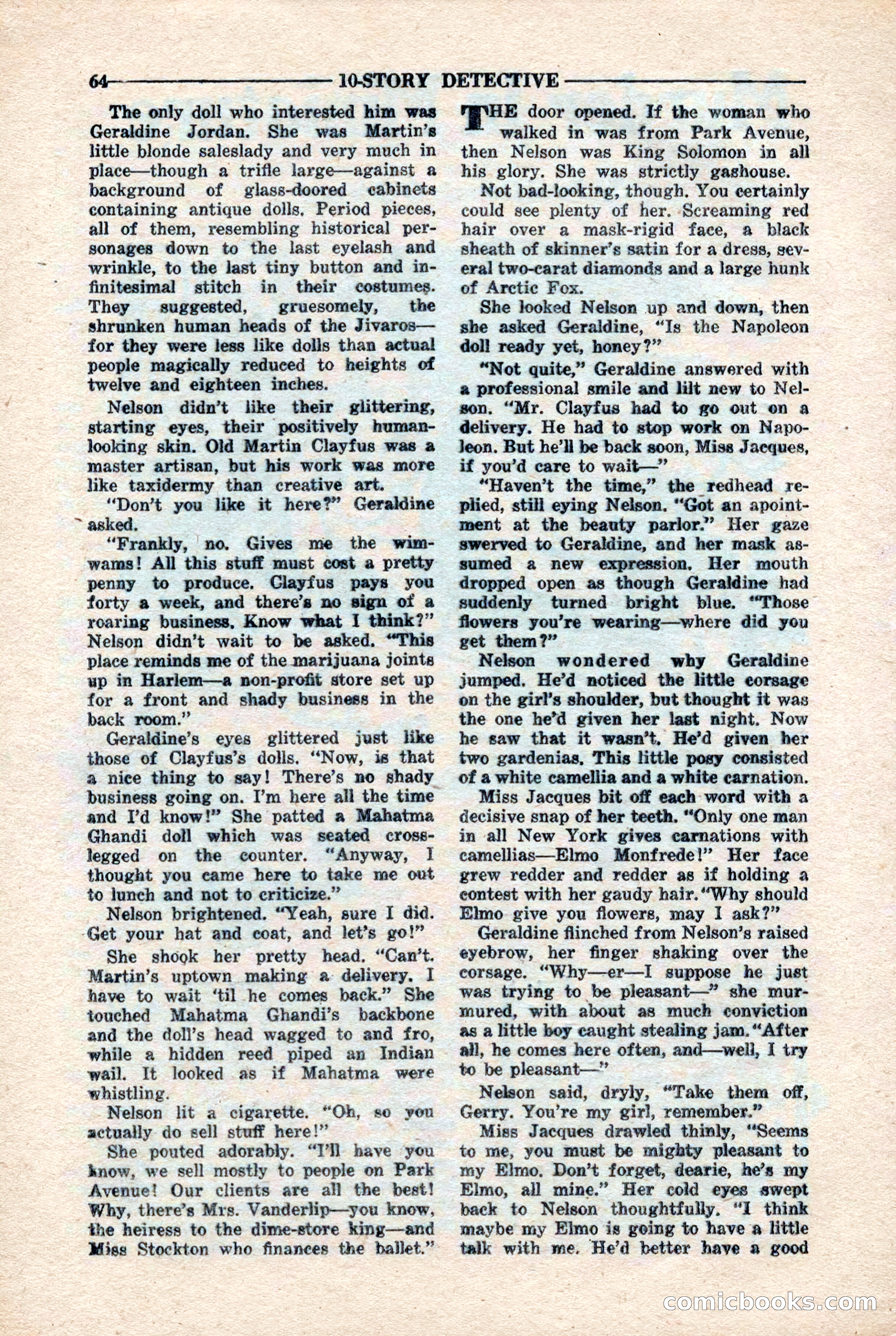
A restored page from Pulp Fiction, 1946. Page through the whole issue in the reader above.
📄 Transcribed text from this page (OCR, searchable)
Machine-transcribed from the original scan — historical spelling and the odd misread are preserved.
64-———_—_—__—_—_—_———_ 10 STORY DETECTIVE / The only doll who interested him was Geraldine Jordan. She was Martin’s little blonde saleslady and very much in place—though a trifle large—against a background of glass-doored cabinets containing antique dolls, Period pieces, all of them, resembling historical per- sonages down to the last eyelash and wrinkle, to the last tiny button and in- finitesimal stitch in their costumes. They suggested, gruesomely, the shrunken human heads of the Jivaros— for they were less like dolls than actual people magically reduced to heights of twelve and eighteen inches. Nelson didn’t like their glittering, starting eyes, their positively human- looking skin. Old Martin Clayfus was a master artisan, but his work was more like taxidermy than creative art. “Don’t you like it here?” Geraldine asked. “Frankly, no. Gives me the wim- wams! All this stuff must cost a pretty penny to produce. Clayfus pays you forty a week, and there’s no sign of a roaring business, Know what I think?” Nelson didn’t wait to be asked. “This place reminds me of the marijuana joints up in Harlem—a non-profit store set up for a front and shady business in the back room.” Geraldine’s eyes glittered just like those of Clayfus’s dolls. “Now, is that a nice thing to say! There’s no shady business going on. I’m here all the time and I’d know!” She patted a Mahatma Ghandi doll which was seated cross- legged on the counter. “Anyway, lI thought you eame here to take me out to lunch and not to criticize.” Nelson brightened. “Yeah, sure I did. -Get your hat and coat, and let’s go!” She shook her pretty head. “Can’t. Martin’s uptown making a- delivery. I have to wait ‘til he comes back.” She touched Mahatma Ghandi’s backbone and the doll’s head wagged to and fro, while a hidden reed piped an Indian wail. It looked as if Mahatma were whistling. ? Nelson lit a cigarette. “Oh, so you actually do sell stuff here!” She pouted adorably. “I’ll have you know, we sell mostly to people on Park Avenue! Our clients are all the best! Why, there’s Mrs. Vanderlip—you know, the heiress to the dime-stoere king—and Miss Stockton who finances the hallet.” BE door opened. If the woman who walked in was from Park Avenue, then Nelson was King Solomon in all his glory. She was strictly gashouse. Not bad-looking, though. You eertainly could see plenty of her. Screaming red hair over a mask-rigid face, a black sheath of skinner’s satin for a dress, sev- eral two-carat diamonds and a large hunk of Arctic Fox. She looked Nelson up and down, then she asked Geraldine, “Is the Napoleon doll ready yet, honey?” “Not quite,” Geraldine answered with a professional smile and lilt new to Nel- gon. “Mr. Clayfus had to go out on a delivery. He had to stop work on Napo- Jeon. But he’ll be back soon, Miss Jacques, if you’d care to wait—” “Haven't the time,” the redhead re- plied, still eying Nelson. “Got an apoint- ment at the beauty parlor.” Her gaze swerved to Geraldine, and her mask as- sumed a new expression. Her mouth dropped open as though Geraldine had suddenly turned bright flowers you’re wearing—where did you get them?” Nelson wondered why Geraldine jumped. He’d noticed the little eorsage on the girl’s shoulder, but thought it was the one he’d given her last night. Now he saw that it wasn’t, He’d given her two gardenias, This little posy consisted of a white and a white carnation. Miss Jacques bit off each word with a decisive snap of her teeth. “Only one man in all New York gives carnations with camellias—Elmo Monfrede!” Her face grew redder and redder as if holding a eontest with her gaudy hair. “Why should Elmo give you flowers, may I ask?” Geraldine flinched from Nelson’s raised eyebrow, her finger shaking over the corsage. “Why—er—I suppose he just was trying to be pleasant—” she mur- mured, with about as much conviction as a little boy caught stealing jam. “After all, he comes here often, and—well, I iry to be pleasant—” Nelson said, dryly, “Take them off, Gerry. You’re my girl, remember.” Miss Jacques drawled thinly, “Seems to me, you must be mighty pleasant to my Elmo. Don’t forget, dearie, he’s my Elmo, all mine.” Her cold eyes swept back to Nelson thoughtfully. “I think maybe my Elmo is going to have a little talk with me. He’d better have a good CoOnmicloo blue. “Those Ss (S©)