
Pulp Fiction, 1946 · page 12 of 84
10-Story Detective Magazine, April 1946 — page 12: what you’re looking at
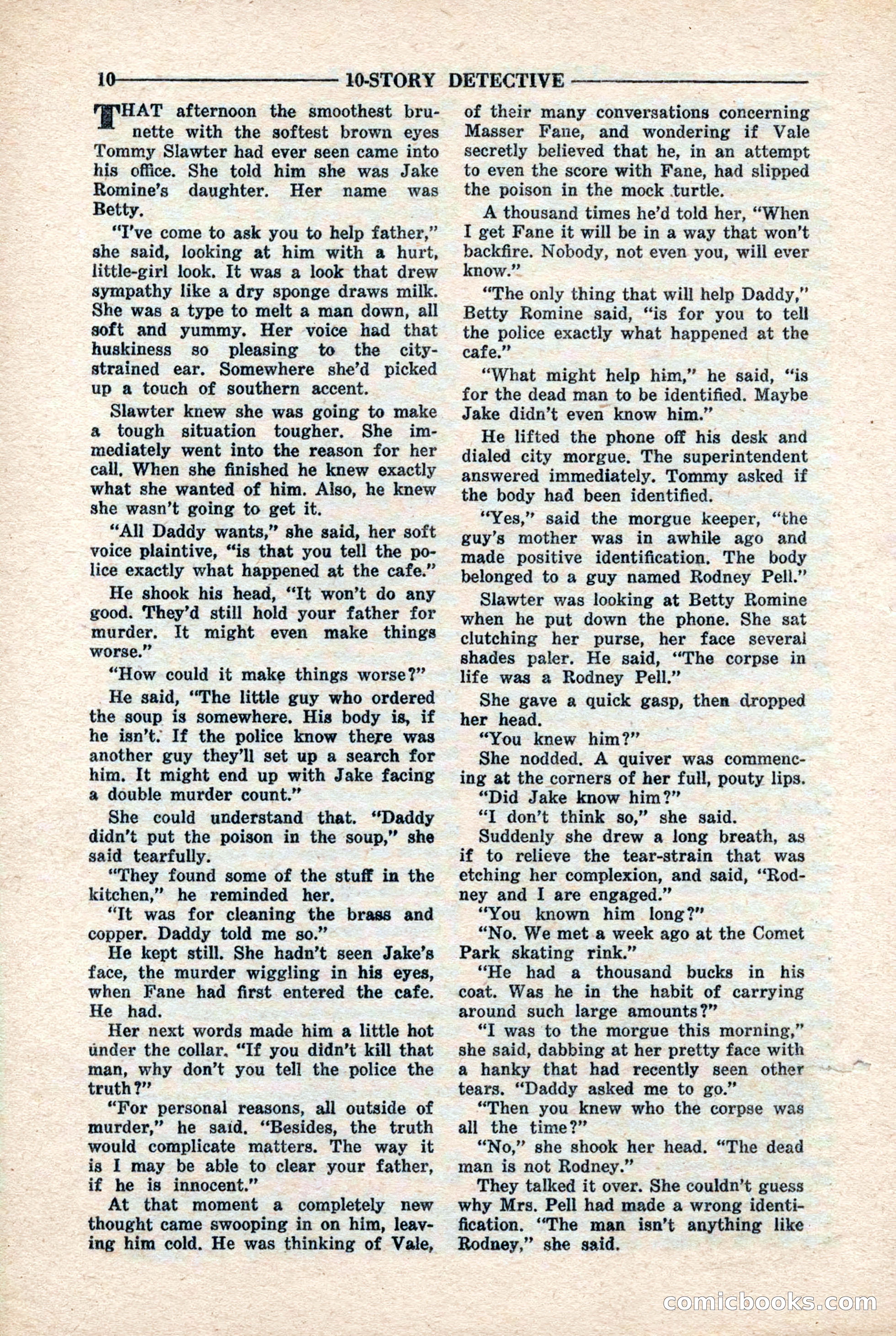
A restored page from Pulp Fiction, 1946. Page through the whole issue in the reader above.
📄 Transcribed text from this page (OCR, searchable)
Machine-transcribed from the original scan — historical spelling and the odd misread are preserved.
10—————— 10-STORY DETECTIVE muAT afternoon the smoothest bru- nette with the softest brown eyes Tommy Slawter had ever seen came into his office. She told him she was Jake Romine’s daughter. Her name was Betty. “I’ve come to ask you to help father,” she said, looking at him with a hurt, little-girl look. It was a look that drew sympathy like a dry sponge draws milk. She was a type to melt a man down, all soft and yummy. Her voice had that huskiness so pleasing to the city- strained ear. Somewhere she’d picked up a touch of southern accent. Slawter knew she was going to make a tough situation tougher. She im- mediately went into the reason for her call, When she finished he knew exactly what she wanted of him. Also, he knew she wasn’t going to get it. “All Daddy wants,” she said, her soft voice plaintive, “is that you tell the po- lice exactly what happened at the cafe.” He shook his head, “It won’t do any good. They’d still hold your father for murder, It might even make things worse.” “How could it make things worse?” He said, “The little guy who ordered the soup is somewhere. His body is, if he isn’t. If the police know there was another guy they’ll set up a search for him. It might end up with Jake facing a double murder count.” She could understand that. “Daddy didn’t put the poison in the soup,” she said tearfully. “They found some of the stuff in the kitchen,” he reminded her. “Tt was for cleaning the brass and copper. Daddy told me so.” He kept still. She hadn’t seen Jake’s face, the murder wiggling in his eyes, when Fane had first entered the cafe. He had. Her next words made him a little hot under the collar. “If you didn’t kill that man, why don’t you tell the police the truth?” “For personal reasons, all outside of murder,” he said, “Besides, the truth would complicate matters. The way it is I may be able to clear your father, if he is innocent.” At that moment a completely new thought came swooping in on him, leav- ing him cold. He was thinking of Vale, of their many conversations concerning Masser Fane, and wondering if Vale secretly believed that he, in an attempt to even the score with Fane, had slipped the poison in the mock turtle. A thousand times he’d told her, “When I get Fane it will be in a way that won’t backfire. Nobody, not even you, will ever know.” “The only thing that will help Daddy,” Betty Romine said, “is for you to tell the police exactly what happened at the cafe.” “What might help him,” he said, “is for the dead man to be identified. Maybe Jake didn’t even know him.” — He lifted the phone off his desk and dialed city morgue. The superintendent answered immediately. Tommy asked if the body had been identified. “Yes,” said the morgue keeper, “the guy’s mother was in awhile ago and made positive identification. The body belonged to a guy named Rodney Pell.” Slawter was looking at Betty Romine when he put down the phone. She sat clutching her purse, her face several shades paler. He said, “The corpse in life was a Rodney Pell.” She gave a quick gasp, then dropped her head. “You knew him?” She nodded. A quiver was commenc- ing at the corners of her full, pouty lips. “Did Jake know him?” “1 don’t think so,” she said. Suddenly she drew a long breath, as if to relieve the tear-strain that was etching her complexion, and said, ‘“‘Rod- ney and I are engaged.” “You known him long?” “No. We met.a week ago at the Comet | Park skating rink.” “He had a thousand bucks in his coat. Was he in the habit of carrying around such large amounts?” “I was to the morgue this morning,” she said, dabbing at her pretty face with a hanky that had recently seen other tears. “Daddy asked me to go.” “Then you knew who the corpse was all the time?” “No,” she shook her head. man is not Rodney.” They talked it over. She couldn’t ruess why Mrs. Pell had made a wrong identi- “The dead fication. “The man isn’t anything like Rodney,” she said. Comichbook co