
Pulp Fiction, 1946 · page 10 of 84
10-Story Detective Magazine, April 1946 — page 10: what you’re looking at
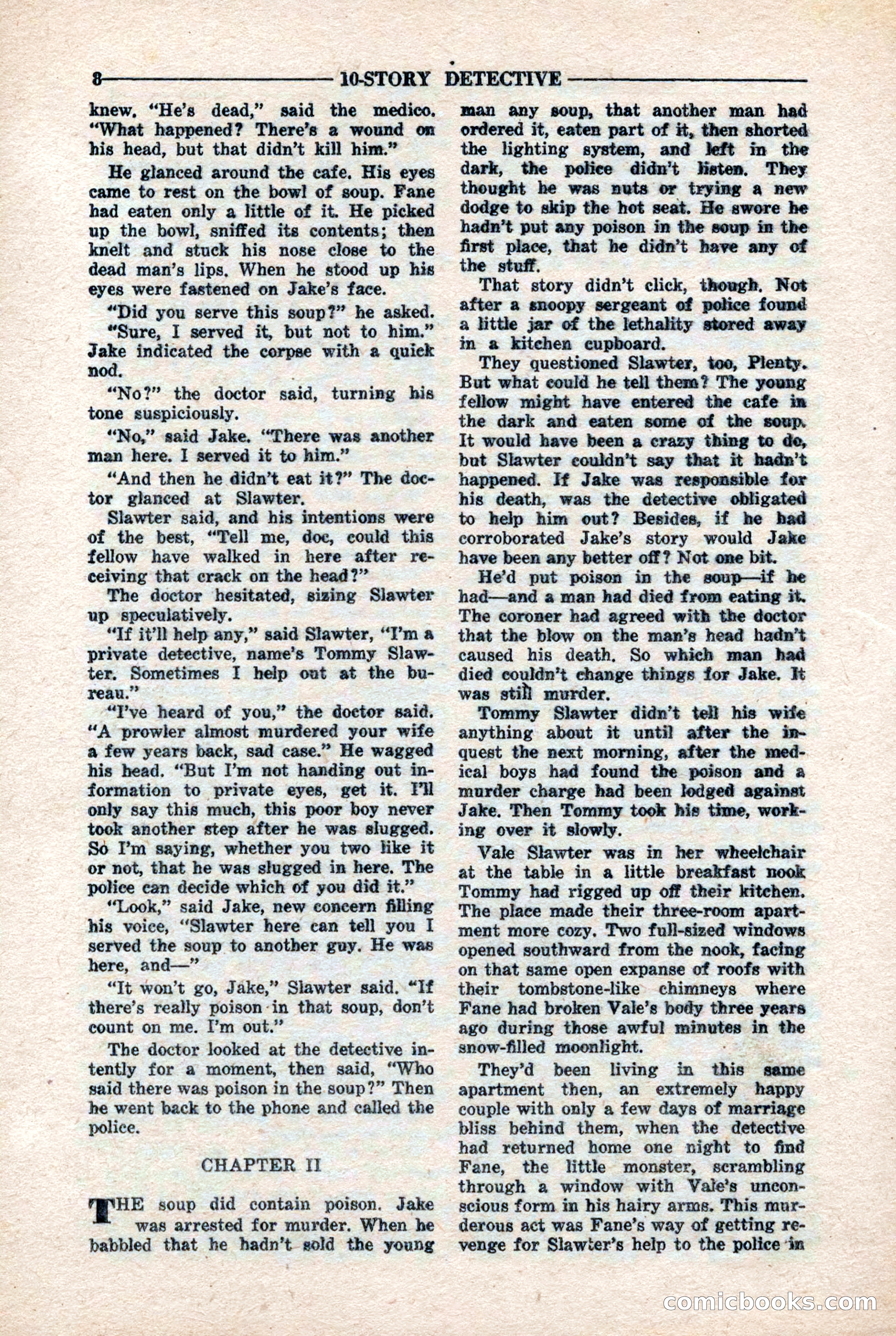
A restored page from Pulp Fiction, 1946. Page through the whole issue in the reader above.
📄 Transcribed text from this page (OCR, searchable)
Machine-transcribed from the original scan — historical spelling and the odd misread are preserved.
g$——_—___________ 10STORY DETECTIVE knew, “He’s dead,” said the medico. “What ha ? There’s a wound on his head, but that didn’t kill him.” He glanced around the cafe. His eyes came to rest on the bow! of soup. Fane had eaten only a little of it. He picked up the howl, sniffed its contents; then knelt and stuck his nose close to the dead man’s lips. When he stood up his eyes were fastened on Jake’s face. “Did you serve this soup?” he asked. “Sure, I served it, but not to him.” Jake indicated the corpse with a quick nod. “No?” the doctor said, turning his tone suspiciously. “No,” said Jake, “There was another man here. I served it to him.” : “And then he didn’t eat it?” The doc- tor glanced at Slawter. Slawter said, and his intentions were of the best, “Tell me, doe, could this fellow have walked in here after re- ceiving that crack on the head?” The doctor hesitated, sizing Slawter up speculatively. “If it'll help any,” said Slawter, “I’m a private detective, name’s Tommy Slaw- ter. Sometimes I help out at the bu- reau.” “T’yve heard of you,” the doctor said. “A prowler almost murdered your wife a few years back, sad case.” He wagged his head. “But I’m not handing out in- formation to private eyes, get it. PH only say this much, this poor boy never took another step after he was slugged. So I’m saying, whether you two like it or not, that he was slugged in here, The police can decide which of you did it.” ‘Look,” said Jake, new concern filling his voice, “Slawter here can tell you I served the soup to another guy. He was here, and—” “It won’t go, Jake,” Slawter said. “If there’s really poison-in that soup, don’t count on me. I’m out.” The doctor looked at the detective in- tently for a moment, then said, “Who said there was poison in the soup?” Then he went back to the phone and called the police. CHAPTER II WE soup did contain poison. Jake was arrested for murder. When he babbled that he hadn’t sold the young the lighting system, and dark, the police didn't hadn’t put any poison in the soup im the first place, that he didn’t have any of the stuff. That story didn’t click, though. Not in a kitehen cupboard. They questioned Slawter, too, Plenty. But what could he tell them? The young fellow might have entered the cafe im the dark and eaten some of the soup, It would have been a crazy thing to de, but Slawter couldn’t say that it hadn’t happened. If Jake was responsible for his death, was the detective obligated to help him out? Besides, if he had corroborated Jake’s story would Jake have been any better off ? Not ome bit. He’d put poison in the soup—if he had—and a man had died from eating it. The coroner had agreed with the doctor that the blow on the man’s head hadn’t caused his death. So which man had died couldn’t change things for Jake. Kt was still murder. 3 Tommy Slawter didn’t tell his wife anything about it until after the in- quest the next morning, after the med- ical boys had found the poison and a murder charge had been lodged against Jake, Then Tommy took his time, work- ing over it slowly. Vale Slawter was in her wheelchair at the table in a little breakfast nook Tommy had rigged up off their kitchen. The place made their three-room apart- ment more cozy. Two full-sized windows opened southward from the nook, facing on that same open expanse of roofs with their tombstone-like chimneys where Fane had broken Vale’s body three years ago during those awful winter in the snow-filled moonlight. They’d been living in this same apartment then, an extremely happy couple with only a few days of marriage bliss behind them, when the detective had returned home one night to find Fane, the little monster, scrambling through a window with YVale’s uncon- scious form im his hairy arms. This mur- derous act was Fane’s way of getting re- venge for Slawter’s help to the police “in GCOmicdooks (6©)