
Pulp Fiction, 1946 · page 9 of 84
10-Story Detective Magazine, April 1946 — page 9: what you’re looking at
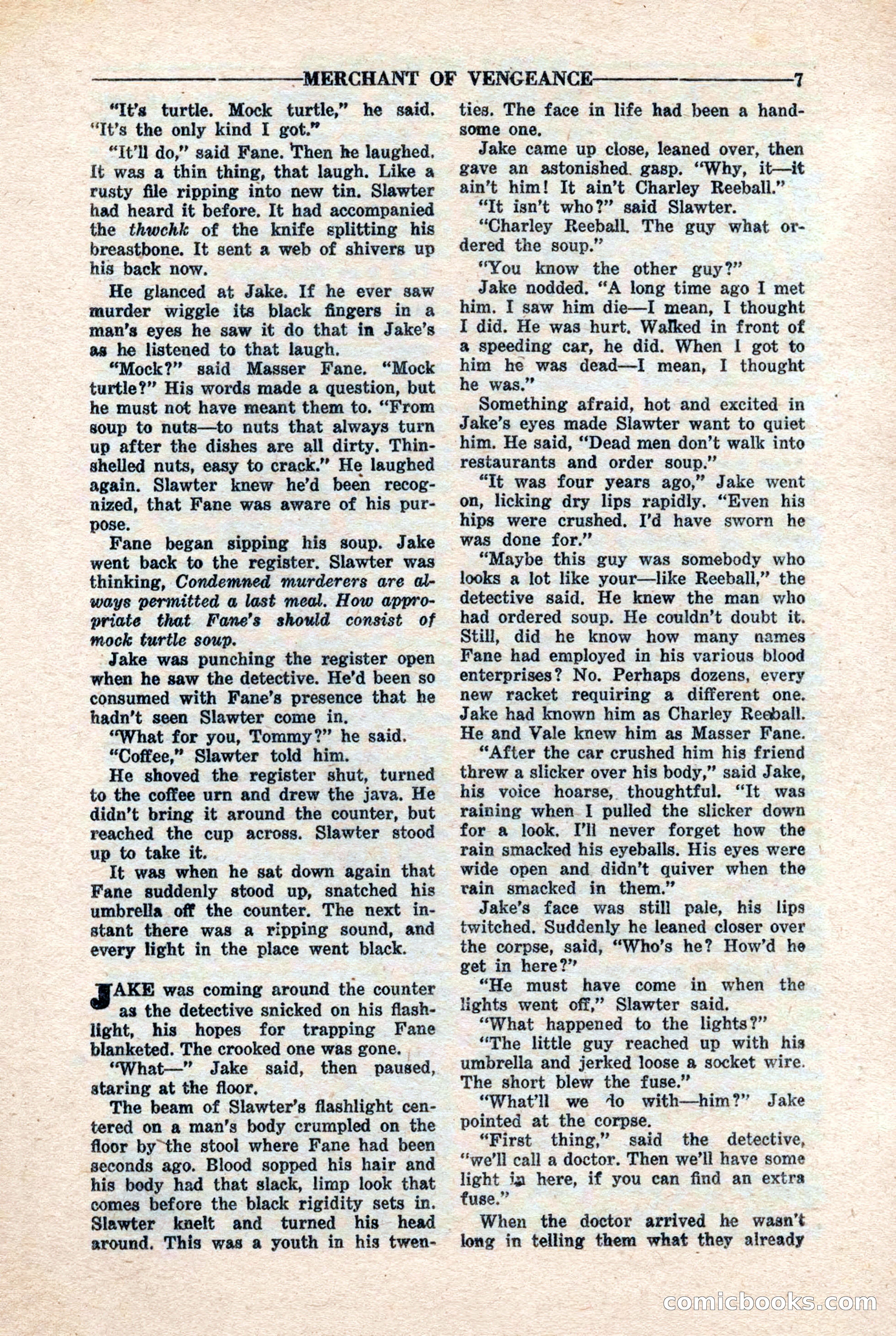
A restored page from Pulp Fiction, 1946. Page through the whole issue in the reader above.
📄 Transcribed text from this page (OCR, searchable)
Machine-transcribed from the original scan — historical spelling and the odd misread are preserved.
————MERCHANT OF VENGEANCE—————————_7 “Tt’s turtle. Mock turtle,” he said. “Tt’s the only kind I got.” “It'll do,” said Fane. Then he laughed. It was a thin thing, that laugh. Like a rusty file ripping into new tin. Slawter had heard it before. It had accompanied the thwchk of the knife splitting his breastbone. It sent a web of shivers up his back now. He glanced at Jake. If he ever saw murder wiggle its black fingers in a man’s eyes he saw it do that in Jake’s as he listened to that laugh. “Mock?” said Masser Fane. “Mock turtle?” His words made a question, but he must not have meant them to. “From soup to nuts—to nuts that always turn up after the dishes are all dirty. Thin- shelled nuts, easy to crack.” He laughed again. Slawter knew he’d been recog- nized, that Fane was aware of his pur- pose. Fane began sipping his soup. Jake went back to the register. Slawter was thinking, Condemned murderers are al- ways permitted a last meal. How appro- priate that Fane’s should consist of mock turtle soup. Jake was punching the register open when he saw the detective. He’d been so consumed with Fane’s presence that he hadn’t seen Slawter come in. “What for you, Tommy?” he said. “Coffee,” Slawter told him. He shoved the register shut, turned to the coffee urn and drew the java. He didn’t bring it around the counter, but reached the cup across. Slawter stood up to take it. It was when he sat down again that Fane suddenly stood up, snatched his umbrella off the counter. The next in- stant there was a ripping sound, and every light in the place went black. gp AKE was coming around the counter as the detective snicked on his flash- light, his hopes for trapping Fane blanketed. The crooked one was gone. ‘“What—” Jake said, then paused, staring at the floor. The beam of Slawter’s flashlight cen- tered on a man’s body crumpled on the floor by the stool where Fane had been seconds ago. Blood sopped his hair and his body had that slack, limp look that comes before the black rigidity sets in. Slawter knelt and turned his head around. This was a youth in his twen- ties. The face in life had been a hand- some one, Jake came up close, leaned over, then gave an astonished. gasp. “Why, it—it ain’t him! It ain’t Charley Reeball.” “It isn’t who?” said Slawter. “Charley Reeball. The guy what or- dered the soup.” “You know the other guy?” Jake nodded. “A long time ago I met him. I saw him die—I mean, I thought I did. He was hurt. Walked in front of &@ speeding car, he did. When I got to him he was dead—I mean, I thought he was.” something afraid, hot and excited in Jake’s eyes made Slawter want to quiet him. He said, “Dead men don’t walk into restaurants and order soup.” “It was four years ago,” Jake went on, licking dry lips rapidly. “Even his hips were crushed. J’d have sworn he was done for.” “Maybe this guy was somebody who looks a lot like your—like Reeball,” the detective said. He knew the man who had ordered soup. He couldn’t doubt it. still, did he know how many names Fane had employed in his various blood enterprises? No. Perhaps dozens, every new racket requiring a different one. Jake had known him as Charley Reeball. He and Vale knew him as Masser Fane. “After the car crushed him his friend threw a slicker over his body,” said Jake, his voice hoarse, thoughtful. “It was raining when I pulled the slicker down for a look. I'll never forget how the rain smacked his eyeballs. His eyes were © wide open and didn’t quiver when the rain smacked in them.” Jake’s face was still pale, his lips twitched. Suddenly he leaned closer over the corpse, said, “Who’s he? How’d he get in here?” “He must have come in when the lights went off,” Slawter said. “What happened to the lights?” “The little guy reached up with his umbrella and jerked loose a socket wire. The short blew the fuse.” “Whatll we ‘do with—him?”’ pointed at the corpse. “First thing,” said the detective, “we'll call a doctor. Then we'll have some light in here, if you can find an extra fuse.” When the doctor arrived he wasn’t long in telling them what they already Jake Comicloooks (C©) inn