
Pulp Fiction, 1946 · page 40 of 84
10-Story Detective Magazine, April 1946 — page 40: what you’re looking at
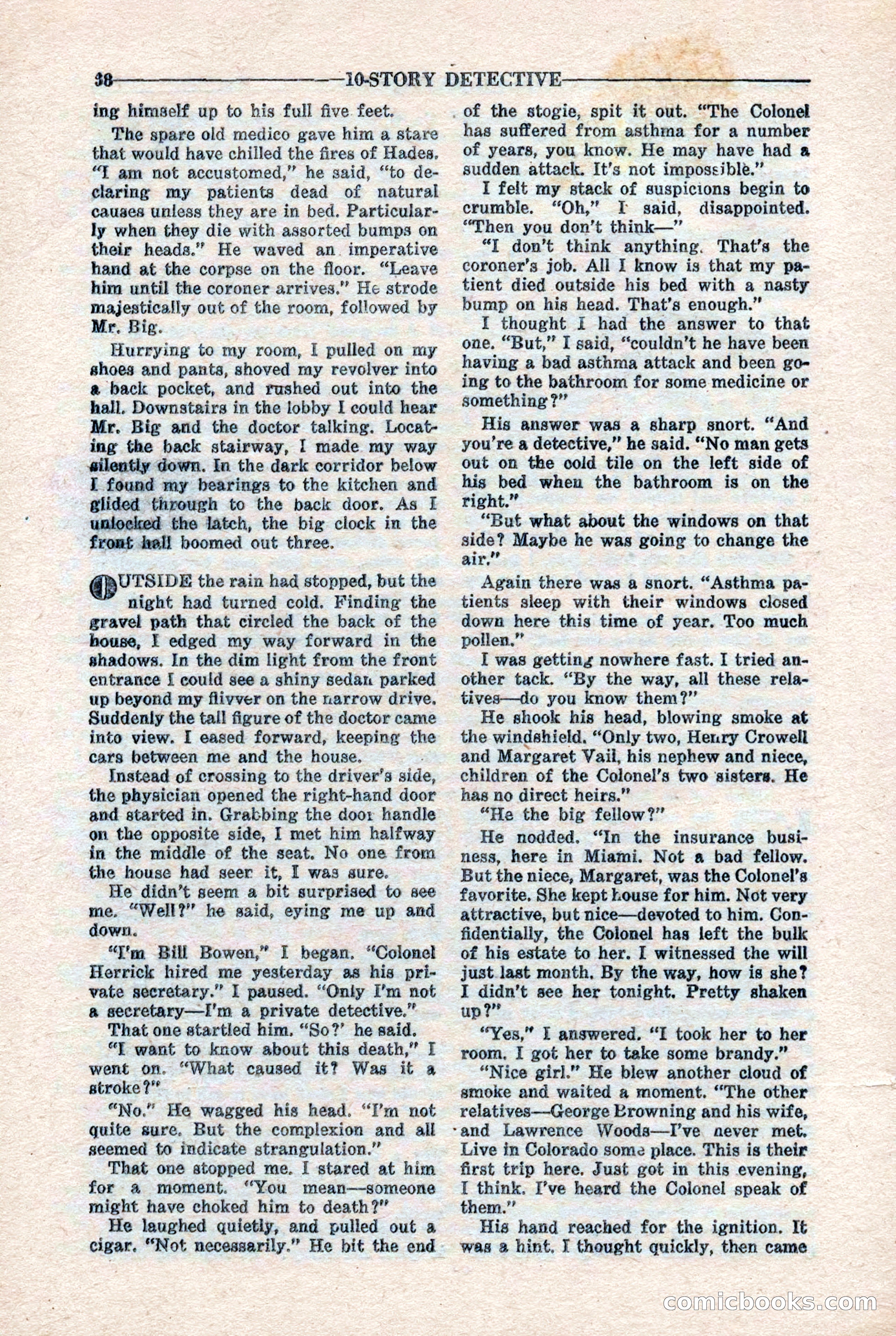
A restored page from Pulp Fiction, 1946. Page through the whole issue in the reader above.
📄 Transcribed text from this page (OCR, searchable)
Machine-transcribed from the original scan — historical spelling and the odd misread are preserved.
§8—___—_—_—__-_—__—_-_—_10-STORY DETECTIVE _ of the stogie, spit it oti. “The Colonel ing himself up to his full five feet. ' The spare old medico gave him a stare that would have chilled the fires of Hades, “F¥ am not accustomed,” he said, “‘to de- claring my patients dead of natural causes unless they are in bed. Particular- ly when they die with assorted bumps on their heads.” He waved an. imperative hand at the corpse on the floor. “Leave him until the coroner arrives.” He strode majestically out of the room, followed by Mr. Big. Hurrying to my room, I pulled on my shoes and pants, shoved my revolver into @ back pocket, and rushed out into the hall. Downstairs in the lobby I could hear Mr. Big and the doctor talking. Locat- ing the back stairway, | made my way ae down. In the dark corridor below I found my bearings to the kitchen and glided through to the back door. As I unloeked the latch, the big clock in the front hell boomed out three. Q@pUtsive the rain had stopped, but the night had turned cold. Finding the gravel path that circled the back of the house, | edged my way forward in the shadows. In the dim light from the front entrance { could see a shiny sedan parked up beyond my flivver on the narrow drive. Suddenly the tall figure of the doctor came into view. I eased forward, keeping the cars between me and the house, Instead of crossing to the driver's side, the physician opened the right-hand door and started in. Grabbing the door handle on the opposite side, I met him halfway in the middle of the seat. No one from the house had seer it, I was gure. He didn’t seem a bit surprised to see me. “Well?” he said, eying me up and down. “S'm Bill Bowen,” I began. “Colonel Herrick hired me yesterday as his pri- vate secretary.” I paused. “Only I’m not a secretary—I'm a private detective.” That one startled him. “So?’ he said. “F want to know about this death,” I went on. “What caused it? Was it a stroke?” “No.” He wagged his head. “I’m not quite sure. But the complexion and all seemed to indicate strangulation.” That one stopped me. I stared at him for a moment. “You mean—someone might have choked him to death?” He laughed quietly, and pulled out a cigar. “Not necessarily.” He bit the end has suffered from asthma for a number of years, you know. He may have had a sudden attack. It’s not impossible.” I felt my stack of suspicions begin to crumble. “Oh,” [ said, disappointed. “Then you don’t think—” “TI don’t think anything. That’s the coroner’s job. All I know is that my pa- tient died outside his bed with a nasty bump on his head. That’s enough.” I thought I had the answer to that one. “But,” I said, “couldn’t he have been having a bad asthma attack and been go- ing to the bathroom for some medicine or something ?” His answer was a sharp snort. “And | you're a detective,” he said. “No man gets out on the oold tile on the left side of his bed when the bathroom is on the right.” “But what about the windows on that side? Maybe he was going to change the - air,” Again there was a snort. “Asthma pa- tients sleep with their windows closed down here this time of year. Too much pollen.” I was getting nowhere fast. I tried an- other tack. “By the way, all these rela- tives—do you know them?” He shook his head, blowing smoke at the windshield. “Only two, Henry Crowell and Margaret Vail, his nephew and niece, children of the Colonel’s two sisters. He has no direct heirs.” . “He the big fellow?” He nodded. “In the insurance busi- ness, here in Miami. Not a bad fellow. — But the niece, Margaret, was the Colonel’s favorite, She kept house for him. Not very attractive, but nice—devoted to him. Con- - fidentially, the Colonel has left the bulk of hig estate to her. I witnessed the will just last month, By the way, how is she? I ba see her tonight, Pretty shaken up re “Yes,” I answered. “I took her to her room. I got her to take some brandy.” “Nice girl.” He blew another cloud of smoke and waited a moment. “The other relatives—George Browning and his wife, -and Lawrence Woods—lI’ve aever met. Live in Colorado some place. This is their first trip here, Just got in this evening, I think. I’ve heard the Colonel speak of them.” His hand reached for the ignition. It was 2 hint, I thought quickly, then came ComicloookKks (C©