
A complete issue · 16 pages · 1879
Puck — December 31, 1879
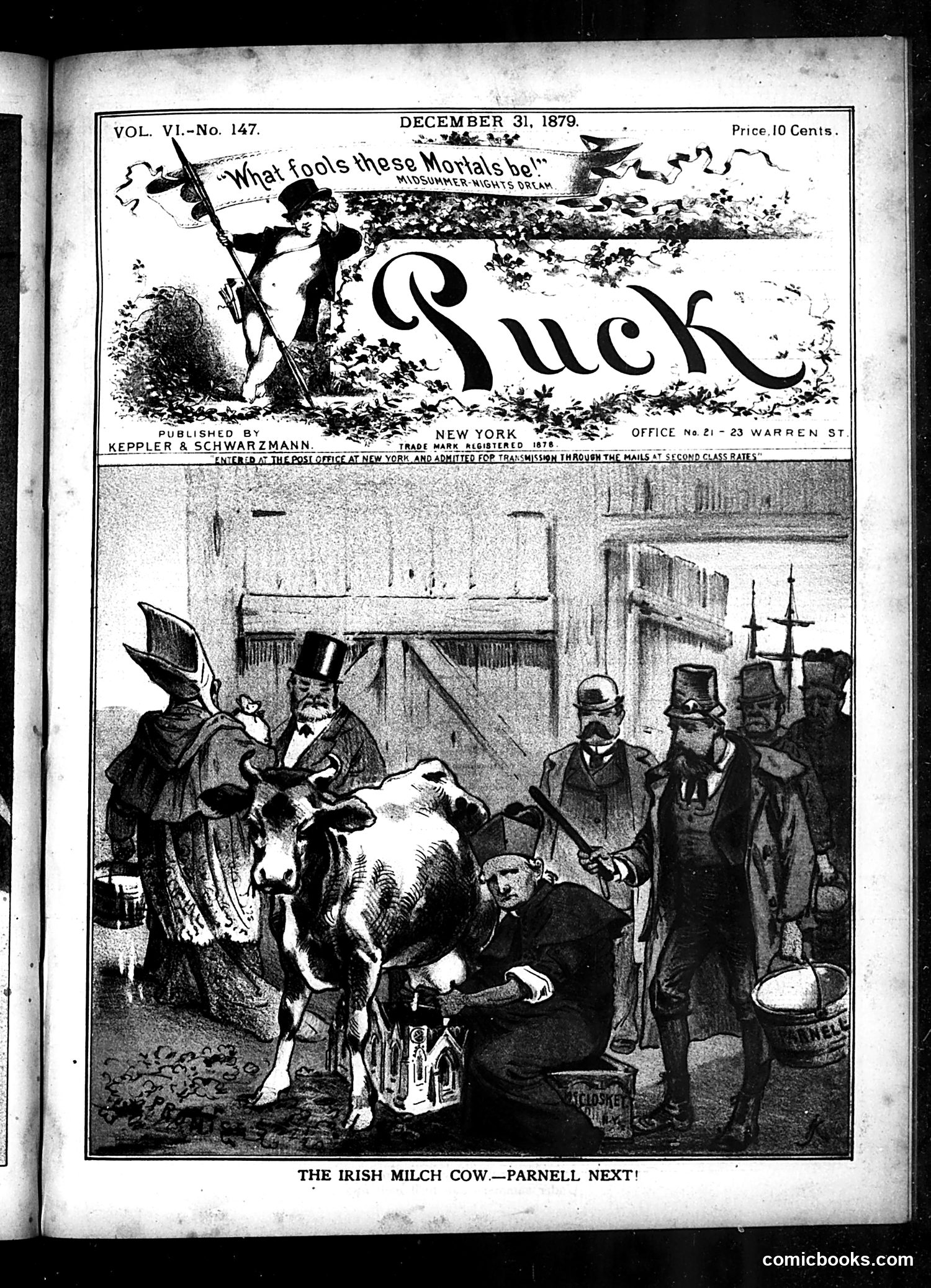
This political cartoon satirizes Ireland's "Land Question"—the contentious issue of Irish tenant farmers and land reform. The main illustration titled "THE IRISH MILCH COW—PARNELL NEXT!" depicts Ireland as a cow being milked by various figures representing different interests: politicians, landlords, and other exploiters. The cow appears exhausted from being drained. Charles Stewart Parnell, the Irish nationalist leader, is referenced in the caption as the next figure to be squeezed or exploited. The satire criticizes how Ireland's resources and people were systematically extracted by multiple parties—implying even nationalist leaders would participate in this exploitation. The header quote "What fools these Mortals be!" frames the entire situation as foolish human behavior.
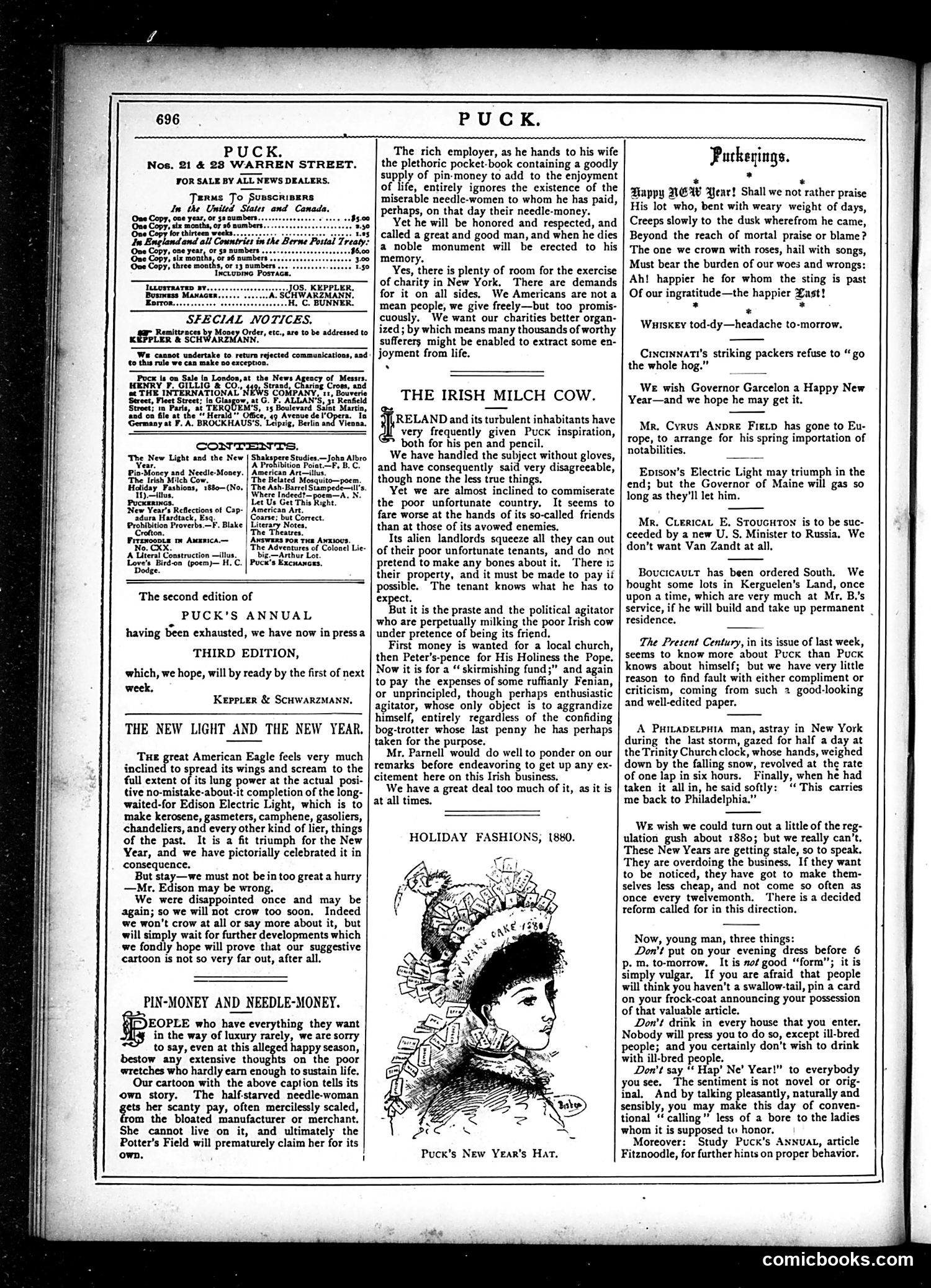
This illustration depicts a fashionable woman's elaborate New Year's hat from 1880, shown in profile. The cartoon satirizes the excessive ornamentation and impractical nature of Victorian women's fashion. The accompanying text critiques how holiday fashions have become increasingly costly and ostentatious. It mocks the social pressure on women to constantly update their wardrobes with expensive, elaborately decorated hats—regardless of practicality or actual need. The piece suggests this represents wasteful consumption driven by fashion industry marketing rather than genuine utility. The humor lies in exaggerating the hat's complexity (crowded with feathers, ribbons, and decorative elements) to ridicule both the fashion industry's manipulation of consumers and society's unrealistic beauty standards for women.
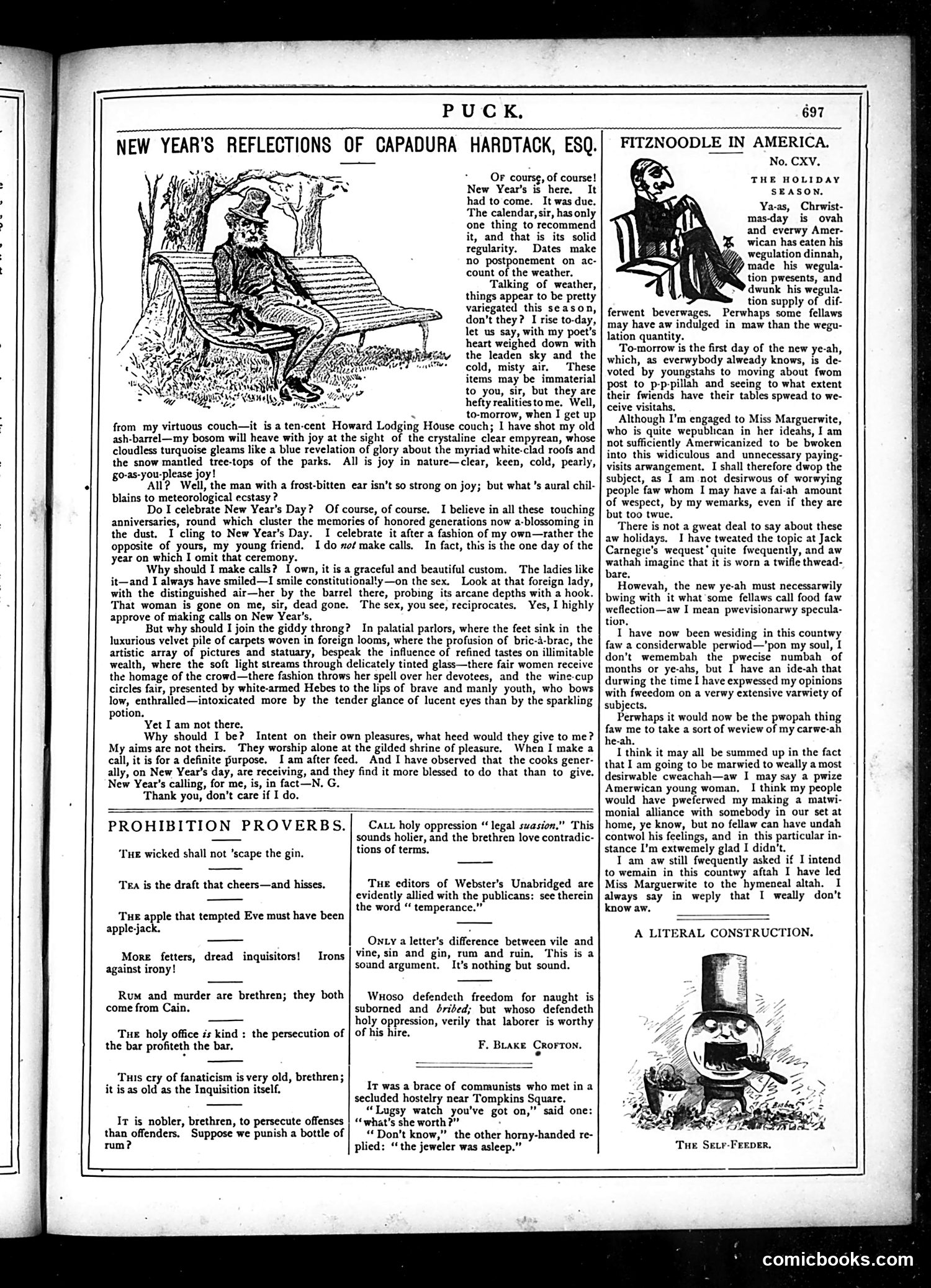
This page contains three satirical pieces rather than a single cartoon: 1. **"New Year's Reflections of Capadura Hardtack, Esq."** — A humorous essay by a fictional character reflecting on New Year's customs and romance, mocking sentimentality around the holiday. 2. **"Prohibition Proverbs"** — Short witty sayings satirizing Prohibition-era laws, including puns like "The wicked shall not 'scape the gin" and "Rum and murder are brethren; they both come from Cain." 3. **"Fitznoodle in America"** — A brief comedy piece about American holiday customs, contrasting American and British traditions. 4. **"A Literal Construction"** — A small cartoon with accompanying joke about a jewelry heist. The content reflects Puck's satirical approach to contemporary social issues, particularly Prohibition's enforcement challenges and American cultural practices.
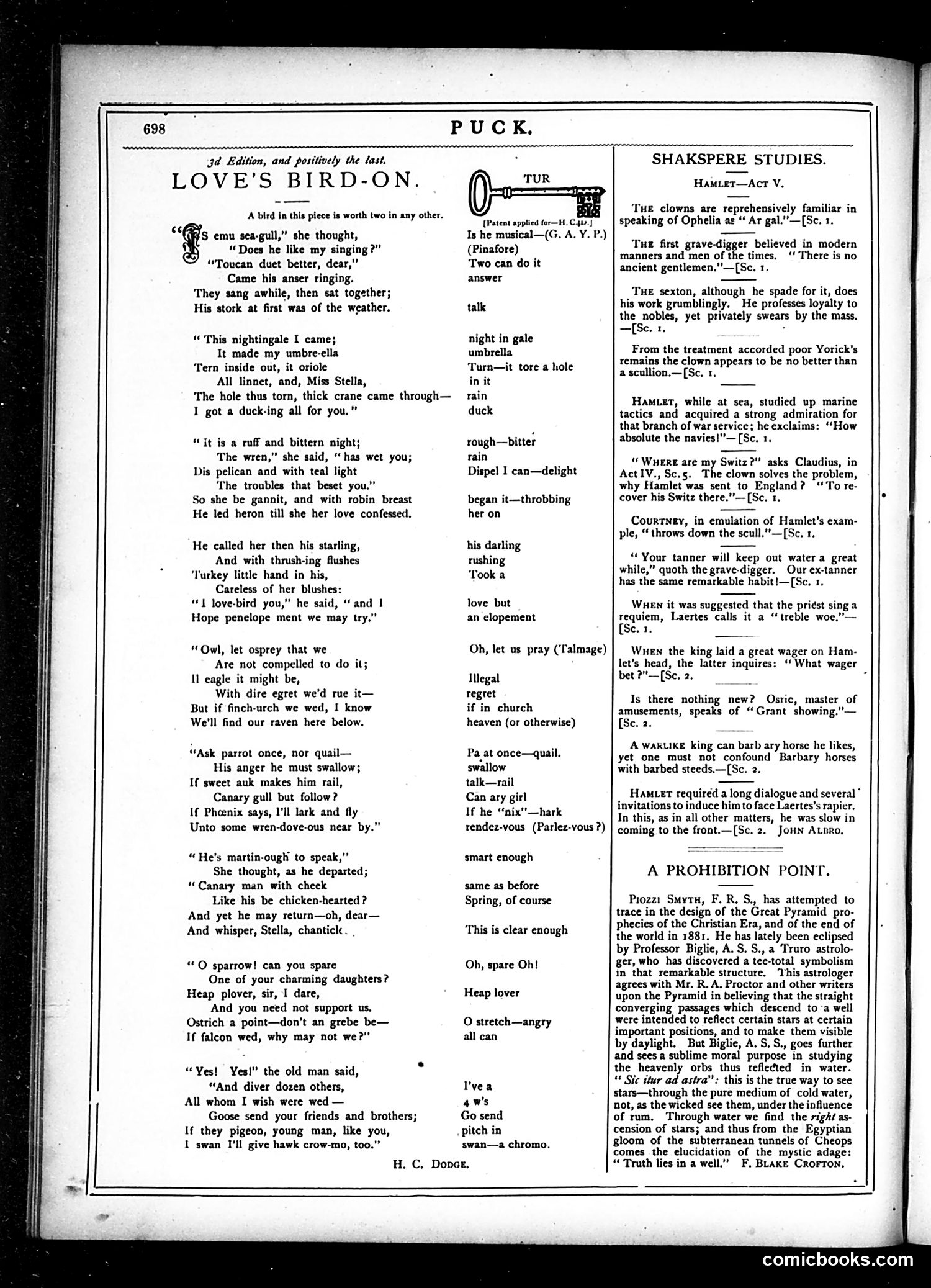
This page from *Puck* magazine contains **no political cartoon**. Instead, it presents: 1. **"Love's Bird-On"** — A poem by H.C. Dodge with marginal annotations explaining archaic or difficult language (e.g., "sea-gull," "night in gale," "rough—bitter"). This appears to be a literary feature offering reader guidance. 2. **"Shakspere Studies: Hamlet—Act V"** — Critical notes on Shakespeare's *Hamlet*, discussing character interpretations and textual details. 3. **"A Prohibition Point"** — A brief article by Prozzi Smith examining symbolism in the Great Pyramid, relating it to moral/religious themes about prohibition. The page is primarily **literary and educational content** rather than satirical commentary, reflecting *Puck*'s broader scope beyond political humor.
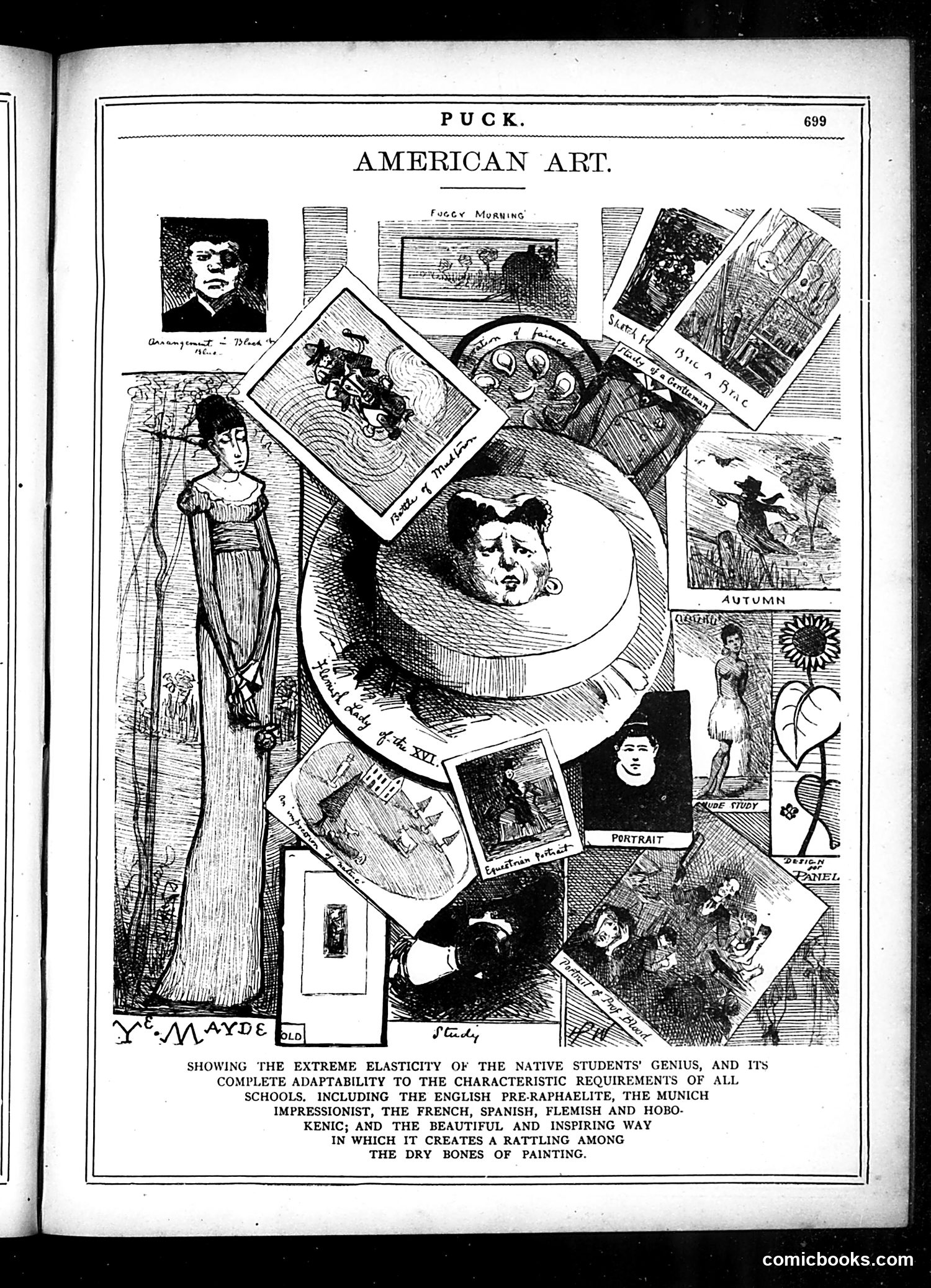
This page satirizes American art education and artistic movements of the early 20th century. The central image shows a large head suspended in a bubble, surrounded by scattered artworks and sketches labeled with various artistic schools: "Foggy Morning," "Portrait," "Autumn," and references to art movements including "English Pre-Raphaelite, the Munich Impressionist, the French, Spanish, Flemish and Hobo-kenic." The caption mockingly criticizes American art students' "extreme elasticity of genius" and their ability to adopt "characteristic requirements of all schools." The figure on the left appears to be a student or artist. The satire suggests that American students indiscriminately imitate multiple European artistic styles without developing authentic originality, rattling "the dry bones of painting" rather than creating genuine art.
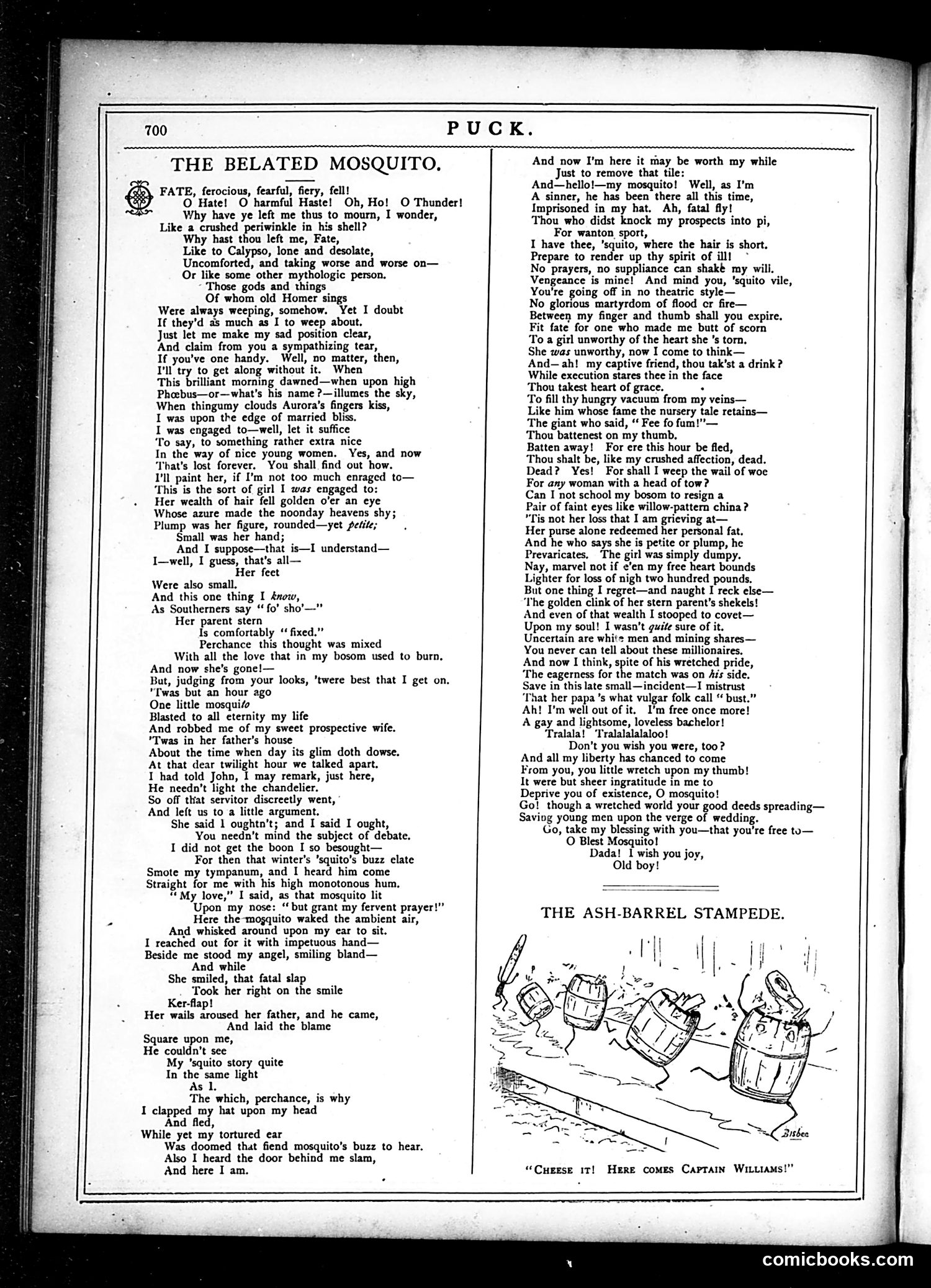
This page contains two distinct pieces: **"The Belated Mosquito"** is a lengthy narrative poem about a male mosquito lamenting his lost love—a female mosquito he was engaged to marry. He catalogues his grievances: she was unworthy, engaged to someone else, and ultimately caused him humiliation. The poem's extended complaint appears satirical, mocking overwrought romantic melodrama and male self-pity. **"The Ash-Barrel Stampede"** is a small illustration showing barrels tumbling down a slope with the caption "Cheese it! Here comes Captain Williams!" This likely references a specific local incident or political figure (Captain Williams), though without additional historical context, the precise reference remains unclear. Both pieces use humor—one through verbose emotional excess, the other through visual comedy—typical of Puck's satirical approach.
This page is primarily **text-based content** rather than illustrated cartoons. It contains: 1. **Poetry sections** ("Where, Indeed?" and "Let Us Get This Right") addressing readers with satirical commentary 2. **Theater reviews** covering productions at various New York venues 3. **Literary notes** discussing contemporary publications 4. **An "American Art" essay** critiquing art education and J. Correggio Smith's work 5. **A "Answers for the Anxious" advice column** The page lacks prominent political cartoons. Instead, it showcases Puck's satirical approach through **witty editorial commentary** on contemporary theater, art institutions, and reader questions. The tone is generally mocking toward artistic pretension and institutional pomposity—typical of Puck's satirical mission. Without seeing accompanying illustrations, the specific satirical targets remain somewhat general rather than person-specific.
This page contains three illustrations labeled "PUCK" on the left side. The top image shows a fish, captioned "The Northern Pike, side and upper on" (text unclear). The central cartoon depicts a caricatured figure in period dress being struck or thrown backward with motion lines, suggesting physical conflict or force. The figure appears labeled but the text is illegible in this reproduction. The bottom image shows what appears to be a dark circular object, possibly representing something abstract or symbolic, captioned "True Etiquette of he was by his Bath" (OCR unclear). Without legible captions and date information, I cannot definitively identify the specific political or social references this satire targets. The imagery suggests commentary on violence or conflict, possibly involving public figures, but I cannot specify whom or what event without risking inaccuracy.
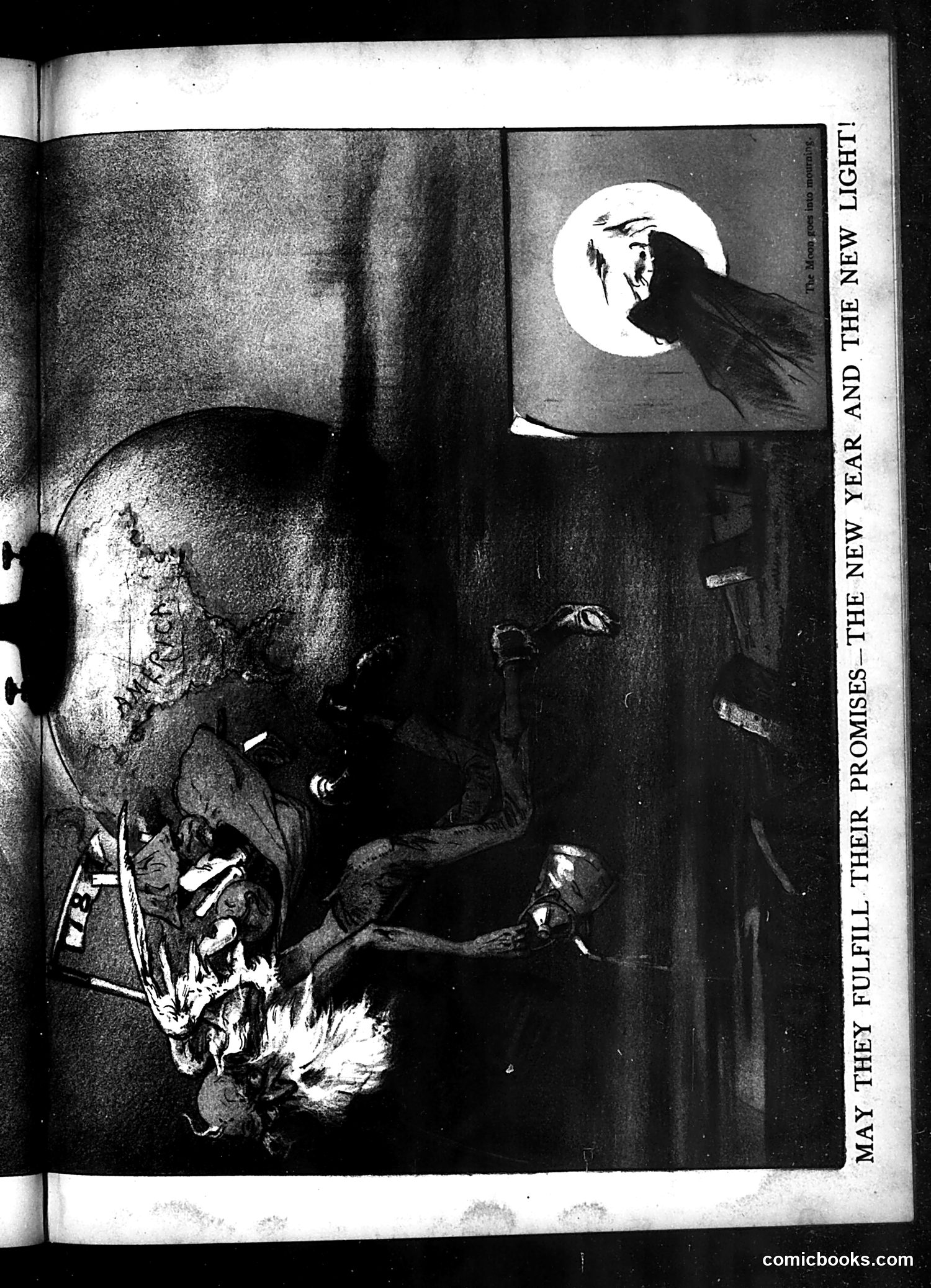
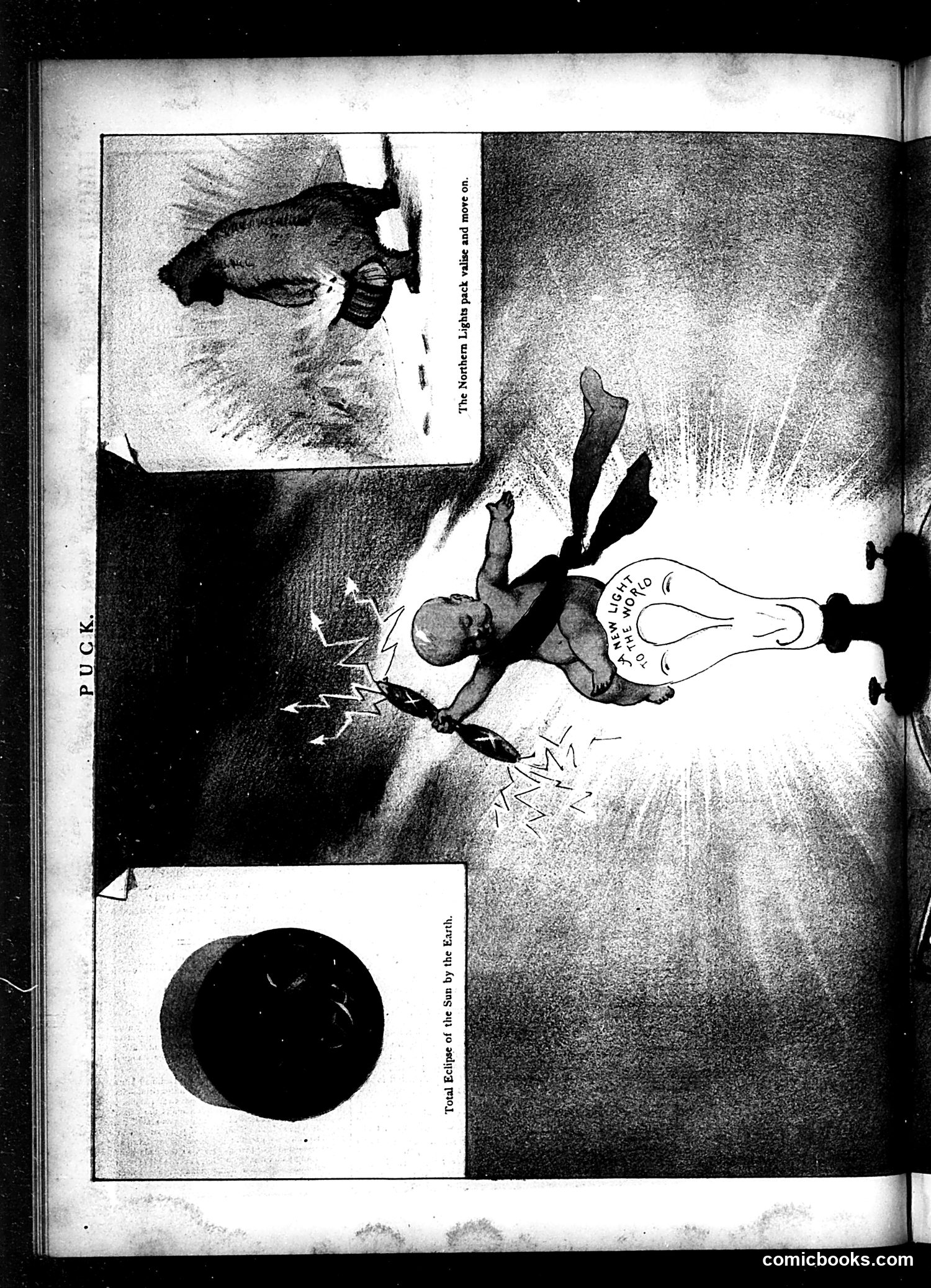
This appears to be a New Year's greeting cartoon from *Puck* magazine, as indicated by the caption "MAY THEY FULFILL THEIR PROMISES—THE NEW YEAR AND THE NEW LIGHT!" The image depicts a dark, gothic scene with a witch or dark figure flying past a full moon, while below, figures appear to be gathered around a fire or light source. The composition contrasts darkness with illumination—likely symbolizing hope or promises for the incoming year. Without clearer visibility of specific figures or additional context, the exact political figures or events referenced remain uncertain. However, the "new light" suggests optimism about forthcoming changes or fulfilled promises, a common New Year's theme in satirical publications of this era.
This page presents the beginning of a serialized story by Arthur Lot titled "The Adventures of Colonel Liebig," written expressly for Puck. The narrative is a first-person account by Colonel Anthony Wayne Liebig, who opens by expressing exhaustion with Civil War discussions. He's a retired military officer claiming significant wartime service, though he complains his contributions are underappreciated. The story appears to be satirical commentary on post-war American patriotism and memory. Liebig comes across as self-aggrandizing and bitter about recognition. Without additional context, the specific political targets remain unclear, but the piece seems to mock inflated military egos and revisionist Civil War narratives circulating in the Gilded Age.
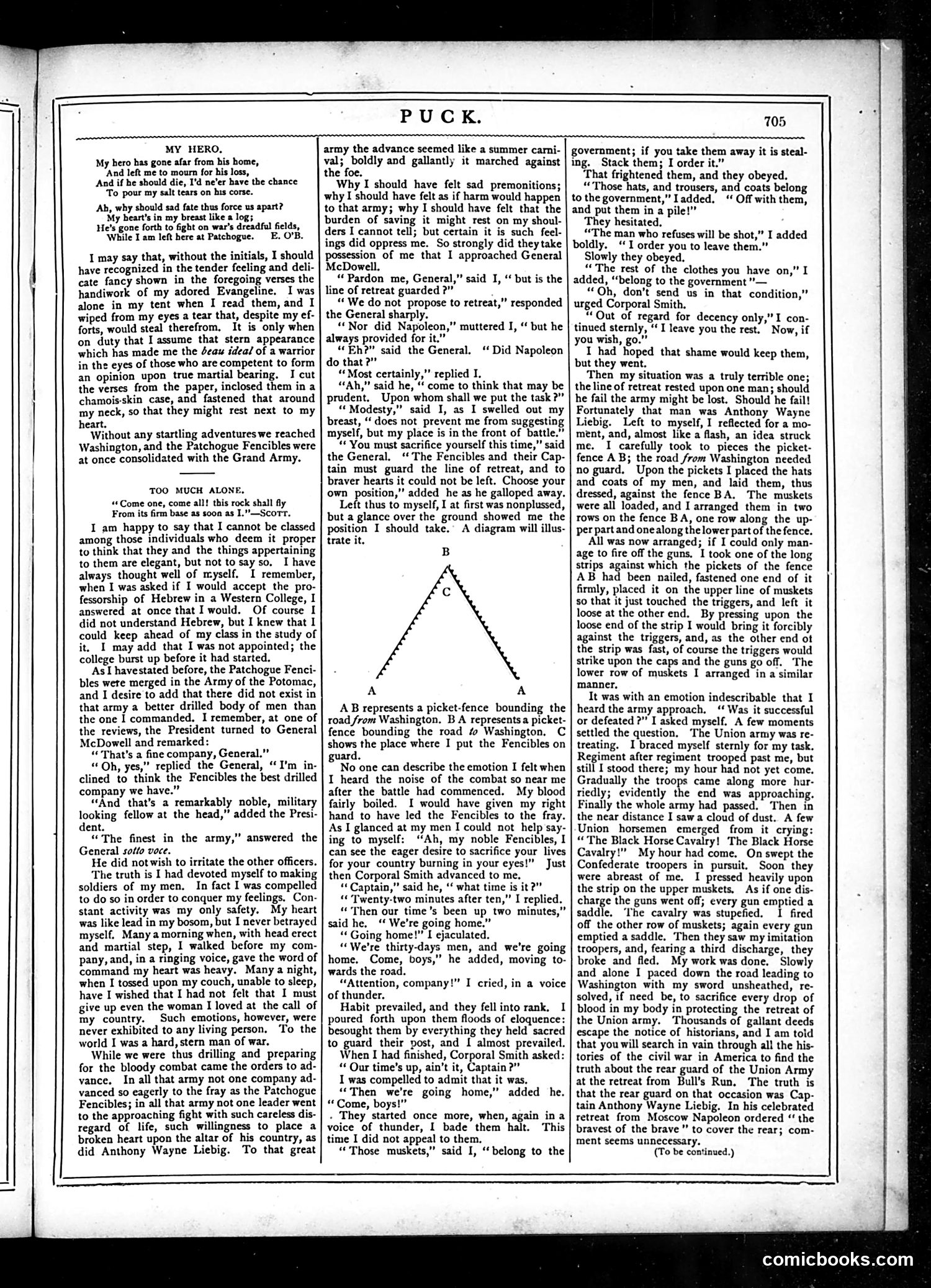
This page contains a narrative story titled "MY HERO" with accompanying text and a small geometric diagram. The story appears to be a first-person account of Civil War military service, describing a narrator's experience protecting a picket fence during a Union Army retreat near Washington, D.C. The satire likely mocks inflated war narratives and self-aggrandizing reminiscences—a common target of Puck's humor. The narrator obsesses over a minor defensive position (a fence line), treating it with exaggerated martial importance while the actual battle rages nearby. This deflates typical heroic war stories through absurd understatement and misplaced priorities, suggesting how civilians romanticized or misrepresented their wartime roles.
This is primarily an **advertising page** from Puck magazine (page 708), not a satirical cartoon page. It contains numerous commercial advertisements for late 19th-century goods and services, including: - Piano sales (Steinway) - Billiard tables - Hair goods - Walking canes - Theatrical productions (Princess Toto) - Department store offerings (Jones) - Hats, mattresses, jewelry, and other merchandise The only substantive non-advertising content is a brief editorial note about the American Telegraph Company purchasing telegraph poles from Miss Ann Ostrander. The page reflects Puck's reliance on advertising revenue and represents typical magazine layout of the era, mixing commercial promotion with editorial content.
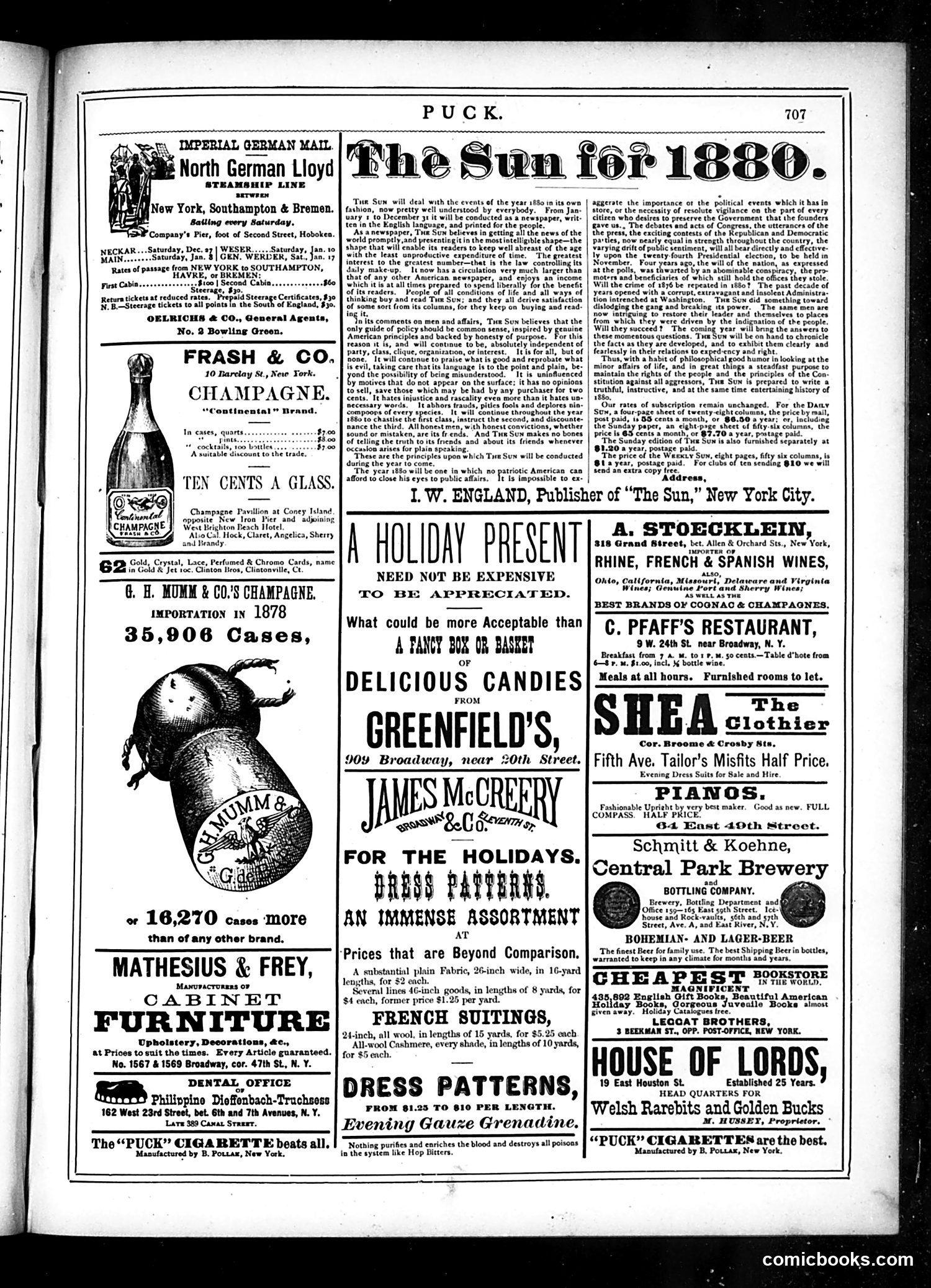
This page is **primarily advertisements** for holiday gifts and services in New York City, not a political cartoon. The masthead announces "The Sun for 1880," likely an editorial preview of coming events. The editorial text discusses the Sun newspaper's coverage of major 1880 events: the presidential election, economic developments, and political affairs. It promises continued independent reporting. Notable ads include champagne, candies from Greenfield's, dress patterns, French fabrics, furniture, and pianos—typical luxury goods marketed for the holiday season to wealthy New York readers. The only illustrated element beyond advertising is a small allegorical figure (possibly representing prosperity or commerce) associated with Mumm & Co.'s champagne. This represents Puck's commercial side rather than its satirical editorial content.
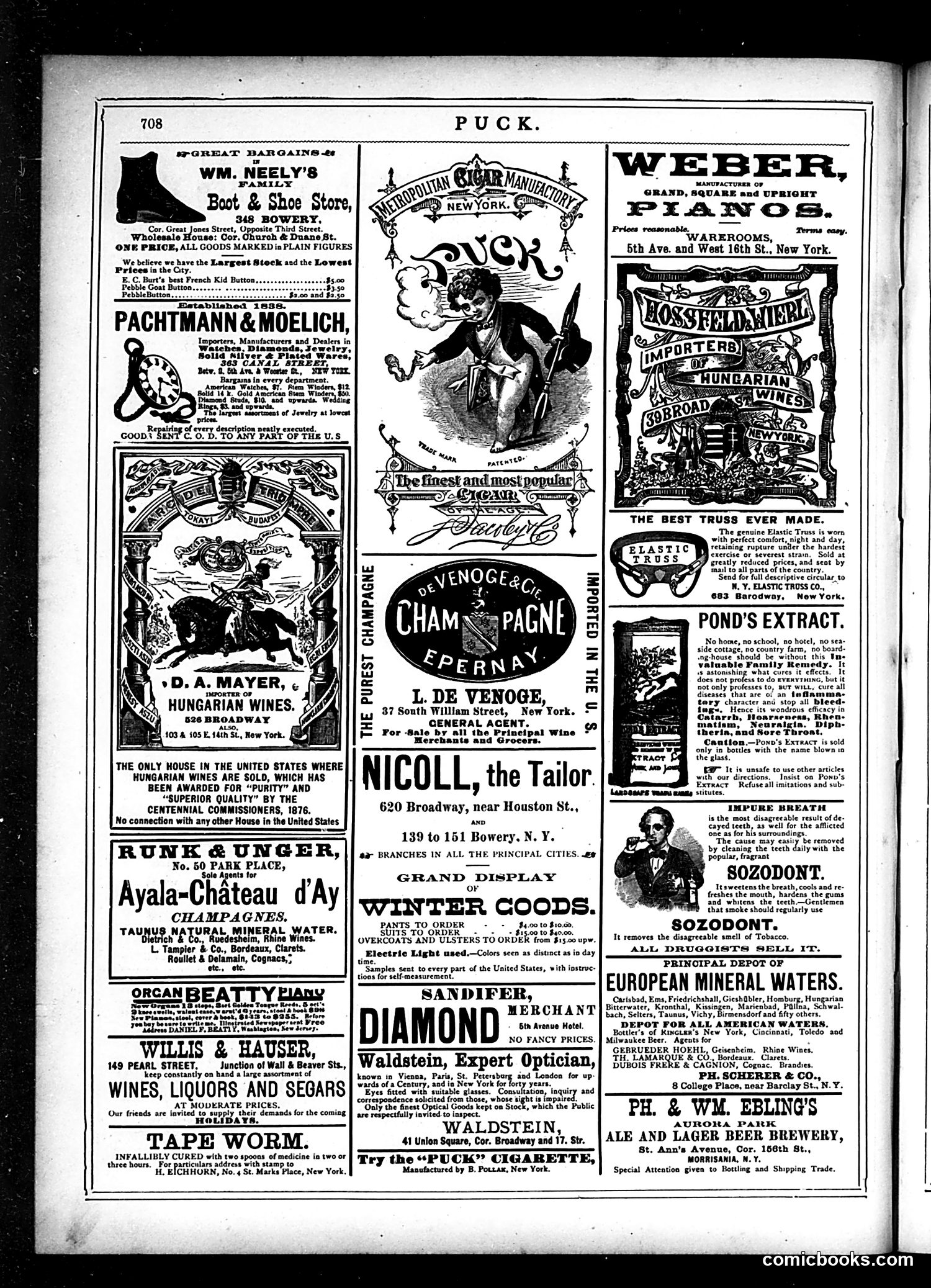
This is primarily an **advertising page** from Puck magazine (page 708), not a political cartoon. It features various commercial advertisements for late 19th-century products and services, including: - Boot and shoe stores - Piano manufacturers - Wine and champagne importers - A tailor (Nicoll) - Mineral waters and patent medicines - Cigars - Beer breweries The only illustrated advertisement of note is the **central "Puck" cigar brand** featuring the magazine's mascot—a mischievous imp or fairy character riding a cigar like a broomstick. This serves as brand recognition, associating the popular magazine with the tobacco product. The page reflects **Gilded Age consumer culture** and advertising practices, with no apparent political satire or social commentary.
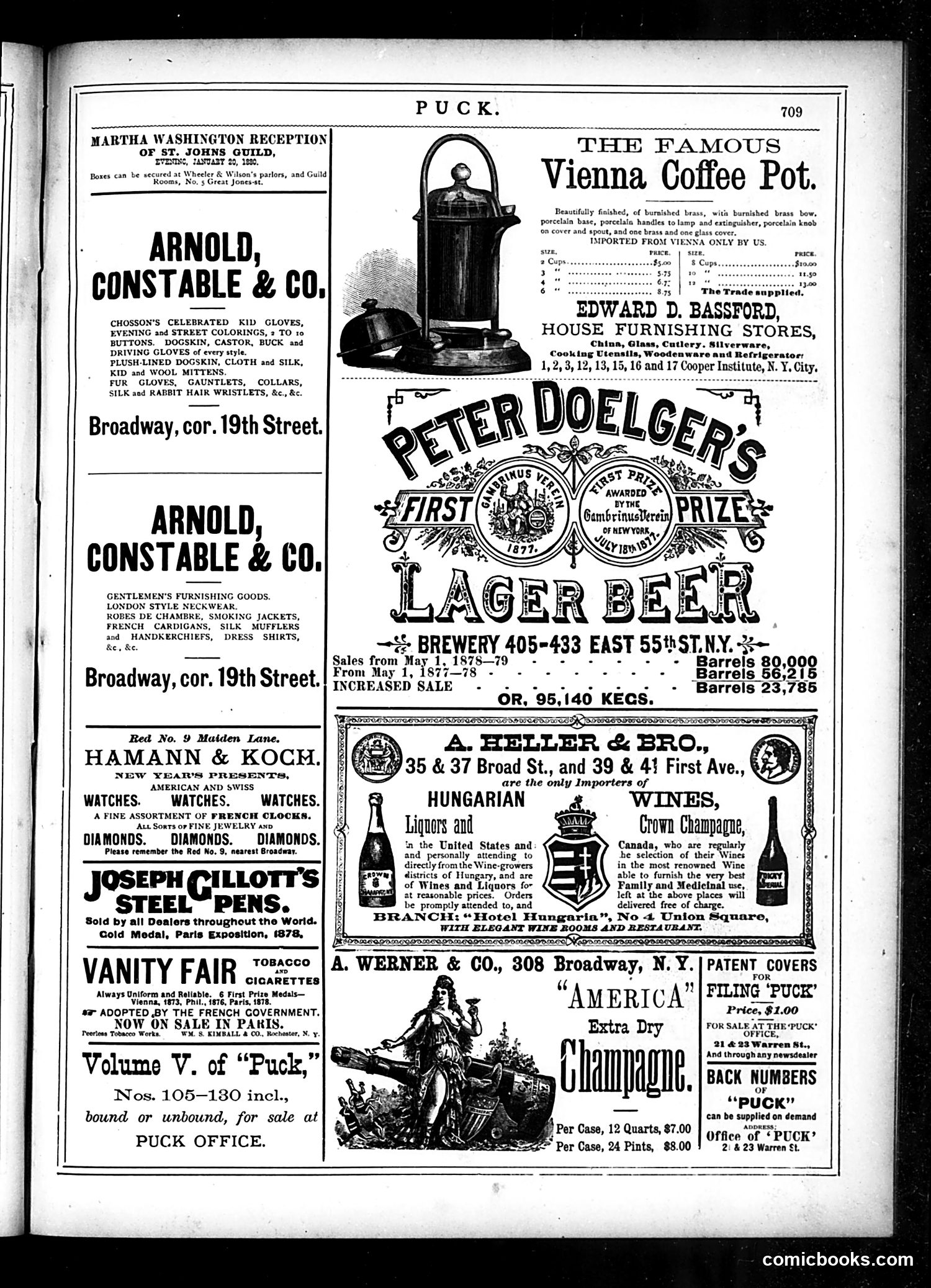
This is primarily an **advertising page** from Puck magazine (page 709), not a satirical cartoon page. It contains various 19th-century commercial advertisements including: - **Arnold, Constable & Co.** (clothing/gloves) - **The Famous Vienna Coffee Pot** (imported kitchenware) - **Edward D. Bassford** (house furnishings) - **Peter Doelgers Lager Beer** (brewery, 405-433 East 55th St., NYC) - **Hamann & Koch** (watches and diamonds) - **Joseph Gillott's Steel Pens** - **Veuve Fair Tobacco & Cigarettes** - **A. Heller & Bro.** (Hungarian wines) - **A. Werner & Co.** (champagne) The page serves as a marketplace snapshot of late-1870s New York consumer goods and services, with no political satire or editorial cartoons visible.
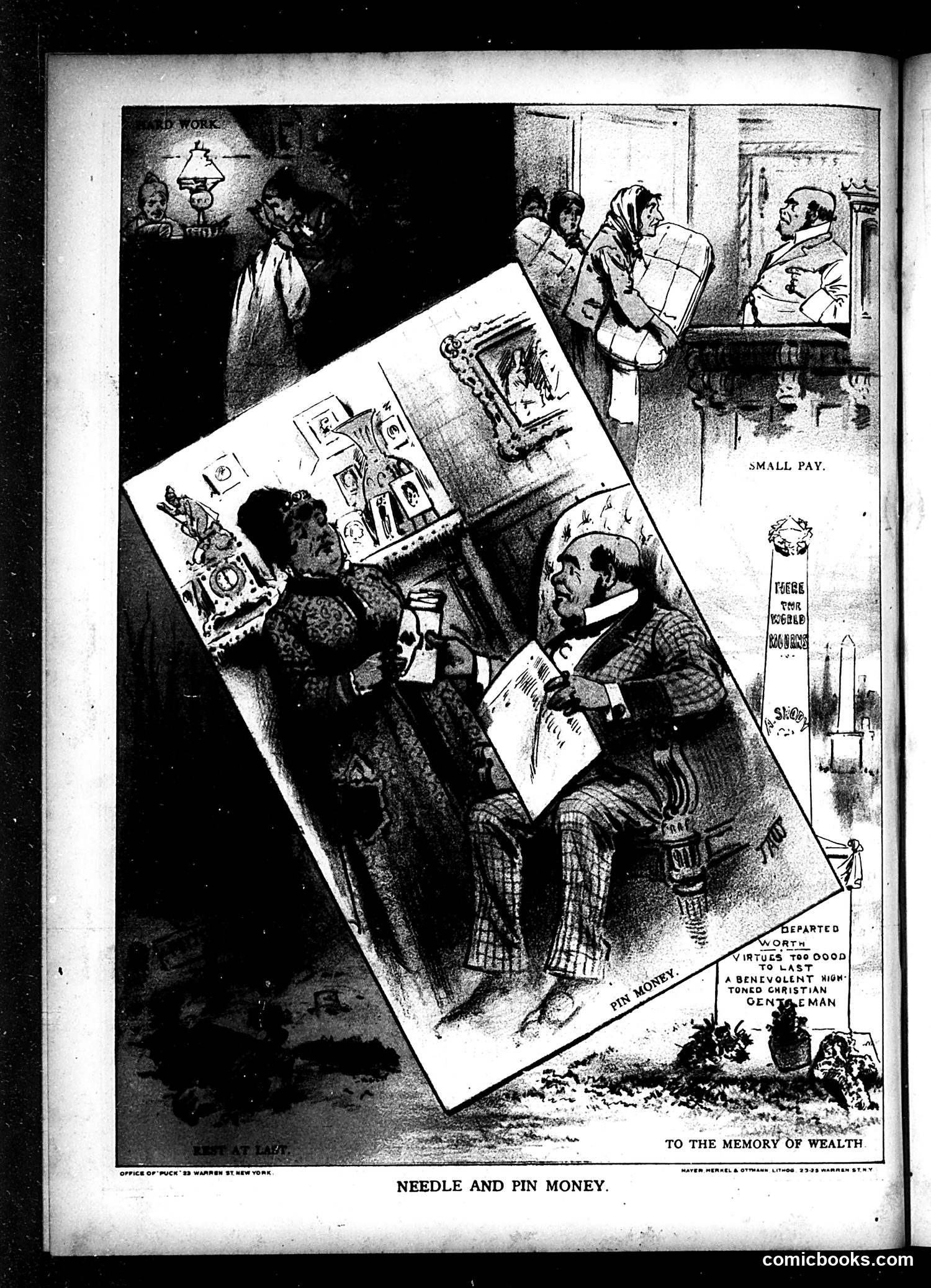
This satirical cartoon critiques clergy—particularly those described as "a tonsured Christian gentleman"—for their hypocrisy regarding wealth. The central figures appear to be religious men examining or handling money and valuables, depicted as casually acquiring funds through what the title suggests are trivial means ("needle and pin money"). The upper panels show various scenes of commercial or financial transactions, while the lower section shows clerics evaluating goods or money with apparent interest. The phrase "pin money" historically referred to small allowances, but here suggests clergy hypocritically accumulate wealth despite vows of poverty or spiritual virtue. The caption "departed worth virtues too good to last" reinforces the satire: these supposedly virtuous religious figures actually prioritize material gain over spiritual principles. This reflects anti-clerical sentiment common in Gilded Age American satire.