
Puck, 1879-12-31 · page 11 of 16
Puck — December 31, 1879 — page 11: what you’re looking at
What you’re looking at
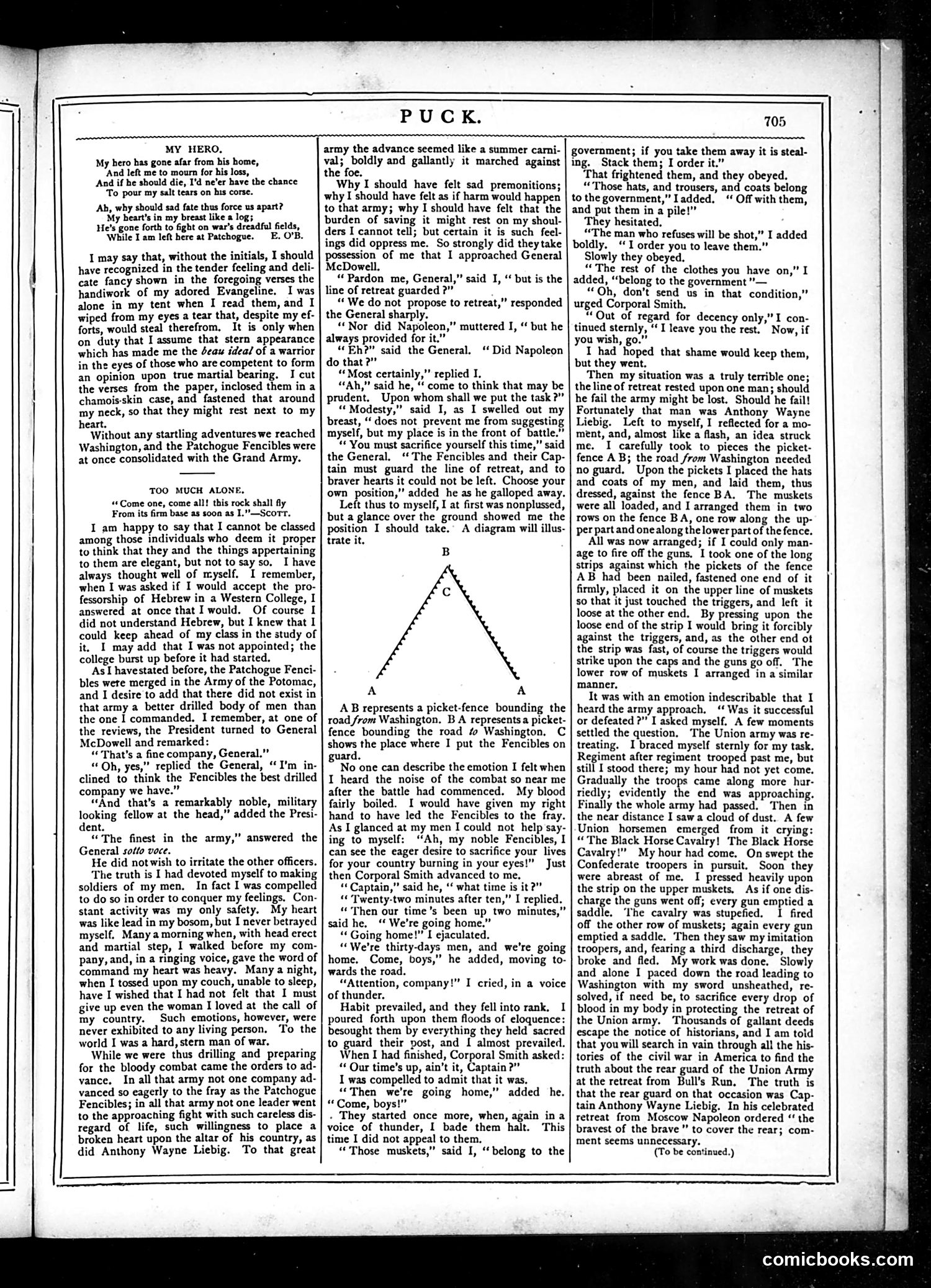
This page contains a narrative story titled "MY HERO" with accompanying text and a small geometric diagram. The story appears to be a first-person account of Civil War military service, describing a narrator's experience protecting a picket fence during a Union Army retreat near Washington, D.C. The satire likely mocks inflated war narratives and self-aggrandizing reminiscences—a common target of Puck's humor. The narrator obsesses over a minor defensive position (a fence line), treating it with exaggerated martial importance while the actual battle rages nearby. This deflates typical heroic war stories through absurd understatement and misplaced priorities, suggesting how civilians romanticized or misrepresented their wartime roles.
📄 Transcribed text from this page (OCR, searchable)
Machine-transcribed from the original scan — historical spelling and the odd misread are preserved.
PUCK. MY HERO, My hero has gone afar from his home, ‘And left me to mourn for his loss, ‘And if he should die, I'd ne’er have the chance To pour my salt tears on his corse. ‘Ah, why should sad fate thus force us apart? My beart’s in my breast like a log; He’s gone forth to fight on war's dreadful fields, ‘While I am left here at Patchogue. E. O'B. I may say that, without the initials, I should have recognized in the tender feeling and deli- cate fancy shown in the foregoing verses the handiwork of my adored Evangeline. I was alone in my tent when I read them, and I wiped from my eyes a tear that, despite my ef- forts, would steal therefrom, It is only when on duty that I assume that stern appearance which has made me the eau idea/ of a warrior in the eyes of those who are competent to form an opinion upon true martial bearing. I cut the verses from the paper, inclosed them in a chamois-skin case, and fastened that around my neck, so that they might rest next to my heart. Without any startling adventures we reached Washington, and the Patchogue Fencibles were at once consolidated with the Grand Army. TOO MUCH ALONE. «Come one, come all! this rock shall fly From its firm base as soon as I.""—Scorr. I am happy to say that I cannot be classed among those individuals who deem it proper to think that they and the things appertaining to them are elegant, but not to say so. I have always thought well of myself. I remember, when I was asked if I would accept the pro- fessorship of Hebrew in a Western College, I answered at once that I would. Of course I did not understand Hebrew, but I knew that I could keep ahead of my class in the study of it. I may add that I was not appointed; the college burst up before it had started. As I havestated before, the Patchogue Fenci- bles were merged in the Army of the Potomac, and I desire to add that there did not exist in that army a better drilled body of men than the one I commanded. I remember, at one of the reviews, the President turned to General McDowell and remarked: «That's a fine company, General.” “Oh, yes,” replied the General, “I'm in- clined to think the Fencibles the best drilled company we have.”” “And that’s a remarkably noble, military looking fellow at the head,” added the Presi- dent. “The finest in the army,” answered the General sotto voce. He did not wish to irritate the other officers. The truth is I had devoted myself to making soldiers of my men. In fact I was compelled to do so in order to conquer my feelings. Con- stant activity was my only safety. My heart was like lead in my bosom, but I never betrayed myself, Many a morning when, with head erect and martial step, I walked before my com- pany, and, in a ringing voice, gave the word of command my heart was heavy. Many a night, when I tossed upon my couch, unable to sleep, have I wished that I had not felt that I must give up even the woman I loved at the call of my country. Such emotions, however, were never exhibited to any living person. To the world I was a hard, stern man of war. While we were thus drilling and preparing for the bloody combat came the orders to ad- vance, In all that army not one company ad- vanced so eagerly to the fray as the Patchogue Fencibles; in all that army not one leader went to the approaching fight with such careless dis- regard of life, such willingness to place a broken heart upon the altar of his country, as did Anthony Wayne Liebig. To that great army the advance seemed like a summer carni- val; boldly and gallantly it marched against the foe. Why I should have felt sad premonitions; why I should have felt as if harm would happen to that army; why I should have felt that the burden of saving it might rest on my shoul- ders I cannot tell; but certain it is such feel- ings did oppress me. So strongly did they take possession of me that I approached General McDowell. “Pardon me, General,” said I, ‘‘ but is the line of retreat guarded ?” “We do not propose to retreat,” responded the General sharply. “Nor did Napoleon,” muttered I, “ but he always provided for it.” “Eh?” said the General. do that ?”” “Most certainly,” replied I. “Ah,” said he, “ come to think that may be prudent. Upon whom shall we put the task ?” “Modesty,” said I, as I swelled out my breast, “‘ does not prevent me from suggesting myself, but my place is in the front of battle.” ** You must sacrifice yourself this time,” said the General, ‘The Fencibles and their Cap- tain must guard the line of retreat, and to braver hearts it could not be left. Choose your own position,” added he as he galloped away. Lek thes to myself, I at first was nonplussed, but a glance over the ground showed me the position I should take.’ A diagram will illus- trate it, “ Did Napoleon B A A AB represents a picket-fence bounding the road from Washington. B A represents a picket- fence bounding the road 4 Washington, C shows the place where I put the Fencibles on guard. No one can describe the emotion I felt when I heard the noise of the combat so near me after the battle had commenced. My blood fairly boiled. I would have given my right hand to have led the Fencibles to the fray. As I glanced at my men I could not help say- ing to myself: “Ah, my noble Fencibles, 1 can see the eager desire to sacrifice your lives for your country burning in your eyes!” Just then Corporal Smith advanced to me, “Captain,” said he, ‘‘ what time is it?” “ Twenty-two minutes after ten,” I replied. “Then our time's been up two minutes,” said he. “We're going home.” “ Going home!” I ejaculated. “We're thirty-days men, and we're going home. Come, boys,” he added, moving to- wards the road. “Attention, company!” I cried, in a voice of thunder. Habit prevailed, and they fell into rank, 1 poured forth upon them floods of eloquence: besought them by everything they held sacred to guard their post, and If almost prevailed. When I had finished, Corporal Smith asked: “ Our time’s up, ain’t it, Captain?” I was compelled to admit that it was, “‘Then we're going home,” added he. “Come, boys!” . They started once more, when, again ina voice of thunder, I bade them halt. This time I did not appeal to them. “Those muskets,” said I, “belong to the government; if you take them away it is steal- ing. Stack them; I order it.” That frightened them, and they obeyed. “Those hats, and trousers, and coats belong to the government,” added. “ Off with them, and put them in a pile!” They hesitated, “The man who refuses will be shot,” I added boldly. ‘I order you to leave them.” Slowly they obeyed, “‘The rest of the clothes you have on,’ I added, “belong to the government "— “Oh, don’t send us in that condition,” urged Corporal Smith. _ ‘Out of regard for decency only,” I con- tinued sternly, “I leave you the rest. Now, if you wish, go.” I had hoped that shame would keep them, but they went. Then my situation was a truly terrible one; the line of retreat rested upon one man; should he fail the army might be lost. Should he fail! Fortunately that man was Anthony Wayne Liebig. Left to myself, I reflected for a mo- ment, and, almost like a flash, an idea struck me. I carefully took to pieces the picket- fence AB; the road from Washington needed no guard, Upon the pickets I placed the hats and coats of my men, and laid them, thus dressed, against the fence BA. The muskets were all loaded, and I arranged them in two rows on the fence BA, one row along the up- per part and onealong the lower part of the fence. All was now arranged; if I could only man- age to fire off the guns. I took one of the long strips against which the pickets of the fence AB had been nailed, fastened one end of it firmly, placed it on the upper line of muskets so that it just touched the triggers, and left it loose at the other end. By pressing upon the loose end of the strip I would bring it forcibly against the triggers, and, as the other end ot the strip was fast, of course the triggers would strike upon the caps and the guns go off. ‘The lower row of muskets I arranged in a similar manner, It was with an emotion indescribable that I heard the army approach, ‘ Was it successful or defeated ?” I asked myself. A few moments settled the question. ‘The Union army was re- treating. I braced myself sternly for my task. Regiment after regiment trooped past me, but still I stood there; my hour had not yet come. Gradually the troops came along more hu riedly; evidently the end was approaching. Finally the whole army had passed. Then in the near distance I saw a cloud of dust. A few Union horsemen emerged from it crying: “The Black Horse Cavalry! The Black Horse Cavalry!” My hour had come. On swept the Confederate troopers in pursuit. Soon they were abreast of me. I pressed heavily upon the strip on the upper muskets, As if one dis- charge the guns went off; every gun emptied a saddle, ‘The cavalry was stupefied. I fired off the other row of muskets; again every gun emptied a saddle. Then they saw my imitation troopers, and, fearing a third discharge, they broke and fied. My work was done. Slowly and alone I paced down the road leading to Washington with my sword unsheathed, re- solved, if need be, to sacrifice every drop of blood in my body in protecting the retreat of the Union army. Thousands of gallant deeds escape the notice of historians, and I am told that you will search in vain through all the his- tories of the civil war in America to find the truth about the rear guard of the Union Army at the retreat from Bull’s Run. The truth is that the rear guard on that occasion was Cap- tain Anthony Wayne Liebig. In his celebrated retreat from Moscow Napoleon ordered “ the bravest of the brave" to cover the rear; com- (To be continued.) ment seems unnecessary. comicbooks.com