
Puck, 1879-12-31 · page 4 of 16
Puck — December 31, 1879 — page 4: what you’re looking at
What you’re looking at
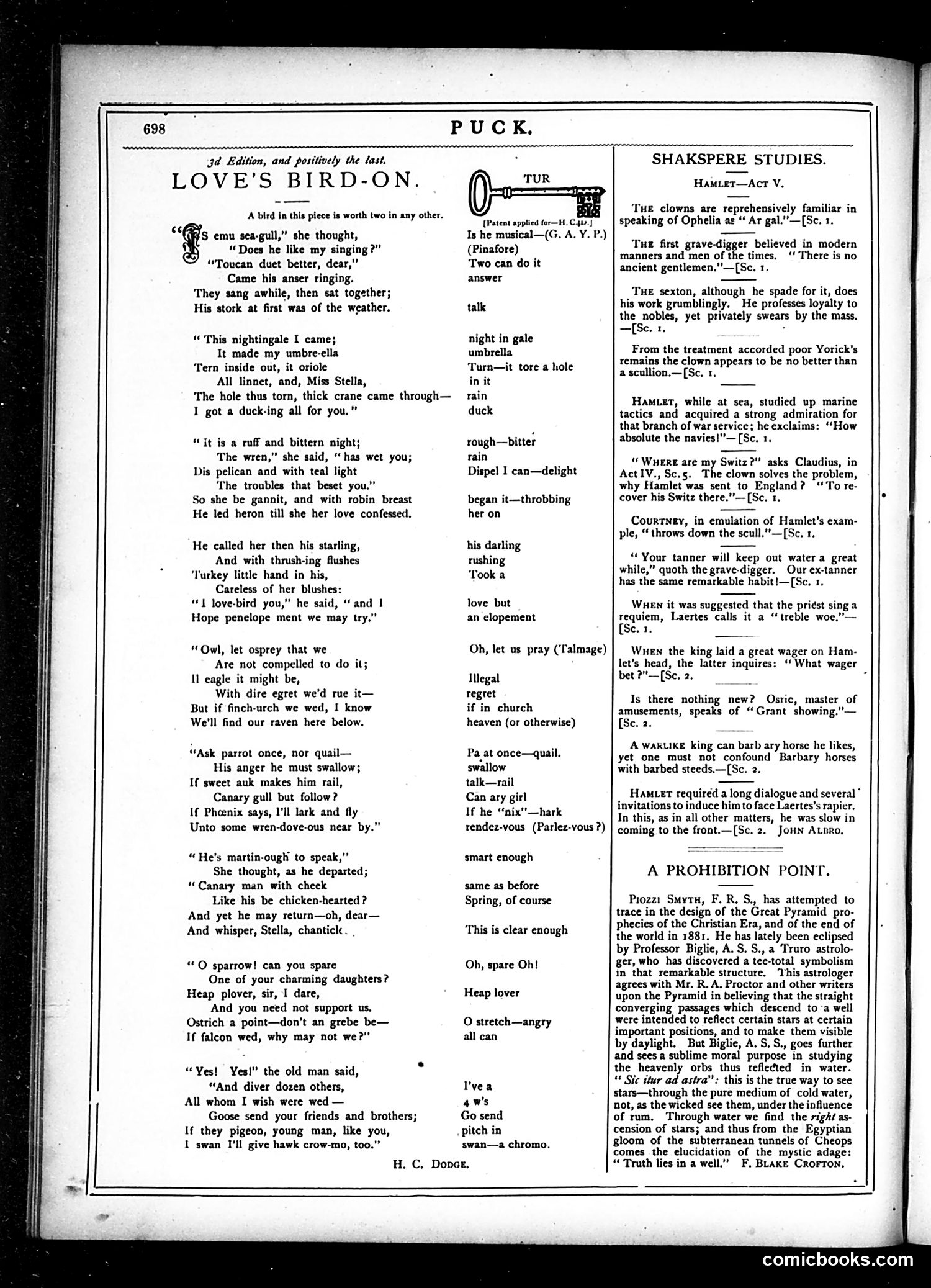
This page from *Puck* magazine contains **no political cartoon**. Instead, it presents: 1. **"Love's Bird-On"** — A poem by H.C. Dodge with marginal annotations explaining archaic or difficult language (e.g., "sea-gull," "night in gale," "rough—bitter"). This appears to be a literary feature offering reader guidance. 2. **"Shakspere Studies: Hamlet—Act V"** — Critical notes on Shakespeare's *Hamlet*, discussing character interpretations and textual details. 3. **"A Prohibition Point"** — A brief article by Prozzi Smith examining symbolism in the Great Pyramid, relating it to moral/religious themes about prohibition. The page is primarily **literary and educational content** rather than satirical commentary, reflecting *Puck*'s broader scope beyond political humor.
📄 Transcribed text from this page (OCR, searchable)
Machine-transcribed from the original scan — historical spelling and the odd misread are preserved.
gd Edition, and positively the last. LOVE’S BIRD-ON. A bird in this piece is worth two in any other. ‘¢ emu sea-gull,” she thought, “Does he like my singing?” “Toucan duet better, dear,” Came his anser ringing. They sang awhile, then sat together; His stork at first was of the weather. “This nightingale I came; It made my umbre-ella Tern inside out, it oriole All linnet, and, Miss Stella, The hole thus torn, thick crane came through— I got a duck-ing all for you.” “it is a ruff and bittern night; ‘The wren,” she said, “has wet you; Dis pelican and with teal light The troubles that beset you.” So she be gannit, and with robin breast He led heron till she her love confessed, He called her then his starling, And with thrush-ing flushes ‘Turkey little hand in his, Careless of her blushes: “1 love-bird you,” he said, “and 1 Hope penelope ment we may try.” “Owl, let osprey that we Are not compelled to do it; II eagle it might be, With dire egret we'd rue it— But if finch-urch we wed, I know We'll find our raven here below. “Ask parrot once, nor quail— His anger he must swallow; If sweet auk makes him rail, Canary gull but follow? If Phoenix says, I'll lark and fly Unto some wren-dove-ous near by.” “He's martin-ough to speak,” She thought, as he departed; “Canary man with cheek Like his be chicken-hearted? And yet he may return—oh, dear— And whisper, Stella, chanticle. _ “©O sparrow! can you spare One of your charming daughters? Heap plover, sir, I dare, And you need not support us. Ostrich a point—don't an grebe be— If falcon wed, why may not we?” “Yes! Yes!” the old man said, “And diver dozen others, All whom I wish were wed — Goose send your friends and brothers; If they pigeon, young man, like you, 1 swan I'll give hawk crow-mo, too.” ()- [Patent applied for—H. Cay. 7 Is he musical—(G. A. Y. P.) (Pinafore) Two can doit answer talk night in gale umbrella Turn—it tore a hole in it rain duck rough—bitter rain Dispel 1 can—delight began it—throbbing her on his darling rushing ‘Took a love but an elopement Oh, let us pray (‘Talmage) IMegal regret if in church heaven (or otherwise) Pa at once—quail, swallow talk—rail Can ary girl If he “nix —hark rendez-vous (Parlez-vous ?) smart enough same as before Spring, of course ‘This is clear enough Oh, spare Oh! Heap lover O stretch—angry all can I've a 4w's Go send pitch in swan—a chromo. H. C. Donce. SHAKSPERE STUDIES. Hamiet—Act V. ‘Tne clowns are reprehensively familiar in speaking of Ophelia az “Ar gal.”"—[Sc. 1. ‘Tue first _grave-digger believed in modern manners and men of the times. ‘‘ There is no ancient gentlemen.”—([Sc. 1. ‘Tue sexton, although he spade for it, does his work grumblingly. He professes loyalty to the nobles, yet privately swears by the mass, —[Se. 1. : From the treatment accorded poor Yorick's remains the clown appears to be no better than a scullion,—[Sc, 1. Hamtet, while at sea, studied up marine tactics and acquired a strong admiration for that branch of war service; he exclaims: ‘How absolute the navies!"—([Sc. 1. “« Wuere are my Switz?” asks Claudius, in ActIV., Sc.5. The clown solves the problem, why Hamlet was sent to England? “To re- cover his Switz there.”"—[Sc. 1. Courtney, in emulation of Hamlet's exam- ple, ‘throws down the scull.”—[Sc. 1. “Your tanner will keep out water a great while,” quoth the grave-digger. Our ex-tanner has the same remarkable habit!—[Sc. 1. WHEN it was suggested that the pri¢st sing a requiem, Laertes calls it a “treble woe.”— (Se. 1. Wuen the king laid a great wager on Ham- let's head, the latter inquires: ‘What wager bet ?"—[Sc. 2. Is there nothing new? Osric, master of amusements, speaks of ‘Grant showing.”— [Sc. 2. Awaxuixe king can barb ary horse he likes, yet one must not confound Barbary horses with barbed steeds.—[Sc. 2 Ham et required a long dialogue and several © invitations to induce him to face Laertes's rapier. In this, as in all other matters, he was slow in coming to the front.—[Sc. 2. JoHn ALBRo. A PROHIBITION POINT. Piozzi SmytH, F. R, S., has attempted to trace in the design of the Great Pyramid pro- phecies of the Christian Era, and of the end of the world in 1881. He has lately been eclipsed by Professor Biglie, A. S. S., a Truro astrolo- ger, who has discovered a tee-total symbolism in that remarkable structure. This astrologer agrees with Mr. R.A, Proctor and other writers upon the Pyramid in believing that the straight converging passages which descend toa well were intended to reflect certain stars at certain important positions, and to make them visible by daylight. But Biglie, A. S.S., goes further and sees a sublime moral purpose in studying the heavenly orbs thus reflected in water. “ Sic itur ad astra’’: this is the true way to see stars—through the pure medium of cold water, not, as the wicked see them, under the influence of rum. Through water we find the right as- cension of stars; and thus from the Egyptian gloom of the subterranean tunnels of Cheops comes the elucidation of the mystic adage: “Truth lies in a well.” F. Blake CRorTon. comicbooks.com