
Puck, 1879-12-31 · page 7 of 16
Puck — December 31, 1879 — page 7: what you’re looking at
What you’re looking at
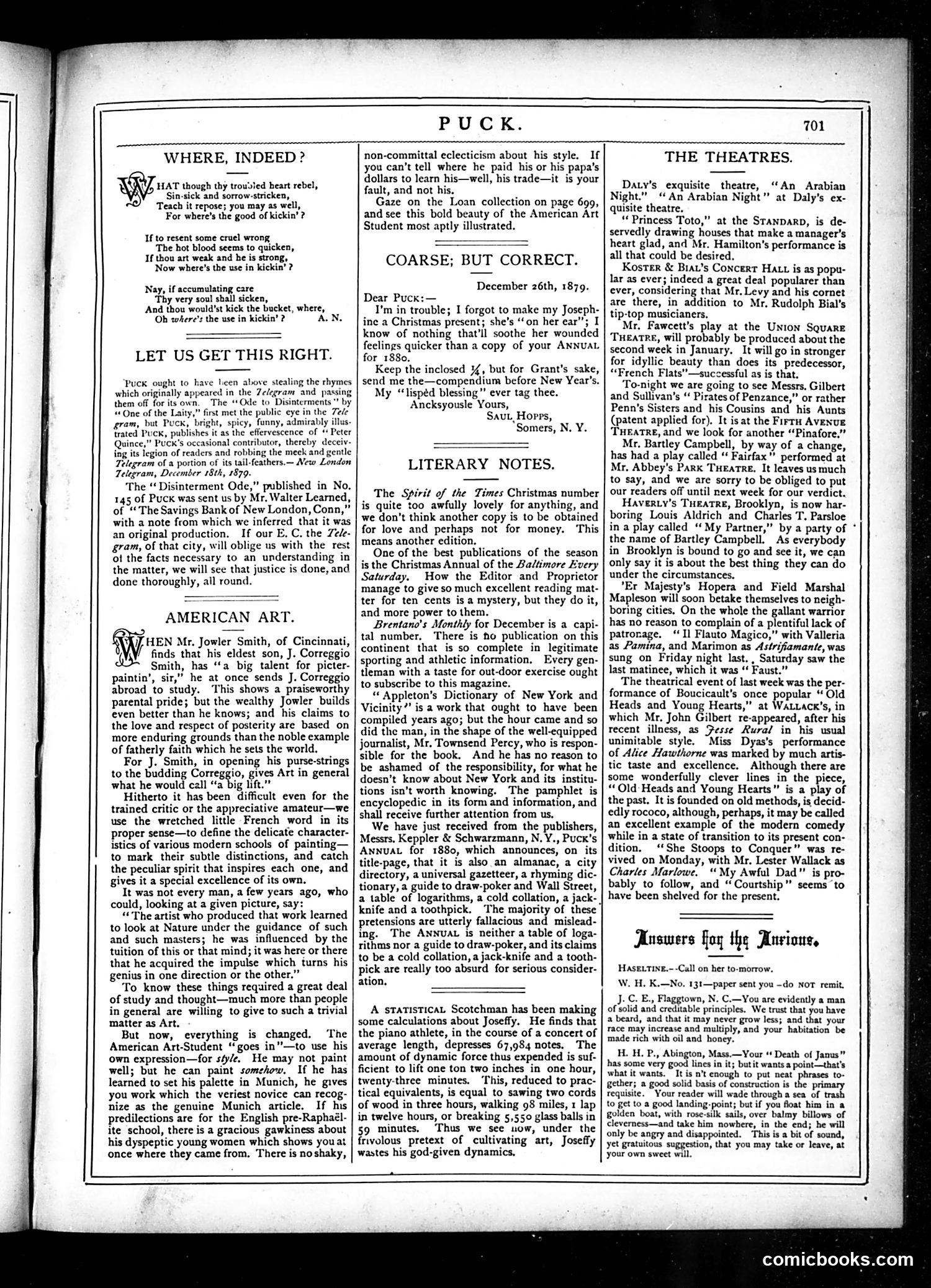
This page is primarily **text-based content** rather than illustrated cartoons. It contains: 1. **Poetry sections** ("Where, Indeed?" and "Let Us Get This Right") addressing readers with satirical commentary 2. **Theater reviews** covering productions at various New York venues 3. **Literary notes** discussing contemporary publications 4. **An "American Art" essay** critiquing art education and J. Correggio Smith's work 5. **A "Answers for the Anxious" advice column** The page lacks prominent political cartoons. Instead, it showcases Puck's satirical approach through **witty editorial commentary** on contemporary theater, art institutions, and reader questions. The tone is generally mocking toward artistic pretension and institutional pomposity—typical of Puck's satirical mission. Without seeing accompanying illustrations, the specific satirical targets remain somewhat general rather than person-specific.
📄 Transcribed text from this page (OCR, searchable)
Machine-transcribed from the original scan — historical spelling and the odd misread are preserved.
PUCK. WHERE, INDEED ? HAT though thy trouvied heart rebel, Sin-sick and sorrow-stricken, Teach it repose; you may as well, For where's the good of kickin’? If to resent some cruel wrong The hot blood seems to quicken, If thou art weak and he is strong, Now where's the use in kickin’ ? Nay, if accumulating care Thy very soul shall sicken, And thou would’st kick the bucket, where, Oh where's the use in kickin’ ? AN, LET US GET THIS RIGHT. Leen above stealing the rhymes which originally appeared in the Zelegram and passing them off for its own. The “Ode to Disinterments"’ by “One of the Laity,” first met the public eye in the 7e/e gram, but Puck, bright, spicy, funny, admirably illus trated Puck, publishes it as the effervescence of * Peter Quince,” Puck's occasional contributor, thereby deceiv- ing its legion of readers and robbing the meck and gentle Telegram of a portion of its tail-feathers.— New London Telegram, December 18th, 1879. The “ Disinterment Ode,” published in No. 145 of Puck was sent us by Mr. Walter Learned, of “The Savings Bank of New London, Conn,” with a note from which we inferred that it was an original production. If our E. C. the Zede- gram, of that city, will oblige us with the rest ol the facts necessary to an understanding in the matter, we will see that justice is done, and done thoroughly, all round. PUCK ought to h AMERICAN ART. HEN Mr. Jowler Smith, of Cincinnati, : finds that his eldest son, J. Correggio Smith, has ‘‘a big talent for picter- paintin’, sir,” he at once sends J. Correggio abroad to study. ‘This shows a praiseworthy parental pride; but the wealthy Jowler builds even better than he knows; and his claims to the love and respect of posterity are based on more enduring grounds than the noble example of fatherly faith which he sets the world. For J. Smith, in opening his purse-strings to the budding Correggio, gives Art in general what he would call “‘a big lift.” Hitherto it has been difficult even for the trained critic or the appreciative amateur—we use the wretched little French word in its proper sense—to define the delicate character- istics of various modern schools of painting— to mark their subtle distinctions, and catch the peculiar spirit that inspires each one, and gives it a special excellence of its own. It was not every man, a few years ago, who could, looking at‘a given picture, say: “The artist who produced that work learned to look at Nature under the guidance of such and such masters; he was influenced by the tuition of this or that mind; it was here or there that he acquired the impulse which turns his genius in one direction or the other.” To know these things required a great deal of study and thought—much more than people in general are willing to give to such a trivial matter as Art, But now, everything is changed. ‘The American Art-Student ‘goes in"—to use his own expression—for sfy/e. He may not paint well; but he can paint somehow. If he has learned to set his palette in Munich, he gives you work which the veriest novice can recog- nize as the genuine Munich article. If his predilections are for the English pre-Raphaél- ite school, there is a gracious gawkiness about his dyspeptic young women which shows youat once where they came from. There is noshaky, non-committal eclecticism about his style. If you can’t tell where he paid his or his papa’s dollars to learn his—well, his trade—it is your fault, and not his. Gaze on the Loan collection on page 699, and see this bold beauty of the American Art Student most aptly illustrated, COARSE; BUT CORRECT. December 26th, 1879. Dear Puck:— I'm in trouble; I forgot to make my Joseph- ine a Christmas present; she’s ‘on her ear’; know of nothing that'll soothe her wounded feelings quicker than a copy of your ANNUAL for 1880, Keep the inclosed 4, but for Grant's sake, send me the—compendium before New Year's. My “lispéd blessing” ever tag thee. Ancksyousle Yours, Sau, Hopps, Somers, N. Y. LITERARY NOTES. The Spirit of the Times Christmas number is quite too awfully lovely for anything, and we don’t think another copy is to be obtained for love and perhaps not for money. This means another edition, One of the best publications of the season is the Christmas Annual of the Baltimore Every Saturday, How the Editor and Proprietor manage to give so much excellent reading mat- ter for ten cents is a mystery, but they do it, and more power to them. Brentano's Monthly for December is a capi- tal number. There is fo publication on this continent that is so complete in legitimate sporting and athletic information. Every gen- tleman with a taste for out-door exercise ought to subscribe to this magazine. “ Appleton’s Dictionary of New York and Vicinity’ is a work that ought to have been compiled years ago; but the hour came and so did the man, in the shape of the well-equipped journalist, Mr. Townsend Percy, who is respon- sible for the book. And he has no reason to be ashamed of the responsibility, for what he doesn’t know about New York and its institu- tions isn’t worth knowing. The pamphlet is encyclopedic in its form and information, and shall receive further attention from us, We have just received from the publishers, Messrs. Keppler & Schwarzmann, N. Y., Puck’s ANNUAL for 1880, which announces, on its title-page, that it is also an almanac, a city directory, a universal gazetteer, a rhyming dic- tionary, a guide to draw-poker and Wall Street, a table of logarithms, a cold collation, a jack- | knife and a toothpick. The majority of these pretensions are utterly fallacious and mislead- ing. The ANNvAL is neither a table of loga- rithms nor a guide to draw-poker, and its claims to be a cold collation, a jack-knife and a tooth- pick are really too absurd for serious consider- ation. A statisticaL Scotchman has been making some calculations about Joseffy. He finds that the piano athlete, in the course of a concert of average length, depresses 67,984 notes. The amount of dynamic force thus expended is suf- ficient to lift one ton two inches in one hour, twenty-three minutes. ‘This, reduced to prac- tical equivalents, is equal to sawing two cords of wood in three hours, walking 98 miles, 1 lap in twelve hours, or breaking 5,550 glass balls in 59 minutes, Thus we see now, under the frivolous pretext of cultivating art, Joseffy wastes his god-given dynamics, THE THEATRES. Daty’s exquisite theatre, “An Arabian Night.” “An Arabian Night” at Daly's ex- quisite theatre, “Princess Toto,” at the Sranparp, is de- servedly drawing houses that make a manager’s heart glad, and Mr. Hamilton's performance is all that could be desired. Koster & Biat’s Concert HALt is as popu- lar as ever; indeed a great deal popularer than ever, considering that Mr.Levy and his cornet are there, in addition to Mr. Rudolph Bial’s tip-top musicianers, Mr. Fawcett’s play at the Union Square Tueatre, will probably be produced about the second week in January. It will go in stronger for idyllic beauty than does its predecessor, “French Flats”—successful as is that, To-night we are going to see Messrs. Gilbert and Sullivan's “ Pirates of Penzance,” or rather Penn's Sisters and his Cousins and his Aunts (patent applied for), It is at the Firru AVENUE Tueatre, and we look for another “Pinafore.” Mr. Bartley Campbell, by way of a change, has had a play called “ Fairfax" performed at Mr. Abbey's Park THEATRE, It leaves us much to say, and we are sorry to be obliged to put our readers off until next week for our verdict. Haverty's THEATRE, Brooklyn, is now har- boring Louis Aldrich and Charles T. Parsloe in a play called “My Partner,” by a party of * the name of Bartley Campbell. As everybody in Brooklyn is bound to go and see it, we can only say it is about the best thing they can do under the circumstances, ‘Er Majesty's Hopera and Field Marshal Mapleson will soon betake themselves to neigh- boring cities, On the whole the gallant warrior has no reason to complain of a plentiful lack of patronage. “Il Flauto Magico,” with Valeria as Pamina, and Marimon as Astrifiamante, was sung on Friday night last., Saturday saw the last matinee, which it was “ Faust.” The theatrical event of last week was the per- formance of Boucicault’s once popular “ Old Heads and Young Hearts,” at Wattack’s, in which Mr, John Gilbert re-appeared, after his recent illness, as Fesse Rural in his usual unimitable style. “Miss Dyas’s performance of Alice Hawthorne was marked by much artis- tic taste and excellence. Although there are some wonderfully clever lines in the piece, “Old: Heads and Young Hearts” is a play of the past. It is founded on old methods, is decid- edly rococo, although, perhaps, it may be called an excellent example of the modern comedy while in a state of transition to its present con- dition. ‘She Stoops to Conquer” was re- vived on Monday, with Mr. Lester Wallack as Charles Marlowe. “My Awful Dad" is pro- bably to follow, and “Courtship” seems ‘to have been shelved for the present. Answers Foy the Anvione, HaseLtine.—-Call on her to-morrow. W. H. No. 131—paper sent you -do Not remit, J.C. E., Flaggtown, N. C.—You are evidently a man of solid and creditable principles. We trust that you have a beard, and that it may never grow less; and that your race may increase and multiply, and your habitation be made rich with oil and honey, H. H. P., Abington, Mass.—Your “ Death of Janus” has some very good lines in it; butit wants a point—that's what it wants. "It is n't enough to put neat phrases to- gether; a good solid basis of construction is the primary Tequisite. Your reader will wade through a sea of trash to get to a good landing-point; but if you float him in a golden boat, with rose-silk sails, over balmy billows of cleverness—and take him nowhere, in the end; he will only be angry and disappointed. This is a bit of sound, yet gratuitous suggestion, that you may take or leave, at your own sweet will. comicbooks.com