
Puck, 1879-12-31 · page 10 of 16
Puck — December 31, 1879 — page 10: what you’re looking at
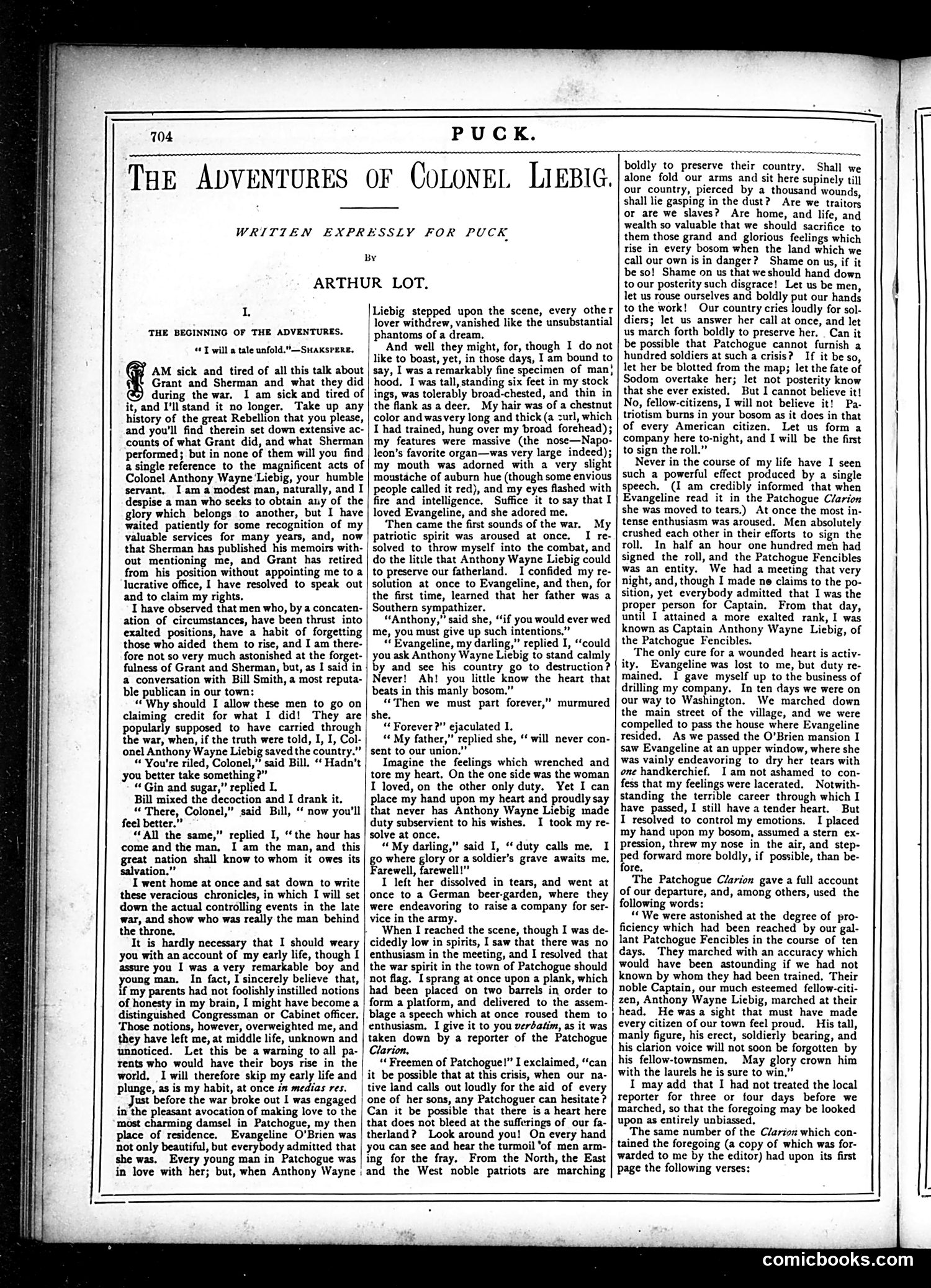
What you’re looking at
This page presents the beginning of a serialized story by Arthur Lot titled "The Adventures of Colonel Liebig," written expressly for Puck. The narrative is a first-person account by Colonel Anthony Wayne Liebig, who opens by expressing exhaustion with Civil War discussions. He's a retired military officer claiming significant wartime service, though he complains his contributions are underappreciated. The story appears to be satirical commentary on post-war American patriotism and memory. Liebig comes across as self-aggrandizing and bitter about recognition. Without additional context, the specific political targets remain unclear, but the piece seems to mock inflated military egos and revisionist Civil War narratives circulating in the Gilded Age.
📄 Transcribed text from this page (OCR, searchable)
Machine-transcribed from the original scan — historical spelling and the odd misread are preserved.
104 PUCK. Tar ADVENTURES OF CoLONEL LIEBIG. WRITIEN EXPRESSLY FOR PUCK B ARTHU I THE BEGINNING OF THE ADVENTURES. «© T will a tale unfold."—SHAxksPERE. | AM sick and tired of all this talk about Grant and Sherman and what they did during the war. I am sick and tired of it, and I'll stand it no longer. Take up any history of the great Rebellion that you please, and you'll find therein set down extensive ac- counts of what Grant did, and what Sherman performed; but in none of them will you find a single reference to the magnificent acts of Colonel Anthony Wayne'Liebig, your humble servant. I am a modest man, naturally, and I despise a man who seeks to obtain any of the glory which belongs to another, but I have waited patiently for some recognition of my valuable services for many years, and, now that Sherman has published his memoirs with- out mentioning me, and Grant has retired from his position without appointing me to a lucrative office, I have resolved to speak out and to claim my rights. I have observed that men who, bya concaten- ation of circumstances, have been thrust into exalted positions, have a habit of forgetting those who aided them to rise, and I am there- fore not so very much astonished at the forget- fulness of Grant and Sherman, but, as I sait a conversation with Bill Smith, a most reputa- ble publican in our town: “Why should I allow these men to go on claiming credit for what I did! ave, are ularly supposed to have carried through the war, when, if the truth were told, I, I, Col- onel Anthony Wayne Liebig saved the country.” “ You're riled, Colonel,” said Bill. “ Hadn't | you better take something?” “Gin and sugar,” replied I. Bill mixed the decoction and I drank it. “ There, Colonel,” said Bill, “‘ now you'll feel better.” “All the same,” replied I, ‘the hour has come and the man. I am the man, and this great nation shall know to whom it owes its salvation.” I went home at once and sat down to write these veracious chronicles, in which I will set down the actual controlling events in the late war, and show who was really the man behind the throne, It is hardly necessary that I should weary you with an account of my early life, though 1 assure you I was avery remarkable boy and young man. In fact, I sincerely believe that, if my parents had not foolishly instilled notions of honesty in my brain, I might have become a distinguished Congressman or Cabinet officer. Those notions, however, overweighted me, and they have left me, at middle life, unknown and unnoticed. Let this be a warning to all pa- rents who would have their boys rise in the world. 1 will therefore skip my early life and plunge, as is my habit, at once in medias res. Just before the war broke out I was engaged | in the pleasant avocation of making love to the most charming damsel in Patchogue, my then place of residence. Evangeline O’Brien was not only beautiful, but everybody admitted that | | like to boast, yet, in those days, Y R LOT. Liebig ste] upon the scene, every other ree oa vanished like the unsubstantial phantoms of a dream. And well they might, for, though I do not , I am bound to say, 1 was a remarkably fine specimen of man! hood. I was tall, standing six feet in my stock ings, was tolerably broad-chested, and thin in the flank as a deer. My hair was of a chestnut color and was very long and thick (a zurl, which Thad trained, hung over my broad forehead); my features were massive (the nose—Napo- leon’s favorite organ—was very large indeed); my mouth was adorned with a very slight moustache of auburn hue (though some envious people called it red), and my eyes flashed with fire and intelligence. Suffice it to say that I loved Evangeline, and she adored me. Then came the first sounds of the war. My patriotic spirit was aroused at once. I re- solved to throw myself into the combat, and do the little that Anthony Wayne Liebig could to preserve our fatherland. I confided my re- solution at once to Evangeline, and then, for the first time, learned that her father was a Southern sympathizer. “Anthony,” said she, “if you would ever wed me, you must give up such intentions,” « Evangeline, my darling,” replied I, “could you ask Anthony Wayne Liebig to stand calmly by and see his country go to destruction? Never! Ah! you little know the heart that beats in this manly bosom.” “Then we must part forever,” murmured she, “ Forever?” ejaculated I. « My father,” replied she, ‘ will never con- sent to our union.” Imagine the feelings which wrenched and tore my heart. On the one side was the woman 1 loved, on the other only duty. Yet I can place my hand upon my heart and proudly say that never has Anthony Wayne Liebig made duty subservient to his wishes. I took my re- solve at once. “My darling,” said I, “duty calls me, I 0 where glory or a soldier’s grave awaits me, ‘arewell, farewell!" I left her dissolved in tears, and went at once to a German beer-garden, where they were endeavoring to raise a company for ser- vice in the army. When I reached the scene, though I was de- cidedly low in spirits, I saw that there was no enthusiasm in the meeting, and I resolved that the war spirit in the town of Patchogue should not flag. I sprang at once upon a plank, which had been placed on two barrels in order to form a platform, and delivered to the assem- blage a speech which at once roused them to enthusiasm. I give it to you verbatim, as it was taken down by a reporter of the Patchogue Clarion, “Freemen of Patchogue!” I exclaimed, “‘can it be possible that at this crisis, when our na- tive land calls out loudly for the aid of every one of her sons, any Patchoguer can hesitate ? Can it be possible that there is a heart here that does not bleed at the sufferings of our fa- therland? Look around you! On every hand you can see aad hear the turmoil ‘of men arm- she was. Every young man in Patchogue was ing for the fray. From the North, the East in love with her; but, when Anthony Wayne: and the West noble patriots are marching boldly to preserve their country. Shall we alone fold our arms and sit here supinely till our country, pierced by a thousand wounds, shall lie gasping in the dust? Are we traitors or are we slaves? Are home, and life, and wealth so valuable that we should sacrifice to them those grand and glorious feelings which rise in every bosom when the land which we call our own is in danger? Shame on us, if it beso! Shame on us that we should hand down to our posterity such disgrace! Let us be men, let us rouse ourselves and boldly put our hands to the work! Our country cries loudly for sol- diers; let us answer her call at once, and let us march forth boldly to preserve her. . Can it be possible that Patchogue cannot furnish a hundred soldiers at such a crisis? If it be so, let her be blotted from the map; let the fate of Sodom overtake her; let not posterity know that she ever existed, But 1 cannot believe it! No, fellow-citizens, I will not believe it! Pa- triotism burns in your bosom as it does in that of every American citizen. Let us form a company here to-night, and I will be the first to sign the roll.” Never in the course of my life have I seen such a powerful effect produced by a single speech, (I am credibly informed that when Evangeline read it in the Patchogue Clarion she was moved to tears.) At once the most in- tense enthusiasm was aroused. Men absolutely crushed each other in their efforts to sign the roll. In half an hour one hundred men had signed the roll, and the Patchogue Fencibles was an entity. We had a meeting that very night, and, though I made ne claims to the po- sition, yet everybody admitted that I was the proper person for Captain. From that day, until I attained a more exalted rank, I was known as Captain Anthony Wayne Liebig, of the Patchogue Fencibles. The only cure for a wounded heart is activ- ity, Evangeline was lost to me, but duty re- mained, I gave myself up to the business of drilling my company. In ten days we were on our way to Washington. We marched down the main street of the village, and we were compelled to pass the house where Evangeline resided. As we passed the O’Brien mansion I saw Evangeline at an upper window, where she was vainly endeavoring to dry her tears with one handkerchief. I am not ashamed to con- fess that my feelings were lacerated. Notwith- standing the terrible career through which I have passed, I still have a tender heart. But I resolved to control my emotions. I placed my hand upon my bosom, assumed a stern ex- pression, threw my nose in the air, and step- ped forward more boldly, if possible, than be- lore, The Patchogue C/arion gave a full account of our departure, and, among others, used the following words: «We were astonished at the degree of pro- ficiency which had been reached by our gal- lant Patchogue Fencibles in the course of ten days. They marched with an accuracy which would have been astounding if we had not known by whom they had been trained. Their noble Captain, our much esteemed fellow-citi- zen, Anthony Wayne Liebig, marched at their head. He was a sight that must have made every citizen of our town feel proud. His tall, manly figure, his erect, soldierly bearing, and his clarion voice will not soon be forgotten by his fellow-townsmen, May glory crown him with the laurels he is sure to win,” 1 may add that I had not treated the local reporter for three or four days before we marched, so that the foregoing may be looked upon as entirely unbiassed. The same number of the C/arion which con- tained the foregoing (a copy of which was for- warded to me by the editor) had upon its first page the following verses: comicbooks.com