
A complete issue · 16 pages · 1879
Puck — December 24, 1879
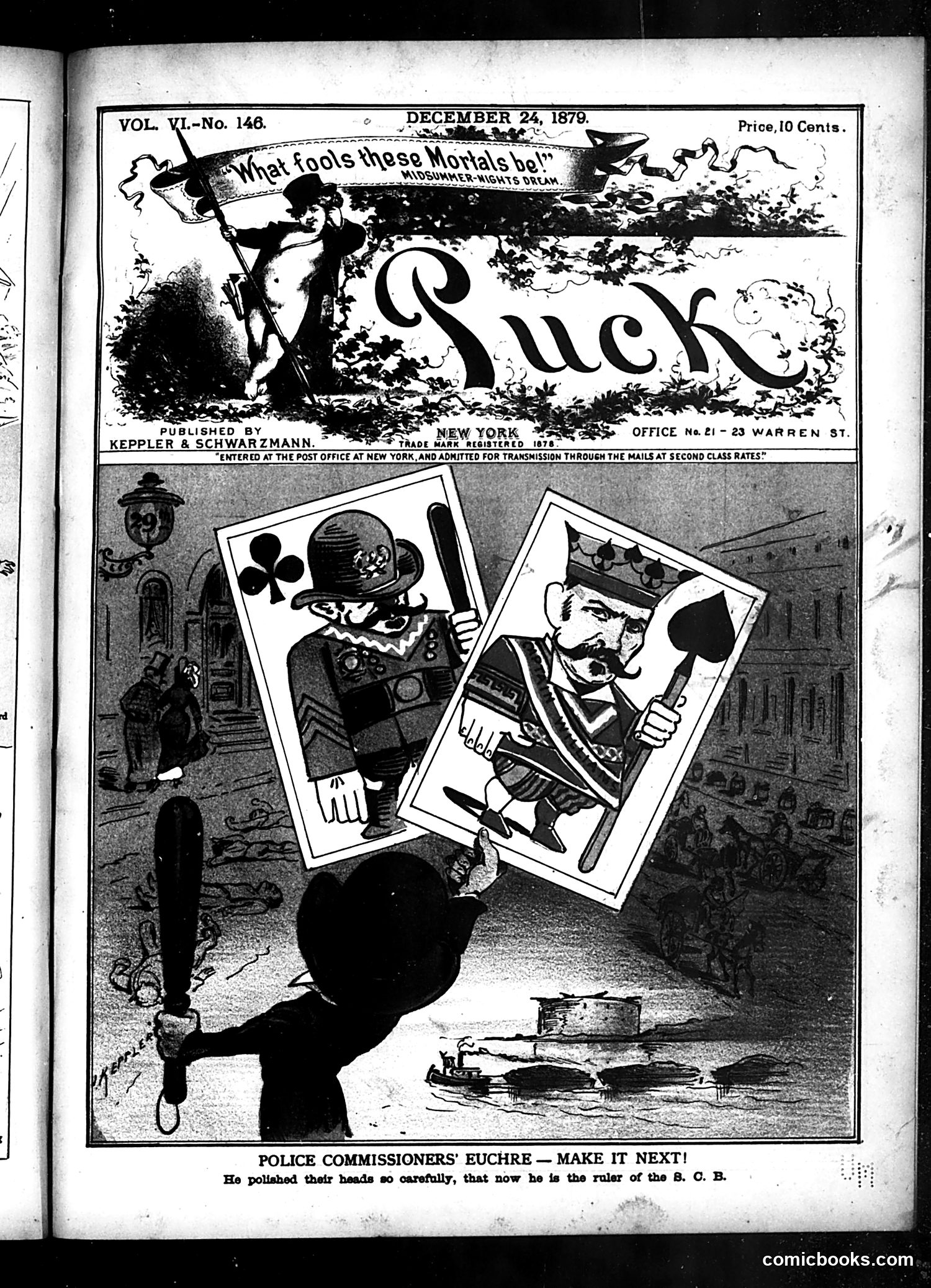
This cartoon satirizes the Police Commissioners' election. The silhouetted figure juggling playing cards (showing clubs and spades suits with military officers) represents political maneuvering. The caption "Police Commissioners' Euchre—Make It Next!" references euchre, a card game, suggesting the commissioners are "playing games" with their selection process. The text states "He polished their heads so carefully, that now he is the ruler of the B.C.B." (Board of City Commissioners, likely). This implies someone—possibly a political operative or reformer—has manipulated the commissioners so thoroughly that he now controls the board. The overall point: the police commission appointment process is a dishonest game of political manipulation rather than genuine governance.
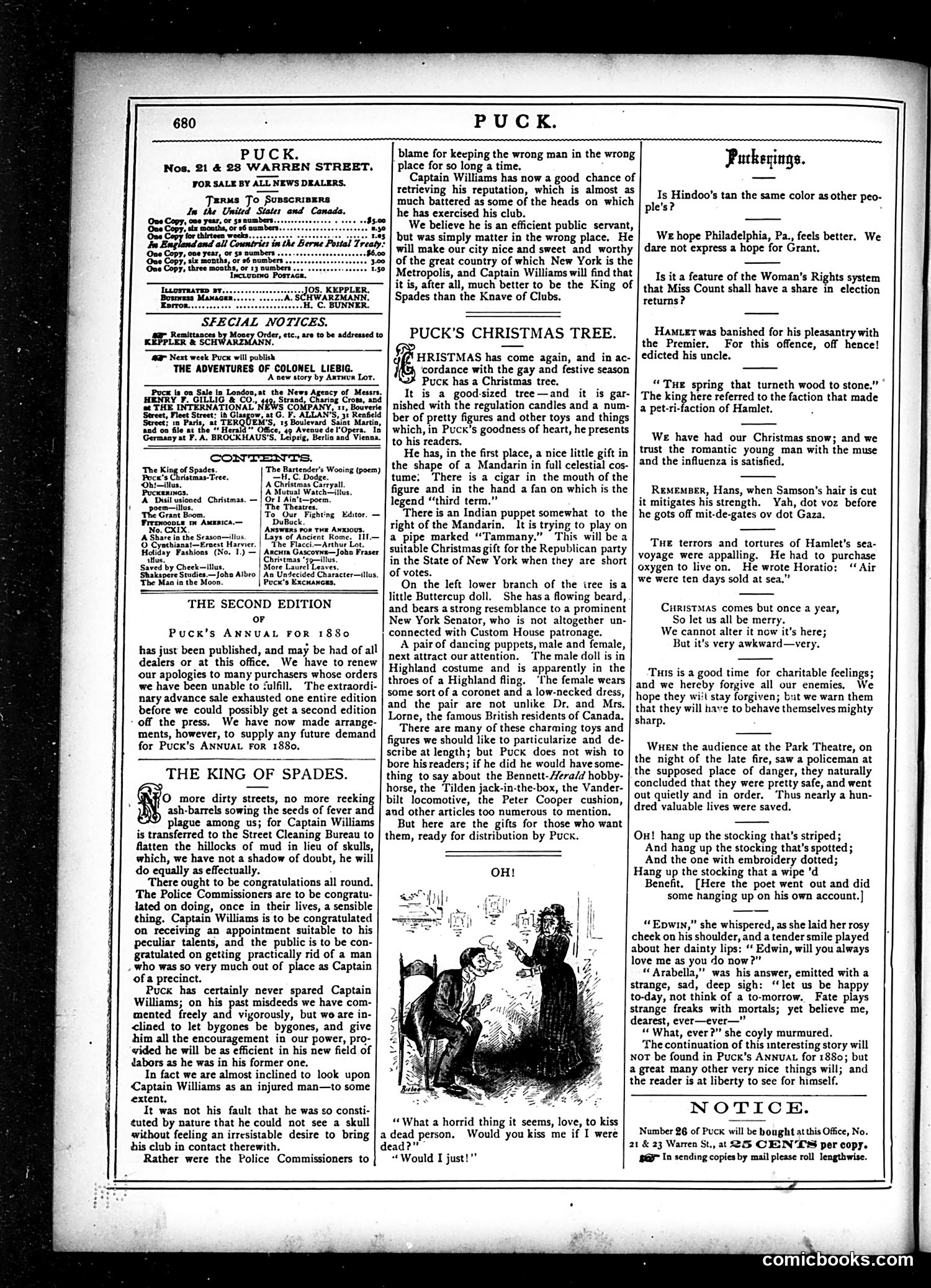
This page primarily contains **editorial content and advertisements** rather than a main political cartoon. The notable illustrated section is "Puck's Christmas Tree," which depicts holiday gift suggestions presented as satirical commentary. The main cartoon shows figures exchanging Christmas gifts with pointed social critiques. One figure appears to be a **policeman** (referenced in the accompanying text about witnessing a fire at a theater), suggesting commentary on public safety or law enforcement conduct. The text references **Captain Williams** and discusses his reputation and suitability for office, indicating this relates to local New York politics of the 1880 era, though the specific political context remains unclear without additional historical documentation. The page functions primarily as **holiday-themed satire** rather than focused political commentary.
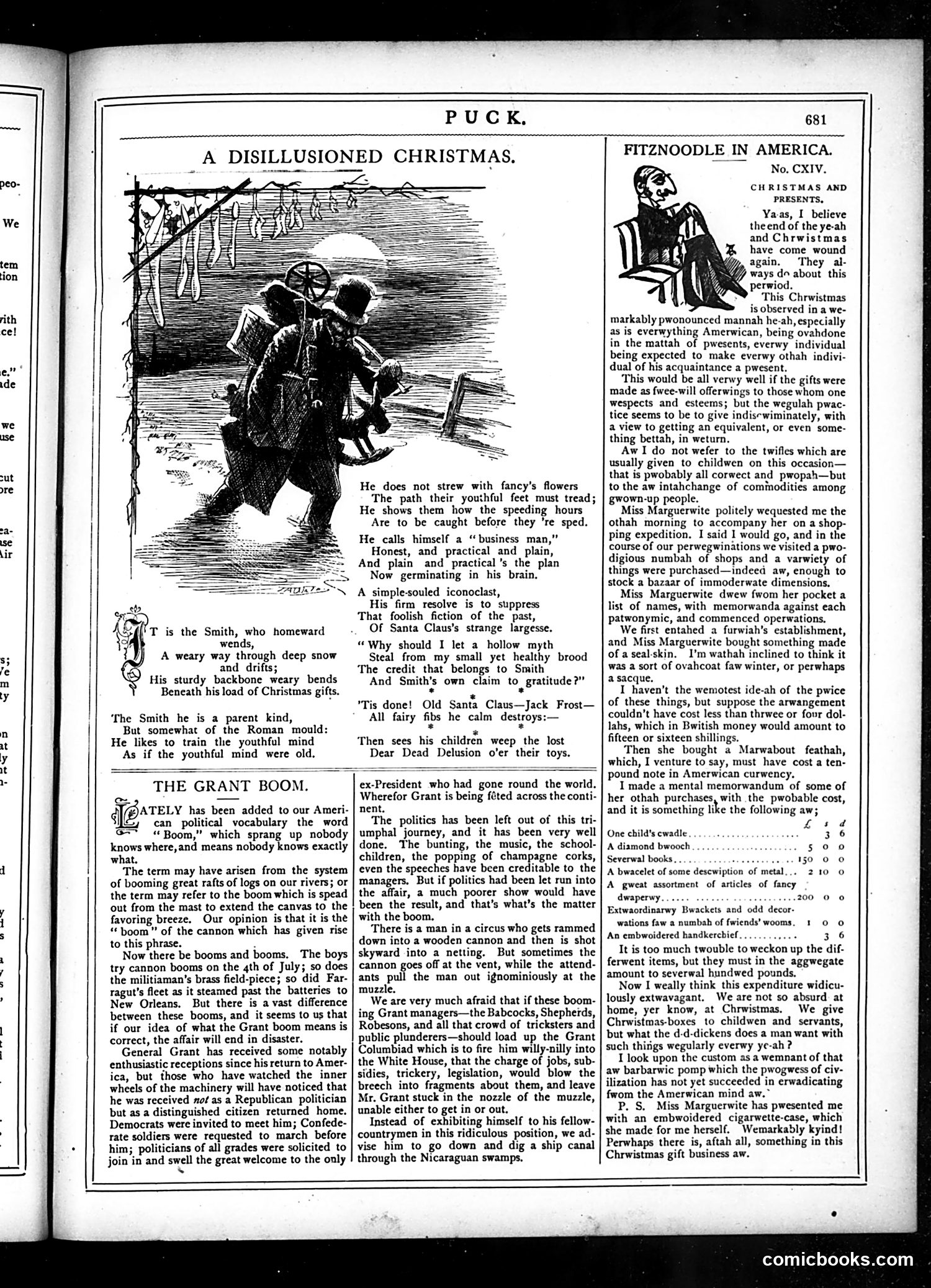
This cartoon satirizes the commercialization of American Christmas during the Gilded Age. The accompanying poem mocks a "business man" named Smith who epitomizes practical materialism—rejecting "fancy's flowers" and "foolish fiction" of Santa Claus for children. Instead of wonder, Smith teaches his kids about "speeding hours" and commercial efficiency. The satire attacks how industrial capitalism corrupts childhood innocence. Smith represents the era's hard-nosed businessman who cannot tolerate sentimentality or myth, reducing Christmas to transaction and utility. The poem's tone is biting: Smith is "a parent kind" but corrupted by "the Roman mould," prioritizing rational self-interest over imagination. Puck uses this figure to criticize how American commerce was strangling traditional holiday magic—a concern that remains relevant today.
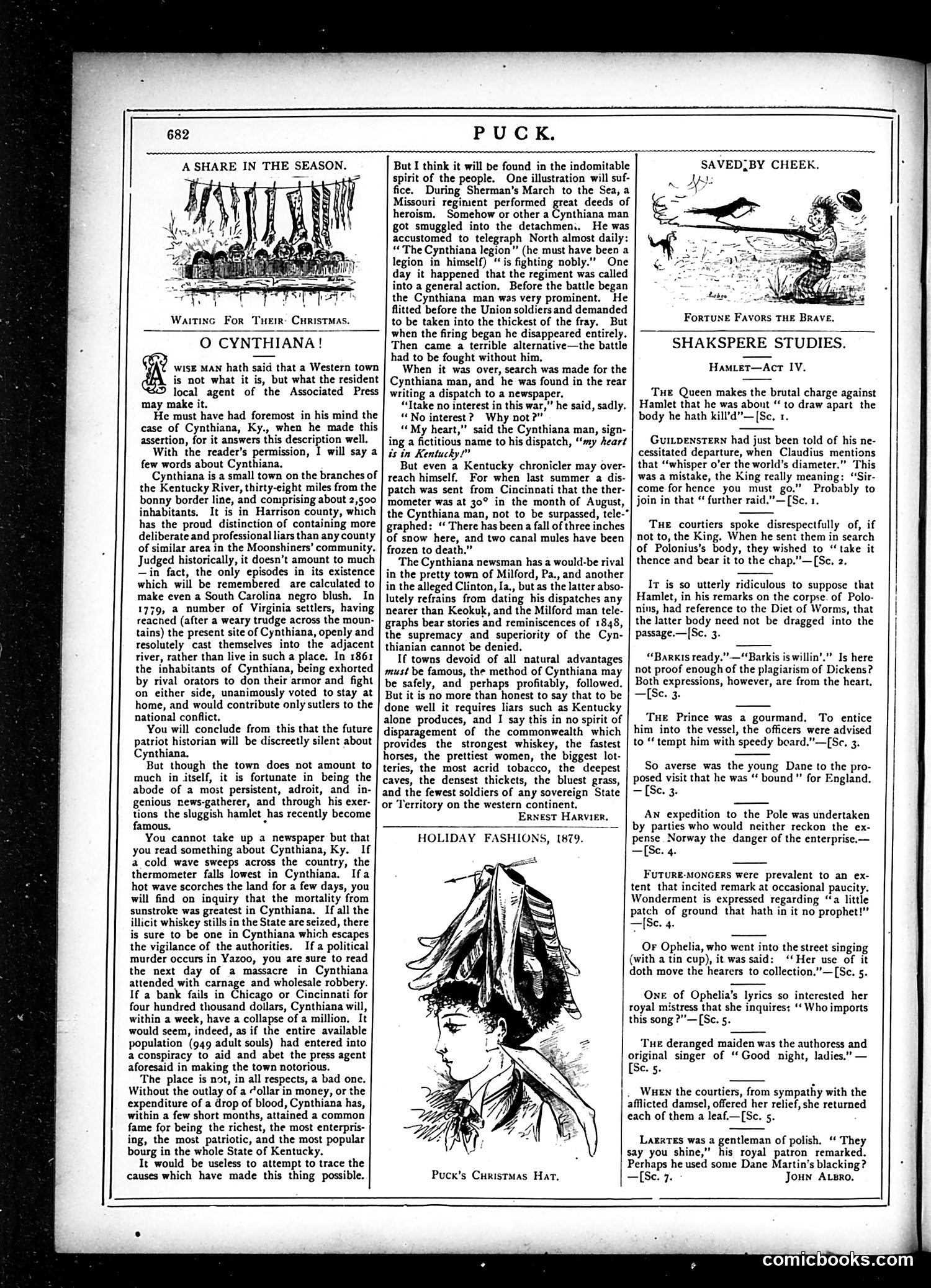
This page contains three distinct sections: **"A Share in the Season" / "Waiting for Their Christmas"**: The left illustration depicts what appears to be impoverished people crowded together in harsh conditions, likely commenting on class inequality during the holiday season. **"O Cynthiana!"**: The central article by Ernest Harvier discusses a small Kentucky town's notoriety for violence and lawlessness, including murders and robberies. It satirizes the town's "fame" while noting the irony that it boasts of being "the richest, most enterprising" in Kentucky. **"Shakespere Studies"** and other sections on the right contain literary commentary on Hamlet. **"Holiday Fashions, 1879"**: The illustration shows a woman's elaborate hat design typical of Victorian-era fashion. The page mixes social commentary, local satire, and cultural critique typical of Puck's approach.
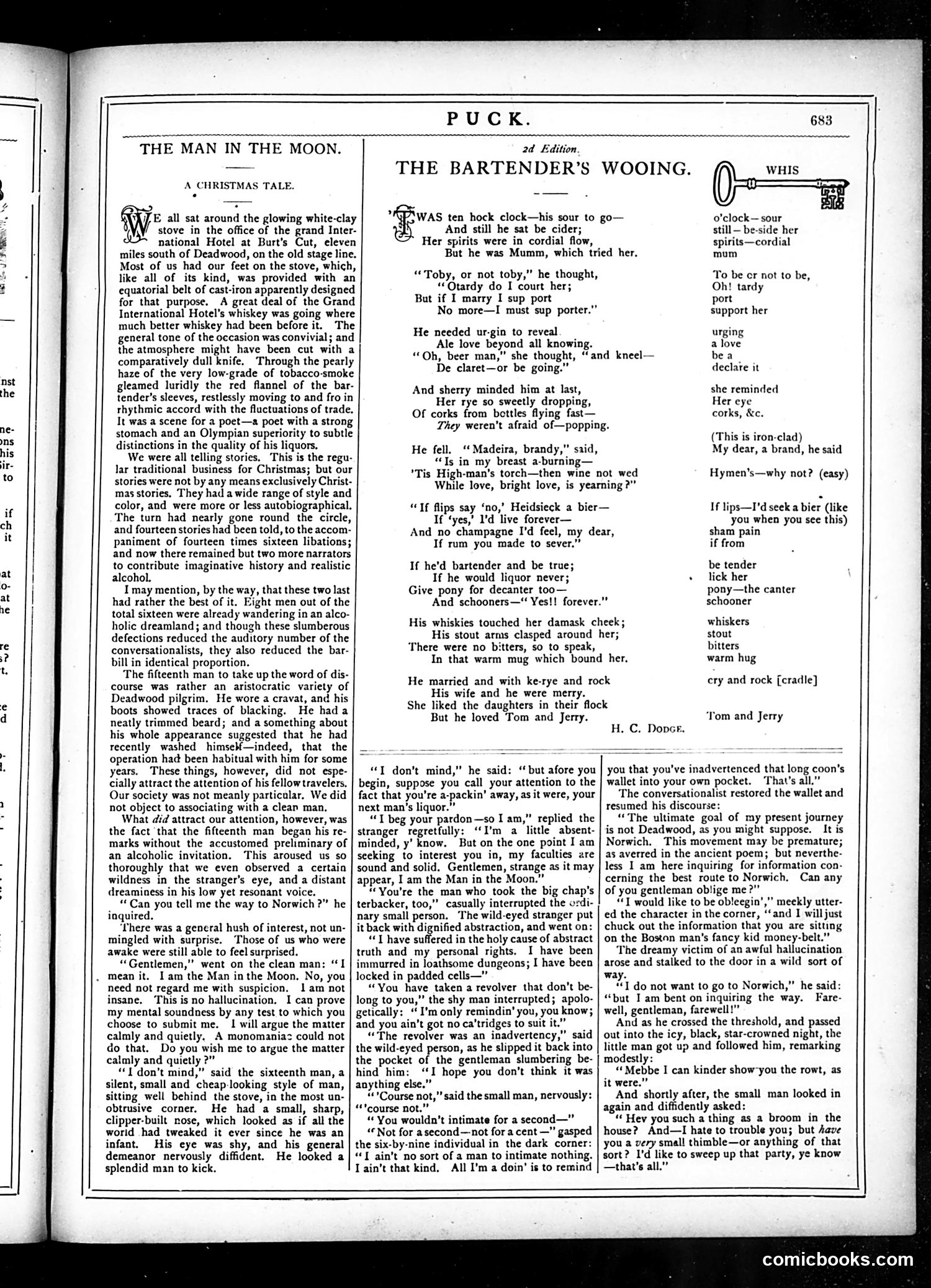
This page contains two separate pieces of fiction/poetry rather than political cartoons: 1. **"The Man in the Moon"** (left) - A Christmas tale describing a scene in a hotel bar, presented as conversational narrative about storytelling traditions. 2. **"The Bartender's Wooing"** (right) - A poem by H.C. Dodge about a bartender courting a woman, told through verse with accompanying stage directions and annotations. Neither piece appears to be political satire. Instead, this represents Puck's literary content—the magazine published humor through stories and poems alongside its famous satirical illustrations. The annotations in the margins appear to be editorial notes or performance directions, suggesting these were meant as dramatic readings or performances for entertainment rather than social/political commentary.
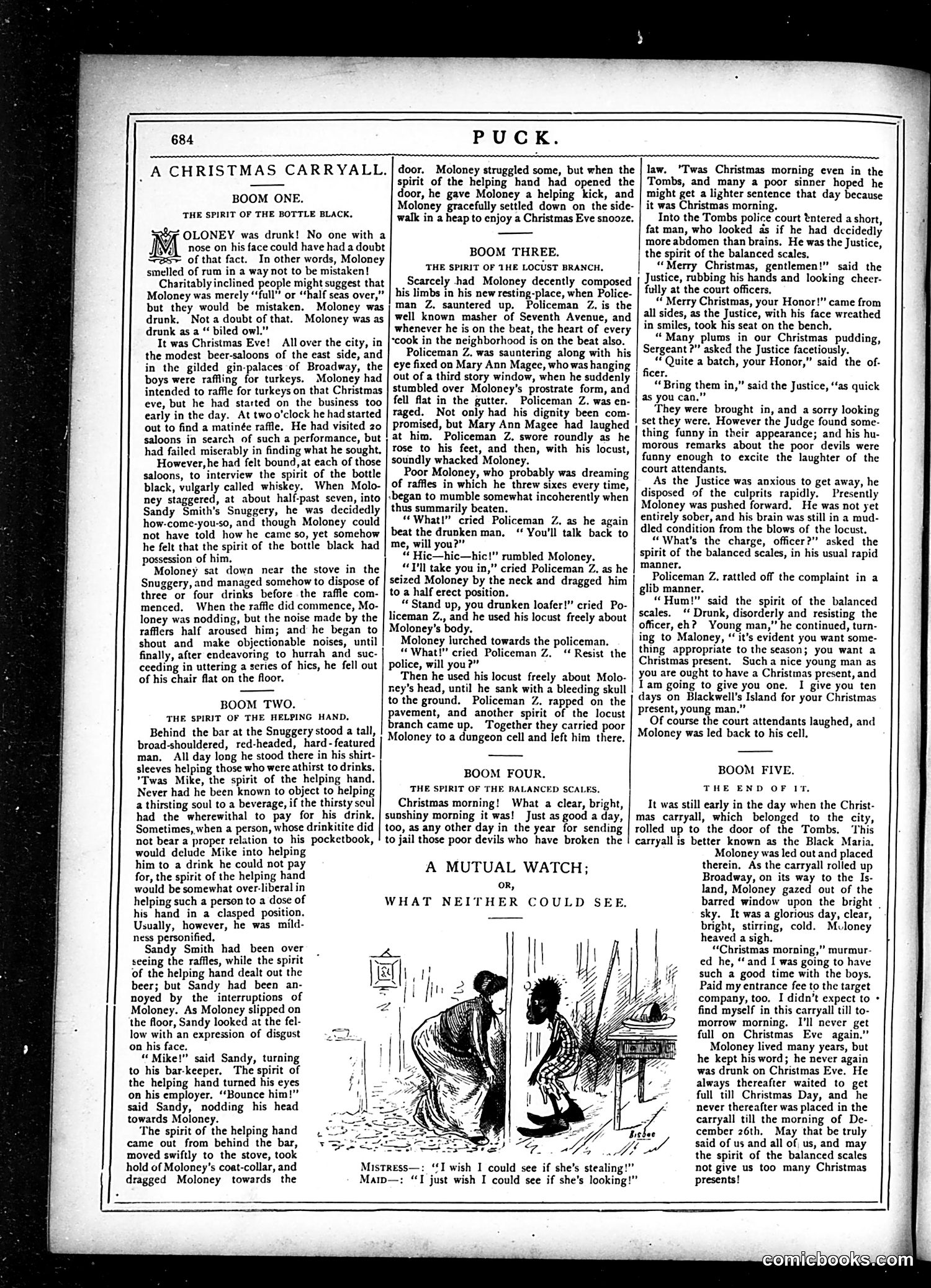
This is a serialized Christmas story in Puck magazine, structured as five "booms" (sections) following the ghost-story format of Dickens's *A Christmas Carol*. The narrative follows Moloney, a drunk, as various spirits teach him moral lessons on Christmas Eve. The main cartoon ("A Mutual Watch; or, What Neither Could See") depicts a maid and mistress—likely representing class differences—unable to see each other's true circumstances. The maid wishes she could see if the mistress is stealing; the mistress wishes she could see if the maid is stealing. The satire critiques mutual suspicion and class distrust during the holiday season, suggesting both servant and employer harbor unjust suspicions of one another. The story uses familiar Victorian moral tropes to address urban poverty and redemption.
This page consists primarily of theatre reviews, advice columns, and literary responses rather than political cartoons. The visible content includes: **"Or I Ain't"** - A poem about an Arab chief in Eastern lands, apparently a humorous narrative piece. **Theatre section** - Reviews of various productions at Abbey's Park Theatre and other venues, including "An Arabian Night," "The Hardback Family," and "Pinaforé." **"To Our Fighting Editor"** - Readers' humorous complaints about spelling and literary matters. **"Lays of Ancient Rome"** - A satirical poem about the Flacci family, using classical Rome as a vehicle for social commentary about domestic disputes and marital law. The satire here appears genteel and literary rather than overtly political—targeting pretension, domestic absurdity, and theatrical excess rather than specific politicians or events.
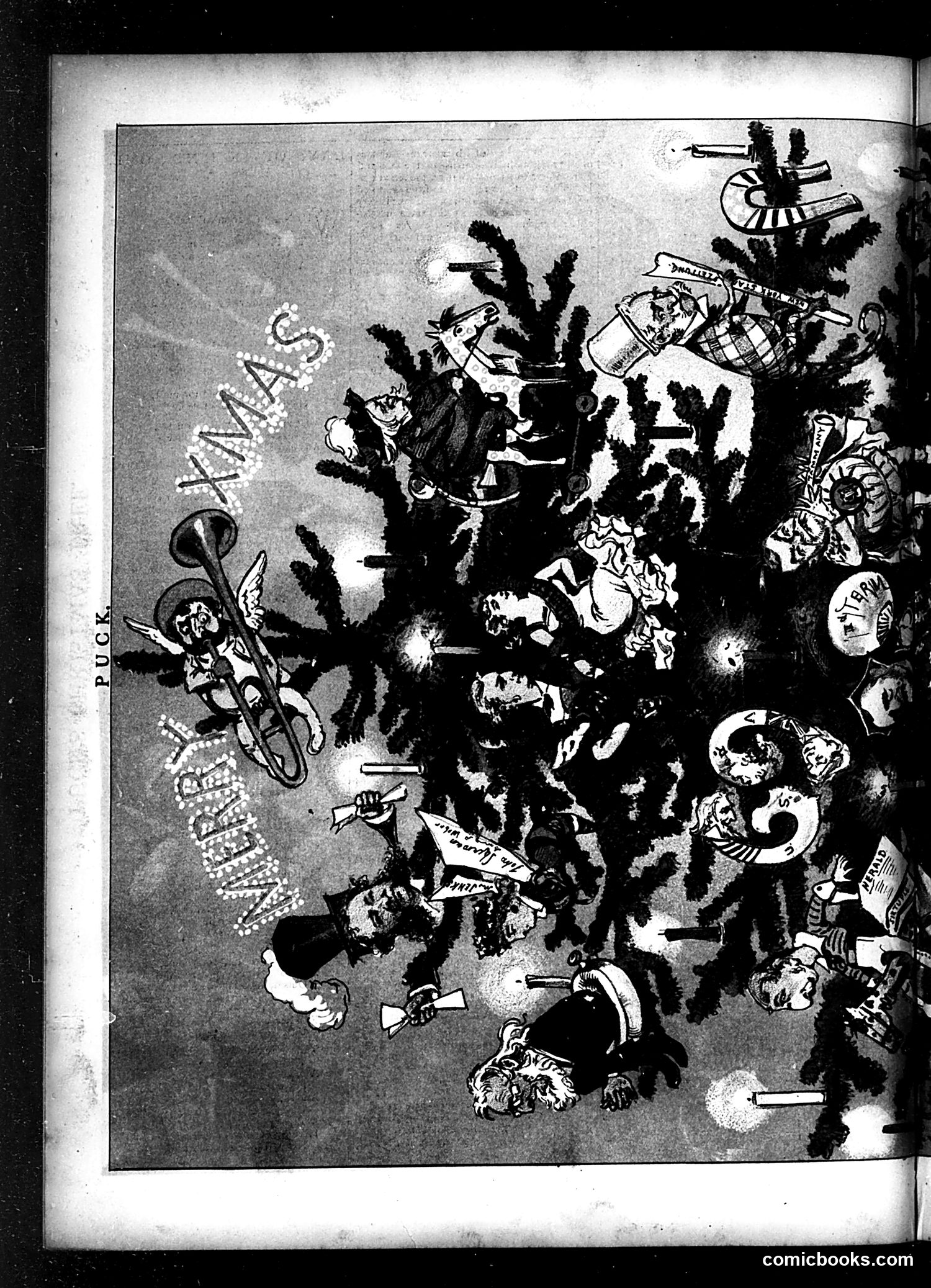
This appears to be a chaotic satirical illustration titled "Xmas" (visible on the left margin), depicting a crowded, anarchic Christmas scene. The image shows numerous figures in apparent pandemonium—people falling, colliding, and creating mayhem around what seems to be holiday festivities. The cartoon likely satirizes the commercialization and chaos of Christmas shopping or holiday excess in late 19th/early 20th-century America. The tightly packed, overlapping figures suggest the disorder and frenzy accompanying holiday celebrations. Various mechanical devices and activity visible suggest industrial-age Christmas commerce. Without clearer identification of specific caricatured figures or readable text identifying particular politicians or social figures, the precise satirical targets remain unclear. The general point appears critical of holiday-season disorder and excess.
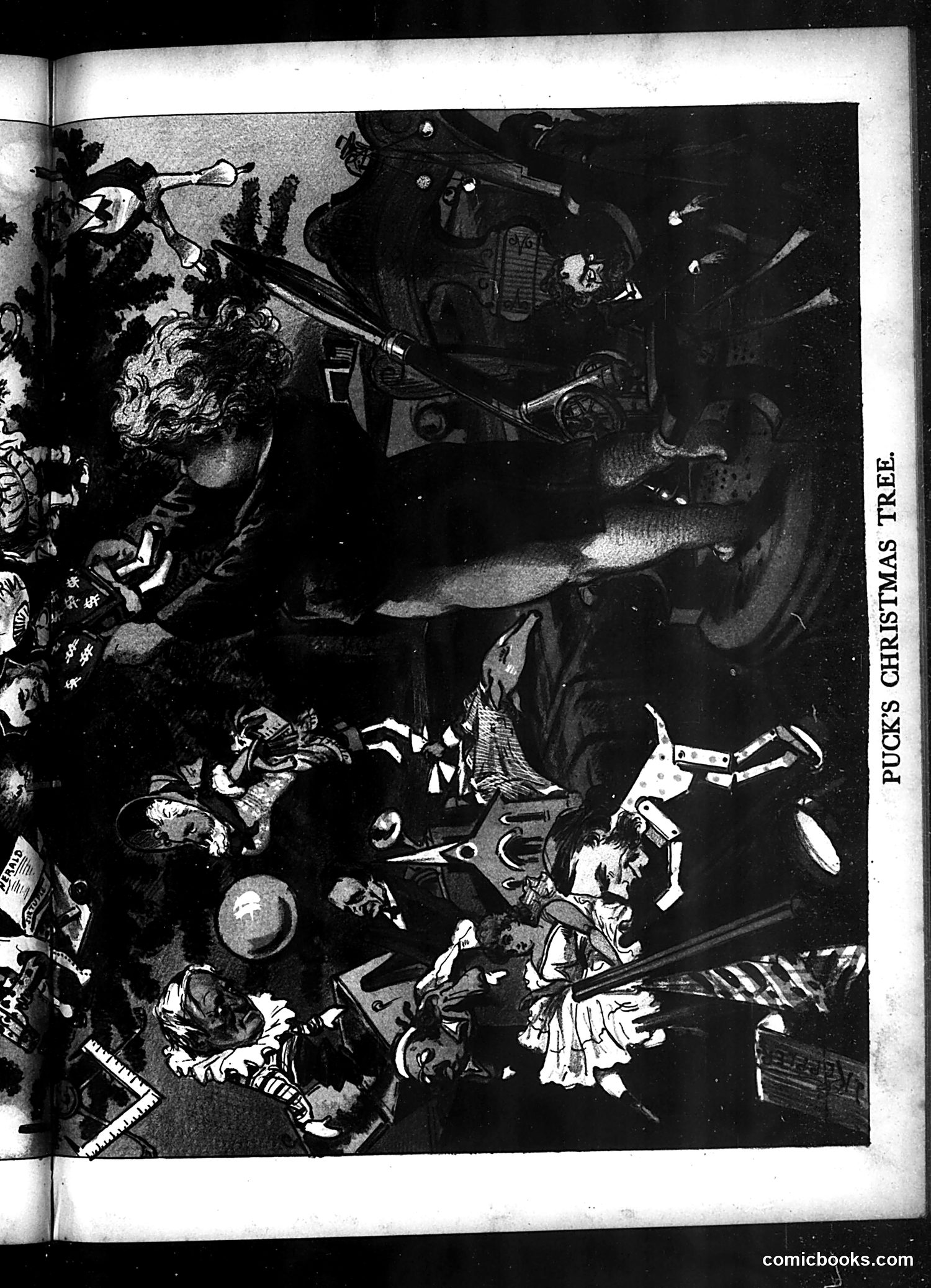
This page shows "Puck's Christmas Tree," a satirical illustration depicting various figures and caricatures arranged around a decorated Christmas tree. The image appears to be a political cartoon from Puck magazine, using the holiday tree as a framework for social commentary. The composition includes multiple figures—some appear to be caricatured politicians or public figures of the era, arranged in a hierarchical or chaotic manner around the tree. The style suggests early-to-mid 20th century American satirical art. Without clearer identification of specific individuals or visible text explaining the particular political references, the exact targets of the satire are unclear from this reproduction alone. The cartoon likely critiqued contemporary political figures, social issues, or holiday-season hypocrisy typical of Puck's editorial approach.
This page contains the conclusion of a serialized story titled "Archie Gascoyne" by John Fraser, not a political cartoon. The text is a Victorian-era narrative about romantic entanglement involving characters named Mademoiselle, the Count, Archie, and the Doctor. The story deals with domestic drama—misunderstandings about a woman's identity and honor, questions of marriage and propriety, and social standing. References to "Silver Lake," "Skye," and Scottish elements suggest British setting. This appears to be fiction serialized in *Puck* magazine rather than satirical commentary. Without seeing illustrations accompanying this text section, I cannot identify specific caricatures or political references. The page functions as literary entertainment rather than political satire.
This page is primarily **text and advertisements** rather than political cartoons. The main content is a serialized story titled "L'ENVOI: An Epilogue Which Is Partly Prologue," which appears to be concluding a longer narrative about characters including Effie, Ronald, Archie, and Captain Macleod. The advertisements below the story include notices for **"Princess Toto"** (theater), **human hair goods** (wigs and switches), **F. Vilmar** (photography), and **Vin Mariani** (a likely patent medicine). This page contains **no evident political satire or social commentary**—it's simply a continuation of serialized fiction typical of Puck's format, supplemented by period commercial advertisements.
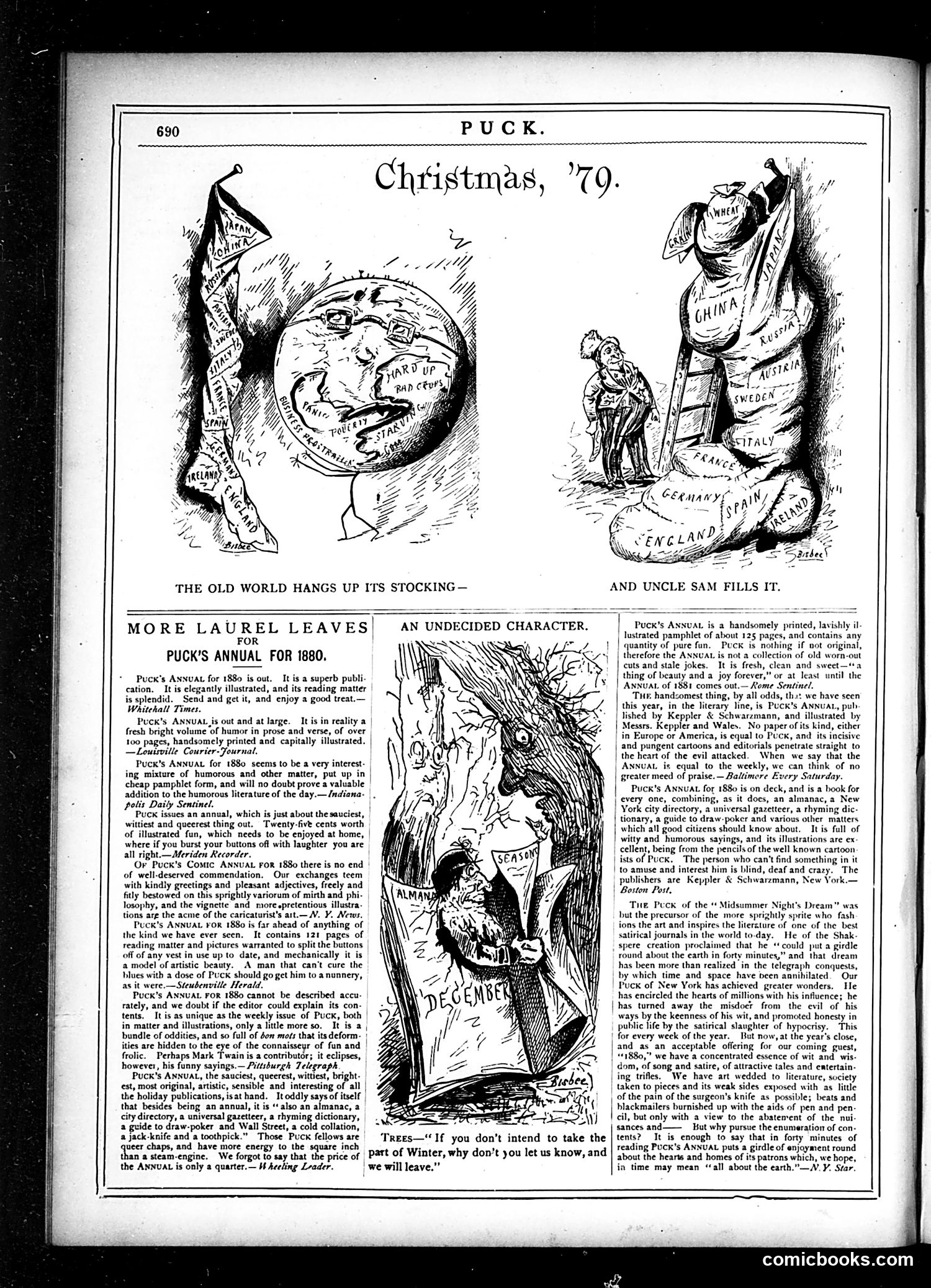
The two cartoons satirize international tensions as the new decade approaches. **Left panel ("The Old World Hangs Up Its Stocking"):** A grotesque face representing the Old World/Europe hangs as a Christmas stocking. Labels on the wrapping identify various nations (appears to include references to European powers), suggesting Europe itself is depicted as worn-out and awaiting relief or judgment. **Right panel ("And Uncle Sam Fills It"):** A towering figure labeled "Uncle Sam" fills the stocking with various goods/nations, including China, Austria, and others. This depicts America as the beneficent power reshaping global affairs. The satire comments on American economic and political ascendancy in 1879, contrasting a decrepit Old World with an expansive, confident United States assuming global influence and commercial dominance.
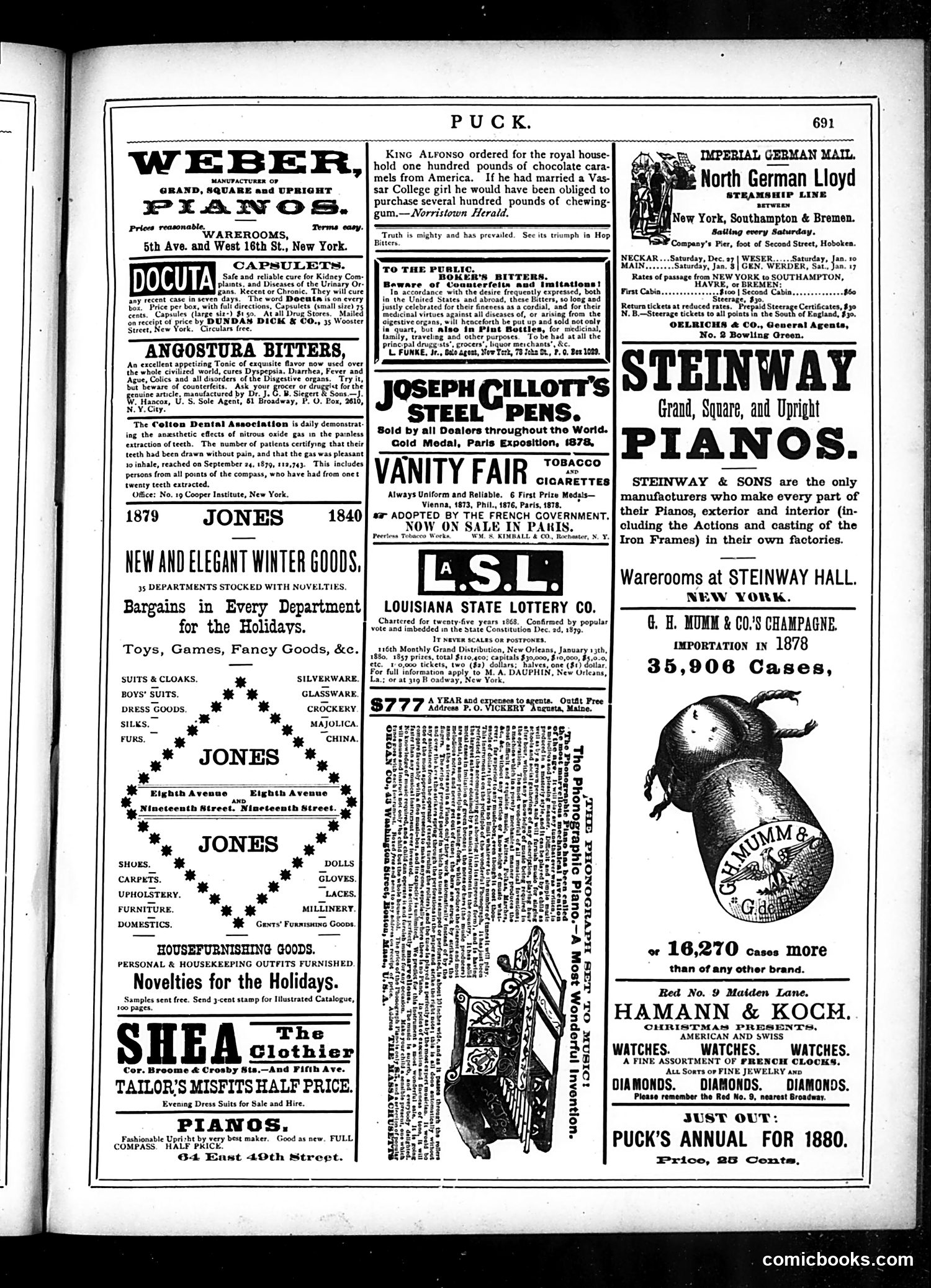
This page is predominantly **advertising**, not political satire or editorial cartooning. The visible content includes: - **Weber Pianos** advertisement (top left) - Multiple patent medicine ads: **Angostura Bitters**, **Joseph Gillott's Steel Pens**, **Vanity Fair Tobacco Cigarettes** - **Steinway Pianos** (large right-side ad) - **Louisiana State Lottery** advertisement - **Jones** department store holiday goods promotion - **G.H. Mumm & Co. Champagne** (with distinctive bottle illustration) - **Hamann & Koch** watches and diamonds - Various other commercial goods The page's primary purpose is generating revenue through paid advertisements rather than presenting satirical commentary. The small illustration visible (appears to be a lottery-related image) is promotional rather than editorial in nature.
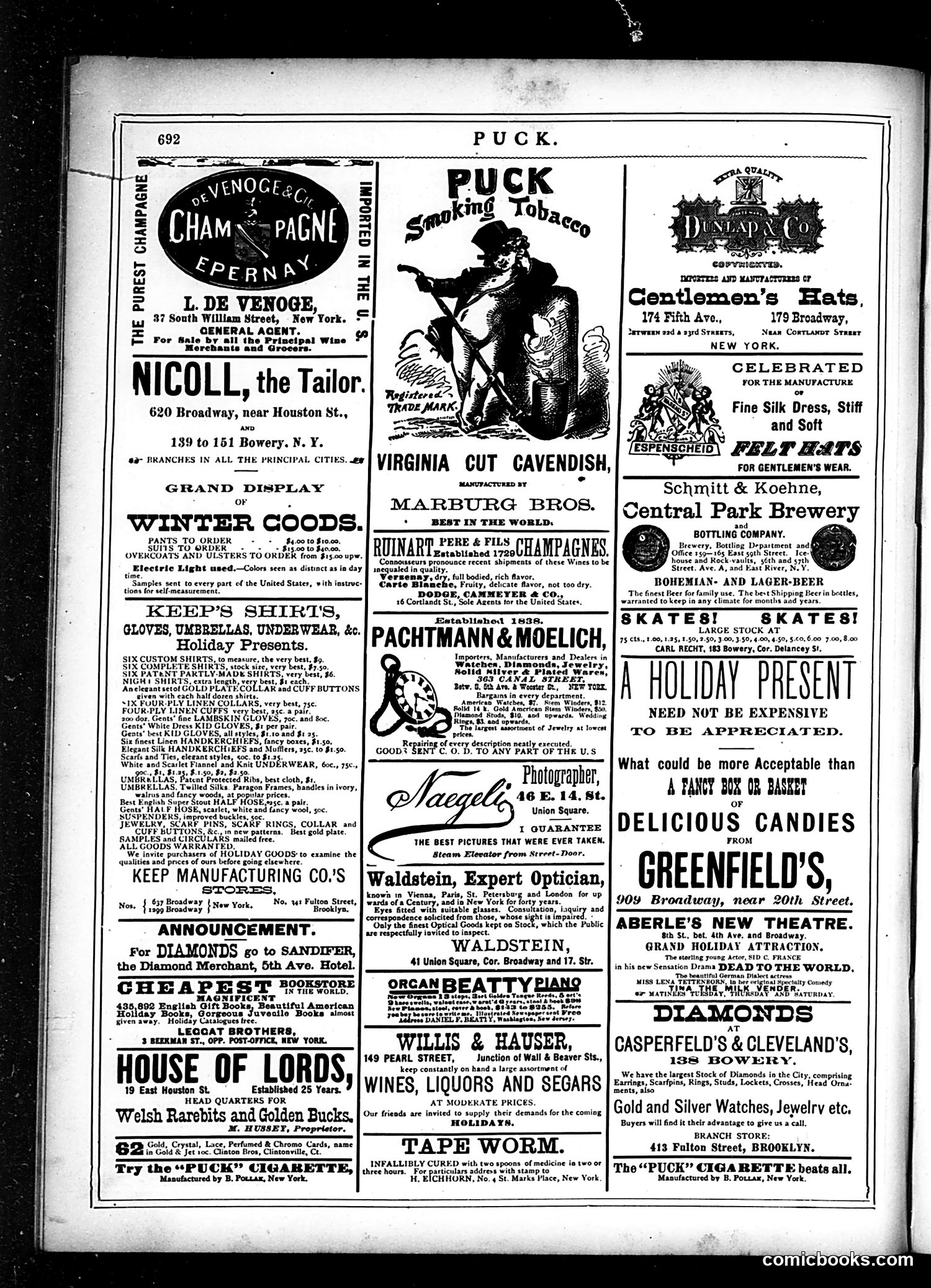
This page is **primarily advertisements** from a late 19th or early 20th-century Puck magazine. The central image shows "PUCK Smoking Tobacco" with a figure in period dress smoking a pipe—a product advertisement rather than political satire. The page contains various commercial ads: champagne, tailoring services, gentlemen's hats, breweries, candies, diamonds, pianos, eyeglasses, and other goods. A small section advertises Aberley's Theatre with reference to a play called "Dead to the World." There is **no discernible political cartoon or satirical content** visible on this page. It functions primarily as a commercial vehicle, with the Puck masthead and brand identity used to attract readers to advertisements. The historical interest lies in documenting late 19th-century New York commerce and consumer goods rather than in political commentary.
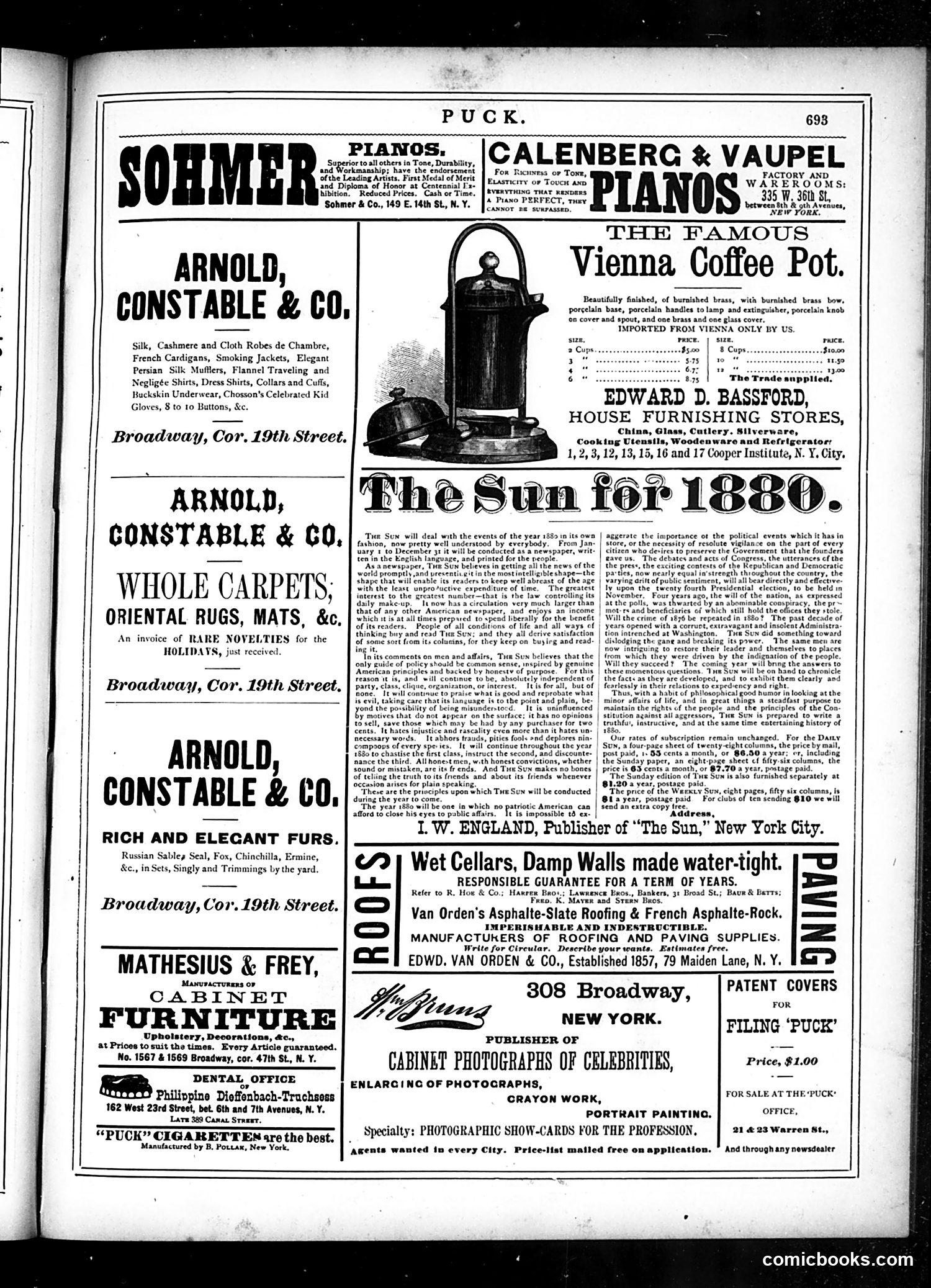
This is primarily an **advertising page** from Puck magazine (page 699), not a satirical cartoon page. The layout features multiple commercial advertisements for goods and services typical of 1880s New York City: - Piano manufacturers (Sohmer, Calenberg & Vaupel) - Furniture dealers (Arnold, Constable & Co.; Mathesius & Frey) - A Vienna Coffee Pot (housewares) - Roofing materials - Carpet and rug merchants - Cabinet photography services The only editorial content is a small piece titled **"The Sun for 1880,"** which discusses The Sun newspaper's editorial principles and circulation rates. This page demonstrates how 19th-century magazines subsidized publication through extensive advertising rather than reader subscriptions alone.
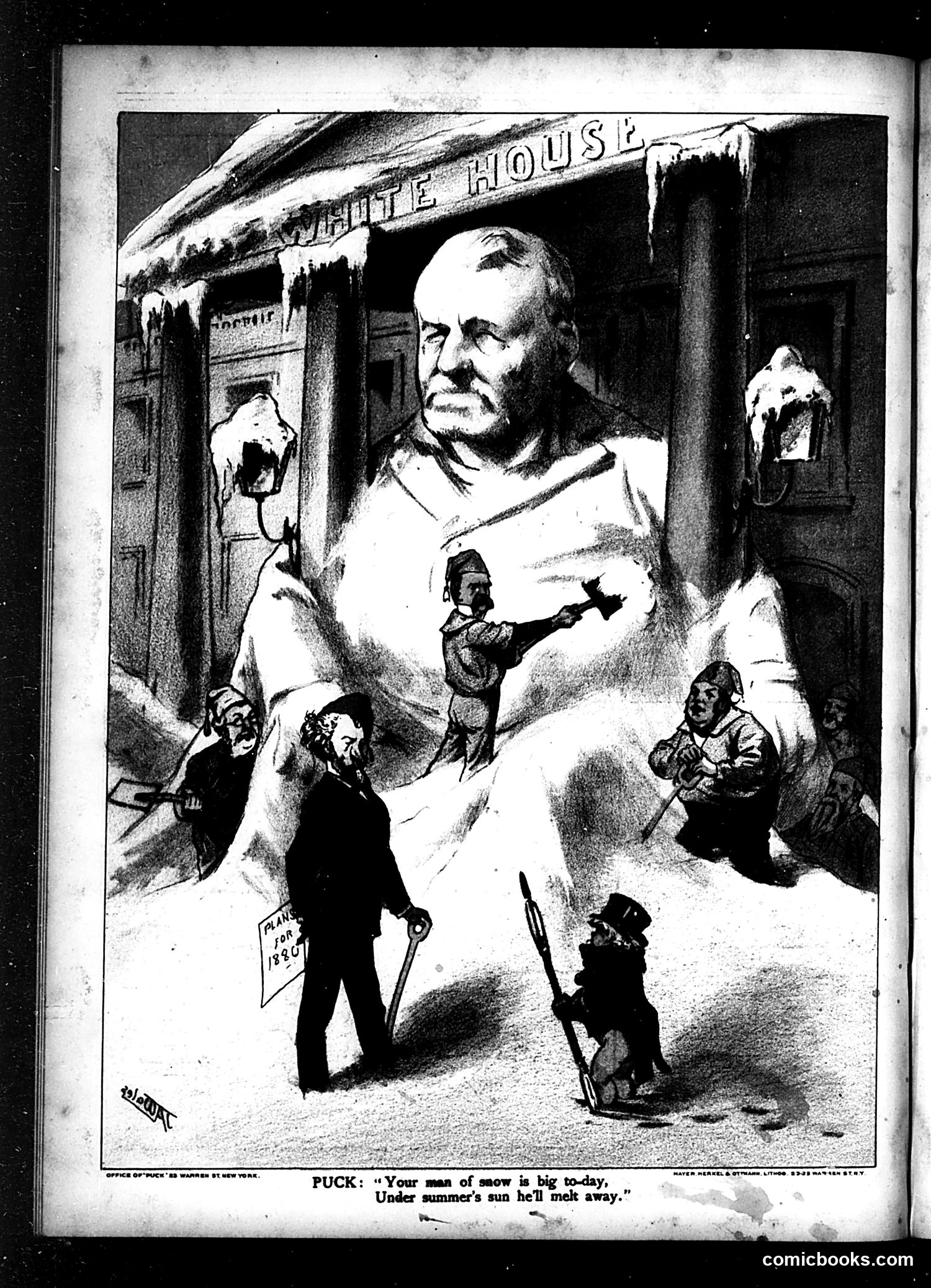
This Puck cartoon depicts a large figure (appearing to represent a political leader or public figure) outside the White House during winter, surrounded by smaller figures with tools and weapons. The caption reads: "Your man of snow is big to-day, Uncle; Under summer's sun he'll melt away." The satire uses a snowman as metaphor—suggesting the figure's power or popularity is temporary and will diminish. The smaller figures around him appear to be workers or soldiers, possibly representing political supporters or government officials. Without being able to definitively identify the large figure or determine the exact date, the cartoon's message is clear: it mocks someone's current prominence as ephemeral, destined to collapse when circumstances change (symbolized by warmer weather melting snow).