
Puck, 1879-12-24 · page 7 of 16
Puck — December 24, 1879 — page 7: what you’re looking at
What you’re looking at
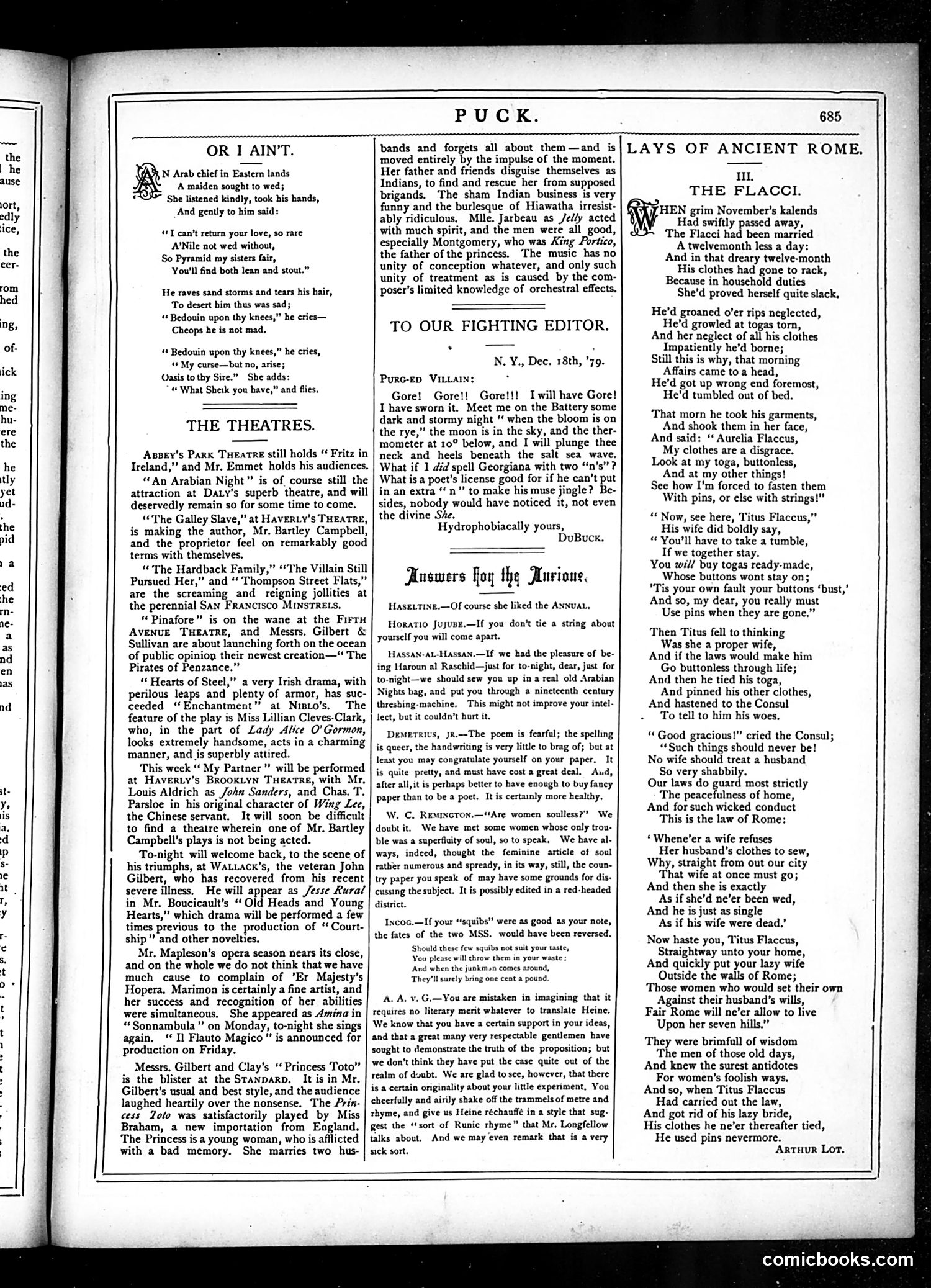
This page consists primarily of theatre reviews, advice columns, and literary responses rather than political cartoons. The visible content includes: **"Or I Ain't"** - A poem about an Arab chief in Eastern lands, apparently a humorous narrative piece. **Theatre section** - Reviews of various productions at Abbey's Park Theatre and other venues, including "An Arabian Night," "The Hardback Family," and "Pinaforé." **"To Our Fighting Editor"** - Readers' humorous complaints about spelling and literary matters. **"Lays of Ancient Rome"** - A satirical poem about the Flacci family, using classical Rome as a vehicle for social commentary about domestic disputes and marital law. The satire here appears genteel and literary rather than overtly political—targeting pretension, domestic absurdity, and theatrical excess rather than specific politicians or events.
📄 Transcribed text from this page (OCR, searchable)
Machine-transcribed from the original scan — historical spelling and the odd misread are preserved.
ort, edly ice, PUCK. 685 OR I AIN’T. N Arab chief in Eastern lands A maiden sought to wed; . She listened kindly, took his hands, ‘And gently to him said: «J can’t return your love, so rare A’Nile not wed without, So Pyramid my sisters fair, You'll find both lean and stout.” He raves sand storms and tears his hair, To desert him thus was sad; «Bedouin upon thy knees," he cries— Cheops he is not mad. + Bedouin upon thy knees,” he cries, «« My curse—but no, arise; Oasis to thy Sire.” She adds: « What Sheik you have,” and flies. THE THEATRES. Appey's Park THEATRE still holds “ Fritz in Ireland,” and Mr. Emmet holds his audiences. “An Arabian Night” is of course still the attraction at DaLy’s superb theatre, and will deservedly remain so for some time to come. “The Galley Slave,” at HAVERLY's THEATRE, is making the author, Mr. Bartley Campbell, and the proprietor feel on remarkably good terms with themselves, “The Hardback Family,” ‘The Villain Still Pursued Her,” and “Thompson Street Flats,” are the screaming and reigning jollities at the perennial San FRaNcisco MINSTRELS. “Pinafore” is on the wane at the Firrx Avenve THEATRE, and Messrs. Gilbert & Sullivan are about launching forth on the ocean of public opiniop their newest creation—“ The Pirates of Penzance.” “ Hearts of Steel,” a very Irish drama, with perilous leaps and plenty of armor, has suc- ceeded “Enchantment” at Nisto's. The feature of the play is Miss Lillian Cleves-Clark, who, in the part of Lady Alice O'Gormon, looks extremely handsome, acts in a charming manner, and jis superbly attired. ‘This week “‘ My Partner” will be performed at Haverty’s BRooKLyN THEATRE, With Mr. Louis Aldrich as John Sanders, and Chas, T. Parsloe in his original character of Wing Lee, the Chinese servant. It will soon be difficult to find a theatre wherein one of Mr. Bartley Campbell's plays is not being acted. To-night will welcome back, to the scene of his triumphs, at WaALLack’s, the veteran John Gilbert, who has recovered from his recent severe illness, He will appear as Jesse Rural in Mr. Boucicault’s ‘Old Heads and Young Hearts,” which drama will be performed a few times previous to the production of “ Court- ship” and other novelties. Mr. Mapleson’s opera season nears its close, and on the whole we do not think that we have much cause to complain of 'Er Majesty's Hopera. Marimon is certainly a fine artist, and her success and recognition of her abilities were simultaneous. She appeared as Amina in “Sonnambula” on Monday, to-night she sings again. “Tl Flauto Magico”” is announced for production on Friday. Messrs. Gilbert and Clay's “Princess Toto” is the blister at the STANDARD. It is in Mr. Gilbert's usual and best style, and the audience laughed heartily over the nonsense. The Prin- cess. Toto was satisfactorily played by Miss Braham, a new importation from England. The Princess is a young woman, who is afflicted with a bad memory. She marries two hus- bands and forgets all about them—and is moved entirely by the impulse of the moment. Her father and friends disguise themselves as Indians, to find and rescue her from supposed brigands. The sham Indian business is very funny and the burlesque of Hiawatha irresist- ably ridiculous, Mlle. Jarbeau as Jelly acted with much spirit, and the men were all good, especially Montgomery, who was King Portico, the father of the princess, The music has no unity of conception whatever, and only such unity of treatment as is caused by the com- poser’s limited knowledge of orchestral effects. TO OUR FIGHTING EDITOR. N. Y., Dec. 18th, ’79. . Purc-ED VILLAIN: Gore! Gore!! Gore!!! Iwill have Gore! I have sworn it. Meet me on the Battery some dark and stormy night “ when the bloom is on the rye,” the moon is in the sky, and the ther- mometer at 10° below, and I will plunge thee neck and heels beneath the salt sea wave. What if 1 did spell Georgiana with two “n's"? What is a poet’s license good for if he can’t put in an extra “nn” to make his muse jingle? Be- sides, nobody would have noticed it, not even the divine She. Hydrophobiacally yours, DuBuck. Answers Foy the Aurinue, Hase.tine.—Of course she liked the ANNUAL. Horatio Juyupe.—If you don't tie a string about yourself you will come apart. HASSAN-AL-HASSAN.—If we had the pleasure of be- ing Haroun al Raschid—just for to-night, dear, just for to-night—we should sew you up ina real old Arabian Nights bag, and put you through a nineteenth century thresbing-machine. This might not improve your intel- lect, but it couldn't burt it. Demereivs, jR.—The poem is fearful; the spelling is queer, the handwriting is very little to brag of; but at least you may congratulate yourself on your paper, It is quite pretty, and must have cost a great deal, Aud, after all,it is perhaps better to have enough to buy fancy paper than to be a poet. It is certainly more healthy, W. C. Remincton.—Are women soulless?” We doubt it. We have met some women whose only trou- ble was a superfiuity of soul, so to speak. We have al- ways, indeed, thought the feminine article of soul rather numerous and spready, in its way, still, the coun- try paper you speak of may have some grounds for dis- cussing the subject. It is possibly edited in a red-headed district. Ixcoc.—If your “squibs”” were as good as your note, the fates of the two MSS, would have been reversed. Should these few squibs not suit your taste, please will throw them in your waste; And when the junkmsn comes around, They'll surely bring one cent a pound. G.—You are mistaken in imagining that it requires no literary merit whatever to translate Heine. We know that you bave a certain support in your ideas, and that a great many very respectable gentlemen have sought to demonstrate the truth of the proposition; but we don't think they have put the case quite out of the realm of daubt. We are glad to see, however, that there is a certain originality about your little experiment, You cheerfully and airily shake off the trammels of metre and rhyme, and give us Heine réchauffé in a style that sug- gest the ‘sort of Runic rhyme” that Mr. Longfellow talks about. And we may even remark that is a very sick sort. LAYS OF ANCIENT ROME. il, THE FLACCI. oa erin November’s kalends lad swiftly passed away, GUS The Flacei had been married A twelvemonth less a day: And in that dreary twelve-month His clothes had gone to rack, Because in household duties She'd proved herself quite slack. He'd groaned o’er rips neglected, He'd growled at togas torn, And her neglect of all his clothes Impatiently he'd borne; Still this is why, that morning Affairs came to a head, He'd got up wrong end foremost, He'd tumbled out of bed. That morn he took his garments, And shook them in her face, And said: “ Aurelia Flaccus, My clothes are a disgrace. Look at my toga, buttonless, And at my other things! See how I'm forced to fasten them With pins, or else with strings!” ‘Now, see here, Titus Flaccus,” His wife did boldly say, “ You'll have to take a tumble, If we together stay, You will buy togas ready-made, Whose buttons wont stay on; ‘Tis your own fault your buttons ‘bust,’ And so, my dear, you really must Use pins when they are gone.” Then Titus fell to thinking Was she a proper wife, And if the laws would make him Go buttonless through life; And then he tied his toga, And pinned his other clothes, And hastened to the Consul To tell to him his woes. “Good gracious!” cried the Consul; “Such things should never be! No wife should treat a husband So very shabbily. Our laws do guard most strictly The peacefulness of home, And for such wicked conduct This is the law of Rome: ‘Whene’er a wife refuses Her husband's clothes to sew, Why, straight from out our city That wife at once must go; And then she is exactly As if she'd ne'er been wed, And he is just as single As if his wife were dead.’ Now haste you, Titus Flaccus, Straightway unto your home, And quickly put your lazy wife Outside the walls of Rome; Those women who would set their own Against their husband's wills, Fair Rome will ne'er allow to live Upon her seven hills.” They were brimfull of wisdom The men of those old days, And knew the surest antidotes For women’s foolish ways. And so, when Titus Flaccus Had carried out the law, And got rid of his lazy bride, His clothes he ne’er thereafter tied, He used pins nevermore. Artuur Lor. comicbooks.com