
Puck, 1879-12-24 · page 5 of 16
Puck — December 24, 1879 — page 5: what you’re looking at
What you’re looking at
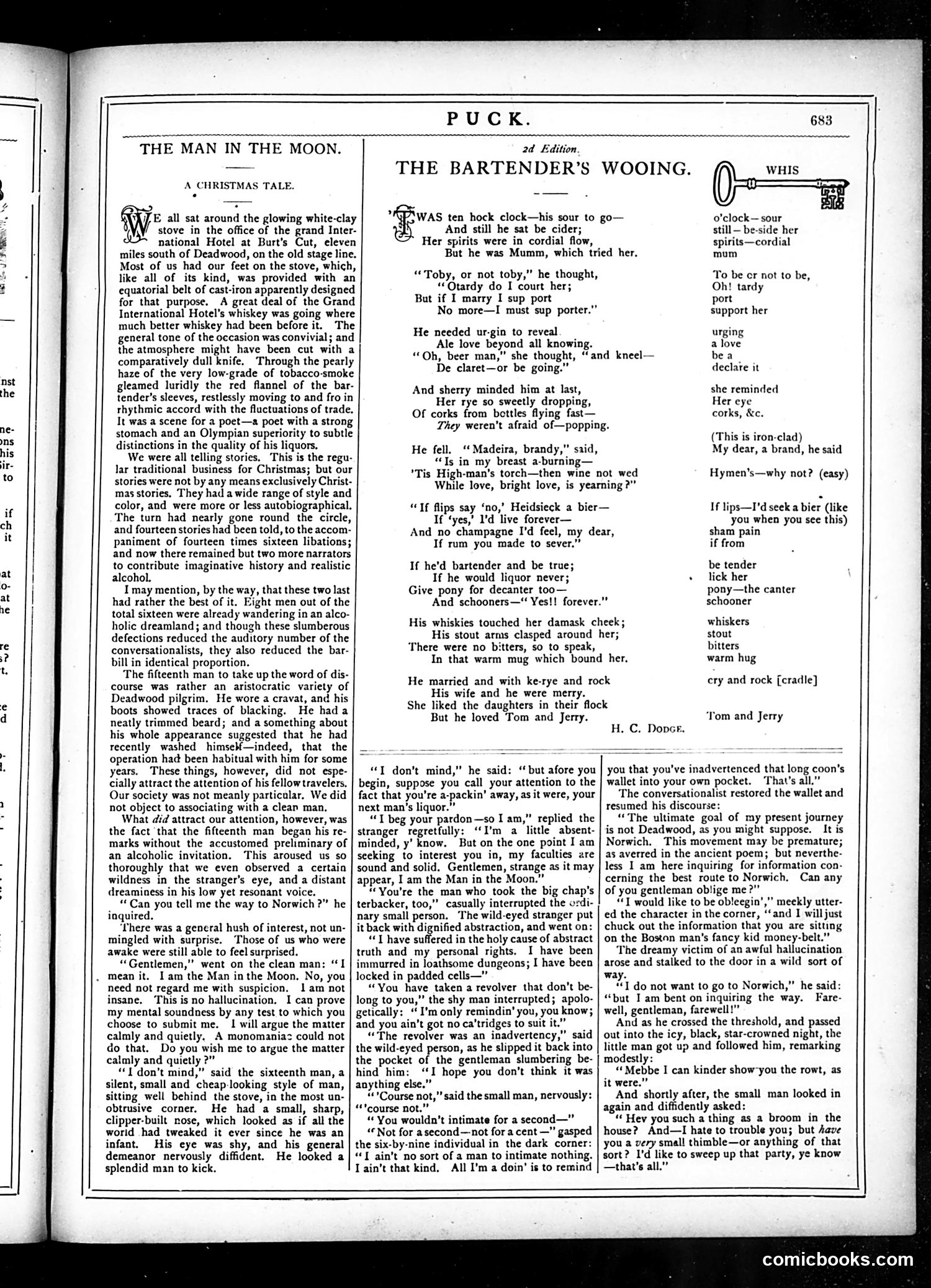
This page contains two separate pieces of fiction/poetry rather than political cartoons: 1. **"The Man in the Moon"** (left) - A Christmas tale describing a scene in a hotel bar, presented as conversational narrative about storytelling traditions. 2. **"The Bartender's Wooing"** (right) - A poem by H.C. Dodge about a bartender courting a woman, told through verse with accompanying stage directions and annotations. Neither piece appears to be political satire. Instead, this represents Puck's literary content—the magazine published humor through stories and poems alongside its famous satirical illustrations. The annotations in the margins appear to be editorial notes or performance directions, suggesting these were meant as dramatic readings or performances for entertainment rather than social/political commentary.
📄 Transcribed text from this page (OCR, searchable)
Machine-transcribed from the original scan — historical spelling and the odd misread are preserved.
‘ at o- at ne re 14 t. an . mean it. Iam the Man inthe Moon. No, you PUCK. THE MAN IN THE MOON. A CHRISTMAS TALE. TE all sat around the glowing white-clay VY stove in the office of the grand Inter- national Hotel at Burt's Cut, eleven miles south of Deadwood, on the old stage line. Most of us had our feet on the stove, which, like all of its kind, was provided with an equatorial belt of cast-iron apparently designed for that purpose. A great deal of the Grand International Hotel’s whiskey was going where much better whiskey had been before it. The general tone of the occasion was convivial; and the atmosphere might have been cut with a comparatively dull knife, Through the pearly haze of the very low-grade of tobacco-smoke gleamed luridly the red flannel of the bar- tender’s sleeves, restlessly moving to and fro in rhythmic accord with the fluctuations of trade, It was a scene for a poet—a poet with a strong stomach and an Olympian superiority to subtle distinctions in the quality of his liquors. We were all telling stories, This is the regu- lar traditional business for Christmas; but our stories were not by any means exclusively Christ- mas stories, They had a wide range of style and color, and were more or less autobiographical. The turn had nearly gone round the circle, and fourteen stories had been told, to the accom- paniment of fourteen times sixteen libations; and now there remained but two more narrators to contribute imaginative history and realistic alcohol. I may mention, by the way, that these two last had rather the best of it. Eight men out of the total sixteen were already wandering in an alco- holic dreamland; and though these slumberous defections reduced the auditory number of the conversationalists, they also reduced the bar- bill in identical proportion. The fifteenth man to take up the word of dis- course was rather an aristocratic variety of Deadwood pilgrim. He wore a cravat, and his boots showed traces of blacking. He hada neatly trimmed beard; and a something about his whole appearance suggested that he had recently washed himself—indeed, that the operation had been habitual with him for some years, These things, however, did not espe- cially attract the attention of his fellowtravelers, Our society was not meanly particalar. We did not object to associating with a clean man, What did attract our attention, however, was the fact ‘that the fifteenth man began his re- marks without the accustomed preliminary of an alcoholic invitation. This aroused us so thoroughly that we even observed a certain wildness in the stranger's eye, and a distant dreaminess in his low yet resonant voice. “Can you tell me the way to Norwich ?” he inquired. ‘There was a general hush of interest, not un- mingled with surprise. Those of us who were awake were still able to feel surprised. “Gentlemen,” went on the clean man: “1 need not regard me with suspicion. 1am not insane, This is no hallucination. I can prove my mental soundness by any test to which you choose to submit me. I will argue the matter calmly and quietly. A monomania> could not do that. Do you wish me to argue the matter calmly and quietly ?” “1 don't mind,” said the sixteenth man, a silent, small and cheap-looking style of man, sitting well behind the stove, in the most un- obtrusive corner. He had a small, sharp, clipper-built nose, which looked as if all the world had tweaked it ever since he was an infant. His eye was shy, and his general 2d Edition. Her spirits were in cordial flow, “Toby, or not toby,” he thought, “Otardy do I court her; But if I marry I sup port No more—I must sup porter.” Of corks from bottles flying fast— He fell. Madeira, brandy,” said, “Ts in my breast a-burning— If ‘yes,’ 1'd live forever— His wife and he were merry. But he loved Tom and Jerry. “1 don’t mind,” he said: ‘but afore you begin, suppose you call your attention to the fact that you're a-packin’ away, as it were, your next man’s liquor.” “T beg your pardon—so I am,” replied the stranger regretfully: ‘I’m a little absent- minded, y’ know. But on the one point I am seeking to interest you in, my faculties are sound and solid. Gentlemen, strange as it may appear, I am the Man in the Moon.” “You're the man who took the big chap's terbacker, too,"” casually interrupted the ordi- nary small person. ‘The wild-eyed stranger put it back with dignified abstraction, and went on: “1 have suffered in the holy cause of abstract truth and my personal rights. I have been immurred in loathsome dungeons; I have been locked in padded cells—” “You have taken a revolver that don’t be- long to you,” the shy man interrupted; apolo- getically: “I'm only remindin’ you, you know; and you ain’t got no ca’tridges to suit it.” “The revolver was an inadvertency,” said the wild-eyed person, as he slipped it back into the pocket of the gentleman slumbering be- hind him: “I hope you don’t think it was anything else,” “Course not,” said the small man, nervously: “course not.” ““You wouldn't intimate for a second—"" “Not for asecond—not for a cent —" gasped the six-by-nine individual in the dark corner: demeanor nervously diffident. He looked a splendid man to kick. “I ain't no sort of a man to intimate nothing. Tain’t that kind, All I’m a doin’ is to remind THE BARTENDER’S WOOING. *NPAWAS ten hock clock—his sour to go— And still he sat be cider; They weren't afraid of—popping. ‘Tis High-man’s torch—then wine not wed While love, bright love, is yearning ?” “If flips say ‘no,’ Heidsieck a bier— He married and with ke-rye and rock She liked the daughters in their flock o’clock—sour still—be-side her spirits—cordial But he was Mumm, which tried her. mom To be cr not to be, Oh! tardy port support her He needed ur-gin to reveal urging Ale love beyond all knowing. a love “Oh, beer man,” she thought, “and kneel— be a De claret—or be going.” declare it And sherry minded him at last, she reminded Her rye so sweetly dropping, Her eye corks, &c. (This is iron-clad) My dear, a brand, he said Hymen’s—why not? (easy) If lips—I'd seek a bier (like you when you see this) And no champagne I'd feel, my dear, sham pain If rum you made to sever.” if from If he'd bartender and be true; be tender If he would liquor never; + lick her Give pony for decanter too— pony—the canter And schooners—‘“ Yes!! forever.” schooner His whiskies touched her damask cheek; whiskers His stout arms clasped around her; stout There were no bitters, so to speak, bitters In that warm mug which bound her. warm hug cry and rock [cradle] Tom and Jerry H. C. Dopce. you that you've inadvertenced that long con's wallet into your own pocket. ‘That's all.”” The conversationalist restored the wallet and resumed his discourse: “The ultimate goal of my present journey is not Deadwood, as you might suppose. It is Norwich. This movement may be premature; as averred in the ancient poem; but neverthe- less I am here inquiring for information con- cerning the best route to Norwich. Can any of you gentleman oblige me?” «T would like to be obleegin’,” meekly utter- ed the character in the corner, ‘and I will just chuck out the information that you are sitting on the Boston man’s fancy kid money-belt.” The dreamy victim of an awful hallucination arose and stalked to the door in a wild sort of way. “T do not want to go to Norwich,” he said: “but Iam bent on inquiring the way. Fare- well, gentleman, farewell!” And as he crossed the threshold, and passed out into the icy, black, star-crowned night, the little man got up and followed him, remarking modestly: “‘Mebbe I can kinder show-you the rowt, as it were.” And shortly after, the small man looked in again and diffidently asked: “« Hev you such a thing as a broom in the house? And—I hate to trouble you; but Aave you a very small thimble—or anything of that sort? I'd like to sweep up that party, ye know —that’s all.” comicbooks.com