
Puck, 1879-12-24 · page 4 of 16
Puck — December 24, 1879 — page 4: what you’re looking at
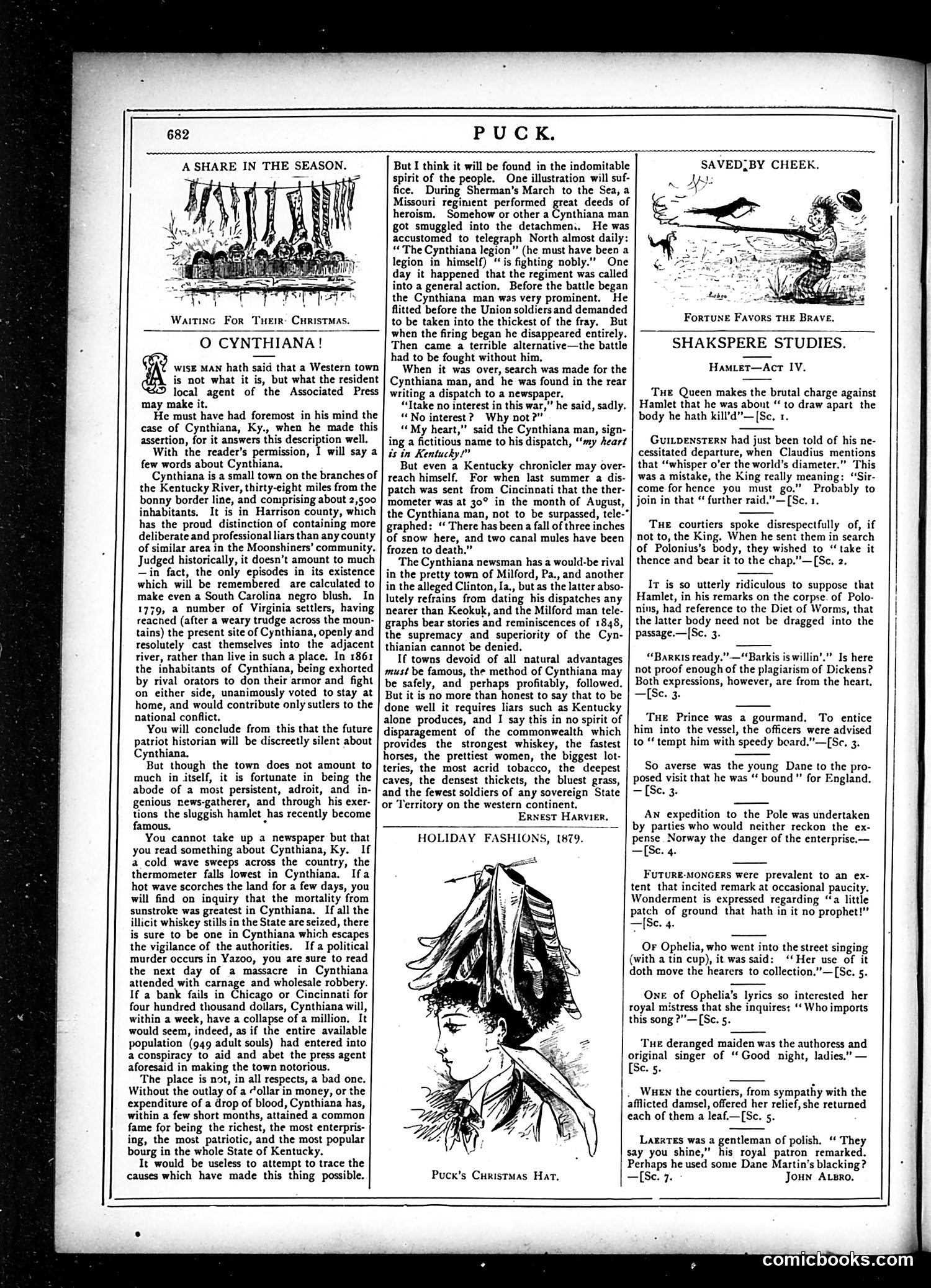
What you’re looking at
This page contains three distinct sections: **"A Share in the Season" / "Waiting for Their Christmas"**: The left illustration depicts what appears to be impoverished people crowded together in harsh conditions, likely commenting on class inequality during the holiday season. **"O Cynthiana!"**: The central article by Ernest Harvier discusses a small Kentucky town's notoriety for violence and lawlessness, including murders and robberies. It satirizes the town's "fame" while noting the irony that it boasts of being "the richest, most enterprising" in Kentucky. **"Shakespere Studies"** and other sections on the right contain literary commentary on Hamlet. **"Holiday Fashions, 1879"**: The illustration shows a woman's elaborate hat design typical of Victorian-era fashion. The page mixes social commentary, local satire, and cultural critique typical of Puck's approach.
📄 Transcribed text from this page (OCR, searchable)
Machine-transcribed from the original scan — historical spelling and the odd misread are preserved.
682 PUCK. A SHARE IN THE SEASON. Waitinc For Tueir: Curistmas. O CYNTHIANA! WISE MAN hath said that a Western town is not what it is, but what the resident local agent of the Associated Press may make it. He must have had foremost in his mind the case of Cynthiana, Ky., when he made this assertion, for it answers this description well. With the reader’s permission, I will say a few words about Cynthiana, Cynthiana is a small town on the branches of the Kentucky River, thirty-eight miles from the bonny border line, and comprising about 2,500 inhabitants, It is in Harrison county, which has the proud distinction of containing more deliberate and professional liars than any county of similar area in the Moonshiners’ community. Judged historically, it doesn’t amount to much —in fact, the only episodes in its existence which will be remembered are calculated to make even a South Carolina negro blush, In 1779, a number of Virginia settlers, having reached (after a weary trudge across the moun- tains) the present site of Cynthiana, openly and resolutely cast themselves into the adjacent river, rather than live in such a place. In 1861 the inhabitants of Cynthiana, being exhorted by rival orators to don their armor and fight on either side, unanimously voted to stay at home, and would contribute only sutlers to the national conflict. You will conclude from this that the future patriot historian will be discreetly silent about Cynthiana, But though the town does not amount to much in itself, it is fortunate in being the abode of a most persistent, adroit, and in- genious news-gatherer, and through his exer- tions the sluggish hamlet has recently become famous, . You cannot take up a newspaper but that you read something about Cynthiana, Ky. If a cold wave sweeps across the country, the thermometer falls lowest in Cynthiana, Ifa hot wave scorches the land for a few days, you will find on inquiry that the mortality from sunstroke was greatest in Cynthiana. If all the illicit whiskey stills in the State are seized, there is sure to be one in Cynthiana which escapes the vigilance of the authorities. If a political murder occurs in Yazoo, you are sure to read the next day of a massacre in Cynthiana attended with carnage and wholesale robbery. If a bank fails in Chicago or Cincinnati for four hundred thousand dollars, Cynthiana will, within a week, have a collapse of a million, It would seem, indeed, as if the entire available population (949 adult souls) had entered into aconspiracy to aid and abet the press agent aforesaid in making the town notorious. The place is not, in all respects, a bad one. Without the outlay of a ollar in money, or the expenditure of a drop of blood, Cynthiana has, within a few short months, attained a common fame for being the richest, the most enterpris- ing, the most patriotic, and the most popular bourg in the whole State of Kentucky. It would be useless to attempt to trace the causes which have made this thing possible. But I think it will be found in the indomitable spirit of the people. One illustration will suf- fice. During Sherman’s March to the Sea, a Missouri regiment performed great deeds of heroism. Somehow or other a Cynthiana man got smuggled into the detachmeni, He was accustomed to telegraph North almost daily: “The Cynthiana legion” (he must have been a legion in himself) “is fighting nobly.” One day it happened that the regiment was called into a general action. Before the battle began the Cynthiana man was very prominent. He flitted before the Union soldiers and demanded to be taken into the thickest of the fray. But when the firing began he disappeared entirely. Then came a terrible alternative—the battle had to be fought without him. When it was over, search was made for the Cynthiana man, and he was found in the rear writing a dispatch to a newspaper. “Itake no interest in this war,” he said, sadly. “No interest? Why not?” ‘My heart,” said the Cynthiana man, sign- ing a fictitious name to his dispatch, “‘my heart is in Kentucky!” But even a Kentucky chronicler may over- reach himself, For when last summer a dis- patch was sent from Cincinnati that the ther- mometer was at 30° in the month of August, the Cynthiana man, not to be surpassed, tele-* graphed: “There has been a fall of three inches of snow here, and two canal mules have been frozen to death,” The Cynthiana newsman has a would-be rival in the pretty town of Milford, Pa., and another in the alleged Clinton, Ia., but as the latter abso- lutely refrains from dating his dispatches any nearer than Keokuk, and the Milford man tele- graphs bear stories and reminiscences of 1848, the supremacy and superiority of the Cyn- thianian cannot be denied. If towns devoid of all natural advantages must be famous, the method of Cynthiana may be safely, and’ perhaps profitably, followed. But it is no more than honest to say that to be done well it requires liars such as Kentucky alone produces, and I say this in no spirit of disparagement of the commonwealth which provides the strongest whiskey, the fastest horses, the prettiest women, the biggest lot- teries, the most acrid tobacco, the deepest caves, the densest thickets, the bluest grass, and the fewest soldiers of any sovereign State or Territory on the western continent. Ernest HaRvier. HOLIDAY FASHIONS, 1879. Puck’s Curistuas Hat. SAVED; BY CHEEK. Fortune Favors THE Brave. SHAKSPERE STUDIES. Hamiet—Act IV. Tue Queen makes the brutal charge against Hamlet that he was about “ to draw apart the body he hath kill’d”—[Sc. 1. Guitpenstern had just been told of his ne- cessitated departure, when Claudius mentions that “whisper o'er the world’s diameter.” This was a mistake, the King really meaning: “Sir- come for hence you must go.” Probably to join in that “ further raid."—[Sc. 1. Tue courtiers spoke disrespectfully of, if not to, the King. When he sent them in search of Polonius’s body, they wished to “take it thence and bear it to the chap.”—[Sc. 2. Ir is so utterly ridiculous to suppose that Hamlet, in his remarks on the corpse. of Polo- nins, had reference to the Diet of Worms, that the latter body need not be dragged into the passage.—[Sc. 3. “Barks ready.” —“Barkis is willin’.” Is here not proof enough of the plagiarism of Dickens? Both expressions, however, are from the heart. —[Sce. 3. Tue Prince was a gourmand. To entice him into the vessel, the officers were advised to “tempt him with speedy beard.”—[Se. 3. So averse was the young Dane to the pro- posed visit that he was “ bound” for England. — [Se. 3. AN expedition to the Pole was undertaken by parties who would neither reckon the ex- pense Norway the danger of the enterprise.— —[Se. 4. FUTURE-MONGERS were prevalent to an ex- tent that incited remark at occasional paucity. Wonderment is expressed regarding “a little Page of ground that hath in it no prophet!’ —|Se. 4. OF Ophelia, who went into the street singing (with a tin cup), it was said: ‘‘Her use of it doth move the hearers to collection.”—[Sc. 5. One. of Ophelia’s lyrics so interested her royal mistress that she inquires: ‘‘ Who imports this song ?”"—[Sc. 5. ‘Tue deranged maiden was the authoress and original singer of “Good night, ladies.” — [Sc. 5. Wuen the courtiers, from sympathy with the afflicted damsel, offered her relief, she returned each of them a leaf—[Sc. 5. Lagates was a gentleman of polish. ‘ The: say you shine,” his royal patron remarked. Perhaps he used some Dane Martin's blacking? —[Se. 7. Joun Avro. comicbooks.com