
Puck, 1879-12-24 · page 10 of 16
Puck — December 24, 1879 — page 10: what you’re looking at
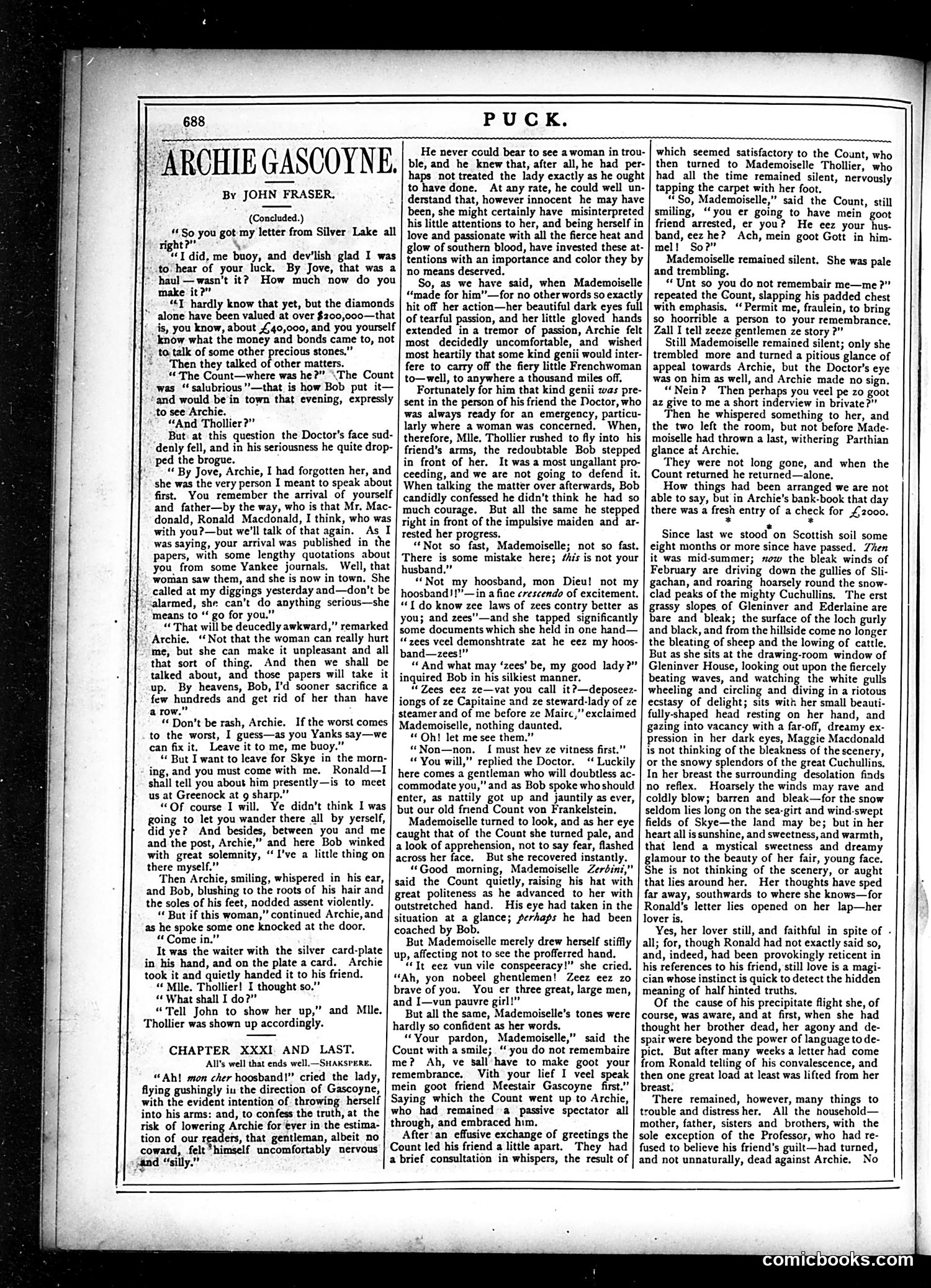
What you’re looking at
This page contains the conclusion of a serialized story titled "Archie Gascoyne" by John Fraser, not a political cartoon. The text is a Victorian-era narrative about romantic entanglement involving characters named Mademoiselle, the Count, Archie, and the Doctor. The story deals with domestic drama—misunderstandings about a woman's identity and honor, questions of marriage and propriety, and social standing. References to "Silver Lake," "Skye," and Scottish elements suggest British setting. This appears to be fiction serialized in *Puck* magazine rather than satirical commentary. Without seeing illustrations accompanying this text section, I cannot identify specific caricatures or political references. The page functions as literary entertainment rather than political satire.
📄 Transcribed text from this page (OCR, searchable)
Machine-transcribed from the original scan — historical spelling and the odd misread are preserved.
PUCK. | ARCHIE GASCOYNE. By JOHN FRASER. (Concluded.) **So you got my letter from Silver Lake all right?” \ ae did, me buoy, and dev'lish glad I was to hear of your luck. By Jove, that was a > haul — wasn’t it? How much now do you make it?” “<T hardly know that yet, but the diamonds alone have been valued at over $200,000—that is, you know, about £40,000, and you yourself know what the money and bonds came to, not }; to. talk of some other precious stones.” Then they talked of other matters. “The Count—where was he?” \The Count * was ‘“salubrious”’—that is how Bob put it— ‘and would be in town that evening, expressly to see Archie. “And Thollier?” But: at this question the Doctor's face sud- denly fell, and in his seriousness he quite drop- ped the brogue. “ By Jove, Archie, I had forgotten her, and she was the very person I meant to speak about first. You remember the arrival of yourself and father—by the way, who is that Mr. Mac- donald, Ronald Macdonald, I think, who was with you?—but we'll talk of that again. As I was saying, your arrival was published in the papers, with some lengthy quotations about you from some Yankee journals, Well, that :{) woman saw them, and she is now in town. She called at my diggings yesterday and—don't be ‘alarmed, she can’t do anything serious—she means to ‘‘ go for you.” “ That will be deucedly awkward,” remarked Archie. ‘Not that the woman can really hurt me, but she can make it unpleasant and all that sort of thing. And then we shall be talked about, and those papers will take it up. By heavens, Bob, I'd sooner sacrifice a few hundreds and get rid of her than have «Don’t be rash, Archie. If the worst comes to the worst, I guess—as you Yanks say—we can fix it, Leave it to me, me buoy.” “ But I want to leave for Skye in the morn- ing, and you must come with me. Ronald—I shall tell you about him presently—is to meet us at Greenock at g sharp.” “Of course I will. Ye didn’t think I was going to let you wander there all by yerself, did ye? And besides, between you and me and the post, Archie,” and here Bob winked with great solemnity, ‘I've a little thing on there myself.” Then Archie, smiling, whispered in his ear, and Bob, blushing to the roots of his hair and the soles of his feet, nodded assent violently. “ But if this woman,” continued Archie, and as he spoke some one knocked at the door. “ Come in.” It was the waiter with the silver card-plate in his hand, and on the plate a card. Archie took it and quietly handed it to his friend. “Mile. Thollier! I thought so.” «‘ What shall I do?” “Tell John to show her up,” and Mlle. Thollier was shown up accordingly. CHAPTER XXXI AND LAST. All's well that ends well.—SHAKSPERE. “Ah! mon cher hoosband!” cried the lady, flying gushingly iu the direction of Gascoyne, with the evident intention of throwing herself into his arms: and, to confess the truth, at the tisk of lowering Archie for ever in the estima- tion of our readers, that gentleman, albeit no coward, felt "himself uncomfortably nervous sand “silly.” He never could bear to see a woman in trou- ble, and he knew that, after all, he had per- haps not treated the lady exactly as he ought to have done. At any rate, he could well un- derstand that, however innocent he may have been, she might certainly have misinterpreted his little attentions to her, and being herself in love and passionate with all the fierce heat and glow of southern blood, have invested these at- tentions with an importance and color they by no means deserved. So, as we have said, when Mademoiselle “made for him”—for no other words so exactly hit off her action—her beautiful dark eyes full of tearful passion, and her little gloved hands extended in a tremor of passion, Archie felt most decidedly uncomfortable, and wished most heartily that some kind genii would inter- fere to carry off the fiery little Frenchwoman to—well, to anywhere a thousand miles off. Fortunately for him that kind genii was pre- sent in the person of his friend the Doctor, who was always ready for an emergency, particu- larly where a woman was concerned, When, therefore, Mlle. Thollier rushed to fly into his friend’s arms, the redoubtable Bob stepped in front of her. It was a most ungallant pro- ceeding, and we ate not going to defend it. When talking the matter over afterwards, Bob candidly confessed he didn’t think he had so much courage, But all the same he stepped right in front of the impulsive maiden and ar- rested her progress. “Not so fast, Mademoiselle; not so fast. There is some mistake here; “his is not your husband.”” “Not my hoosband, mon Dieu! not my hoosband!!””—in a fine crescendo of excitement. “I do know zee laws of zees contry better as you; and zees”—and she tapped significantly some documents which she held in one hand— “zees veel demonshtrate zat he eez my hoos- band—zees!”” “And what may ‘zees’ be, my good lady?” inquired Bob in his silkiest manner. “Zees eez ze—vat you call it?—deposeez- iongs of ze Capitaine and ze steward-lady of ze steamer and of me before ze Mairc,” exclaimed Mademoiselle, nothing daunted. “Oh! let me see them.” “Non—non. { must hev ze vitness first.” “You will,” replied the Doctor. “ Luckily here comes a gentleman who will doubtless ac- commodate you,”and as Bob spoke who should enter, as nattily got up and jauntily as ever, but our old fmnend Count von Frankelstein. Mademoiselle turned to look, and as her eye caught that of the Count she turned pale, and a look of apprehension, not to say fear, flashed across her face, But she recovered instantly. “Good morning, Mademoiselle Zerdini,” said the Count quietly, raising his hat with great politeness as he advanced to her with outstretched hand. His eye had taken in the situation at a glance; perhaps he had been coached by Bob. But Mademoiselle merely drew herself stiffly up, affecting not to see the proffered hand. “Tt eez vun vile conspeeracy!” she cried. “Ah, yon nobeel ghentlemen! Zeez eez zo brave of you. You er three great, large men, and I—vun pauvre girl!” But all the same, Mademoiselle’s tones were hardly so confident as her words, “Your pardon, Mademoiselle,” said the Count with a smile; “you do not remembaire me? Ah, ve Sall have to make goot your remembrance. Vith your lief I veel speak mein goot friend Meestair Gascoyne first.” Saying which the Count went up to Archie, who had remained a passive spectator all through, and embraced him. After’ an effusive exchange of greetings the Count led his friend a little apart. They had a brief consultation in whispers, the result of which seemed satisfactory to the Count, who then turned to Mademoiselle Thollier, who had all the time remained silent, nervously tapping the carpet with her foot. “So, Mademoiselle,” said the Count, still smiling, “you er going to have mein goot friend arrested, er you? He eez your hus- band, eez he? Ach, mein goot Gott in him- mel! So?” Mademoiselle remained silent. She was pale and trembling. “Unt so you do not remembair me—me ?” repeated the Count, slapping his padded chest with emphasis, ‘“ Permit me, fraulein, to bring so hoorrible a person to your remembrance. Zall I tell zeeze gentlemen ze story ?” Still Mademoiselle remained silent; only she trembled more and turned a pitious glance of appeal towards Archie, but the Doctor's eye was on him as well, and Archie made no sign. “Nein? Then perhaps you veel pe zo goot az give to me a short inderview in brivate?” Then he whispered something to her, and the two left the room, but not before Made- moiselle had thrown a last, withering Parthian glance af Archie. They were not long gone, and when the Count returned he returned—alone. How things had been arranged we are not able to say, but in Archie's bank-book that day there was a fresh entry of a check for £2000. * * * Since last we stood on Scottish soil some eight months or more since have passed. Zhen it was mid-summer; now the bleak winds of February are driving down the gullies of Sli- gachan, and roaring hoarsely round the snow- clad peaks of the mighty Cuchullins, The erst grassy slopes. of Gleninver and Ederlaine are bare and bleak; the surface of the loch gurly and black, and from the hillside come no longer the bleating of sheep and the lowing of cattle. But as she sits at the drawing-room window of Gleninver House, looking out upon the fiercely beating waves, and watching the white gulls wheeling and circling and diving in a riotous ecstasy of delight; sits with her small beauti- fully-shaped head resting on her hand, and gazing into vacancy with a far-off, dreamy ex- pression in her dark eyes, Maggie Macdonald is not thinking of the bleakness of the scenery, or the snowy splendors of the great Cuchullins. In her breast the surrounding desolation finds no reflex. Hoarsely the winds may rave and coldly blow; barren and bleak—for the snow seldom lies long on the sea-girt and wind-swept fields of Skye—the land may be; but in her heart all is sunshine, and sweetness, and warmth, that lend a mystical sweetness and dreamy glamour to the beauty of her fair, young face. She is not thinking of the scenery, or aught that lies around her. Her thoughts have sped far away, southwards to where she knows—for Ronald’s letter lies opened on her lap—her lover is, Yes, her lover still, and faithful in spite of - all; for, though Ronald had not exactly said so, and, indeed, had been provokingly reticent in his references to his friend, still love is a magi- cian whose instinct is quick to detect the hidden meaning of half hinted truths. Of the cause of his precipitate flight she, of course, was aware, and at first, when she had thought her brother dead, her agony and de- spair were beyond the power of language to de- pict. But after many weeks a letter had come from Ronald telling of his convalescence, and then one great load at least was lifted from her breast. There remained, however, many things to trouble and distress her. All the household— mother, father, sisters and brothers, with the sole exception of the Professor, who had re- fused to believe his friend's guilt—had turned, and not unnaturally, dead against Archie, No