
Puck, 1879-12-24 · page 11 of 16
Puck — December 24, 1879 — page 11: what you’re looking at
What you’re looking at
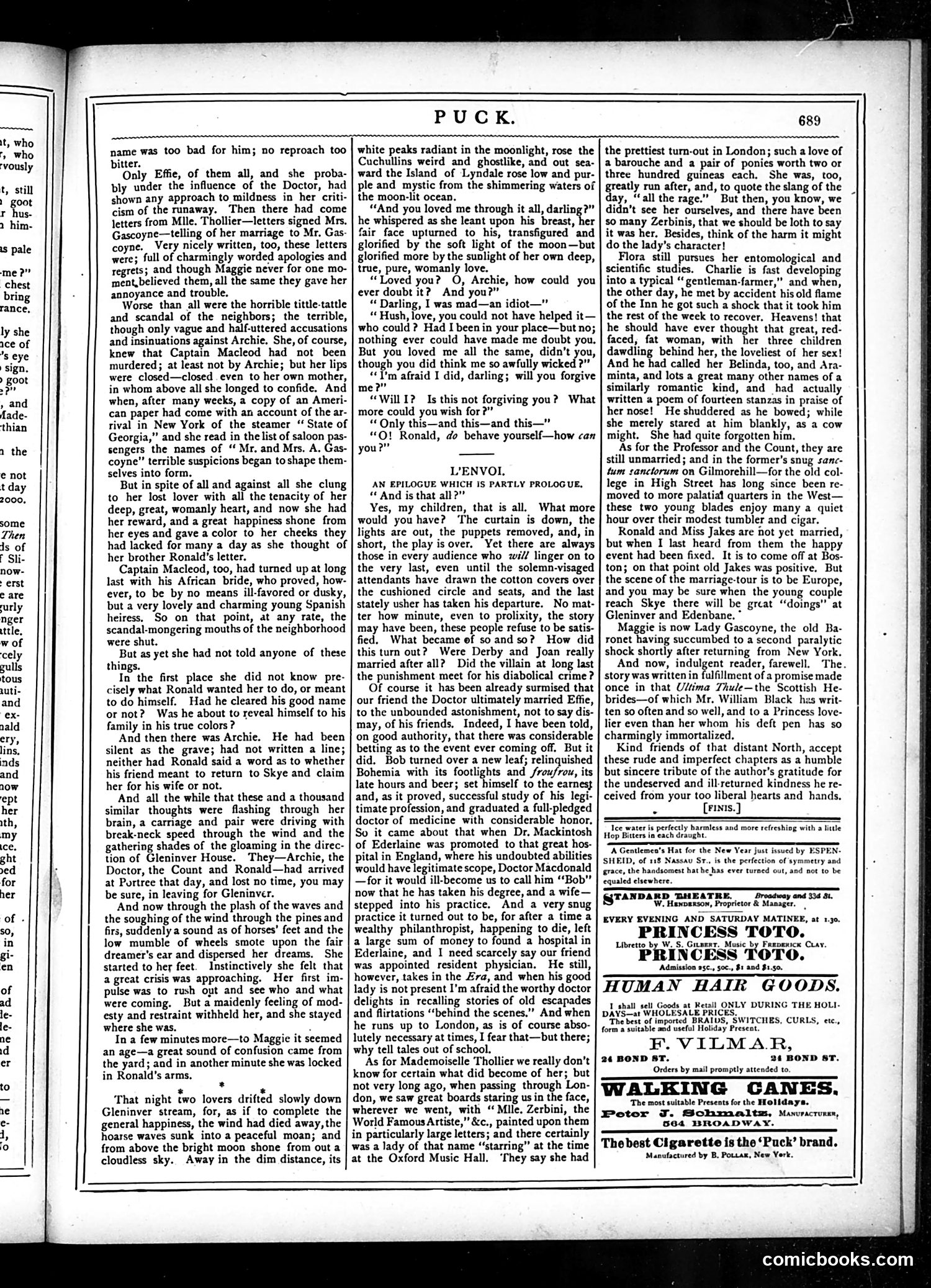
This page is primarily **text and advertisements** rather than political cartoons. The main content is a serialized story titled "L'ENVOI: An Epilogue Which Is Partly Prologue," which appears to be concluding a longer narrative about characters including Effie, Ronald, Archie, and Captain Macleod. The advertisements below the story include notices for **"Princess Toto"** (theater), **human hair goods** (wigs and switches), **F. Vilmar** (photography), and **Vin Mariani** (a likely patent medicine). This page contains **no evident political satire or social commentary**—it's simply a continuation of serialized fiction typical of Puck's format, supplemented by period commercial advertisements.
📄 Transcribed text from this page (OCR, searchable)
Machine-transcribed from the original scan — historical spelling and the odd misread are preserved.
PUCK. 689 name was too bad for him; no reproach too bitter. Only Effie, of them all, and she proba- bly under the influence of the Doctor, had shown any approach to mildness in her criti- cism of the runaway. Then there had come letters from Mlle. Thollier—letters signed Mrs. Gascoyne—telling of her marriage to Mr. Gas- coyne. Very nicely written, too, these letters were; full of charmingly worded apologies and regrets; and though Maggie never for one mo- ment,believed them, all the same they gave her annoyance and trouble. Worse than all were the horrible tittle-tattle and scandal of the neighbors; the terrible, though only vague and half-uttered accusations and insinuations against Archie, She, of course, knew that Captain Macleod had not been murdered; at least not by Archie; but her lips were closed—closed even to her own mother, in whom above all she longed to confide. And when, after many weeks, a copy of an Ameri- can paper had come with an account of the ar- rival in New York of the steamer “ State of Georgia,” and she read in the list of saloon pas- sengers the names of “ Mr. and Mrs. A, Gas- coyne” terrible suspicions began to shape them- selves into form. white peaks radiant in the moonlight, rose the But in spite of all and against all she clung to her lost lover with all the tenacity of her deep, great, womanly heart, and now she had her reward, and a great happiness shone from her eyes and gave a color to her cheeks they had lacked for many a day as she thought of her brother Ronald’s letter. Captain Macleod, too, had turned up at long last with his African bride, who proved, how- ever, to be by no means ill-favored or dusky, but a very lovely and charming young Spanish heiress, So on that point, at any rate, the scandal-mongering mouths of the neighborhood were shut. But as yet she had not told anyone of these things. In the first place she did not know pre- cisely what Ronald wanted her to do, or meant to do himself. Had he cleared his good name or not? Was he about to reveal himself to his family in his true colors? And then there was Archie. He had been silent as the grave; had not written a line; neither had Ronald said a word as to whether his friend meant to return to Skye and claim her for his wife or not. And all the while that these and a thousand similar thoughts were flashing through her brain, a carriage and pair were driving with break-neck speed through the wind and the gathering shades of the gloaming in the direc- tion of Gleninver House. They—Archie, the Doctor, the Count and Ronald—had arrived at Portree that day, and lost no time, you may be sure, in leaving for Gleninver. And now through the plash of the waves and the soughing of the wind through the pines and firs, suddenly a sound as of horses’ feet and the low mumble of wheels smote upon the fair dreamer's ear and dispersed her dreams. She started to her feet. Instinctively she felt that a great crisis was approaching. Her first im- pulse was to rush out and see who and what were coming. But a maidenly feeling of mod- esty and restraint withheld her, and she stayed where she was. . In a few minutes more—to Maggie it seemed an age—a great sound of confusion came from the yard; and in another minute she was locked in Ronald’s arms, * ‘That night two lovers drifted slowly down Gleninver stream, for, as if to complete the general happiness, the wind had died away, the hoarse waves sunk into a peaceful moan; and from above the bright moon shone from out a cloudless sky. Away in the dim distance, its Cuchullins weird and ghostlike, and out sea- ward the Island of Lyndale rose low and pur- ple and mystic from the shimmering waters of the moon-lit ocean. “And you loved me through it all, darling?” he whispered as she leant upon his breast, her fair face upturned to his, transfigured and glorified by the soft light of the moon—but glorified more by the sunlight of her own deep, true, pure, womanly love. “Loved you? O, Archie, how could you ever doubt it? And you?” “ Darling, I was mad—an idiot—"” “Hush, love, you could not have helped it— who could? Had I been in your place—but no; nothing ever could have made me doubt you. But you loved me all the same, didn’t you, though you did think me so awfully wicked ?” on afraid I did, darling; will you forgive me?” “Will 1? Is this not forgiving you? What more could you wish for?” “Only this—and this—and this—"”’ “O! Ronald, do behave yourself—how can you?” L’ENVOI, AN EPILOGUE WHICH IS PARTLY PROLOGUE. “ And is that all?” Yes, my children, that is all. What more would you have? The curtain is down, the lights are out, the puppets removed, and, in short, the play is over, Yet there are always those in every audience who wi// linger on to the very last, even until the solemn-visaged attendants have drawn the cotton covers over the cushioned circle and seats, and the last stately usher has taken his departure. No mat- ter how minute, even to prolixity, the story may have been, these people refuse to be satis- fied, What became ef so and so? How did this turn out? Were Derby and Joan really married after all? Did the villain at long last the punishment meet for his diabolical crime? Of course it has been already surmised that our friend the Doctor ultimately married Effie, to the unbounded astonishment, not to say dis- may, of his friends, Indeed, I have been told, on good authority, that there was considerable betting as to the event ever coming off. But it did. Bob turned over a new leaf; relinquished Bohemia with its footlights and /roufrou, its late hours and beer; set himself to the earnest and, as it proved, successful study of his legi- timate profession, and graduated a full-pledged doctor of medicine with considerable honor, So it came about that when Dr, Mackintosh of Ederlaine was promoted to that great hos- pital in England, where his undoubted abilities would have legitimate scope, Doctor Macdonald —for it would ill-become us to call him ‘‘Bob” now that he has taken his degree, and a wife— stepped into his practice. And a very snug practice it turned out to be, for after a time a wealthy philanthropist, happening to die, left a large sum of money to found a hospital in Ederlaine, and I need scarcely say our friend was appointed resident physician. He still, however, takes in the Zra, and when his good lady is not present I’m afraid the worthy doctor delights in recalling stories of old escapades and flirtations ‘behind the scenes.” And when he runs up to London, as is of course abso- lutely necessary at times, I fear that—but there; why tell tales out of school. As for Mademoiselle Thollier we really don’t know for certain what did become of her; but not very long ago, when passing through Lon- don, we saw great boards staring us in the face, wherever we went, with “Mlle. Zerbini, the World Famous Artiste,” &c., painted upon them in particularly large letters; and there certainly was a lady of that name “starring” at the time at the Oxford Music Hall. ‘They say she had the prettiest turn-out in London; such a love of a barouche and a pair of ponies worth two or three hundred guineas each. She was, too, greatly run after, and, to quote the slang of the | lay, “all the rage.” But then, you know, we didn’t see her ourselves, and there have been so many Zerbinis, that we should be loth to say it was her, Besides, think of the harm it might do the lady’s character! Flora still pursues her entomological and scientific studies. Charlie is fast developing into a typical “ gentleman-farmer,” and when, the other day, he met by accident his old flame of the Inn he got such a shock that it took him the rest of the week to recover. Heavens! that he should have ever thought that great, red- faced, fat woman, with her three children dawdling behind her, the loveliest of her sex! And he had called her Belinda, too, and Ara- minta, and lots a great many other names of a similarly romantic kind, and had actually written a poem of fourteen stanzas in praise of her nose! He shuddered as he bowed; while she merely stared at him blankly, as a cow might, She had quite forgotten him. As for the Professor and the Count, they are still unmarried; and in the former's snug sanc- tum sanctorum on Gilmorehill—for the old col- lege in High Street has long since been re- moved to more palatial quarters in the West— these two young blades enjoy many a quiet hour over their modest tumbler and cigar. Ronald and Miss Jakes are not yet married, but when I last heard from them the happy event had been fixed. It is to come off at Bos- ton; on that point old Jakes was positive. But the scene of the marriage-tour is to be Europe, and you may be sure when the young couple teach Skye there will be great ‘doings’ at Gleninver and Edenbane. * Maggie is now Lady Gascoyne, the old Ba- ronet having succumbed to a second paralytic shock shortly after returning from New York. And now, indulgent reader, farewell. The. story was written in fulfillment of a promise made once in that Ultima Thule—the Scottish He- brides—of which Mr. William Black hes writ- ten so often and so well, and to a Princess love- lier even than her whom his deft pen has so charmingly immortalized. Kind friends of that distant North, accept these rude and imperfect chapters as a humble but sincere tribute of the author's gratitude for the undeserved and ill-returned kindness he re- ceived from your too liberal hearts and hands. [rinis.] Tce water is perfectly harmless and more refreshing with a little Hop Bitters in each draught. ‘A Gentlemea'’s Hat for the New Year just issued by ESPEN- SHEID, of 118 Nassau Sr., is the perfection of symmetry and grace, the handsomest hat he has ever turned out, and not to be equaled elsewhere. STANDARD BHEATRE. ‘Broadway and 334 8. 7. Hampanson, Proprietor & Manager. EVERY EVENING AND SATURDAY MATINEE, at 1.30. PRINCESS TOTO. Libretto by W. S. Girmerr. Music by Frenexicx Cray. PRINCESS TOTO. Admission asc., soc., 81 and $1.50. HUMAN HAIR GOODS. I shall sell Goods at Retail ONLY DURING THE HOLI- DAYS—at WHOLESALE PRICES, The best of imported BRAIVS, SWITCHES, CURLS, etc., form a suitable and useful Holiday Present. EF. VILMAR, 24 BOND ST. 24 BOND ST. Orders by mail promptly attended to. WALKING CANES. The most suitable Presents for the Holidays. BRetor J. Schmaltz, Maxvractunen, 564 BROADWAY. The best Cigarette is the ‘Puck’ brand. Manufactured by B. Potax, New Verk. See eres comicbooks.com