
A complete issue · 18 pages · 1879
Puck — December 10, 1879
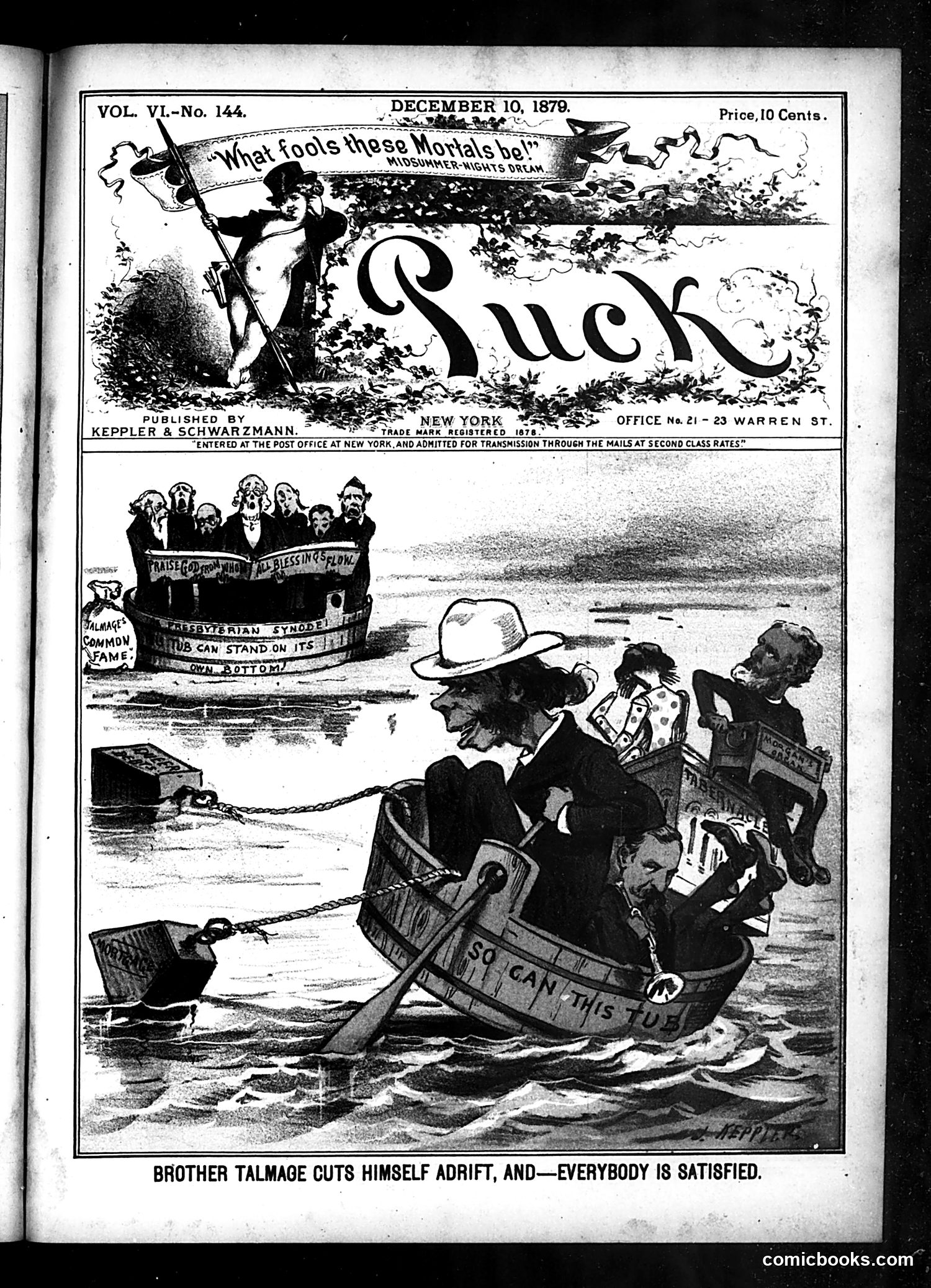
This satirical cartoon critiques religious hypocrisy, likely targeting specific Protestant denominations. The top panel shows clergy crowded into a tub labeled "Presbyterian Synod," with text suggesting they're spiritually adrift—"What fools these Mortals be!" The main cartoon depicts "Brother Talmage" (likely referring to Thomas De Witt Talmage, a prominent Brooklyn preacher) cutting himself loose from a boat labeled "Sycants Tub." Religious figures in the background watch from their crowded vessel. The caption states he "cuts himself adrift, and—everybody is satisfied." The satire suggests Talmage's departure from his religious community was welcomed relief, mocking both his personal conduct and institutional church politics of the era.
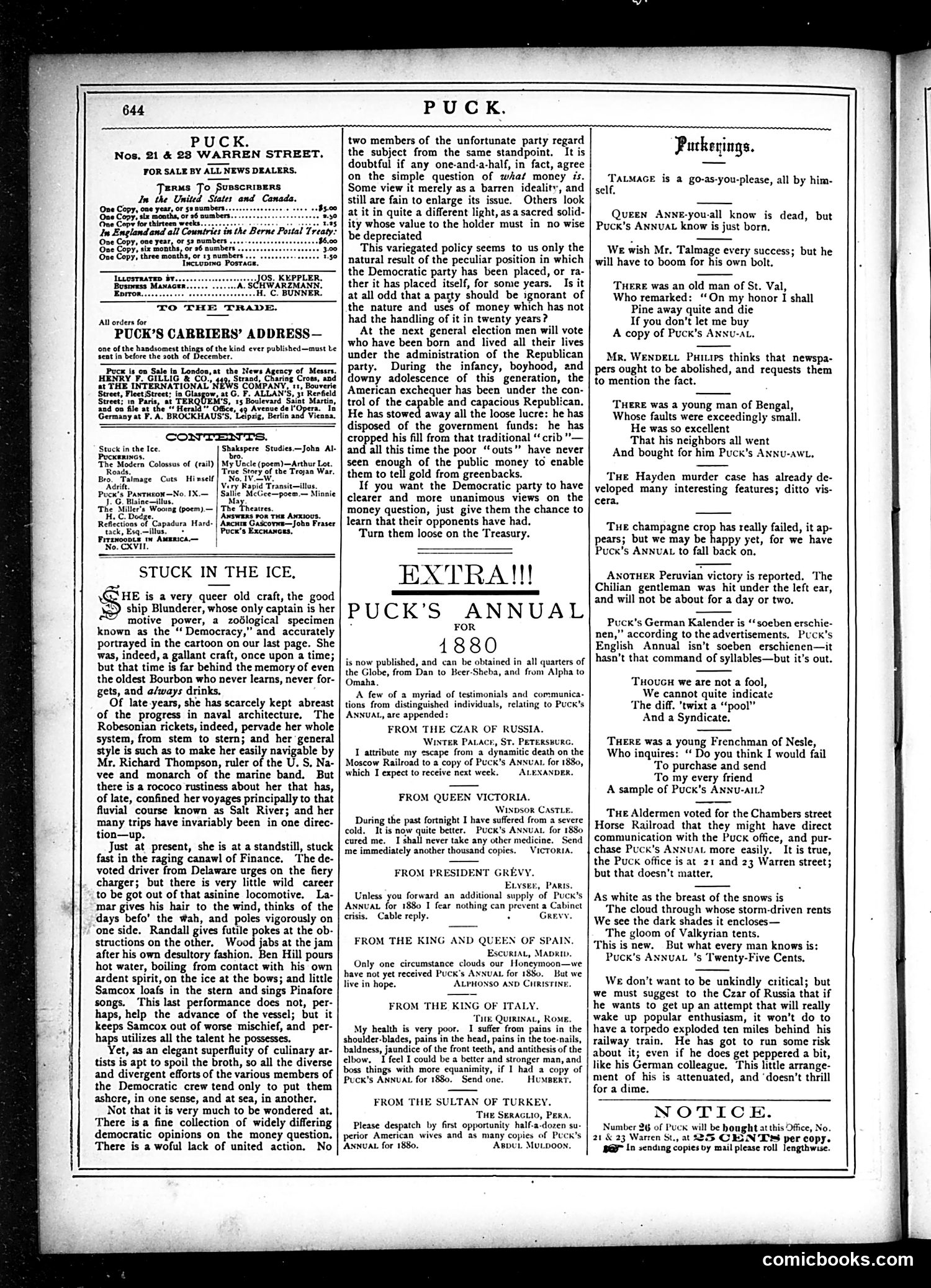
This page is primarily **advertising and announcements** for Puck's 1880 Annual rather than political cartoons. The main content includes: - **"Stuck in the Ice"**: A humorous anecdote about a ship trapped in ice, featuring wordplay about a "queer old craft" - **Puckerings** (brief satirical items): Short jabs at various topics, including: - Queen Victoria's death (anachronistic—Victoria died 1901, suggesting OCR or dating errors) - References to Democratic Party monetary policy debates - A Peruvian military victory - German and French political matters - **Testimonials**: Reprinted endorsements from various world leaders (Czar of Russia, President Grevy, King of Spain, Sultan of Turkey) praising Puck's Annual The testimonials are likely **satirical fabrications**, meant to humorously inflate the magazine's international prestige.
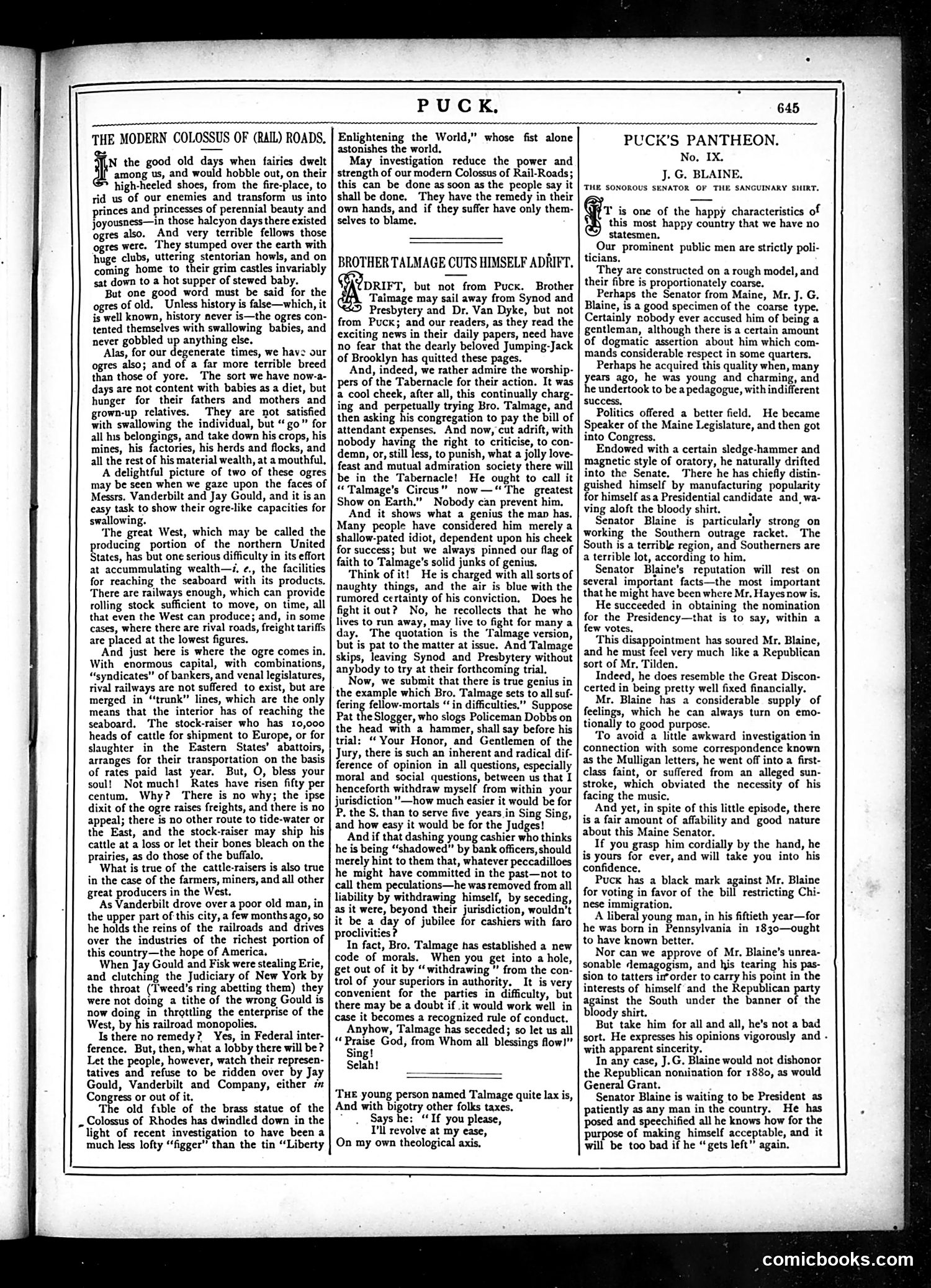
This page contains two distinct articles rather than political cartoons. "The Modern Colossus of (Rail)Roads" critiques the enormous power wielded by railroad corporations, comparing them to the legendary Colossus of Rhodes. The piece argues railroads have become dangerously monopolistic, controlling vast wealth and political influence while exploiting workers and the public. It advocates for regulatory intervention to curtail their power. "Brother Talmage Cuts Himself Adrift" discusses Rev. Thomas DeWitt Talmage, a prominent preacher who apparently withdrew from public controversy. The satirical piece praises his decision to avoid political and social debates, suggesting his previous pronouncements lacked genuine wisdom despite his popularity and reputation. Both articles use humor to critique institutional power—whether corporate or religious—and those who wield it irresponsibly.
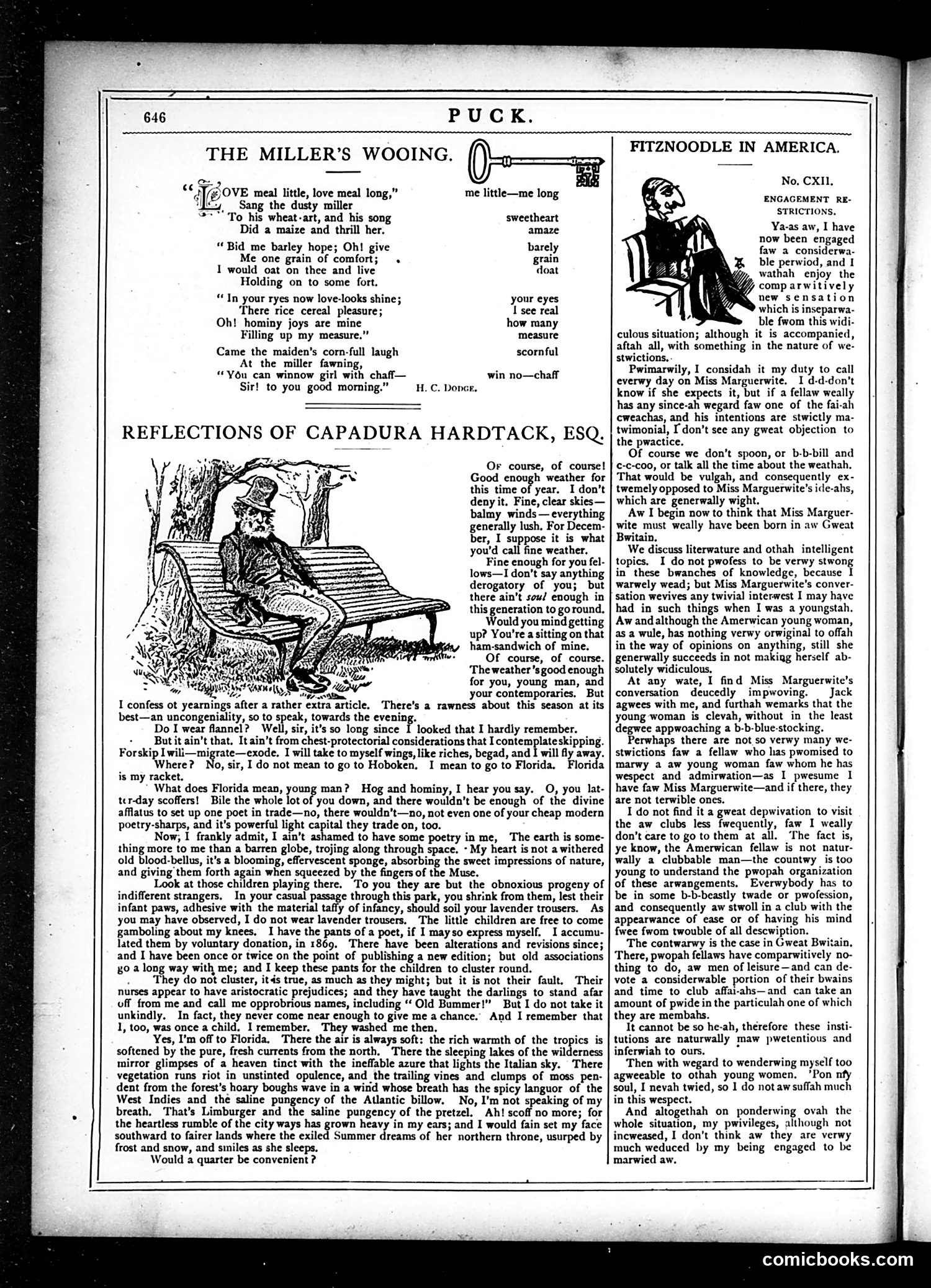
This page contains three separate items: 1. **"The Miller's Wooing"** — A poem with musical notation, appears to be sentimental verse about courtship, unrelated to satire. 2. **"Reflections of Capadura Hardtack, Esq."** — A substantial essay featuring a sketch of a man on a bench. The author discusses Florida's climate favorably and critiques modern American society, particularly young women and their independence. The piece appears to be nostalgic social commentary rather than political satire, lamenting changes in courtship customs and women's education. 3. **"Fitznoodle in America"** (No. CXII) — A column about an Englishman's observations of American society, focusing on his engagement to Miss Marguerite and reflections on American women's behavior and intellect. The page is primarily **literary content and social commentary** rather than visual political cartooning.
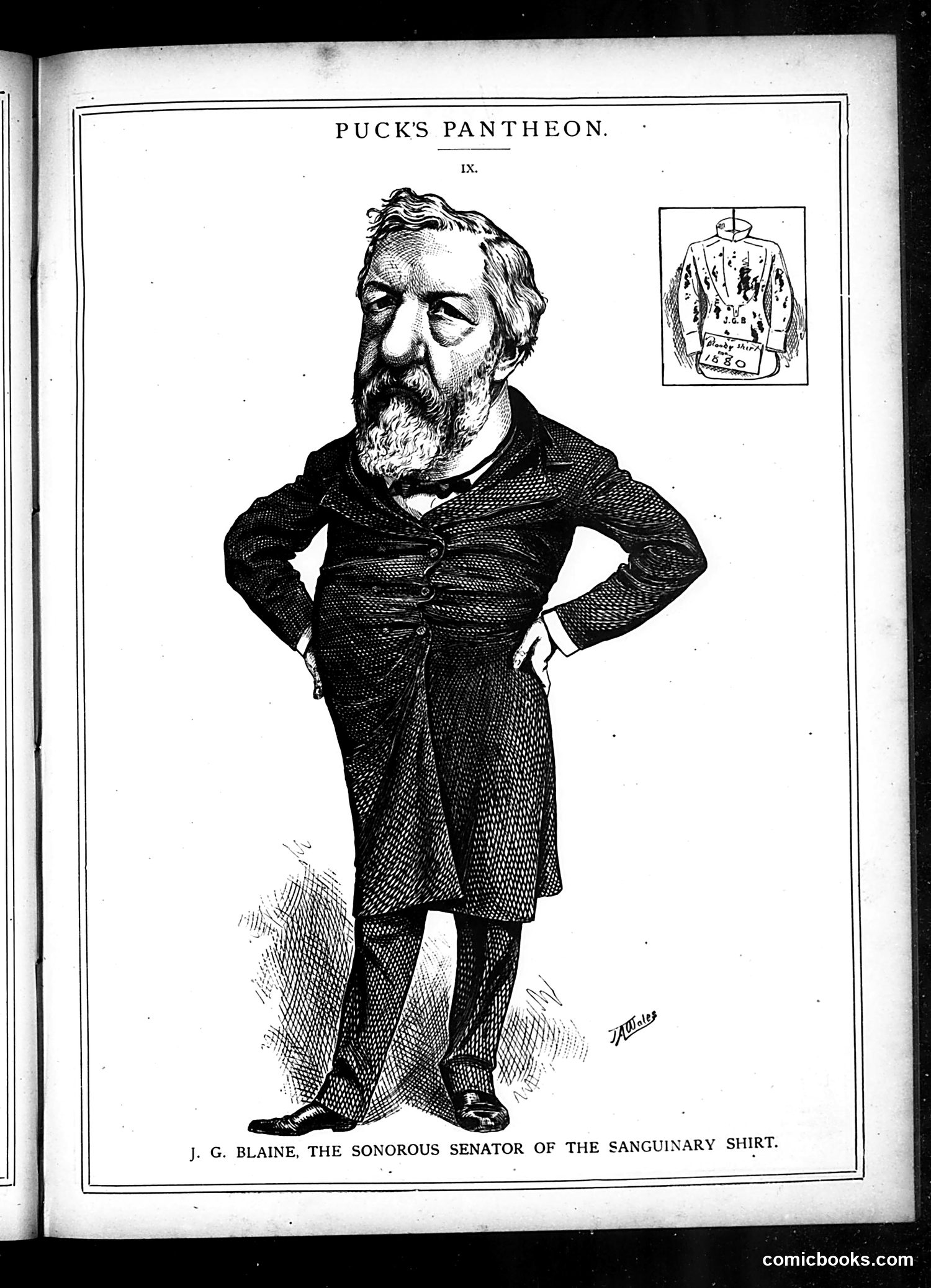
This satirical illustration depicts **J.G. Blaine, identified as "The Sonorous Senator of the Sanguinary Shirt."** The caricature exaggerates his beard and facial features in the style typical of 19th-century political satire. The phrase "Sanguinary Shirt" is a cutting reference, likely alluding to Blaine's association with Republican Reconstruction policies and political violence of the post-Civil War era. "Sonorous" suggests his reputation as a skilled orator. The small inset showing a decorated garment reinforces the "sanguinary shirt" metaphor—possibly mocking both his oratorical flourishes and his political record. This appears designed to ridicule Blaine's political persona and his party's controversial policies through sarcastic language and exaggerated portraiture.
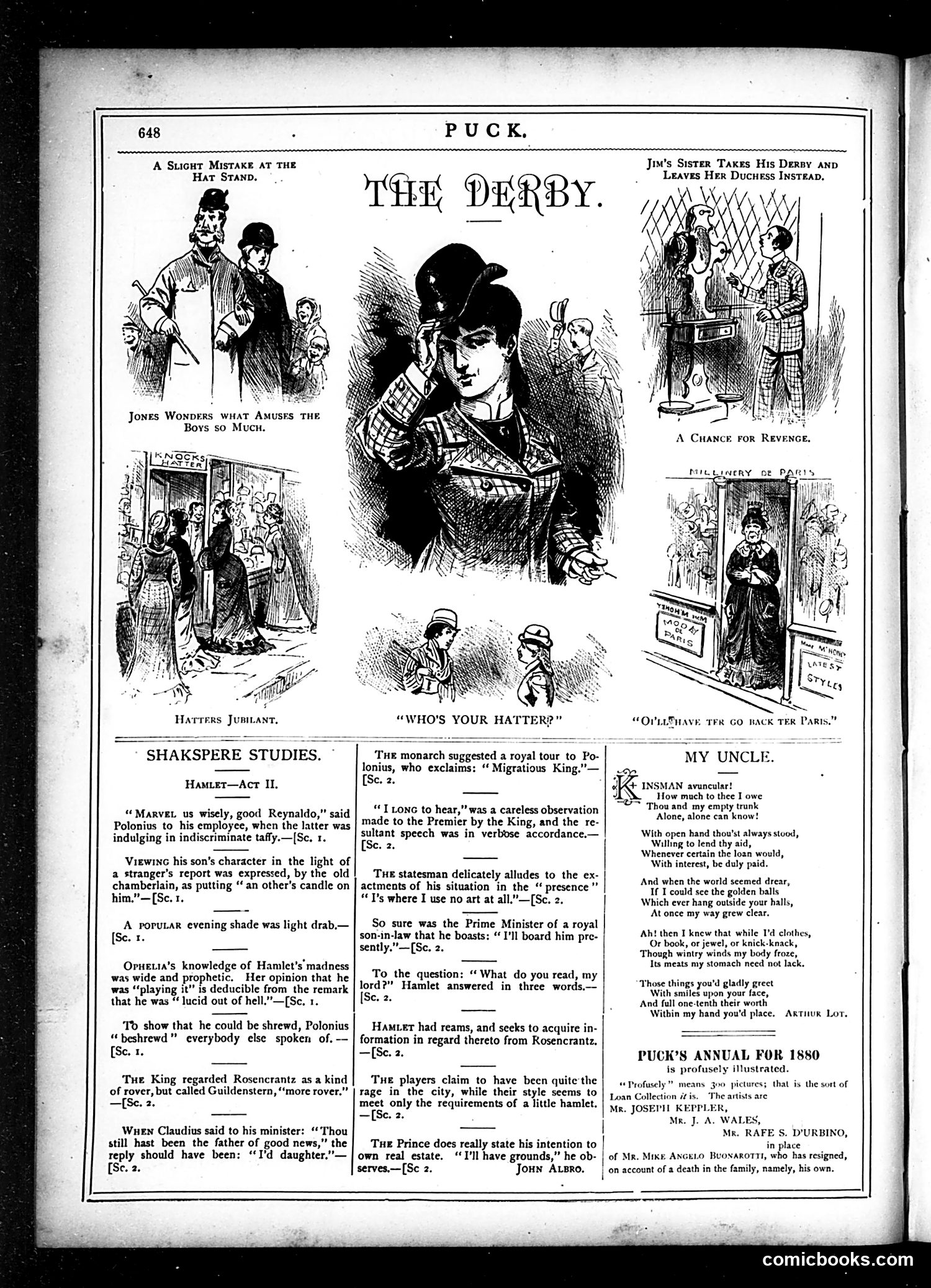
This page satirizes British horse racing (the Derby) and upper-class society through several interconnected vignettes: **Main cartoon**: A woman in elegant attire adjusts her hat, suggesting vanity and focus on appearance at the fashionable event. **Side panels** show comedic mishaps: a man loses his Derby ticket, a woman's hat causes confusion ("Who's your hatter?"), and society figures experience social embarrassment. **"A Slight Mistake at the Hat Stand"**: Attendees confuse belongings, poking fun at the crowded, pretentious nature of the event. **"Jim's Sister Takes His Derby"**: Implies women's social climbing or inappropriate behavior at exclusive occasions. The satire mocks the superficiality and social chaos of high-society attendance at prestigious sporting events, where appearance and status matter more than actual enjoyment.
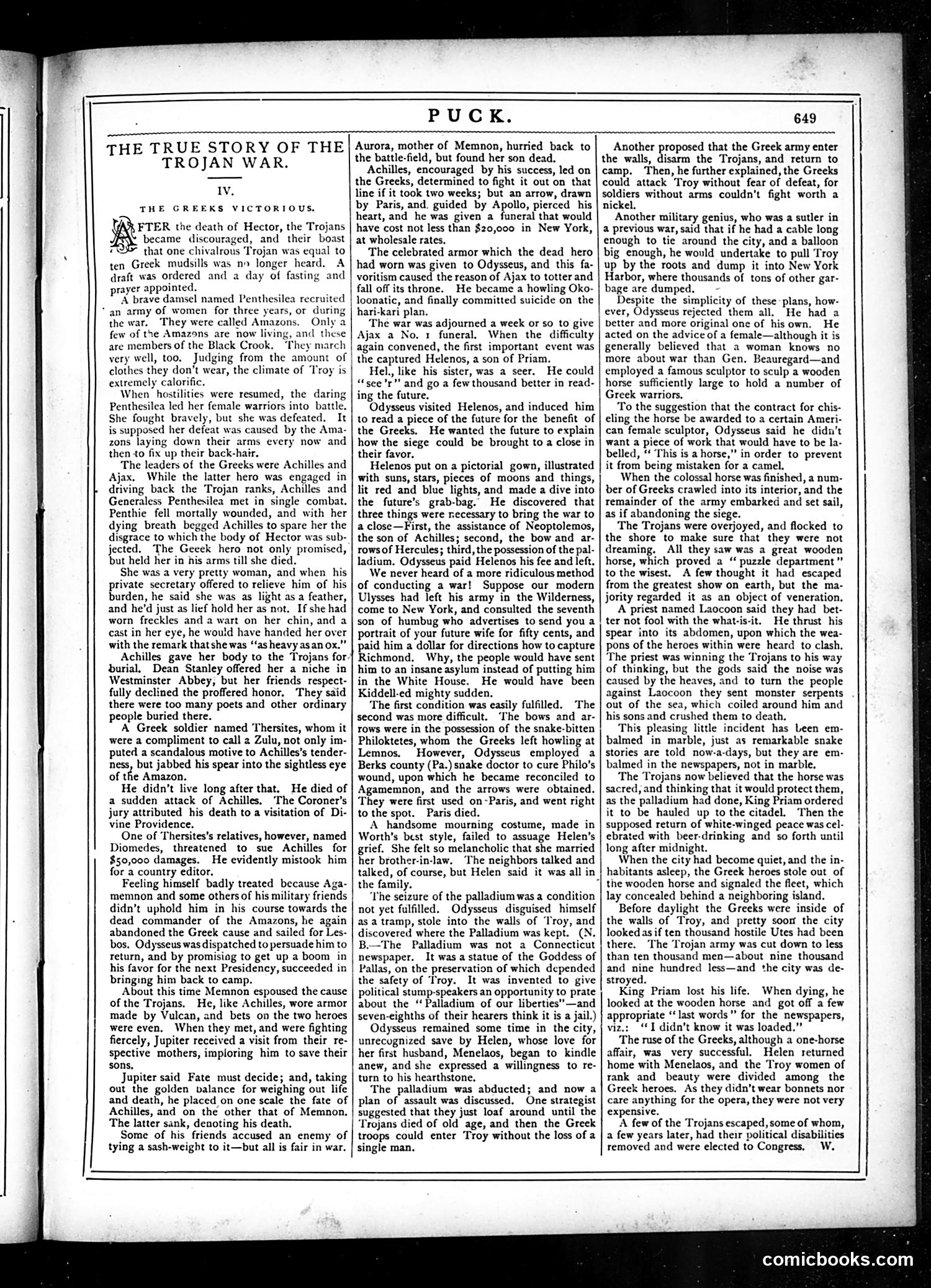
This page contains **text only—no cartoon or illustration**. It's part of a serialized article titled "The True Story of the Trojan War," Section IV: "The Greeks Victorious." The content presents a humorous, tongue-in-cheek retelling of classical mythology, mixing mythological events with anachronistic American references (e.g., mentions of New York, Connecticut newspapers, the White House, a Pennsylvania snake doctor). The satire lies in treating ancient Greek legends as if they were contemporary American news stories, complete with ridiculous details like Odysseus commissioning a sculptor to carve a wooden horse and advertising it as a "puzzle department." This is **satirical literature rather than visual satire**—Puck's humor here comes through irreverent prose rather than political cartooning.
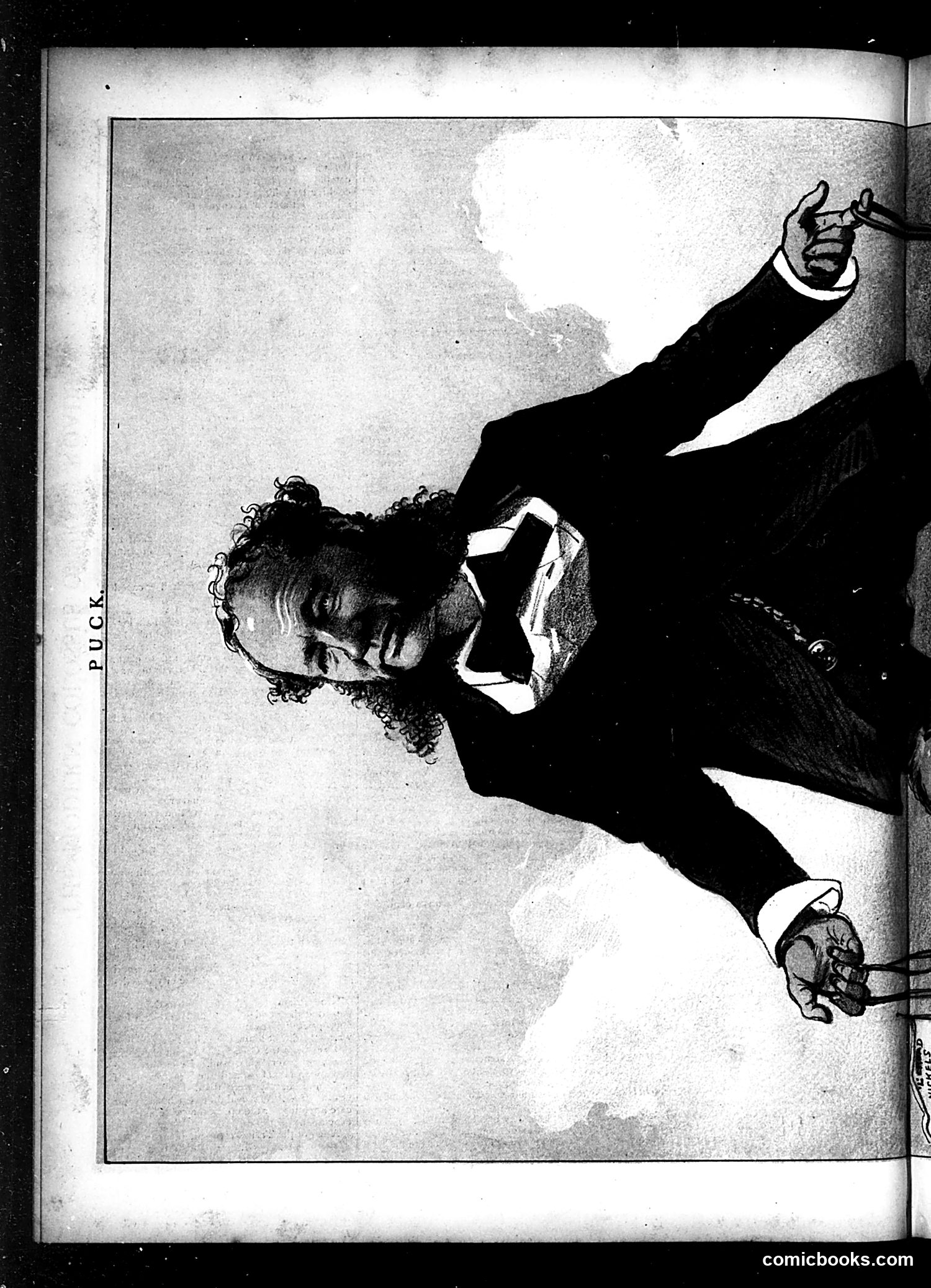
This page appears to be a political cartoon showing a figure in formal black attire (suit and collar) in an exaggerated, contorted pose—stretched upward with one arm extended dramatically. The figure has curly/wild hair and an expressive face. The word "PUCK" appears on the left margin, confirming this is from Puck magazine. The cartoon's style and the figure's theatrical posture suggest satire of a political or public figure, likely mocking their ambitions, speeches, or public behavior through physical caricature. Without additional text visible on this page or knowledge of the publication date, I cannot definitively identify the specific person being caricatured or the exact political event being satirized. The exaggerated stretching pose likely represents inflated rhetoric or grandiose ambitions.
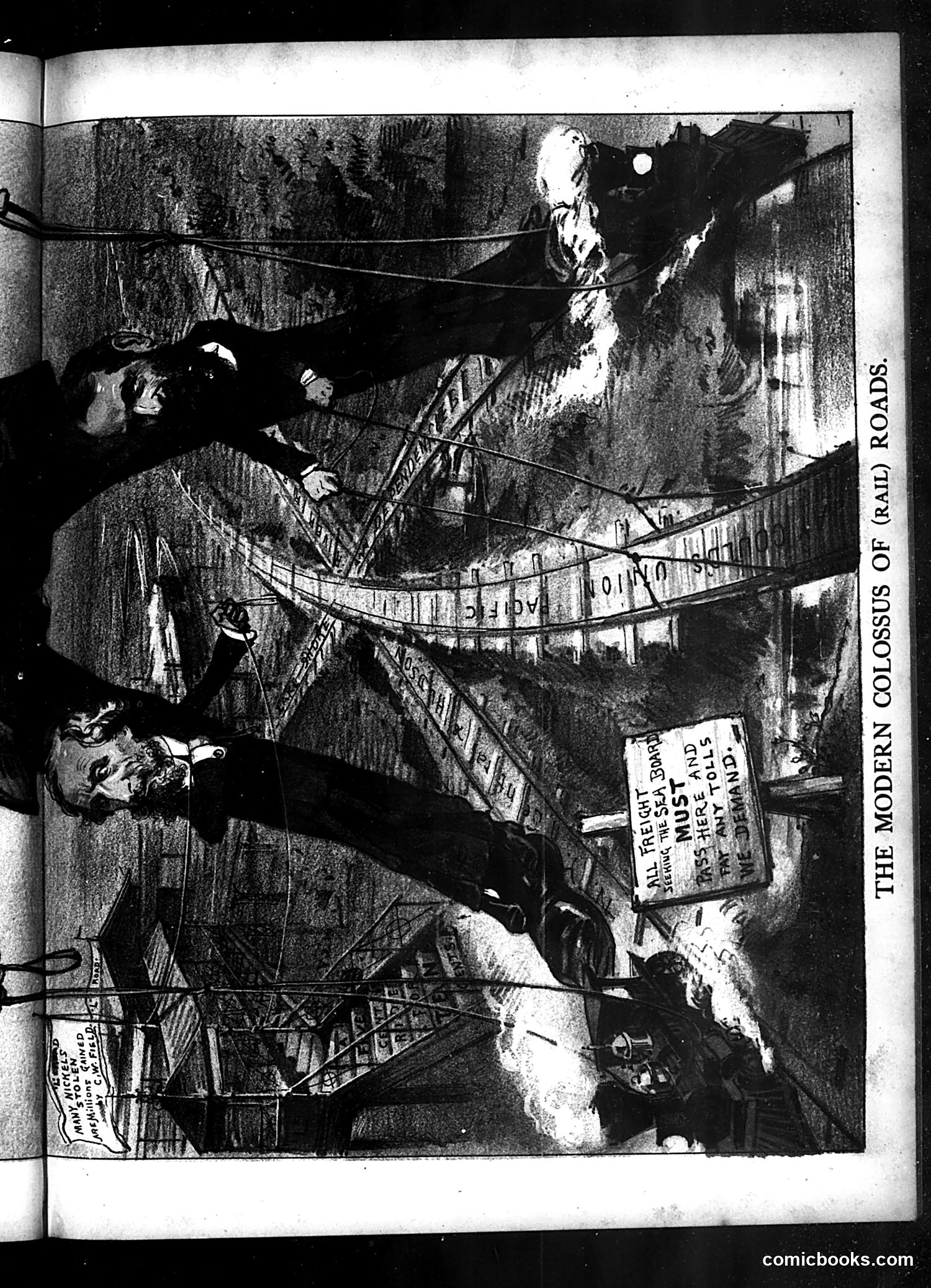
This political cartoon satirizes the enormous power and reach of railroad corporations in American infrastructure. The image depicts a giant skeletal or death-like figure straddling a vast network of railroad tracks and bridges, dominating the landscape below where small human figures appear insignificant. The title references the "Colossus of Rhodes," invoking comparisons to ancient monuments of power—here suggesting railroads have become an all-powerful force in modern America. The scattered signs and text (though illegible in this reproduction) likely criticize specific railroad monopolies or practices. This reflects Gilded Age concerns about corporate consolidation, where major railroad companies wielded enormous political and economic influence over American development, seemingly beyond public control or accountability.
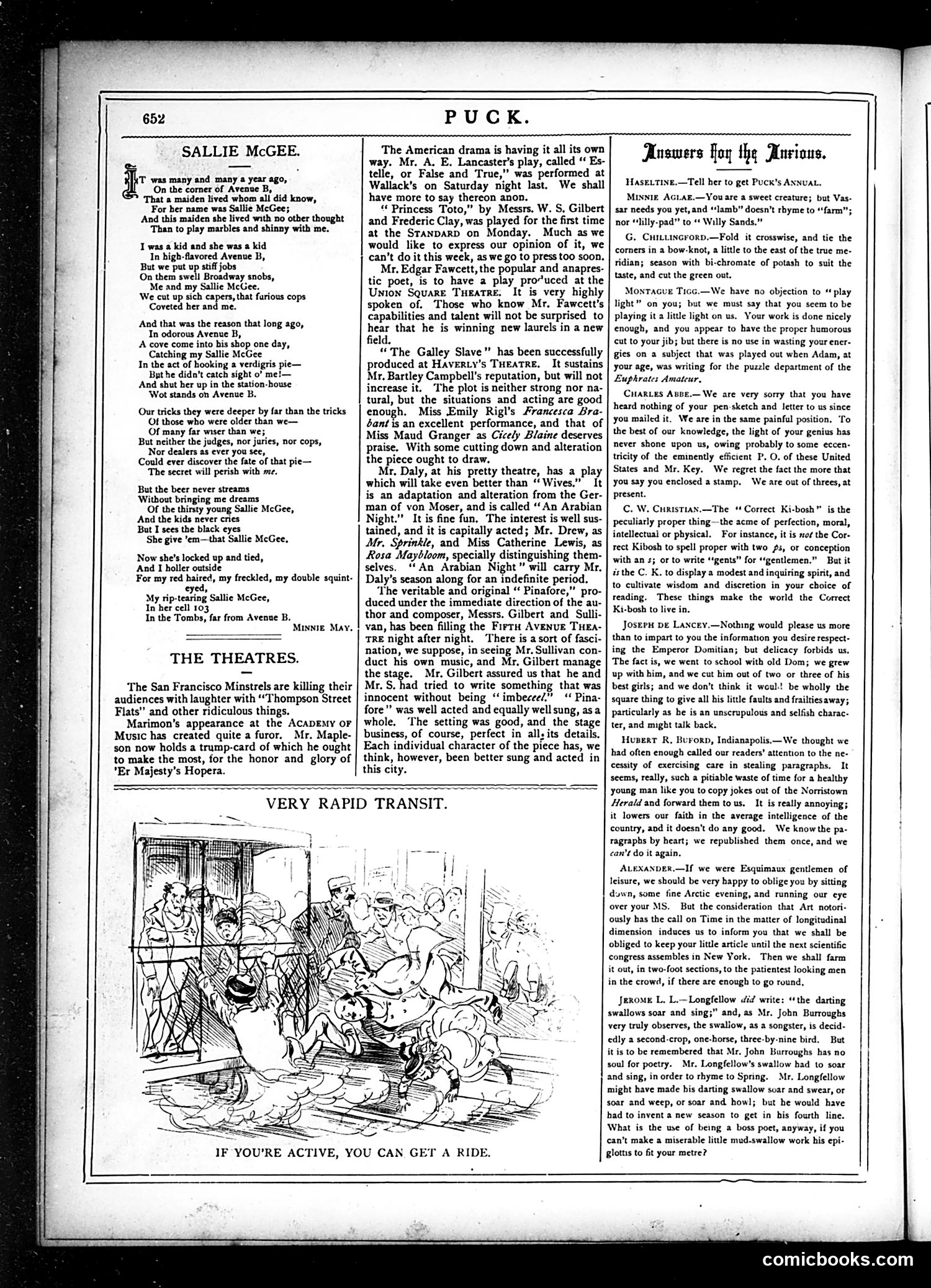
This Puck cartoon satirizes overcrowded public transportation in what appears to be early 20th-century America. The illustration shows a chaotic scene of passengers packed impossibly tight in a transit vehicle—men, women, and children compressed together in a tangled mass. The caption "IF YOU'RE ACTIVE, YOU CAN GET A RIDE" is ironic: the cartoon suggests that getting aboard requires aggressive physical maneuvering rather than orderly boarding. The joke targets the inadequacy of urban transit systems to handle passenger volume, a common complaint during rapid American urbanization. The crude, exaggerated crowding—bodies overlapping and contorted—emphasizes the absurdity and indignity of the experience. This reflects genuine public frustration with metropolitan transportation infrastructure struggling to keep pace with city growth.
This page contains **serialized fiction, not political satire or cartoons**. It's part of "Archie Gascoyne: A Romance of Skye," written expressly for Puck by John Fraser. The text describes Archie's return to a Scottish inn where he encounters Colonel friends discussing a local legend about an obese telegraph pole humorously nicknamed after a chestnut horse. The narrative includes drinking, betting on horse races, and banter about landscape features. **This is lighthearted adventure fiction** rather than political commentary. Puck, while primarily a satirical magazine, clearly published serialized stories. The humor here derives from character personality clashes and Scottish dialect rather than contemporary political references or social satire.
This page is primarily **text content**, specifically Chapter XXIX of a serialized story titled "Saved by a Miracle—Sir Tristam Lived The wonderful story of his life told in full." The narrative describes Archie's recovery after being shot during a confrontation with a ruffian. A young man named Ronald (actually Ronald Campbell) visits Archie in his hotel, revealing they share a mysterious connection—Ronald's voice sounds familiar to Archie. The story involves themes of **identity and fate**: Ronald may be connected to Archie's past, possibly relating to an old romance involving a "youthful Romeo and Juliet." The plot emphasizes Victorian-era melodrama with hints of lost love, separation, and potential redemption. This appears to be **serialized fiction** rather than satirical political content typical of Puck magazine's usual offerings.
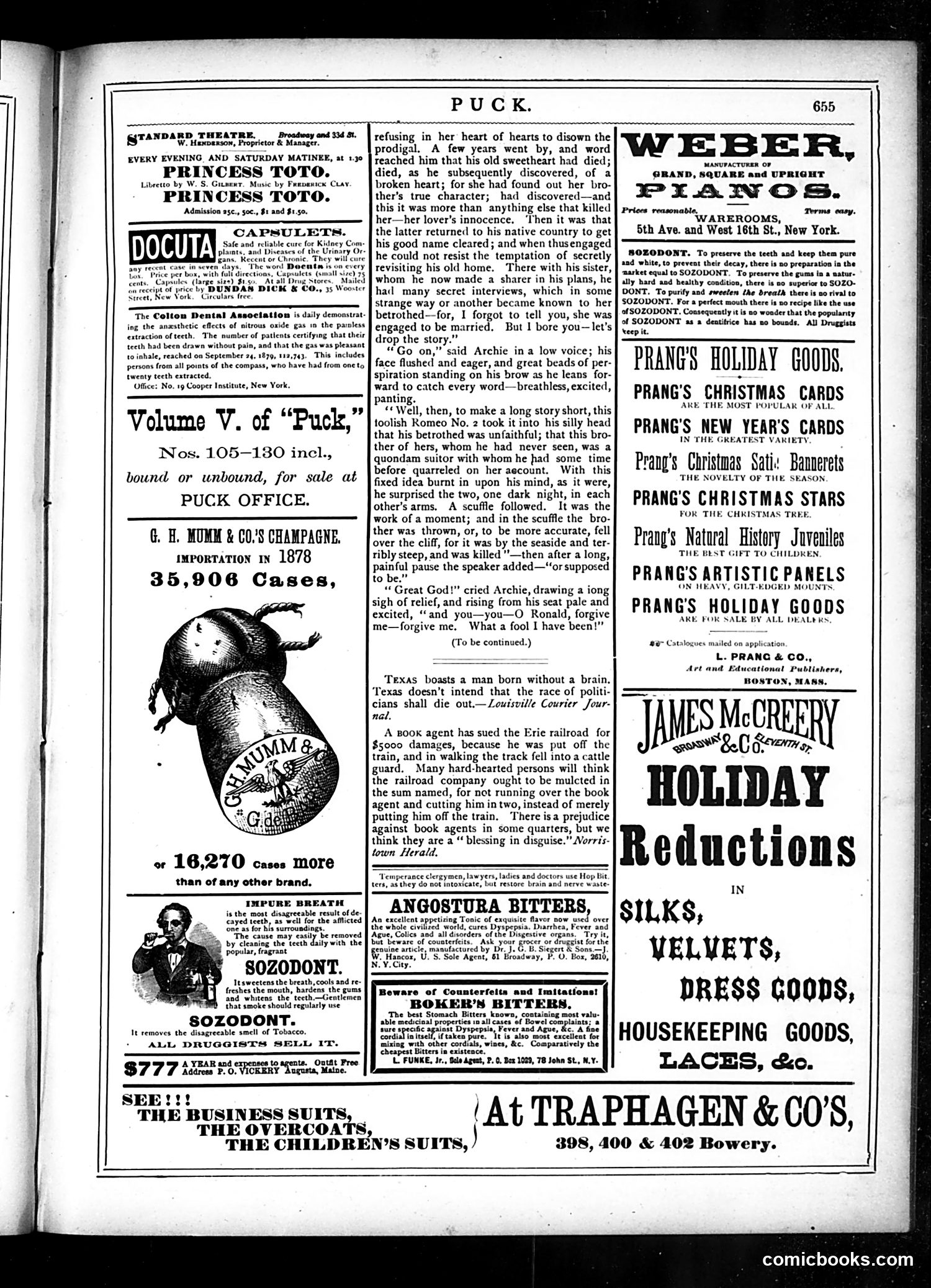
This page is primarily **advertising and announcements** rather than political satire. The main content advertises theatrical productions ("Princess Toto" at Standard Theatre), G.H. Mumm champagne (featuring a large bottle illustration claiming "16,270 Cases more than any other brand"), and various patent medicines like Sozodont toothpaste and Angostura Bitters. The right side promotes **Prang's holiday goods** and **James McCrerry's holiday sales** on silks and housekeeping items. A brief article discusses a romantic plot point, and there's a small satirical note mocking Texas politicians' intellect. However, this appears to be filler content; the page primarily functions as a **commercial vehicle**, typical of Puck's business model combining humor with lucrative advertising space.
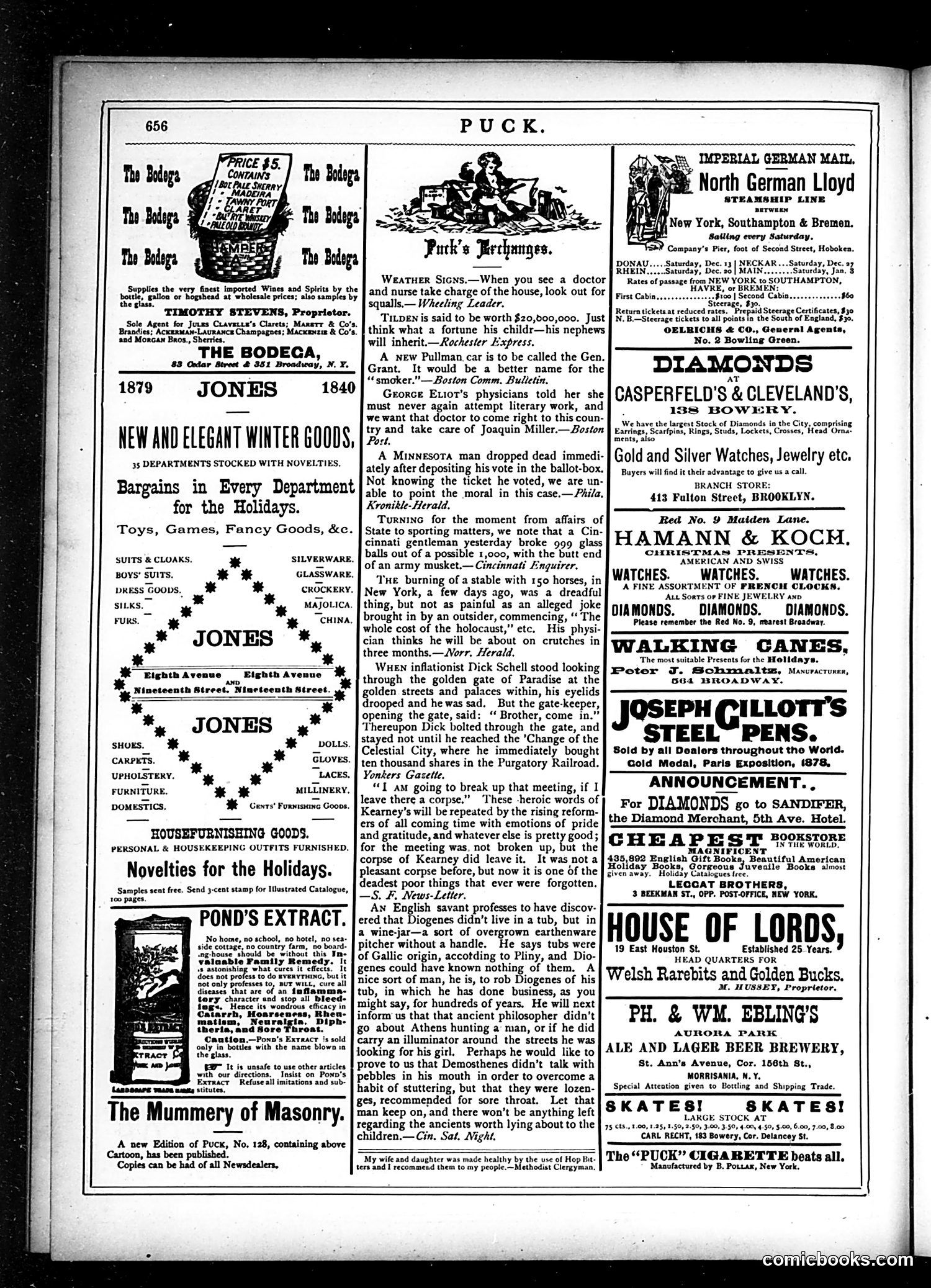
This page is primarily **advertising and miscellaneous content** rather than political satire. The dominant feature is a large "Puck's Archaiques" section containing brief humorous anecdotes and observations—social commentary rather than partisan satire. Topics include a doctor's house call, a wealthy Tilden heir, and various amusing incidents involving horses, glass breaking, and romantic escapades. The rest of the page consists of period advertisements: Jones department store, shipping lines, jewelry stores, beer breweries, and novelty items. The only illustrated cartoon element is a small "Mummery of Masonry" notice at bottom left. Unlike typical Puck political cartoons, this page emphasizes light social humor and commercial advertising, with no identifiable political figures or partisan commentary visible.
This page is primarily **advertising**, not editorial content or political cartoons. It features commercial advertisements for products and services typical of the late 19th century, including: - Seal skin sacques and fur-lined cloaks (James McCreery & Co.) - Champagne and wines (multiple importers) - Smoking tobacco and cigarettes ("Puck" brand) - Billiard and bowling equipment - Cabinet furniture - Tailoring services The only illustrated element is a **Puck brand smoking tobacco advertisement** featuring a caricatured figure, but this is commercial rather than satirical content. The page represents Puck magazine's revenue model: the satirical editorial content was subsidized by advertising from merchants and manufacturers seeking upscale consumers.
This is primarily an **advertising page** from Puck magazine, not a satirical cartoon page. It contains numerous commercial advertisements for various products and services popular in late 19th/early 20th-century New York, including: - Pianos (Sohmer, Calenberg & Vaupel) - A Vienna Coffee Pot - Gentlemen's hats - Felt hats - A piano with organ - Beer and brewery services - Roofing supplies - Billiard tables - Photography services - Optical services - Medical devices (trusses) The page demonstrates how Puck monetized its publication through advertisements rather than relying solely on editorial content. The ads reflect the consumer goods and services available to middle and upper-class New Yorkers of the period.
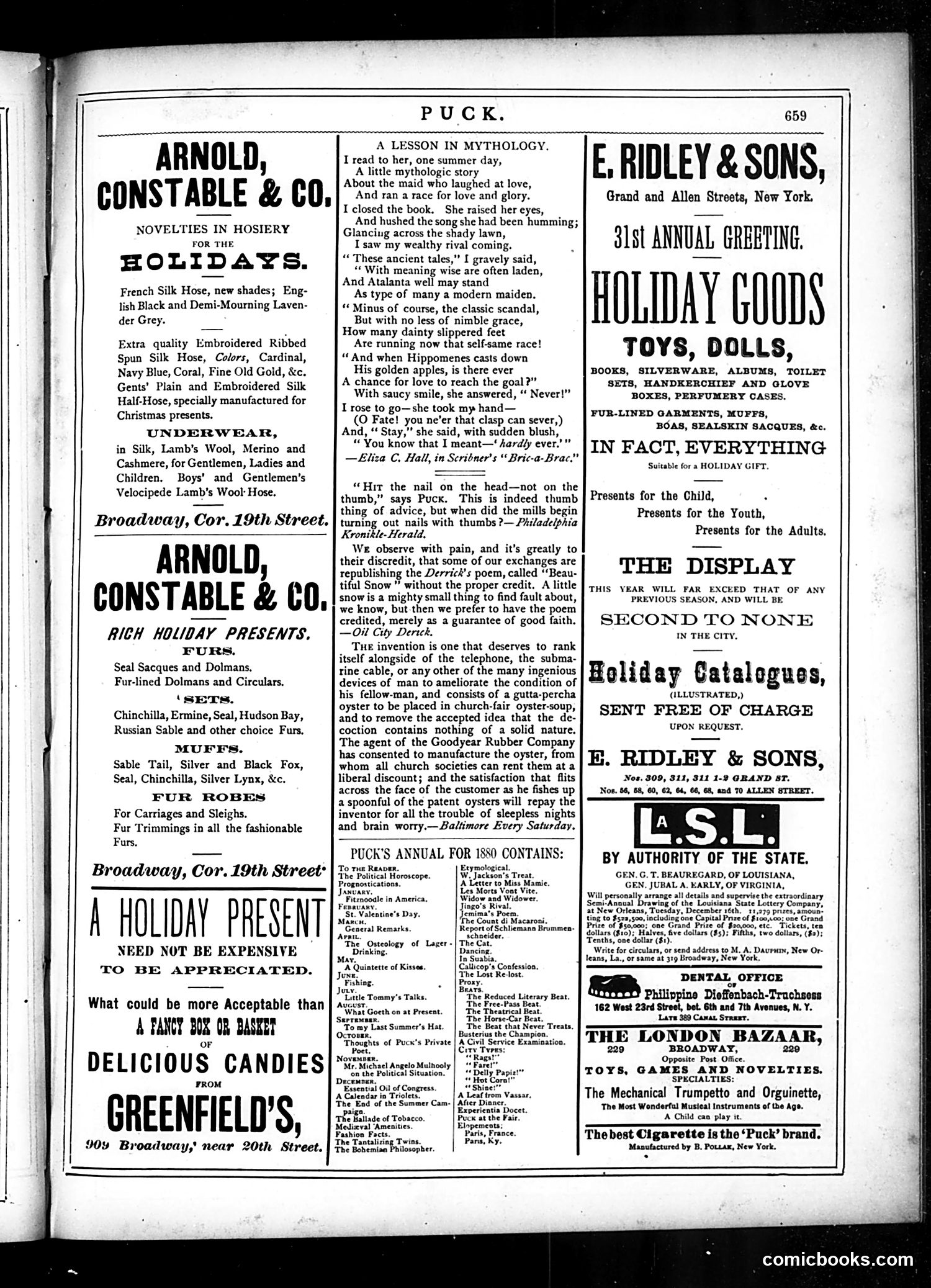
This page is primarily **advertising and editorial content**, not a political cartoon. It consists of: - Multiple holiday shopping advertisements for stores like Arnold, Constable & Co. (furs, hosiery, underwear) and E. Ridley & Sons (toys, dolls, books) - "A Lesson in Mythology," a humorous poem about classical mythology, apparently satirizing over-educated commentary on literature - Brief Puck editorial commentary mocking various social absurdities (oyster soup at church fairs, the Goodyear Rubber Company's invention) - A candy advertisement from Greenfield's The only identifiable satirical content targets pretentious intellectuals discussing classical literature and the gap between grand inventions and their actual practical utility—typical Puck themes—but these are minor editorial flourishes amid commercial notices.
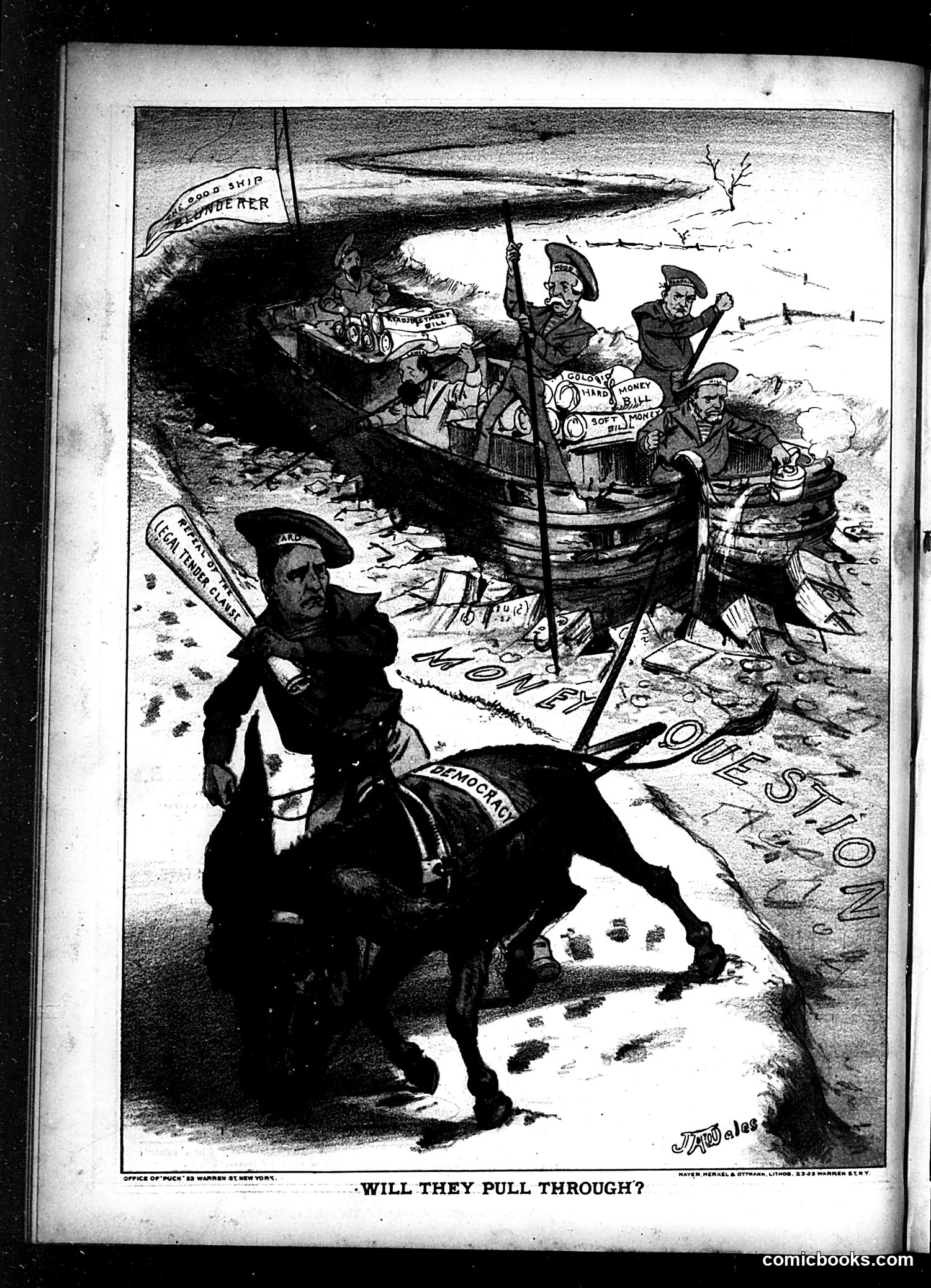
This political cartoon depicts a sinking ship labeled "Good Ship Conducter" (likely referencing a conductor or leader) with several figures aboard and one on horseback in the water below, labeled "Bendock" (unclear if this is the main figure's name or title). The cartoon's title—"Will They Pull Through?"—poses a question about survival. The imagery suggests a crisis or failure: passengers aboard a distressed vessel while someone below struggles. The scattered cargo and barrels marked with text (partially illegible) indicate economic loss or waste. Without clearer identification of the specific political figures or events referenced, the exact subject remains uncertain, though the satire clearly mocks leadership during some perceived crisis or governmental failure of the era.