
Puck, 1879-12-10 · page 3 of 18
Puck — December 10, 1879 — page 3: what you’re looking at
What you’re looking at
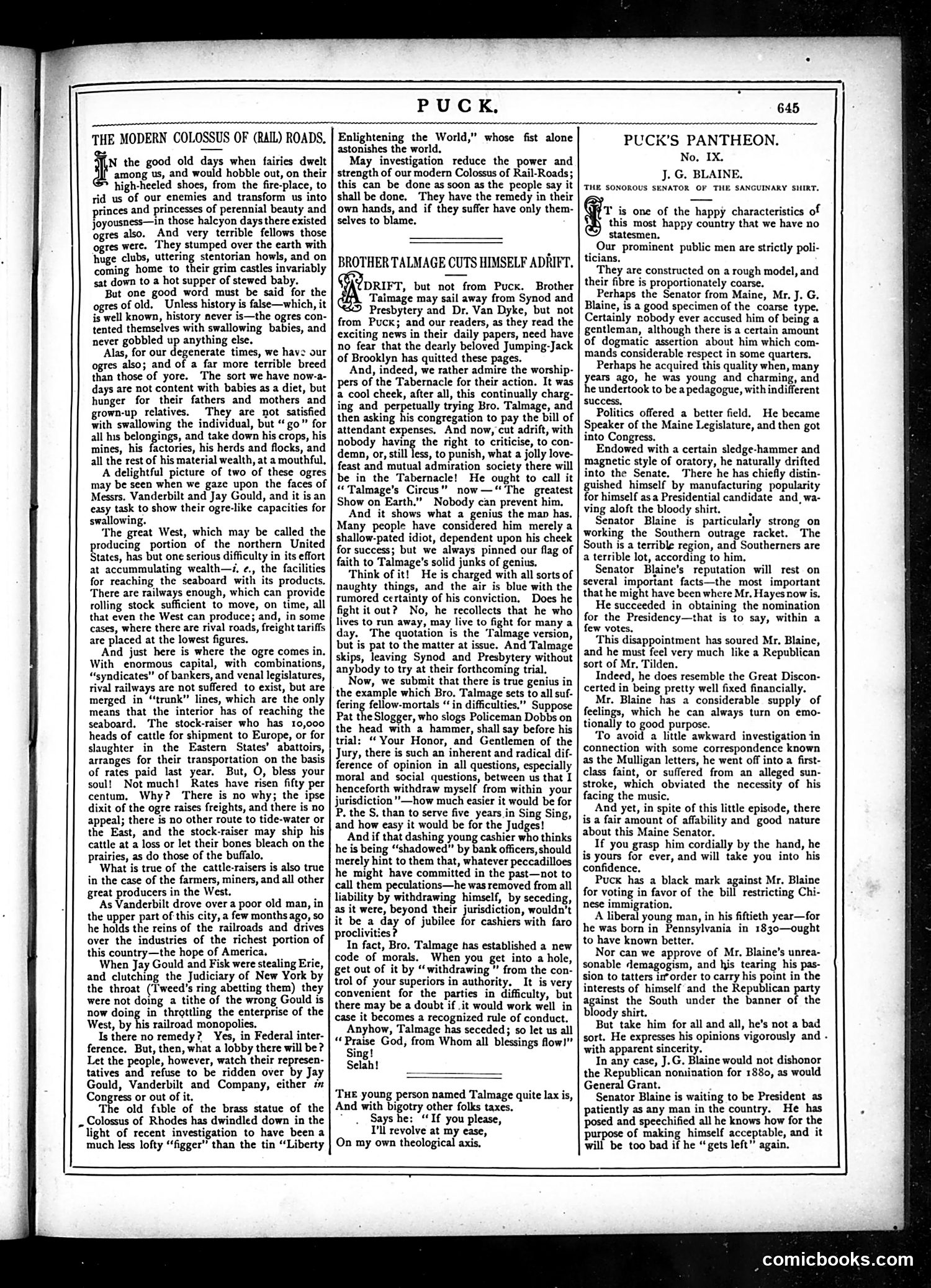
This page contains two distinct articles rather than political cartoons. "The Modern Colossus of (Rail)Roads" critiques the enormous power wielded by railroad corporations, comparing them to the legendary Colossus of Rhodes. The piece argues railroads have become dangerously monopolistic, controlling vast wealth and political influence while exploiting workers and the public. It advocates for regulatory intervention to curtail their power. "Brother Talmage Cuts Himself Adrift" discusses Rev. Thomas DeWitt Talmage, a prominent preacher who apparently withdrew from public controversy. The satirical piece praises his decision to avoid political and social debates, suggesting his previous pronouncements lacked genuine wisdom despite his popularity and reputation. Both articles use humor to critique institutional power—whether corporate or religious—and those who wield it irresponsibly.
📄 Transcribed text from this page (OCR, searchable)
Machine-transcribed from the original scan — historical spelling and the odd misread are preserved.
PUCK, THE MODERN COLOSSUS OF (RAIL) ROADS. N the good old days when fairies dwelt among us, and would hobble out, on their high-heeled shoes, from the fire-place, to rid us of our enemies and transform us into rinces and princesses of perennial beauty and joyousness—in those halcyon days there existed ogres also. And very terrible fellows those ogres were. They stumped over the earth with huge clubs, uttering stentorian howls, and on coming home to their grim castles invariably sat down to a hot supper of stewed baby. But one good word must be said for the ogres of old. Unless history is false—which, it is well known, history never is—the ogres con- tented themselves with swallowing babies, and never gobbled up anything else. Alas, for our degenerate times, we have our ogres also; and of a far more terrible breed than those of yore. The sort we have now-a- days are not content with babies as a diet, but hunger for their fathers and mothers and grown-up relatives. They are not satisfied with swallowing the individual, but “go” for all his belongings, and take down his crops, his mines, his factories, his herds and flocks, and all the rest of his material wealth, at a mouthful, A delightful picture of two of these ogres may be seen when we gaze upon the faces of Messrs. Vanderbilt and Jay Gould, and it is an easy task to show their ogre-like capacities for swallowing. ‘The great West, which may be called the roducing portion of the northern United tates, has but one serious difficulty in its effort at accummulating wealth—s, ¢., the facilities for reaching the seaboard with its products. ‘There are railways enough, which can provide rolling stock sufficient to move, on time, all that even the West can produce; and, in some cases, where there are rival roads, freight tariffs are placed at the lowest figures. ‘And just here is where the ogre comes in, With enormous capital, with combinations, “syndicates” of bankers, and venal legislatures, rival railways are not suffered to exist, but are merged in “trunk” lines, which are the only means that the interior has of reaching the seaboard. The stock-raiser who has 10,000 heads of cattle for shipment to Europe, or for slaughter in the Eastern States’ abattoirs, arranges for their transportation on the basis of rates paid last year. But, O, bless your soul! Not much! Rates have risen fifty per centum, Why? There is no why; the ipse dixit of the ogre raises freights, and there is no appeal; there is no other route to tide-water or the East, and the stock-raiser may ship his cattle at a loss or let their bones bleach on the prairies, as do those of the buffalo. What is true of the cattle-raisers is also true in the case of the farmers, miners, and all other great producers in the West. As Vanderbilt drove over a poor old man, in the upper part of this city, a few months ago, so he holds the reins of the railroads and drives over the industries of the richest portion of this country—the hope of America, When Jay Gould and Fisk were stealing Erie, and clutching the Judiciary of New York by the throat (‘Tweed’s ring abetting them) they were not doing a tithe of the wrong Gould is now doing in throttling the enterprise of the West, by his railroad monopolies, Is there no remedy? Yes, in Federal inter- ference. But, then, what a lobby there will be? Let the people, however, watch their represen- tatives and refuse to be ridden over by Jay Gould, Vanderbilt and Company, either i Congress or out of it, i old fible of the brass statue of the ~ Colossus of Rhodes has dwindled down in the light of recent investigation to have been a much less lofty “figger” than the tin “Liberty Enlightening the World,” whose fist alone astonishes the world, May investigation reduce the power and strength of our modern Colossus of Rail-Roads; this can be done as soon as the people say it shall be done, They have the remedy in their own hands, and if they suffer have only them- selves to blame. BROTHER TALMAGE CUTS HIMSELF ADRIFT. DRIFT, but not from Puck. Brother Taimage may sail away from Synod and Presbytery and Dr. Van Dyke, but not from Puck; and our readers, as they read the exciting news in their daily papers, need have no fear that the dearly beloved Jumping-Jack of Brooklyn has quitted these pages. And, indeed, we rather admire the worship- pers of the Tabernacle for their action. It was a cool cheek, after all, this continually charg- ing and perpetually trying Bro. Talmage, and then asking his congregation to pay the bill of attendant expenses. And now, cut adrift, with nobody having the right to criticise, to con- demn, or, still less, to punish, what a jolly love- feast and mutual admiration society there will be in the Tabernacle! He ought to call it “Talmage's Circus” now—‘‘The greatest Show on Earth.” Nobody can prevent him. And it shows what a genius the map has. Many people have considered him merely a shallow-pated idiot, dependent upon his cheek for success; but we always pinned our flag of faith to Talmage’s solid junks of genius. Think of it! He is charged with all sorts of naughty things, and the air is blue with the rumored certainty of his conviction. Does he fight it out? No, he recollects that he who lives to run away, may live to fight for many a day. The quotation is the Talmage version, but is pat to the matter at issue. And Talmage skips, leaving Synod and Presbytery without anybody to try at their forthcoming trial. Now, we submit that there is true genius in the example which Bro, Talmage sets to all suf- fering fellow-mortals ‘in difficulties.” Suppose Pat the Slogger, who slogs Policeman Dobbs on the head with a hammer, shall say before his trial: “ Your Honor, and Gentlemen of the Jury, there is such an inherent and radical dif- ference of opinion in all questions, especially moral and social questions, between us that I henceforth withdraw myself from within your jurisdiction "—how much easier it would be for P. the S, than to serve five years in Sing Sing, and how easy it would be for the Judges! And if that dashing young cashier who thinks he is being ‘‘shadowed” by bank officers, should merely hint to them that, whatever peccadilloes he might have committed in the past—not to call them peculations—he was removed from all liability by withdrawing himself, by seceding, as it were, beyond their jurisdiction, wouldn’t it be day of jubilee for cashiers with faro proclivi In fact, Bro, Talmage has established a new code of morals. When you get into a hole, get out of it by “withdrawing” from the con- trol of your superiors in authority. It is very convenient for the parties in difficulty, but there may be a doubt if .it would work well in case it becomes a recognized rule of conduct. Anyhow, Talmage has seceded; so let us all “Praise God, from Whom all blessings flow!” Sing! Selah! ‘THE young person named Talmage quite lax is, And with bigotry other folks tare a . Says he: “If you please, I'll revolve at my ease, On my own theological axis. PUCK’S PANTHEON. No, IX. J. G. BLAINE, THE SONOROUS SENATOR OF THE SANGUINARY SHIRT. 'T is one of the happy characteristics of this most happy country that we have no statesmen, _ Our prominent public men are strictly poli- ticians. ‘They are constructed on a rough model, and their fibre is proportionately coarse. Perhaps the Senator from Maine, Mr. J. G. Blaine, is a good specimen of the coarse type. Certainly nobody ever accused him of being a gentleman, although there is a certain amount of dogmatic assertion about him which com- mands considerable respect in some quarters, Perhaps he acquired this quality when, many ears ago, he was young and charming, and ¢ undertook to be a pedagogue, with indifferent success, Politics offered a better field. He became Speaker of the Maine Legislature, and then got into Congress. Endowed with a certain sledge-hammer and magnetic style of oratory, he naturally drifted into the Senate, There he has chiefly distin- guished himself by manufacturing popularity for himself asa Presidential candidate and, wa- ving aloft the bloody shirt. . Senator Blaine is particularly strong on working the Southern outrage racket. The South is a terrible region, and Southerners are a terrible lot, according to him, Senator Blaine’s reputation will rest on several important facts—the most important that he might have been where Mr. Hayes now is. He succeeded in obtaining the nomination for the Presidency—that is to say, within a few votes. ‘This disappointment has soured Mr. Blaine, and he must feel very much like a Republican sort of Mr. Tilden. Indeed, he does resemble the Great Discon- certed in being pretty well fixed financially. Mr. Blaine has a considerable supply of feelings, which he can always turn on emo- tionally to good purpose. To avoid a little awkward investigation in connection with some correspondence known as the Mulligan letters, he went off into a first- class faint, or suffered from an alleged sun- stroke, which obviated the necessity of his facing the music. And yet, in spite of this little episode, there is a fair amount of affability and good nature about this Maine Senator. If you grasp him cordially by the hand, he is yours for ever, and will take you into his confidence, Puck has a black mark against Mr. Blaine for voting in favor of the bill restricting Chi- nese immigration. A liberal young man, in his fiftieth year—for he was born in Pennsylvania in 1830—ought to have known better. Nor can we approve of Mr, Blaine’s unrea- sonable demagogism, and his tearing his pas- sion to tatters inorder to carry his point in the interests of himself and the Republican party against the South under the banner of the bloody shirt. But take him for all and all, he’s not a bad sort. He expresses his opinions vigorously and . with apparent sincerity, In any case, J.G, Blaine would not dishonor the Republican nomination for 1880, as would General Grant. Senator Blaine is waiting to be President as patiently as any man in the country. He has posed and speechified all he knows how for the purpose of making himself acceptable, and it will be too bad if he “gets left” again. _comicbooks.com