
Puck, 1879-12-10 · page 7 of 18
Puck — December 10, 1879 — page 7: what you’re looking at
What you’re looking at
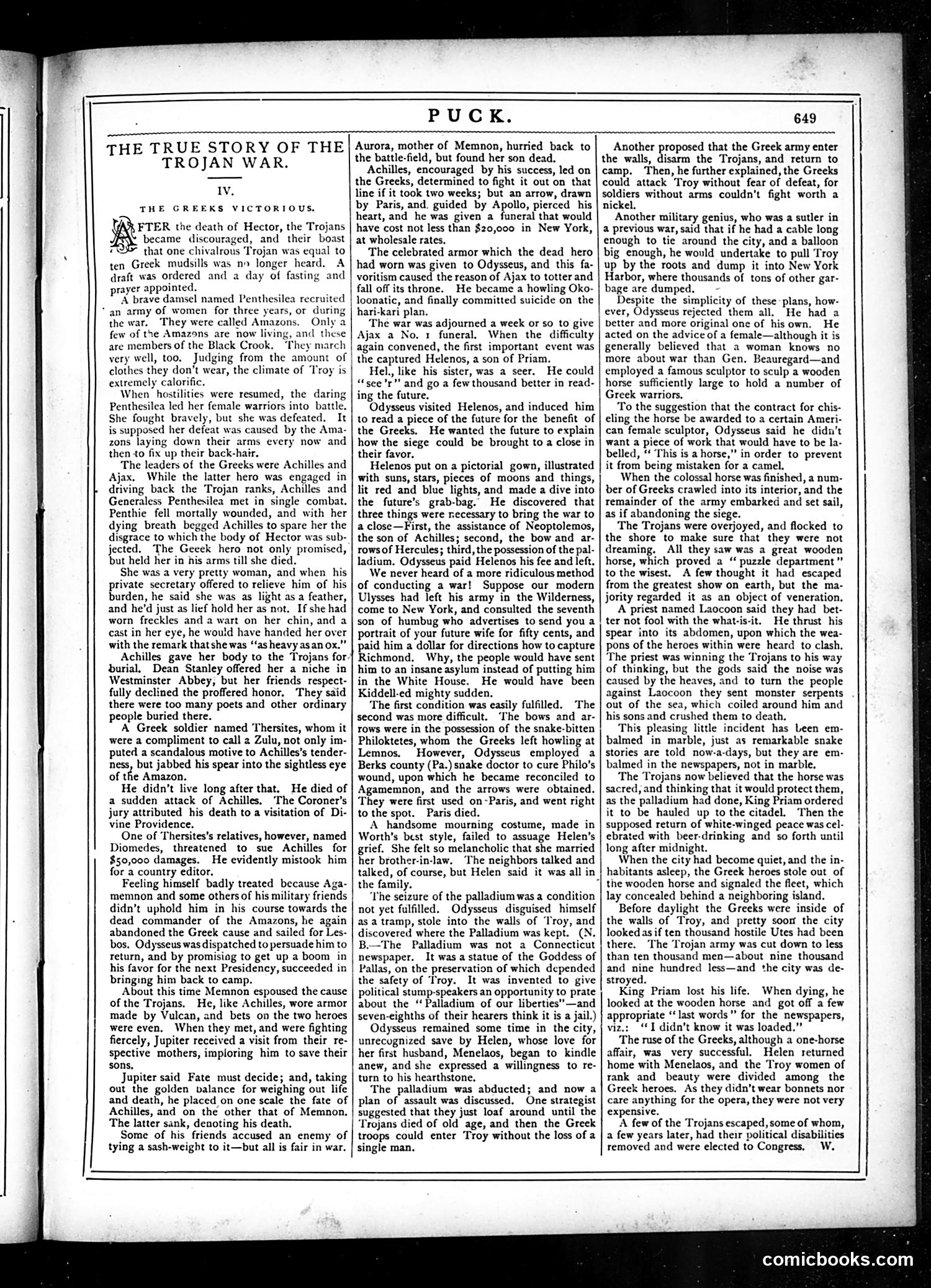
This page contains **text only—no cartoon or illustration**. It's part of a serialized article titled "The True Story of the Trojan War," Section IV: "The Greeks Victorious." The content presents a humorous, tongue-in-cheek retelling of classical mythology, mixing mythological events with anachronistic American references (e.g., mentions of New York, Connecticut newspapers, the White House, a Pennsylvania snake doctor). The satire lies in treating ancient Greek legends as if they were contemporary American news stories, complete with ridiculous details like Odysseus commissioning a sculptor to carve a wooden horse and advertising it as a "puzzle department." This is **satirical literature rather than visual satire**—Puck's humor here comes through irreverent prose rather than political cartooning.
📄 Transcribed text from this page (OCR, searchable)
Machine-transcribed from the original scan — historical spelling and the odd misread are preserved.
PUCK. 649 THE TRUE STORY OF THE TROJAN WAR. Iv. THE G KS VICTORIOUS. FTER the death of Hector, the Trojans became discouraged, and their boast € that one chivalrous Trojan was equal to ten Greek mudsills was no longer heard. A draft was ordered and a day of fasting and prayer appointed, A brave damsel named Penthesilea recruited * an army of women for three years, or during the war. They were called Amazons. Only a few of the Amazons are now living, and these are members of the Black Crook. ‘They march very well, too. Judging from the amount of clothes they don’t wear, the climate of Troy is extremely calorific. When hostilities were resumed, the daring Penthesilea led her female warriors into battle, She fought bravely, but she was defeated. It is supposed her defeat was caused by the Ama- zons laying down their arms every now and then to fix up their back-hai The leaders of the Greeks were Achilles and Ajax. While the latter hero was engaged in driving back the Trojan ranks, Achilles and Generaless Penthesilea met in single combat. Penthie fell mortally wounded, and with her dying breath begged Achilles to spare her the disgrace to which the body of Hector was sub- jected. The Geeek hero not only promised, but held her in his arms till she died. She was a very pretty woman, and when his private secretary offered to relieve him of his burden, he said she was as light as a feather, and he’d just as lief hold her as not. If she had worn freckles and a wart on her chin, and a cast in her eye, he would have handed her over with the remark that she was ‘‘as heavy as an ox.” Achilles gave her body to the Trojans for durial, Dean Stanley offered her a niche in Westminster Abbey, but her friends respect- fully declined the proffered honor. They said there were too many poets and other ordinary people buried there. A Greek soldier named Thersites, whom it were a compliment to call 2 Zulu, not only im- puted a scandalous motive to Achilles's tender- ness, but jabbed his spear into the sightless eye of the Amazon, He didn’t live long after that. He died of a sudden attack of Achilles. The Coroner's jury attributed his death to a visitation of Di- vine Providence. One of Thersites's relatives, however, named Diomedes, threatened to sue Achilles for $50,000 damages. He evidently mistook him for a country editor. Feeling himself badly treated because Aga- memnon and some others of his military friends didn’t uphold him in his course towards the dead commander of the Amazons, he again abandoned the Greek cause and sailed for Les- bos. Odysseus was dispatched to persuade him to return, and by promising to get up a boom in his favor for the next Presidency, succeeded in bringing him back to camp. About this time Memnon espoused the cause of the Trojans. He, like Achilles, wore armor made by Vulcan, and bets on the two heroes were even, When they met, and were fighting fiercely, Jupiter received a visit from their re- spective mothers, imploring him to save their sons, Jupiter said Fate must decide; and, taking out the golden valance for weighing out life and death, he placed on one scale the fate of Achilles, and on the other that of Memnon. The latter sank, denoting his death, Some of his friends accused an enemy of tying a sash-weight to it—but all is fair in war. Aurora, mother of Memnon, hurried back to the battle-field, but found her son dead, Achilles, encouraged by his success, led on the Greeks, determined to fight it out on that line if it took two weeks; but an arrow, drawn by Paris, and. guided by Apollo, pierced his heart, and he was given a funeral that would have cost not less than $20,000 in New York, at wholesale rates. The celebrated armor which the dead hero had worn was given to Odysseus, and this fa- voritism caused the reason of Ajax to totterand fall off its throne. He became a howling Oko- | loonatic, and finally committed suicide on the hari-kari plan. ‘The war was adjourned a week or so to give Ajax a No. 1 funeral, When the difficulty again convened, the first important event was the captured Helenos, a son of Priam. Hel., like his sister, was a seer. He could “see 'r’’ and go a few thousand better in read- ing the future, Odysseus visited Helenos, and induced him to read a piece of the future for the benefit of the Greeks, He wanted the future to explain how the siege could be brought to a close in their favor. Helenos put on a pictorial gown, illustrated with suns, stars, pieces of moons and things, lit red and blue lights, and made a dive into the future’s grab-bag. He discovered that three things were necessary to bring the war to a close—First, the assistance of Neoptolemos, the son of Achilles; second, the bow and ar- rows of Hercules; third, the possession of the pal- ladium. Odysseus paid Helenos his fee and left. We never heard of a more ridiculous method of conducting a war! Suppose our modern Ulysses had left his army in the Wilderness, come to New York, and consulted the seventh son of humbug who advertises to send you a portrait of your future wife for fifty cents, and paid him a dollar for directions how to capture Richmond, Why, the people would have sent him to an insane asylum instead of putting him in the White House. He would have been Kiddell-ed mighty sudden. The first condition was easily fulfilled. The second was more difficult. The bows and ar- rows were in the possession of the snake-bitten Philoktetes, whom the Greeks left howling at mnos, ‘However, Odysseus employed a Berks county (Pa.) snake doctor to cure Philo’s wound, upon which he became reconciled to Agamemnon, and the arrows were obtained. They were first used on-Paris, and went right to the spot. Paris died. A handsome mourning costume, made in Worth’s best style, failed to assuage Helen's grief. She felt so melancholic that she married her brother-in-law. The neighbors talked and talked, of course, but Helen said it was all in the family. ‘The seizure of the palladium was a condition not yet fulfilled. Odysseus disguised himself as a tramp, stole into the walls of Troy, and discovered where the Palladium was kept. (N. B,—The Palladium was not a Connecticut newspaper. It was a statue of the Goddess of Pallas, on the preservation of which depended the safety of Troy. It was invented to give political stump-speakers an opportunity to prate about the “ Palladium of our liberties” —and seven-eighths of their hearers think it is a jail.) Odysseus remained some time in the city, unrecognized save by Helen, whose love for her first husband, Menelaos, began to kindle anew, and she expressed a willingness to re- turn to his hearthstone, ‘The palladium was abducted; and now a plan of assault was discussed. One strategist suggested that they just loaf around until the ‘Trojans died of old age, and then the Greek troops could enter Troy without the loss of a single man. Another proposed that the Greek army enter the walls, disarm the Trojans, and return to camp. Then, he further explained, the Greeks could attack Troy without fear of defeat, for soldiers without arms couldn't fight worth a nickel. Another military genius, who was a sutler in a previous war, said that if he had a cable long enough to tie around the city, and a balloon big enough, he would undertake to pull Troy up by the roots and dump it into New York Harbor, where thousands of tons of other gar- bage are dumped. Despite the simplicity of these plans, how- ever, Odysseus rejected them all. He had a better and more original one of hisown. He acted on the advice of a female—although it is generally believed that a woman knows no more about war than Gen. Beauregard—and employed a famous sculptor to sculp a wooden horse sufficiently large to hold a number of Greek warriors. To the suggestion that the contract for chis- eling the horse be awarded to a certain Ameri- can female sculptor, Odysseus said he didn’t want a piece of work that would have to be la- belled, “ This is a horse,” in order to prevent it from being mistaken for a camel. When the colossal horse was finished, a num- ber of Greeks crawled into its interior, and the remainder of the army embarked and set sail, as if abandoning the siege. The Trojans were overjoyed, and flocked to the shore to make sure that they were not dreaming. All they saw was a great wooden horse, which proved a “ puzzle department” to the wisest. A few thought it had escaped from the greatest show on earth, but the ma- jority regarded it as an object of veneration. A priest named Laocoon said they had bet- ter not fool with the what-is-it. He thrust his spear into its abdomen, upon which the wea- pons of the heroes within were heard to clash. ‘The priest was winning the Trojans to his way of thinking, but the gods said the noise was caused by the heaves, and to turn the people against Laocoon they sent monster serpents out of the sea, which coiled around him and his sons and crushed them to death, This pleasing little incident has Leen em- balmed in marble, just as remarkable snake stories are told now-a-days, but they are em- balmed in the newspapers, not in marble, The Trojans now believed that the horse was sacred, and thinking that it would protect them, as the palladium had done, King Priam ordered it to be hauled up to the citadel. Then the supposed return of white-winged peace was cel- ebrated with beer-drinking and so forth until long after midnight. When the city had become quiet, and the in- habitants asleep, the Greek heroes stole out of “| the wooden horse and signaled the fleet, which lay concealed behind a neighboring island. Before daylight the Greeks were inside of the walls of Troy, and pretty soon the city looked as if ten thousand hostile Utes had been there. The ‘Trojan army was cut down to less than ten thousand men—about nine thousand and nine hundred less—and the city was de- stroyed. King Priam lost his life. When dying, he looked at the wooden horse and got off a few appropriate “last words” for the newspapers, viz; I didn’t know it was loaded.” The ruse of the Greeks, although a one-horse affair, was very successful. Helen returned home with Menelaos, and the Troy women of rank and beauty were divided among the Greek heroes. As they didn’t wear bonnets nor care anything for the opera, they were not very expensive. A few of the Trojans escaped, some of whom, a few years later, had their political disabilities removed and were elected to Congress, W. comicbooks.com