
Puck, 1879-12-10 · page 10 of 18
Puck — December 10, 1879 — page 10: what you’re looking at
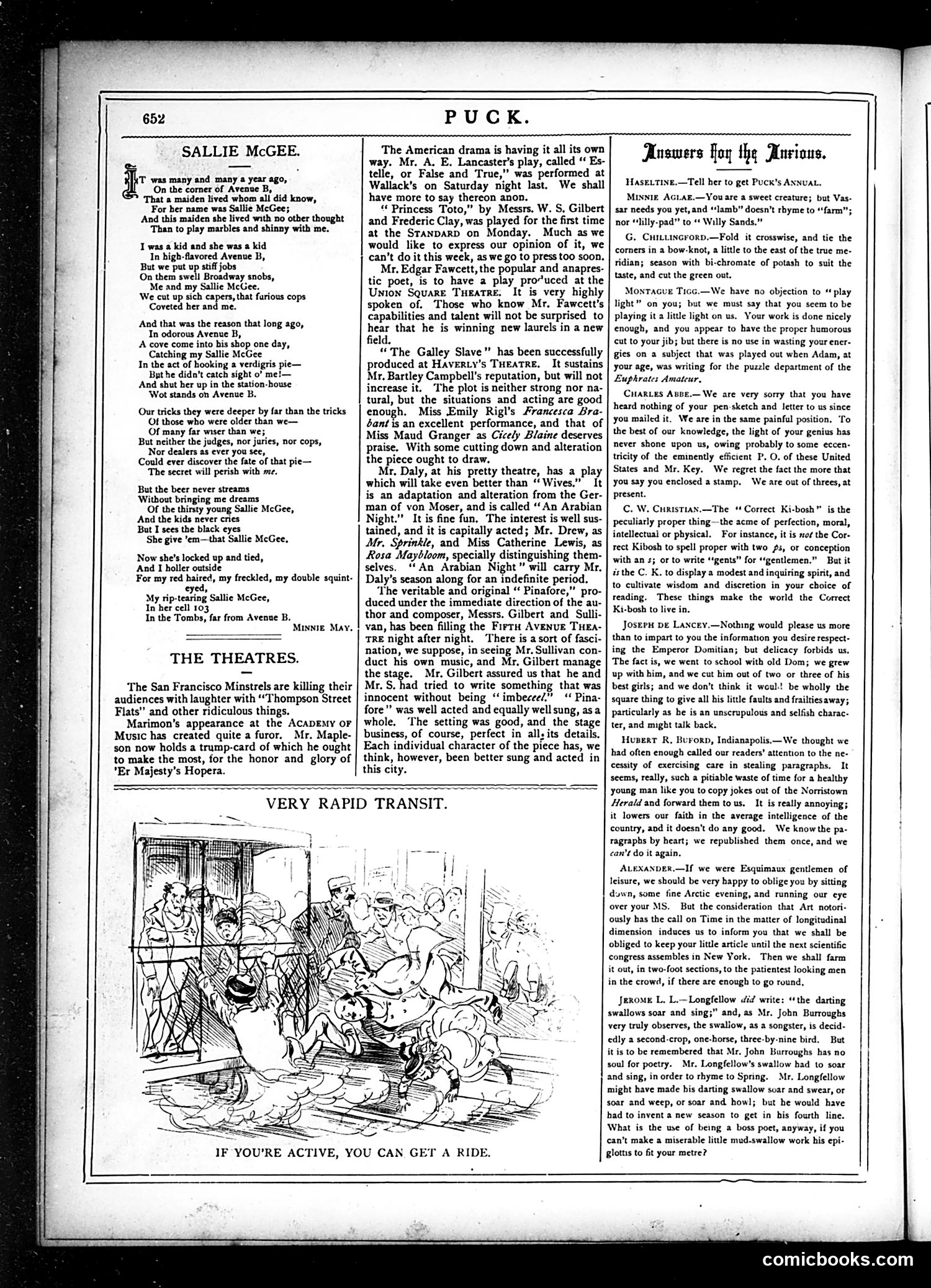
What you’re looking at
This Puck cartoon satirizes overcrowded public transportation in what appears to be early 20th-century America. The illustration shows a chaotic scene of passengers packed impossibly tight in a transit vehicle—men, women, and children compressed together in a tangled mass. The caption "IF YOU'RE ACTIVE, YOU CAN GET A RIDE" is ironic: the cartoon suggests that getting aboard requires aggressive physical maneuvering rather than orderly boarding. The joke targets the inadequacy of urban transit systems to handle passenger volume, a common complaint during rapid American urbanization. The crude, exaggerated crowding—bodies overlapping and contorted—emphasizes the absurdity and indignity of the experience. This reflects genuine public frustration with metropolitan transportation infrastructure struggling to keep pace with city growth.
📄 Transcribed text from this page (OCR, searchable)
Machine-transcribed from the original scan — historical spelling and the odd misread are preserved.
PUCK. SALLIE McGEE. T was many and many a year ago, On the comer of Avenue B, ‘That a maiden lived whom all did know, For her name was Sallie McGee; ‘And this maiden she lived with no other thought ‘Than to play marbles and shinny with me. I was a kid and she was a kid In bigh-flavored Avenue B, But we put up stiff jobs On them swell Broadway snobs, Me and my Sallie McGee. We cut up sich capers, that furious cops Coveted her and me. And that was the reason that long ago, In odorous Avenue B, A cove come into his shop one day, Catching my Sallie McGee In the act of hooking a verdigris pie— Bathe didn’t catch sight o” me!— And shut her up in the station-house ‘Wot stands on Avenue B. Our tricks they were deeper by far than the tricks Of those who were older than we— Of many far wiser than we; But neither the judges, nor juries, nor cops, Nor dealers as ever you see, Could ever discover the fate of that pie— ‘The secret will perish with me. But the beer never streams Without bringing me dreams Of the thirsty young Sallie McGee, And the kids never cries But I sees the black eyes She give 'em—that Sallie McGee, Now she's locked up and tied, And I holler outside For my red haired, my freckled, my double squint- My rip-teaving Sallie McGee, In her cell 103 In the Tombs, far from Avenue B. MINNIE May. THE THEATRES. The San Francisco Minstrels are killing their audiences with laughter with “Thompson Street Flats” and other ridiculous things. Marimon’s appearance at the ACADEMY OF Music has created quite a furor. Mr. Maple- son now holds a trump-card of which he ought to make the most, for the honor and glory of "Er Majesty’s Hopera. The American drama is having it all its own way. Mr. A. E. Lancaster's play, called ‘ Es- telle, or False and True,” was performed at Wallack’s on Saturday night last. We shall have more to say thereon anon. “Princess Toto,” by Messrs. W. S, Gilbert and Frederic Clay, was played for the first time at the StanparD on Monday. Much as we would like to express our opinion of it, we can’t do it this week, as we go to press too soon. Mr. Edgar Fawcett, the popular and anapres- tic poet, is to have a play pro“uced at the Union Square THEATRE: It is very highly spoken of. Those who know Mr. Fawcett's capabilities and talent will not be surprised to hear that he is winning new laurels in a new field. “The Galley Slave” has been successfully produced at HAvERLY’s THEATRE, It sustains Mr. Bartley Campbell's reputation, but will not increase it. ‘The plot is neither strong nor na- tural, but the situations and acting are good enough. Miss Emily Rigl’s Francesca Bra- dant is an excellent performance, and that of Miss Maud Granger as Cicely Blaine deserves praise. With some cutting down and alteration the piece ought to draw. Mr. Daly, at his pretty theatre, has a play which will take even better than ‘ Wives.” It is an adaptation and alteration from the Ger- man of von Moser, and is called “An Arabian Night.” It is fine fun. The interest is well sus- tained, and it is capitally acted; Mr. Drew, as Mr. Sprinkle, and Miss Catherine Lewis, as Rosa Maybloom, specially distinguishing them- selves. “An Arabian Night” will carry Mr. Daly’s season along for an indefinite period. ‘The veritable and original “ Pinafore,” pro- duced under the immediate direction of the au- thor and composer, Messrs. Gilbert and Sulli- van, has been filling the Firr AVENUE THEA- ‘TRE night after night. ‘There is a sort of fasci- nation, we suppose, in seeing Mr. Sullivan con- duct his own music, and Mr. Gilbert manage the stage. Mr, Gilbert assured us that he and Mr. S, had tried to write something that was innocent without being “ imbecee/.” ‘ Pina- fore” was well acted and equally well sung, as a whole, The setting was good, and the stage business, of course, perfect in all: its details. Each individual character of the piece has, we think, however, been better sung and acted in this city. VERY RAPID TRANSIT. IF YOU'RE ACTIVE, YOU CAN GET A RIDE, Answers Hoy the Anions, Hasevtine.—Tell her to get Puck’s ANNUAL. MINNIg AGLAE.—Youare a sweet creature; but V: sar needs you yet, and ‘lamb” doesn’t rhyme to farm’ nor “lilly-pad” to “ Willy Sands.” G. Cumuncrorp.—Fold it crosswise, and tie the corners in a bow-knot, a little to the east of the true me- ridian; season with bi-chromate of potash to suit the taste, and cut the green out. Montacve Tice. light” on you; but we must say that you seem to be playing it a little light on us. Your work is done nicely enough, and you appear to have the proper humorous cut to your jib; but there is no use in wasting your ener- gies on a subject that was played out when Adam, at your age, was writing for the puzzle department of the Euphrates Amateur, CHARLES Aune.—We are very sorry that you have heard nothing of your pen-sketch and letter to us since you mailed it. We are in the same painful position. ‘To the best of our knowledge, the light of your genius has never shone upon us, owing probably to some eccen- tricity of the eminently efficient P. O. of these United States and Mr. Key. We regret the fact the more that you say you enclosed a stamp, We are out of threes, at Present. C. W. Curistian.—The “Correct Ki-bosh” is the peculiarly proper thing—the acme of perfection, moral, intellectual or physical. For instance, it is nof the Cor- rect Kibosh to spell proper with two fs, or conception with an 5; or to write “gents” for “gentlemen.” Bat it isthe C. K, to display a modest and inquiring spirit, and to cultivate wisdom and discretion in your choice of reading. These things make the world the Correct Ki-bosh to live in. We have no objection to «play Josep pe Laxcey.—Nothing would please us more than to impart to you the information you desire respect- ing the Emperor Domitian; but delicacy forbids us. The fact is, we went to school with old Dom; we grew up with him, and we cut him out of two or three of his best girls; and we don’t think it woul! be wholly the square thing to give all his little faults and frailties away; particularly as he is an unscrupulous and selfish charac- ter, and might talk back. Huser R, Buroxn, Indianapolis.—We thought we had often enough called our readers’ attention to the ne- cessity of exercising care in stealing paragraphs. It seems, really, such a pitiable waste of time for a healthy young man like you to copy jokes out of the Norristown Herald and forward them tous. It is really annoying; it lowers our faith in the average intelligence of the country, and it doesn't do any good. We know the pa- ragraphs by heart; we republished them once, and we can’t do it again. ALEXANDER.—If we were Esquimaux gentlemen of leisure, we should be very happy to oblige you by sitting dywn, some fine Arctic evening, and running our eye over your MS. But the consideration that Art notori- ously has the call on Time in the matter of longitudinal dimension induces us to inform you that we shall be obliged to keep your little article until the next scientific congress assembles in New York. Then we shall farm it out, in two-foot sections, to the patientest looking men in the crowd, if there are enough to go round, Jerome L. L.—Longfellow did write: “the darting swallows soar and sing;” and, as Mr. Jobn Burroughs very truly observes, the swallow, as a songster, is decid- edly a second-crop, one-horse, three-by-nine bird. But it is to be remembered that Mr. John Burroughs has no soul for poetry. Mr. Longfellow’s swallow had to soar and sing, in order to rhyme to Spring. Mr. Longfellow might have made his darting swallow soar and swear, or soar and weep, or soar and howl; but he would have had to invent a new season to get in bis fourth line. What is the use of being a boss poet, anyway, if you can’t make a miserable little mud.swallow work his epi- glottis to fit your metre? comicbooks.com