
A complete issue · 18 pages · 1879
Puck — December 3, 1879
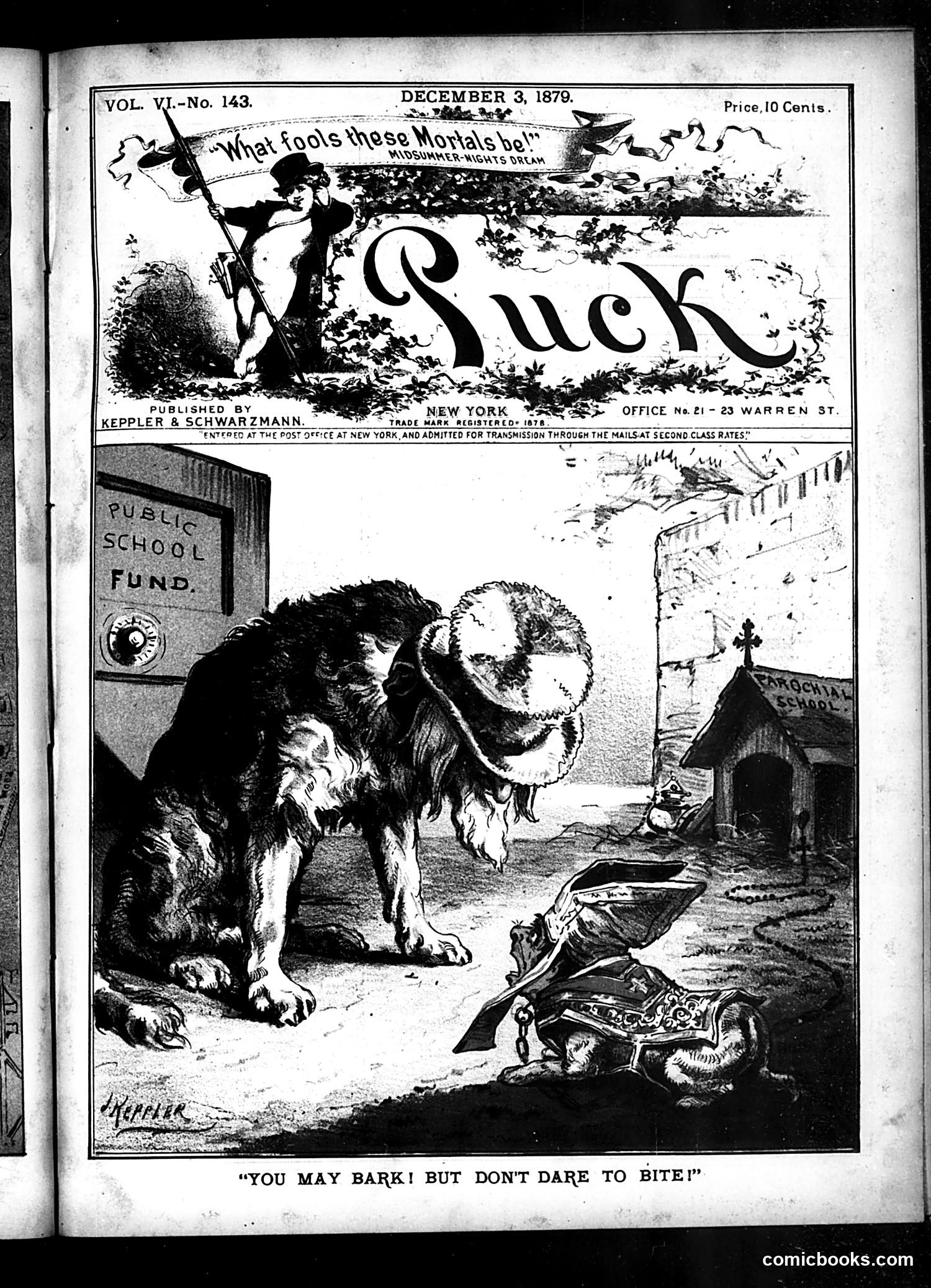
This satirical cartoon depicts a large dog wearing two hats, standing before buildings labeled "Public School Fund" and "Parochial School." The caption reads: "You may bark! But don't dare to bite!" The cartoon appears to address the **school funding controversy** of the 1870s-1880s between public and parochial (Catholic) education advocates. The dog likely represents either a political faction or the general public debate itself. The warning about barking but not biting suggests that while public debate about education funding was permitted, actual legislative action threatening one school system or the other would not be tolerated—reflecting the heated but ultimately constrained nature of this era's sectarian education dispute.
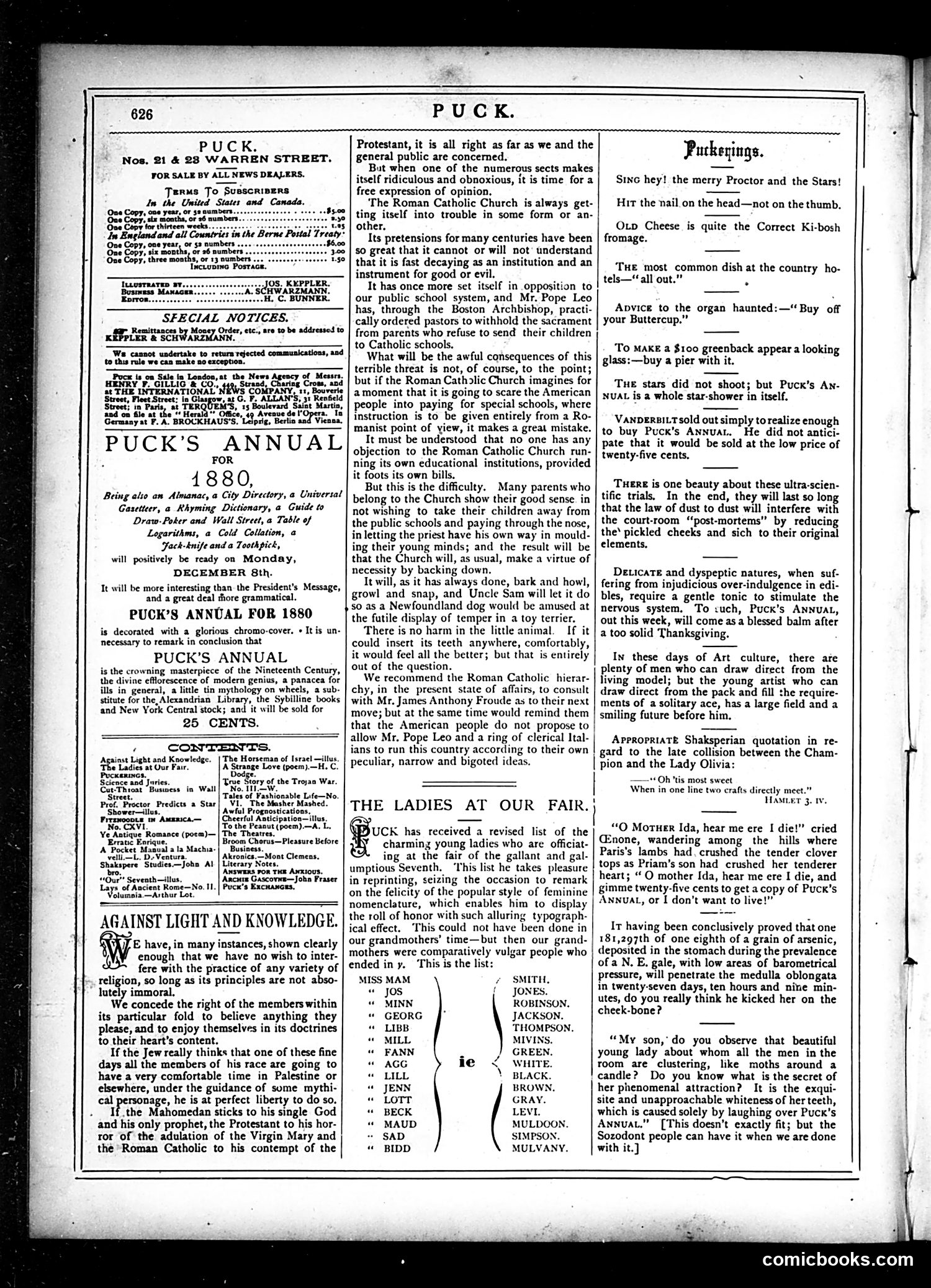
This page is primarily **advertising and editorial content** rather than political cartoons. The main items include: 1. **Puck's Annual for 1880** announcement—promoting an upcoming humor almanac 2. **"The Ladies at Our Fair"**—a section listing charming young women officiating at a fair, with humorous commentary about their names and appearances 3. **"Against Light and Knowledge"**—an editorial attacking religious intolerance, specifically criticizing the Roman Catholic Church's opposition to public education and its pressure on parents to send children to Catholic schools instead The satire targets **institutional religion's resistance to secular education**, framing the Church's actions as obscurantist and harmful to American progress. The tone is critical but reasoned, typical of Puck's 19th-century liberal stance on church-state separation and public education access. The page reflects broader **19th-century American debates over Catholic immigration and educational policy**.
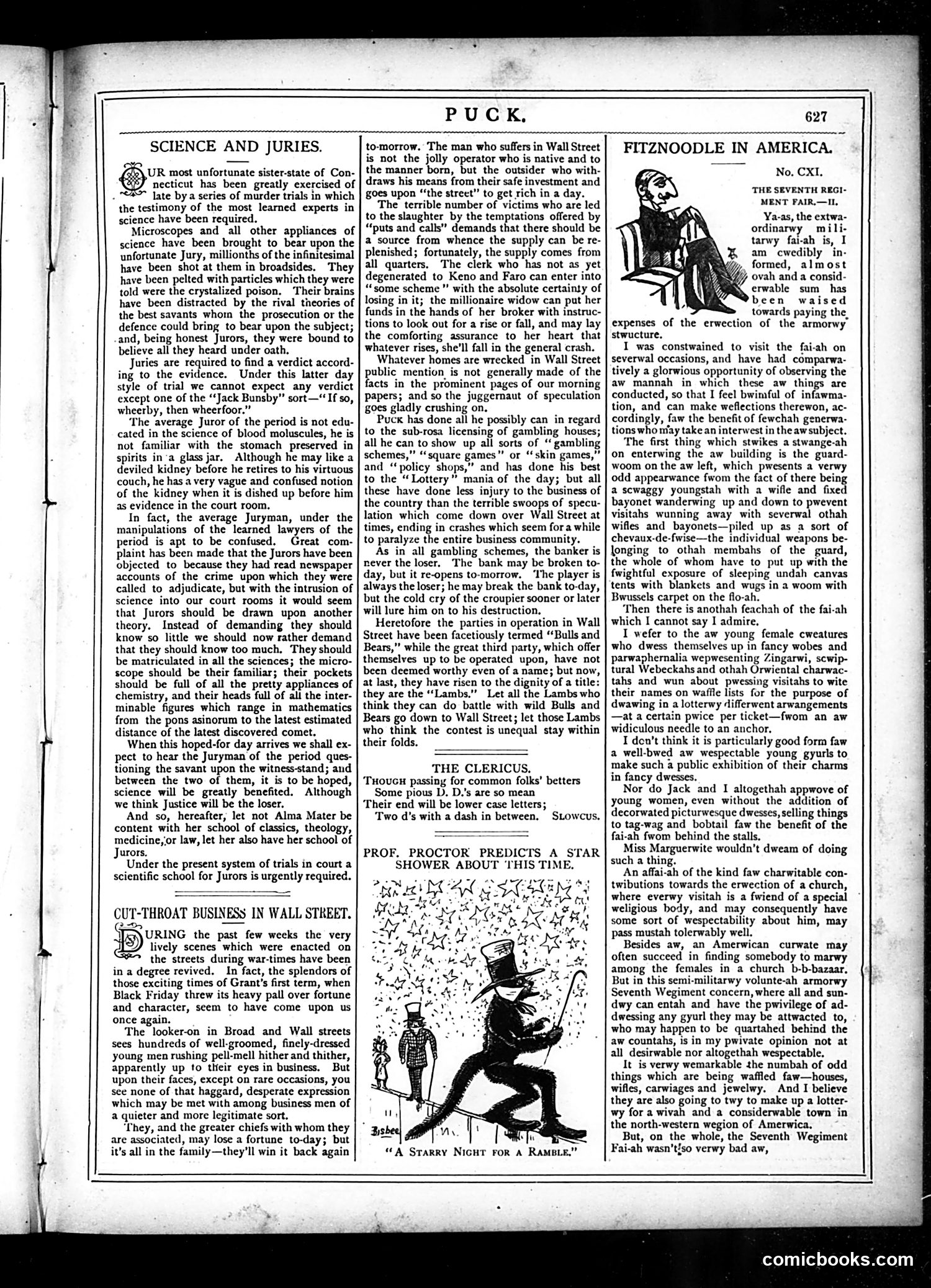
This page contains three satirical pieces about contemporary issues: **"Science and Juries"** criticizes jurors' lack of scientific knowledge in murder trials, arguing they're confused by expert testimony and easily swayed by eloquent lawyers rather than evidence. **"Cut-Throat Business in Wall Street"** (with accompanying illustration) satirizes the ruthless, predatory nature of Wall Street financial operations. The cartoon depicts a figure engaged in aggressive, violent behavior, suggesting finance operates like warfare with "cut-throat" tactics among competing businessmen seeking illegitimate gains. **"The Clericus"** offers brief commentary on proper typography conventions. **"Fitznoodle in America"** (No. CXI) appears to be a serialized travel column about observing American customs and institutions, including remarks about churches and charitable organizations. The page reflects Puck's characteristic satirical approach to American social and economic problems of the era.
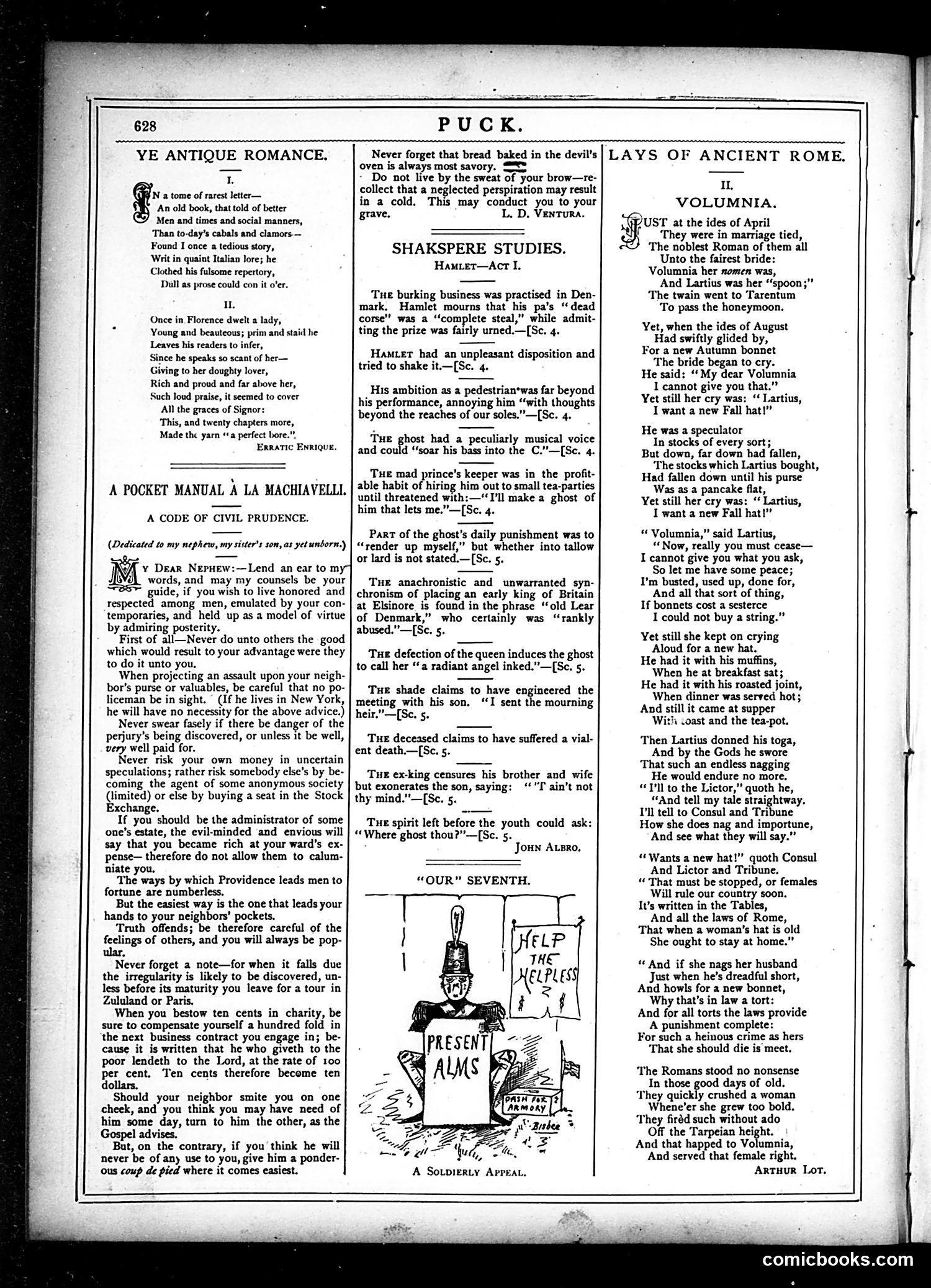
The page contains literary and satirical content rather than political cartoons. The main sections include: **"Ye Antique Romance"** - A humorous poem about a lady in Florence whose suitors prove disappointing, satirizing romantic idealization. **"Shakespere Studies"** - Brief commentary on *Hamlet*, poking fun at theatrical interpretations and the ghost's musical abilities. **"A Pocket Manual à la Machiavelli"** - Advice to a nephew on practical morality and manipulation, satirizing cynical self-interest. **The cartoon** titled "A Soldierly Appeal" depicts a helpless beggar, likely criticizing indifference to poverty or failed charity systems. **"Lays of Ancient Rome"** features classical verse about Roman women. The page is primarily **literary satire** rather than political commentary, mocking romantic conventions, theatrical pretension, and social hypocrisy through parody and verse.
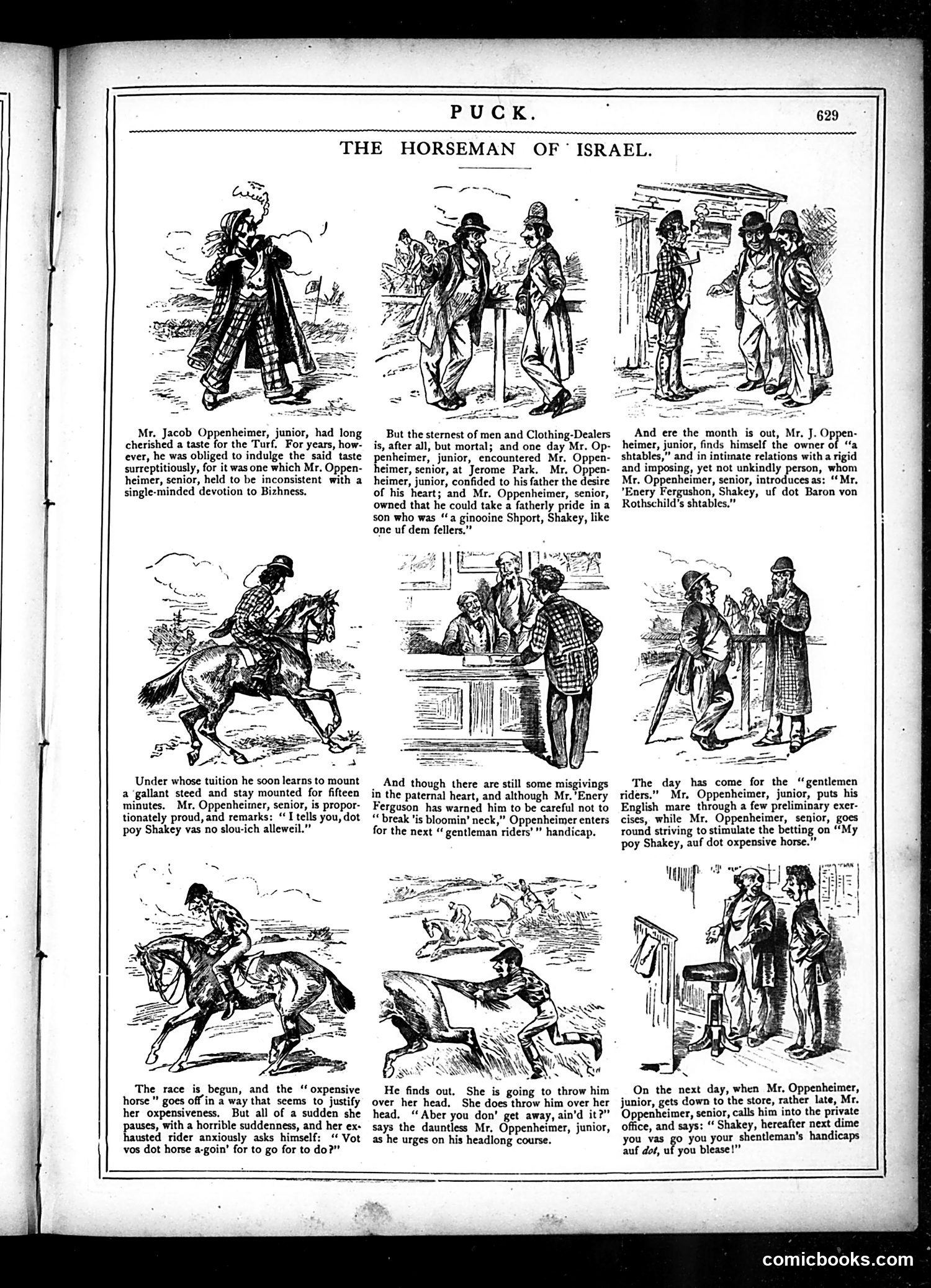
This satirical piece mocks Jacob Oppenheimer Jr., a Jewish businessman, through a narrative comic strip. The title "Horseman of Israel" is clearly ironic—Oppenheimer is repeatedly shown as an incompetent, nervous rider who cannot control his horse "Shakey." The satire plays on antisemitic stereotypes: Oppenheimer is portrayed as an uncultured clothing dealer trying to adopt genteel pursuits (horseback riding, acquiring "gentleman riders") but failing embarrassingly. His father, Oppenheimer Sr., represents establishment wealth and disapproval of his son's pretensions. The repeated emphasis on the horse throwing him, his anxiety, and his social awkwardness suggests the cartoon's purpose was mocking Jewish assimilation attempts and reinforcing prejudicial caricatures about Jewish unsuitability for "refined" activities.
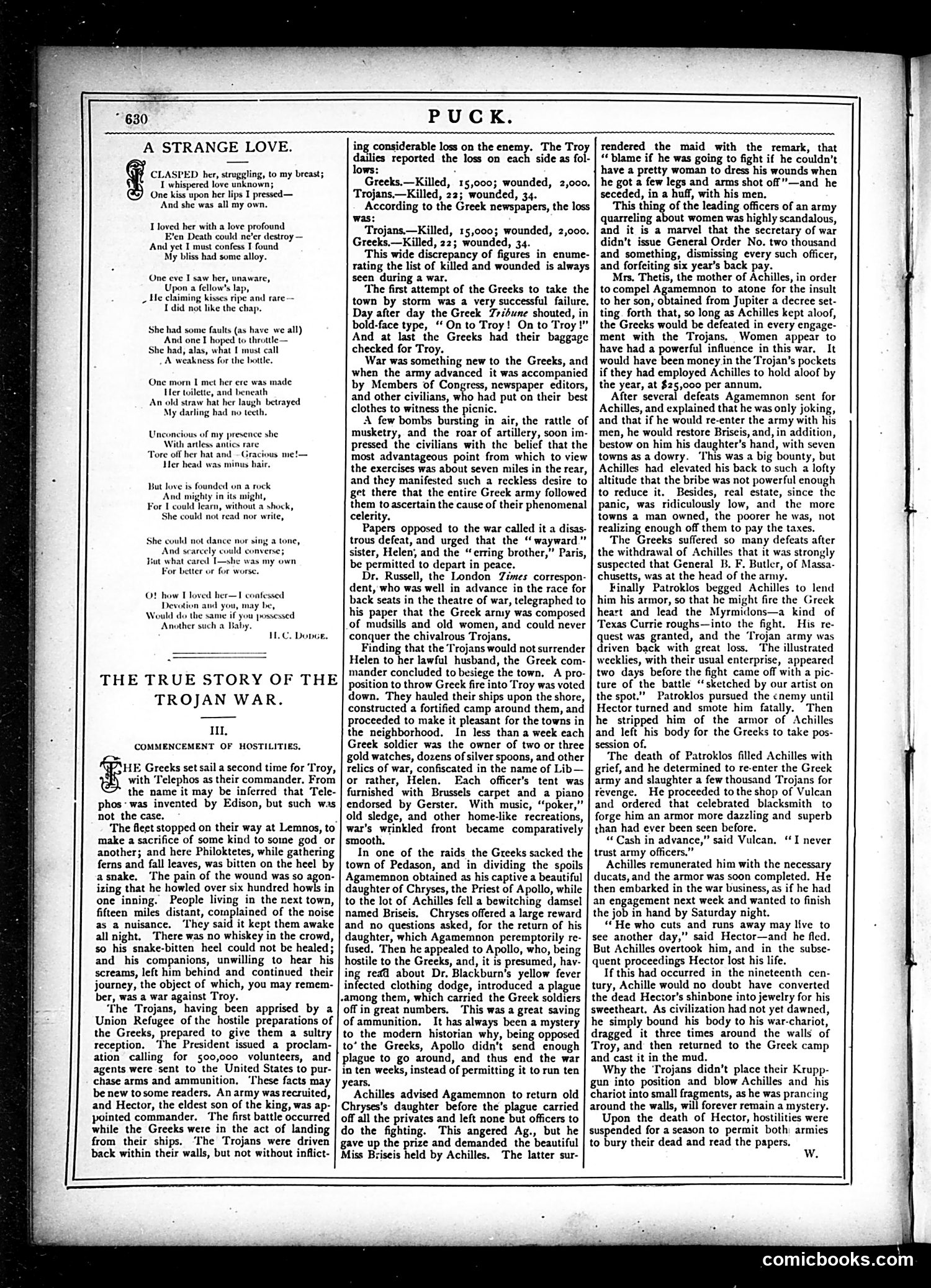
This page contains two distinct elements: 1. **"A Strange Love"** (left): A romantic poem about unrequited love, featuring classical verse about a woman who dances and sings but scorns her suitor. This appears to be general literary content rather than political satire. 2. **"The True Story of the Trojan War, III: Commencement of Hostilities"** (right): A humorous historical account that uses the Trojan War as a framework for satirizing contemporary American society. It references newspaper editors, Members of Congress, and modern civilian observers at the conflict—suggesting Puck is mocking how Americans sensationalize or trivialize serious historical events through the lens of contemporary politics and media. The satire lies in applying modern American institutional chaos to ancient history.
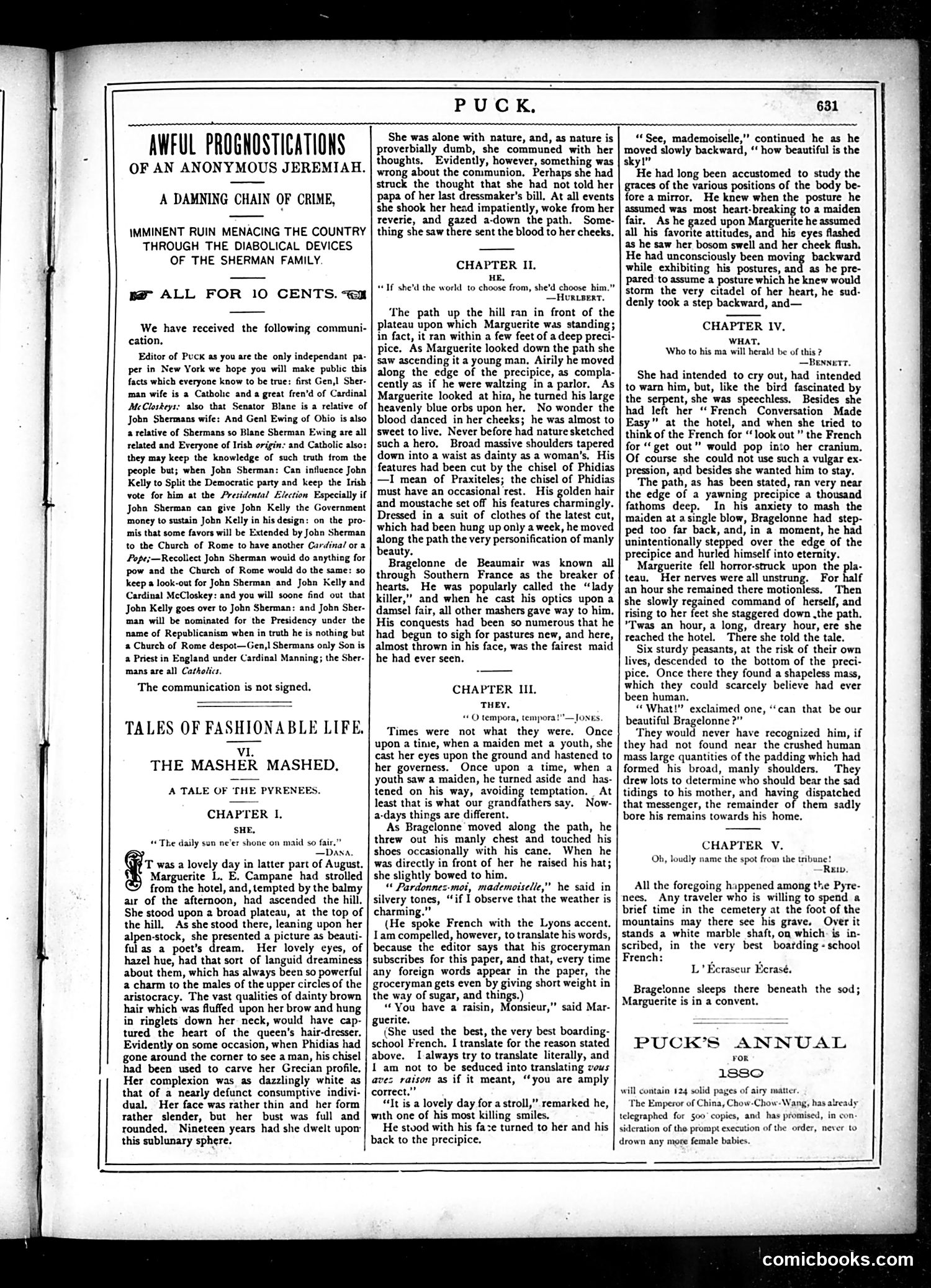
This page from Puck magazine (1890) contains **no political cartoon**. Instead, it features: 1. **"Awful Prognostications of an Anonymous Jeremiah"** — a satirical letter to the editor warning of Catholic influence and the Sherman family's political power, apparently mocking alarmist nativist concerns of the era. 2. **"Tales of Fashionable Life: The Mashel Mashed"** — a serialized short story set in the Pyrenees, featuring characters like Marguerite and Draglaonne de Beaumair. The narrative appears to be romantic fiction with melodramatic elements typical of period magazine serialization. 3. **"Puck's Annual for 1890"** — an advertisement for the magazine's annual edition. This is primarily a **text and literary page** rather than a satirical cartoon page, focused on fiction and reader submissions.
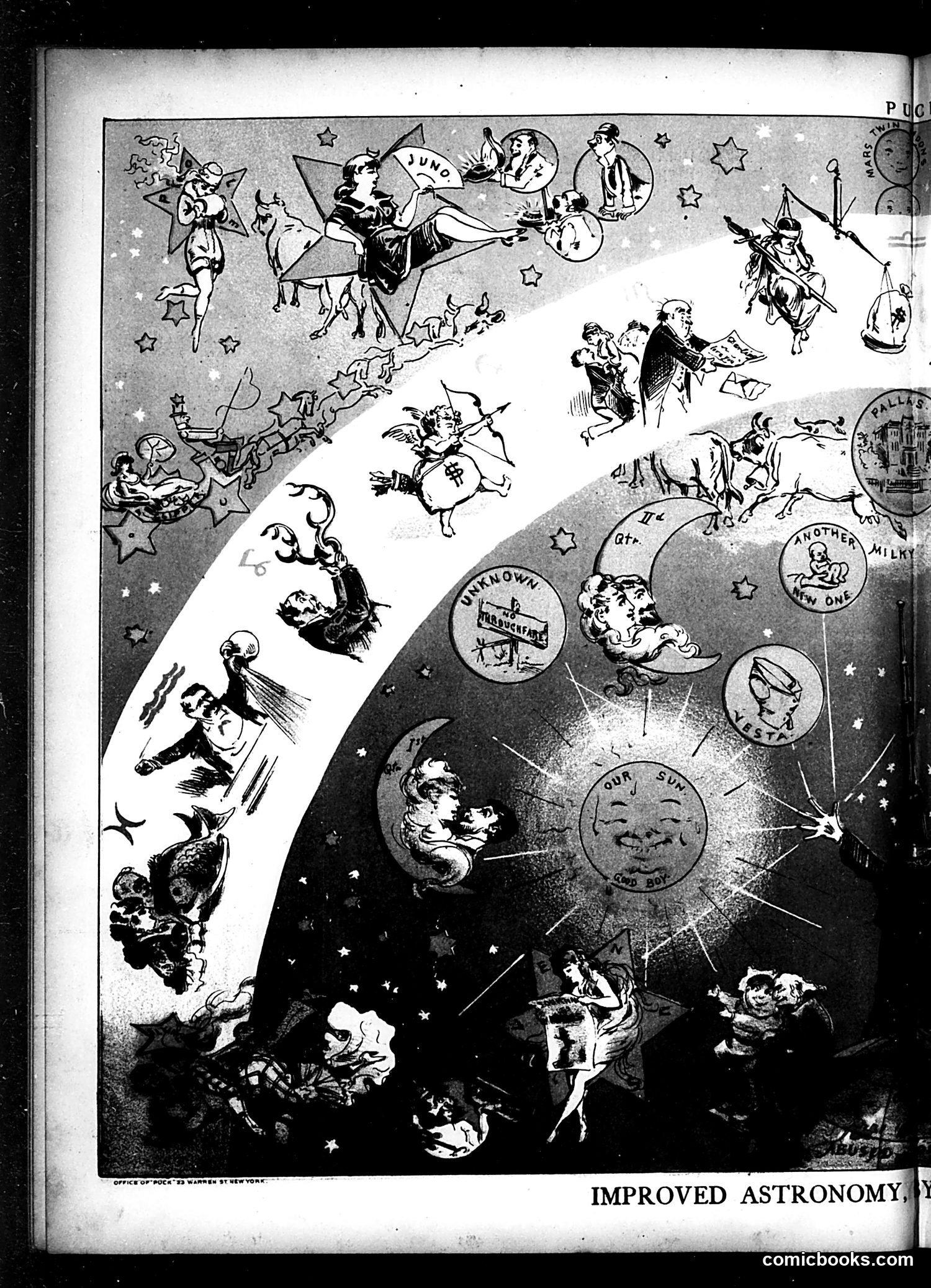
This satirical cartoon mocks commercial advertising and consumer culture by reimagining the night sky as a product marketplace. Instead of traditional constellations, the heavens display branded items and mascots within circular medallions—including what appears to be milk bottles, product logos, and recognizable commercial characters. The central sun is replaced by a smiling face, likely representing the commercialization of nature itself. Various figures (appearing to be salesmen or advertising agents) populate the space, some riding vehicles through the sky, actively promoting these products. The satire critiques how advertising was increasingly saturating American culture by the early 20th century, literally replacing natural phenomena with consumer goods. The title "Improved Astronomy" is ironic—suggesting that replacing stars with advertisements somehow represents progress, when it actually represents cultural degradation through commercialism.
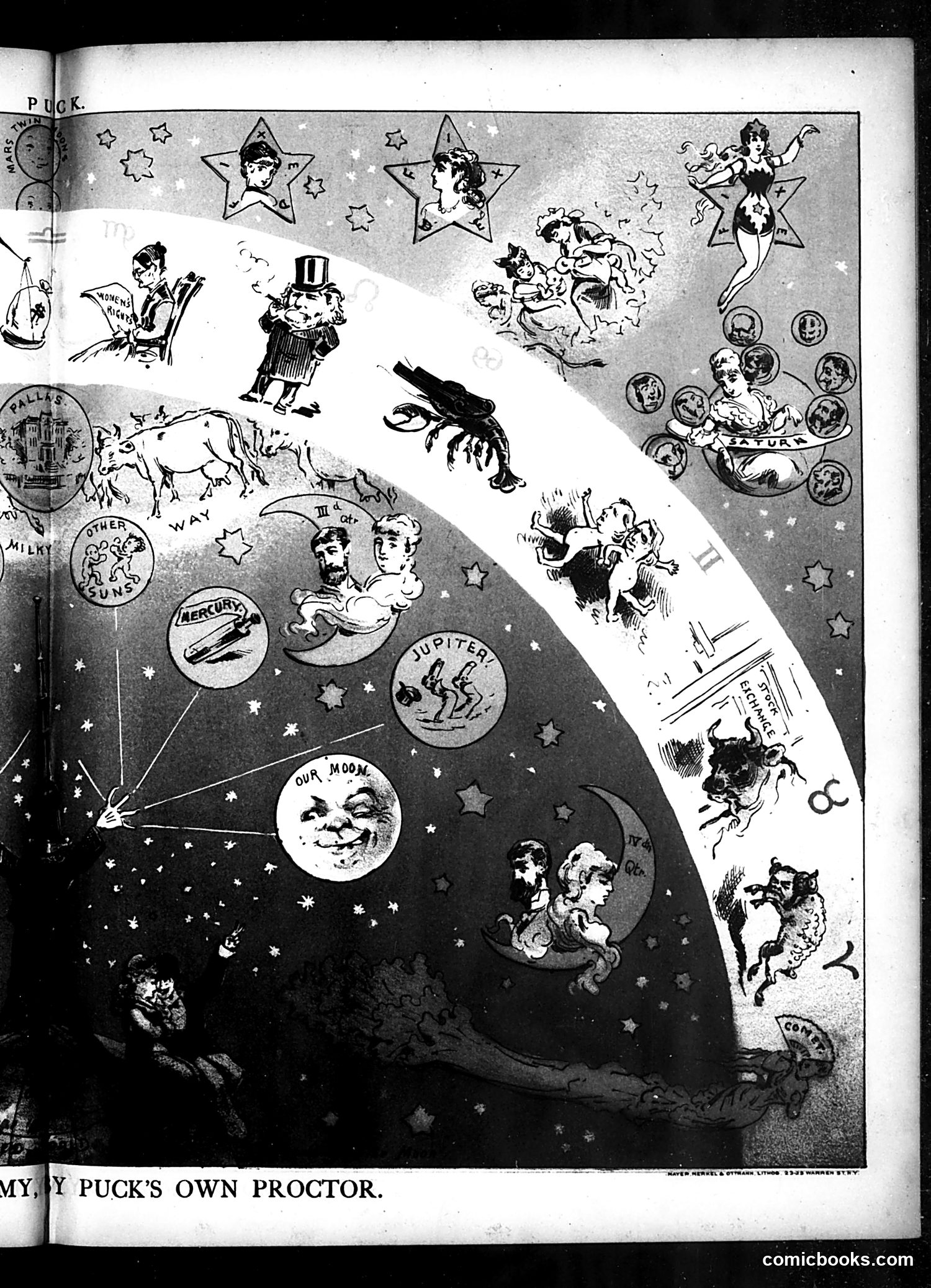
This appears to be a satirical celestial map from Puck magazine, depicting the night sky as populated with figures from American public life and entertainment. The circular planets and moons are labeled with names like "Old Moon," "Jupiter," "Mercury," and "Milky Way," each containing caricatured faces or scenes. Stars, cherubs, and theatrical figures populate the composition. The title "My Puck's Own Proctor" suggests this is Puck magazine's own satirical ordering of the cosmos—a humorous reorganization of the heavens according to the publication's editorial perspective. Without identifying specific individuals visible in the caricatures, the overall effect mocks contemporary political and social figures by literally elevating them to cosmic importance while rendering them absurd through exaggeration.
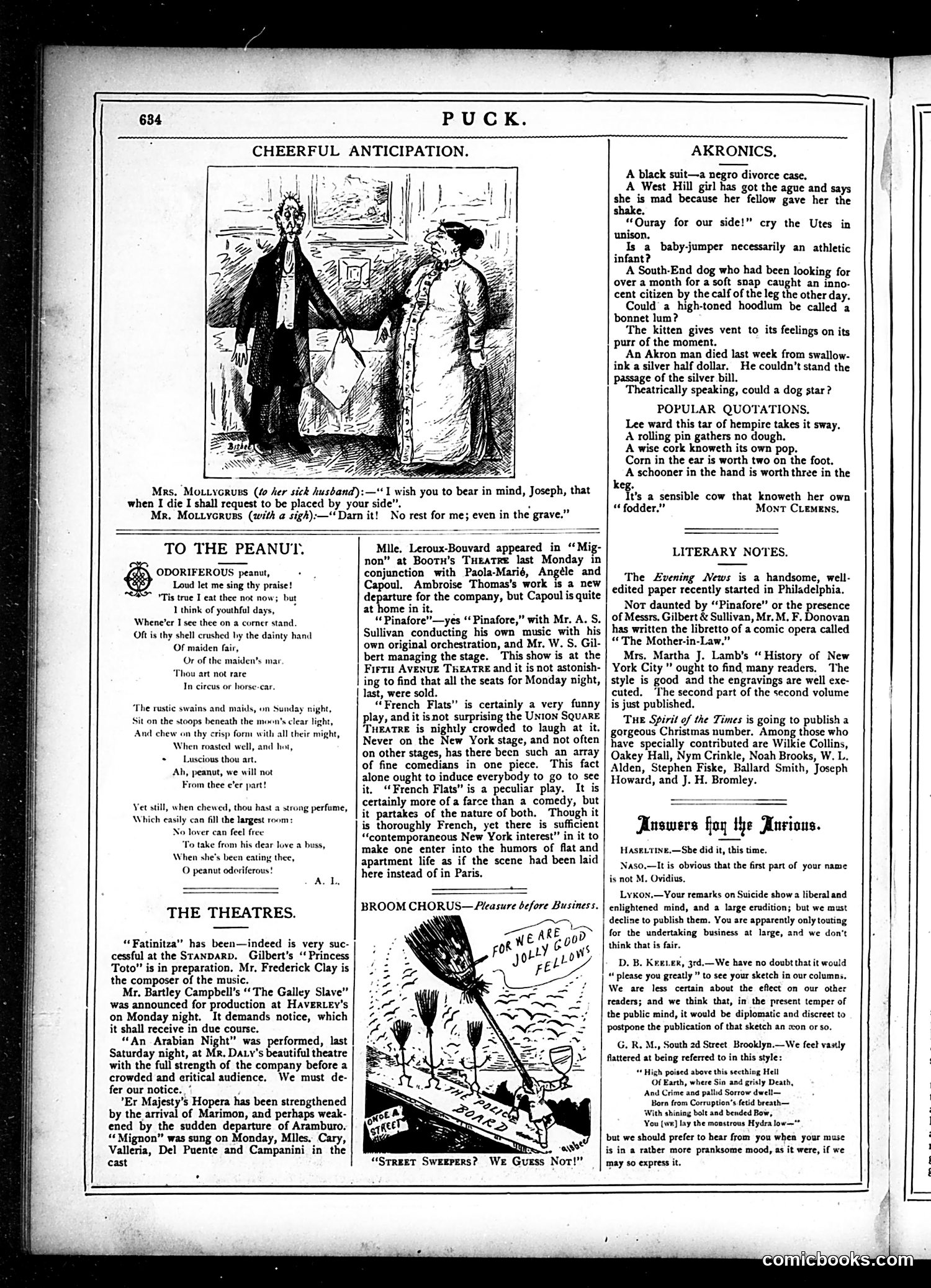
This cartoon depicts a husband and wife in what appears to be a darkly comedic domestic scene. The caption reveals the husband's grim outlook: he wishes to be placed at his wife's side after death, but only so he can "rest" — suggesting he finds marriage exhausting or oppressive. The woman's eager expression ("Cheerful Anticipation") contrasts with his dread, implying she welcomes the prospect of eternal togetherness while he dreads it even in the afterlife. This satirizes Victorian marriage dynamics and gender relations — specifically the stereotype of women as emotionally dependent on matrimony while men view it as burdensome. The joke relies on contemporary anxieties about marital obligation and companionship, presented through dark humor about death and the grave.
This page contains the opening of "Archie Gascoyne: A Romance of Skye," a serialized fiction story written by John Fraser for Puck magazine. It is **not a political cartoon or satire**, but rather a literary piece—specifically Chapter XXIX of an adventure narrative. The text describes Archie's dangerous journey through Scottish highlands during winter, his arrival at Hell's Glen Station, and his encounter with rough miners at a hotel. The story emphasizes adventure, Scottish settings, and social class contrasts (Archie is portrayed as an educated gentleman among working-class characters). This represents Puck's **literary content section** rather than political commentary or satirical cartooning.
This page is primarily text—a serialized story titled "Chapter XXX" (continuing from a previous installment), not a political cartoon. The story appears to be a Western adventure narrative featuring characters named Archie, the Colonel, and Jim. The only non-story content visible is an advertisement at the bottom for "Sozodont" toothpaste, which emphasizes preserving teeth and keeping them "pure white." This was a common late 19th/early 20th-century patent medicine advertisement. Without seeing the actual cartoon content (if any exists on this page), I cannot identify satirical figures or political references. The page appears to be a typical Puck interior page mixing serialized fiction with period advertising.
This page is primarily **advertisements and literary content** rather than political cartoons. The visible material includes: - **"L'Ingenu"**: A poem about nature and romantic encounter, likely a reprinted literary work - **Advertisements**: For steamship lines (North German Lloyd), jewelry stores, silk merchants, furniture retailers, and other commercial businesses typical of the era - **A small illustration**: Shows an ornate chair, accompanying the furniture advertisement The page lacks the satirical cartoons Puck was known for. Instead, it reflects how 19th-century magazines mixed editorial content with paid advertising to sustain operations. The advertisements themselves reveal period consumer interests—jewelry, fine fabrics, transatlantic travel—targeting middle and upper-class readers. No specific political satire or identifiable caricatures are visible on this particular page.
This page is primarily **advertising and miscellaneous content** rather than political cartoons. The main features are: 1. **The Bodega wine advertisement** - promoting imported wines and spirits 2. **G.H. Mumm & Co. Champagne** - advertising 35,006 cases, claiming superiority over competitors 3. **Jones department store** - advertising winter goods (millinery, gloves, silks, shoes, furniture, etc.) 4. **Weber pianos, caramels, and other consumer goods** The only editorial content appears to be brief humorous columns titled "A Conundrum," discussing a poem about Rupert and the Hanlan-Courtney boat race, plus miscellaneous social commentary on war, journalism, and Shakespeare. This is essentially a **late 19th-century magazine back page** dominated by commercial advertisements interspersed with light satirical commentary—typical of Puck's revenue model.
This page is primarily **advertising**, not editorial content or political cartoons. It consists of merchant advertisements from late 19th-century New York City, including: - Toy and doll shops - Champagne and wine sellers - Photographers - Furniture and carpet dealers - Tailors and furriers - A restaurant The only illustrated content is a **Puck magazine masthead** featuring the character Puck—a mischievous sprite holding a conductor's baton—described as "the finest and most popular comic." This is the publication's own branding, not a cartoon with satirical intent. The page demonstrates Puck's business model: combining satirical editorial content (elsewhere in the magazine) with paid advertisements to reach affluent New York readers.
This is primarily an **advertising page** from Puck magazine (page 640), not a political cartoon. It features various commercial advertisements from late 1870s New York, including: - **Peter Doelger's Lager Beer** (brewery in East 55th Street) - **A. Heller & Bro.** (Hungarian wines and liquors) - **A. Werner & Co.** (champagne) - **Central Park Brewery** (bottling company) - **Edward D. Bassford** (house furnishing stores) - **Vienna Coffee Pot** (imported kitchenware) Other ads promote clothing, optician services, cigars, and patent covers. The page reflects 1870s New York commercial life and immigrant communities (note Hungarian wine merchants). There are no political cartoons or satirical commentary visible—this is a straightforward advertisement collection typical of Puck's revenue model.
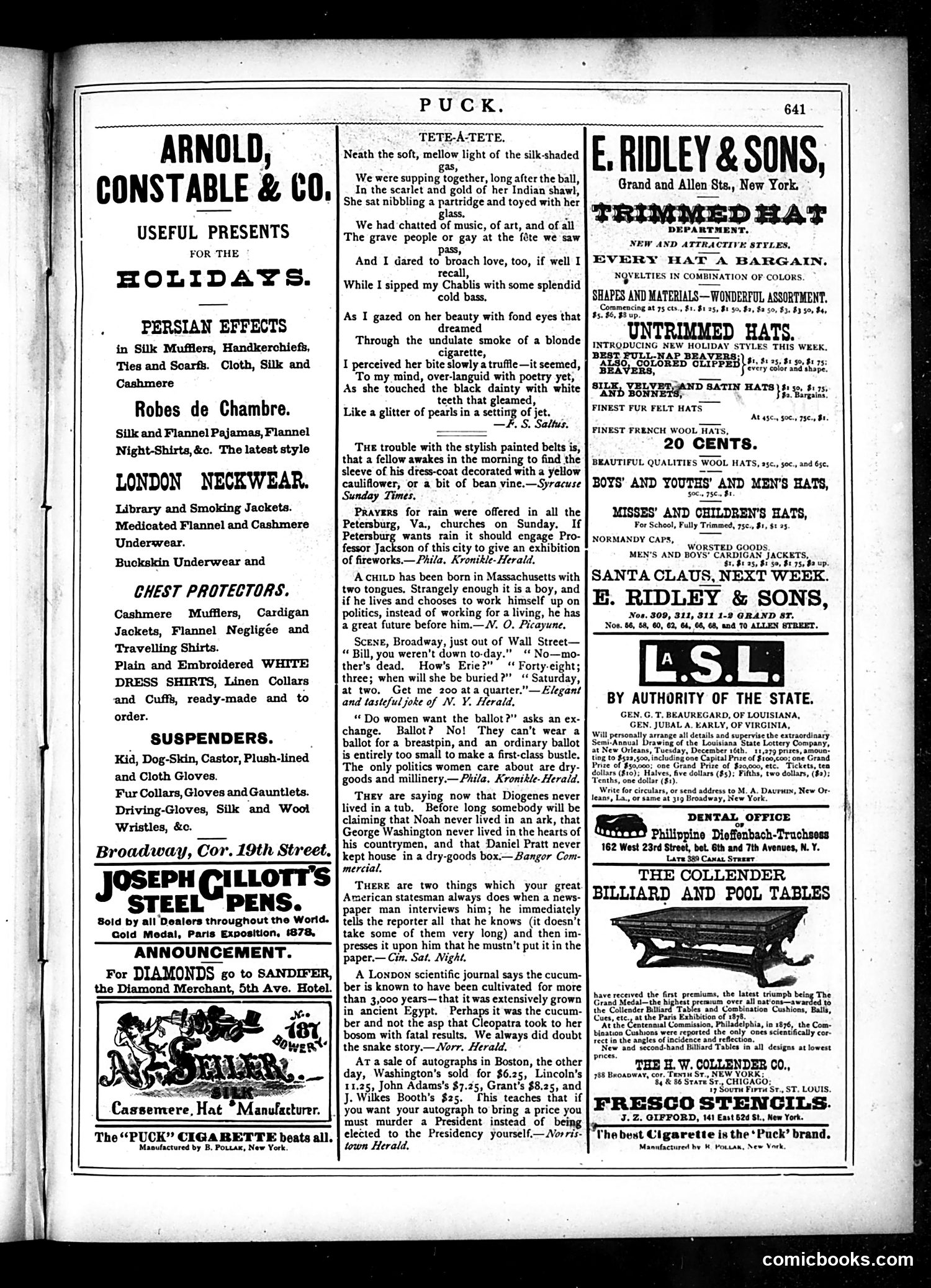
This page is **primarily advertising**, not political satire or comics. It contains multiple commercial advertisements from the late 19th century, including: - Arnold, Constable & Co. (Persian effects, robes, neckwear, undergarments) - E. Ridley & Sons (trimmed hats department) - Joseph Gillott's Steel Pens - Fresco Stencils - The Collender Billiard and Pool Tables The only non-advertising content appears to be a "TÊTE-À-TÊTE" poem in the upper portion, describing a romantic or social encounter, written by what appears to be "F. S. Salter" or similar. As a **Puck magazine page**, this represents the publication's business model: satirical content supported by period advertisements. The ads themselves document late 19th-century consumer culture and fashion.
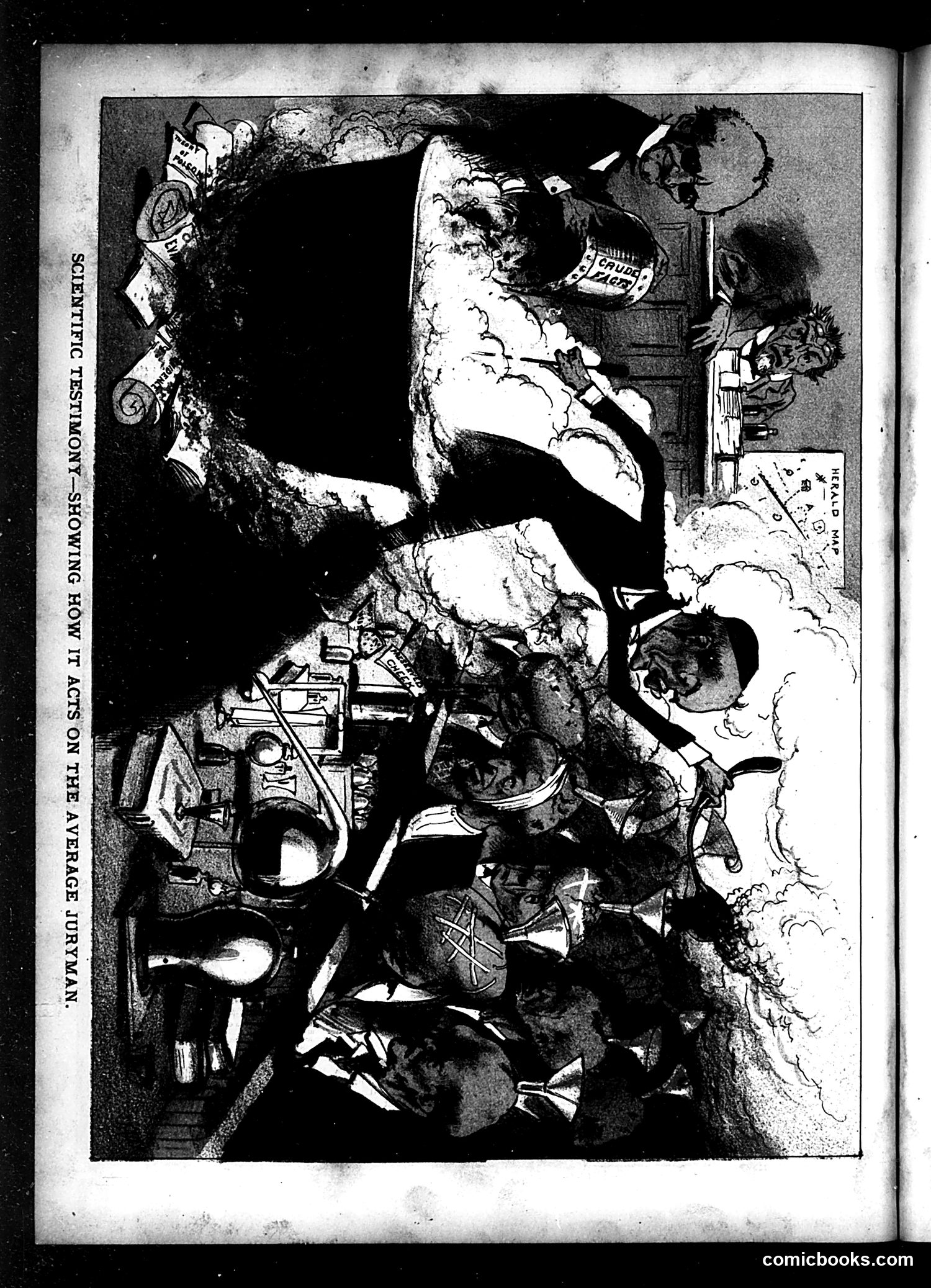
This page appears to be a political cartoon satirizing domestic policy, though the image quality makes precise identification challenging. The caption text "SCIENTIFIC TESTIMONIALS—SHOWS TESTIMONY AS IT ACTS ON THE AVERAGE JURYMAN" suggests the cartoon critiques how expert witnesses or scientific testimony influences jury decisions in court cases. The composition shows multiple figures arranged around what appears to be a courtroom scene, with various objects and documents scattered about. The satire likely mocks either the misuse of "scientific" evidence to sway jurors, or the gullibility of average jurors when presented with pseudo-scientific arguments. Without clearer image resolution or additional context, I cannot confidently identify specific historical figures or events referenced, though the theme concerns judicial procedures and testimony standards.