
Puck, 1879-12-03 · page 6 of 18
Puck — December 3, 1879 — page 6: what you’re looking at
What you’re looking at
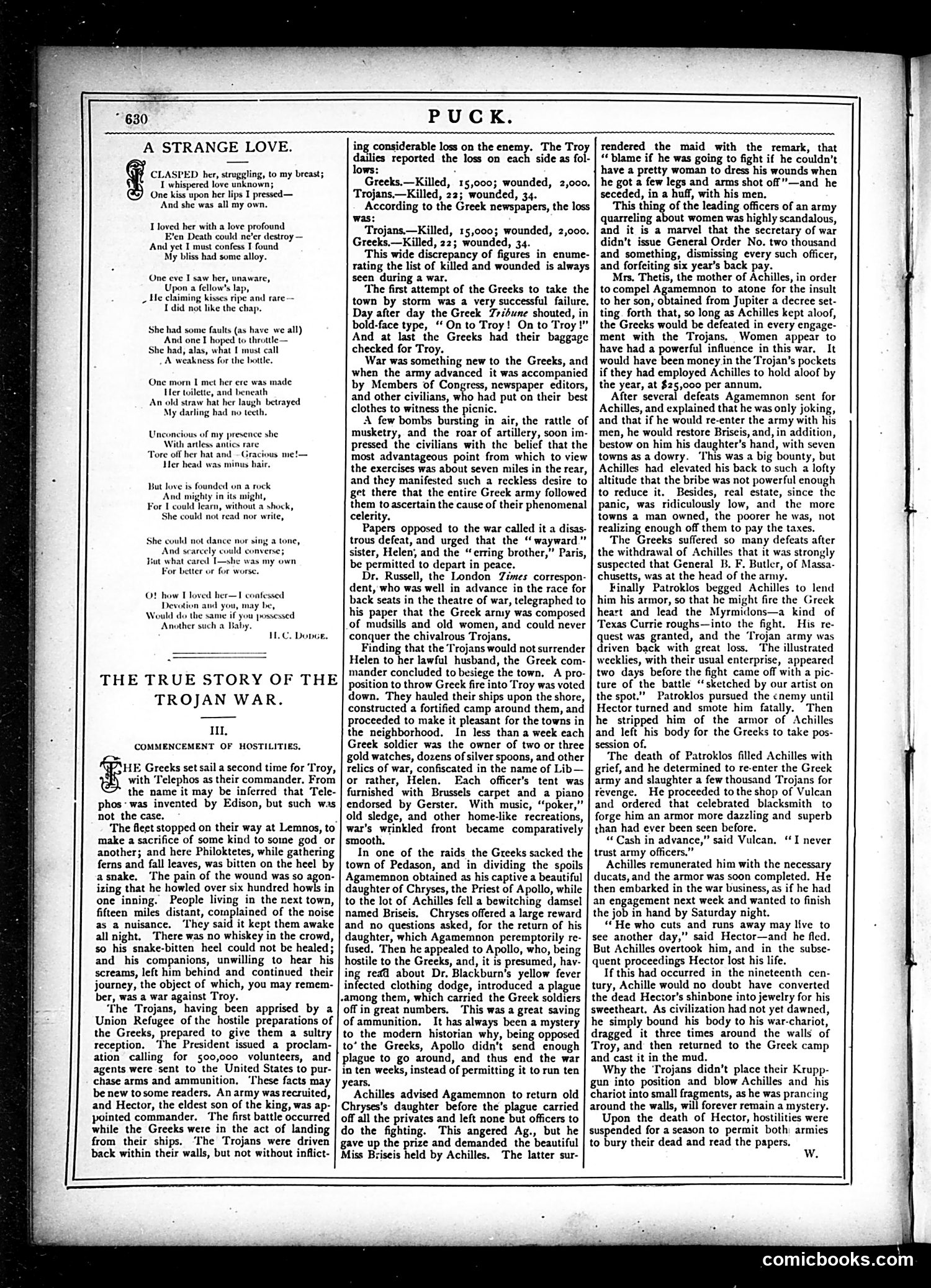
This page contains two distinct elements: 1. **"A Strange Love"** (left): A romantic poem about unrequited love, featuring classical verse about a woman who dances and sings but scorns her suitor. This appears to be general literary content rather than political satire. 2. **"The True Story of the Trojan War, III: Commencement of Hostilities"** (right): A humorous historical account that uses the Trojan War as a framework for satirizing contemporary American society. It references newspaper editors, Members of Congress, and modern civilian observers at the conflict—suggesting Puck is mocking how Americans sensationalize or trivialize serious historical events through the lens of contemporary politics and media. The satire lies in applying modern American institutional chaos to ancient history.
📄 Transcribed text from this page (OCR, searchable)
Machine-transcribed from the original scan — historical spelling and the odd misread are preserved.
PUCK. A STRANGE LOVE. g CLASPED her, struggling, to my breast; I whispered love unknown; One kiss upon her lips I pressed— ‘And she was all my own, I loved her with a love profound E’en Death could ne'er «lestroy — And yet I must confess I found My bliss had some alloy. One eve I saw her, unaware, Upon a fellow’s lap, _ He claiming kisses ripe and rare— I did not like the chap. She had some faults (as have we all) And one I hoped to throttle— She had, alas, what f must call _ A weakness for the bottle. One morn I met her et made Her toilette, and beneath An old straw hat her laugh betrayed My darling had no teeth. Unconcious of my prese With artless antic Tore off her hat a Her head was or sing atone, pnVverse 5 was my own For better of for worse. O! how Loved her—1 confessed Devotion and you, may be, Would do the same if you possessed Another such a Baby. ILC. Doce. THE TRUE STORY OF THE TROJAN WAR. Il, COMMENCEMENT OF HOSTILITIES, HE Greeks set sail a second time for Troy, with Telephos as their commander. From the name it may be inferred that Tele- phos: was invented by Edison, but such was not the case. The fleet stopped on their way at Lemnos, to make a sacrifice of some kind to some god or another; and here Philoktetes, while gathering ferns and fall leaves, was bitten on the heel by asnake, The pain of the wound was so agon- izing that he howled over six hundred howls in one inning. People living in the next town, fifteen miles distant, complained of the noise as a nuisance. ‘They said it kept them awake all night. ‘There was no whiskey in the crowd, so his snake-bitten heel could not be healed; and his companions, unwilling to hear his screams, left him behind and continued their journey, the object of which, you may remem- ber, was a war against Troy. The Trojans, having been apprised by a Union Refugee of the hostile preparations of the Greeks, prepared to give them a sultry reception. ‘The President issued a proclam- ation calling for 500,000 volunteers, and agents were sent to the United States to pur- chase arms and ammunition, ‘These facts may be new tosome readers, An army was recruited, and Hector, the eldest son of the king, was ap- pointed commander. The first battle occurred while the Greeks were in the act of landing from their ships. ‘The Trojans were driven back within their walls, but not without inflict- ing considerable loss on the enemy. The Troy dailies reported the loss on each side as fol- WS: 5 Greeks.—Killed, 15,000; wounded, 2,000, Trojans,—Killed, 22; wounded, 34. According to the Greek newspapers, the loss was: Trojans.—Killed, 15,000; wounded, 2,000. Greeks.—Killed, 22; wounded, 34. This wide discrepancy of figures in enume- rating the list of killed and wounded is always seen during a war. The first attempt of the Greeks to take the town by storm was a very successful failure, Day after day the Greek Zribune shouted, in bold-face type, “On to Troy! On to Troy !" And at last the Greeks had their baggage checked for Troy. War was something new to the Greeks, and when the army advanced it was accompanied by Members of Congress, newspaper editors, and other civilians, who had put on their best clothes to witness the picnic. A few bombs bursting in air, the rattle of musketry, and the roar of artillery, soon im- pressed the civilians with the belief that the most advantageous point from which to view the exercises was about seven miles in the rear, and they manifested such a reckless desire to get there that the entire Greek army followed them to ascertain the cause of their phenomenal celerity. Papers opposed to the war called it a disas- trous defeat, and urged that the “ wayward” sister, Helen, and the “erring brother,” Paris, be permitted to depart in peace. Dr. Russell, the London Zimes correspon- dent, who was well in advance in the race for back seats in the theatre of war, telegraphed to his paper that the Greek army was composed of mudsills and old women, and could never conquer the chivalrous Trojans. Finding that the Trojans would not surrender Helen to her lawful husband, the Greek com- mander concluded to besiege the town, A pro- position to throw Greek fire into Troy was voted down. They hauled their ships upon the shore, constructed a fortified camp around them, and proceeded to make it pleasant for the towns in the neighborhood. In less than a week each Greek soldier was the owner of two or three gold watches, dozens of silver spoons, and other relics of war, confiscated in the name of Lib— or rather, Helen. Each officer’s tent was furnished with Brussels carpet and a piano endorsed by Gerster. With music, “poker,” .| old sledge, and other home-like recreations, war's wrinkled front became comparatively smooth, In one of the raids the Greeks sacked the town of Pedason, and in dividing the spoils Agamemnon obtained as his captive a beautiful daughter of Chryses, the Priest of Apollo, while to the lot of Achilles fell a bewitching damsel named Briseis, Chryses offered a large reward and no questions asked, for the return of his daughter, which Agamemnon peremptorily re- fused. ‘Then he appealed to Apollo, who, being hostile to the Greeks, and, it is presumed, hav- ing red@ about Dr. Blackburn's yellow fever infected clothing dodge, introduced a plague among them, which carried the Greek soldiers off in great numbers. This was a great saving of ammunition. It has always been a mystery to the modern historian why, being opposed to’ the Greeks, Apollo didn’t send enough plague to go around, and thus end the war in ten weeks, instead of permitting it to run ten ears, 3 Achilles advised Agamemnon to return old Chryses’s daughter before the plague carried off all the privates and left none but officers to do the fighting. This angered Ag., but he gave up the prize and demanded the beautiful Miss Briseis held by Achilles. The latter sur- rendered the maid with the remark, that “blame if he was going to fight if he couldn't have a pretty woman to dress his wounds when he got a few legs and arms shot off’—and he seceded, in a huff, with his men. This thing of the leading officers of an army quarreling about women was highly scandalous, and it is a marvel that the secretary of war didn’t issue General Order No. two thousand and something, dismissing every such officer, and forfeiting six year’s back pay. Mrs. Thetis, the mother of Achilles, in order to compel Agamemnon to atone for the insult to her son, obtained from Jupiter a decree set- ting forth that, so long as Achilles kept aloof, the Greeks would be defeated in every engage- ment with the Trojans. Women appear to have had a powerful influence in this war. It would have been money in the Trojan’s pockets if they had employed Achilles to hold aloof by the year, at $25,000 per annum, After several defeats Agamemnon sent for Achilles, and explained that he was only joking, and that if he would re-enter the army with his men, he would restore Briscis, and, in addition, bestow on him his daughter's hand, with seven towns as a dowry. ‘This was a big bounty, but Achilles had elevated his back to such a lofty altitude that the bribe was not powerful enough to reduce it. Besides, real estate, since the panic, was ridiculously low, and’ the more towns a man owned, the poorer he was, not realizing enough off them to pay the taxes. The Greeks suffered so many defeats after the withdrawal of Achilles that it was strongly suspected that General B. F. Butler, of Massa- chusetts, was at the head of the army. Finally Patroklos begged Achilles to lend him his armor, so that he might fire the Greek heart and lead the Myrmidons—a kind of Texas Currie roughs—into the fight. His re- quest was granted, and the ‘Trojan army was driven back with great loss. The illustrated weeklies, with their usual enterprise, appeared two days before the fight came off with a pic- ture of the battle ‘sketched by our artist on the spot.” Patroklos pursued the cnemy until Hector turned and smote him fatally, Then he stripped him of the armor of Achilles and left his body for the Greeks to take pos- session of, The death of Patroklos filled Achilles with grief, and he determined to re-enter the Greek army and slaughter a few thousand Trojans for revenge. He proceeded to the shop of Vulcan and ordered that celebrated blacksmith to forge him an armor more dazzling and superb than had ever been seen before. “Cash in advance,” said Vulcan. “I never trust army officers.” Achilles remunerated him with the necessary ducats, and the armor was soon completed. He then embarked in the war business, as if he had an engagement next week and wanted to finish the job in hand by Saturday night. “He who cuts and runs away may live to see another day,” said Hector—and he fled. But Achilles overtook him, and in the subse- quent proceedings Hector lost his life. If this had occurred in the nineteenth cen- tury, Achille would no doubt have converted the dead Hecior’s shinbone into jewelry for his sweetheart. As civilization had not yet dawned, he simply bound his body to his war-chariot, dragged it three times around the walls of Troy, and then returned to the Greek camp and cast it in the mud, Why the ‘Trojans didn’t place their Krupp- gun into position and blow Achilles and his chariot into small fragments, as he was prancing around the walls, will forever remain a mystery. Upon the death of Hector, hostilities were suspended for a season to permit both: armies to bury their dead and read the papers. comicbooks.com