
Puck, 1879-12-03 · page 4 of 18
Puck — December 3, 1879 — page 4: what you’re looking at
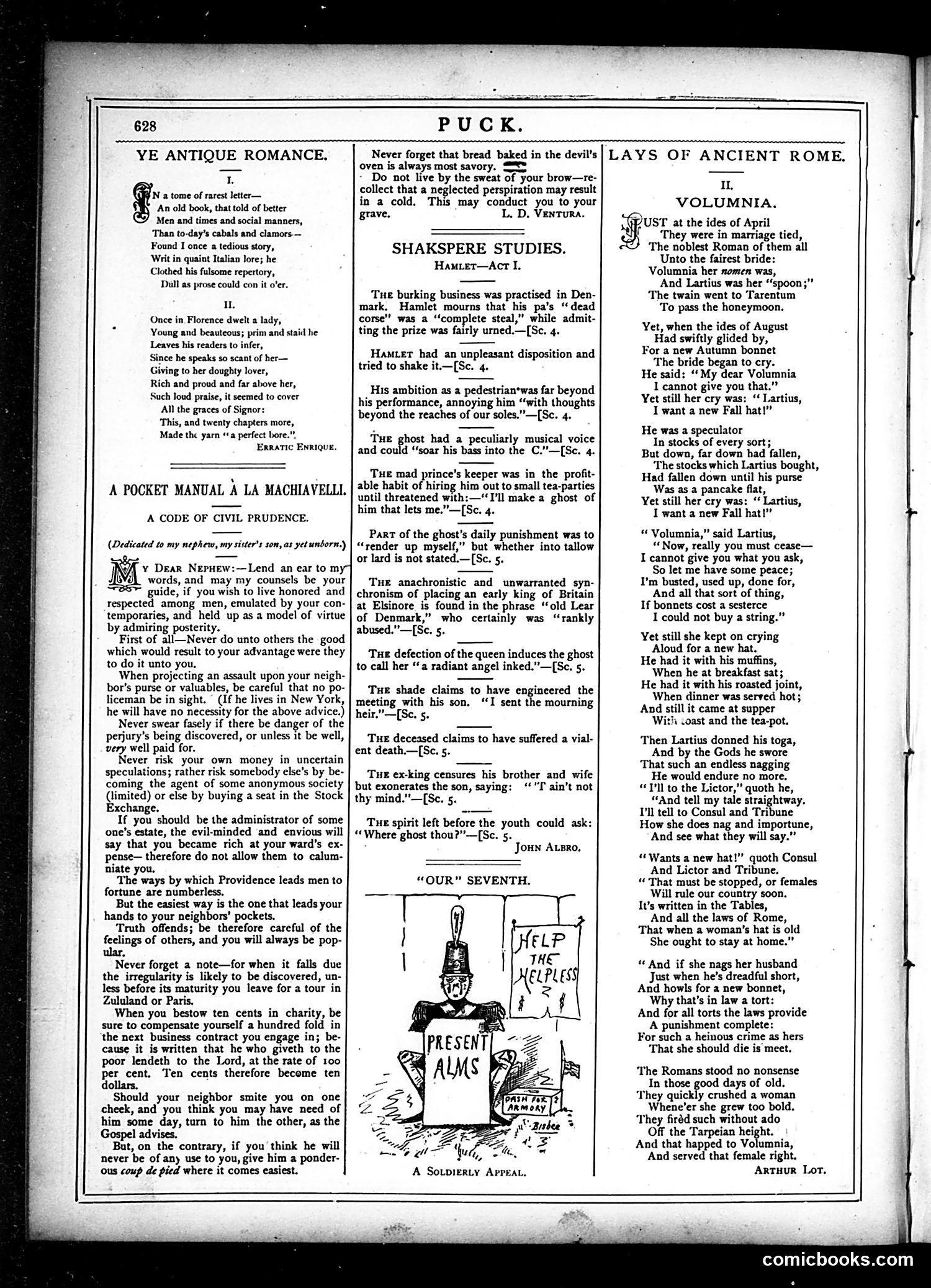
What you’re looking at
The page contains literary and satirical content rather than political cartoons. The main sections include: **"Ye Antique Romance"** - A humorous poem about a lady in Florence whose suitors prove disappointing, satirizing romantic idealization. **"Shakespere Studies"** - Brief commentary on *Hamlet*, poking fun at theatrical interpretations and the ghost's musical abilities. **"A Pocket Manual à la Machiavelli"** - Advice to a nephew on practical morality and manipulation, satirizing cynical self-interest. **The cartoon** titled "A Soldierly Appeal" depicts a helpless beggar, likely criticizing indifference to poverty or failed charity systems. **"Lays of Ancient Rome"** features classical verse about Roman women. The page is primarily **literary satire** rather than political commentary, mocking romantic conventions, theatrical pretension, and social hypocrisy through parody and verse.
📄 Transcribed text from this page (OCR, searchable)
Machine-transcribed from the original scan — historical spelling and the odd misread are preserved.
628 PUCK. YE ANTIQUE ROMANCE, 1 IN a tome of rarest letter— ‘An old book, that told of better ‘Men and times and social manners, ‘Than to-day’s cabals and clamors — Found I once a tedious story, ‘Writ in quaint Italian lore; he Clothed his fulsome repertory, Dill as prose could con it o'er. Once in Florence dwelt a lady, Young and beauteous; prim and staid he Leaves his readers to infer, Since he speaks so scant of her— Giving to her doughty lover, Rich and proud and far above her, Such loud praise, it seemed to cover All the graces of Signor: This, and twenty chapters more, Made the yarn “a perfect bore." ERRATIC ENRIQUE. A POCKET MANUAL A LA MACHIAVELLI. A CODE OF CIVIL PRUDENCE. (Dedicated to my nephew, my sister's son, as yetunborn.) y Dear NepHew:—Lend an ear to m: J words, and may my counsels be your “85~ guide, if you wish to live honored and respected among men, emulated by your con- temporaries, and held up as a model of virtue by admiring posterity. First of all—Never do unto others the good which would result to your advantage were they to do it unto you. When projecting an assault upon your neigh- bor's purse or valuables, be careful that no po- liceman be in sight. " (If he lives in New York, he will have no necessity for the above advice.) Never swear fasely if there be danger of the perjury’s being discovered, or unless it be well, very well paid for. Never risk your own money in uncertain speculations; rather risk somebody else’s by be- coming the agent of some anonymous society (limited) or else by buying a seat in the Stock Exchange. If you should be the administrator of some one’s estate, the evil-minded and envious will say that you became rich at your ward's ex- pense— therefore do not allow them to calum- niate you. ‘The ways by which Providence leads men to fortune are numberless. But the easiest way is the one that leads your hands to your neighbors’ pockets. Truth offends; be therefore careful of the feelings of others, and you will always be pop- Never forget a note—for when it falls due the irregularity is likely to be discovered, un- less before its maturity you leave for a tour in Zululand or Paris, When you bestow ten cents in charity, be sure to compensate yourself a hundred fold in the next business contract you engage in; be- cause it is written that he who giveth to the poor lendeth to the Lord, at the rate of 100 per cent. Ten cents therefore become ten dollars. Should your neighbor smite you on one cheek, and you think you may have need of him some day, turn to him the other, as the Gospel advises. Bat, on the contrary, if you’think he will never be of any use to you, give him a ponder- ous coup de pied where it comes easiest. Never forget that bread baked in the devil’s oven is always most savory. “=< Do not live by the sweat of your brow—re- collect that a neglected perspiration may result in a cold, This may conduct you to your grave. L. D. Ventura. SHAKSPERE STUDIES. Hamvet—Acrt I. Tue burking business was practised in Den- mark, Hamlet mourns that his pa’s “dead corse’ was a “complete steal,” while admit- ting the prize was fairly urned.—[Sc. 4. Hamter had an unpleasant disposition and tried to shake it.—[Sc. 4. His ambition as a pedestrian*was far beyond his performance, annoying him ‘with thoughts beyond the reaches of our soles.”—[Sc. 4. Tue ghost had a peculiarly musical voice and could “soar his bass into the C."—[Sc. 4. Tue mad prince's keeper was in the profit- able habit of hiring him out to small tea-parties until threatened with:—‘‘I’ll make a ghost of him that lets me.”—[Sc. 4. Parr of the ghost’s daily punishment was to “render up myself,” but whether into tallow or lard is not stated.—[Sc. 5. Tue anachronistic and unwarranted syn- chronism of placing an early king of Britain at Elsinore is found in the phrase “old Lear of Denmark,” who certainly was ‘rankly abused.” —[Sc. 5. Tue defection of the queen induces the ghost to call her “a radiant angel inked.”—[Sc. 5. Tue shade claims to have engineered the meeting with his son, ‘lI sent the mourning heir."—[Sc. 5. Tue deceased claims to have suffered a vial- ent death.—[Sc. 5. Tue ex-king censures his brother and wife but exonerates the son, saying: “I ain’t not thy mind."—[Sc. 5. Tue spirit left before the youth could ask: “Where ghost thou?”—[Sc. 5. Joun Atsro, “OUR” SEVENTH. LAYS OF ANCIENT ROME, IL VOLUMNIA. UST at the ides of April (‘They were in marriage tied, The noblest Roman of them all Unto the fairest bride: Volumnia her nomen was, ‘And Lartius was her “spoon;” The twain went to Tarentum To pass the honeymoon. Yet, when the ides of August Had swiftly glided by, For a new Autumn bonnet ‘The bride began to cry. He said: ‘‘ My dear Volumnia 1 cannot give you that.” Yet still her cry was: ‘‘ Lartius, I want a new Fall hat!” He was a speculator In stocks of every sort; But down, far down had fallen, ‘The stocks which Lartius bought, Had fallen down until his purse Was as a pancake flat, Yet still her cry was: “Lartius, I want a new Fall hat!" “ Volumnia,” said Lartius, “Now, really you must cease— I cannot give you what you ask, So let me have some peace; I'm busted, used up, done for, And all that sort of thing, If bonnets cost a sesterce I could not buy a string.” Yet still she kept on crying Aloud for a new hat. He had it with his muffins, When he at breakfast sat; He had it with his roasted joint, When dinner was served hot; And still it came at supper With .oast and the tea-pot. Then Lartius donned his toga, And by the Gods he swore ‘That such an endless nagging He would endure no more. “T'll to the Lictor,” quoth he, “And tell my tale straightway, T'll tell to Consul and Tribune How she does nag and importune, And see what they will say.” “Wants a new hat!’’ quoth Consul And Lictor and Tribune. “ That must be stopped, or females Will rule our country soon. It’s written in the Tables, And all the laws of Rome, That when a woman’s hat is old She ought to stay at home.” “ And if she nags her husband Just when he’s dreadful short, And howls for a new bonnet, Why that’s in law a tort: And for all torts the laws provide A punishment complete: For such a heinous crime as hers ‘That she should die is meet. ‘The Romans stood no nonsense In those good days of old. ‘They quickly crushed a woman Whene’er she grew too bold. ‘They firéd such without ado Off the Tarpeian height. And that happed to Volumnia, And served that female right. ARTHUR Lot. comicbooks.com