
A complete issue · 18 pages · 1879
Puck — November 19, 1879
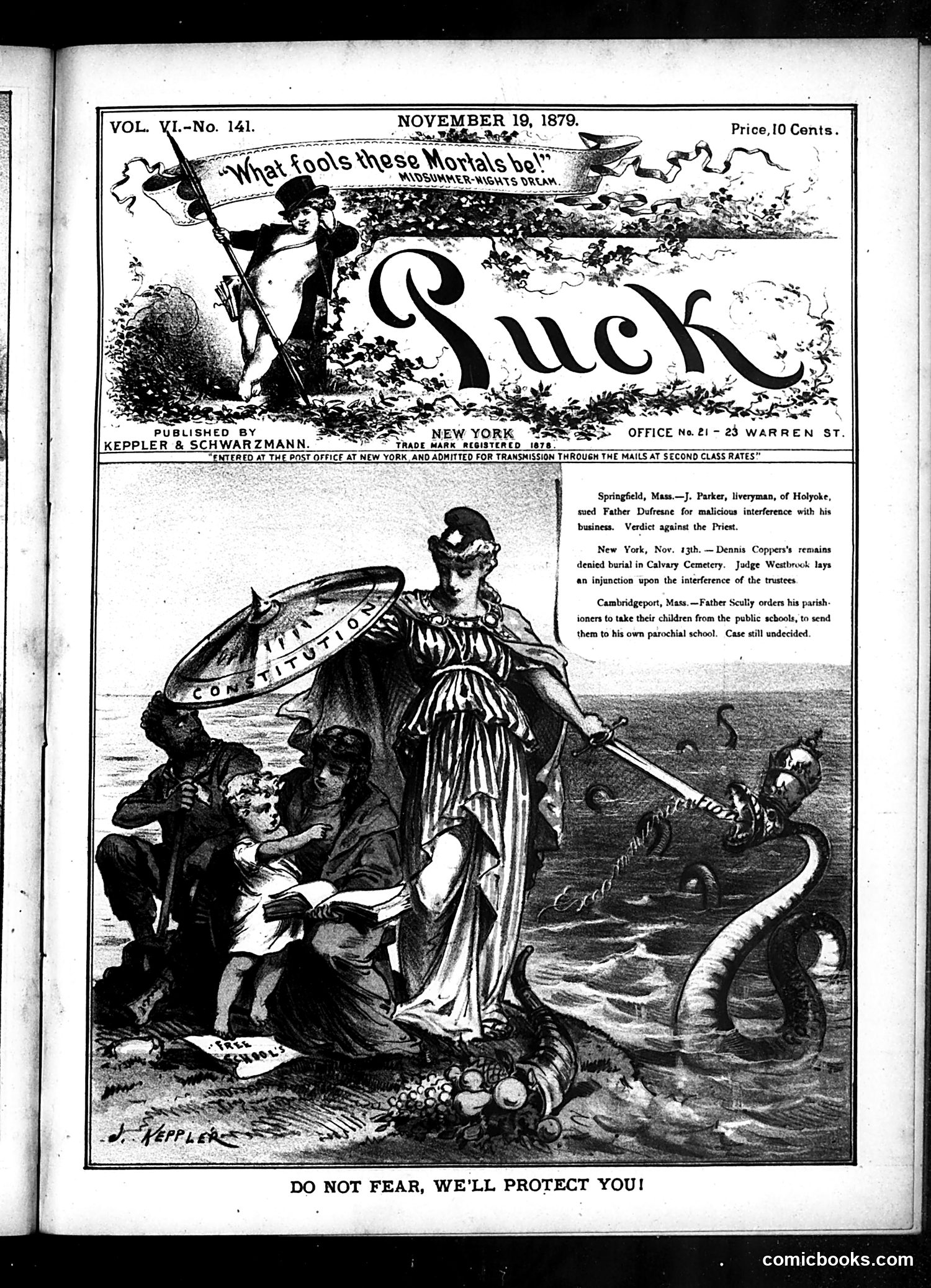
The main cartoon depicts **Lady Liberty** (the female figure holding the Constitution) protecting frightened citizens and children from turbulent waters labeled "anarchy." Creatures emerge from the sea, likely representing threats to social order. The satire's point: government must shield Americans from dangerous forces—possibly anarchism, labor unrest, or immigration-related chaos that worried the period. The banner "Do Not Fear, We'll Protect You!" presents this as reassurance, though Puck's satirical intent appears ambiguous: it may mock either government overreach in security or public hysteria about threats. The accompanying news items reference priest scandals and religious disputes, typical of Puck's coverage mixing politics with social commentary.
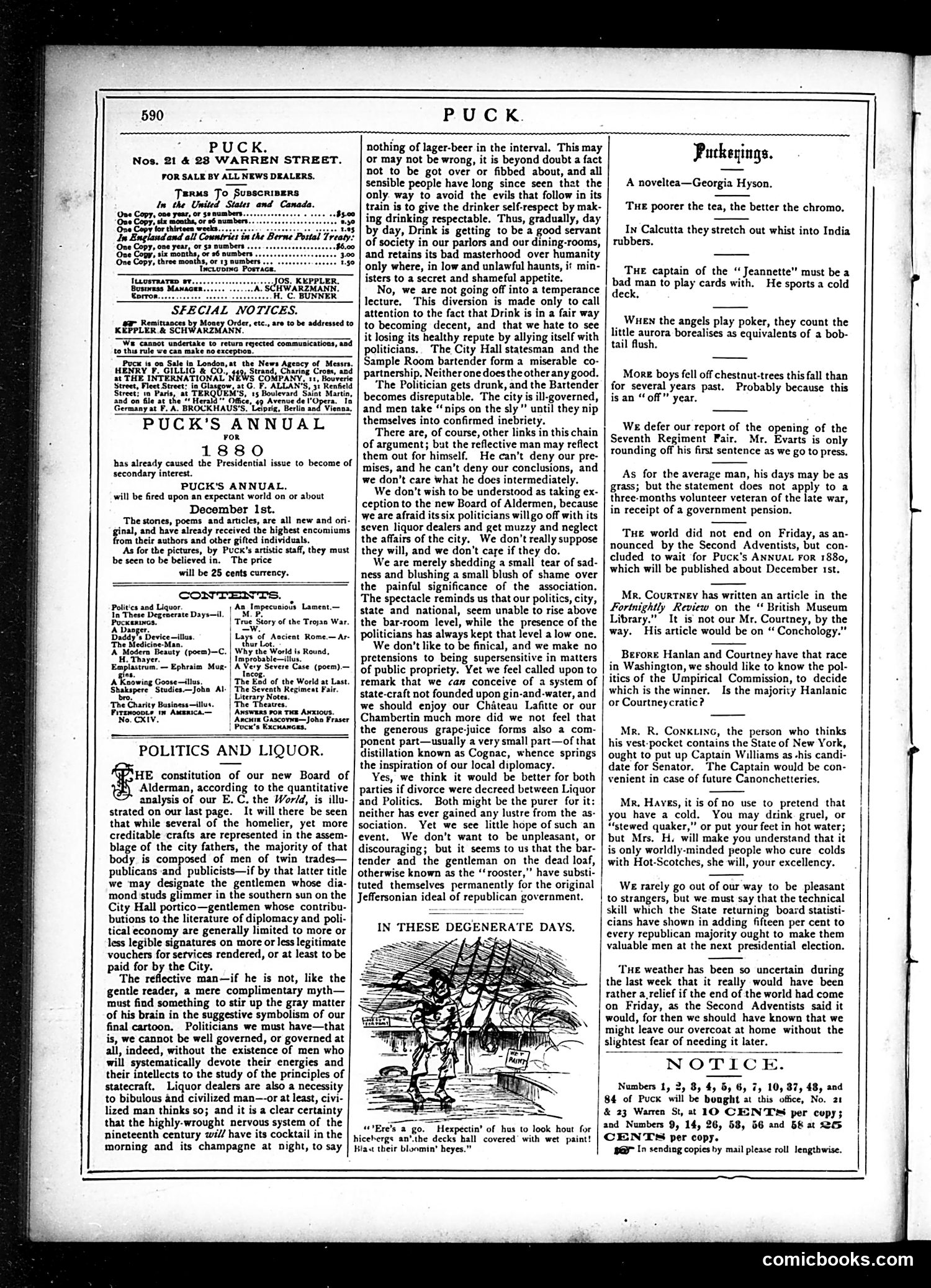
The page is primarily **text and advertising** rather than a major political cartoon. The main illustrated content shows a sketch titled "IN THESE DEGENERATE DAYS" depicting a figure in the rain appearing to search for something, with the caption "He's a go. Hespedes' of his to look for for hitch-go-up 'in the decks laid covered with wet paint! Just their dharma' boys." The illustration's meaning is **unclear from the image alone**—it appears to be a humorous scene about someone encountering an obstacle or mishap in rainy conditions, but the context and specific reference remain ambiguous. The rest of the page contains articles on politics, liquor regulation, and social commentary typical of Puck's satirical approach, but lacks accompanying major cartoons.
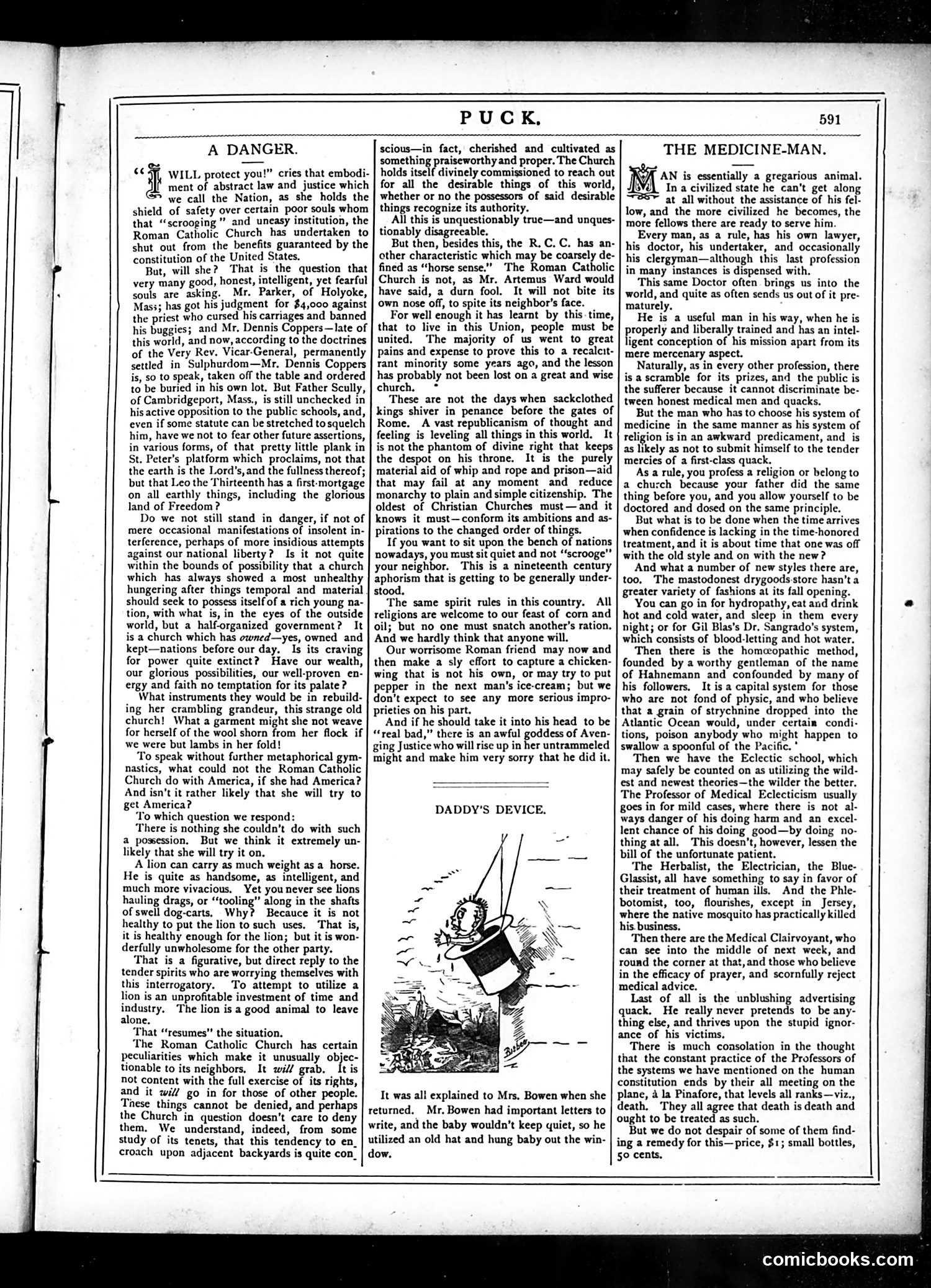
This cartoon satirizes parenting technology of its era. The illustration shows a contraption suspending a baby in what appears to be a mechanical harness or swinging device—labeled "Daddy's Device." The accompanying text explains that Mrs. Bowen returns home to find Mr. Bowen has rigged this apparatus to keep their fussy baby quiet while he tends to important letters. The satire mocks fathers who use labor-saving "gadgets" as substitutes for actual childcare. The broader article on this page critiques both Roman Catholicism and various medical quacks. The "Daddy's Device" segment targets lazy parenting and the era's growing faith in mechanical solutions to domestic problems—a common Puck theme ridiculing modern convenience culture.
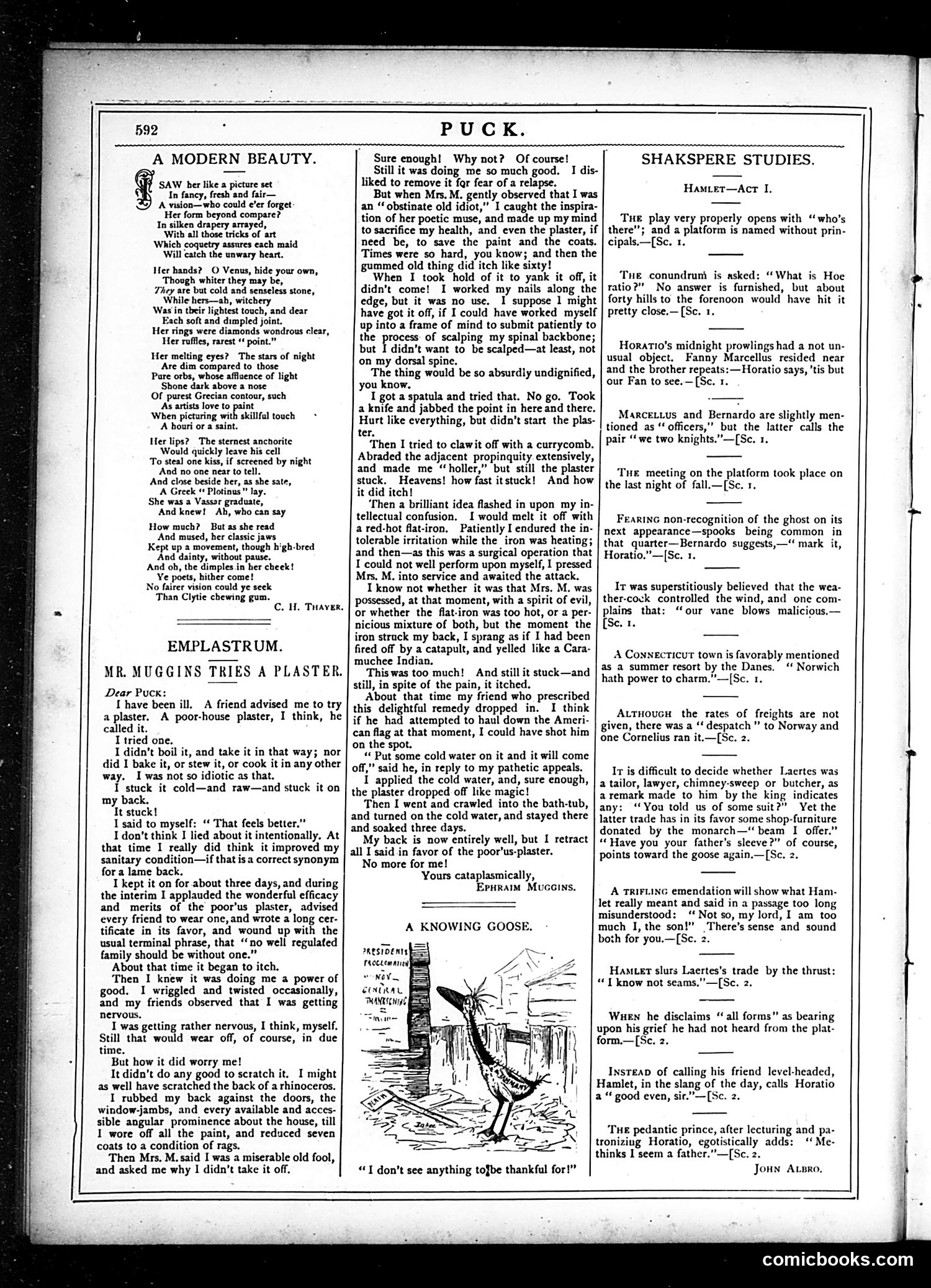
This page contains three distinct sections: 1. **"A Modern Beauty"** — A poem satirizing fashionable women, mocking their elaborate appearance and vanity ("picture set / In a golden frame"). 2. **"Emplastrum: Mr. Muggins Tries a Plaster"** — A humorous personal essay by Ephraim Muggins describing his attempt to use a medical plaster for back pain. The narrative focuses on domestic comedy: the plaster's ineffectiveness, his wife's skepticism, and the messy removal process. This appears to be satirical commentary on dubious patent medicines and health remedies popular in the era. 3. **"A Knowing Goose"** — A small illustrated comic showing a goose with caption "I don't see anything to be thankful for!" — likely satirizing complaints or ingratitude. The page also includes Shakespeare study notes unrelated to the satire. The content reflects Puck's typical mix of social satire and domestic humor.
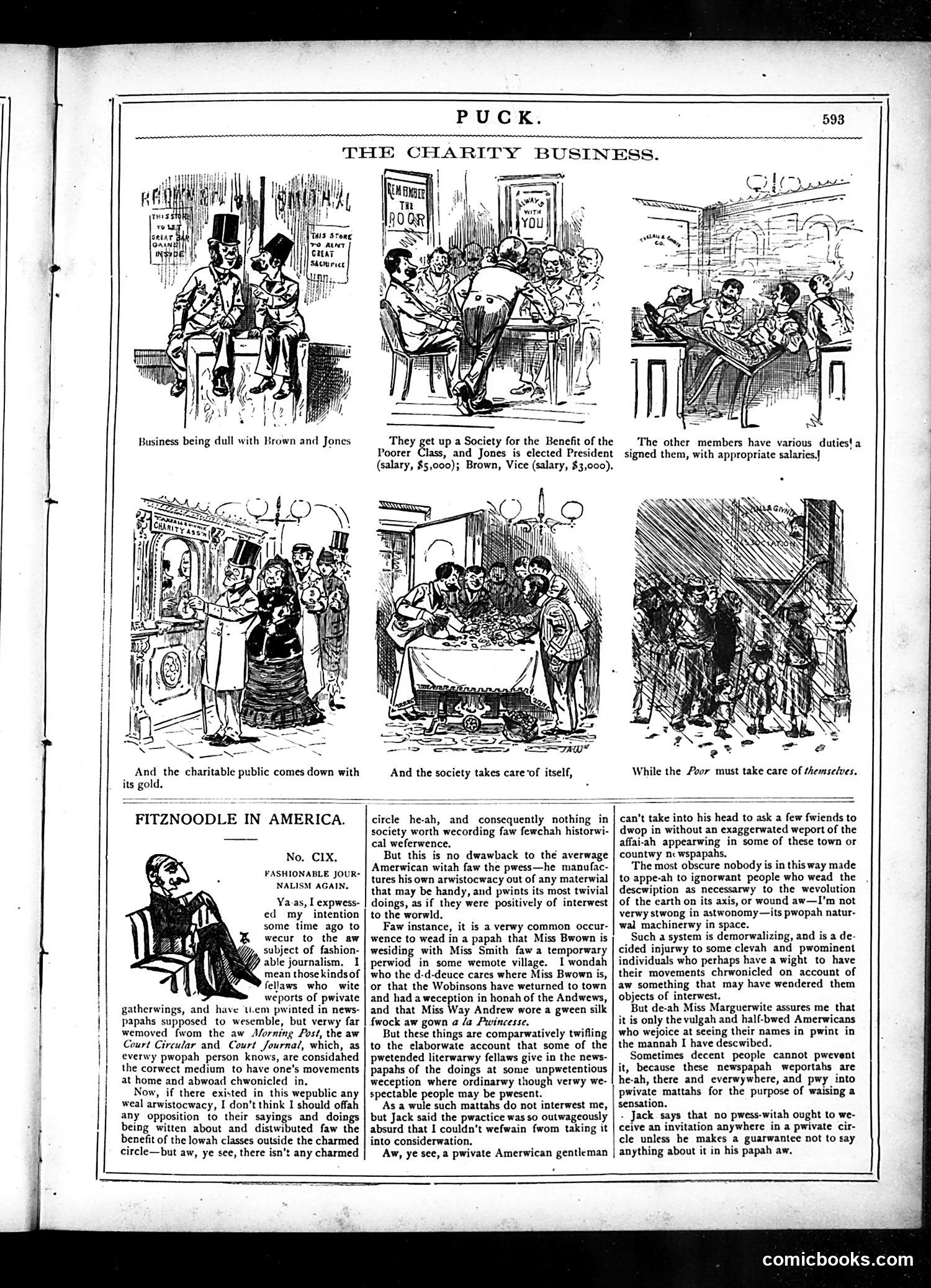
This Puck satirical comic mocks the fashionable upper classes' approach to charitable work. The sequence shows wealthy individuals establishing a "Society for the Benefit of the Poorer Class," with Jones elected president at a substantial salary (£5,000) and Brown as vice-president (£1,000). The satire's point: charity becomes a business opportunity for the wealthy themselves. Rather than genuinely helping the poor, the society primarily generates salaries and positions for its affluent members, while the actual poor ("the Poor") must fend for themselves. The comic criticizes how philanthropic organizations often benefit organizers more than intended beneficiaries—a social critique relevant across eras about the misallocation of charitable resources.
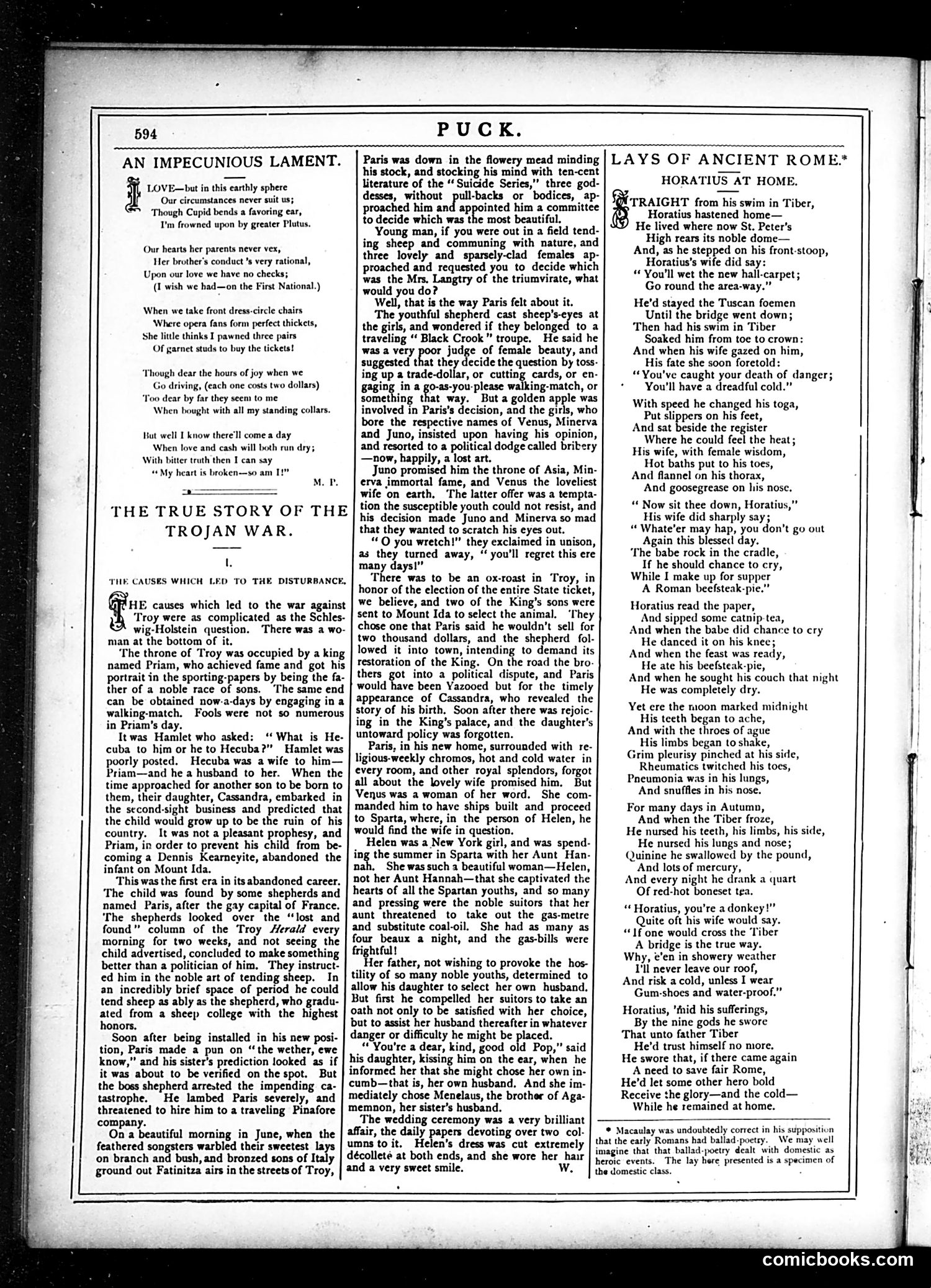
This page contains primarily **literary content rather than political satire**. The main pieces are: 1. **"An Impecunious Lament"** — a poem about romantic disappointment and class anxiety, where a poor man cannot compete for a woman's affections due to lack of wealth. 2. **"The True Story of the Trojan War"** — a lengthy satirical prose piece that reimagines the Trojan War through a modern American lens, with Paris depicted as an American con man and the conflict framed as a dispute over economic interests rather than Helen. 3. **"Lays of Ancient Rome: Horatius at Home"** — classical poetry presented humorously. No identifiable political figures or contemporary events appear on this page. It's primarily **humorous literary content** rather than the visual political cartooning Puck was known for.
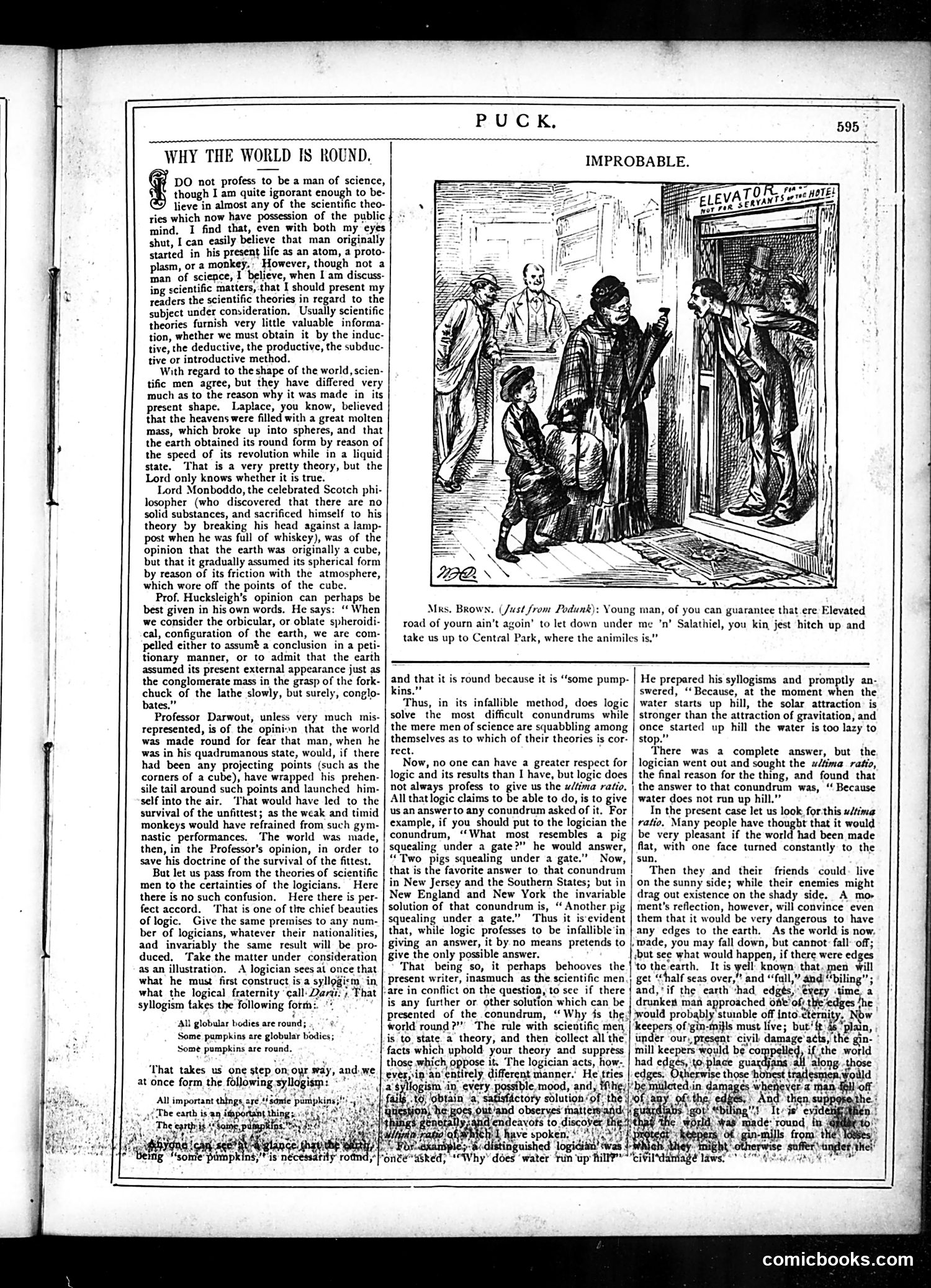
The page contains two distinct pieces: **Left column:** "Why the World Is Round" - A pseudo-scientific essay mocking overly complex scholarly explanations. It ridicules logicians and professors who construct elaborate, contradictory theories to explain simple phenomena. The satire suggests that academics often obscure truth through needless complexity rather than direct observation. **Right cartoon:** "Improbable" - Shows an elevator operator and Mrs. Brown discussing taking children to Central Park. The joke appears to reference the absurdity of an urban elevator operator guaranteeing to prevent children from misbehaving—an impossible task presented as if it were a simple service offer. The overall theme satirizes pretentious claims of expertise and authority where none genuinely exists, whether among scientists or service workers.
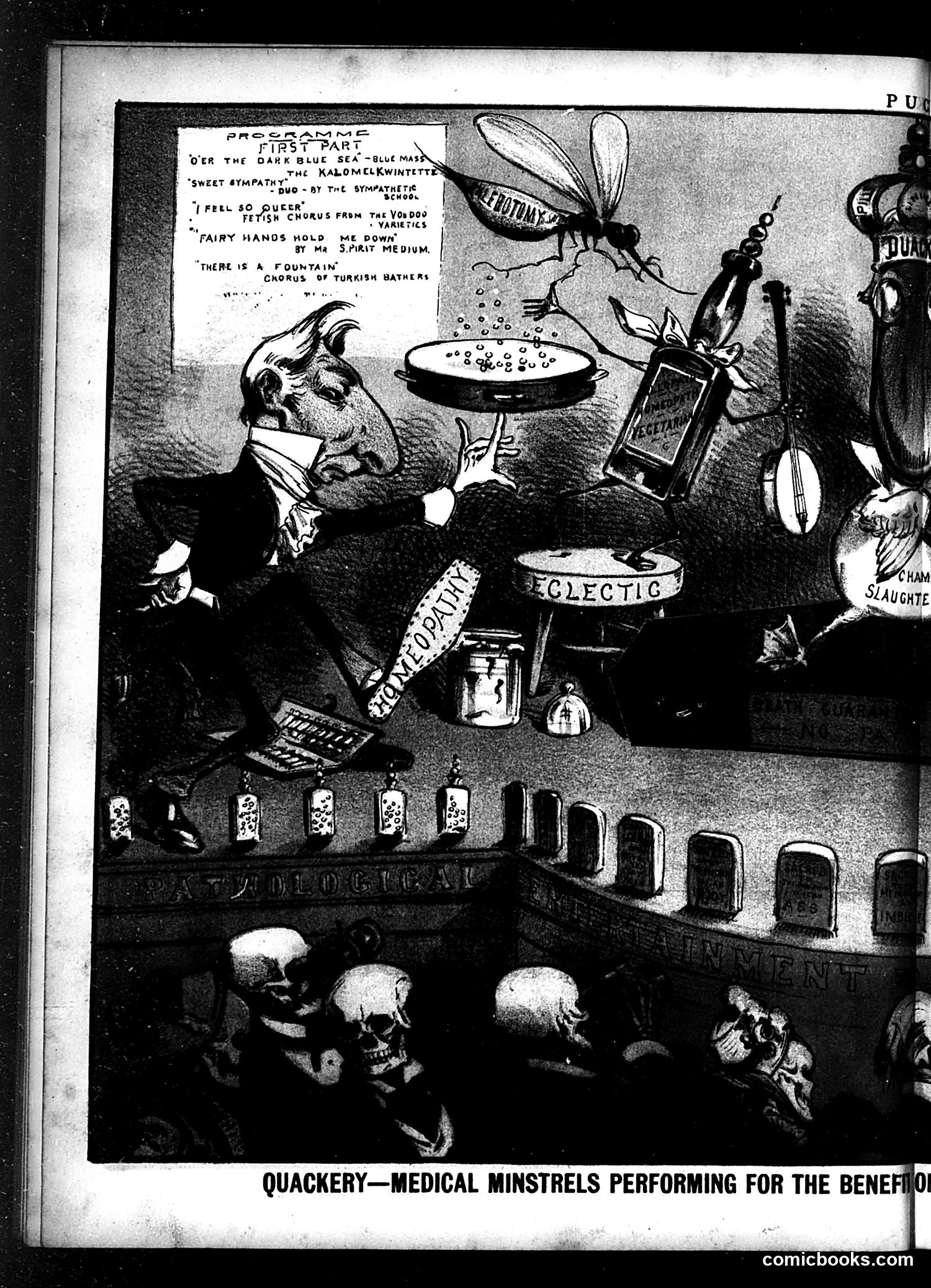
This Puck cartoon satirizes medical quackery and fraudulent health practitioners. The central figure—a well-dressed man with an exaggerated, scheming expression—appears to be a charlatan "doctor" or quack surrounded by dubious remedies and theatrical props. The title references "Medical Minstrels Performing for the Benefit of..." (text cut off), suggesting these fraudsters are entertainers exploiting the gullible public rather than legitimate physicians. The visible text lists fake treatments ("Sweet Sympathy," "Fairy Hands," etc.), mocking their absurdity. Various bottles, devices, and a large insect prop represent worthless "cures." Skulls at the bottom underscore the danger—these scams literally killed people. The satire targets the widespread 19th-century problem of unregulated medical fraud that preyed on desperate, sick Americans lacking access to real healthcare.
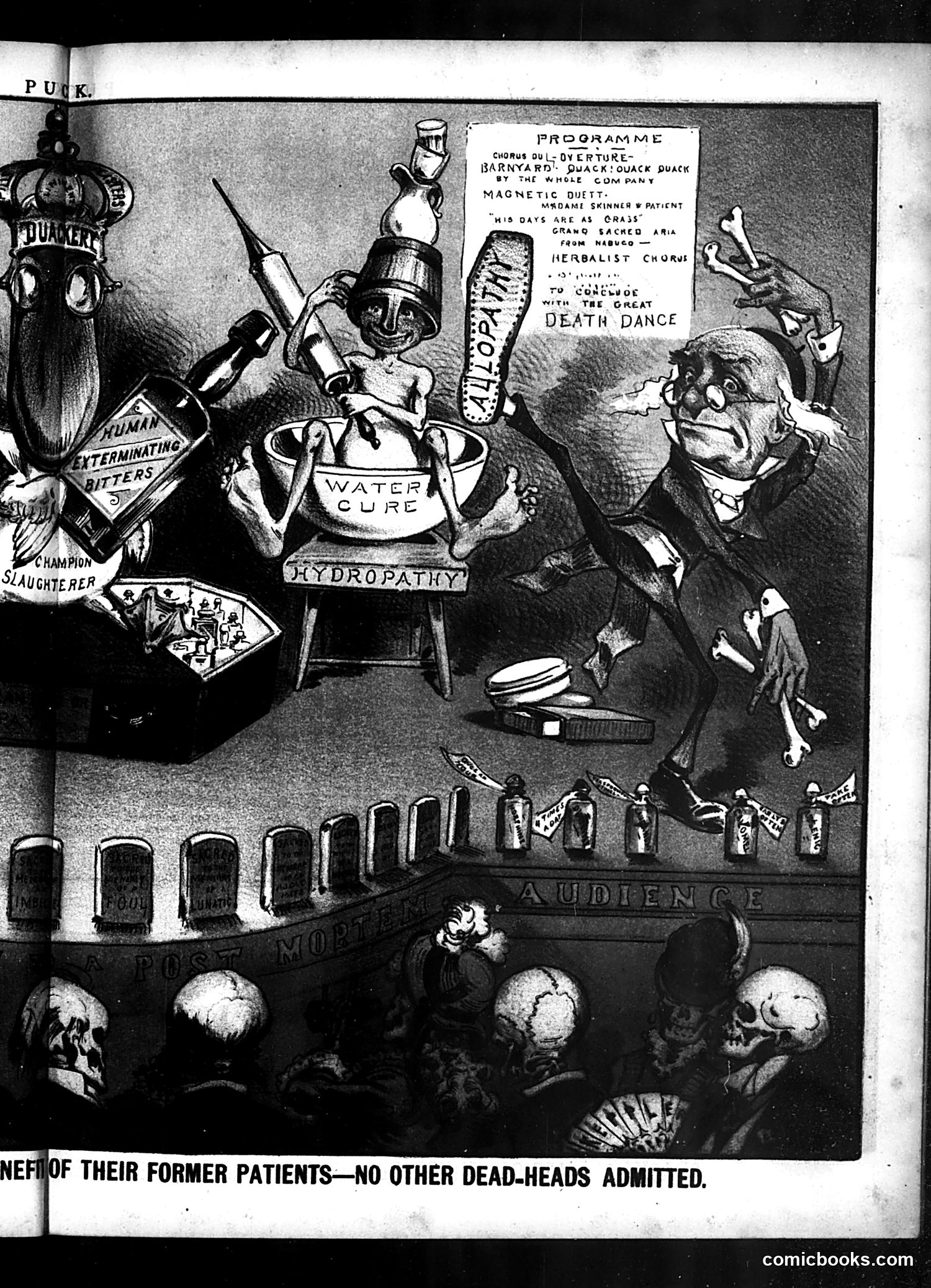
This page satirizes medical quackery and fraudulent health treatments popular in the late 19th/early 20th century. The central image depicts a theatrical "death dance" performance where various dubious remedies—water cure, hydropathy, magnetic treatments—are presented as entertainment for an audience of skulls (representing deceased victims). The left side shows bottles of "Human Exterminating Bitters" and "Champion Slaughterer," mocking patent medicines marketed as cure-alls. A sinister figure conducts this macabre show, while the program lists absurd treatments like "Quack quack quack" and "Herbalist Chorus." The bottom shows an audience of skulls labeled "post mortem audience" with text suggesting "No other dead-heads admitted"—a grim pun implying these treatments killed patients who became literal "dead-heads." The satire attacks predatory medical fraudsters preying on desperate patients.
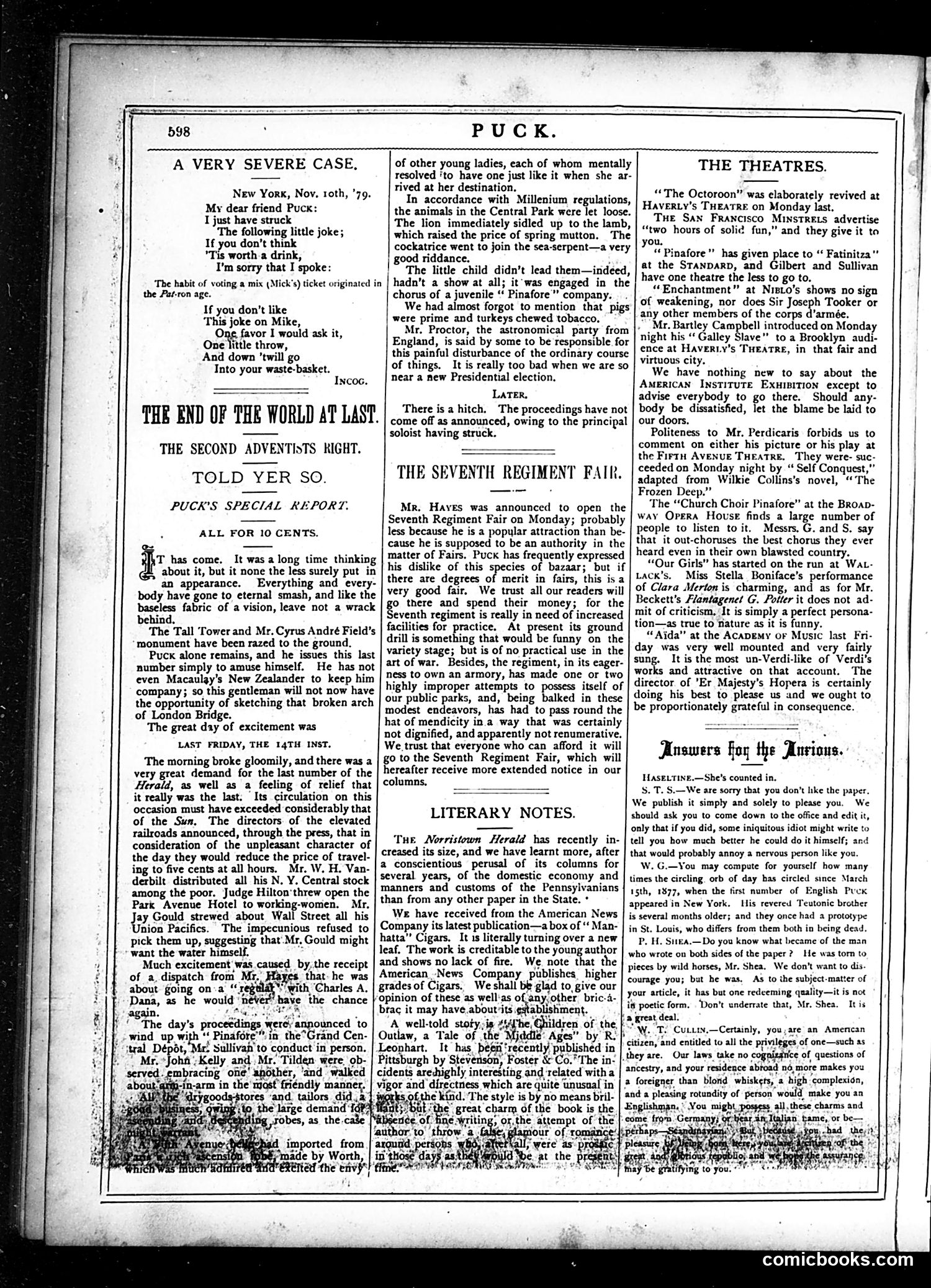
This page consists primarily of **text content rather than political cartoons**—it contains theater reviews, literary notes, and advice columns. The main satirical pieces are brief: 1. **"A Very Severe Case"** mocks a voter's indecision, using the joke "If you don't like this joke on Mick, / Try another one; ask it, / One little throw, / And down 'twill go / Into your waste-basket." This appears to satirize Irish-American voters (referenced as "Mick"). 2. **"The End of the World at Last"** and **"The Second Adventists' Night"** are humor pieces about apocalyptic predictions. The page also reviews theaters and discusses the "Seventh Regiment Fair," suggesting this is from 1879 based on the header date visible. The content reflects Puck's mix of entertainment criticism and light social satire rather than hard political commentary.
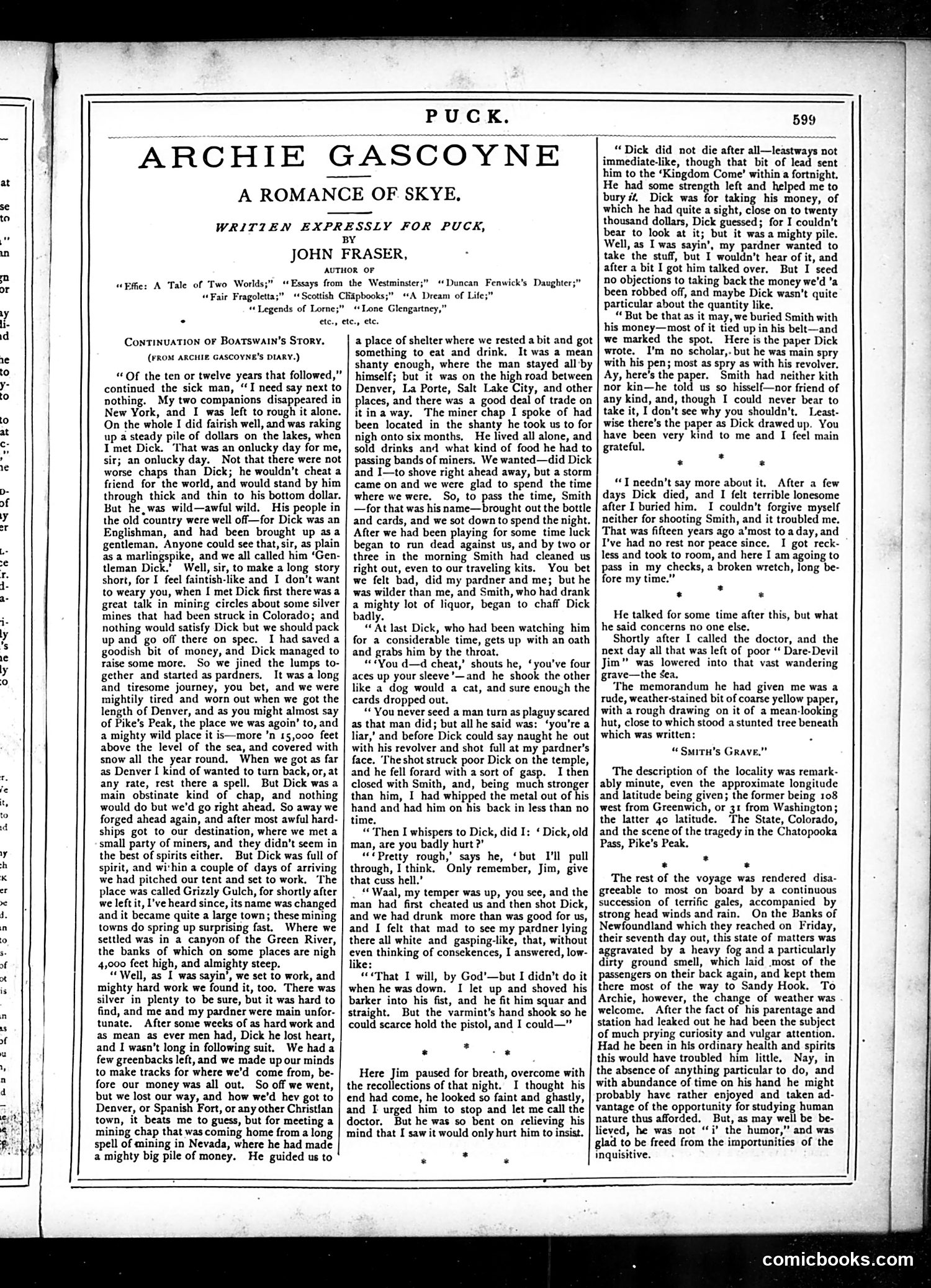
This page is **not a political cartoon** but rather the opening of a serialized short story written by John Fraser, expressly for Puck magazine. The narrative concerns Dick, a Scottish miner, and his adventures in the Highlands. The text describes Dick's hardscrabble life—mining, drinking, fighting—and a specific incident where he was shot after a dispute, possibly involving theft or romantic rivalry. There is **no political satire evident** on this page. It appears to be adventure fiction set in Scotland, typical of the serialized stories Puck published alongside its satirical cartoons. The story emphasizes rugged frontier life and working-class character drama rather than contemporary political commentary.
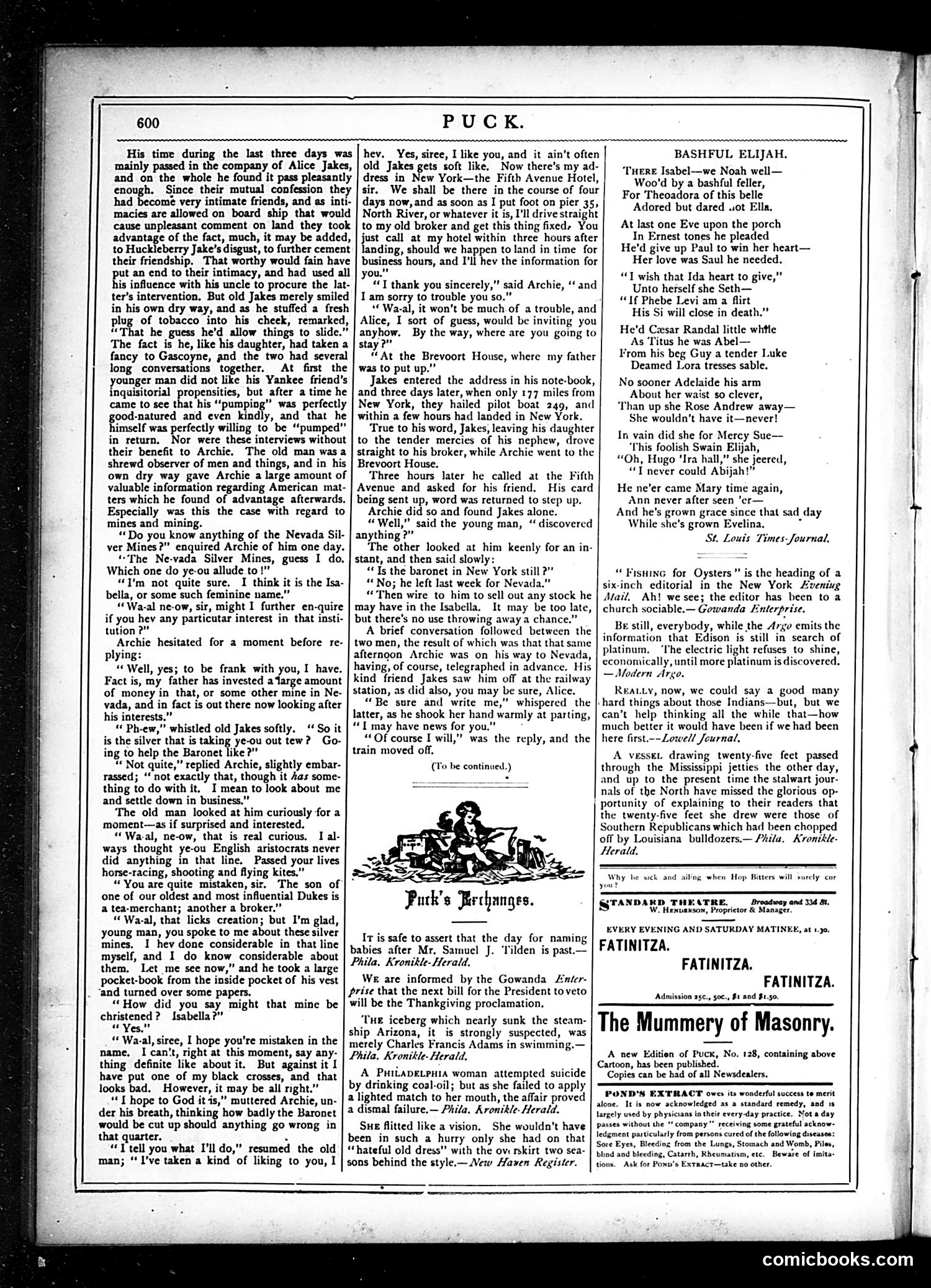
This page is primarily **text-based content** rather than political cartoons. The main feature is a serialized story titled "Bashful Elijah" about a romantic plot involving characters named Archie, Alice, and Jake—apparently a narrative about securing a marriage proposal. The lower portion contains brief satirical **news items** ("Puck's Archipelago") mocking contemporary events: naming a battleship after a woman, Charles Francis Adams swimming, and a Philadelphia woman's attempted suicide. At bottom are **advertisements** for theater productions including "Fatinitza" and "The Mummery of Masonry," plus a patent medicine ad ("Pond's Extract"). **No clear political cartoons appear on this visible page.** The satire is gentle, focused on social gossip and human-interest absurdities rather than partisan politics.
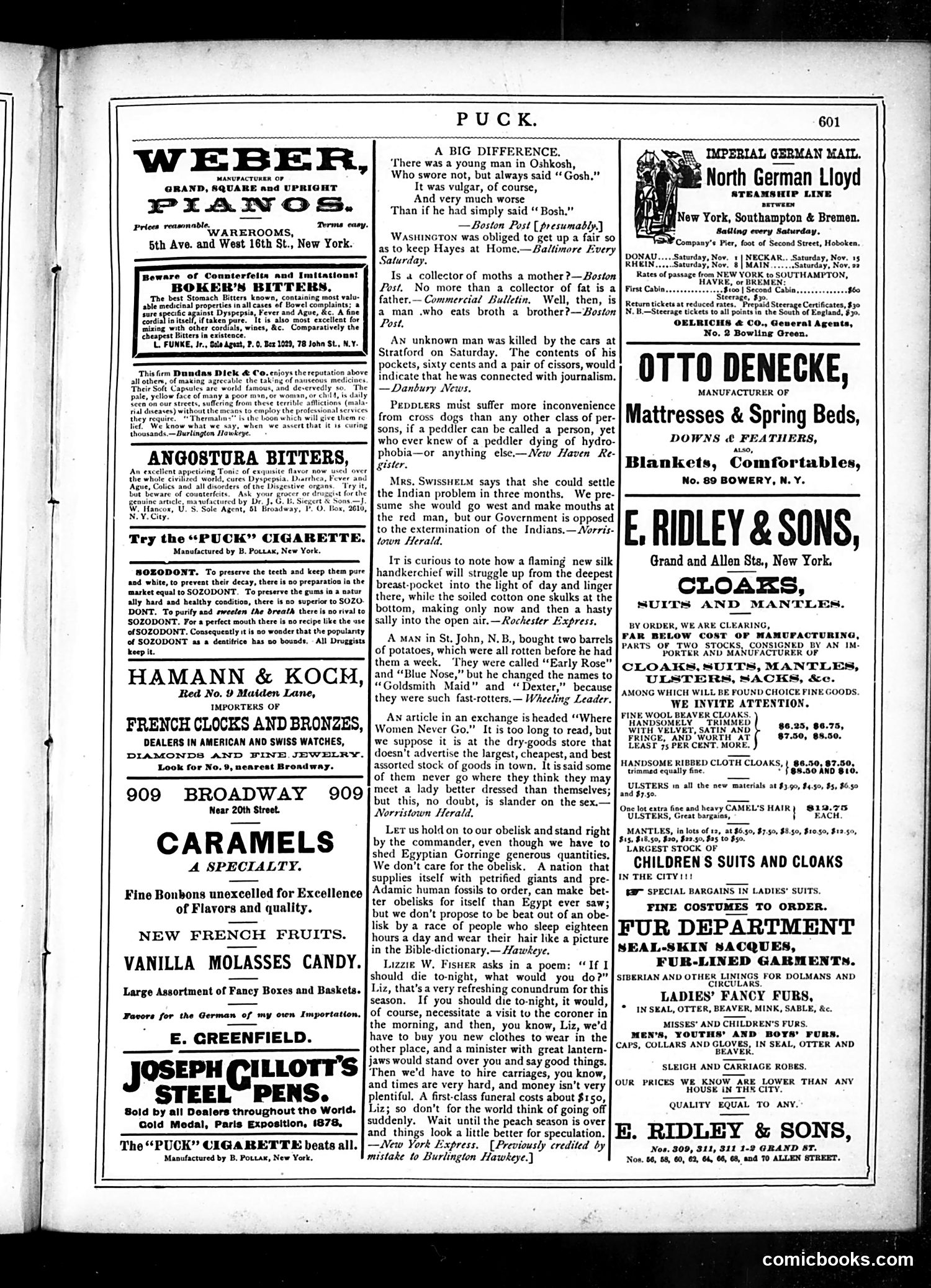
This page is primarily **advertising content** rather than satirical cartoons. It features commercial advertisements for various products including: - Weber pianos - Boker's Bitters (a medicinal tonic) - Hamann & Koch jewelry - French clocks and bronzes - Caramels and candy - Joseph Gillott's steel pens - E. Ridley & Sons clothing and furs There is one brief **satirical text piece** titled "A Big Difference," a short humor column mocking a man from Oshkosh who says "Gosh" instead of "Bosh"—social commentary on regional dialect differences. The page also includes shipping advertisements for the North German Lloyd steamship line and other commercial notices. This represents typical **19th-century magazine monetization**, where satirical content shared space with extensive paid advertising.
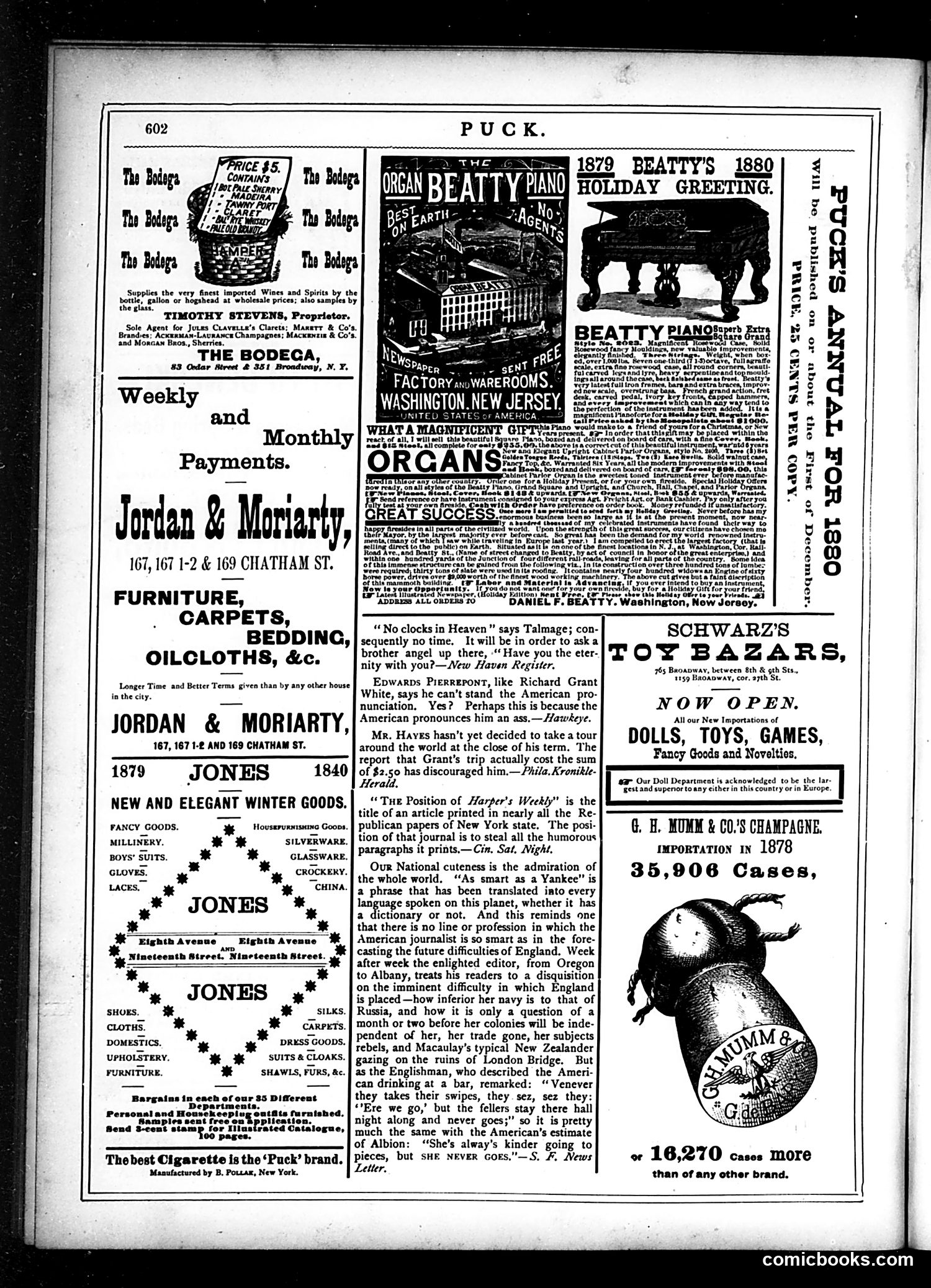
This is primarily an **advertising page** from Puck magazine (page 602), not a political cartoon page. The dominant content consists of commercial advertisements for: - **Beatty Piano** (1879-1880 holiday greeting featuring a grand piano) - **Beatty Organs** (Washington, New Jersey factory) - **Jordan & Moriarty** (furniture, carpets, oilcloths) - **Jones** (winter goods, fancy items, silks, shoes) - **Schwarz's Toy Bazars** (newly opened toy and novelty store) - **G.D. Mumm & Co.'s Champagne** (promoting 35,906+ cases imported in 1878) The only editorial content visible is a brief column discussing American pronunciation, the editor of *Harper's Weekly*, and comparative naval strength between England and Russia. The page reflects late-19th-century consumer culture and advertising practices in popular magazines.
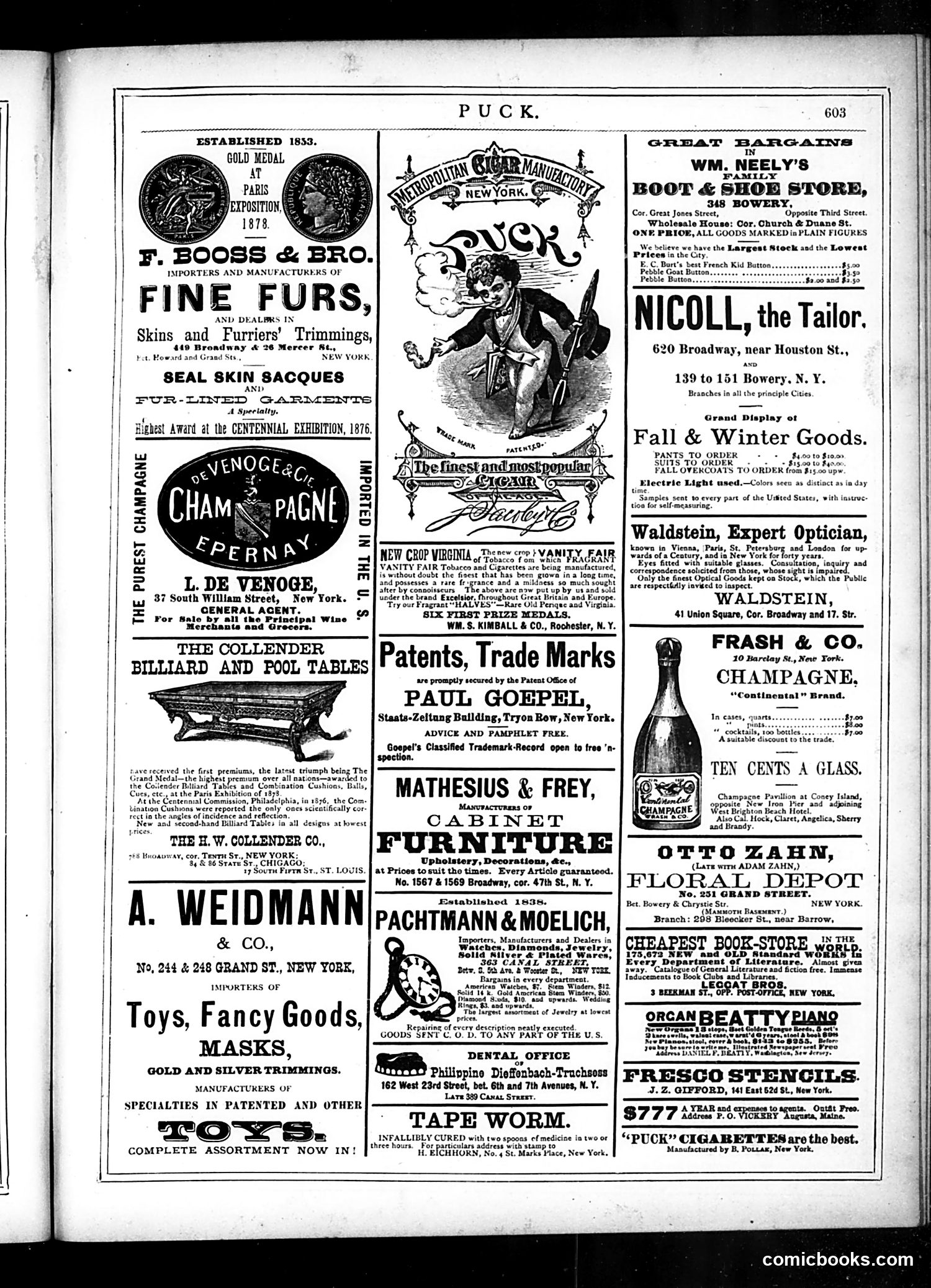
This is primarily an **advertising page** from Puck magazine (page 603), featuring numerous commercial advertisements from the late 19th century. The main illustrated content is a **Puck masthead cartoon** showing a mischievous impish figure (Puck himself, the magazine's mascot) in classical style, labeled as "The finest and most popular Puck Steeplecase." The page contains no apparent political cartoon or social satire beyond the magazine's branding. Instead, it displays ads for luxury goods (furs, champagne, furniture), services (tailoring, optometry), and novelties (toys, billiard tables, stencils)—typical of Puck's revenue model. The advertisements themselves reflect Gilded Age consumer culture and New York City commerce, but carry no obvious satirical message. This is a commercial, not editorial, page.
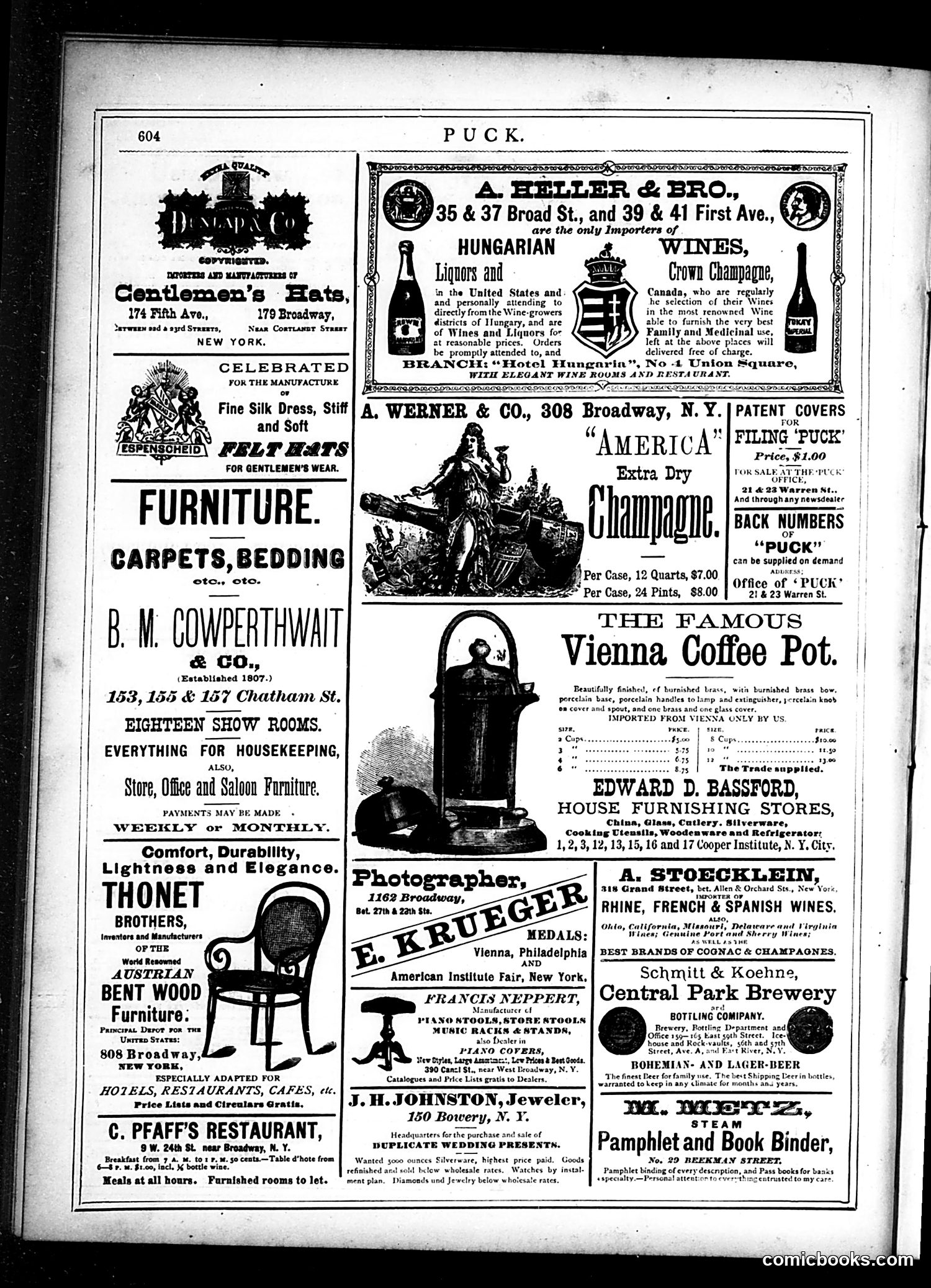
This page is **primarily advertising**, not satirical content. It contains commercial advertisements for late 19th-century businesses including: - Gentlemen's hats (Dunlap & Co.) - Furniture and carpets (B.M. Cowperthwait & Co., Thonet Brothers) - Hungarian wines and champagne (Schladé & Brandt) - A Vienna coffee pot - Photography services (E. Krueger) - A jewelry store (J.H. Johnston) - A restaurant (C. Pfaff's) - A steam pamphlet binding service While this is from *Puck* magazine, this particular page lacks satirical cartoons or political commentary. The advertisements show typical American commercial offerings of the era, with decorative Victorian-era illustrations accompanying business listings. The page functions as a revenue source for the magazine rather than editorial content.
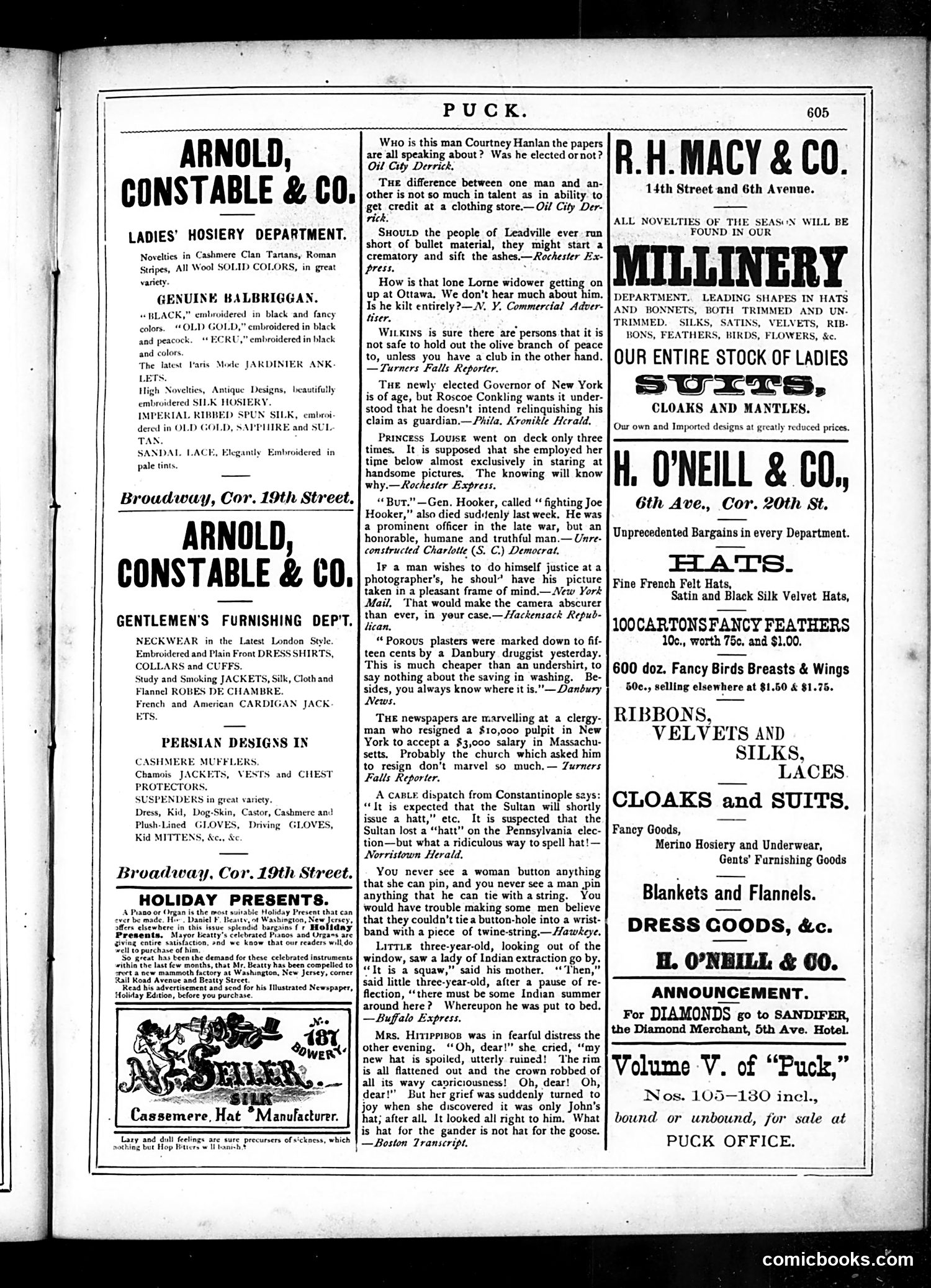
This page is primarily **advertising**, not political satire. It contains department store and clothing advertisements for establishments like Arnold, Constable & Co., R.B. Macy & Co., and H. O'Neill & Co., featuring women's fashions (hats, cloaks, millinery, silks, ribbons). The only editorial content is a column of brief humorous observations about contemporary life—topics like a widow in Ottawa, New York's governor, a photographer's picture frame, church donations, and newspaper anecdotes. These are **light social commentary** rather than partisan political satire, typical of Puck's miscellaneous humor sections. The page includes one small decorative illustration (a "Cashmere Hat Manufacturer" logo), but contains no significant political cartoons or caricatures requiring historical context.
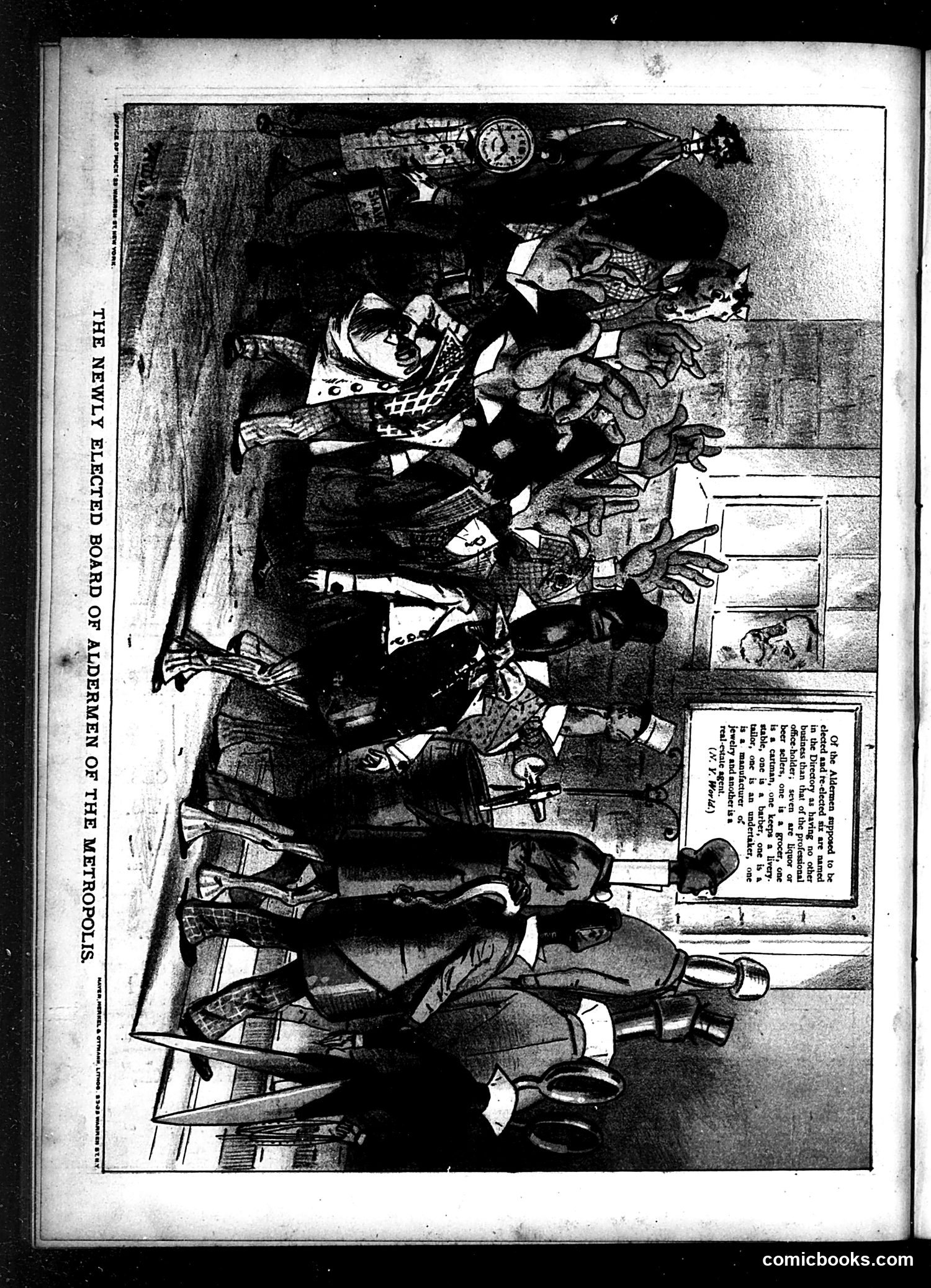
This political cartoon satirizes corruption among New York City's newly elected aldermen (city council members). The image depicts several figures in formal dress gathered around what appears to be a desk or counter, with one figure prominently displayed holding what looks like money or documents. The satire suggests these elected officials are primarily interested in personal financial gain rather than public service. The exaggerated caricatures and their positioning—seemingly focused on acquiring wealth—implies widespread graft and bribery among municipal government. Without specific dates or names visible, this represents Puck magazine's recurring theme of mocking urban political corruption, a major satirical focus during the Gilded Age when city politics were notoriously dominated by patronage systems and embezzlement.