
Puck, 1879-11-19 · page 7 of 18
Puck — November 19, 1879 — page 7: what you’re looking at
What you’re looking at
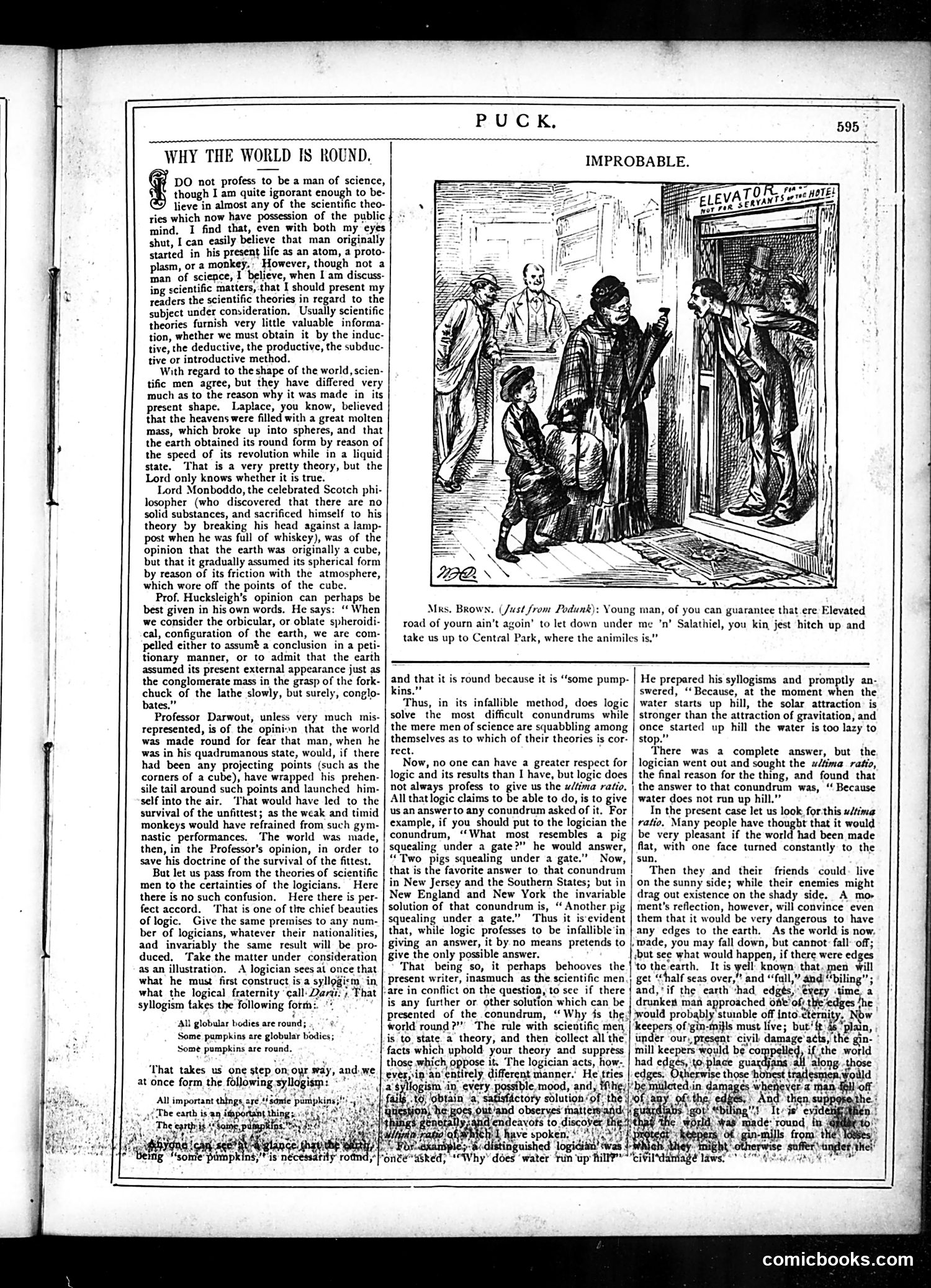
The page contains two distinct pieces: **Left column:** "Why the World Is Round" - A pseudo-scientific essay mocking overly complex scholarly explanations. It ridicules logicians and professors who construct elaborate, contradictory theories to explain simple phenomena. The satire suggests that academics often obscure truth through needless complexity rather than direct observation. **Right cartoon:** "Improbable" - Shows an elevator operator and Mrs. Brown discussing taking children to Central Park. The joke appears to reference the absurdity of an urban elevator operator guaranteeing to prevent children from misbehaving—an impossible task presented as if it were a simple service offer. The overall theme satirizes pretentious claims of expertise and authority where none genuinely exists, whether among scientists or service workers.
📄 Transcribed text from this page (OCR, searchable)
Machine-transcribed from the original scan — historical spelling and the odd misread are preserved.
WHY THE WORLD IS ROUND. DO not profess to be a man of science, though I am quite ignorant enough to be- lieve in almost any of the scientific theo- ries which now have possession of the public mind, I find that, even with both my ‘eyes shut, I can easily believe that man originally started in his present life as an atom, a proto- plasm, or a monkey,’ However, though not a man of science, I believe, when I am discuss- ing scientific matters, that I should present my readers the scientific theories in regard to the subject under consideration. Usually scientific theories furnish very little valuable informa- tion, whether we must obtain it by the induc- tive, the deductive, the productive, the subduc- tive or introductive method. With regard to the shape of the world, scien- tific men agree, but they have differed very much as to the reason why it was made in its present shape. Laplace, you know, believed that the heavens were filled with a great molten mass, which broke up into spheres, and that the earth obtained its round form by reason of the speed of its revolution while in a liquid state. That is a very pretty theory, but the Lord only knows whether it is true. Lord Monboddo, the celebrated Scotch phi- losopher (who discovered that there are no solid substances, and sacrificed himself to his theory by breaking his head against a lamp- post when he was full of whiskey), was of the opinion that the earth was originally a cube, but that it gradually assumed its spherical form by reason of its friction with the atmosphere, which wore off the points of the cube. Prof. Hucksleigh’s opinion can perhaps be best given in his own words. He says: “When we consider the orbicular, or oblate spheroidi- cal, configuration of the earth, we are com- pelled either to assumé a conclusion in a peti- tionary manner, or to admit that the earth assumed its present external appearance just as the conglomerate mass in the grasp of the fork- chuck of the lathe slowly, but surely, conglo- bates.” Professor Darwout, unless very much mis- represented, is of the opinin that the world was made round for fear that man, when he was in his quadrumanous state, would, if there had been any projecting points (such as the corners of a cube), have wrapped his prehen- sile tail around such points and launched him- self into the air. ‘That would have led to the survival of the unfittest; as the weak and timid monkeys would have refrained from such gym- nastic performances. The world was made, then, in the Professor's opinion, in order to save his doctrine of the survival of the fittest. But let us pass from the theories of scientific men to the certainties of the logicians. Here there is no such confusion. Here there is per- fect accord. ‘That is one of tite chief beauties of logic. Give the same premises to any num- ber of logicians, whatever their nationalities, and invariably the same result will be pro- duced, ‘Take the matter under consideration as an illustration. A logician sees at once that what he must first construct is a syllogism. ii what the logical fraternity ‘call: 2% syllogism takes the following forth: All globular bodies are round; .. Some pumpkins are globular bodies; Some pumpkins are round. ‘That takes us one step on our way, and. we at once form the following syllogism: All important things, 23 ‘punipki 1{iThe earth is an iiaportaing thing; Ths earth it s“Soing, pimple ii gag ae sane en IMPRO! BABLE. AT On cf one note! rf Mrs. Brown. (Just from Podunk): Young man, of you can guarantee that ere Elevated road of yourn ain't agoin’ to let down under m take us up to Central Park, where the anim’ ’n’ Salathiel, you kin, jest hitch up and and that it is round because it is ‘some pump- kins.” Thus, in its infallible method, does logic solve the most difficult conundrums while the mere men of science are squabbling among themselves as to which of their theories is cor- rect. Now, no one can have a greater respect for logic and its results than I have, but logic does not always profess to give us the w/tima ratio, All that logic claims to be able to do, is to give us an answerto any conundrum asked of it. For example, if you should put to the logician the conundrum, ‘‘What most resembles a pig squealing under a gate?” he would answer, “Two pigs squealing under a gate.” Now, that is the favorite answer to that conundrum in New Jersey and the Southern States; but in New England and New York the invariable solution of that conundrum is, “ Another pig squealing under a gate.” Thus it is'evident that, while logic professes to be infallible'in giving an answer, it by no means pretends to give the only possible answer. That being so, it perhaps behooves the present writer, inasmuch as the scientific men are in conflict on the question, to see if there is any further or other solution which can be presented of the conundrum, “Why 4s. the: world round?” The rule with scientific men, is to. state. a theory, and then collect all the. facts which uphold your theory and suppress those which oppose it. The logician acts, how-. Evegin an entirely, apap ana He fat ag} ism an, ¢very.possible,mood, and, if ai i igbtain ‘a, satisfdctory sdlution ‘of’ the igiaors oui and observes taliban enotal ater iO discover the wiafwhith | have spoken. Se aanipiey “disinguied logidiiis’ was nte*asked; “Why” does ‘water ‘rin ‘up fill?” He prepared his syllogisms and promptly an- swered, “Because, at the moment when the water starts up hill, the solar attraction is stronger than the attraction of gravitation, and once started up hill the water is too lazy to stop.” ‘There was a complete answer, but the. logician went out and sought the w/tima ratio, the final reason for the thing, and found that the answer to that conundrum was, ‘“ Because water does not run up hill.” In the present case let us look, for this u/tima ratio. Many people have thought that it would be very pleasant if the world had been made flat, with one face turned constantly to the sun, Then they and their friends could: live on the sunny side; while their enemies might drag out existence on the shady side. A mor ment’s reflection, however, will convince even them that it would be very dangerous to have any edges to the earth. As the world is now, | wade, you may fall down, but cannot: fall: off; ‘but see what would happen, if there were edges to theearth. It is well: known that.men will get “half seas over,” and “fall,” and “‘biling” ; | and,’ if the earth ‘had edgés,“éxery « ime, 2 | drunkes man approached ont off tie edges he would probably’ sturnble off into.eternity. Now keeper of'gin-mifls must live; but! {t'4s "plain, under our, present civil damage’ acts, the gin- mill keepers would be compelled, if the world had ig toyplace pat all along, those edges. Otherwise those ‘honest tratlesmen.Woilld ff 1¢ miileted i hene Sidiabs. got! “bili : chad the #0) SSS atta ‘ comicbooks.com