
Puck, 1879-11-19 · page 6 of 18
Puck — November 19, 1879 — page 6: what you’re looking at
What you’re looking at
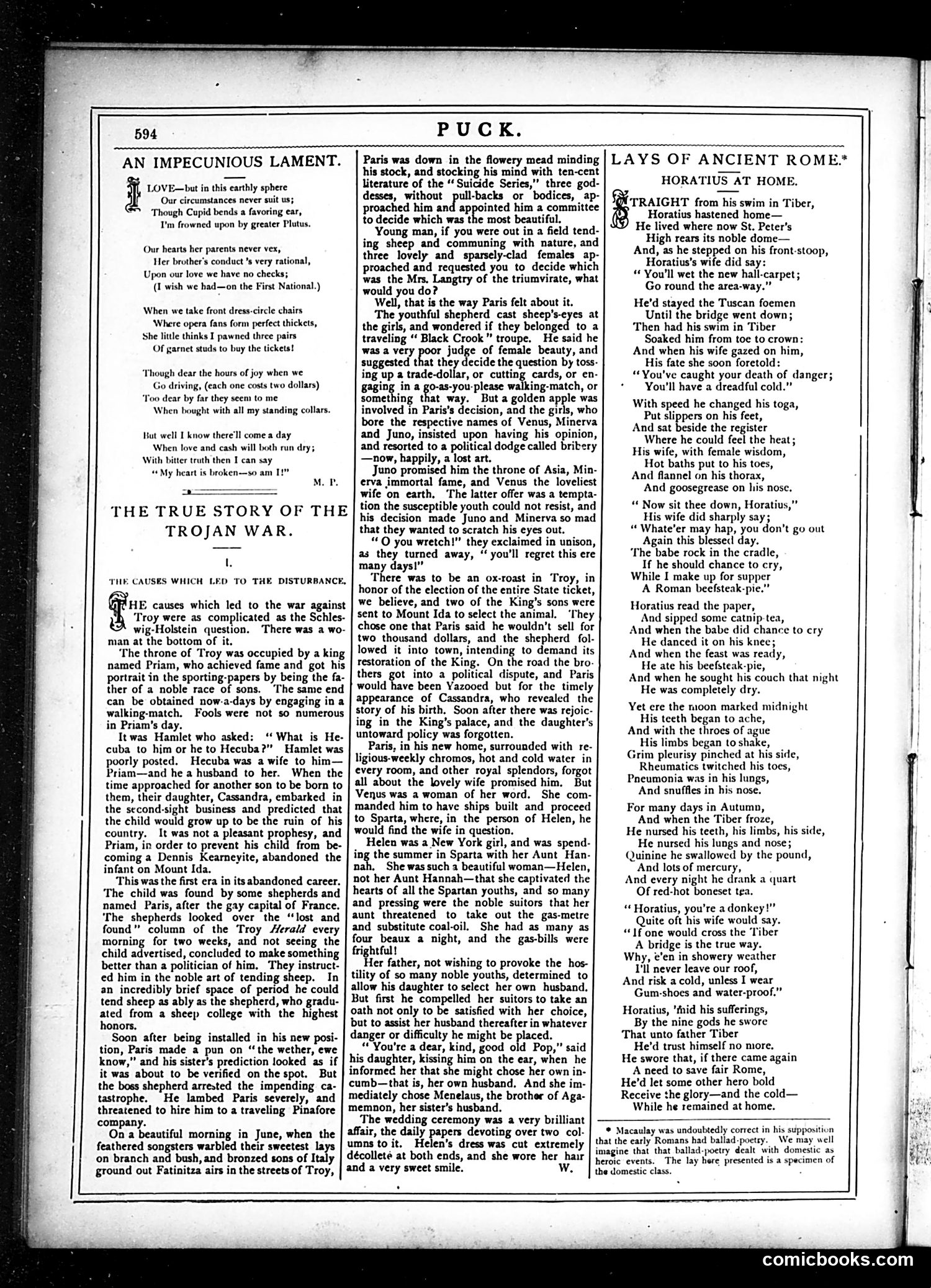
This page contains primarily **literary content rather than political satire**. The main pieces are: 1. **"An Impecunious Lament"** — a poem about romantic disappointment and class anxiety, where a poor man cannot compete for a woman's affections due to lack of wealth. 2. **"The True Story of the Trojan War"** — a lengthy satirical prose piece that reimagines the Trojan War through a modern American lens, with Paris depicted as an American con man and the conflict framed as a dispute over economic interests rather than Helen. 3. **"Lays of Ancient Rome: Horatius at Home"** — classical poetry presented humorously. No identifiable political figures or contemporary events appear on this page. It's primarily **humorous literary content** rather than the visual political cartooning Puck was known for.
📄 Transcribed text from this page (OCR, searchable)
Machine-transcribed from the original scan — historical spelling and the odd misread are preserved.
594 PUCK. AN IMPECUNIOUS LAMENT. LOVE—but in this earthly sphere Our circumstances never suit us; “Though Cupid bends a favoring ear, I'm frowned upon by greater Plutus. Our hearts her parents never vex, Her brother's conduct ’s very rational, Upon our love we have no checks; (I wish we had—on the First National.) When we take front dress-circle chairs Where opera fans form perfect thickets, She little thinks I pawned three pairs Of garnet studs to buy the tickets! ‘Though dear the hours of joy when we Go driving, (each one costs two dollars) ‘Too dear by far they seem to me When bought with all my standing collars. Hut well I know there'll come a day When love and cash will both run dry; With bitter truth then I can say “My heart is broken—so am I!” MP. THE TRUE STORY OF THE TROJAN WAR. I ‘THE CAUSES WHICH LED TO THE DISTURBANCE, HE causes which led to the war against Troy were as complicated as the Schles- wig-Holstein question. ‘There was a wo- man at the bottom of it, ‘The throne of ‘Troy was occupied by a king named Priam, who achieved fame and got his portrait in the sporting-papers by being the fa- ther of a noble race of sons. The same end can be obtained now-a-days by engaging in a walking-match. Fools were not so numerous in Priam's day. Itwas Hamlet who asked: ‘‘ What is He- cuba to him or he to Hecuba?” Hamlet was poorly posted. Hecuba was a wife to him— Priam—and he a husband to her. When the time approached for another son to be born to them, their daughter, Cassandra, embarked in the second-sight business and predicted that the child would grow up to be the ruin of his country, It was not a pleasant prophesy, and Priam, in order to prevent his child from be- coming a Dennis Kearneyite, abandoned the infant on Mount Ida. This was the first era in its abandoned career. The child was found by some shepherds and named Paris, after the gay capital of France. ‘The shepherds looked over the “lost and found” column of the Troy Herald every morning for two weeks, and not seeing the child advertised, concluded to make something better than a politician of him. They instruct- ed him in the noble art of tending sheep. In an incredibly brief space of period he could tend sheep as ably as the shepherd, who gradu- ated from a sheep college with the highest honors. Soon after being installed in his new posi- tion, Paris made a pun on “the wether, ewe know,” and his sister’s prediction looked as if it was about to be verified on the spot. But the boss shepherd arrested the impending ca- tastrophe. He lambed Paris severely, and threatened to hire him to a traveling Pinafore company. On a beautiful morning in June, when the feathered songsters warbled their sweetest lays on branch and bush, and bronzed sons of Italy ground out Fatinitza airs in the streets of Troy, Paris was down in the flowery mead minding his stock, and stocking his mind with ten-cent literature of the “Suicide Series,” three god- desses, without pull-backs or bodices, ap- proached him and appointed him a committee to decide which was the most beautiful, Young man, if you were out in a field tend- ing sheep and communing with nature, and three lovely and sparsely-clad females ap- proached and requested you to decide which was the Mrs. Langtry of the triumvirate, what would you do? Well, that is the way Paris felt about it. The youthful shepherd cast sheep’s-eyes at the girls, and wondered if they belonged to a traveling “ Black Crook” troupe. He said he was a very poor judge of female beauty, and suggested that they decide the question by toss- ing up a trade-dollar, or cutting cards, or en- gaging in a go-as-you-please walking-match, or something that way. But a golden apple was involved in Paris's decision, and the girls, who bore the respective names of Venus, Minerva and Juno, insisted upon having his opii and resorted to a political dodge called bribery —now, happily, a lost art. Juno promised him the throne of Asia, Min- erva immortal fame, and Venus the loveliest wife on earth, ‘The latter offer was a tempta- tion the susceptible youth could not resist, and his decision made Juno and Minerva so mad that they wanted to scratch his eyes out. “O you wretch!” they exclaimed in unison, as they turned away, “ you'll regret this ere many days!” ‘There was to be an ox-roast in Troy, in honor of the election of the entire State ticket, we believe, and two of the King’s sons were sent to Mount Ida to select the animal. ‘They chose one that Paris said he wouldn't sell for two thousand dollars, and the shepherd fol- lowed it into town, intending to demand its restoration of the King. On the road the bro- thers got into a political dispute, and Paris would have been Yazooed but for the timely appearance of Cassandra, who revealed the story of his birth. Soon after there was rejoic- ing in the King’s palace, and the daughter's untoward policy was forgotten. Paris, in his new home, surrounded with re- ligious-weekly chromos, hot and cold water in every room, and other royal splendors, forgot all about the lovely wife promised him. But Venus was a woman of her word. She com- manded him to have ships built and proceed to Sparta, where, in the person of Helen, he would find the wife in question, Helen was a New York girl, and was spend- ing the summer in Sparta with her Aunt Han- nah, She was such a beautiful woman—Helen, not her Aunt Hannah—that she captivated the hearts of all the Spartan youths, and so many and pressing were the noble suitors that her aunt threatened to take out the gas-metre and substitute coal-oil. She had as many as four beaux a night, and the gas-bills were frightful! ler father, not wishing to provoke the hos- tility of so many noble youths, determined to allow his daughter to select her own husband, But first he compelled her suitors to take an oath not only to be satisfied with her choice, but to assist her husband thereafter in whatever danger or difficulty he might be placed. “You're a dear, kind, good old Pop,” said his daughter, kissing him on the ear, when he informed her that she might chose her own in- cumb—that is, her own husband. And she im- mediately chose Menelaus, the brother of Aga- memnon, her sister’s husband. ‘The wedding ceremony was a very brilliant affair, the daily papers devoting over two col- umns to it. Helen’s dress was cut extremely décolleté at both ends, and she wore her hair HORATIUS AT HOME. TRAIGHT from his swim in Tiber, Horatius hastened home— He lived where now St. Peter's High rears its noble dome— And, as he stepped on his front-stoop, Horatius’s wife did say: “ You'll wet the new hall-carpet; Go round the area-way.”” He'd stayed the Tuscan foemen Until the bridge went down; ‘Then had his swim in Tiber Soaked him from toe to crown: And when his wife gazed on him, His fate she soon foretold: “You've caught your death of danger; You'll have a dreadful cold.” With speed he changed his toga, Put slippers on his feet, And sat Beside the register Where he could feel the heat; His wife, with female wisdom, Hot baths put to his toes, And flannel on his thorax, And goosegrease on his nose. “ Now sit thee down, Horatius,” His wife did sharply say; “ Whate’er may hap, you don’t go out Again this blessed day. ‘The babe rock in the cradle, If he should chance to cry, While I make up for supper A Roman beefsteak-pie.” Horatius read the paper, And sipped some catnip-tea, And when the babe did chance to cry He danced it on his knee; And when the feast was ready, He ate his beefsteak-pie, And when he sought his couch that night He was completely dry. Yet ere the moon marked midnight His teeth began to ache, And with the throes of ague His limbs began to shake, Grim pleurisy pinched at his side, Rheumatics twitched his toes, Pneumonia was in his lungs, And snuffles in his nose, For many days in Autumn, And when the Tiber froze, He nursed his teeth, his limbs, his side, He nursed his lungs and nose; Quinine he swallowed by the pound, And lots of mercury, And every night he drank a quart Of red-hot boneset tea. “ Horatius, you're a donkey!” Quite oft his wife would say. “If one would cross the ‘Tiber A bridge is the true way. Why, e’en in showery weather T'll never leave our roof, And risk a cold, unless I wear Gum-shoes and water-proof.” Horatius, 'tnid his sufferings, By the nine gods he swore That unto father Tiber He'd trust himself no more. He swore that, if there came again ‘A need to save fair Rome, He'd let some other hero bold Receive the glory—and the cold— While he remained at home. © Macaulay was undoubtedly correct in his supposition that the early Romans had ballad-poctry. We may well imagine that that ballad-poetry dealt with domestic as and a very sweet smile. WwW. heroic events. The lay here presented is a specimen of the domestic class. : LAYS OF ANCIENT ROME* comicbooks.com