
Puck, 1879-11-19 · page 3 of 18
Puck — November 19, 1879 — page 3: what you’re looking at
What you’re looking at
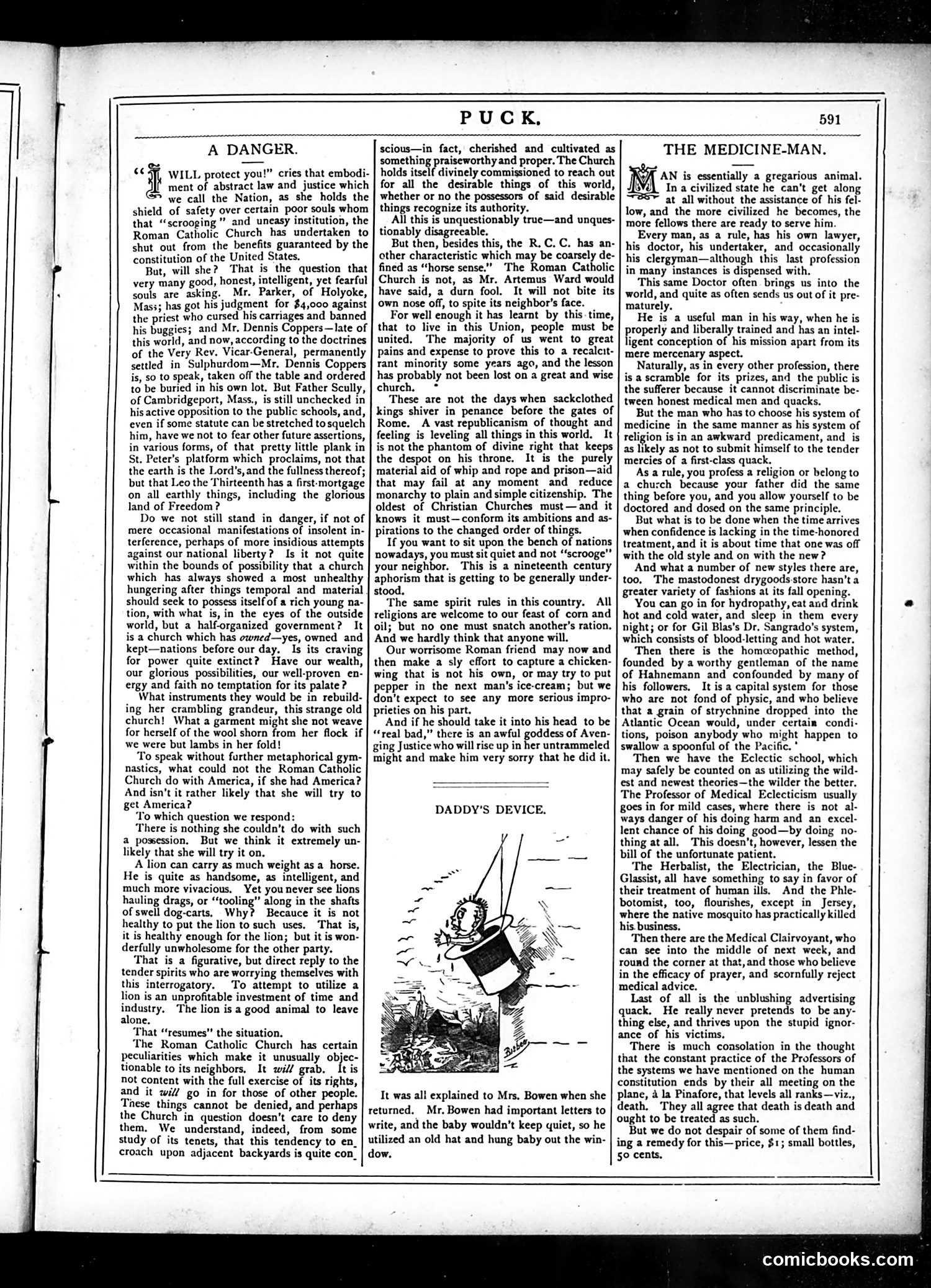
This cartoon satirizes parenting technology of its era. The illustration shows a contraption suspending a baby in what appears to be a mechanical harness or swinging device—labeled "Daddy's Device." The accompanying text explains that Mrs. Bowen returns home to find Mr. Bowen has rigged this apparatus to keep their fussy baby quiet while he tends to important letters. The satire mocks fathers who use labor-saving "gadgets" as substitutes for actual childcare. The broader article on this page critiques both Roman Catholicism and various medical quacks. The "Daddy's Device" segment targets lazy parenting and the era's growing faith in mechanical solutions to domestic problems—a common Puck theme ridiculing modern convenience culture.
📄 Transcribed text from this page (OCR, searchable)
Machine-transcribed from the original scan — historical spelling and the odd misread are preserved.
PUCK, 591 A DANGER. CATT WILL protect you!” cries that embodi- ment of abstract law and justice which we call the Nation, as she holds the shield of safety over certain poor souls whom that “scrooging ” and uneasy institution, the Roman Catholic Church has undertaken to shut out from the benefits guaranteed by the constitution of the United States, But, will she? That is the question that very many good, honest, intelligent, yet fearful Souls are asking. Mr. Parker, of Holyoke, Mass; has got his judgment for $4,000 against the priest who cursed his carriages and banned his buggies; and Mr. Dennis Coppers—late of this world, and now, according to the doctrines of the Very Rev. Vicar-General, permanently settled in Sulphurdom—Mr. Dennis Coppers is, so to speak, taken off the table and ordered to be buried in his own lot. But Father Scully, of Cambridgeport, Mass,, is still unchecked in his active opposition to the public schools, and, even if some statute can be stretched tosquelch him, have we not to fear other future assertions, in various forms, of that pretty little plank in St. Peter’s platform which proclaims, not that the earth is the Lord’s, and the fullness thereof; but that Leo the Thirteenth has a first-mortgage on all earthly things, including the glorious land of Freedom? Do we not still stand in danger, if not of mere occasional manifestations of insolent in- terference, perhaps of more insidious attempts against our national liberty? Is it not quite within the bounds of possibility that a church which has always showed a most unhealthy hungering after things temporal and material should seek to possess itself of a rich young na- tion, with what is, in the eyes of the outside world, but a half-organized government? It is a church which has owned—yes, owned and kept—nations before our day. Is its craving for power quite extinct? Have our wealth, our glorious possibilities, our well-proven_en- ergy and faith no temptation for its palate? What instruments they would be in rebuild- ing her crambling grandeur, this strange old church! What a garment might she not weave for herself of the wool shorn from her flock if we were but lambs in her fold! To speak without further metaphorical gym- nastics, what could not the Roman Catholic Church do with America, if she had America? And isn’t it rather likely that she will try to get America? which question we respond: There is nothing she couldn't do with such a possession, But we think it extremely un- likely that she will try it on. A lion can carry as much weight as a horse. He is quite as handsome, as intelligent, and much more vivacious, Yet you never see lions hauling drags, or “tooling” along in the shafts of swell dog-carts. Why? Becauce it is not healthy to put the lion to such uses. That is, it is healthy enough for the lion; but it is won- derfully unwholesome for the other party. That is a figurative, but direct reply to the tender spirits who are worrying themselves with this interrogatory. To attempt to utilize a lion is an unprofitable investment of time and industry, The lion is a good animal to leave alone. ‘That “resumes” the situation. The Roman Catholic Church has certain peculiarities which make it unusually objec- tionable to its neighbors. It wi// grab. It is not content with the full exercise of its rights, and it wi? go in for those of other people. These things cannot be denied, and perhaps the Church in question doesn't care to deny them. We understand, indeed, from some study of its tenets, that this tendency to en_ croach upon adjacent backyards is quite con. scious—in fact, cherished and cultivated as something Piabeworthy sad proper. The Church holds itself divinely commissioned to reach out for all the desirable things of this world, whether or no the possessors of said desirable things recognize its authority. All this is unquestionably truae—and unques- tionably disagreeable. But then, besides this, the R.C.C. has an- other characteristic which may be coarsely de- fined as ‘“‘horse sense.” The Roman Catholic Church is not, as Mr. Artemus Ward would have said, a durn fool. It will not bite its own nose off, to spite its neighbor's face. For well enough it has learnt by this. time, that to live in this Union, people must be united. The majority of us went to great pains and expense to prove this to a recalcit- rant minority some years ago, and the lesson has probably not been lost on a great and wise church, * These are not the days when sackclothed kings shiver in penance before the gates of Rome. A vast republicanism of thought and feeling is leveling all things in this world. It is not the phantom of divine right that keeps the despot on his throne. It is the purely material aid of whip and rope and prison—aid that may fail at any moment and reduce monarchy to plain and simple citizenship. The oldest of Christian Churches must—and it knows it must—conform its ambitions and as- pirations to the changed order of things. If you want to sit upon the bench of nations nowadays, you must sit quiet and not ‘“‘scrooge"’ your neighbor. This is a nineteenth century aphorism that is getting to be generally under- stood. The same spirit rules in this country. All religions are welcome to our feast of corn and oil; but no one must snatch another's ration, And we hardly think that anyone will. Our worrisome Roman friend may now and then make a sly effort to capture a chicken- wing that is not his own, or may try to put pepper in the next man’s ice-cream; but we don’t expect to see any more serious impro- prieties on his part. And if he should take it into his head to be “real bad,” there is an awful goddess of Aven- ging Justice who will rise up in her untrammeled might and make him very sorry that he did it, DADDY'S DEVICE. It was all explained to Mrs, Bowen when she returned. Mr. Bowen had important letters to write, and the baby wouldn’t keep quiet, so he utilized an old hat and hung baby out the win- dow. THE MEDICINE-MAN. AN is essentially a gregarious animal. In a civilized state he can’t get along at all without the assistance of his fel- low, and the more civilized he becomes, the more fellows there are ready to serve him. Every man, as a rule, has his own lawyer, his doctor, his undertaker, and occasionally his clergyman—although this last profession in many instances is dispensed with. This same Doctor often brings us into the world, and quite as often sends us out of it pre- maturely, He is a useful man in his way, when he is properly and liberally trained and has an intel- ligent conception of his mission apart from its mere mercenary aspect. Naturally, as in every other profession, there is a scramble for its prizes, and the public is the sufferer because it cannot discriminate be- tween honest medical men and quacks, But the man who has to choose his system of medicine in the same manner as his system of religion is in an awkward predicament, and is as likely as not to submit himself to the tender mercies of a first-class quack. As a rule, you profess a religion or belong to a church because your father did the same thing before you, and you allow yourself to be doctored and dosed on the same principle. But what is to be done when the time arrives when confidence is lacking in the time-honored treatment, and it is about time that one was off with the old style and on with the new? And what a number of new styles there are, too, The mastodonest drygoods-store hasn't a greater variety of fashions at its fall opening. You can go in for hydropathy, eat and drink hot and cold water, and sleep in them every night; or for Gil Blas’s Dr. Sangrado’s system, which consists of blood-letting and hot water. Then there is the homceopathic method, founded by a worthy gentleman of the name of Hahnemann and confounded by many of his followers, It is a capital system for those who are not fond of physic, and who believe that a grain of strychnine dropped into the Atlantic Ocean would, under certain condi- tions, poison anybody who might happen to swallow a spoonful of the Pacific. * Then we have the Eclectic school, which may safely be counted on as utilizing the wild- est and newest theories—the wilder the better. The Professor of Medical Eclecticism usually goes in for mild cases, where there is not al- ways danger of his doing harm and an excel- lent chance of his doing good—by doing no- thing at all. This doesn’t, however, lessen the bill of the unfortunate patient. The Herbalist, the Electrician, the Blue- Glassist, all have something to say in favor of their treatment of human ills. And the Phle- botomist, too, flourishes, except in Jersey, where the native mosquito has practically killed his business, Then there are the Medical Clairvoyant, who can see into the middle of next week, and round the corner at that, and those who believe in the efficacy of prayer, and scornfully reject medical advice. Last of all is the unblushing advertising quack. He really never pretends to be any- thing else, and thrives upon the stupid ignor- ance of his victims. There is much consolation in the thought that the constant practice of the Professors of the systems we have mentioned on the human constitution ends by their all meeting on the plane, a la Pinafore, that levels all ranks—viz., death. They all agree that death is death and ought to be treated as such. But we do not despair of some of them find- ing a remedy for this—price, $1; small bottles, 50 cents, comicbooks.com