
Puck, 1879-11-19 · page 4 of 18
Puck — November 19, 1879 — page 4: what you’re looking at
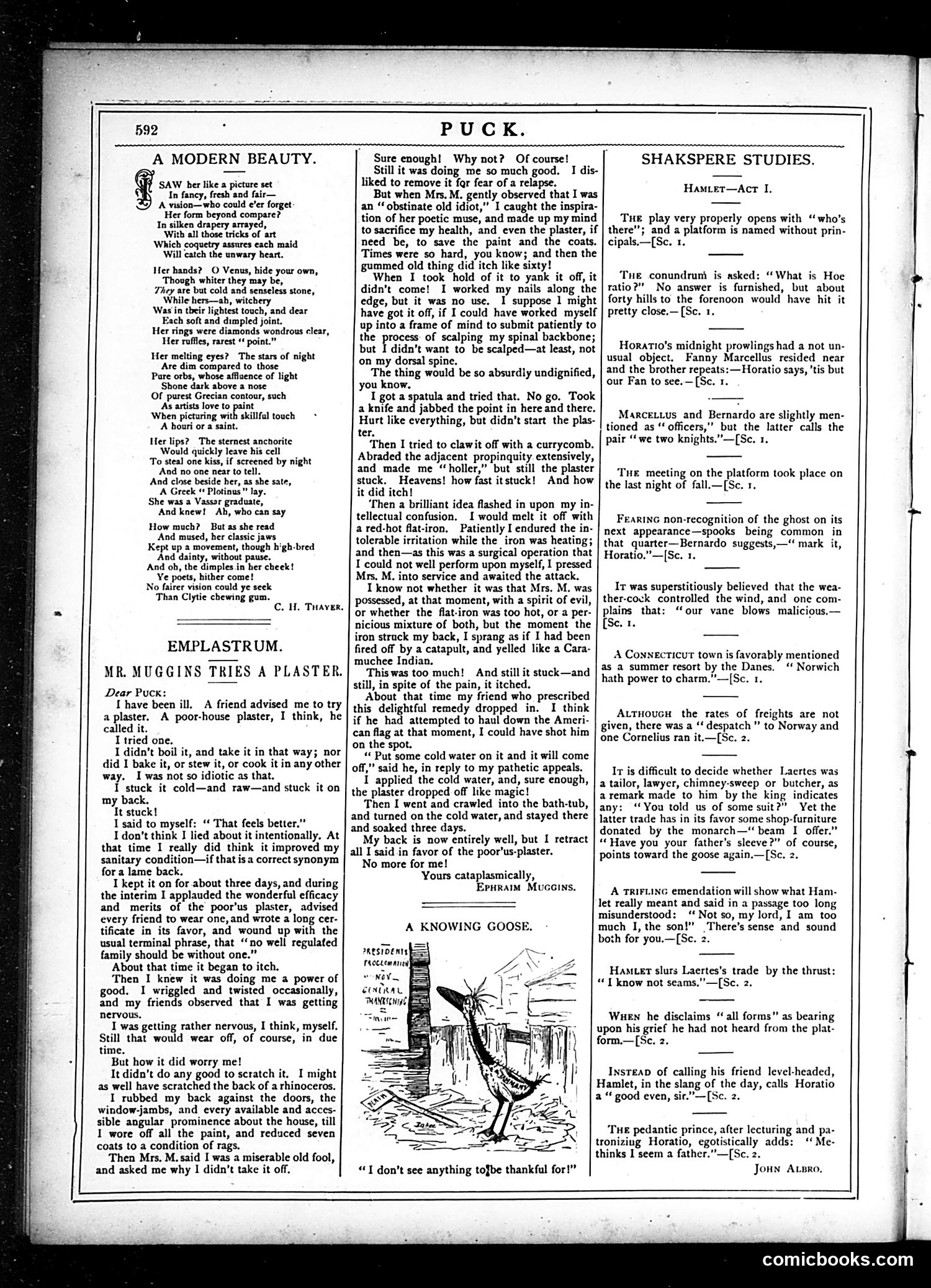
What you’re looking at
This page contains three distinct sections: 1. **"A Modern Beauty"** — A poem satirizing fashionable women, mocking their elaborate appearance and vanity ("picture set / In a golden frame"). 2. **"Emplastrum: Mr. Muggins Tries a Plaster"** — A humorous personal essay by Ephraim Muggins describing his attempt to use a medical plaster for back pain. The narrative focuses on domestic comedy: the plaster's ineffectiveness, his wife's skepticism, and the messy removal process. This appears to be satirical commentary on dubious patent medicines and health remedies popular in the era. 3. **"A Knowing Goose"** — A small illustrated comic showing a goose with caption "I don't see anything to be thankful for!" — likely satirizing complaints or ingratitude. The page also includes Shakespeare study notes unrelated to the satire. The content reflects Puck's typical mix of social satire and domestic humor.
📄 Transcribed text from this page (OCR, searchable)
Machine-transcribed from the original scan — historical spelling and the odd misread are preserved.
592 i PUCK. A MODERN BEAUTY. SAW her like a picture set In fancy, fresh and fair— A vision—who could e’er forget Her form beyond compare? In silken drapery arrayed, With all those tricks of art Which coquetry assures each maid Will catch the unwary heart. Her hands? Venus, hide your own, ‘Thoogh whiter they may be, They are but cold and senseless stone, While hers—ah, witchery in their lightest touch, and dear +h soft and dimpled joint. Her rings were diamonds wondrous clear, Her raffles, rarest “ point.” Her melting eyes? The stars of night ‘Are dim compared to those Pare orbs, whose affluence of light Shone dark above a nose Of purest Grecian contour, such As artists love to paint When picturing with skillful touch A houri or a saint. Her lips? The sternest anchorite Would quickly leave his cell To steal one kiss, if screened by night And no one near to tell. And close beside her, as she sate, A Greek * Plotinus” lay. She was a Vassar graduate, ‘And knew! Ab, who can say How much? Bat as she read ‘And mused, her classic jaws Kept up a movement, though h'gh-bred And dainty, without pause. And ob, the dimples in her cheek! Ye poets, hither come! No fairer vision could ye seek Than Clytie chewing gum. v C,H. Tuaver. EMPLASTRUM. MR. MUGGINS TRIES A PLASTER. Dear Puck: Thave been ill, A friend advised me to try a plaster. A poor-house plaster, I think, he called it. I tried one, I didn’t boil it, and take it in that way; nor did I bake it, or stew it, or cook it in any other way. I was not so idiotic as that. IT stuck it cold—and raw—and stuck it on my back, It stuck! I said to myself: ‘“ That feels better.” I don't think I lied about it intentionally. At that time I really did think it improved my sanitary condition—if that isa correct synonym for a lame back. I kept it on for about three days, and during the interim I applauded the wonderful efficacy and merits of the poor'us plaster, advised every friend to wear one, and wrote a tong cer- tificate in its favor, and wound up with the usual terminal phrase, that ‘no well regulated family should be without one.” About that time it began to itch. ‘Then I knew it was doing me a power of good. I wriggled and twisted occasionally, and my friends observed that I was getting nervous. I was getting rather nervous, I think, myself. Still that would wear off, of course, in due time. But how it did worry me! It didn’t do any good to scratch it. I might as well have scratched the back of a rhinoceros. I rubbed my back against the doors, the window-jambs, and every available and acces- Sure enough! Why not? Of course! Still it was doing me so much good. liked to remove it for fear of a relapse. But when Mrs. M. gently observed that I was an “obstinate old idiot,” I caught the inspira- tion of her poetic muse, and made up my mind to sacrifice my health, and even the plaster, if need be, to save the paint and the coats. Times were so hard, you know; and then the gummed old thing did itch like sixty! When I took hold of it to yank it off, it didn’t come! I worked my nails along the edge, but it was no use, I suppose 1 might have got it off, if I could have worked myself up into a frame of mind to submit patiently to the process of scalping my spinal backbone; but Paidn't want to be scalped—at least, not on my dorsal spine. The thing would be so absurdly undignified, you know. I got a spatula and tried that. No go. Took a knife and jabbed the point in here and there. Hurt like everything, but didn’t start the plas- ter, Then I tried to clawit off with a currycomb. Abraded the adjacent propinquity. extensively, and made me “holler,” but still the plaster stuck. Heavens! how fast it stuck! And how it did itch! ‘Then a brilliant idea flashed in upon my in- tellectual confusion. I would melt it off with a red-hot flat-iron. Patiently I endured the in- tolerable irritation while the iron was heating; and then—as this was a surgical operation that I could not well perform upon myself, I pressed Mrs. M. into service and awaited the attack. I know not whether it was that Mrs. M. was ossessed, at that moment, with a spirit of evil, or whether the flat-iron was too hot, or a per- nicious mixture of both, but the moment the iron struck my back, I sprang as if I had been fired off by a catapult, and yelled like a Cara- muchee Indian. This was too much! And still it stuck—and still, in spite of the pain, it itched. About that time my friend who prescribed this delightful remedy dropped in. I think if he had attempted to haul down the Ameri- can flag at that moment, I could have shot him on the spot. “« Put some cold water on it and it will come off,” said he, in reply to my pathetic appeals. I applied the cold water, and, sure enough, the plaster dropped off like magic! Then I went and crawled into the bath-tub, and turned on the cold water, and stayed there and soaked three days. My back is now entirely well, but I retract all I said in favor of the poor'us-plaster. No more for me! Yours cataplasmically, Epxraim Mucoins, 1 dis- A KNOWING GOOSE. sible angular prominence about the house, till I wore off all the paint, and reduced seven coats to a condition of rags. Then Mrs. M. said I was a miserable old fool, and asked me why | didn’t take it off. SHAKSPERE STUDIES. Hamiet—Act I. Tue play very properly opens with “who's there”; and a platform is named without prin- cipals.—[Sc. 1. Tue conundruni is asked: “What is Hoe ratio?” No answer is furnished, but about forty hills to the forenoon would have hit it pretty close.—([Sc. 1. Horatio’s midnight prowlings had a not un- usual object. Fanny Marcellus resided near and the brother repeats: —Horatio says, 'tis but our Fan to see.—[Sc. 1. Marcettus and Bernardo are slightly men- tioned as “ officers,” but the latter calls the pair “we two knights.”—[Sc. 1. Tue meeting on the platform took place on the last night of fall.—[Sc. 1. FeariNG non-recognition of the ghost on its next appearance—spooks being common in that quarter—Bernardo suggests,—‘ mark it, Horatio.”—[Sc. 1. Ir was superstitiously believed that the wea- ther-cock controlled the wind, and one com- plains that: “our vane blows malicious,— Se. 1. A Connecticut town is favorably mentioned as a summer resort by the Danes. ‘ Norwich hath power to charm.”—[Sc. 1. ALTHOUGH the rates of freights are not given, there was a ‘‘ despatch " to Norway and one Cornelius ran it.—[Sc. 2. Ir is difficult to decide whether Laertes was a tailor, lawyer, chimney-sweep or butcher, as aremark made to him by the king indicates any: ‘You told us of some suit?” Yet the latter trade has in its favor some shop-furniture donated by the monarch—“ beam I offer.” “Have you your father's sleeve?” of course, points toward the goose again.—[Sc. 2. A TRIFLING emendation will show what Ham- let really meant and said in a passage too long misunderstood: ‘‘ Not so, my lord, I am too much I, the son!” There’s sense and sound both for you.—[Sc. 2. Ham er slurs Laertes's trade by the thrust: “I know not seams.""—[Sc. 2. Wuen he disclaims “all forms” as bearing upon his grief he had not heard from the plat- form.—[Sc. 2. Insteap of calling his friend level-headed, Hamlet, in the slang of the day, calls Horatio a “ good even, sir.”—[Sc. 2. ‘Tue pedantic prince, after lecturing and pa- tronizing Horatio, egotistically adds: ‘‘ Me- thinks I seem a father.”—[Sc. 2. Joun Atpro. | comicbooks.com