
A complete issue · 18 pages · 1879
Puck — October 29, 1879
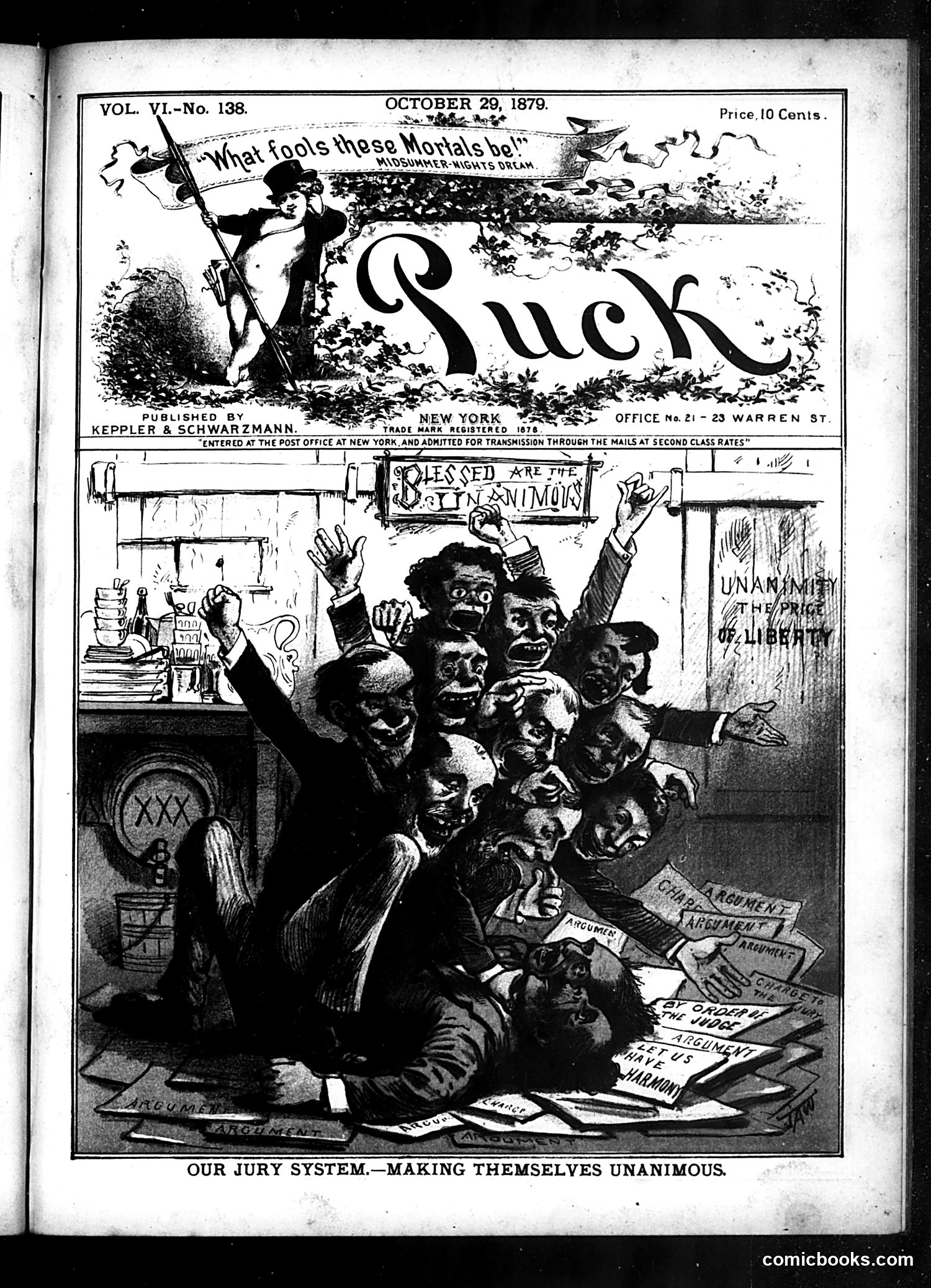
This cartoon satirizes the American jury system. The title "Our Jury System—Making Themselves Unanimous" shows a group of caricatured jurors in a tavern labeled "Blessed Are The Unanimous," surrounded by bottles and papers labeled "Argument." The figures appear intoxicated and celebratory, with raised arms and exaggerated expressions. The satire critiques how jurors reportedly reached unanimous verdicts through drinking and socializing rather than careful deliberation of evidence. The scattered papers labeled "Argument" suggest substantive legal reasoning was abandoned. The tavern setting implies jurors prioritized consensus and alcohol over justice. This reflects contemporary concerns about jury competence and the reliability of verdict unanimity requirements in the American legal system.
This page contains a political article titled **"The 'Independent Voter' as a Factor in Politics"** rather than a cartoon. The piece argues that independent voters—those refusing party allegiance—represent authentic American citizenship and moral authority. The article criticizes party loyalty, suggesting voters should evaluate candidates individually rather than follow party leaders blindly. It references a specific election context involving candidates named **Kelly, Robinson, and Cornell**, advocating that independent voters could decisively influence outcomes. The satire targets partisan machine politics and voter manipulation, promoting the radical (for the 1880s-1890s era) idea that voters should think critically rather than accept party dictates. The tone suggests this independent voter movement posed a genuine political threat to established party structures.
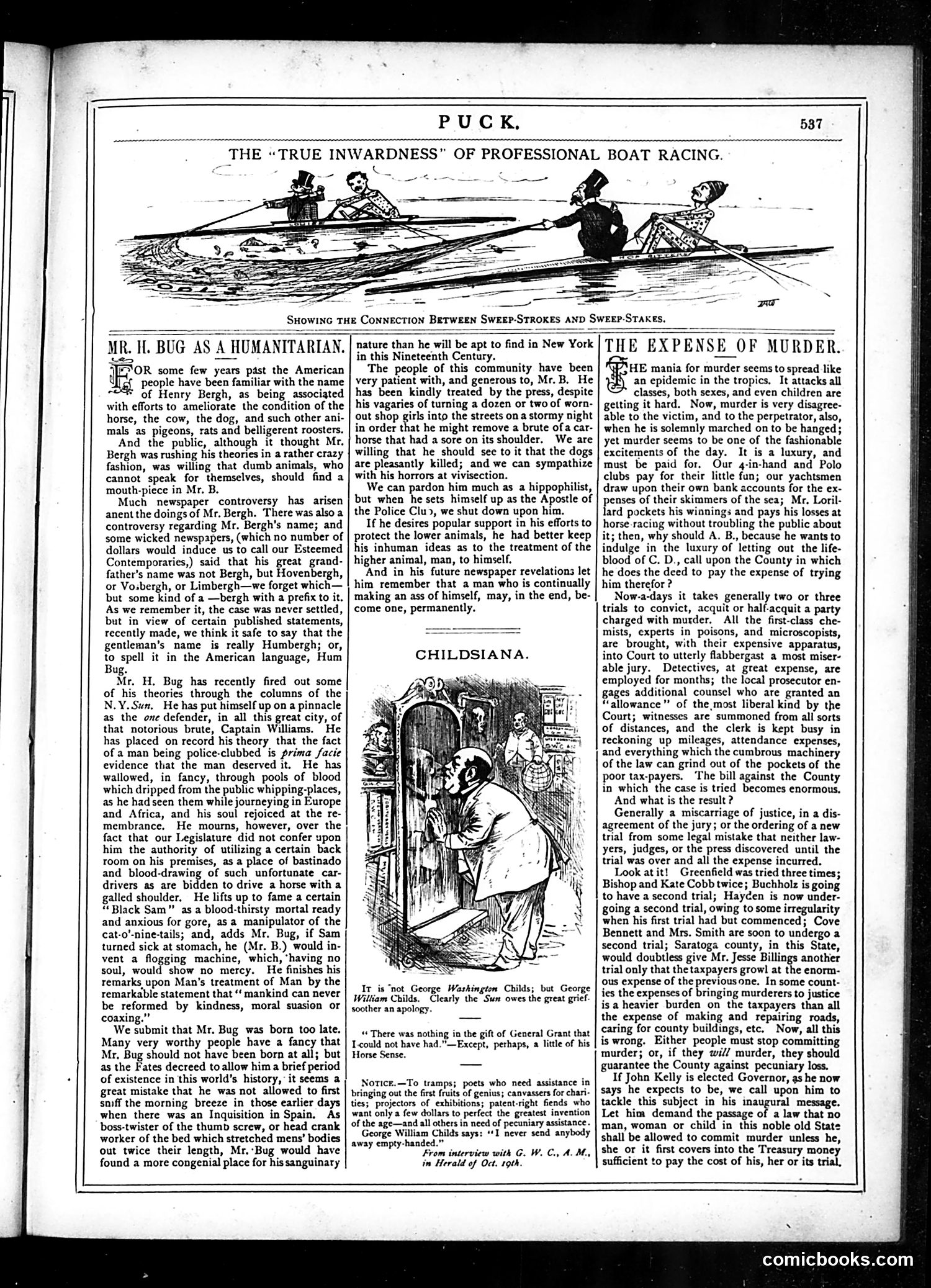
**Main Cartoon**: "The True Inwardness of Professional Boat Racing" depicts two racing shells with oarsmen. The caption "Showing the Connection Between Sweep-Strokes and Sweep Stakes" is a pun: "sweep-strokes" (rowing technique) versus "sweep stakes" (gambling). This satirizes the corruption in professional boat racing—suggesting races were fixed for betting purposes rather than won fairly through athletic skill. **Left Article**: "Mr. H. Bug as a Humanitarian" mocks Henry Bergh, founder of the ASPCA, for his animal welfare advocacy. The satire suggests his crusades against animal cruelty were hypocritical or self-aggrandizing. **Right Article**: "The Expense of Murder" criticizes the enormous public cost of murder trials, with extensive expert witnesses and court proceedings straining taxpayers while delivering questionable justice.
This page contains no political cartoons. Instead, it features several humorous prose pieces typical of Puck's satirical content: **"Chinese Grip"** is a poem mocking superstition and implausible folk remedies. **"Not True"** is a letter from D.O. Gratias debunking Brooklyn rumors that a man named Tatnall had artificial joints surgically installed—presented as absurd gossip the writer felt compelled to refute. **"Reflections of a Lounger"** contains brief social commentary, including critiques of babies and child-rearing practices, written with sardonic humor typical of the era's gentleman-magazine style. The page demonstrates Puck's use of written satire alongside visual cartoons to mock contemporary society, superstition, and urban gossip culture of 1870s America.
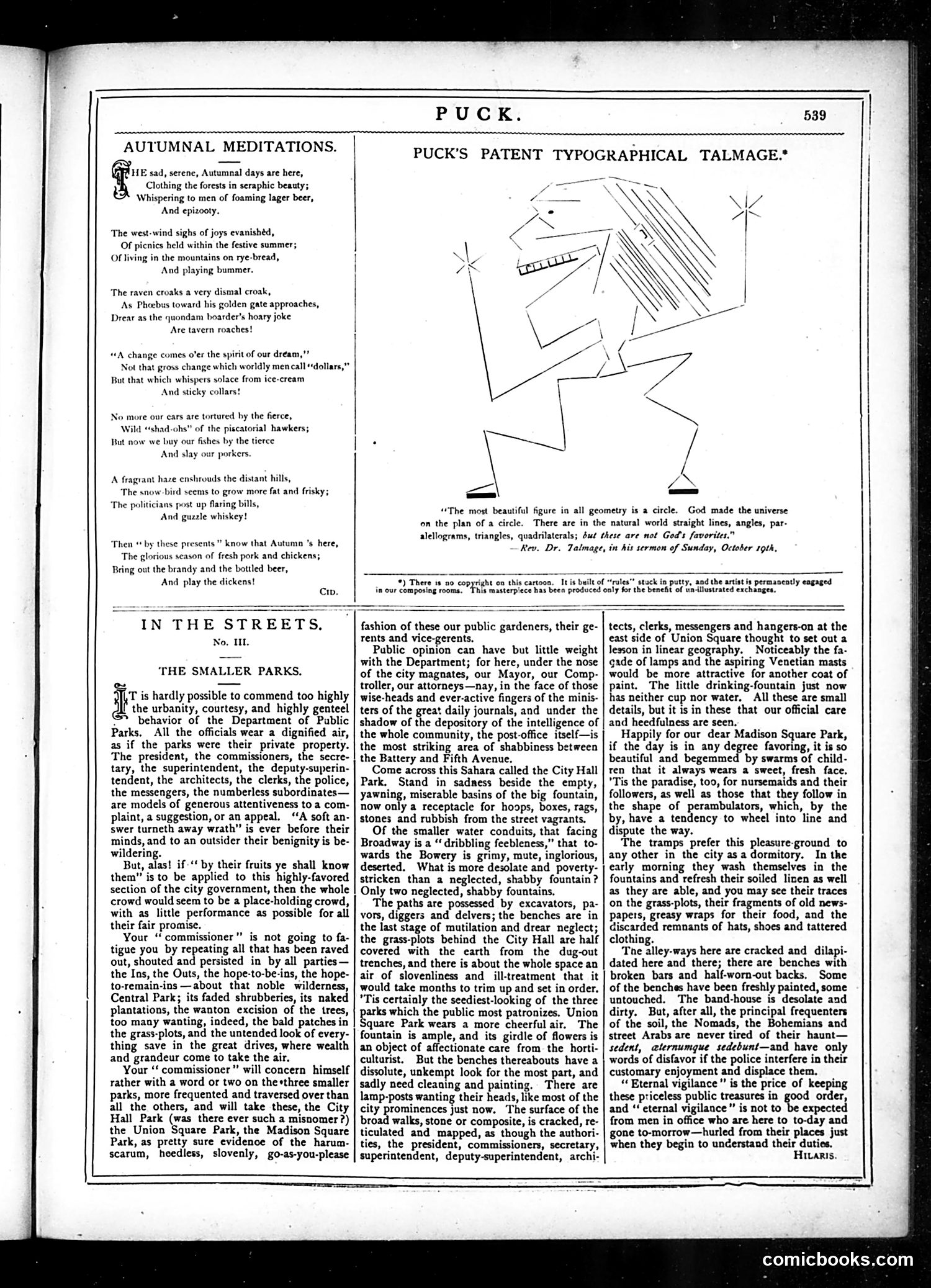
This page contains two distinct sections: **"Autumnal Meditations"** (left): A poem celebrating autumn's arrival, with nostalgic imagery of seasonal pleasures—picnics, mountain living, beer, and outdoor activities. **"Puck's Patent Typographical Talmage"** (right): A crude geometric cartoon mocking sermon composition or religious rhetoric. The caption quotes Rev. Dr. Talmage's Sunday sermon about circles representing God's perfect geometry. The cartoon appears to satirize formulaic preaching—reducing complex theological argument to simple shapes and lines, suggesting Talmage's sermons were overly simplistic or mechanically constructed. The remaining text discusses Madison Square Park improvements and urban infrastructure complaints. The satire targets what Puck viewed as pretentious or hollow religious oratory of the era.
This page contains **no political cartoon or satire**. Instead, it's a serialized fictional story titled "Rutherfoord the Good: A Tale of the Middle Ages," beginning Chapter I. The text describes a medieval narrative involving a character named Rutherfoord, his wife the Margravine, and courtly life at Castle de Blanc. It includes dialogue about feasts, servants, and aristocratic disputes—standard adventure fiction of the period. This appears to be **regular literary content** from Puck magazine, not satirical commentary. The "tale of the middle ages" framing is literal fiction rather than political allegory. Without additional context or visual illustrations on this particular page, there is no discernible satire or political meaning to explain to modern readers.
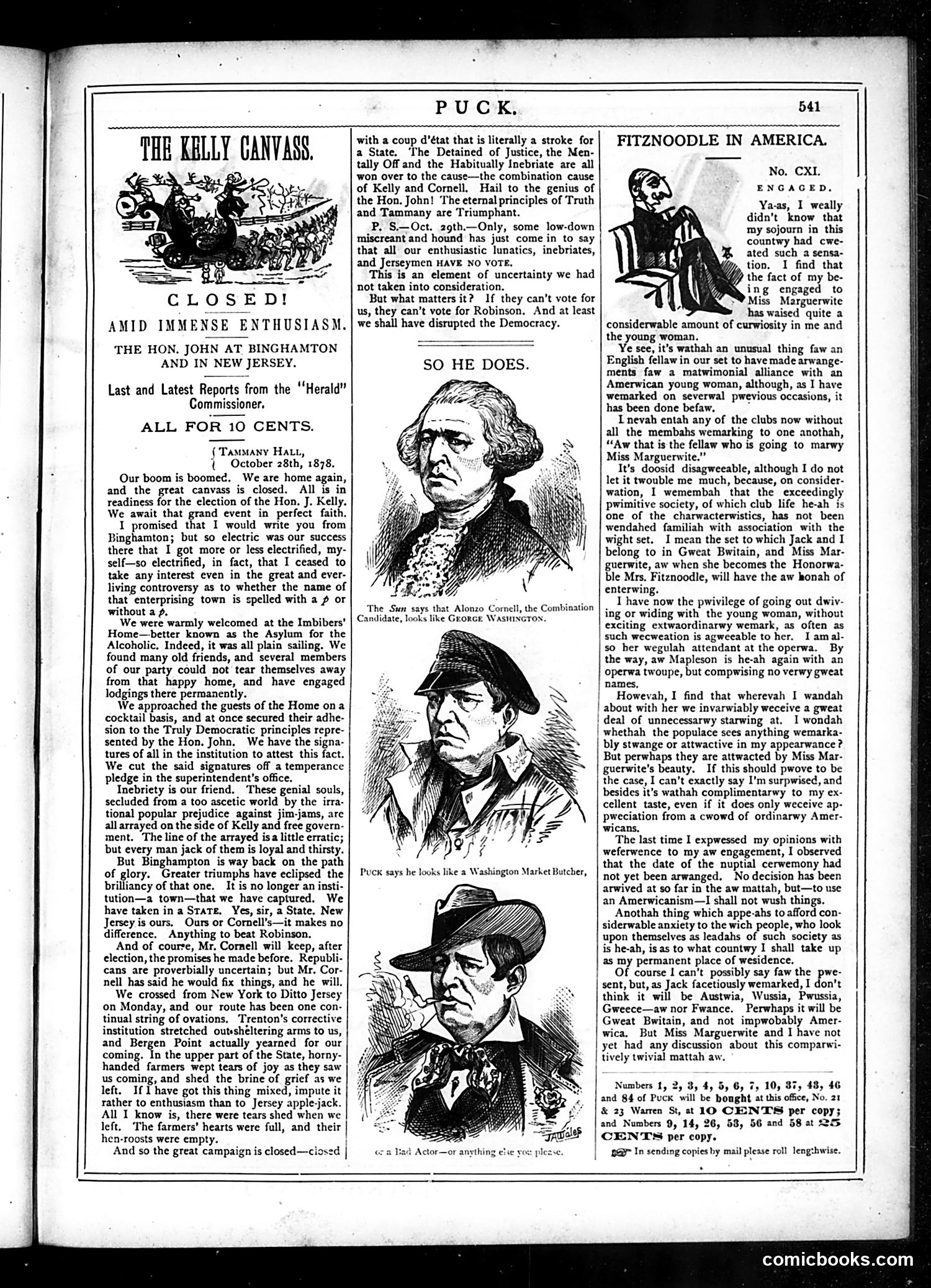
This page contains political commentary rather than a traditional cartoon. "The Kelly Canvass" discusses John Kelly at Binghamton and New Jersey, celebrating Democratic electoral success. The text describes enthusiasm from supporters and mentions Kelly's position as a "Combination Candidate," comparing him to George Washington. On the right, "Fitznoodle in America" features portrait sketches (likely politicians or public figures, though specific identities aren't clearly labeled in the visible text) discussing social engagements and opera attendance. The commentary appears satirical regarding American society and class pretensions. The overall piece seems to mock political ambitions and social climbing among American elites in this 1878 issue, using exaggerated character sketches to highlight perceived absurdities.
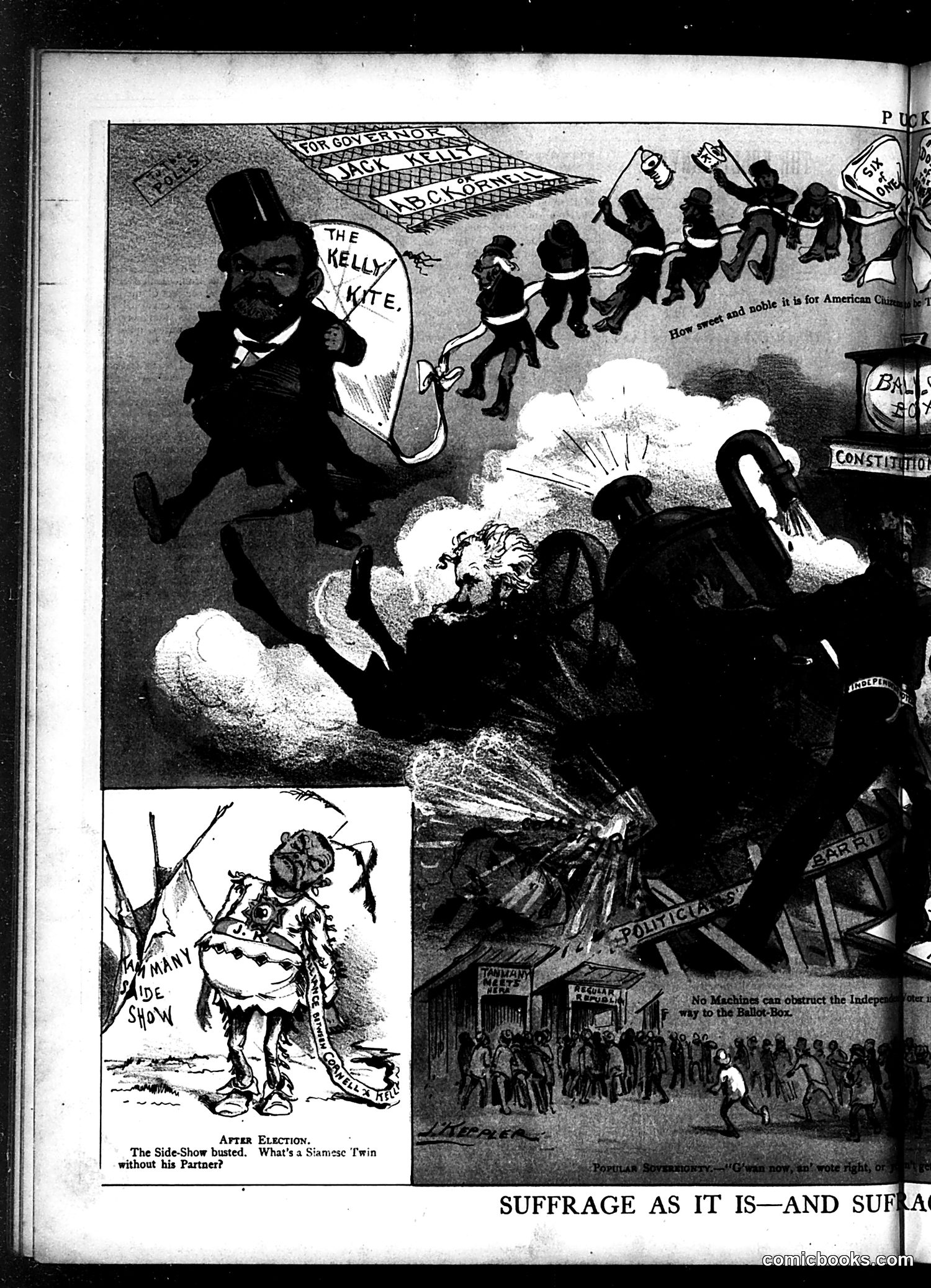
This page satirizes American electoral politics and the suffrage movement. The main cartoon depicts "The Kelly Kite"—a figure in formal dress manipulating a string of smaller figures, likely representing political corruption or machine politics controlling voters. Below, a smaller panel labeled "After Election" shows a disheveled character labeled "The Side-Show," commenting that "What's a Siamese Twin without his Partner?"—suggesting political alliances fracturing post-election. The page's title references "Suffrage as it is—and suffrag[e as it should be]" (text cut off), indicating commentary on women's voting rights. The bottom scene depicts crowds at what appears to be a polling location, addressing voting access and political participation during the Progressive Era suffrage debates.
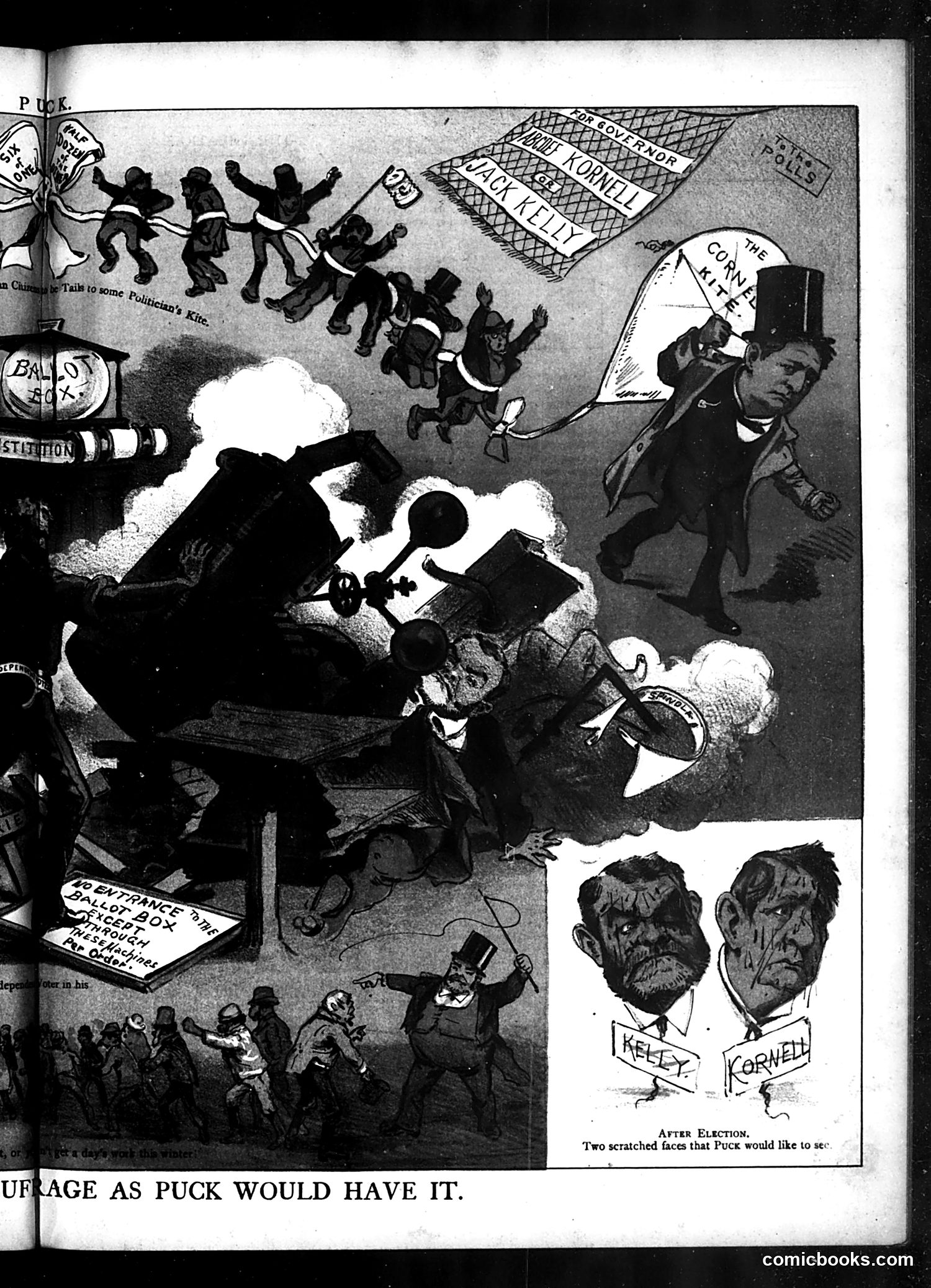
This satirical cartoon depicts anti-suffrage sentiment, imagining a dystopian future if women gained voting rights. The central figure appears to be a portly politician lounging while women (shown as silhouettes) actively campaign and conduct political business around him—inverting traditional gender roles to comic effect. The bottom panel labeled "After Election" shows two grotesque male faces labeled "KELLY" and "KORNELL" (likely political figures), representing "two scratched faces that Puck would like to see"—suggesting these politicians would be defeated under female suffrage. The overall message mocks women's political involvement as chaotic and emasculating, a common anti-suffrage trope from the early 20th century. Puck uses exaggeration and ridicule to argue against women's voting rights, though modern readers would recognize this as sexist propaganda rather than humor.
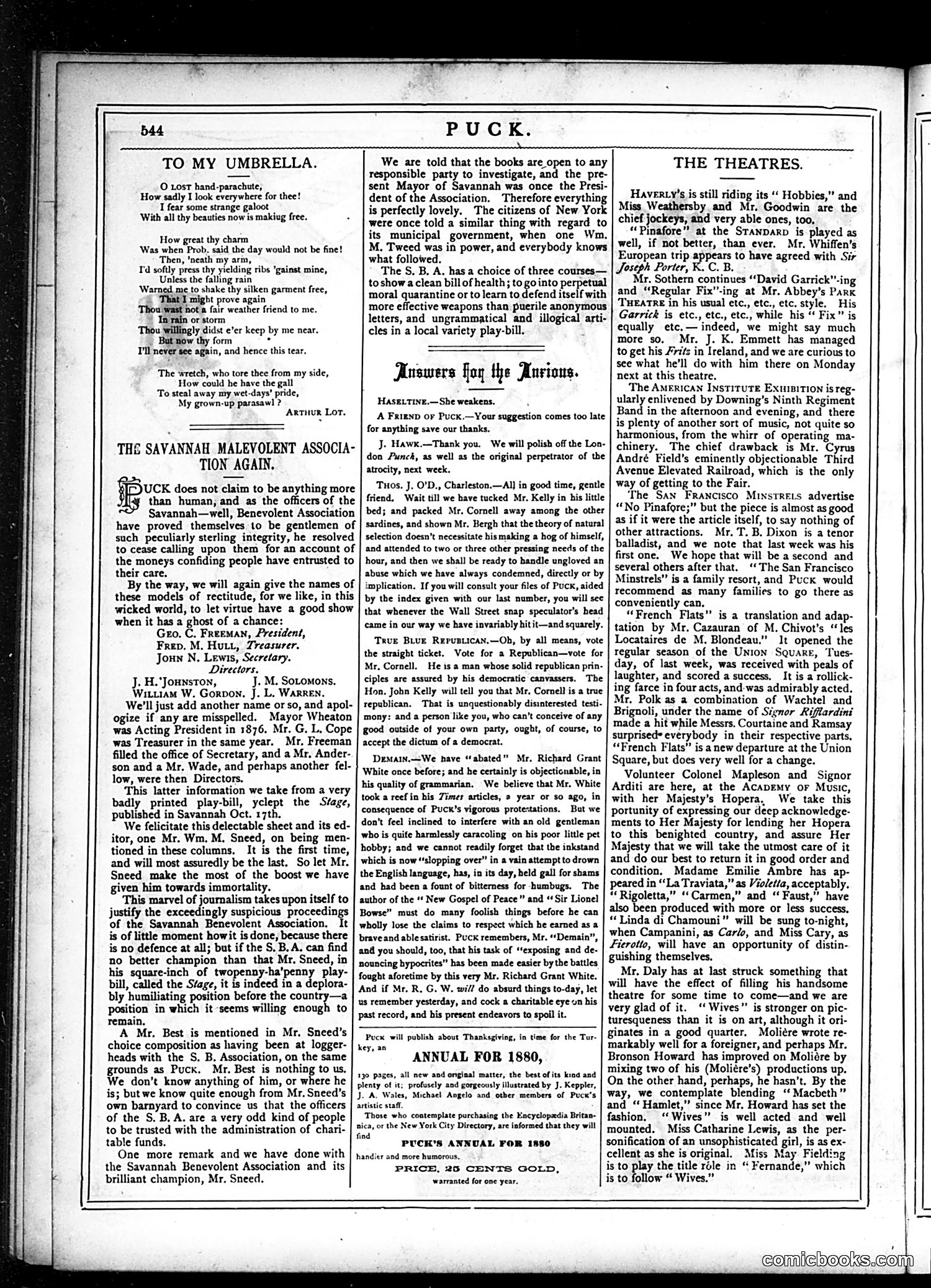
This page contains three main sections: a poem "To My Umbrella," an article about the Savannah Benevolent Association, and theater reviews titled "The Theatres." The content is primarily **textual rather than visual satire**. The article about the Savannah association appears to be satirizing the organization's integrity and practices, with the editors (particularly Fred. M. Hull, Treasurer, and John H. Lewis, Secretary) defending against accusations of mismanagement. The theatrical reviews discuss current productions at various New York theaters, including performances of "Pinafore" and other works. Without clearer visual caricatures visible in the image provided, the specific satirical targets and their identities cannot be definitively determined. The page appears to emphasize **written satire and commentary** over illustrated cartoons typical of Puck's format.
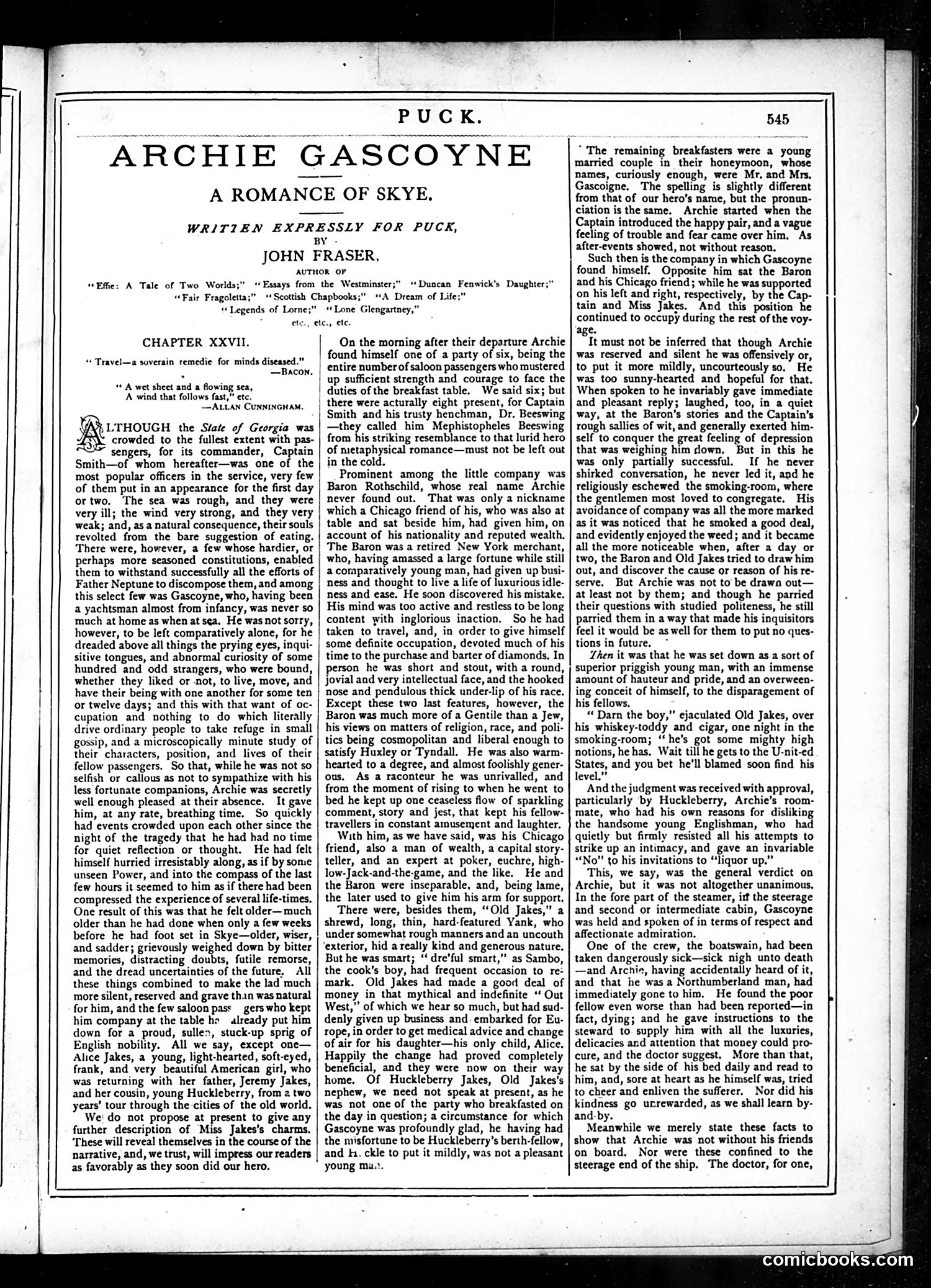
This page from *Puck* magazine contains no political cartoon or satirical illustration. Instead, it presents **Chapter XXVII of a serialized romance story titled "Archie Gascoyne: A Romance of Skye"** by John Fraser. The content is a conventional Victorian-era narrative about a gentleman character named Archie and his travels aboard a steamship. The text describes his companions, including a Baron Rothschild character and various passengers, along with social interactions and personality sketches. This is simply **fiction content**—part of *Puck*'s regular literary offerings alongside its famous political satire. No cartoon or satirical commentary appears on this particular page.
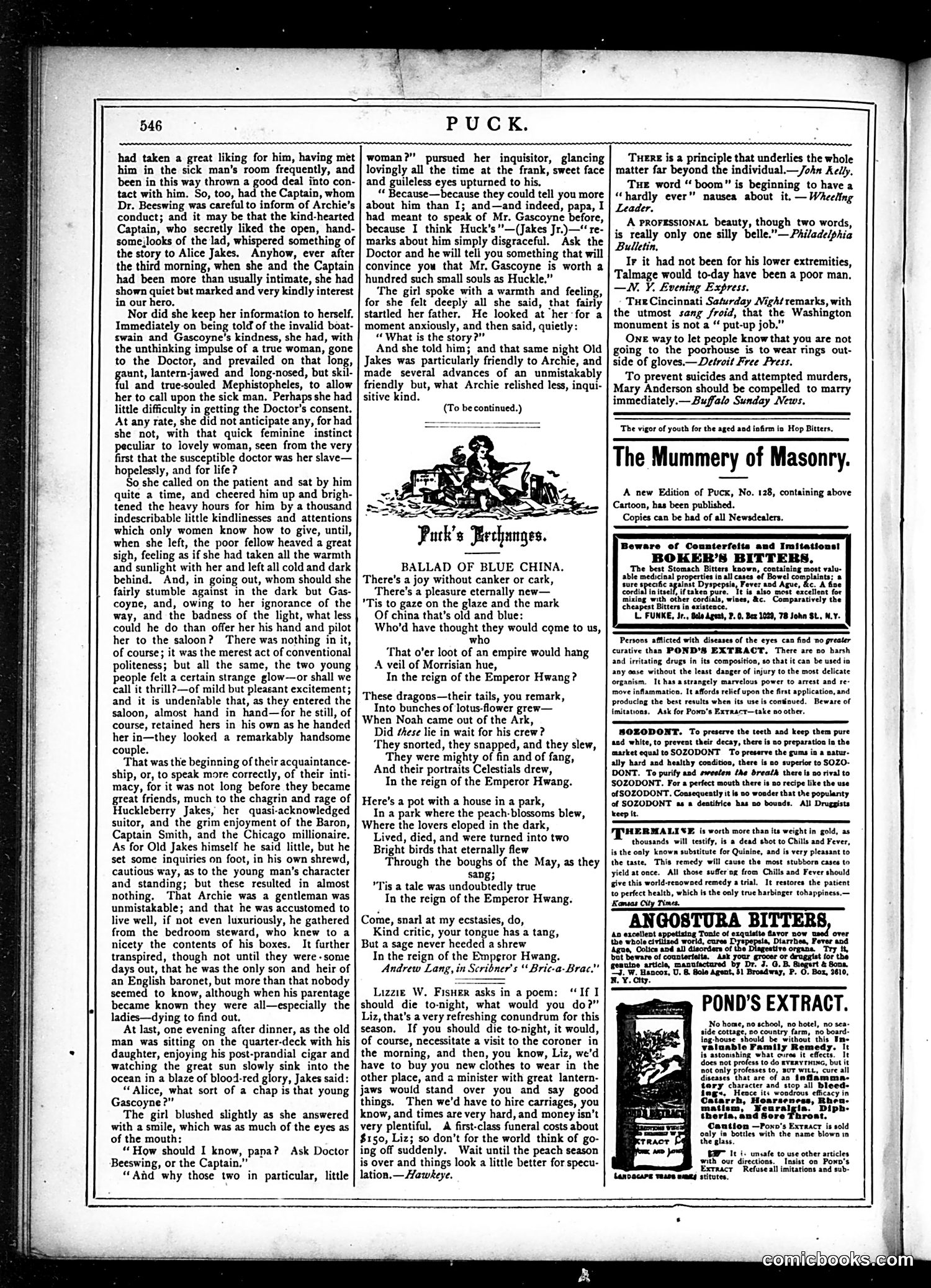
This page is primarily **text and advertising** rather than political satire. The main content is a serialized story ("To be continued") about a doctor and romantic entanglement, typical of Puck's narrative fiction. The small illustration labeled **"Puck's Exchanges"** appears to be a decorative vignette rather than political commentary. Below that is a **"Ballad of Blue China,"** a poem about imperial China and romantic longing—likely humorous verse rather than satire. The right column contains **product advertisements**, including "The Mummery of Masonry" (a book), bitters (patent medicine), and **Pond's Extract** (a popular 19th-century remedy). This page demonstrates that Puck balanced satirical cartoons with literary content and advertising to fill its pages and generate revenue.
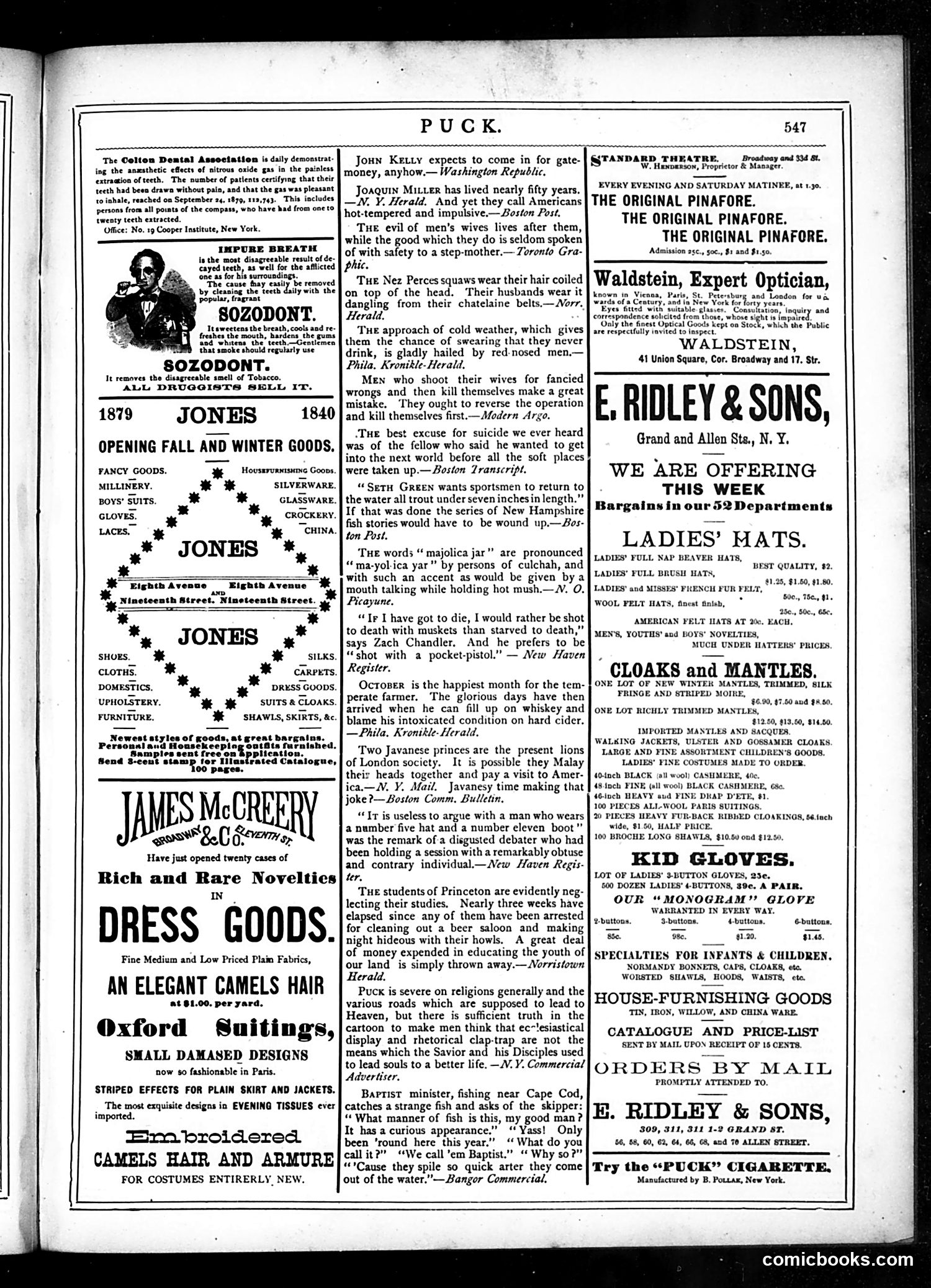
This page is primarily **advertising and commercial content** rather than political satire. The dominant features are large advertisements for department stores (E. Ridley & Sons, James McCreery & Co.), opticians (Waldstein), and clothing retailers (Jones), promoting fall/winter goods like dress fabrics, hats, gloves, and household items. The only editorial cartoon visible is a small illustration labeled "SOZODONT" (a toothpaste advertisement) featuring a caricatured face, likely mocking dental hygiene or promoting the product through humor—typical 19th-century advertising practice. The scattered text fragments appear to be satirical commentary on contemporary society (wives, weather, Princeton students), but lack sufficient context for clear political interpretation without the full articles.
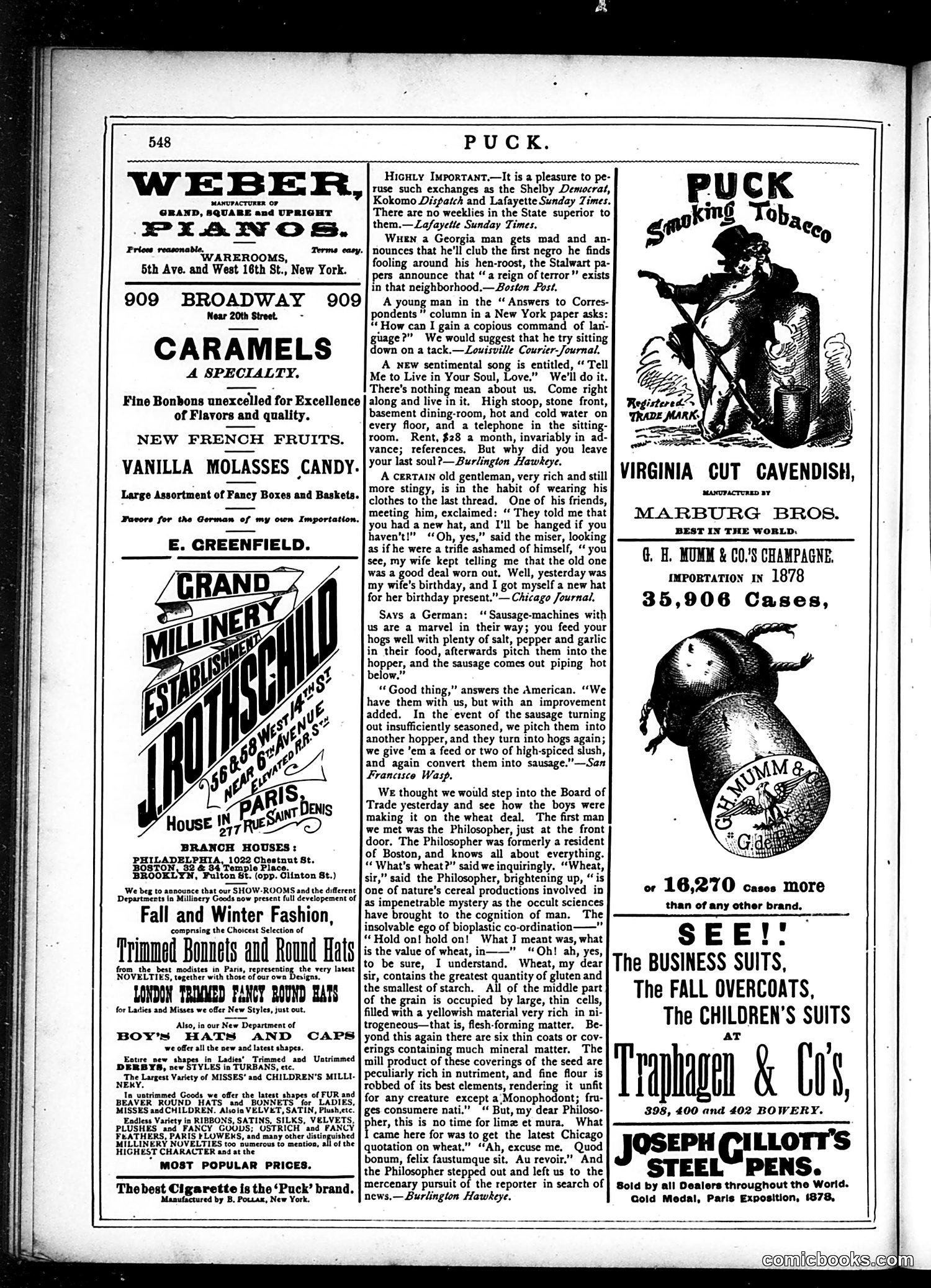
This page is predominantly **advertising** rather than political satire. The content includes commercial notices for pianos (Weber), candy (E. Greenfield), millinery fashions (Grand Establishment in Paris), tobacco products (Puck Smoking Tobacco, Virginia Cut Cavendish by Marburg Bros.), champagne (G.H. Mumm), and clothing (Etaborough & Co.). The right side features the **Puck Smoking Tobacco mascot**—a jovial figure—which was the magazine's recurring branding element. The center contains miscellaneous humor pieces and anecdotes rather than coherent political cartoons. This appears to be a typical Puck issue from approximately 1878 (based on the Paris Exposition 1878 reference), mixing satirical editorial content with substantial paid advertising that funded the publication.
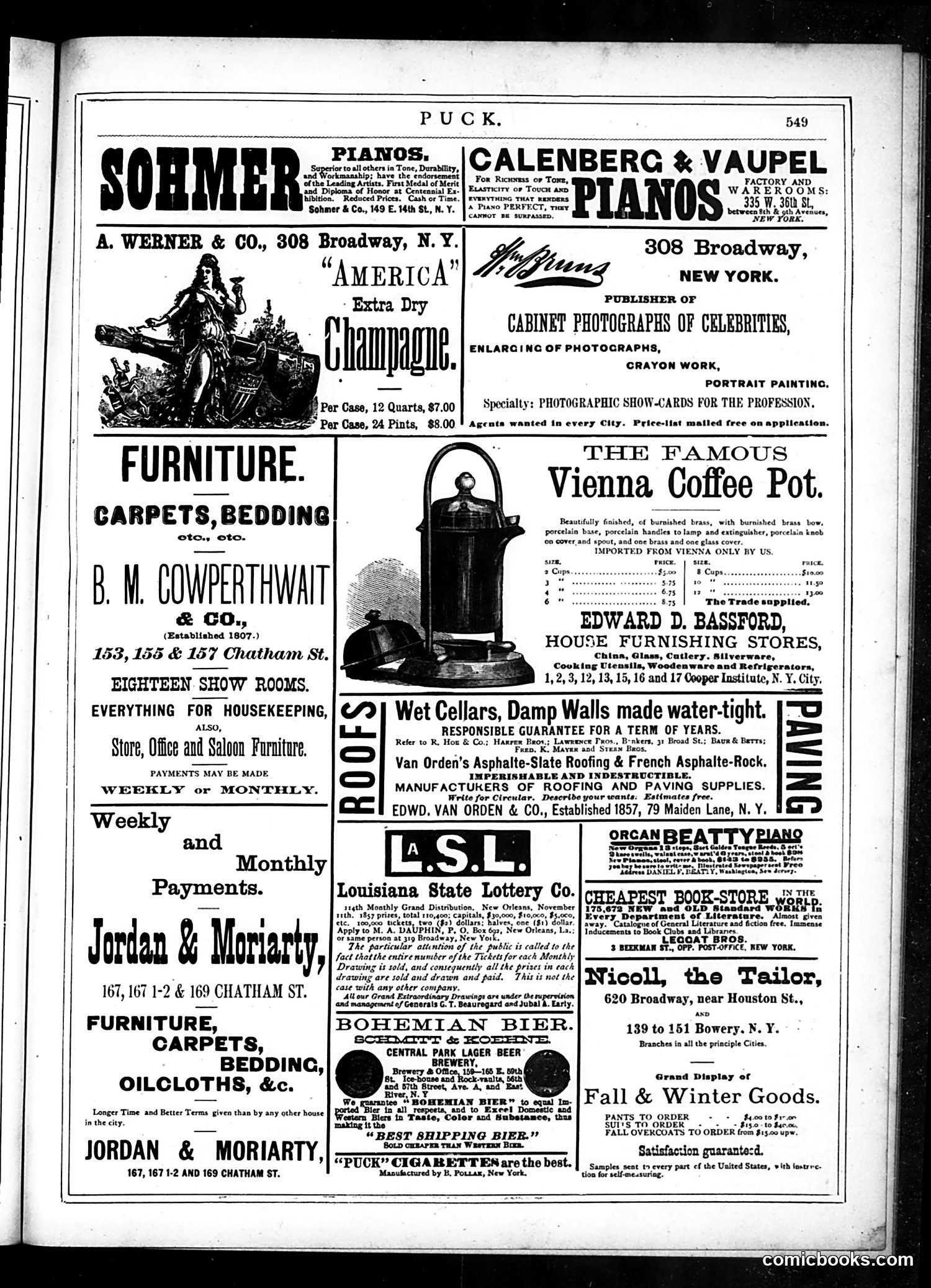
This page is primarily **advertising, not editorial content**. It features numerous commercial advertisements from late 19th-century New York businesses, including: - Piano makers (Sohmer, Calenberg & Vaupel) - Furniture and carpet dealers (B.M. Cowperthwait, Jordan & Moriarty) - A Vienna coffee pot distributor - Roofing suppliers - The Louisiana State Lottery - Bohemian beer brewery - Various other goods and services The only potentially satirical element is the Louisiana State Lottery ad, which Puck may have been mocking as a scam, though this isn't explicitly clear from the text alone. The page number (549) and "PUCK" masthead confirm this is from the magazine, but this particular issue appears dedicated almost entirely to paid advertising rather than satirical cartoons or political commentary.
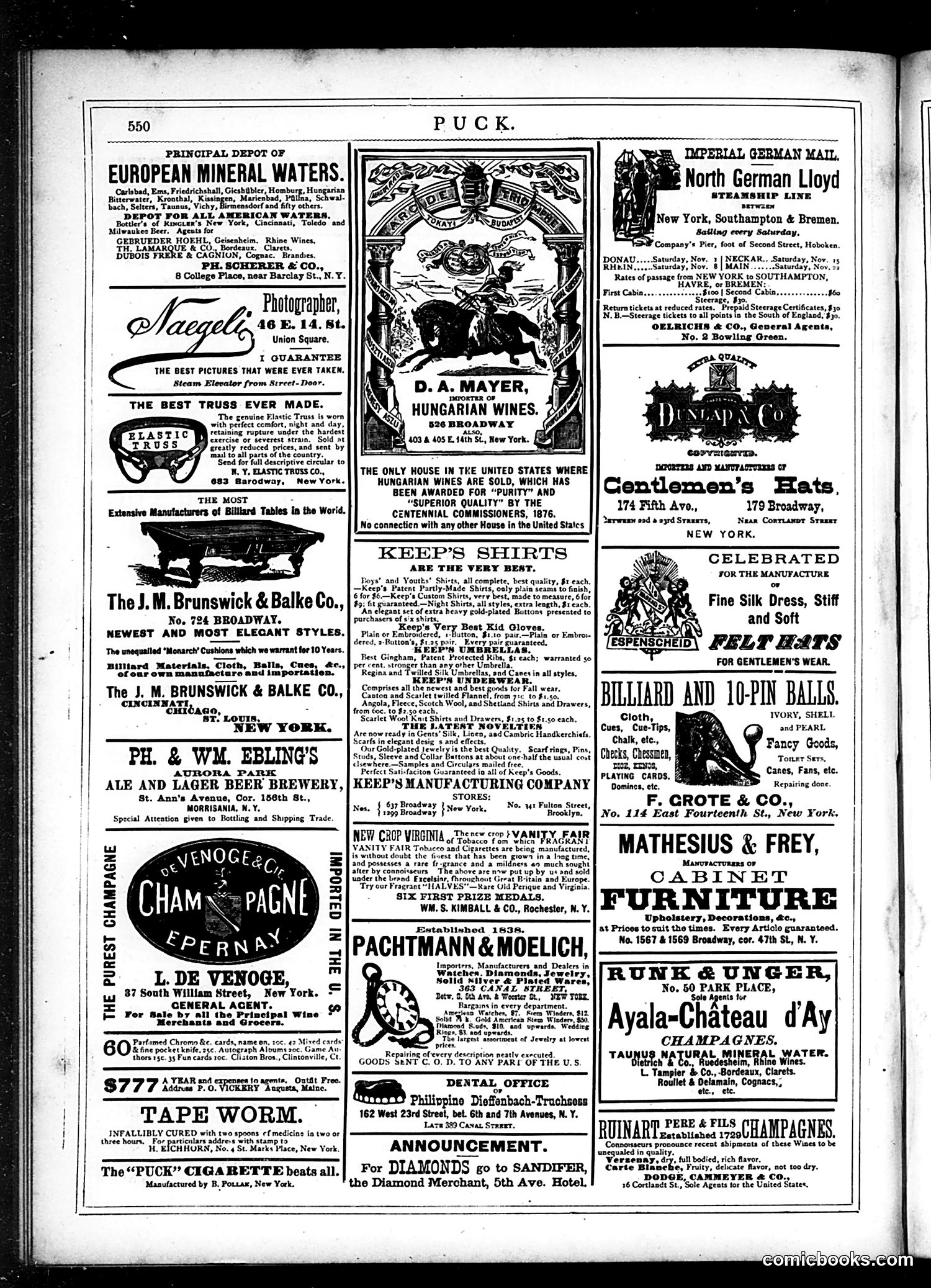
This is primarily an **advertising page** from Puck magazine (page 550), containing commercial advertisements rather than political satire or comics. The ads promote various products and services typical of the late 19th century: European mineral waters, photographer services, billiard tables, beer breweries, clothing (truss devices, shirts, hats), furniture, champagnes, and jewelry. The central decorative element is a coat-of-arms or emblem for "D.A. Mayer, Importer of Hungarian Wines" at 326 Broadway, New York. There is no discernible political cartoon or satirical content visible on this page—it functions purely as a revenue-generating advertising section, which was common in Puck and similar magazines of this era.
This page is **predominantly advertising** for late 19th-century retailers (Arnold, Constable & Co.; H. O'Neill & Co.; Hamann & Koch), featuring women's hosiery, underwear, hats, and imported costumes. The only substantive editorial content is a brief anecdote titled "NOT EXACTLY HIS LINE" about a circus performer named Chiarini who encounters a young man from Carson wanting circus employment. The narrative humorously depicts the young man's misunderstandings about circus work—confusing animal training duties with absurd interpretations. It's a lighthearted human-interest story rather than political satire. The page also includes a brief note about Edward IV drama selection and a barber-shop anecdote, both minor filler pieces. No significant political cartoons or satirical commentary appear on this page.
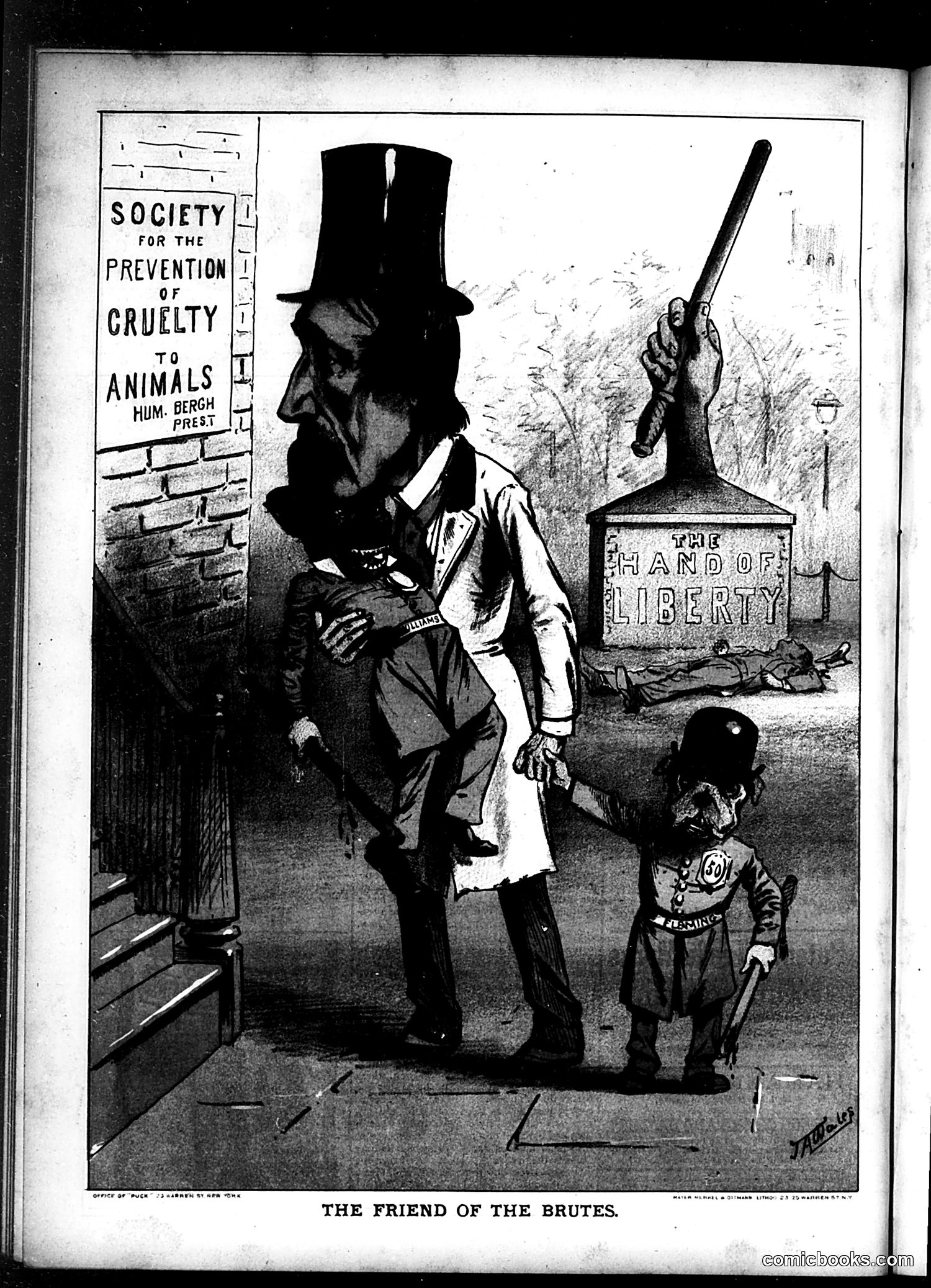
This Puck cartoon satirizes a military or political figure (caricatured with an exaggerated nose and top hat) as a hypocrite. The sign on the left references the "Society for the Prevention of Cruelty to Animals" with "Hum. Bergh Priest," likely alluding to Henry Bergh, founder of the ASPCA. The figure holds a torch labeled "Hand of Liberty" while standing beside a small child soldier in military uniform. The satire's point: this person claims to care about preventing cruelty (to animals) yet supports or enables the brutal treatment of children through militarism or war. The caption "The Friend of the Brutes" is ironic—suggesting someone who befriends animals while disregarding human suffering, particularly children's welfare.