
Puck, 1879-10-29 · page 10 of 18
Puck — October 29, 1879 — page 10: what you’re looking at
What you’re looking at
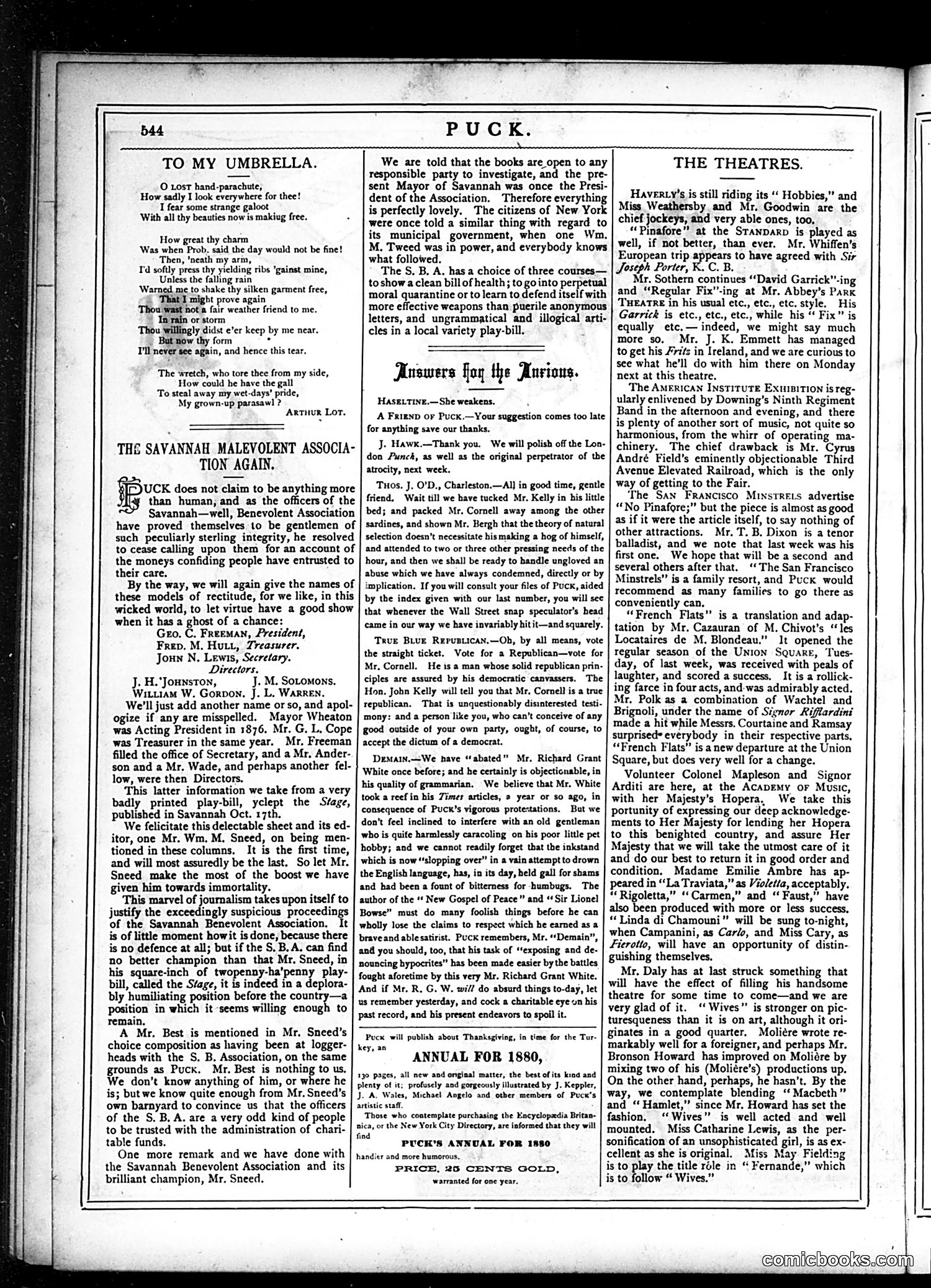
This page contains three main sections: a poem "To My Umbrella," an article about the Savannah Benevolent Association, and theater reviews titled "The Theatres." The content is primarily **textual rather than visual satire**. The article about the Savannah association appears to be satirizing the organization's integrity and practices, with the editors (particularly Fred. M. Hull, Treasurer, and John H. Lewis, Secretary) defending against accusations of mismanagement. The theatrical reviews discuss current productions at various New York theaters, including performances of "Pinafore" and other works. Without clearer visual caricatures visible in the image provided, the specific satirical targets and their identities cannot be definitively determined. The page appears to emphasize **written satire and commentary** over illustrated cartoons typical of Puck's format.
📄 Transcribed text from this page (OCR, searchable)
Machine-transcribed from the original scan — historical spelling and the odd misread are preserved.
TO MY UMBRELLA. O ost hand-parachute, How sadly I look everywhere for thee! I fear some strange galoot With all thy beauties now is makiug free. How great thy charm ‘Was when Prob. said the day would not be fine! Then, ‘neath my arm, Td softly press thy yielding ribs ‘gainst mine, Unless the falling rain ‘Warned me to shake thy silken garment free, That I might prove again Thou wast hot a fair weather friend to me. Tn rain or storm Thou willingly didst e’er keep by me near. But now thy form . Till never see again, and hence this tear. ‘The wretch, who tore thee from my side, How could he have the gall To steal away my wet-days' pride, My grown-up parasawl ? Artur Lor. THE SAVANNAH MALEVOLENT ASSOCIA- TION AGAIN. fpucs does not claim to be anything more than human, and as the officers of the Savannah—well, Benevolent Association have proved themselves to be gentlemen of such peculiarly sterling integrity, he resolved to cease calling upon them for an account of the moneys confiding people have entrusted to their care, By the way, we will again give the names of these models of rectitude, for we like, in this wicked world, to let virtue have a good show when it has a ghost of a chance: Geo, C. Freeman, President, Frep. M. Hutt, Zreasurer. Joun N, Lewis, Secretary. Directors. J. H.*Jounston, J. M. Sotomons, Wittiam W. Gorvon. J. L. WARREN. We'll just add another name or so, and apol- ogize if any are misspelled. Mayor Wheaton was Acting President in 1876. Mr. G. L. Cope was Treasurer in the same year. Mr. Freeman filled the office of Secretary, and a Mr, Ander- son and a Mr, Wade, and perhaps another fel- low, were then Directors. This latter information we take from a very badly printed play-bill, yclept the Stage, published in Savannah Oct. 17th. We felicitate this delectable shect and its ed- itor, one Mr. Wm. M. Sneed, on being men- tioned in these columns. It is the first time, and will most assuredly be the last. So let Mr. Sneed make the most of the boost we have given him towards immortality. This marvel of journalism takes upon itself to justify the exceedingly suspicious proceeaings of the Savannah Benevolent Association. It is of little moment howit is done, because there is no defence at all; but if the S, B, A. can find no better champion than that Mr. Sneed, in his square-inch of twopenny-ha’penny play- bill, called the Stage, it is indeed in a deplora- bly humiliating position before the country—a position in which it ‘seems willing enough to remain. A Mr. Best is mentioned in Mr. Sneed’s choice composition as having been at logger- heads with the S. B, Association, on the same grounds as Puck. Mr. Best is nothing to us. We don’t know anything of him, or where he is; but we know quite enough from Mr. Sneed’s own barnyard to convince us that the officers of the S. B.A. are a very odd kind of people to be trusted with the administration of chari- table funds. One more remark and we have done with the Savannah Benevolent Association and its We are told that the books are open to any responsible party to investigate, and the pre- sent Mayor of Savannah was once the Presi- dent of the Association. Therefore everything is perfectly lovely. The citizens of New York were once told a similar thing with regard to its municipal government, when one Wm, M, Tweed was in power, and everybody knows what followed. The S, B, A. has a choice of three courses— toshow aclean bill of health; to gointo perpetual moral quarantine or to learn to defend itself with more effective weapons than puerile anonymous letters, and ungrammatical and illogical arti- cles in a local variety play-bill. Auswers fy the Ruvions. HAsELTINE.—She weakens. A Frienp oF Puck.—Your suggestion comes too late for anything save our thanks. J. Hawx.—Thank you. We will polish off the Lon- don Punch, as well as the original perpetrator of the atrocity, next week. THos. J. O'D., Charleston.—All in good time, gentle friend, Wait till we have tucked Mr. Kelly in his little bed; and packed Mr. Cornell away among the other sardines, and shown Mr. Bergh that the theory of natural selection doesn’t necessitate his making a hog of himself, and attended to two or three other pressing needs of the hour, and then we shall be ready to handle ungloved an abuse which we have always condemned, directly or by implication, If you will consult your files of Puck, aided by the index given with our last number, you will see that whenever the Wall Street snap speculator’s head came in our way we have invariably hit it—and squarely. Trug BLUE REPUBLICAN.—Ob, by all means, vote the straight ticket. Vote for a Republican—vote for Mr, Cornell. He is a man whose solid republican prin- ciples are assured by his democratic canvassers, The Hon. Jobn Kelly will tell you that Mr. Cornell is a true republican. That is unquestionably disinterested testi- mony: and a person'like you, who can’t conceive of any good outside of your own party, ought, of course, to accept the dictum of a democrat. Demain.—We have “abated” Mr. Richard Grant ‘White once before; and he certainly is objectionable, in his quality of grammarian. We believe that Mr. White took a reefin his Zimes articles, 2 year or so ago, in consequence of Puck’s vigorous protestations. But we don’t feel inclined to interfere with an old gentleman who is quife harmlessly caracoling on his poor little pet hobby; and we cannot readily forget that the inkstand which is now “sloping over” in a vain attempt to drown the English language, has, in its day, held gall for shams and had been a fount of bitterness for -humbugs. The author of the ‘« New Gospel of Peace” and «Sir Lionel Bowse” must do many foolish things before he can wholly lose the claims to respect which he earned as a braveand ablesatirist. Puck remembers, Mr. “Demain”, and you should, too, that his task of “exposing and de- nouncing bypocrites” has been made easier by the battles fought aforetime by this very Mr. Richard Grant White. ‘And if Mr. R. G. W. will do absurd things to-day, let us remember yesterday, and cock a charitable eye on his, past record, and his present endeavors to spoil it. Puck will publish about Thanksgiving, in time for the Tur- “o" ANNUAL FOR 1880, 130 pages, all new and onginal matter, the best of its kind and plenty of it; profusely and gorgeously illustrated by J. Keppler, J. A. Wales, Michael Angelo and other members of Puck's artistic staff ‘Those who contemplate purchasing the Encyclopzedia Britan- nica, or the New York City Directory, are informed that they will find PUCH’S ANNUAL FOR 1880 handier and more humorous. PRICE, 26 CENTS GOLD, brilliant champion, Mr. Sneed. warranted for one year. THE THEATRES. Haverty's is still riding its ‘‘ Hobbies,” and Miss Weathersby and Mr. Goodwin are the chief jockeys, and very able ones, too, “Pinafore” at the Stanparp is played as well, if not better, than ever. Mr. Whiffen’s European trip appea to have agreed with Sir Joseph Porter, KC. B. Mr. Sothern continues “David Garrick"-ing and “Regular Fix”-ing at Mr. Abbey's Park Tueatre in his usual etc., etc., etc. style. His Garrick is etc., etc., etc., while his “ Fix” is equally etc.— indeed, we might say much more so. Mr. J. K. Emmett has managed to get his Fvi¢s in Ireland, and we are curious to see what he'll do with him there on Monday next at this theatre. The American InstiTUTE Exuisition is reg- ularly enlivened by Downing’s Ninth Regiment Band in the afternoon and evening, and there is plenty of another sort of music, not quite so harmonious, from the whirr of operating ma- chinery. The chief drawback is Mr. Cyrus André Field’s eminently objectionable Third Avenue Elevated Railroad, which is the only way of getting to the Fair. The San Francisco Minstrets advertise “No Pinafore;” but the piece is almost as good as if it were the article itself, to say nothing of other attractions. Mr. T. B. Dixon is a tenor balladist, and we note that last week was his first one. We hope that will be a second and several others after that. ‘The San Francisco Minstrels” is a family resort, and Puck would recommend as many families to go there as conveniently can, “French Flats” is a translation and adap- tation by Mr. Cazauran of M. Chivot’s “les Locataires de M. Blondeau.” It opened the regular season of the Union Square, Tues- day, of last week, was received with peals of laughter, and scored a success. It is a rollick- ing farce in four acts, and-was admirably acted. Mr. Polk as a combination of Wachtel and Brignoli, under the name of Signor Rifiardini made a hit while Messrs. Courtaine and Ramsay surprised* everybody in their respective parts, “French Flats” is a new departure at the Union Square, but does very well for a change. Volunteer Colonel Mapleson and Signor Arditi are here, at the ACADEMY OF Music, with her Majesty's Hopera, We take this portunity of expressing our deep acknowledge- ments to Her Majesty for lending her Hopera to this benighted country, and assure Her Majesty that we will take the utmost care of it and do our best to return it in good order and condition, Madame Emilie Ambre has ap- d in ‘La Traviata,” as Violeta, acceptably. “ Rigoletta,” “Carmen,” and “ Faust,” have also been produced with more or less succi “Linda di Chamouni” will be sung to-night, when Campanini, as Car/o, and Miss Cary, as Fierotto, will have an opportunity of distin- guishing themselves, Mr. Daly has at last struck something that will have the effect of filling his handsome theatre for some time to come—and we are very glad of it. ‘ Wives” is stronger on pic- turesqueness than it is on art, although it ori- ginates in a good quarter. Moliére wrote re- markably well for a foreigner, and perhaps Mr. Bronson Howard has improved on Moliére by mixing two of his (Moliére’s) productions up. On the other hand, perhaps, he hasn't. By the way, we contemplate blending ‘“ Macbeth” and “ Hamlet,” since Mr. Howard has set the fashion. ‘‘ Wives" is well acted and well mounted. Miss Catharine Lewis, as the per- sonification of an unsophisticated girl, is as ex- cellent as she is original. Miss May Fielding is to play the title role in “ Fernande,” which is to follow “ Wives.” comichooks.conp