
Puck, 1879-10-29 · page 3 of 18
Puck — October 29, 1879 — page 3: what you’re looking at
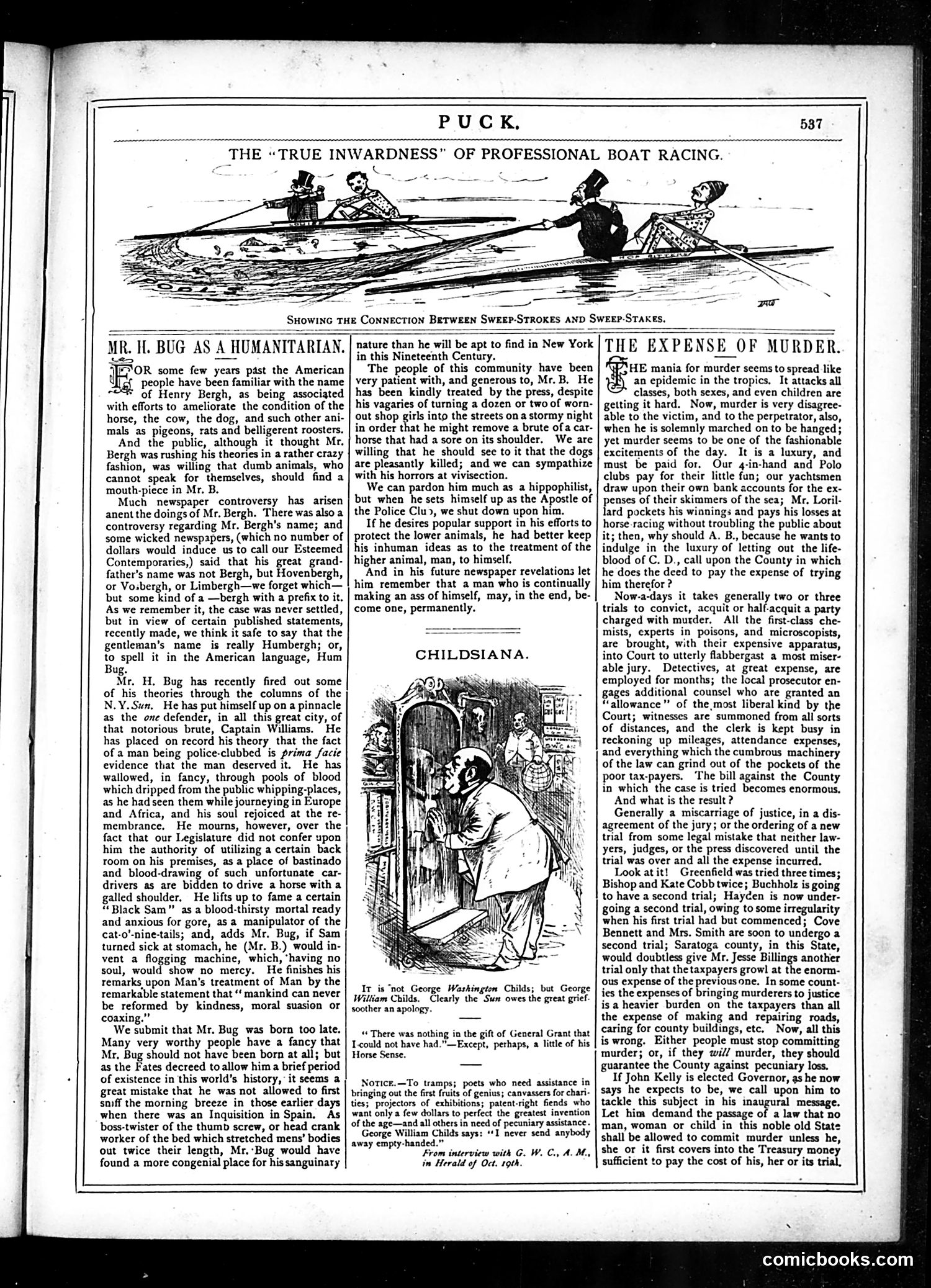
What you’re looking at
**Main Cartoon**: "The True Inwardness of Professional Boat Racing" depicts two racing shells with oarsmen. The caption "Showing the Connection Between Sweep-Strokes and Sweep Stakes" is a pun: "sweep-strokes" (rowing technique) versus "sweep stakes" (gambling). This satirizes the corruption in professional boat racing—suggesting races were fixed for betting purposes rather than won fairly through athletic skill. **Left Article**: "Mr. H. Bug as a Humanitarian" mocks Henry Bergh, founder of the ASPCA, for his animal welfare advocacy. The satire suggests his crusades against animal cruelty were hypocritical or self-aggrandizing. **Right Article**: "The Expense of Murder" criticizes the enormous public cost of murder trials, with extensive expert witnesses and court proceedings straining taxpayers while delivering questionable justice.
📄 Transcribed text from this page (OCR, searchable)
Machine-transcribed from the original scan — historical spelling and the odd misread are preserved.
PUCK, THE “TRUE INW ARDNESS” OF PROFESSIONAL BOAT RACING. SHowING THE CONNECTION BETWEEN SWEEP-STROKES AND SWEEP-STAKES. A HUMANITARIAN. MR. Il. BUG AS Le5 5) 'OR some few years past the American people have been familiar with the name of Henry Bergh, as being associated with efforts to ameliorate the condition of the horse, the cow, the dog, and such other ani- mals as pigeons, rats and belligerent roosters. And the public, although it thought Mr. Bergh was rushing his theories in a rather crazy fashion, was willing that dumb animals, who cannot speak for themselves, should find a mouth-piece in Mr. B. Much newspaper controversy has arisen anent the doings of Mr. Bergh. There was also a controversy regarding Mr. Bergh’s name; and some wicked newspapers, (which no number of dollars would induce us to call our Esteemed Contemporaries,) said that his great grand- father's name was not Bergh, but Hovenbergh, or Vosbergh, or Limbergh—we forget which— but some kind of a —bergh with a prefix to it, As we remember it, the case was never settled, but in view of certain published statements, recently made, we think it safe to say that the gentleman’s name is really Humbergh; or, to spell it in the American language, Hum Bug. Mr. H, Bug has recently fired out some of his theories through the columns of the N.Y. Sun, He has put himself up on a pinnacle as the one defender, in all this great city, of that notorious brute, Captain Williams. He has placed on record his theory that the fact of a man being police-clubbed is prima facie evidence that the man deserved it. He has wallowed, in fancy, through pools of blood which dripped from the public whipping-places, as he had seen them while journeying in Europe and Africa, and his soul rejoiced at the re- membrance, He mourns, however, over the fact that our Legislature did not confer upon him the authority of utilizing a certain back room on his premises, as a place of bastinado and blood-drawing of such unfortunate car- drivers as are bidden to drive a horse with a galled shoulder, He lifts up to fame a certain “Black Sam” as a blood-thirsty mortal ready and anxious for gore, as a manipulator of the cat-o'-nine-tails; and, adds Mr. Bug, if Sam turned sick at stomach, he (Mr. B.) would in- vent a flogging machine, which, “having no soul, would show.no mercy. He finishes his remarks upon Man's treatment of Man by the remarkable statement that “‘ mankind can never be reformed by kindness, moral suasion or coaxing.” We submit that Mr. Bug was born too late. Many very worthy people have a fancy that Mr, Bug should not have been born at all; but as the Fates decreed to allow hima brief period of existence in this world’s history, it seems a great mistake that he was not allowed to first sniff the morning breeze in those earlier days when there was an Inquisition in Spain. As boss-twister of the thump screw, or head crank worker of the bed which stretched mens’ bodies out twice their length, Mr,-Bug would have found a more congenial place for his sanguinary nature than he will be apt to find in New York in this Nineteenth Century. The people of this community have been very patient with, and generous to, Mr. B, He has been kindly treated by the press, despite his vagaries of turning a dozen or two of worn- out shop girls into the streets ona stormy night in order that he might remove a brute ofa car- horse that had a sore on its shoulder. We are willing that he should sec to it that the dogs are pleasantly killed; and we can sympathize with his horrors at vivisection. We can pardon him much as a hippophilist, but when he sets himself up as the Apostle of the Police Clu>, we shut down upon him. If he desires popular support in his efforts to protect the lower animals, he had better keep his inhuman ideas as to the treatment of the higher animal, man, to himself. And in his future newspaper revelations let him remember that a man who is continually making an ass of himself, may, in the end, be- come one, permanently, Ir is “not George Washington Childs; but George Wiltiam Childs. Clearly the Sum owes the great grief. soother an apology. “There was nothing in the gift of General Grant that L-could not have had.”"—Except, perhaps, a little of his Horse Sense. Norice.—To tramps; poets who need assistance in bringing out the first fruits of genius; canvassers for chari- ties; projectors of exhibitions; patent-right fiends who want only a few dollars to perfect the greatest invention of the age—and all others in need of pecuniary assistance. George William Childs says: “I never send anybody away empty-handed.” From interview with G. W. Cu, A. Mey im Herald of Oct. 19th. THE EXPENSE OF MURDER. HE mania for murder seems to spread like an epidemic in the tropics, It attacks all classes, both sexes, and even children are getting it hard. Now, murder is very disagree- able to the victim, and to the perpetrator, also, when he is solemnly marched on to be hanged; yet murder seems to be one of the fashionable excitements of the day. It is a luxury, and must be paid for. Our 4-in-hand and Polo clubs pay for their little fun; our yachtsmen draw upon their own bank accounts for the ex- penses of their skimmers of the sea; Mr. Loril- lard pockets his winnings and pays his losses at horse-racing without troubling the public about it; then, why should A. B., because he wants to indulge in the luxury of letting out the life- blood of C. D., call upon the County in which he does the deed to pay the expense of trying him therefor ? Now-a-days it takes generally two or three trials to convict, acquit or half-acquit a party charged with murder. All the first-class che- mists, experts in poisons, and microscopists, are brought, with their expensive apparatus, into Court to utterly flabbergast a most miser- able jury. Detectives, at great expense, are employed for months; the local prosecutor en- gages additional counsel who are granted an “allowance” of the most liberal kind by the Court; witnesses are summoned from all sorts of distances, and the clerk is kept busy in reckoning up mileages, attendance expenses, and everything which the cumbrous machinery of the law can grind out of the pockets of the poor tax-payers. The bill against the County in which the case is tried becomes enormous, And what is the result ? Generally a miscarriage of justice, in a dis- agreement of the jury; or the ordering of anew trial from some legal mistake that neither law- yers, judges, or the press discovered until the trial was over and all the expense incurred. Look at it! Greenfield was tried three times; Bishop and Kate Cobb twice; Buchholz is going to have a second trial; Hayden is now under- going a second trial, owing to some irregularity when his first trial had but commenced; Cove Bennett and Mrs. Smith are soon to undergo a second trial; Saratoga county, in this State, would doubtless give Mr. Jesse Billings another trial only that the taxpayers growl at the enorm- ous expense of the previous one. In some count- ies the expenses of bringing murderers to justice isa heavier burden on the taxpayers than all the expense of making and repairing roads, caring for county buildings, etc. Now, all this is wrong. Either people must stop committing murder; or, if they wi// murder, they should guarantee the County against pecuniary loss. If John Kelly is elected Governor, as he now says he expects to be, we call upon him to tackle this subject in his inaugural message. Let him demand the passage ofa law that no man, woman or child in this noble old State shall be allowed to commit murder unless he, she or it first covers into the Treasury money sufficient to pay the cost of his, her or its trial, comicbooks.com