
Puck, 1879-10-29 · page 11 of 18
Puck — October 29, 1879 — page 11: what you’re looking at
What you’re looking at
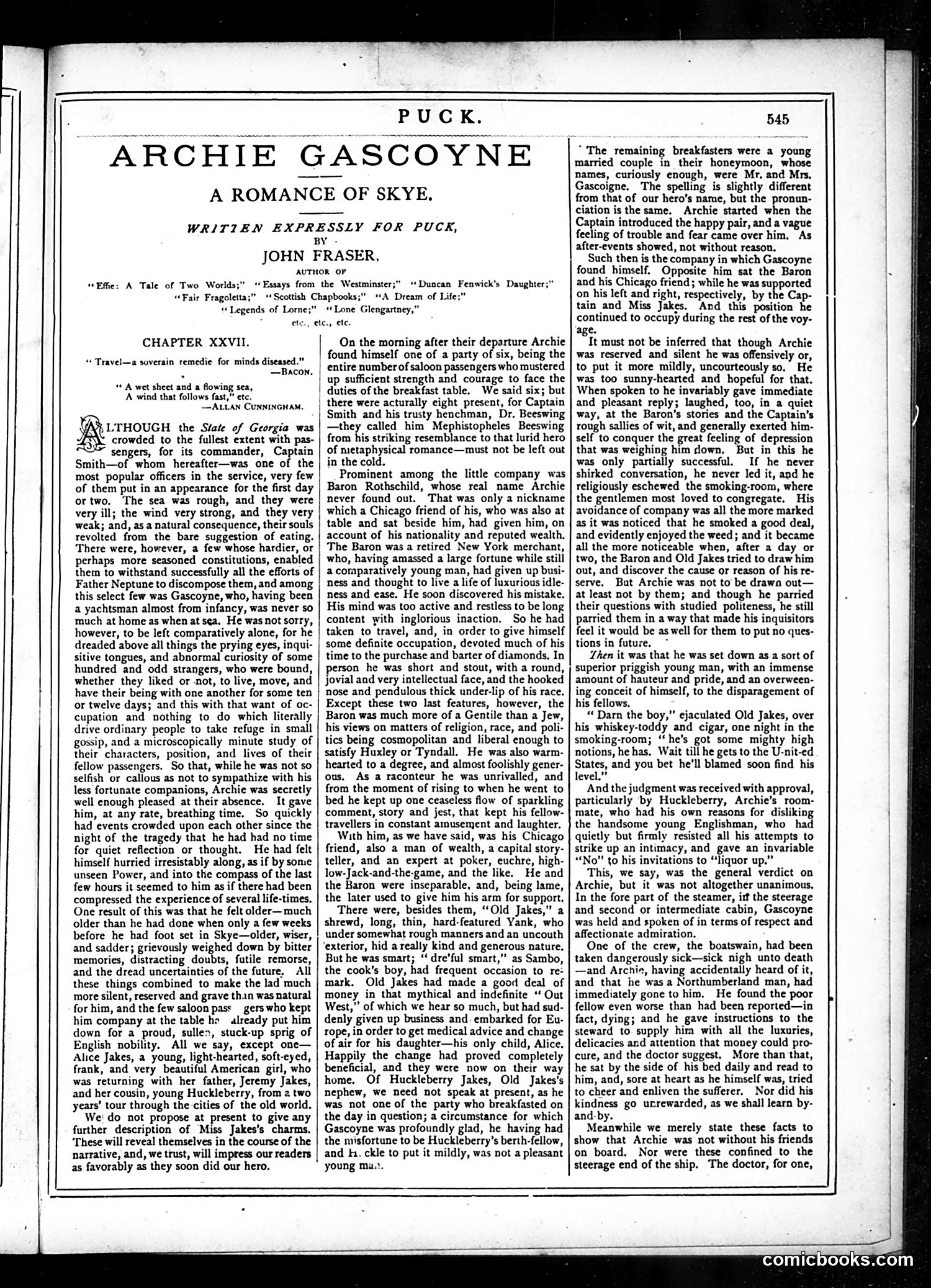
This page from *Puck* magazine contains no political cartoon or satirical illustration. Instead, it presents **Chapter XXVII of a serialized romance story titled "Archie Gascoyne: A Romance of Skye"** by John Fraser. The content is a conventional Victorian-era narrative about a gentleman character named Archie and his travels aboard a steamship. The text describes his companions, including a Baron Rothschild character and various passengers, along with social interactions and personality sketches. This is simply **fiction content**—part of *Puck*'s regular literary offerings alongside its famous political satire. No cartoon or satirical commentary appears on this particular page.
📄 Transcribed text from this page (OCR, searchable)
Machine-transcribed from the original scan — historical spelling and the odd misread are preserved.
ARCHIE GASCOYNE A ROMANCE OF SKYE. WRITTEN EXPRESSLY FOR PUCK, BY - JOHN FRASER, AUTHOR OF “Effie: A Tale of Two Worlds; “Essays from the Westminster;” “Duncan Fenwick’s Daughter;” «Fair Fragoletta; “Scottish Chapbooks;” “A Dream of Life;” “Legends of Lorne; ‘Lone Glengartney,” ete, ete, ete. CHAPTER XXVII. “ Travel—a soverain remedie for minds diseased.” —Bacon. | “+ A wet sheet and a flowing sea, ‘A wind that follows fast,” etc. —ALLAN CUNNINGHAM. SRe mous the State of Georgia was J crowded to the fullest extent with pas- sengers, for its commander, Captain Smith—of whom hereafter—was one of the most popular officers in the service, very few of them put in an appearance for the first day or two, The sea was rough, and they were very ill; the wind very strong, and they very weak; and, as a natural consequence, their souls revolted from the bare suggestion of eating. There were, however, a few whose hardier, or perhaps more seasoned constitutions, enabled them to withstand successfully all the efforts of Father Neptune to discompose them, and among this select few was Gascoyne, who, having been a yachtsman almost from infancy, was never so much at home as when at sea. He was not sorry, however, to be left comparatively alone, for he dreaded above all things the prying eyes, inqui- sitive tongues, and abnormal curiosity of some hundred and odd strangers, who were bound, whether they liked or not, to live, move, and have their being with one another for some ten or twelve days; and this with that want of oc- cupation and nothing to do which literally drive ordinary people to take refuge in small gossip, and a microscopically minute study of their characters, position, and lives of their fellow passengers. So that, while he was not so selfish or callous as not to sympathize with his less fortunate companions, Archie was secretly well enough pleased at their absence. It gave him, at any rate, breathing time. So quickly had events crowded upon each other since the night of the tragedy that he had had no time for quiet reflection or thought. He had felt himself hurried irresistably along, as if by some unseen Power, and into the compass of the last few hours it seemed to him as if there had been compressed the experience of several life-times. One result of this was that he felt older—much older than he had done when only a few weeks before he had foot set in Skye—older, wiser, and sadder; grievously weighed down by bitter memories, distracting doubts, futile remorse, and the dread uncertainties of the future, All these things combined to make the lad much more silent, reserved and grave than was natural for him, and the few saloon pass_ gers who kept him company at the table ho already put him down for a proud, sullen, stuck-up sprig of English nobility. All we say, except one— Alice Jakes, a young, light-hearted, soft-eyed, frank, and very beautiful American girl, who was returning with her father, Jeremy Jakes, and her cousin, young Huckleberry, from 2 two years’ tour through the-cities of the old world. We' do not propose at present to give any further description of Miss Jakes’s charms. ‘These will reveal themselves in the course of the narrative, and, we trust, will impress our readers as favorably as they soon did our hero. On the morning after their departure Archie found himself one of a party of six, being the entire numberof saloon passengers who mustered up sufficient strength and courage to face the duties of the breakfast table. We said six; but | there were acturally eight present, for Captain Smith and his trusty henchman, Dr. Beeswing —they called him Mephistopheles Beeswing from his striking resemblance to that lurid hero of nietaphysical romance—must not be left out in the cold. Prominent among the little company was Baron Rothschild, whose real name Archie never found out. That was only a nickname which a Chicago friend of his, who was also at table and sat beside him, had given him, on account of his nationality and reputed wealth. The Baron was a retired New York merchant, who, having amassed a large fortune while still a comparatively young man, had given up busi- ness and thought to live a life of luxurious idle- ness and ease, He soon discovered his mistake. His mind was too active and restless to be long content with inglorious inaction. So he had taken to travel, and, in order to give himself | some definite occupation, devoted much of his time to the purchase and barter of diamonds, In erson he was short and stout, with a round, jovial and very intellectual face, and the hooked nose and pendulous thick under-lip of his race. Except these two last features, however, the Baron was much more of a Gentile than a Jew, his views on matters of religion, race, and poli- tics being cosmopolitan and liberal enough to satisfy Huxley or Tyndall. He was also warm- hearted to a degree, and almost foolishly gener- ous, As a raconteur he was unrivalled, and from the moment of rising to when he went to bed he kept up one ceaseless flow of sparkling comment, story and jest, that kept his fellow- travellers in constant amusement and laughter. With him, as we have said, was his Chicago friend, also a man of wealth, a capital story- teller, and an expert at poker, euchre, high- low-Jack-and-the-game, and the like. He and the Baron were inseparable, and, being lame, the later used to give him his arm for support, There were, besides them, ‘Old Jakes,” a shrewd, long, thin, hard-featured Yank, who under somewhat rough manners and an uncouth ‘exterior, hid a really kind and generous nature, But he was smart; ‘‘dre'ful smart,” as Sambo, the cook's boy, had frequent occasion to re: mark. Old Jakes had made a good deal of money in that mythical and indefinite ‘‘ Out West,” of which we hear so much, but had sud- denly given up business and. embarked for Eu- rope, in order to get medical advice and change of air for his daughter—his only child, Alice. Happily the change had proved completely beneficial, and they were now on their way home, Of Huckleberry Jakes, Old Jakes's nephew, we need not speak at present, as he was not one of the party who breakfasted on the day in question; a circumstance for which Gascoyne was profoundly glad, he having had the misfortune to be Huckleberry’s berth-fellow, and h. ckle to put it mildly, was not a pleasant young mu.?. 545 ‘The remaining breakfasters were a young married couple in their honeymoon, whose names, curiously enough, were Mr, and Mrs. Gascoigne. The spelling is slightly different from that of our hero’s name, but the pronun- ciation isthe same. Archie started when the Captain introduced the happy pair, and a vague feeling of trouble and fear came over him. As after-events showed, not without reason, Such then is the company in which Gascoyne found himself. Opposite him sat the Baron and his Chicago friend; while he was supported on his left and right, respectively, by the Cap- tain and Miss Jakes. And this position he continued to occupy during the rest of the voy- ec. It must not be inferred that though Archie was reserved and silent he was offensively or, to put it more mildly, uncourteously so. He was too sunny-hearted and hopeful for that. When spoken to he invariably gave immediate and pleasant reply; laughed, too, in a quiet way, at the Baron’s stories and the Captain's rough sallies of wit, and generally exerted him- self to conquer the great feeling of depression that was weighing him down. But in this he was only partially successful. If he never shirked conversation, he never led it, and he religiously eschewed the smoking-room, where the gentlemen most loved to congregate. His avoidance of company was all the more marked as it was noticed that he smoked a good deal, and evidently enjoyed the weed; and it became all the more noticeable when, after a day or two, the Baron and Old Jakes tried to draw him out, and discover the cause or reason of his re- serve. But Archie was not to be drawn out— at least not by them; and though he parried their questions with studied politeness, he still parried them in a way that made his inquisitors feel it would be as well for them to put no ques- tions in future. Zhen it was that he was set down as a sort of superior priggish young man, with an immense amount of hauteur and pride, and an overween- ing conceit of himself, to the disparagement of his fellows. “Darn the boy,” ejaculated Old Jakes, over his whiskey-toddy and cigar, one night in the smoking-room; ‘he's got some mighty high notions, he has, Wait till he gets to the U-nit-ed States, and you bet he'll blamed soon find his level.” ‘And the judgment was received with approval, particularly by Huckleberry, Archie's room: mate, who had his own reasons for disliking the handsome young Englishman, who had quietly but firmly resisted all his attempts to strike up an intimacy, and gave an invariable “No” to his invitations to “liquor up.” This, we say, was the general verdict on Archie, but it was not altogether unanimous, In the fore part of the steamer, irf the steerage and second or intermediate cabin, Gascoyne was held and spoken of in terms of respect and affectionate admiration. One of the crew, the boatswain, had been taken dangerously sick—sick nigh unto death —and Archie, having accidentally heard of it, and that he was a Northumberland man, had immediately gone to him. He found the poor fellow even worse than had been reported—in fact, dying; and he gave instructions to the steward to supply him with all the luxuries, delicacies and attention that money could pro- cure, and the doctor suggest. More than that, he sat by the side of his bed daily and read to him, and, sore at heart as he himself was, tried to cheer and enliven the sufferer. Nor did his kindness go urrewarded, as we shall learn by- and-by. Meanwhile we merely state these facts to show that Archie was not without his friends on board. Nor were these confined to the steerage end of the ship. The doctor, for one, —