
Puck, 1879-10-29 · page 4 of 18
Puck — October 29, 1879 — page 4: what you’re looking at
What you’re looking at
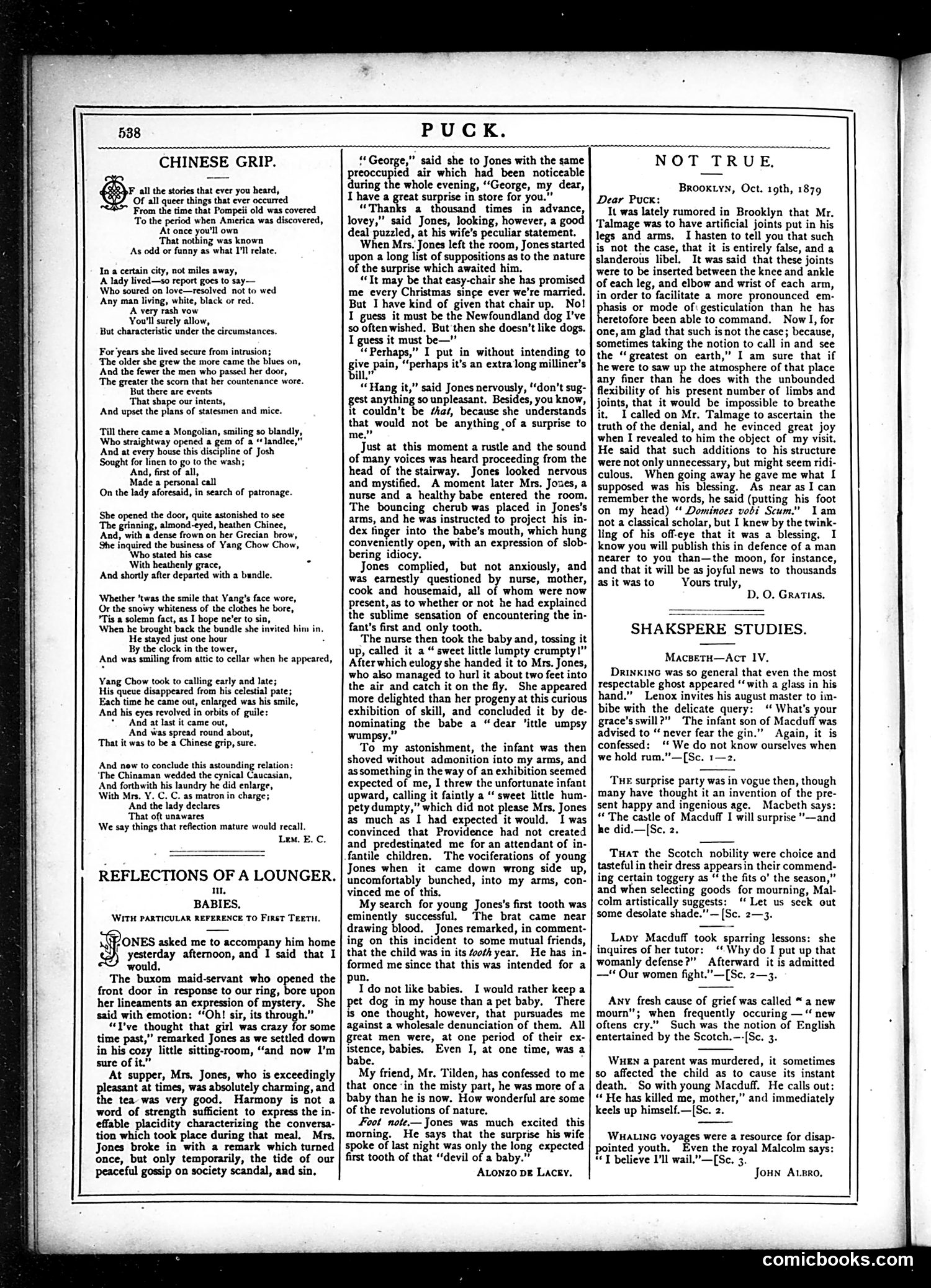
This page contains no political cartoons. Instead, it features several humorous prose pieces typical of Puck's satirical content: **"Chinese Grip"** is a poem mocking superstition and implausible folk remedies. **"Not True"** is a letter from D.O. Gratias debunking Brooklyn rumors that a man named Tatnall had artificial joints surgically installed—presented as absurd gossip the writer felt compelled to refute. **"Reflections of a Lounger"** contains brief social commentary, including critiques of babies and child-rearing practices, written with sardonic humor typical of the era's gentleman-magazine style. The page demonstrates Puck's use of written satire alongside visual cartoons to mock contemporary society, superstition, and urban gossip culture of 1870s America.
📄 Transcribed text from this page (OCR, searchable)
Machine-transcribed from the original scan — historical spelling and the odd misread are preserved.
538 PUCK. CHINESE GRIP. FF all the stories that ever you heard, Of all queer things that ever occurred From the time that Pompeii old was covered To the period when America was discovered, At once fey own ‘That nothing was known ‘As odd or funny as what I'll relate. In a certain city, not miles away, A lady lived—so report goes to say— Who soured on love—resolved not to wed Any man living, white, black or red. A very rash vow You'll surely allow, But characteristic under the circumstances. For years she lived secure from intrusion; ‘The older she grew the more came the blues on, And the fewer the men who passed her door, ‘The greater the scorn that her countenance wore. But there are events ‘That shape our intents, ; And upset the plans of statesmen and mice. Till there came a Mongolian, smiling so blandly, ‘Who straightway opened a gem of a “landlee,” And at every house this discipline of Josh Sought for linen to go to the wash; And, first of all, Made a personal call On the lady aforesaid, in search of patronage. She opened the door, quite astonished to see The grinning, almond-eyed, heathen Chinee, And, with a dense frown on her Grecian brow, he inquired the business of Yang Chow Chow, ‘Who stated his case With heathenly grace, And shortly after departed with a bundle. Whether ‘twas the smile that Yang's face wore, Or the snoixy whiteness of the clothes he bore, "Tis a solemn fact, as I hope ne’er to sin, When he brought back the bundle she invited him in. He stayed just one hour 3 By the clock in the tower, And was smiling from attic to cellar when he appeared, Yang Chow took to calling early and late; His queue disappeared from his celestial pate; Each time he came out, enlarged was his smile, And his eyes revolved in orbits of guile: * And at last it came out, And was spread round about, That it was to be a Chinese grip, sure. And new to conclude this astounding relation: ‘The Chinaman wedded the cynical Caucasian, And forthwith his laundry he did enlarge, With Mrs. Y. C. C. as matron in charge; And the lady declares That oft unawares We say things that reflection mature would recall. Lem. E. C. REFLECTIONS OF A LOUNGER. Mm, BABIES, WITH PARTICULAR REFERENCE TO First TEETH. ONES asked me to accompany him home ) yesterday afternoon, and I said that I would, The buxom maid-servant who opened the front door in response to our ring, bore upon her lineaments an expression of mystery. She said with emotion: ‘Oh! sir, its through.” “T've thought that girl was crazy for some time past,” remarked Jones as we settled down in his cozy little sitting-room, ‘and now I’m sure of it.” At supper, Mrs, Jones, who is exceedingly pleasant at times, was absolutely charming, and the tea was very good. Harmony is not a word of strength sufficient to express the in- effable placidity characterizing the conversa- tion which took place during that meal. Mrs. Jones broke in with a remark which turned once, but only temporarily, the tide of our peaceful gossip on society scandal, and sin, { George,” said she to Jones with the same preoccupied air which had been noticeable during the whole evening, ‘George, my dear, Thavea reat surprise in store for you.”” “Thanks a thousand times in advance, lovey,” said Jones, looking, however, a good deal puzzled, at his wife’s peculiar statement. When Mrs. Jones left the room, Jones started upon a long list of suppositions as to the nature of the surprise which awaited him. “It may be that easy-chair she has promised me every Christmas singe ever we're married. But I have kind of given that chair up, Nol! I guess it must be the Newfoundland dog I’ve so oftenwished. But then she doesn't like dogs. I guess it must be—"’ “Perhaps,” I put in without intending to give pain, “perhaps it’s an extra long milliner’s bill.” “Hang it,” said Jones nervously, “don't sug- est anything so unpleasant. Besides, you know, it couldn’t be ¢hat, because she understands that would not be anything of a surprise to me.” Just at this moment a rustle and the sound of many voices was heard proceeding from the head of the stairway. Jones looked nervous and mystified. A moment later Mrs. Jozes, a nurse and a healthy babe entered the room. The bouncing cherub was placed in Jones's arms, and he was instructed to project his in- dex finger into the babe’s mouth, which hung conveniently open, with an expression of slob- bering idiocy. Jones complied, but not anxiously, and was earnestly questioned by nurse, mother, cook and housemaid, all of whom were now present, as to whether or not he had explained the sublime sensation of encountering the in- fant’s first and only tooth. ‘The nurse then took the baby and, tossing it up, called it a“ sweet little lumpty crumpty!” After which eulogy she handed it to Mrs. Jones, who managed to hurl it about two feet into the air and catch it on the fly. She appeared more delighted than her progeny at this curious exhibition of skill, and concluded it by de- nominating the babe a “dear 'ittle umpsy wumpsy.”” To my astonishment, the infant was then shoved without admonition into my arms, and as something in the way of an exhibition seemed expected of me, I threw the unfortunate infant upward, calling it faintly a“ sweet little hum- pety dumpty,” which did not please Mrs. Jones as much as I had expected it would. I was convinced that Providence had not created and predestinated me for an attendant of in- fantile children. The vociferations of young Jones when it came down wrong side up, uncomfortably bunched, into my arms, con- vinced me of this. My search for young Jones's first tooth was eminently successful. The brat came near drawing blood. Jones remarked, in comment- ing on this incident to some mutual friends, that the child was in its foofh year. He has in- formed me since that this was intended for a pun. 1 do not like babies. I would rather keep a pet dog in my house than a pet baby. There is one thought, however, that pursuades me against a wholesale denunciation of them. All great men were, at one period of their ex- istence, babies. Even I, at one time, was a babe. My friend, Mr. Tilden, has confessed to me that once -in the misty part, he was more of a baby than he is now. How wonderful are some of the revolutions of nature. Foot note—Jones was much excited this morning. He says that the surprise his wife spoke of last night was only the long expected first tooth of that ‘‘devil of a baby.” Atonzo pg Lacry. NOT TRUE. Brooxtyn, Oct. 19th, 1879 Dear Puck: It was lately rumored in Brooklyn that Mr. ‘Talmage was to have artificial joints put in his legs and arms, I hasten to tell you that such is not the case, that it is entirely false, and a slanderous libel. It was said that these joints were to be inserted between the knee and ankle of each leg, and elbow and wrist of each arm, in order to facilitate a more pronounced em- phasis or mode oft gesticulation than he has heretofore been able to command. Now], for one, am glad that such isnot the case; because, sometimes taking the notion to call in and see the “greatest on earth,” I am sure that if he were to saw up the atmosphere of that place any finer than he does with the unbounded flexibility of his present number of limbs and joints, that it would be impossible to breathe it. I called on Mr. Talmage to ascertain the truth of the denial, and he evinced great joy when I revealed to him the object of my visit. He said that such additions to his structure were not only unnecessary, but might seem ridi- culous, When going away he gave me what I supposed was his blessing. As near as I can remember the words, he said (putting his foot on my head) ‘ Dominoes vobi Scum.” Lam not a classical scholar, but I knew by the twink- ling of his off-eye that it was a blessing. I know you will publish this in defence of a man nearer to you than—the moon, for instance, and that it will be as joyful news to thousands as it was to Yours truly, D. O. Gratias. SHAKSPERE STUDIES. MacsetH—Act IV, DRINKING was so general that even the most respectable ghost appeared “with a glass in his hand,” Lenox invites his august master to im- bibe with the delicate query: ‘ What's your grace’s will?” The infant son of Macduff was advised to “ never fear the gin.” Again, it is confessed: ‘* We do not know ourselves when we hold rum.”—[Sc. 1—2. ‘THE surprise party was in vogue then, though many have thought it an invention of the pre- sent happy and ingenious age. Macbeth says: “ The castle of Macduff I will surprise "—and he did.—[Sc. 2. Tuat the Scotch nobility were choice and tasteful in their dress appears in their commend- ing certain toggery as “ the fits o’ the season,” and when selecting goods for mourning, Mal- colm artistically suggests: |“ Let us seek out some desolate shade.” —[Sc. 2—3. Lavy Macduff took sparring lessons: she inquires of her tutor: ‘Why do I put up that womanly defense?” Afterward it is admitted —‘ Our women fight.”—[Sc. 2—3. Any fresh cause of grief was called “a new mourn”; when frequently occuring — “ new oftens cry.” Such was the notion of English entertained by the Scotch.—-[Sc. 3. Wuen a parent was murdered, it sometimes so affected the child as to cause its instant death. So with young Macduff. He calls out: “ He has killed me, mother,” and immediately keels up himself.—[Sc. 2. WHALING voyages were a resource for disap- pointed youth, Even the royal Malcolm says: “T believe I'll wail.”"—[Sc. 3. Joun Axpro, comicbooks.com