
A complete issue · 16 pages · 1879
Puck — June 18, 1879
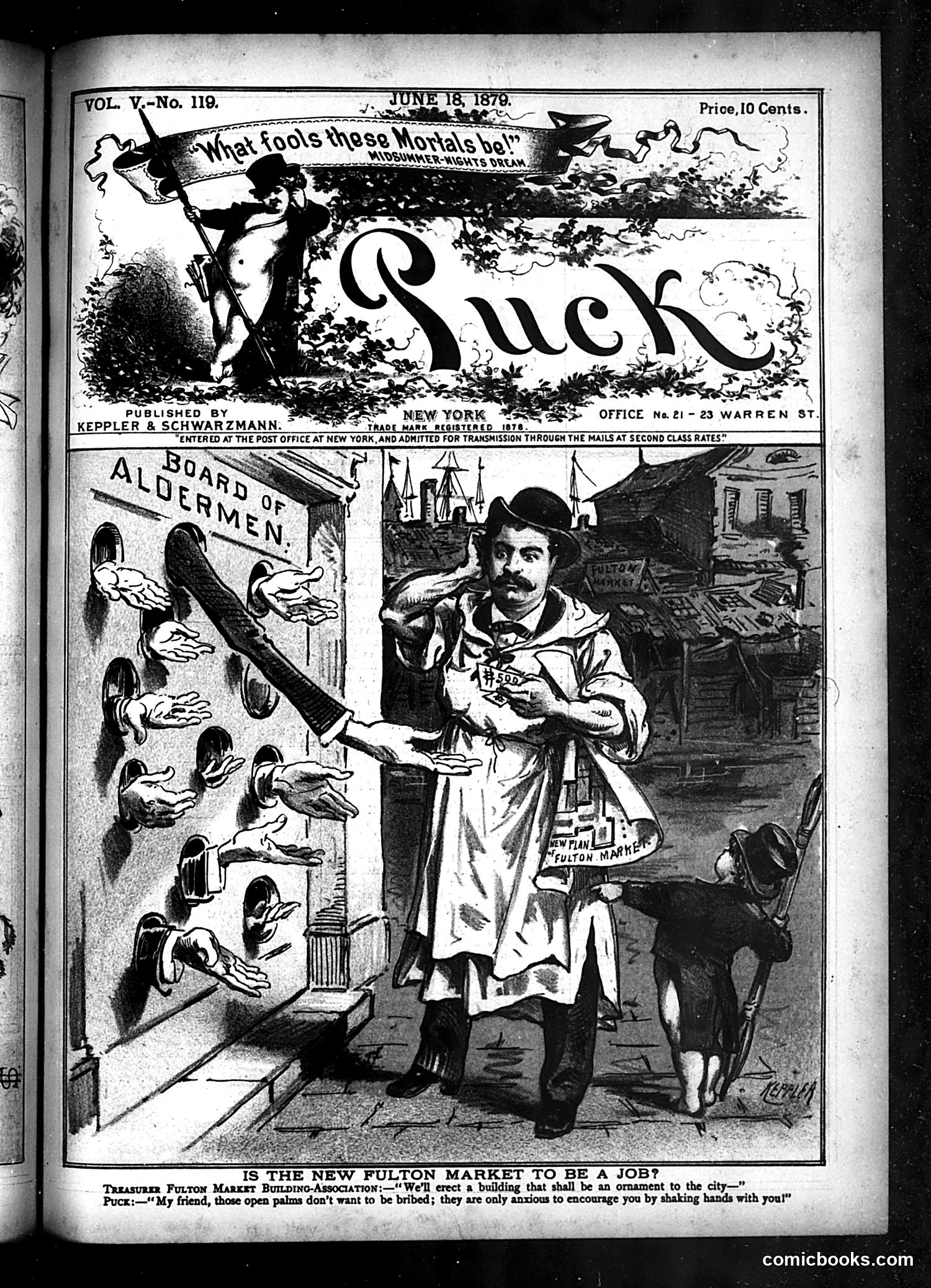
This satirical cartoon mocks New York City's proposed Fulton Market building project. The central figure appears to be a municipal official or politician (labeled "Board of Aldermen"), depicted as a butcher juggling various concerns while promoting the new market construction. The satire criticizes the Fulton Market building initiative as wasteful or misguided urban planning. The "Board of Aldermen" juggling act suggests municipal incompetence—the aldermen are portrayed as unable to manage multiple responsibilities simultaneously. The caption's dialogue between "Treasurer" and "Price" mocks their shallow justification: claiming the building will be "an ornament to the city" while acknowledging citizens' real concerns about fiscal responsibility are merely encouraged through handshakes. The cartoon attacks the disconnect between promised civic benefits and actual taxpayer interests.
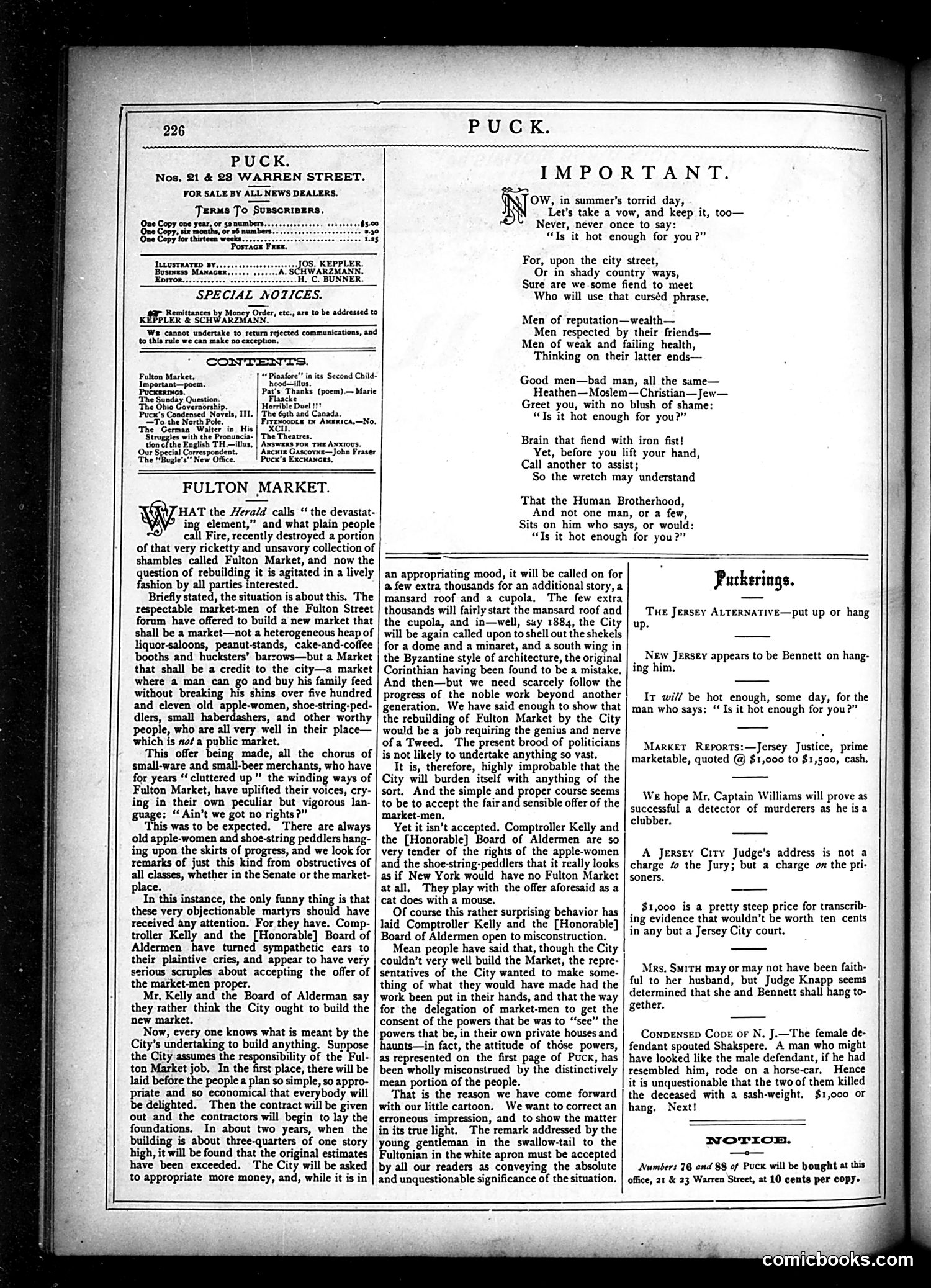
This page is primarily **editorial content rather than a political cartoon**. The main feature is "Fulton Market," a lengthy satirical article about New York City's famous market and a dispute over rebuilding it. The piece satirizes **political inefficiency and corruption** surrounding the market's reconstruction. It critiques the Board of Aldermen and Comptroller Kelly for their mishandling of the project, suggesting they're more interested in personal gain than public service. The satire targets the gap between what politicians promise versus what they actually deliver. The smaller "Puckerings" section contains brief quips mocking contemporary figures and events, though specific identities are unclear without additional context. The overall tone is typical Puck: using humor to expose governmental incompetence and self-interest.
This page contains three distinct articles with no visible political cartoons: **"The Sunday Question"** discusses religious tolerance and liberty, defending against accusations that America is intolerant of Catholics, Jews, and other minorities. It argues Americans are fundamentally free and criticizes those who claim otherwise. **"The Ohio Governorship"** debates candidates for Ohio's governor, likely Foster and General Ewing, discussing their relative merits without taking a strong partisan stance. **"The Man with the Giglamps"** is a humorous sketch about a myopic theater-goer whose thick eyeglasses cause comic mishaps—he crushes them, loses them, and generally creates disturbance through poor vision. The page is primarily text-based editorial and satirical commentary rather than visual political cartooning.
This page contains **no political cartoon or satire**. Instead, it's a serialized fiction story titled "To the North Pole in a Minute and a Half" by Jooles Vaisne, appearing in Puck's Condensed Novels series. The narrative follows Professor Blunderfog, a eccentric academic character who devises an elaborate scheme to reach the North Pole using a specially designed tub. The story is a comedic adventure tale featuring absurdist humor—the humor derives from the ridiculous premise (reaching the North Pole in minimal time) and the professor's grandiose but impractical scientific methodology. This represents Puck's literary content rather than its famous political cartooning, offering readers serialized humorous fiction alongside satire.
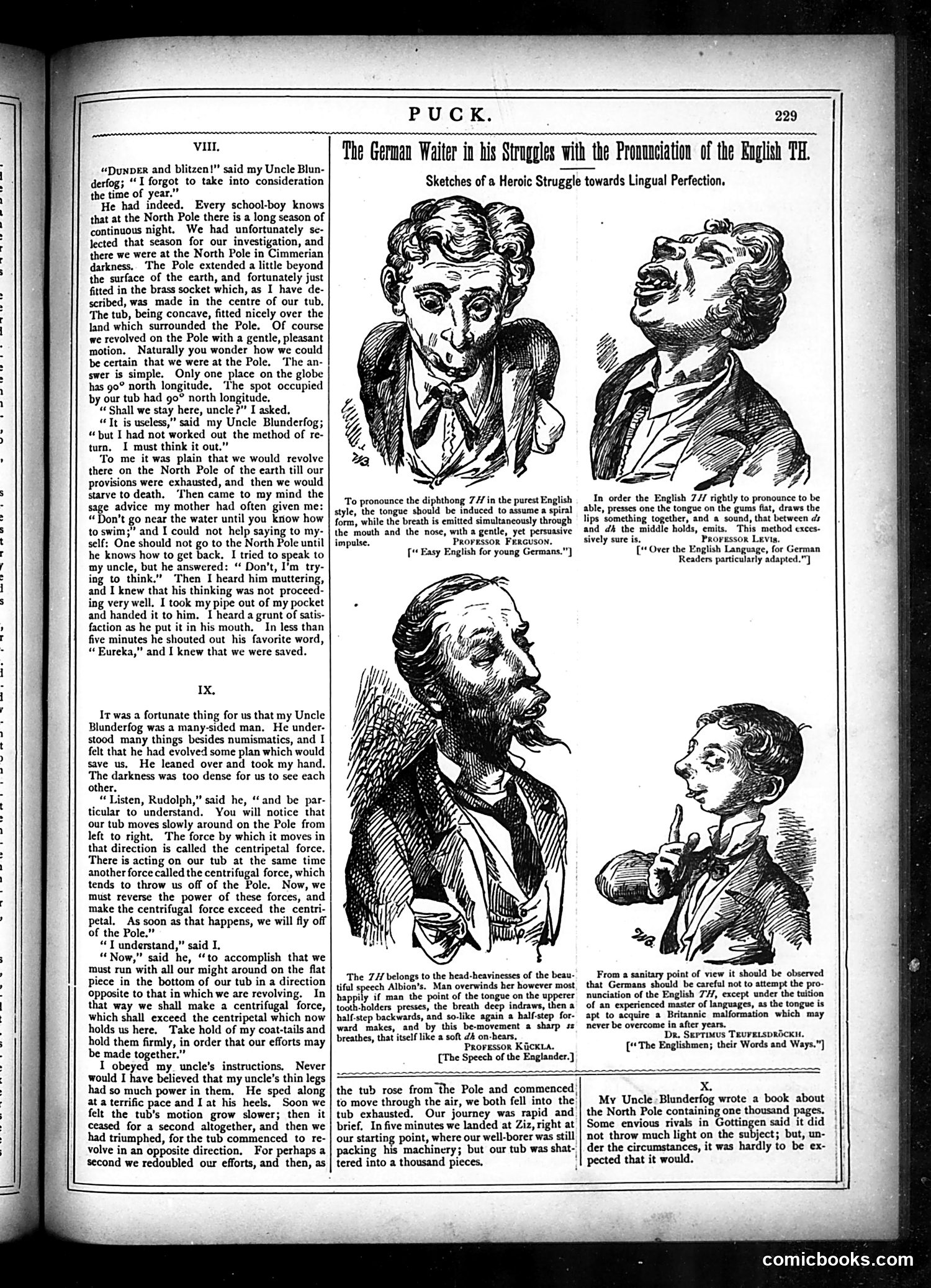
This page from *Puck* satirizes German immigrants' struggles with English pronunciation, specifically the "TH" sound. The title reads "The German Waiter in his Struggles with the Pronunciation of the English TH." The illustrations depict a German man attempting to master English phonetics, with diagrams showing tongue placement for proper "TH" pronunciation. The accompanying text includes Uncle Blunderford's anecdotal account of traveling to the North Pole in a bathtub and a lesson on linguistic mechanics. The satire targets German-American immigrants' accent difficulties—a common comedic subject in early American magazines. The detailed linguistic instruction paired with absurdist narrative (the North Pole bathtub journey) creates humor through incongruity. This reflects period attitudes toward immigrant communities and their cultural assimilation challenges.
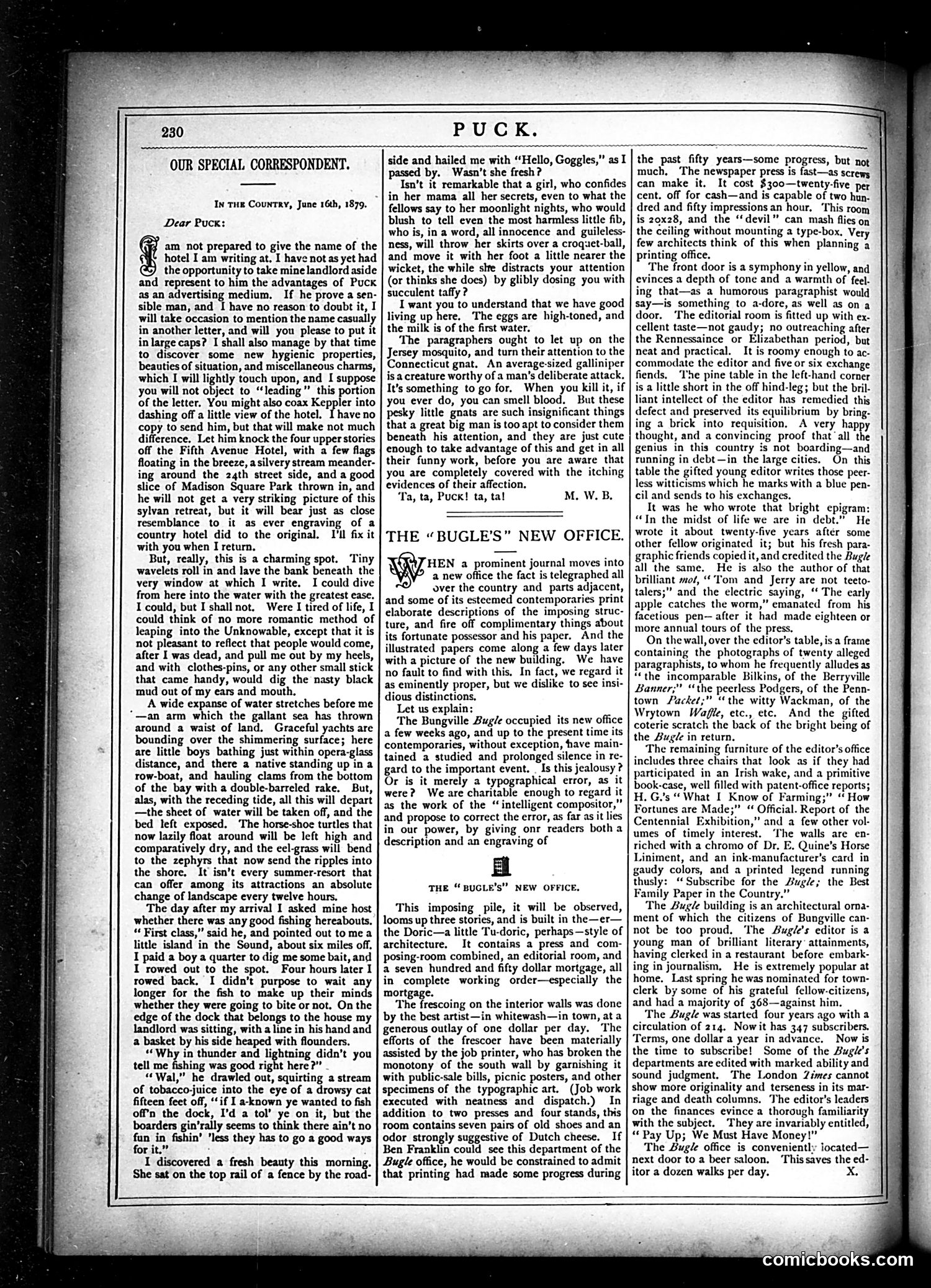
This page contains **no political cartoon**—it's primarily text content from Puck's editorial sections. The main content includes: 1. **"Our Special Correspondent"** — A humorous letter from the countryside describing rural life, country hotels, and local observations in exaggerated, satirical prose typical of Puck's style. 2. **"The Bugle's New Office"** — An article about a journal moving to a new building, discussing the office's modest setup and finances. The piece pokes fun at the publication's limited resources and celebrates the modest accomplishment of the move. Both pieces exemplify Puck's satirical approach to everyday American life and journalism itself, using humor to comment on social conditions rather than direct political cartooning.
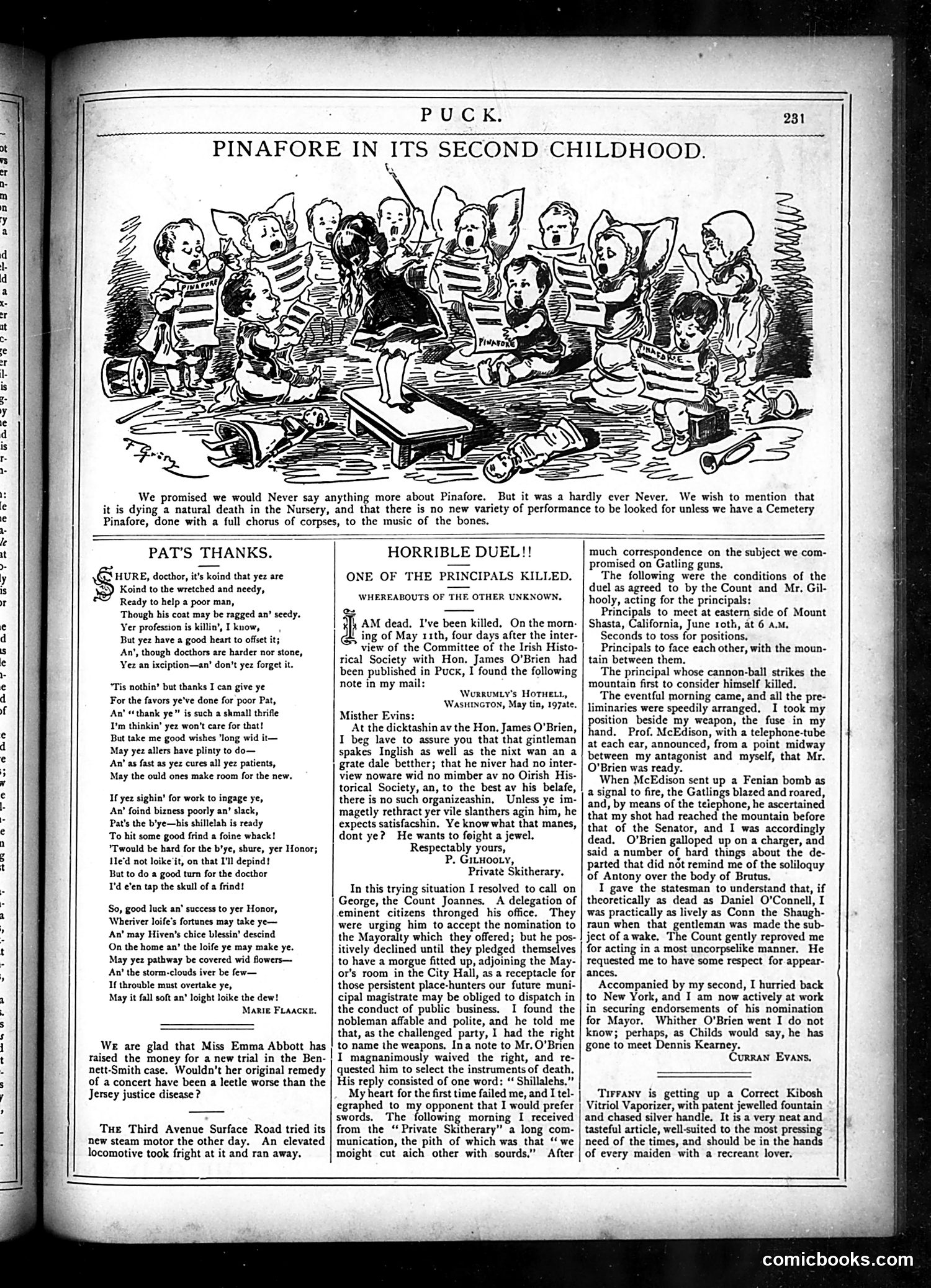
This cartoon satirizes the continued popularity of Gilbert & Sullivan's operetta *HMS Pinafore*, which premiered in 1878. The illustration shows children performing the opera in a nursery setting, surrounded by toys and simple props—a coffin serving as a stage. The accompanying text announces Pinafore's "dying a natural death in the Nursery" and jokes that there's "no new variety of performance to be looked for unless we have a Cemetery Pinafore." The satire targets the opera's enduring cultural dominance and over-performance by this point. By depicting it as something for children in a nursery—even a death scene—Puck mocks how the once-innovative work has become exhausted, overly familiar, and relegated to amateur theatrical status rather than maintaining its original sophisticated appeal.
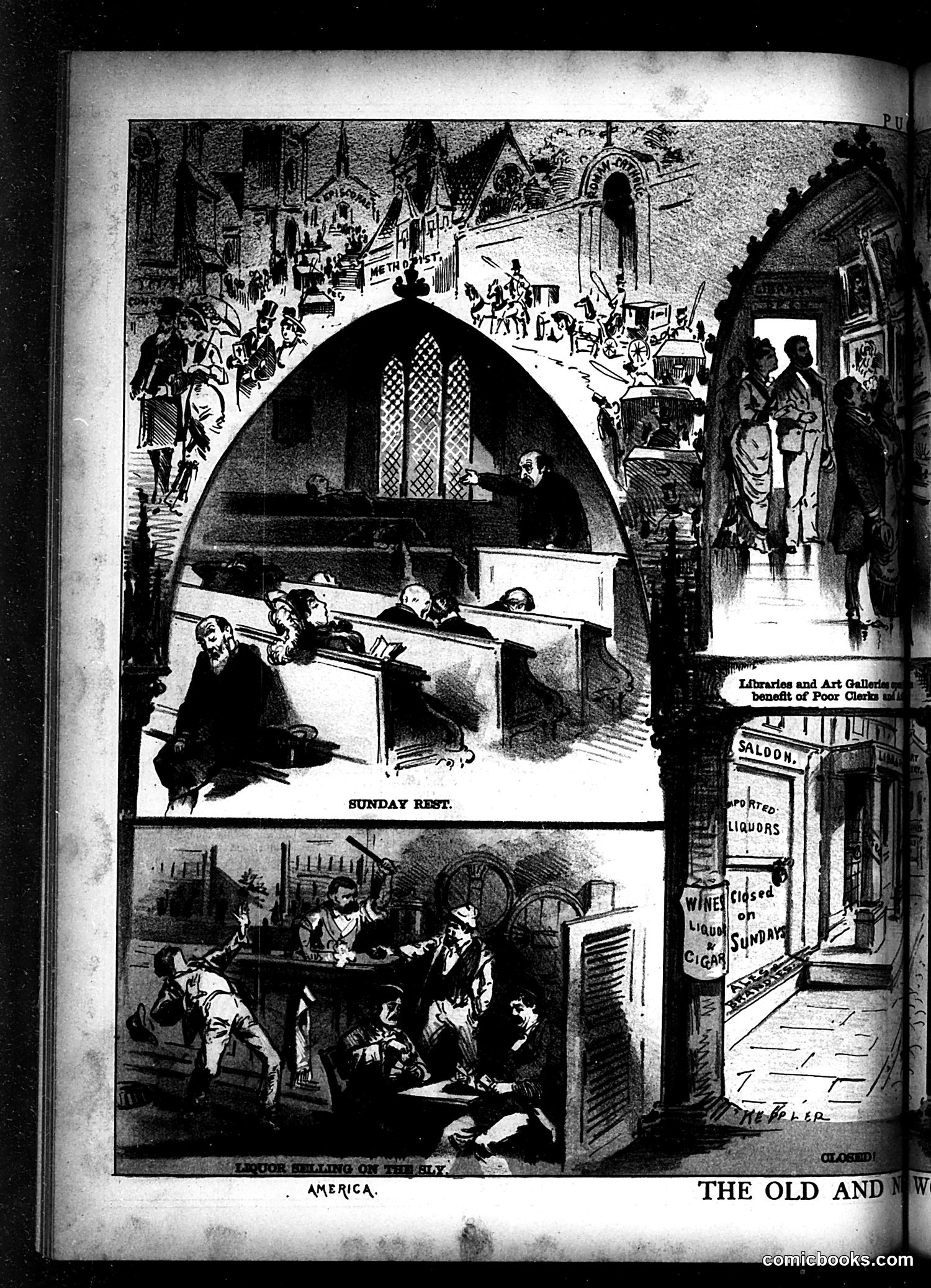
This page contrasts American religious and secular life through two scenes titled "Sunday Rest." **Top panel**: Shows a church interior where worshippers sit in pews while a clergyman preaches. A bustling street scene visible through the arch depicts commerce and activity continuing outside. **Bottom panel**: Depicts a saloon where people drink and socialize, with a sign advertising "Wine, Liquor on Sunday" visible outside. **The satire**: The cartoon critiques the hypocrisy of American Sunday observance laws. While churches preach moral rest and religious devotion, saloons openly conduct business on the Sabbath. The caption "The Old and New America" suggests tension between traditional religious values and emerging secular commercial culture that ignores religious restrictions on Sunday activity.
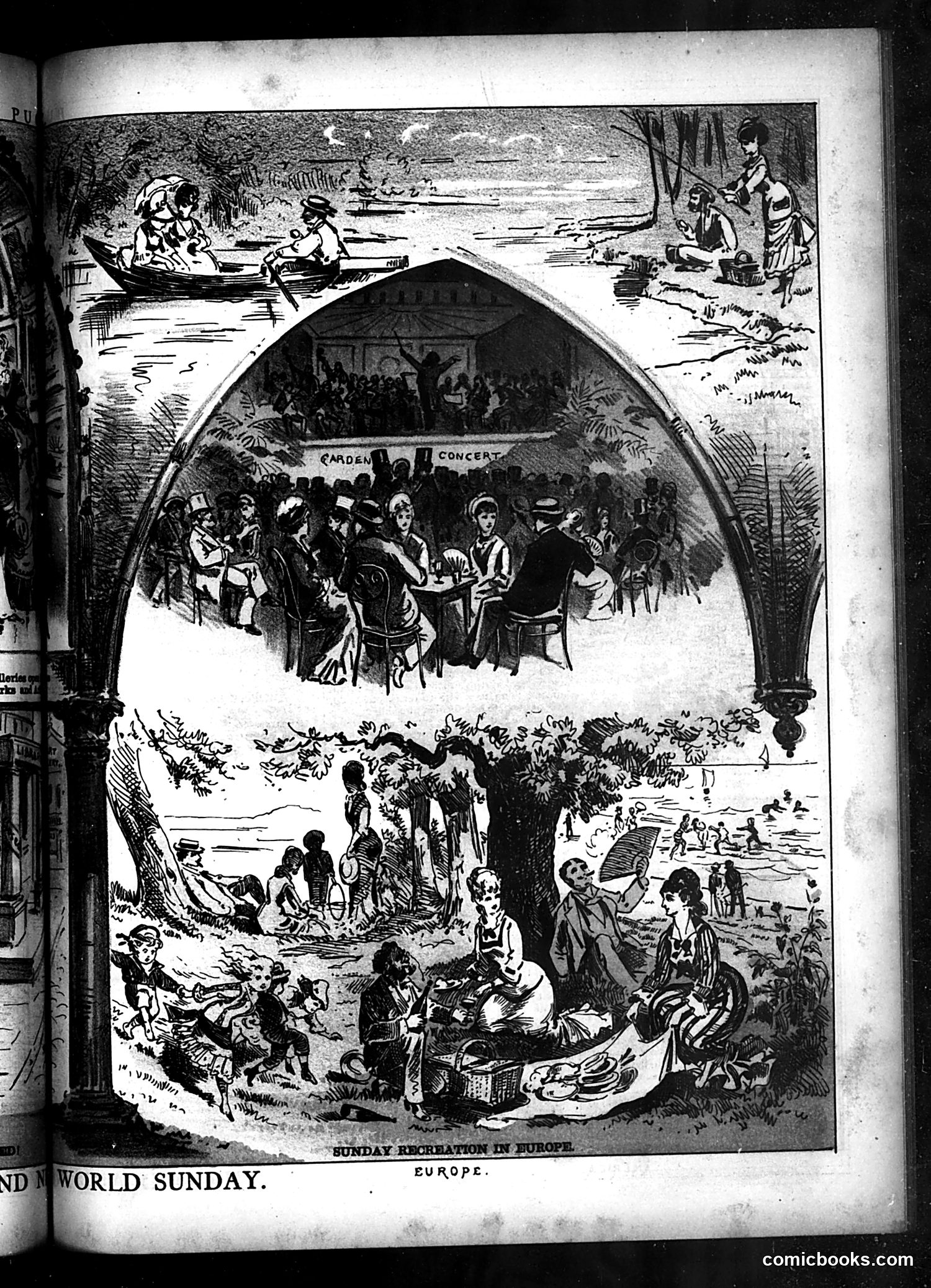
This satirical illustration titled "Sunday Recreation in Europe" depicts leisure activities across the continent. The central vignette shows a "Garden Concert" under an arched tent, where well-dressed Europeans attend a musical performance. Surrounding scenes illustrate other pastimes: boating and fishing along riverbanks, picnicking with families, and beach activities. The satire appears to contrast European leisure culture with implied American Sunday practices. By showcasing refined, organized entertainment—orchestral concerts, formal gatherings—alongside rural recreations, Puck likely comments on class distinctions and cultural attitudes toward rest days. The "World Sunday" heading suggests comparative commentary on how different societies spend their weekly respite, possibly satirizing European formality or America's perceived materialism.
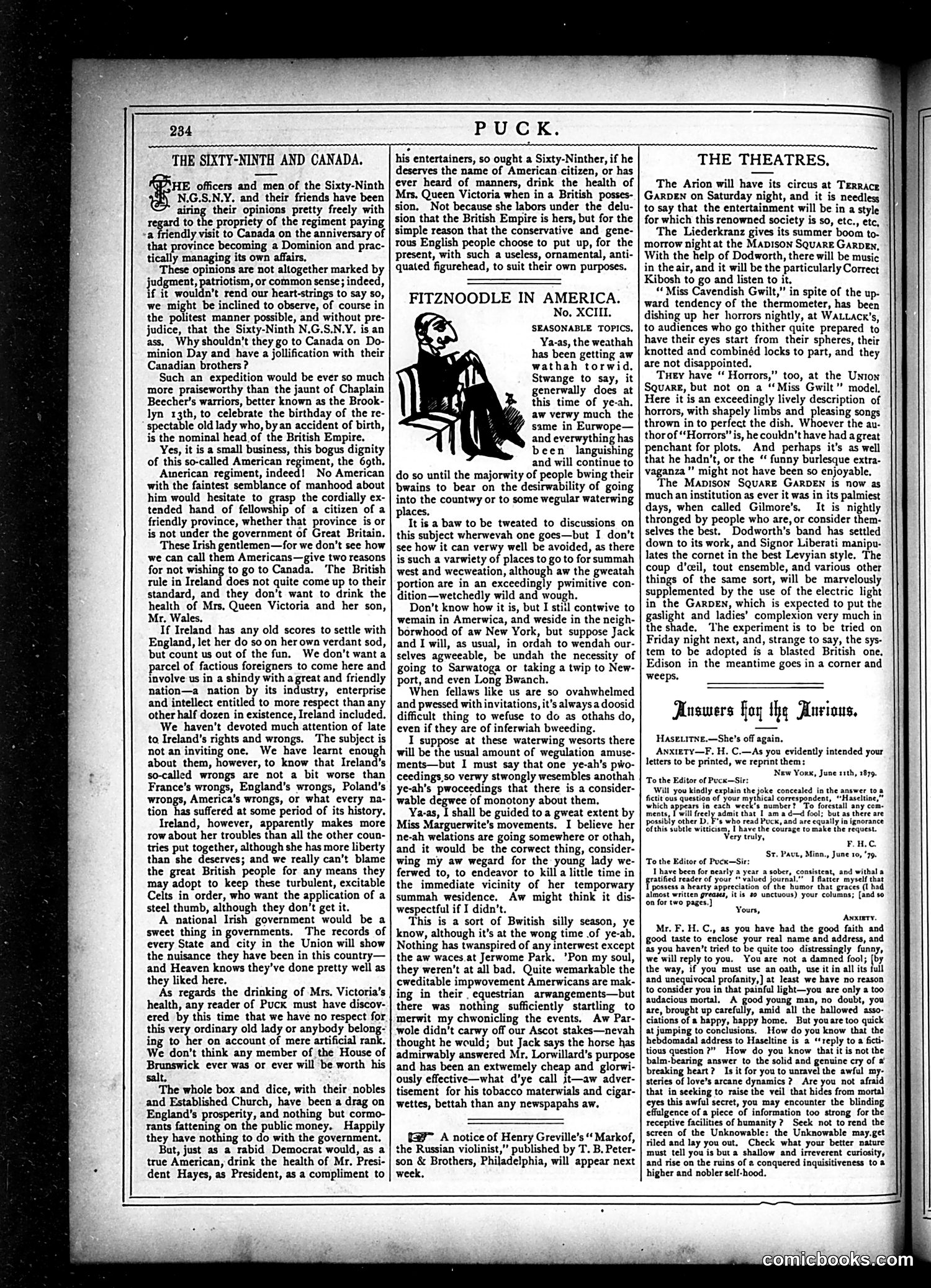
This page contains three main sections: "The Sixty-Ninth and Canada" (left column), "Fitznoodle in America" (center with illustration), and "The Theatres" (right column), plus an "Answers for the Anxious" advice column. The central cartoon shows a figure labeled "Fitznoodle" appearing to sit in contemplation. The accompanying text satirizes American attitudes toward visiting Canada and waterfront destinations like New York and Long Beach. The satire targets American snobbery about Canada while also critiquing the "overwhelmed and pressed" nature of visiting these locations. The left article humorously argues against a proposed Sixty-Ninth Regiment trip to Canada, using mock-patriotic reasoning about preferring to stay in America. Overall, the page mixes social commentary on American tourism and attitudes toward Britain's dominion with theatrical reviews and an advice column.
This page contains the continuation of "Archie Gascoyne, A Romance of Skye," a serialized story by John Fraser written expressly for Puck magazine. The page is primarily text—a narrative fiction piece rather than a political cartoon or satirical illustration. It appears to be Chapter X of the romance, depicting a conversation between Archie and other characters at breakfast. The text focuses on character descriptions and romantic plot development rather than social or political commentary. The page includes no visible political cartoons or satirical illustrations that would convey contemporary social critique. This is simply a literary serial—the type of fiction Puck magazines included alongside their famous satirical illustrations.
This page is primarily a **humor column** rather than a political cartoon. The section titled "Puck's Persiflage" contains brief satirical commentary on contemporary events and figures. The visible items mock: - **Congressional adjournment** (June 28th) - joking the President needs time to recover from dealing with Congress - **An equestrian incident** - someone falling from a horse, satirizing vanity - **A "Lady" white visitor** to the President - appearing "horribly ugly" - Various lighter social observations about musicians, naval matters, and drinking customs The tone is gossipy and comedic rather than sharp political critique. Without clearer image resolution of any accompanying illustrations, the specific targets and satirical points remain partially unclear, though the column clearly aims at contemporary public figures and social foibles.
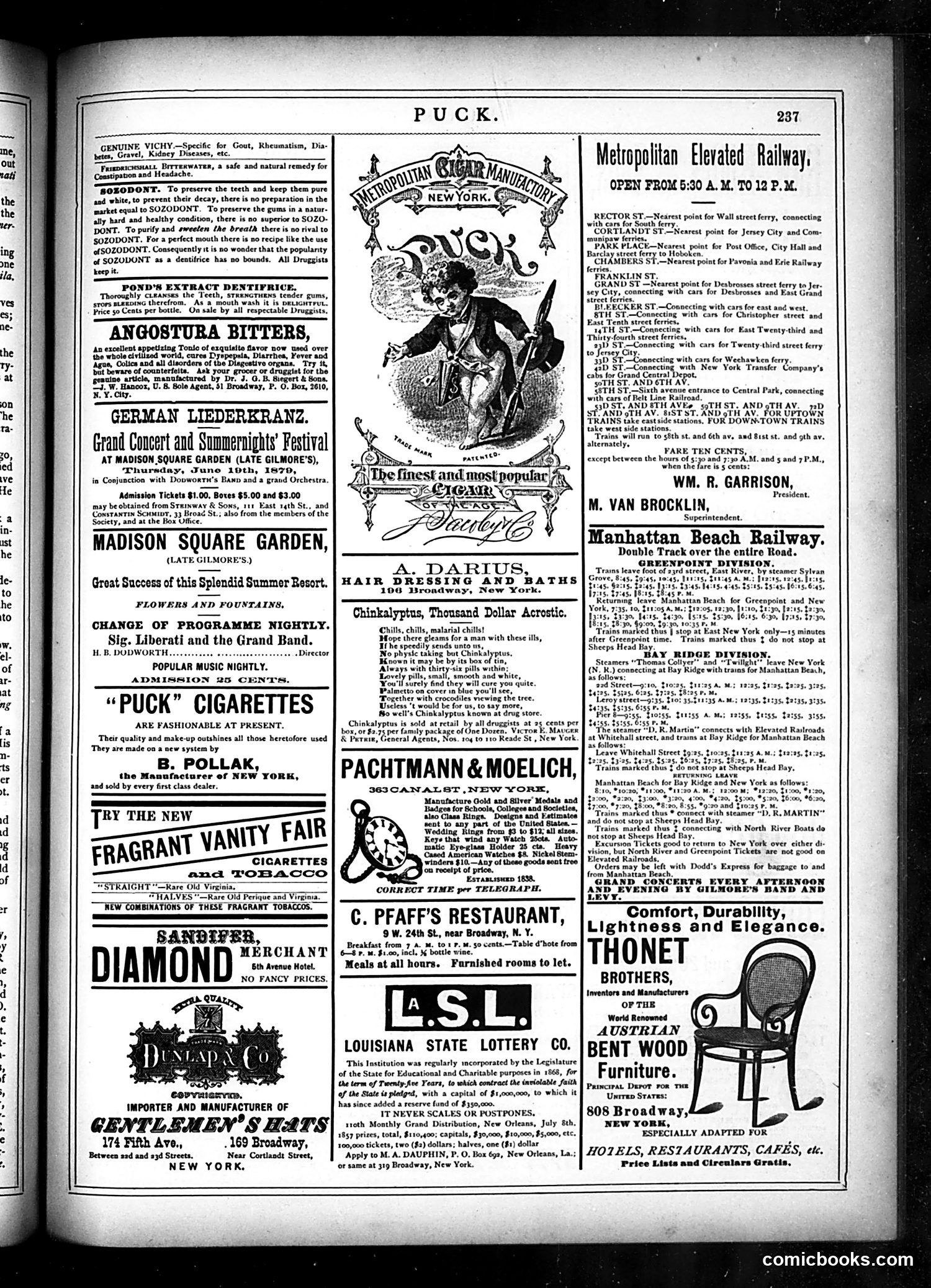
This page is primarily **advertising and service listings** for New York City businesses (circa late 1800s), with one central illustration. The main cartoon features a cherubic figure labeled "Puck" — the magazine's mascot — holding what appears to be a cigar or smoking implement. The figure is characteristic of Puck magazine's branding: a mischievous sprite representing satirical commentary and humor. Below this are advertisements for cigars, restaurants, furniture, lottery tickets, and transportation services (Metropolitan Elevated Railway, Manhattan Beach Railway). **The content reflects**: This is primarily a **commercial page** rather than political satire. The Puck illustration serves as branding rather than commenting on current events. The advertisements reveal late-19th-century New York commerce — railroads, luxury goods, gambling, and dining establishments catering to urban populations.
This page is primarily **advertisements** with no visible political cartoons or satirical content. The ads feature period businesses (1870s-80s era based on style): clothing retailers like Edw. Ridley & Sons offering suits and dry goods; Lord & Taylor's bathing suits; photographers including E. Krueger and Naegeli; furniture makers; champagne importers; and other commercial enterprises typical of New York businesses. The only illustrated content is product imagery: champagne bottles for Piper-Heidsieck and John Osborn Son & Co., and Isaac Smith's umbrellas with a decorative logo. As a Puck magazine page, this represents the publication's revenue model rather than its satirical mission. The back pages of such magazines were devoted entirely to paying advertisements rather than editorial content.
This page is primarily **advertising**, not satirical content. It contains commercial advertisements for various late 19th-century products and services, including: - Clothing retailers (bathing suits, dress shirts, gloves) - A Vienna coffee pot - Hungarian wines and champagne - Umbrellas and parasols - An "America" Extra Dry Champagne - A tailor shop (Barrett) - Steamboat passage (Albany and Troy day boats) - Watches and jewelry - A patent filing system for Puck magazine itself The only visual element beyond product images is a small decorative illustration of a cherub or allegorical figure with a champagne bottle. There are no political cartoons or satirical commentary visible on this page—it functions as a revenue-generating advertising section of the magazine rather than editorial content.
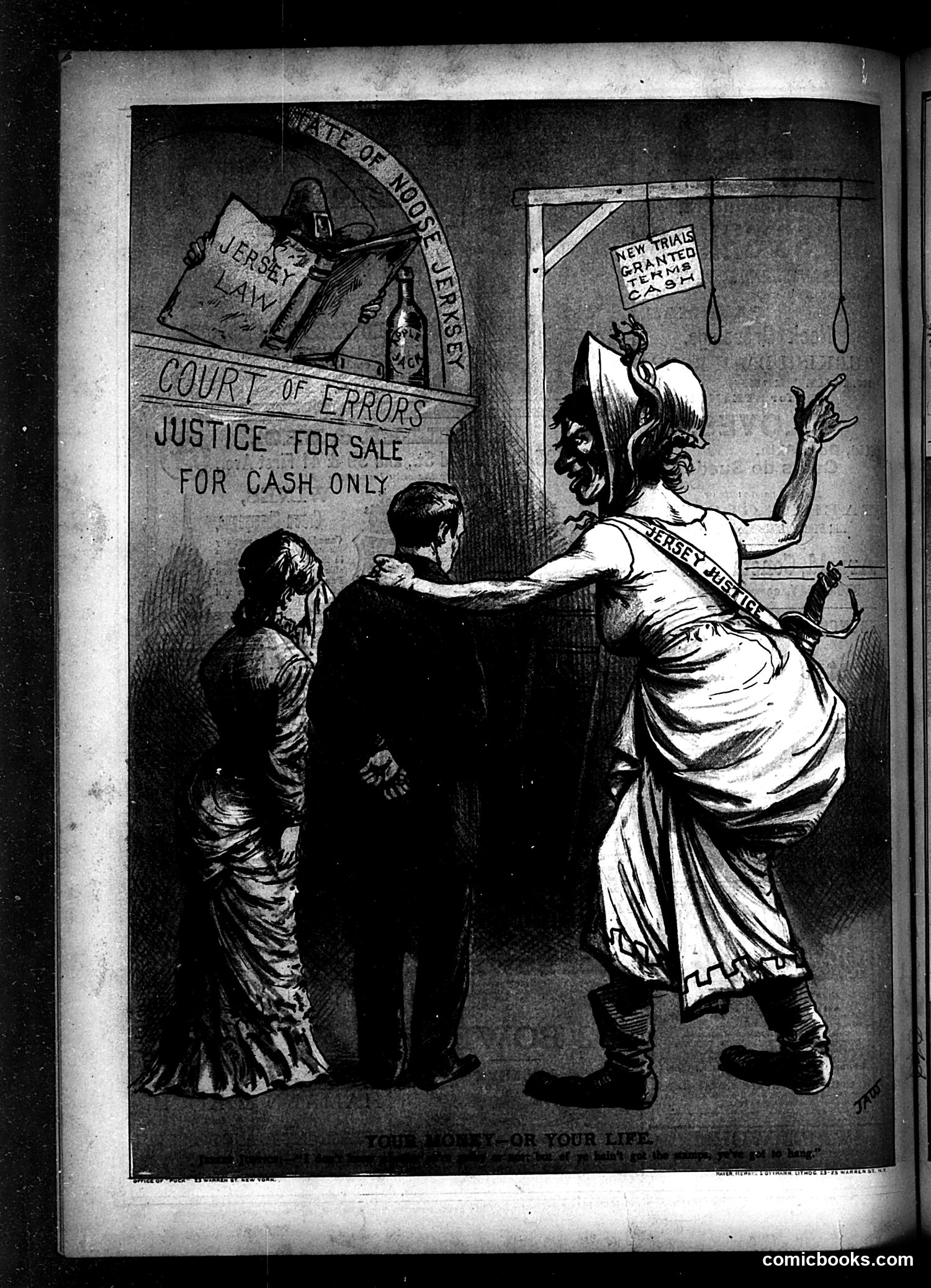
This Puck cartoon satirizes corruption in New Jersey's legal system. The central image depicts Lady Justice (identifiable by her classical robes and blindfold) operating a "Court of Errors" where "Justice for Sale / For Cash Only" — explicitly labeling the judiciary as corrupt and purchasable. Two figures on the left appear to be wealthy clients or politicians conducting business with the corrupted Justice figure. The right panel references "New Trials Granted / To Cash" with nooses visible, suggesting that wealthy defendants can literally escape execution through bribery. The caption reads "Your Life or Tour Life," implying that justice outcomes depend on financial resources rather than law. This is a damning critique of New Jersey's judicial system as fundamentally compromised by money.