
Puck, 1879-06-18 · page 3 of 16
Puck — June 18, 1879 — page 3: what you’re looking at
What you’re looking at
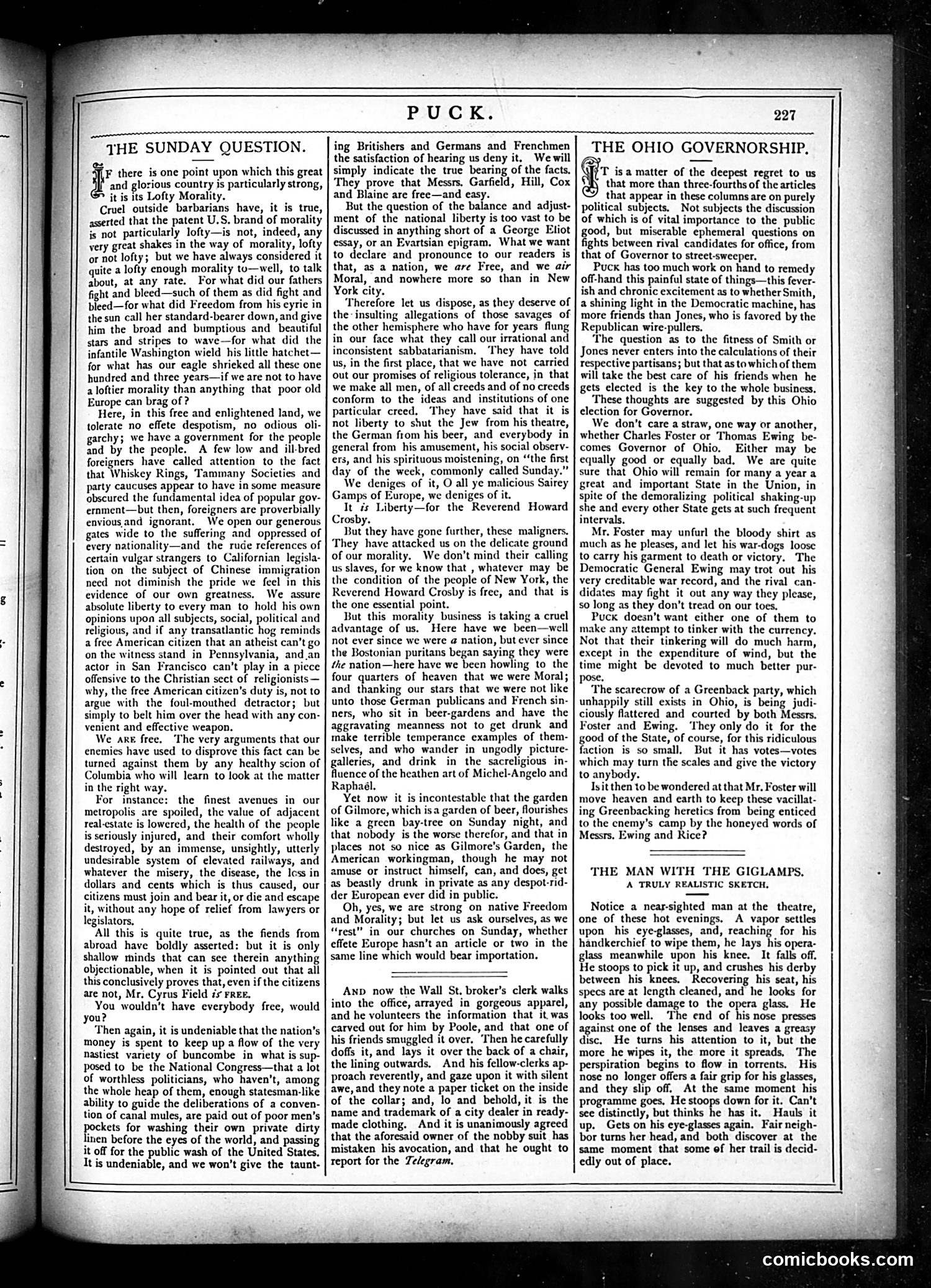
This page contains three distinct articles with no visible political cartoons: **"The Sunday Question"** discusses religious tolerance and liberty, defending against accusations that America is intolerant of Catholics, Jews, and other minorities. It argues Americans are fundamentally free and criticizes those who claim otherwise. **"The Ohio Governorship"** debates candidates for Ohio's governor, likely Foster and General Ewing, discussing their relative merits without taking a strong partisan stance. **"The Man with the Giglamps"** is a humorous sketch about a myopic theater-goer whose thick eyeglasses cause comic mishaps—he crushes them, loses them, and generally creates disturbance through poor vision. The page is primarily text-based editorial and satirical commentary rather than visual political cartooning.
📄 Transcribed text from this page (OCR, searchable)
Machine-transcribed from the original scan — historical spelling and the odd misread are preserved.
PUCK. 227 JHE SUNDAY QUESTION. F there is one point upon which this great and glorious country is particularly strong, it is its Lofty Morality. Cruel outside barbarians have, it is true, asserted that the patent U.S. brand of morality is not particularly lofty—is not, indeed, any very great shakes in the way of morality, lofty or not lofty; but we have always considered it quite a lofty enough morality to—well, to talk about, at any rate. For what did our fathers fight and bleed—such of them as did fight and bleed—for what did Freedom from his eyrie in the sun call her standard-bearer down, and give him the broad and bumptious and beautiful stars and stripes to wave—for what did the infantile Washington wield his little hatchet— for what has our eagle shrieked all these one hundred and three years—if we are not to have a loftier morality than anything that poor old Europe can brag of ? Here, in this free and enlightened land, we tolerate no effete despotism, no odious oli- garchy; we have a government for the people and by the people. A few low and ill-bred foreigners have called attention to the fact that Whiskey Rings, Tammany Societies and party caucuses appear to have in some measure obscured the fundamental idea of popular gov- ernment—but then, foreigners are proverbially envious and ignorant. We open our generous gates wide to the suffering and oppressed of every nationality—and the rude references of certain vulgar strangers to Californian legisla- tion on the subject of Chinese immigration need not diminish the pride we feel in this evidence of our own greatness. We assure absolute liberty to every man to hold his own opinions upon all subjects, social, political and religious, and if any transatlantic hog reminds a free American citizen that an atheist can’t go on the witness stand in Pennsylvania, and an actor in San Francisco can’t play in a piece offensive to the Christian sect of religionists— why, the free American citizen's duty is, not to argue with the foul-mouthed detractor; but simply to belt him over the head with any con- venient and effective weapon. We are free. The very arguments that our enemies have used to disprove this fact can be turned against them by any healthy scion of Columbia who will learn to look at the matter in the right way. For instance: the finest avenues in our metropolis are spoiled, the value of adjacent real-estate is lowered, the health of the people is seriously injured, and their comfort wholly destroyed, by an immense, unsightly, utterly undesirable system of elevated railways, and whatever the misery, the disease, the lcss in dollars and cents which is thus caused, our citizens must join and bear it, or die and escape it, without any hope of relief from lawyers or legislators, All this is quite true, as the fiends from abroad have boldly asserted: but it is only shallow minds that can see therein anything objectionable, when it is pointed out that all this conclusively proves that, even if the citizens are not, Mr. Cyrus Field és Free. You wouldn't have everybody free, would you? Then again, it is undeniable that the nation’s money is spent to keep up a flow of the very nastiest variety of buncombe in what is sup- posed to be the National Congress—that a lot of worthless politicians, who haven't, among the whole heap of them, enough statesman-like ability to guide the deliberations of a conven- tion of canal mules, are paid out of poor men’s pockets for washing their own private dirty linen before the eyes of the world, and passing it off for the public wash of the United States. It is undeniable, and we won't give the taunt- ing Britishers and Germans and Frenchmen the satisfaction of hearing us deny it, We will simply indicate the true bearing of the facts. They prove that Messrs. Garfield, Hill, Cox and Blaine are free—and easy. But the question of the balance and adjust- ment of the national liberty is too vast to be discussed in anything short of a George Eliot essay, or an Evartsian epigram, What we want to declare and pronounce to our readers is that, as a nation, we are Free, and we air Moral, and nowhere more so than in New York city. ‘Therefore let us dispose, as they deserve of the- insulting allegations of those savages of the other hemisphere who have for years flung in our face what they call our irrational and inconsistent sabbatarianism, ‘They have told us, in the first place, that we have not carried out our promises of religious tolerance, in that we make all men, of all creeds and of no creeds conform to the ideas and institutions of one particular creed, ‘They have said that it is not liberty to shut the Jew from his theatre, the German from his beer, and everybody in gencral from his amusement, his social observ- ers, and his spirituous moistening, on “the first day of the week, commonly called Sunday.” We deniges of it, O all ye malicious Sairey Gamps of Europe, we deniges of it. It és Liberty—for the Reverend Howard Crosby. But they have gone further, these maligners, They have attacked us on the delicate ground of our morality. We don’t mind their calling us slaves, for we know that , whatever may be the condition of the people of New York, the Reverend Howard Crosby is free, and that is the one essential point. But this morality business is taking a cruel advantage of us. Here have we been—well not ever since we were @ nation, but ever since the Bostonian puritans began saying they were the nation—here have we been howling to the four quarters of heaven that we were Moral; and thanking our stars that we were not like unto those German publicans and French sin- ners, who sit in beer-gardens and have the aggravating meanness not to get drunk and make terrible temperance examples of them- selves, and who wander in ungodly picture- galleries, and drink in the sacreligious in- fluence of the heathen art of Michel-Angelo and Raphaél. Yet now it is incontestable that the garden of Gilmore, which isa garden of beer, flourishes like a green bay-tree on Sunday night, and that nobody is the worse therefor, and that in places not so nice as Gilmore’s Garden, the American workingman, though he may not amuse or instruct himself, can, and does, get as beastly drunk in private as any despot-rid- der European ever did in public. Oh, yes, we are strong on native Freedom and Morality; but let us ask ourselves, as we “rest” in our churches on Sunday, whether effete Europe hasn’t an article or two in the same line which would bear importation. Anp now the Wall St. broker’s clerk walks into the office, arrayed in gorgeous apparel, and he volunteers the information that it was carved out for him by Poole, and that one of his friends smuggled it over. ‘Then he carefully doffs it, and lays it over the back of a chair, the lining outwards. And his fellow-clerks ap- proach reverently, and gaze upon it with silent awe, and they note a paper ticket on the inside of the collar; and, lo and behold, it is the name and trademark of a city dealer in ready- made clothing. And it is unanimously agreed that the aforesaid owner of the nobby suit has mistaken his avocation, and that he ought to report for the Telegram, THE OHIO GOVERNORSHIP. 'T isa matter of the deepest regret to us that more than three-fourths of the articles "_ that appear in these columns are on purely political subjects. Not subjects the discussion of which is of vital importance to the public good, but miserable ephemeral questions on fights between rival candidates for office, from that of Governor to street-sweeper. Puck has too much work on hand to remedy off-hand this painful state of things—this fever- ish and chronic excitement as to whether Smith, a shining light in the Democratic machine, has more friends than Jones, who is favored by the Republican wire-pullers. The question as to the fitness of Smith or Jones never enters into the calculations of their respective partisans; but that as to which of them will take the best care of his friends when he gets elected is the key to the whole business. ‘These thoughts are suggested by this Ohio election for Governor. We don't care a straw, one way or another, whether Charles Foster or Thomas Ewing be- comes Governor of Ohio. Either may be equally good or equally bad. We are quite sure that Ohio will remain for many a year a great and important State in the Union, in spite of the demoralizing political shaking-up she and every other State gets at such frequent intervals. Mr. Foster may unfurl the bloody shirt as much as he pleases, and let his war-dogs loose to carry his garment to death or victory. The Democratic General Ewing may trot out his very creditable war record, and the rival can- didates may fight it out any way they please, so long as they don't tread on our toes. Puck doesn’t want cither one of them to make any attempt to tinker with the currency, Not that their tinkering will do much harm, except in the expenditure of wind, but the time might be devoted to much better pur- pose, The scarecrow of a Greenback party, which unhappily still exists in Ohio, is being judi- ciously flattered and courted by both Messrs. Foster and Ewing. ‘They only do it for the good of the State, of course, for this ridiculous faction is so small, But it has votes—votes which may turn the scales and give the victory to anybody. Isit then to be wondered at that Mr. Foster will move heaven and earth to keep these vacillat- ing Greenbacking heretics from being enticed to the enemy’s camp by the honeyed words of Messrs. Ewing and Rice? THE MAN WITH THE GIGLAMPS. A TRULY REALISTIC SKETCH, Notice a neas-sighted man at the theatre, one of these hot evenings. A vapor settles upon his eye-glasses, and, reaching for his handkerchief to wipe them, he lays his opera- glass meanwhile upon his knee. It falls off. He stoops to pick it up, and crushes his derby between his knees. Recovering his seat, his specs are at length cleaned, and he looks for any possible damage to the opera glass. He looks too well. ‘The end of his nose presses against one of the lenses and leaves a greasy disc, He turns his attention to it, but the more he wipes it, the more it spreads, The perspiration begins to flow in torrents. His nose no longer offers a fair grip for his glasses, and they slip off. At the same moment his programme goes, He stoops down for it. Can't see distinctly, but thinks he has it. Hauls it up. Gets on his eye-glasses again. Fair neigh- bor turns her head, and both discover at the same moment that some of her trail is decid- edly out of place, comicbooks.com