
Puck, 1879-06-18 · page 6 of 16
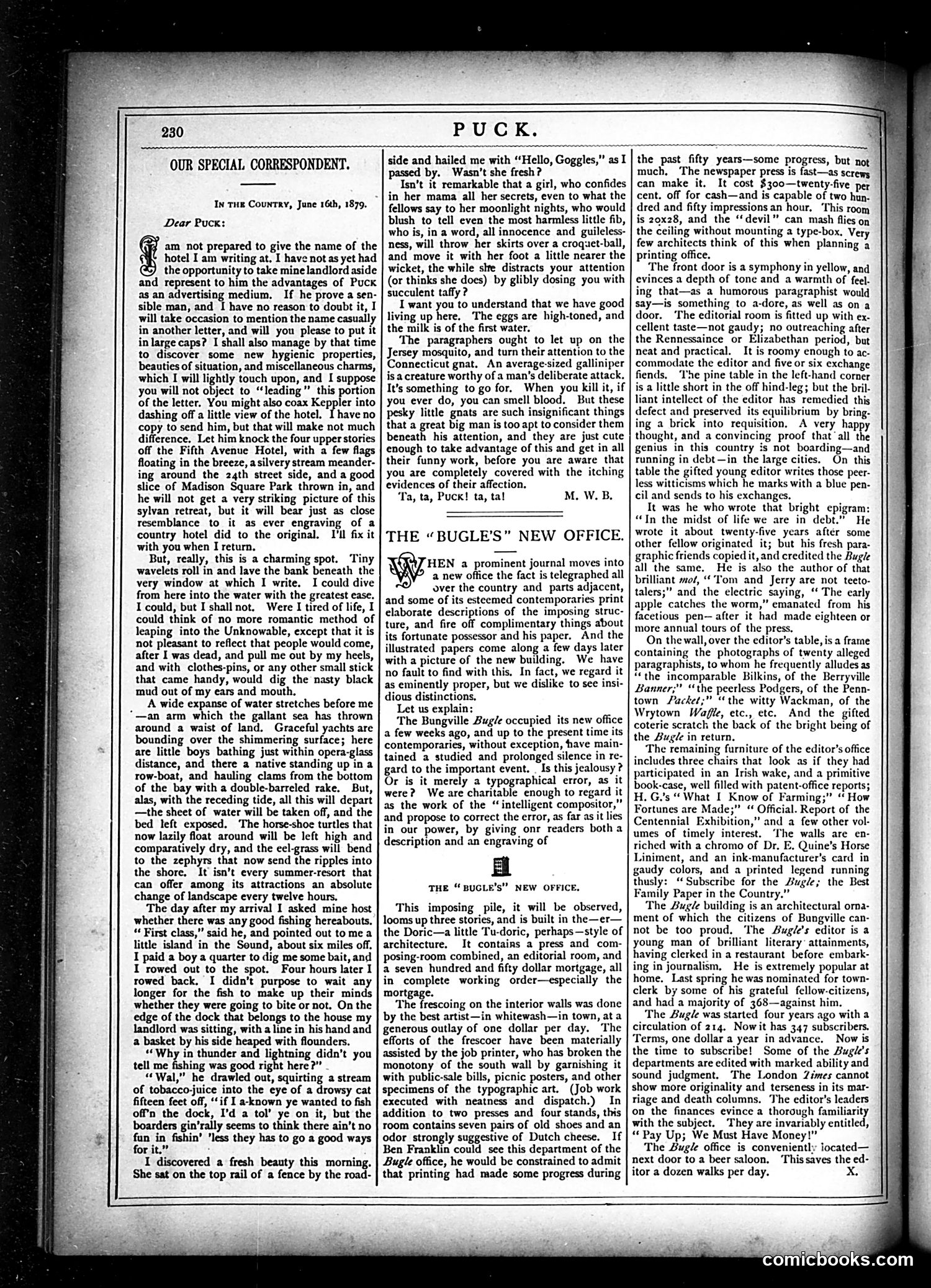
Puck — June 18, 1879 — page 6: what you’re looking at
What you’re looking at
This page contains **no political cartoon**—it's primarily text content from Puck's editorial sections. The main content includes: 1. **"Our Special Correspondent"** — A humorous letter from the countryside describing rural life, country hotels, and local observations in exaggerated, satirical prose typical of Puck's style. 2. **"The Bugle's New Office"** — An article about a journal moving to a new building, discussing the office's modest setup and finances. The piece pokes fun at the publication's limited resources and celebrates the modest accomplishment of the move. Both pieces exemplify Puck's satirical approach to everyday American life and journalism itself, using humor to comment on social conditions rather than direct political cartooning.
📄 Transcribed text from this page (OCR, searchable)
Machine-transcribed from the original scan — historical spelling and the odd misread are preserved.
OUR SPECIAL CORRESPONDENT. In THR Country, June 16th, 1879. Dear Puck: am not prepared to give the name of the hotel I am writing at. I have not as yet had the opportunity to take mine landlord aside and represent to him the advantages of Puck as an advertising medium. If he prove a sen- sible man, and I have no reason to doubt it, I will take occasion to mention the name casually in another letter, and will you please to put it in large caps? I shall also manage by that time to discover some new hygienic properties, beauties of situation, and miscellaneous charms, which I will lightly touch upon, and I suppose you will not object to “leading” this portion of the letter. You might also coax xepP ler into dashing off a little view of the hotel. Ihave no copy to send him, but that will make not much difference. Let him knock the four upper stories off the Fifth Avenue Hotel, with a few flags floating in the breeze, asilvery stream meander- ing around the 24th street side, and a good slice of Madison Square Park thrown in, and he will not get a very striking picture of this sylvan retreat, but it will bear just as close resemblance to it as ever engraving of a country hotel did to the original. I'll fix it with you when I return, But, really, this is a charming spot. ‘Tiny wavelets roll in and lave the bank beneath the very window at which I write. I could dive from here into the water with the greatest ease, I could, but I shall not, Were I tired of life, I could think of no more romantic method of leaping into the Unknowable, except that it is not pleasant to reflect that people would come, after I was dead, and pull me out by my heels, and with clothes-pins, or any other small stick that came handy, would dig the nasty black mud out of my ears and mouth, ‘A wide expanse of water stretches before me “—an arm which the gallant sea has thrown around a waist of land. Graceful yachts are bounding over the shimmering surface; here are little boys bathing just within opera-glass distance, and there a native standing up in a row-boat, and hauling clams from the bottom of the bay with a double-barreled rake. But, alas, with the receding tide, all this will depart —the sheet of water will be taken off, and the bed left exposed. The horse-shoe turtles that now lazily float around will be left high and comparatively dry, and the eel-grass will bend to the zephyrs that now send the ripples into the shore, It isn’t every summer-resort that can offer among its attractions an absolute change of landscape every twelve hours, The day after my arrival I asked mine host whether there was any good fishing hereabouts. “ First class,” said he, and pointed out tome a little island in the Sound, about six miles off. I paid a boy a quarter to dig me some bait, and I rowed out to the spot. Four hours later I rowed back. I didn’t purpose to wait any longer for the fish to make up their minds whether they were going to bite or not. On the edge of the dock that belongs to the house my landlord was sitting, with a line in his hand and a basket by his side heaped with flounders. «Why in thunder and lightning didn’t you tell me fishing was good right here?” “Wal,” he drawled out, squirting a stream of tobacco-juice into the eye of a drowsy cat fifteen feet off, ‘if I a-known ye wanted to fish off the dock, I'd a tol’ ye on it, but the boarders gin’rally seems to think there ain’t no fan in fishin’ ‘less they has to go a good ways for it.” I discovered a fresh beauty this morning. She sat on the top rail of a fence by the road- PUCK. side and hailed me with “Hello, Goggles,” as I by. Wasn’t she fresh? Isn’t it remarkable that a girl, who confides in her mama all her secrets, even to what the fellows say to her moonlight nights, who would blush to tell even the most harmless little fib, who is, in a word, all innocence and guileless- ness, will throw her skirts over a croquet-ball, and move it with her foot a little nearer the wicket, the while slre distracts your attention (or thinks she docs) by glibly dosing you with succulent taffy ? I want you to understand that we have good living up here. The eggs are high-toned, and the milk is of the first water, ‘The paragraphers ought to let up on the Jersey mosquito, and turn their attention to the Connecticut gnat. An average-sized galliniper is a creature worthy of a man's deliberate attack, It’s something to go for. When you kill it, if you ever do, you can smell blood. But these pesky little gnats are such insignificant things that a great big man is too apt to consider them beneath his attention, and they are just cute enough to take advantage of this and get in all their funny work, before you are aware that you are completely covered with the itching evidences of their affection. Ta, ta, Puck! ta, tal M. W. B. THE “BUGLE’S” NEW OFFICE. HEN a prominent journal moves into a new office the fact is telegraphed all over the country and parts adjacent, and some of its esteemed contemporaries print elaborate descriptions of the imposing struc- ture, and fire off complimentary things about its fortunate possessor and his paper. And the illustrated papers come along a few days later with a picture of the new building. We have no fault to find with this, In fact, we regard it as eminently proper, but we dislike to see insi- dious distinctions, Let us explain: ‘The Bungville Bugée occupied its new office a few weeks ago, and up to the present time its contemporaries, without exception, have main- tained a studied and prolonged silence in re- gard to the important event. . Is this jealousy ? Or is it merely a typographical error, as it were? Weare charitable enough to regard it as the work of the “intelligent compositor,” and propose to correct the error, as far as it lies in our power, by giving onr readers both a description and an engraving of a THE “ BUGLE'S” NEW OFFICE, This imposing pile, it will be observed, looms up three stories, and is built in the—er— the Doric—a little Tu-doric, perhaps—style of architecture. It contains a press and com- posing-room combined, an editorial room, and a seven hundred and fifty dollar mortgage, all in complete working order—especially the mortgage. The frescoing on the interior walls was done by the best artist—in whitewash—in town, at a generous outlay of one dollar per day. The efforts of the frescoer have been materially assisted by the job printer, who has broken the monotony of the south wall by garnishing it with public-sale bills, picnic posters, and other specimens of the typographic art. (Job work executed with neatness and dispatch.) In addition to two presses and four stands, this room contains seven pairs of old shoes and an odor strongly suggestive of Dutch cheese. If Ben Franklin could see this department of the Bugle office, he would be constrained to admit that printing had made some progress during the past fifty years—some progress, but not much, The newspaper press is fast—as screws can make it. It cost $300—twenty-five cent. off for cash—and is capable of two hun. dred and fifty impressions an hour. ‘This room is 20x28, and the “devil” can mash flies on the ceiling without mounting a type-box, Very few architects think of this when planning a printing office. The front door is a symphony in yellow, and evinces a depth of tone and a warmth of feel. ing that—as a humorous paragraphist would say—is something to a-dore, as well as on a door. ‘The editorial room is fitted up with ex- cellent taste—not gaudy; no outreaching after the Rennessaince or Elizabethan period, but neat and practical. It is roomy enough to ac- commodate the editor and five or six exchange fiends, ‘I'he pine table in the left-hand corner is a little short in the off hind-leg; but the bril- liant intellect of the editor has remedied this defect and preserved its equilibrium by bring. ing a brick into requisition, A very happy thought, and a convincing proof that‘all the genius in this country is not boarding—and running in debt—in the large cities. On this table the gifted young editor writes those peer- less witticisms which he marks with a blue pen- cil and sends to his exchanges. It was he who wrote that bright epigram: “In the midst of life are in debt.” He wrote it about twenty-five years after some other fellow originated it; but his fresh para- graphic friends copied it, and credited the Bugle all the same. He is also the author of that brilliant moé, “Tom and Jerry are not teeto- talers;” and the electric saying, “The early apple catches the worm,” emanated from his facetious pen— after it had made eighteen or more annual tours of the press. On the wall, over the editor’s table, is a frame containing the photographs of twenty alleged paragraphists, to whom he frequently alludes as “the incomparable Bilkins, of the Berryville Banner; the peerless Podgers, of the Penn- town Packet;" “the witty Wackman, of the Wrytown Waffle, etc., etc. And the gifted coterie scratch the back of the bright being of the Bugle in return. The remaining furniture of the editor’s office includes three chairs that look as if they had participated in an Irish wake, and a primitive book-case, well filled with patent-office reports; H. G.’s “ What I Know of Farming;” “ How Fortunes are Made;” “ Official. Report of the Centennial Exhibition,” and a few other vol- umes of timely interest. ‘The walls are en- riched with a chromo of Dr. E. Quine’s Horse Liniment, and an ink-manufacturer’s card in gaudy colors, and a printed legend running thusly: “Subscribe for the Bugle; the Best Family Paper in the Country.” The Bugle building is an architectural orna- ment of which the citizens of Bungville can- not be too proud. The Bugée’s editor is a young man of brilliant literary’ attainments, having clerked in a restaurant before embark- ing in journalism, He is extremely popular at home, Last spring he was nominated for town- clerk by some of his grateful fellow-citizens, and had a majority of 368—against him. The Bugle was started four years ago with a circulation of 214. Nowit has 347 subscribers. ‘Terms, one dollar a year in advance. Now is the time to subscribe! Some of the Bugh’s departments are edited with marked ability and sound judgment. The London Zimes cannot show more originality and terseness in its mar- riage and death columns. The editor's leaders on the finances evince a thorough familiarity with the subject. They are invariably entitled, “Pay Up; We Must Have Money!” The Bugle office is conveniently iocated— next door to a beer saloon, ‘This saves the ed- itor a dozen walks per day.