
Puck, 1879-06-18 · page 2 of 16
Puck — June 18, 1879 — page 2: what you’re looking at
What you’re looking at
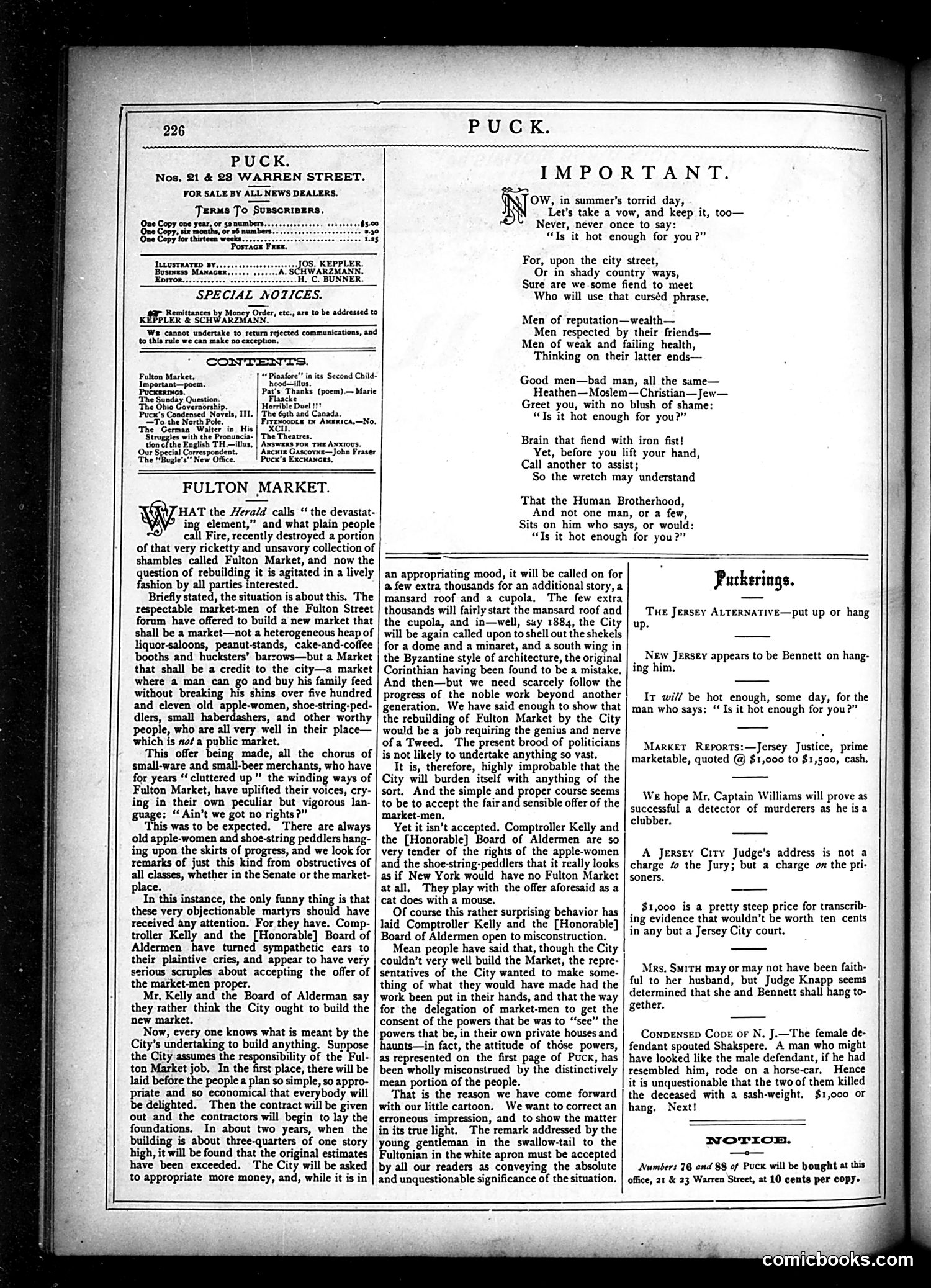
This page is primarily **editorial content rather than a political cartoon**. The main feature is "Fulton Market," a lengthy satirical article about New York City's famous market and a dispute over rebuilding it. The piece satirizes **political inefficiency and corruption** surrounding the market's reconstruction. It critiques the Board of Aldermen and Comptroller Kelly for their mishandling of the project, suggesting they're more interested in personal gain than public service. The satire targets the gap between what politicians promise versus what they actually deliver. The smaller "Puckerings" section contains brief quips mocking contemporary figures and events, though specific identities are unclear without additional context. The overall tone is typical Puck: using humor to expose governmental incompetence and self-interest.
📄 Transcribed text from this page (OCR, searchable)
Machine-transcribed from the original scan — historical spelling and the odd misread are preserved.
226 PUCK. PUCK. Nos. 21 & 28 WARREN STREET. FOR SALE BY ALL NEWS DEALERS. Jerus Jo Sunscrinzns. JOS. KEPPLER. ‘HWARZMANN. C. BUNNER. SPECIAL NOTICES. Remittances by Money Order, etc., are to be addressed to KEPPLER & SCHWARZMANN. ‘We cannot undertake to return rejected communications, and to this rule we can make no exception. CONTENTS. “Pinafore” in its Second Child- Folton Market, ri important—poem. lus. Pocxanmos. Pat's Thanks (poem)— Marie ‘The Sunday Question: che The Obio Covernorship. Horrible Duel 1!" Puc’s Condensed Novels, IIT. | The 69th and Canada. Pole Frezsoopts i Axrnica,—No. XC. The Theatres. Axswans rox THe Axxious. | Ancute Gascorne—Joha Fraser | Pocx’s Excuances, FULTON MARKET. HAT the Herald calls “ the devastat- element,” and what plain people I Fire, recently destroyed a portion of that very ricketty and unsavory collection of shambles called Fulton Market, and now the question of rebuilding it is agitated in a lively fashion by all ties interested. Briefly stated, the situation is about this. The respectable market-men of the Fulton Street forum have offered to build a new market that shall be a market—not a heterogencous heap of liquor-saloons, peanut-stands, cake-and-coffee booths and hucksters’ barrows—but a Market that shall be a credit to the city—a market where a man can go and buy his family feed without breaking his shins over five hundred and eleven old apple-women, shoe-string-ped- dlers, small haberdashers, and other worthy people, who are all very well in their place— which is sof a public market. This offer being made, all the chorus of small-ware and small-beer merchants, who have for years ‘‘cluttered up" the winding ways of Fulton Market, have uplifted their voices, cry- ing in their own peculiar but vigorous lan- guage: “‘ Ain’t we got no rights?” This was to be expected. There are always old apple-women and shoe-string peddlers hang- ing upon the skirts of progress, and we look for remarks of just this kind from obstructives of all classes, whether in the Senate or the market- place. In this instance, the only funny thing is that these very objectionable martyrs should have received any attention. For they have. Comp- troller Kelly and the [Honorable] Board of Aldermen have turned sympathetic ears to their plaintive cries, and appear to have very serious scruples about accepting the offer of the market-men proper. Mr. Kelly and the Board of Alderman say they rather think the City ought to build the new market. Now, every one knows what is meant by the City’s undertaking to build anything. Suppose the City assumes the responsibility of the Ful- ton Market job. In the first place, there will be laid before the people a plan so simple, so appro- priate and so economical that everybody will be delighted. Then the contract will be given out and the contractors will begin to lay the foundations. In about two years, when the building is about three-quarters of one story high, it will be found that the original estimates have been exceeded. The City will be asked IMPORTANT. OW, in summer's torrid day, Let's take a vow, and keep it, too— Never, never once to say: Ts’ it hot enough for you?” For, upon the city street, Or in shady country ways, Sure are we-some fiend to meet Who will use that curséd phrase. Men of reputation—wealth— Men respected by their friends— Men of weak and failing health, Thinking on their latter ends— Good men—bad man, all the same— Heathen—Moslem—Christian—Jew— Greet you, with no blush of shame: “Ts it hot enough for you?” Brain that fiend with iron fist! Yet, before you lift your hand, Call another to assist; So the wretch may understand That the Human Brotherhood, And not one man, or a few, Sits on him who says, or would: “Is it hot enough for you?” an appropriating mood, it will be called on for a few extra thousands for an additional story, a mansard roof and a cupola. The few extra thousands will fairly start the mansard roof and the cupola, and in—well, suy 1884, the City will be again called upon to shell out the shekels for a dome and a minaret, and a south wing in the Byzantine style of architecture, the original Corinthian having been found to be a mistake. And then—but we need scarcely follow the progress of the noble work beyond another generation. We have said enough to show that the rebuilding of Fulton Market by the City would be a job requiring the genius and nerve ofa Tweed. The present brood of politicians is not likely to undertake anything so vast, It is, therefore, highly improbable that the City will burden itself with anything of the sort. And the simple bad proper course seems to be to accept the fair and sensible offer of the market-men, Yet it isn’t accepted, Comptroller Kelly and the [Honorable] Board of Aldermen are so very tender of the rights of the apple-women and the shoe-string-peddlers that it really looks as if New York would have no Fulton Market atall. They play with the offer aforesaid as a cat does with a mouse. Of course this rather surprising behavior has laid Comptroller Kelly and the [Honorable] Board of Aldermen open to misconstruction. Mean people have said that, though the City couldn’t very well build the Market, the repre- sentatives of the City wanted to make some- thing of what they would have made had the work been put in their hands, and that the way for the delegation of market-men to get the consent of the powers that be was to ‘‘see” the powers that be, in their own private houses and haunts—in fact, the attitude of thdse powers, as represented on the first page of Puck, has been wholly misconstrued by the distinctively mean portion of the people. That is the reason we have come forward with our little cartoon, We want to correct an erroneous impression, and to show the matter in its true light. The remark addressed by the roung gentleman in the swallow-tail to the ‘ultonian in the white apron must be accepted by all our readers as conveying the absolute Puckerings. ‘THE Jersey ALTERNATIVE—put up or hang up. New Jersey appears to be Bennett on hang- ing him. Ir will be hot enough, some day, for the man who says: “ Is it hot enough for you?” Market Reports:—Jersey Justice, prime marketable, quoted @ $1,000 to $1,500, cash, We hope Mr. Captain Williams will prove as successful a detector of murderers as he isa clubber. A Jersey City Judge’s address is not a charge fo the Jury; but a charge on the pri- soners, $1,000 is a pretty steep price for transcrib- ing evidence that wouldn’t be worth ten cents in any but a Jersey City court. Mrs. SaiTH may or may not have been faith- ful to her husband, but Judge Knapp seems determined that she and Bennett shall hang to- gether, Conpensep Cope oF N. J.—The female de- fendant spouted Shakspere. A man who might have looked like the male defendant, if he had resembled him, rode on a horse-car, Hence it is unquestionable that the two of them killed the deceased with a sash-weight. $1,000 or hang. Next! NOTICE. —— Numbers 76 and 88 of Puck will be bought at this office, 21 & 23 Warren Street, at 10 cents per copy. to appropriate more mone; d, whil in | and unquestionable significance of the situation.