
A complete issue · 16 pages · 1878
Puck — July 10, 1878
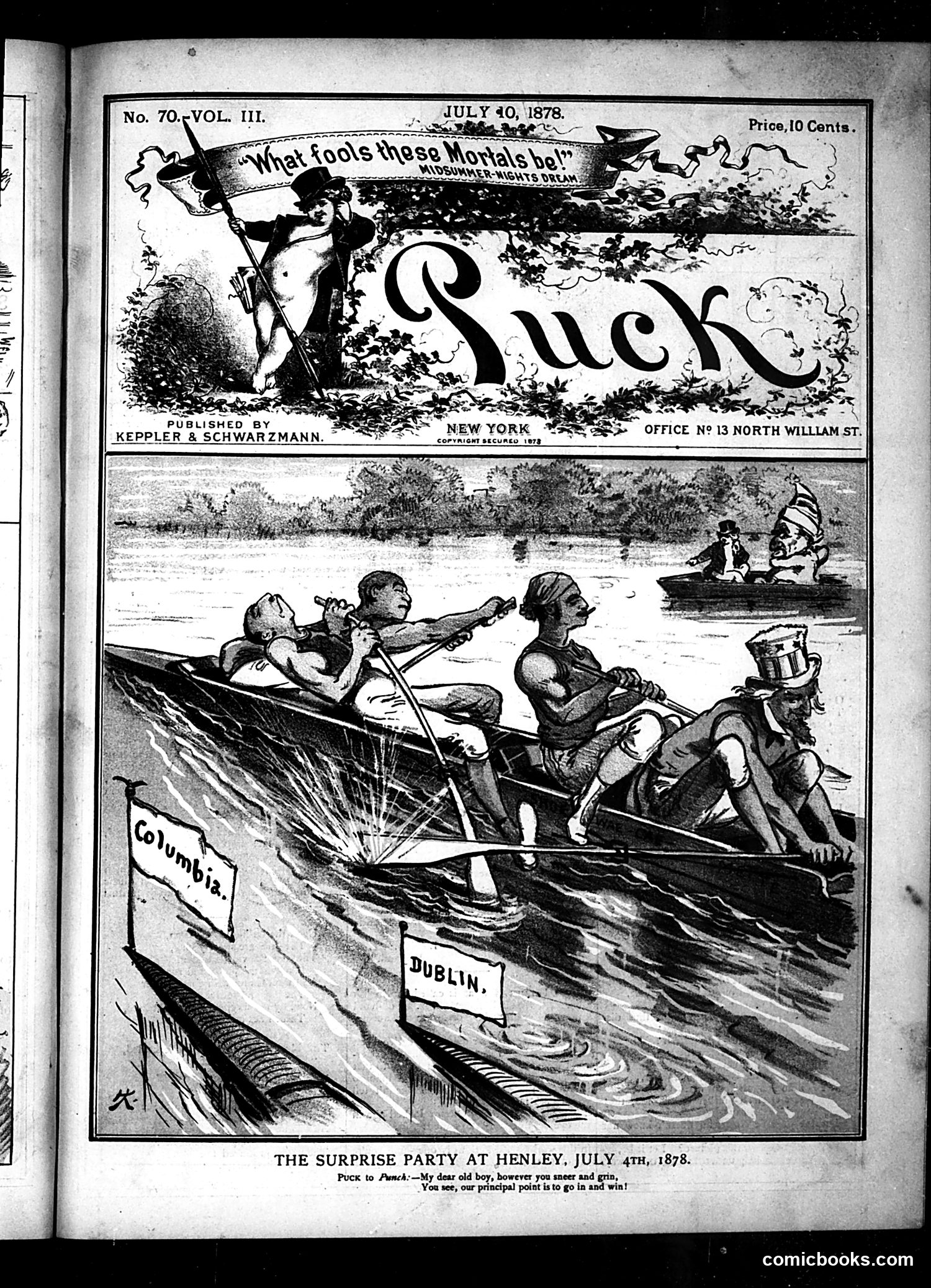
This cartoon satirizes an incident at Henley-on-Thames, England's prestigious rowing regatta. The boat labeled "Dublin" contains Irish rowers, while "Columbia" (representing America) appears nearby. The figure in the top hat (likely a British official or aristocrat) seems alarmed by their presence. The satire plays on the 4th of July timing—American Independence Day—suggesting Irish and American rowers created an unexpected, unwelcome "surprise" at this elite British sporting event. The caption's quote about "old boy" and "principal point" implies social discomfort among the British establishment at having colonial/foreign competitors intrude on their exclusive gathering. The joke reflects 19th-century tensions between Britain and both Irish and American interests.
This page is primarily **editorial and literary content** rather than political cartoons. The main feature is "Gail Hamilton," a portrait and biographical piece about a notable female writer/correspondent for *The Tribune* magazine. The text reveals she had dual identities—one public persona and another private identity—which the editors are now revealing for the first time. The "Puckerings" column contains brief satirical observations on contemporary society: women's athletics, book learning's limitations, prayer meetings, music appreciation, and social customs. The "Cartoons" section features **light verse** about American ideals and summer pleasures—not political satire. There's no clear identification of specific political figures or events; instead, it's general social commentary typical of Puck's humorous approach to American life and values.
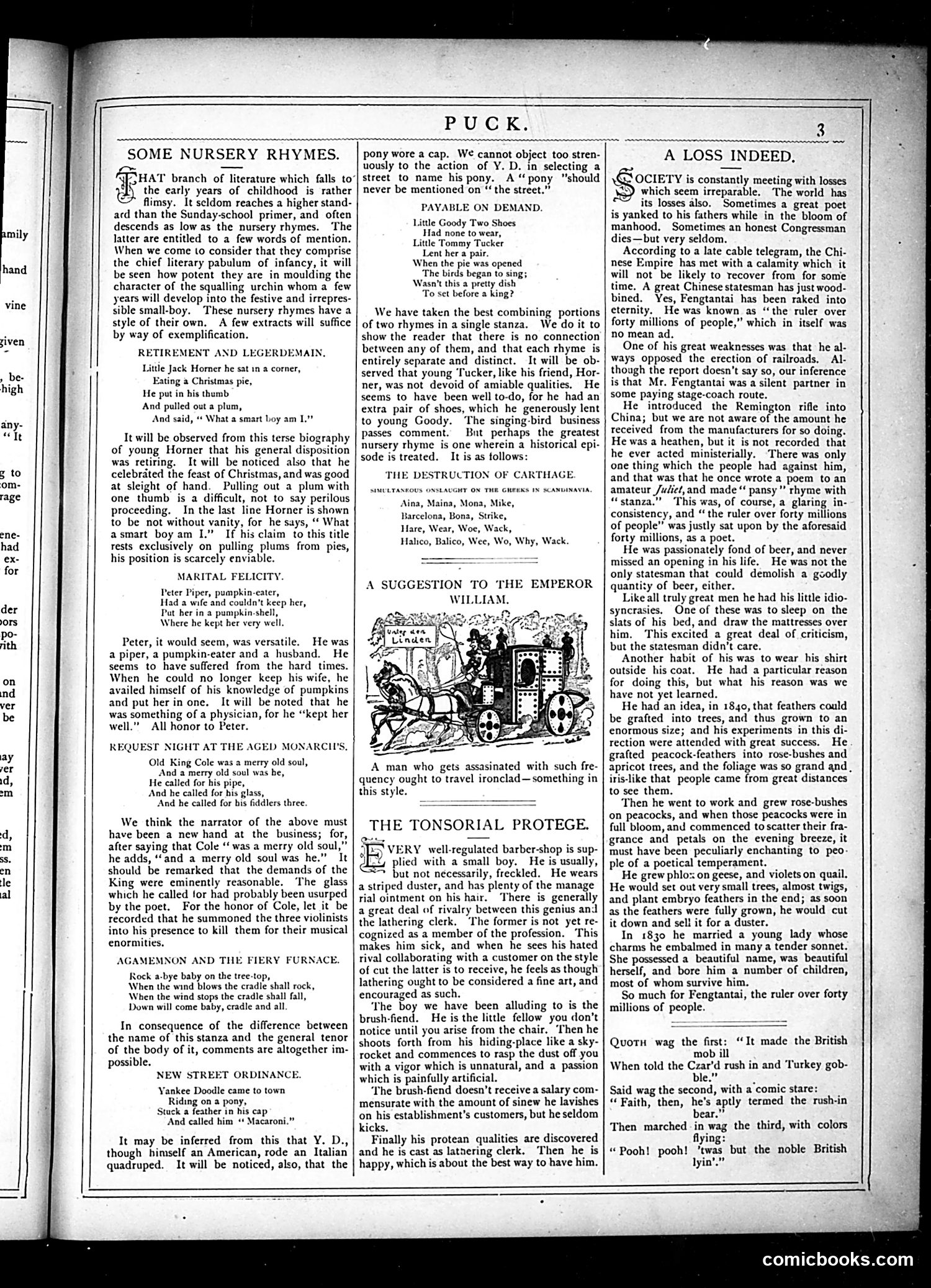
This page contains several satirical pieces rather than a single cartoon. "A Loss Indeed" mocks the death of a Chinese statesman, sarcastically comparing his importance to that of a poet who wrote about feathers and beer. The piece critiques what it sees as disproportionate mourning. "A Suggestion to the Emperor William" features an illustration (partially visible) with accompanying text about a man assassinated on a train—likely referencing a contemporary event, though the specific incident is unclear from this excerpt alone. "The Tonsorial Protege" satirizes a barber's assistant who becomes a pretentious lattering clerk, mocking social climbing and affected behavior in the working class. Other pieces include nursery rhyme parodies and satirical verses on various topics. The overall tone is characteristic of Puck's late-19th-century social and political satire.
This page contains **two literary pieces**, not political cartoons: 1. **"A Tramp's Heaven"** — A sentimental poem by Joe Walker about a homeless man's dreams of comfort and rest, featuring typical late-19th-century sympathy toward vagrants. 2. **"Carhart's Cosmopolitan Circus"** — A satirical story by Ernest Havergal mocking a struggling circus company. The narrative ridicules the circus's financial collapse and the absurd behavior of its mismanaged animal acts (an unruly elephant, giraffe, and lion). The satire targets poor management, debt, and the desperation of traveling circuses during economic hardship. The page reflects Puck's characteristic mix of sentimental verse and satirical prose commentary on American social conditions and commercial failures of the era.
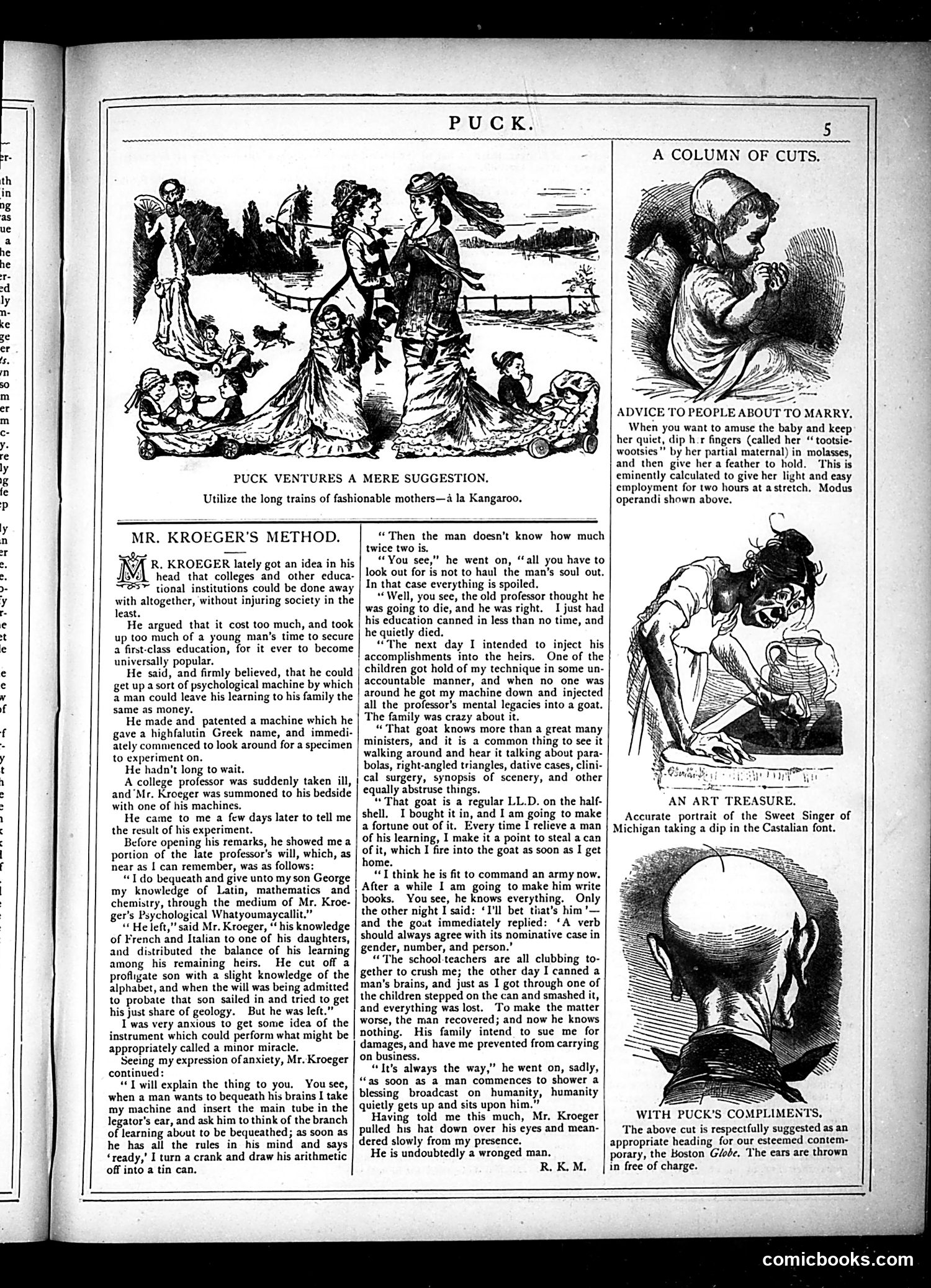
The main cartoon "Puck Ventures a Mere Suggestion" depicts fashionable mothers using long trains on their dresses as kangaroo-like pouches to carry children. This satirizes the impracticality and danger of Victorian women's fashion—the exaggerated trains become absurd when applied to actual childcare. "Mr. Kroeger's Method" tells of an eccentric professor who created a "psychological machine" to transfer his knowledge into his goat's brain. The satire mocks pseudo-scientific educational fads and overly complex pedagogical theories of the era. The remaining cuts offer miscellaneous humor: marriage advice involving molasses and feathers, and a portrait of a "Sweet Singer of Michigan" taking a dip. The page primarily satirizes Victorian fashion excess, dubious scientific trends, and social pretension.
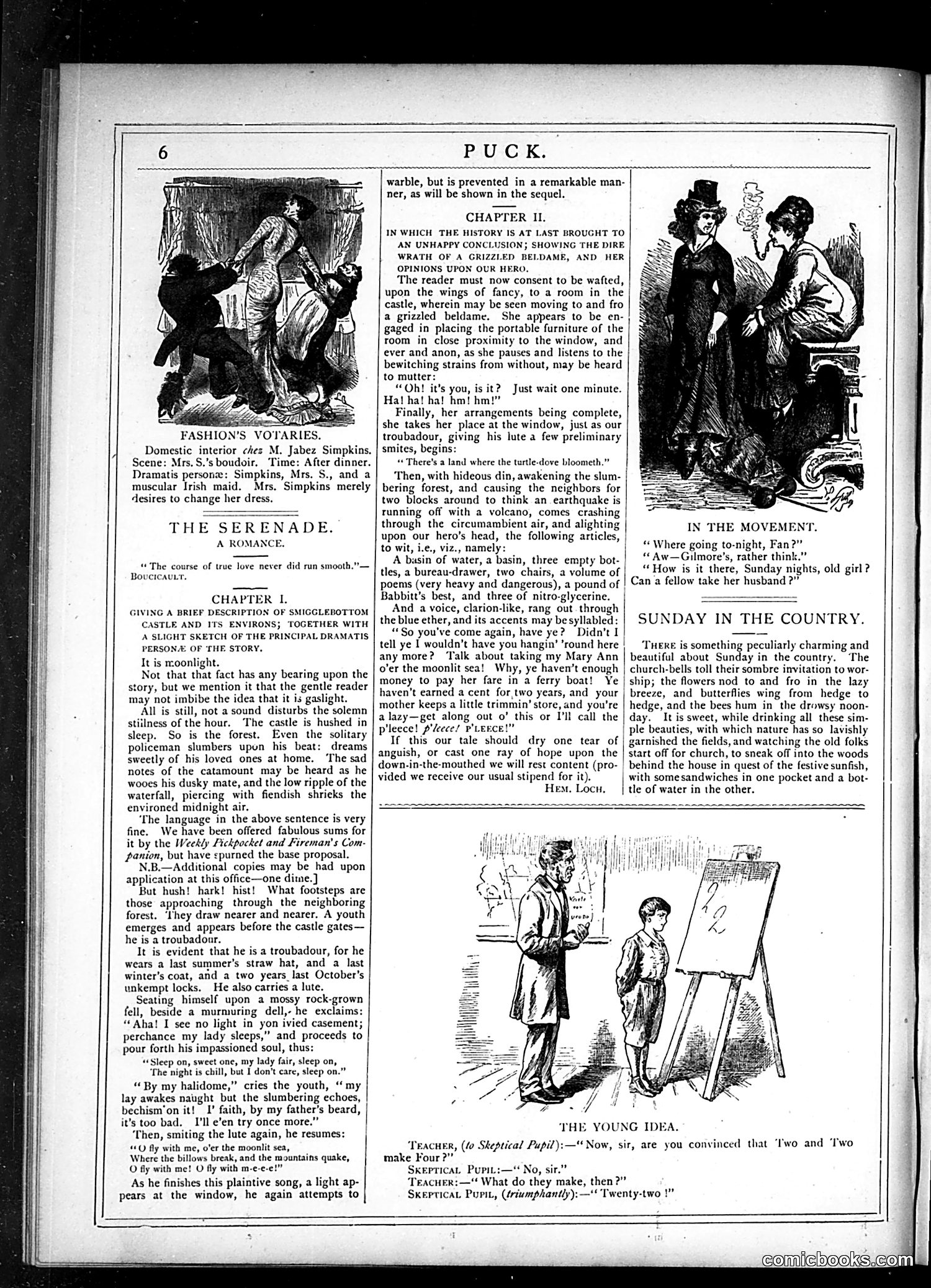
This page contains primarily **literary content** rather than political satire. It features "The Serenade: A Romance," serialized fiction appearing in Chapter II, along with a separate section titled "Sunday in the Country." The illustrations are **decorative and narrative-driven** rather than satirical cartoons: - Top left shows a domestic interior scene with figures in period dress - Upper right depicts people in Victorian clothing, labeled "In the Movement" - Bottom illustration shows "The Young Idea," depicting an adult and child with a drawing or writing lesson The page functions as **entertainment and humor literature** rather than political commentary. The "Young Idea" section contains a light pedagogical joke about mathematics, while the serialized story provides romance-themed narrative fiction typical of Puck's miscellaneous content alongside its famous satirical cartoons.
This page contains a satirical story about Mr. Macintosh, a wealthy gentleman visiting a fashionable dressmaker's establishment in Paris. The narrative mocks Victorian-era gender dynamics and male naiveté: Macintosh becomes entranced by the beautiful female dressmakers and busts, losing focus on practical matters while ostensibly conducting business. The satire targets male susceptibility to feminine charm and the pretensions of high society. The story portrays Macintosh as foolishly distracted by aesthetic beauty (both of women and artwork) when he should be focused on rational business dealings. The humor derives from his internal conflict between desire and propriety—a common theme in Victorian satirical humor about masculine weakness. The page also includes an unrelated poem, "Chintz," by R.K. Munkittrick.
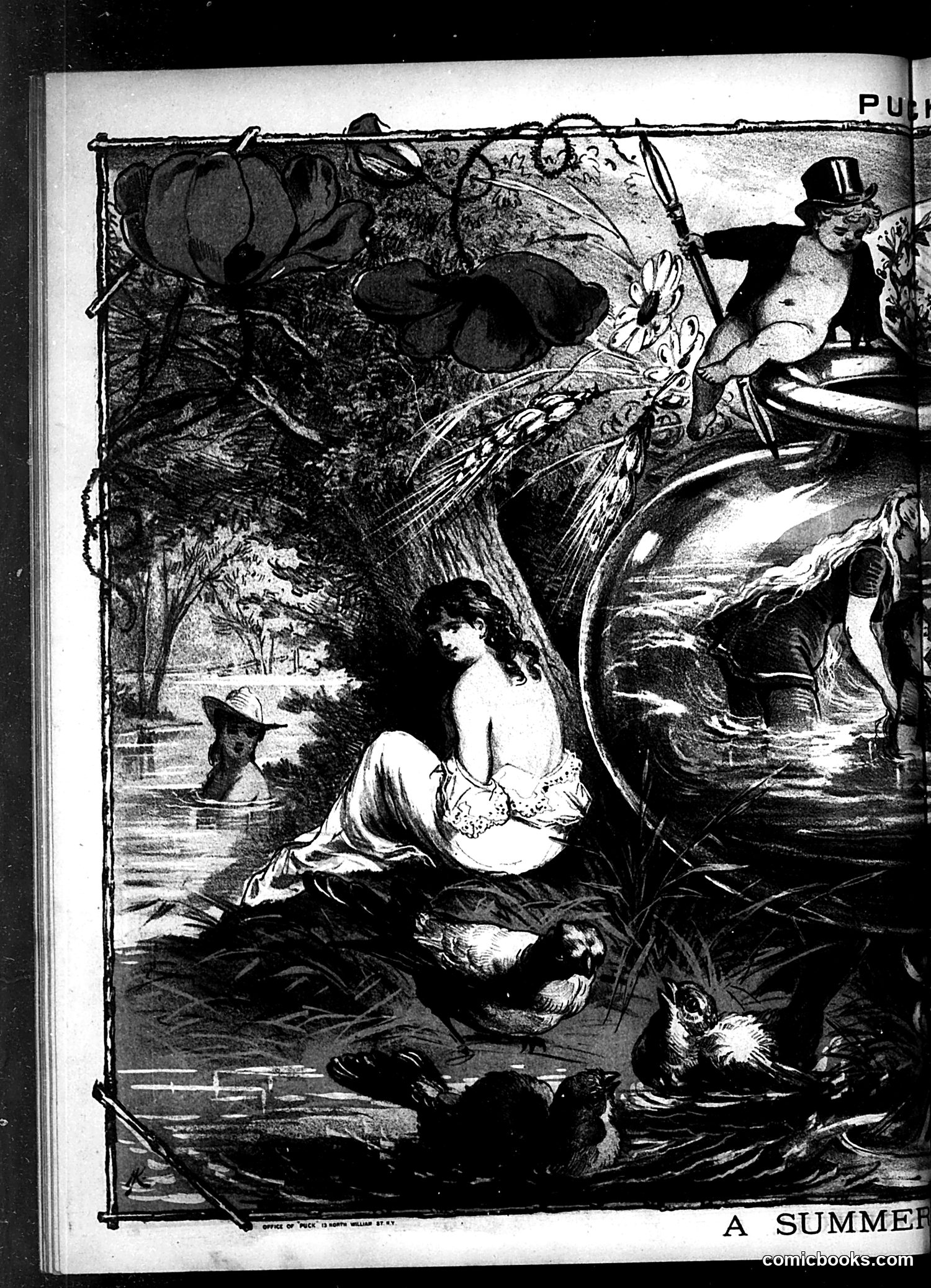
This appears to be a classical allegorical illustration rather than a political cartoon. The image shows a semi-nude female figure in a pastoral setting, surrounded by cherubs, cornucopias, and harvest abundance—traditional iconography representing Summer or a harvest deity. The caption reads "A SUMMER" (partially visible), suggesting this is likely part of a series depicting the four seasons. The elaborate engraving style and mythological figures were common in Puck's decorative content. Without seeing the complete caption or accompanying text, I cannot identify specific political satire or social commentary. This appears to be decorative seasonal artwork rather than topical satire, though the publication date would help clarify any contemporary references I'm unable to detect from the image alone.
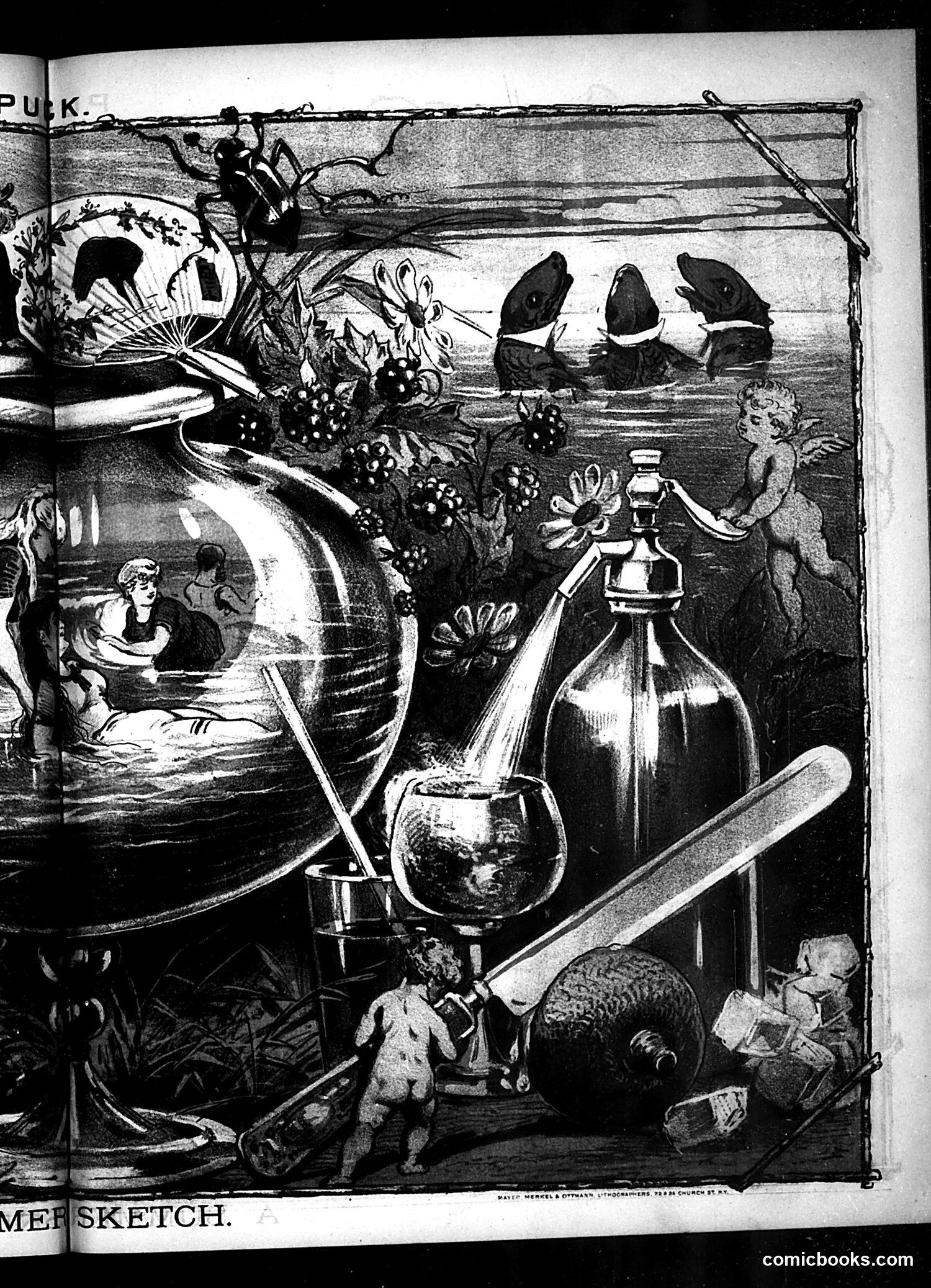
This appears to be a satirical "Sketch" from Puck magazine depicting an alchemist's or naturalist's laboratory scene. The central composition shows various vessels, bottles, and scientific equipment arranged around fantastical elements—cherubs, plants bearing fruit (possibly grapes), and three bird-like creatures in water at top right. The satire likely mocks pseudoscientific pursuits or charlatan "natural philosophers" popular in the late 19th century. The juxtaposition of legitimate scientific apparatus with mythological cherubs and impossible botanical hybrids suggests ridicule of fraudulent claims about transformation, alchemy, or miraculous discoveries. Without clearer text or caption visible in this image, the specific political or social target remains unclear, though the overall message appears critical of scientific pretense.
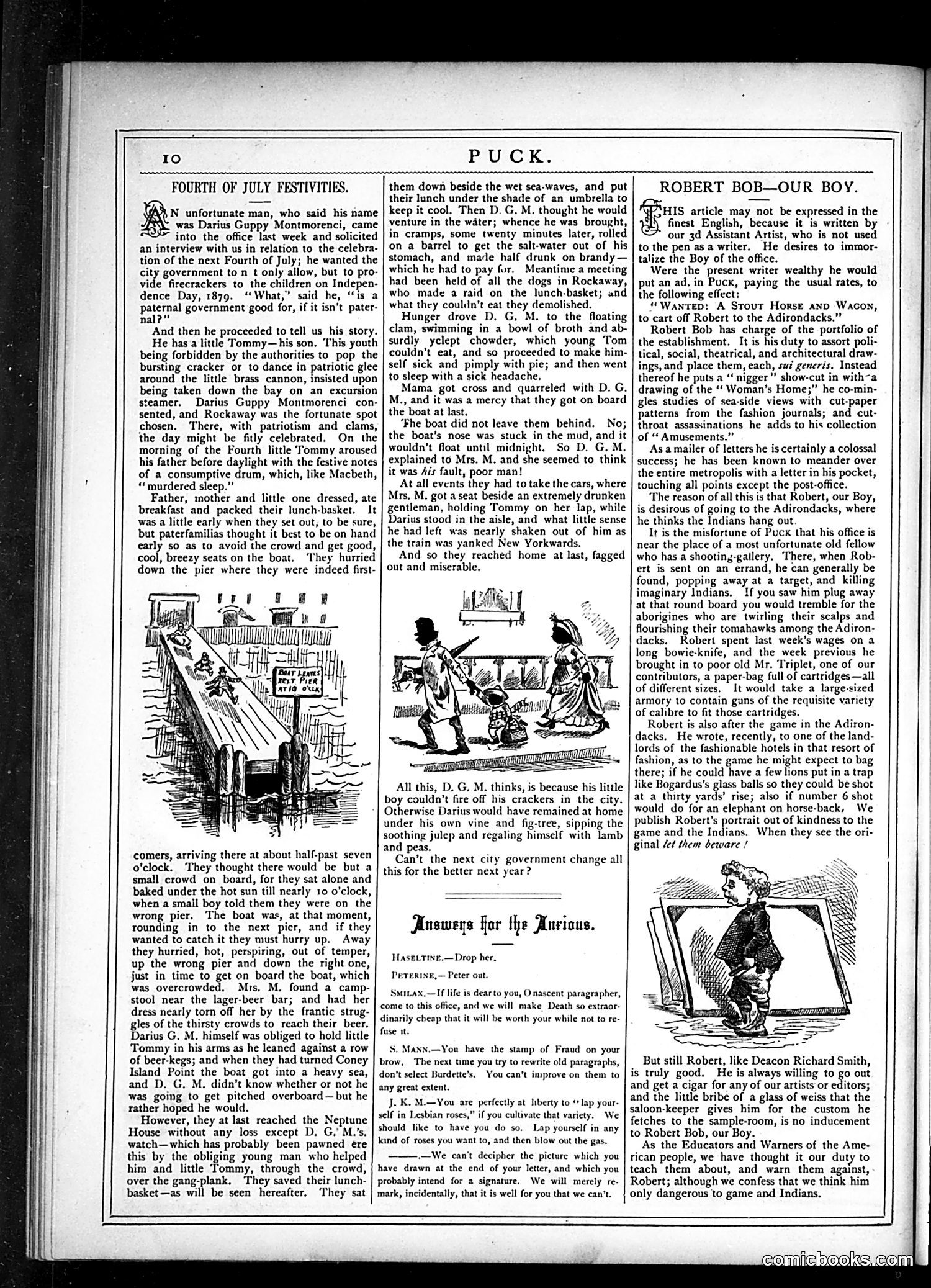
This page satirizes mismanagement of Independence Day celebrations in New York City. The main story mocks an unfortunate man named Darius Cuppy Montmorenci, whose chaotic Fourth of July outing becomes a disaster—his son Tommy gets drunk, he loses money on boat rides, and the family ends up exhausted and broke. The cartoon illustrations show crowded, poorly-organized holiday scenes at the waterfront and piers, with masses of people creating dangerous conditions. The satire targets inadequate city government oversight of public festivities and the dangers posed to families by overcrowded, unregulated holiday entertainment venues. It's a critique of civic negligence during celebrations rather than partisan political satire.
This page contains **literary content rather than political cartoons**. The main features are: 1. **"Doctor Snoop's Elixir of Youth"** — A satirical article mocking a patent medicine scam, depicting an elderly woman duped into buying an ineffective "elixir." This reflects late-19th-century American anxiety about fraudulent health tonics marketed to the gullible. 2. **"Nils Jensen"** — A short story excerpt about a Norwegian man enjoying his homeland's natural beauty. 3. **"Of Auld Lang Syne"** — Poetry by an uncredited author (marked "—London"). The page is primarily **literary/humorous editorial content** rather than visual satire. The "Elixir" piece satirizes common medical fraud of the era, a legitimate target of Puck's mocking journalism.
This page from Puck contains a lengthy fictional narrative titled "Nils" rather than a political cartoon. The story follows a poor Norwegian boy named Nils Jensen who grows into an industrious, principled man despite humble circumstances. The text emphasizes Nils's moral character—his honesty, hard work, and rejection of vice—presenting him as an exemplary immigrant figure. The narrative contrasts his virtue against the temptations of poverty and urban life, celebrating qualities like self-reliance and religious devotion. Rather than satirizing specific political figures or events, this appears to be Puck using its pages for sentimental storytelling that promotes 19th-century values of industry and moral uprightness, possibly reflecting contemporary attitudes toward Scandinavian immigrants and the "American dream" narrative.
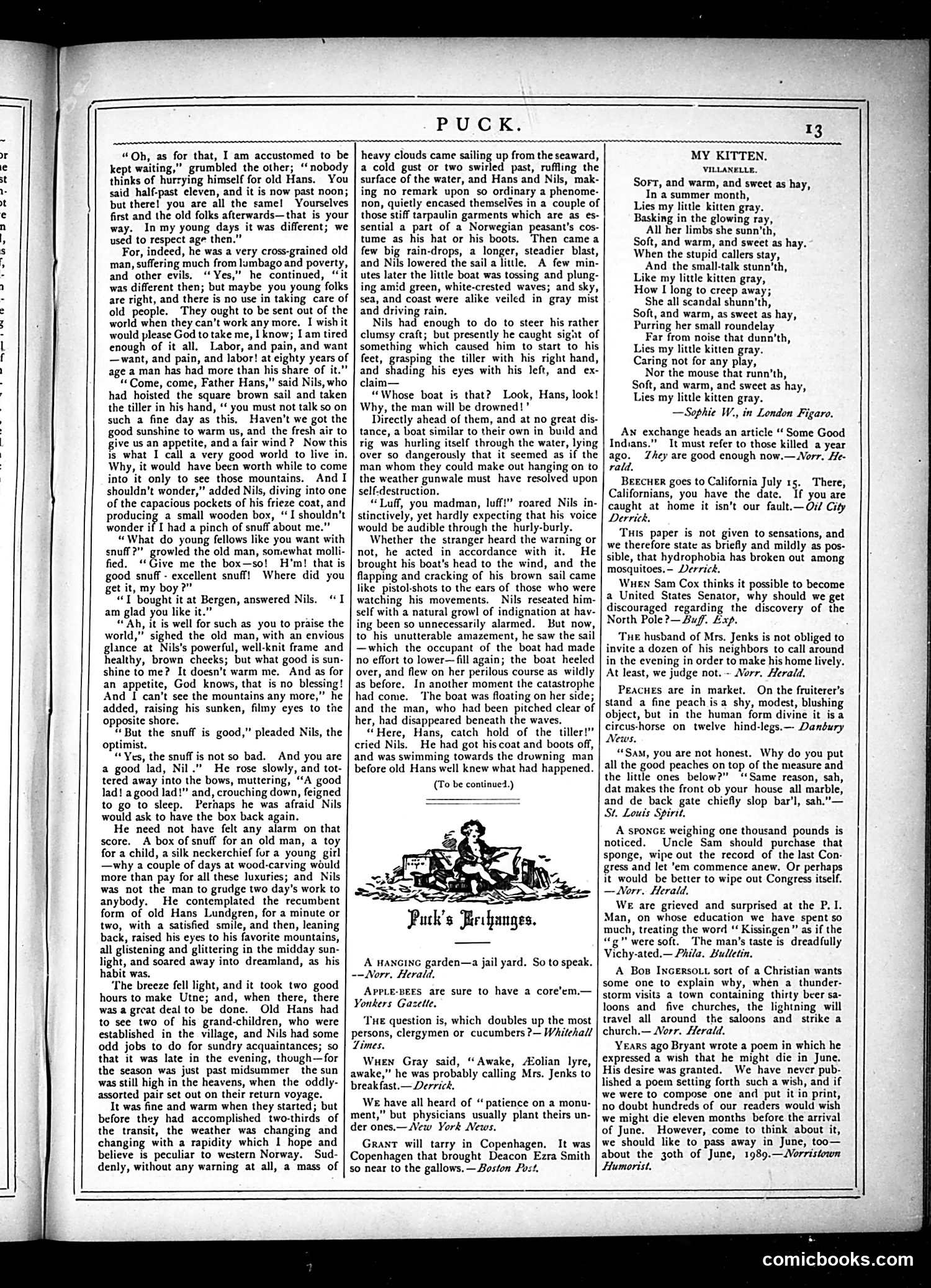
This page combines a serialized story ("Puck's Brigandage") with various editorial snippets and advertisements. The main illustration shows a dramatic maritime rescue scene—two men in a small boat during rough seas, apparently saving someone from drowning. The accompanying text describes their heroic efforts, suggesting this is part of an ongoing narrative serialization. The page also includes "My Kitten" (a poem), "Puck's Brilanges" (brief satirical notes on current topics), and various humorous commentary on contemporary issues including references to a U.S. Senator, California, and social observations. Without clearer caricatures or labeled political figures visible in the artwork itself, the specific satirical targets of individual items remain unclear from this image alone.
This appears to be primarily an **advertising page** from Puck magazine (page 14), not a political cartoon. The page is dominated by commercial advertisements for various products and services: mineral water, furniture, dental offices, printing inks, yeast, safes, and other goods typical of late 19th-century commerce. The only substantive editorial content visible is brief satirical anecdotes in the upper left, including a joke about an American abroad and commentary on Poor Sammy Tilden (likely referencing the 1876 presidential candidate). These are short humorous snippets rather than developed cartoons. The page primarily functioned as revenue-generating advertising space rather than satirical commentary.
This is primarily an **advertising page** rather than satirical content. The page features multiple commercial advertisements typical of Puck magazine's revenue model, including: - Puck's own announcement of a new "General Designing Office" employing cartoonist Joseph Keppler for illustrations and lithographic portraits - Dogan Hatter (102 Nassau Street) - Dinada Co. (gentlemen's vests) - Devenoge & Co. Champagne - A bookstore advertisement - Nicoll the Tailor - A. Werner & Co. wine company - Puck's 1878 Almanac (15 cents) - Patent filing covers and back issue availability The page demonstrates how 19th-century humor magazines sustained themselves through advertising rather than subscription alone. No political satire or cartoon content is visible on this particular page.
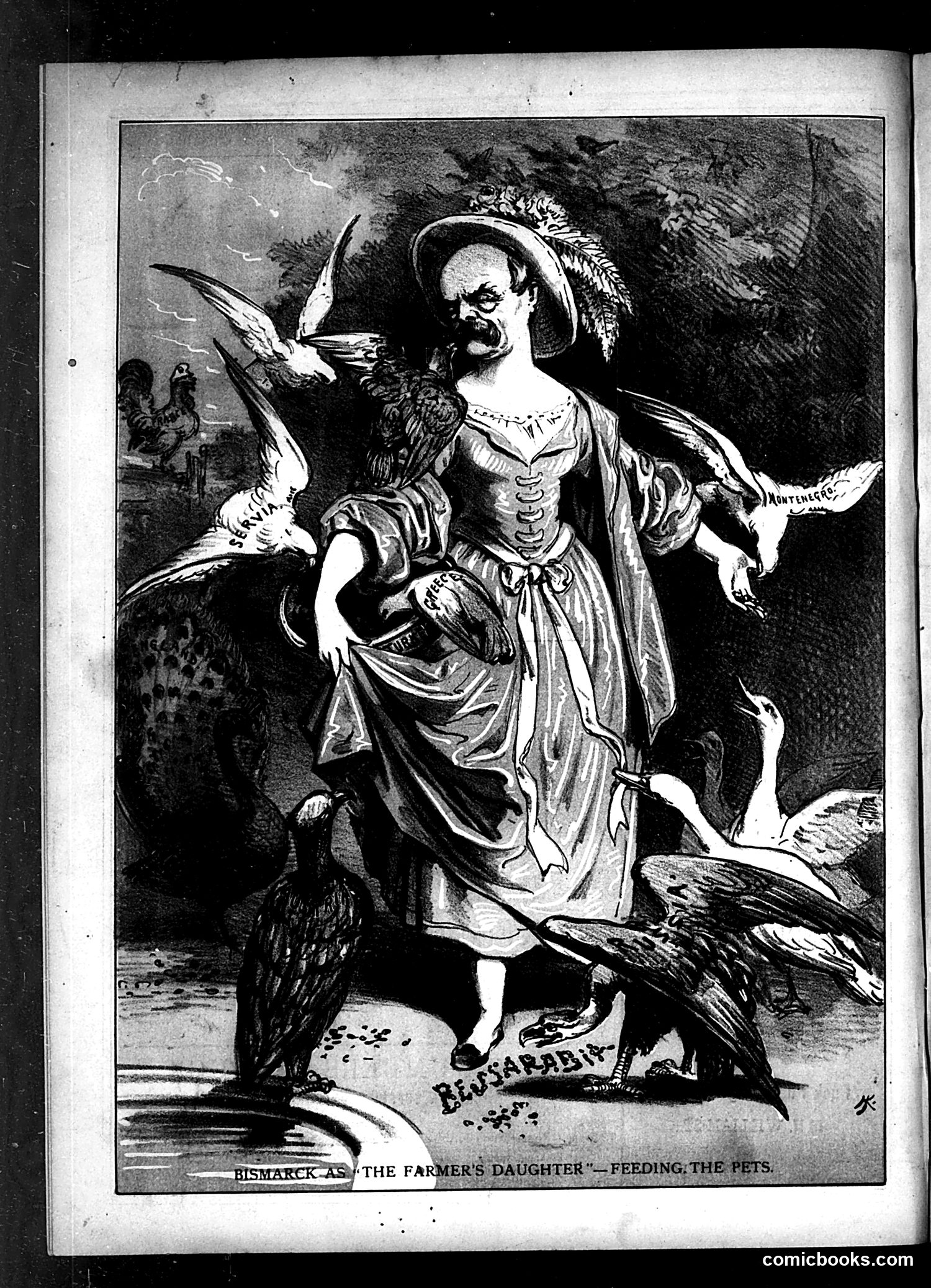
This is a satirical depiction of Otto von Bismarck, Prussia's chancellor, dressed as a farmer's daughter in a mocking feminized costume. He's feeding various birds and animals, likely representing European nations or political entities that Bismarck manipulated during his tenure. The satire ridicules Bismarck's diplomatic maneuvering—portraying his careful "feeding" of various powers as a domestic, feminized activity rather than serious statecraft. By dressing him as a farmer's daughter performing a trivial household task, *Puck* suggests his realpolitik and power plays were either absurd or that he infantilized international relations. The humor relies on American readers' familiarity with Bismarck's notorious diplomatic scheming in European politics.