
Puck, 1878-07-10 · page 13 of 16
Puck — July 10, 1878 — page 13: what you’re looking at
What you’re looking at
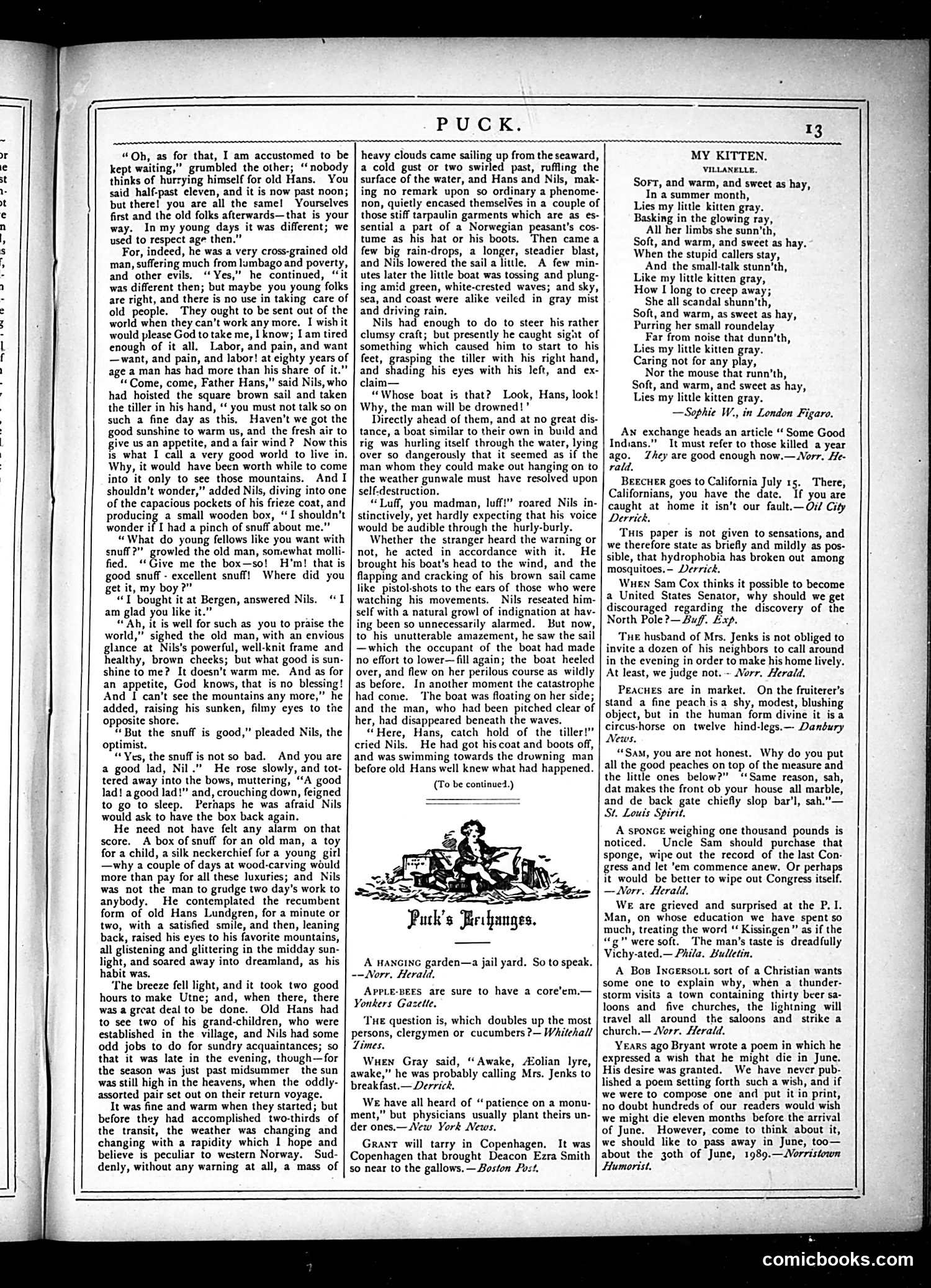
This page combines a serialized story ("Puck's Brigandage") with various editorial snippets and advertisements. The main illustration shows a dramatic maritime rescue scene—two men in a small boat during rough seas, apparently saving someone from drowning. The accompanying text describes their heroic efforts, suggesting this is part of an ongoing narrative serialization. The page also includes "My Kitten" (a poem), "Puck's Brilanges" (brief satirical notes on current topics), and various humorous commentary on contemporary issues including references to a U.S. Senator, California, and social observations. Without clearer caricatures or labeled political figures visible in the artwork itself, the specific satirical targets of individual items remain unclear from this image alone.
📄 Transcribed text from this page (OCR, searchable)
Machine-transcribed from the original scan — historical spelling and the odd misread are preserved.
PUCK. “Oh, as for that, I am accustomed to be kept waiting,” grumbled the other; “nobody thinks of hurrying himself for old Hans. You said half-past eleven, and it is now past noon; but there! you are all the same! Yourselves first and the old folks afterwards—that is your way. In my young days it was different; we used to respect age then.” For, indeed, he was a very cross-grained old man, suffering much from lumbago and poverty, and other evils. ‘ Yes," he continued, “it was different then; but maybe you young folks are right, and there is no use in taking care of old people. They ought to be sent out of the world when they can’t work any more. I wish it would please God to take me, I know; I am tired enough of it all. Labor, and pain, and want —want, and pain, and labor! at eighty years of age a man has had more than his share of it.” “Come, come, Father Hans,” said Nils, who had hoisted the square brown sail and taken the tiller in his hand, ‘* you must not talk so on such a fine day as this, Haven't we got the good sunshine to warm us, and the fresh air to give us an appetite, anda fair wind ? Now this is what I call a very good world to live in. Why, it would have been worth while to come into it only to see those mountains. And I shouldn't wonder,” added Nils, diving into one of the capacious pockets of his frieze coat, and producing a small wooden box, “I shouldn’t wonder if I had a pinch of snuff about me.” “What do young fellows like you want with snuff?” growled the old man, somewhat molli- fied. ‘Give me the box—so! H'm! that is good snuff - excellent snuff! Where did you get it, my boy ?” “T bought it at Bergen, answered Nils. am glad you like it.” “Ab, it is well for such as you to praise the world,” sighed the old man, with an envious glance at Nils's powerful, well-knit frame and healthy, brown cheeks; but what good is sun- shine to me? It doesn't warm me. And as for an appetite, God knows, that is no blessing! And I can't see the mountains any more,” he added, raising his sunken, filmy eyes to the opposite shore. “But the snuff is good,” pleaded Nils, the optimist. “Yes, the snuff is not so bad. And you are a good lad, Nil.” He rose slowly, and tot- tered away into the bows, muttering, “A good lad! a good lad!” and, crouching down, feigned to go to sleep. Perhaps he was afraid Nils would ask to have the box back again. He need not have felt any alarm on that score. A box of snuff for an old man, a toy for a child, a silk neckerchief for a young girl —why a couple of days at wood-carving would more than pay for all these luxuries; and Nils was not the man to grudge two day’s work to anybody. He contemplated the recumbent form of old Hans Lundgren, for a minute or two, with a satisfied smile, and then, leaning back, raised his eyes to his favorite mountains, all glistening and glittering in the midday sun- light, and soared away into dreamland, as his habit was. ‘The breeze fell light, and it took two good hours to make Utne; and, when there, there was a great deal to be done. Old Hans had to see two of his grand-children, who were established in the village, and Nils had some odd jobs to do for sundry acquaintances; so that it was late in the evening, though—for the season was just past midsummer the sun was still high in the heavens, when the oddly- assorted pair set out on their return voyage. It was fine and warm when they started; but before they had accomplished two-thirds of the transit, the weather was changing and changing with a rapidity which I hope and believe is peculiar to western Norway. Sud- denly, without any warning at all, a mass of «“] heavy clouds came sailing up from the seaward, a cold gust or two swirled past, ruffling the surface of the water, and Hans and Nils, mak- ing no remark upon so ordinary a phenome- non, quietly encased themselves in a couple of those stiff tarpaulin garments which are as es- sential a part of a Norwegian peasant’s cos- tume as his hat or his boots. Then came a few big rain-drops, a longer, steadier blast, and Nils lowered the sail a little, A few min- utes later the little boat was tossing and plung- ing amid green, white-crested waves; and sky, sea, and coast were alike veiled in gray mist and driving rain, Nils had enough to do to steer his rather clumsy craft; but presently he caught signt of something which caused him to start to his fect, grasping the tiller with his right hand, and’ shading his eyes with his left, and ex- claim— “Whose boat is that? Look, Hans, look! Why, the man will be drowned!’ Directly ahead of them, and at no great dis- tance, a boat similar to their own in build and rig was hurling itself through the water, lying over so dangerously that it seemed as if the man whom they could make out hanging on to the weather gunwale must have resolved upon self-destruction. “Luff, you madman, luff!” roared Nils in- stinctively, yet hardly expecting that his voice would be audible through the hurly-burly. Whether the stranger heard the warning or not, he acted in accordance with it. He brought his boat’s head to the wind, and the flapping and cracking of his brown sail came like pistol-shots to the ears of those who were watching his movements. Nils reseated him- self with a natural growl of indignation at hav- ing been so unnecessarily alarmed. But now, to his unutterable amazement, he saw the sail —which the occupant of the boat had made no effort to lower—fill again; the boat heeled over, and flew on her perilous course as wildly as before. In another moment the catastrophe had come. The boat was floating on her side; and the man, who had been pitched clear of her, had disappeared beneath the waves. “Here, Hans, catch hold of the tiller!” cried Nils. He had got his coat and boots off, and was swimming towards the drowning man before old Hans well knew what had happened. (To be continued.) A HANGING garden—a jail yard. So to speak. --Norr. Herald. APPLE-BEES are sure to have a core’em,— Yonkers Gazette, ‘Tue question is, which doubles up the most persons, clergymen or cucumbers ?— Whitehall Limes. Wuen Gray said, “Awake, olian lyre, awake,” he was probably calling Mrs. Jenks to breakfast.— Derrick. WE have all heard of “ patience on a monu- ment,” but physicians usually plant theirs un- der ones.—New York News. Grant will tarry in Copenhagen, It was Copenhagen that brought Deacon Ezra Smith so near to the gallows.— Boston Post, MY KITTEN. VILLANELLE. Sort, and warm, and sweet as hay, In a summer month, Lies my little kitten gray. Basking in the glowing ray, All her limbs she sunn’th, Soft, and warm, and sweet as hay. When the stupid callers stay, And the small-talk stunn’th, Like my little kitten gray, How I long to creep away; She all scandal shunn’th, Soft, and warm, as sweet as hay, Purring her small roundelay Far from noise that dunn’th, Lies my little kitten gray. Caring not for any play, Nor the mouse that runn’th, Soft, and warm, and sweet as hay, Lies my little kitten gray. —Sophie W., in London Figaro. An exchange heads an article “ Some Good Indians.” It must refer to those killed a year ago. hey are good enough now.—Norr. He- rald. BEECHER goes to California July 15. There, Californians, you have the date. If you are caught at home it isn’t our fault.—Oi/ City Derrick, Tuts paper is not given to sensations, and we therefore state as briefly and mildly as pos- sible, that hydrophobia has broken out among mosquitoes.- Derrick. Wuen Sam Cox thinks it possible to become a United States Senator, why should we get discouraged regarding the discovery of the North Pole?— Buf’. Exp. ‘Tue husband of Mrs. Jenks is not obliged to invite a dozen of his neighbors to call around in the evening in order to make his home lively. At least, we judge not. - Morr. Herald. Peacues are in market. On the fruiterer’s stand a fine peach isa shy, modest, blushing object, but in the human form divine it isa circus-horse on twelve hind-legs.— Dandury News. “Sam, you are not honest. Why do you put all the good peaches on top of the measure and the little ones below?” ‘Same reason, sah, dat makes the front ob your house all marble, and de back gate chiefly slop bar’l, sah."— ‘St. Louis Spirit. A SPONGE weighing one thousand pounds is noticed. Uncle Sam should purchase that sponge, wipe out the record of the last Con- gress and let 'em commence anew. Or perhaps it would be better to wipe out Congress itself. —WNorr, Herald. We are grieved and surprised at the P. I. Man, on whose education we have spent so much, treating the word ‘ Kissingen” as if the “g" were soft. The man’s taste is dreadfully Vichy-ated.— Phila, Bulletin, A Bop InGeRsoLt sort of a Christian wants some one to explain why, when a thunder- storm visits a town containing thirty beer sa- loons and five churches, the lightning will travel all around the saloons and strike a church.— Norr. Herald. Years ago Bryant wrote a poem in which he expressed a wish that he might die in June. His desire was granted. We have never pub- lished a poem setting forth such a wish, and if we were to compose one and put it in print, no doubt hundreds of our readers would wish we might die eleven months before the arrival of June. However, come to think about it, we should like to pass away in June, too— about the goth of June, 1989.—Worristown Humorist. comicbooks.com