
Puck, 1878-07-10 · page 3 of 16
Puck — July 10, 1878 — page 3: what you’re looking at
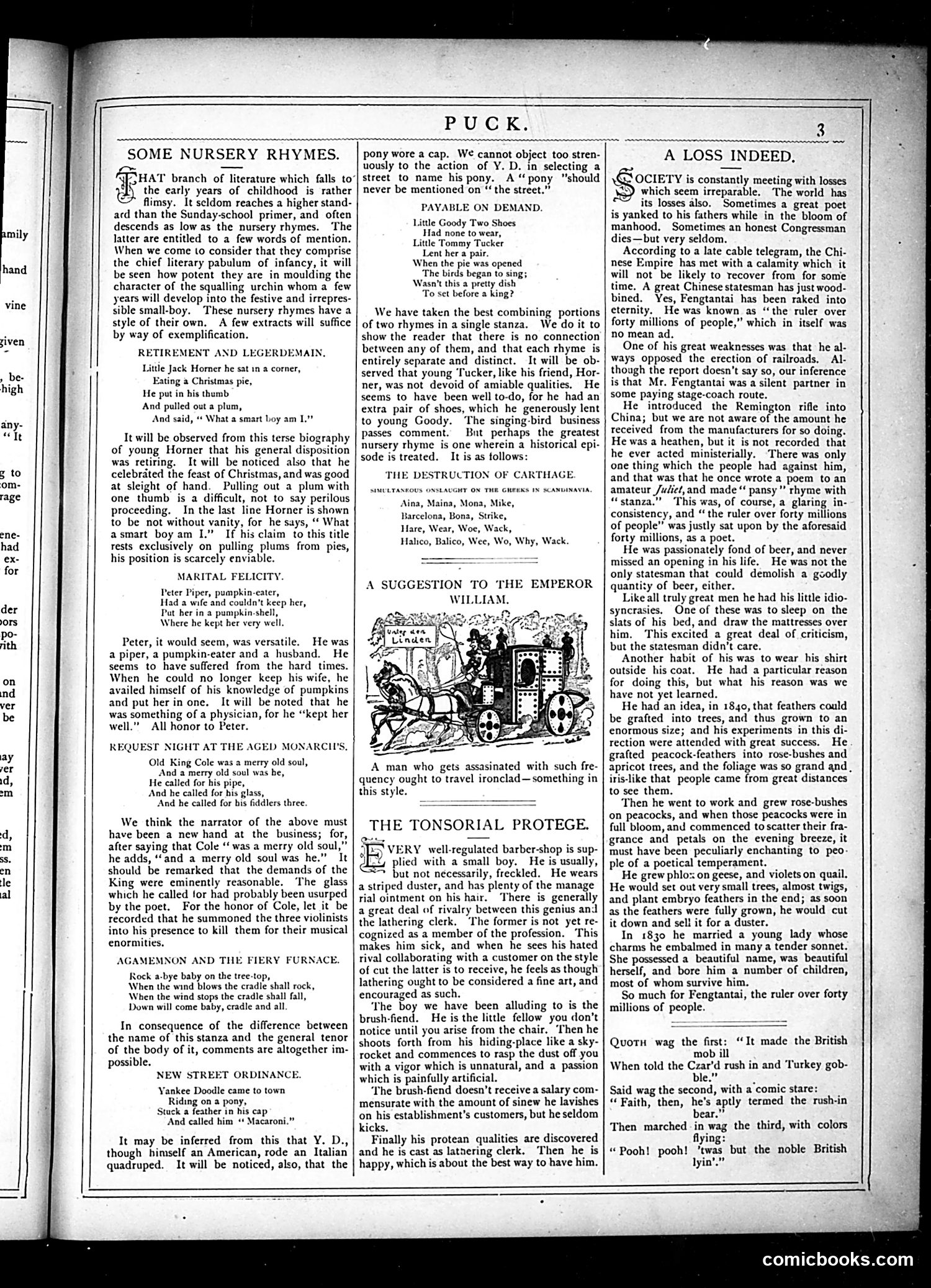
What you’re looking at
This page contains several satirical pieces rather than a single cartoon. "A Loss Indeed" mocks the death of a Chinese statesman, sarcastically comparing his importance to that of a poet who wrote about feathers and beer. The piece critiques what it sees as disproportionate mourning. "A Suggestion to the Emperor William" features an illustration (partially visible) with accompanying text about a man assassinated on a train—likely referencing a contemporary event, though the specific incident is unclear from this excerpt alone. "The Tonsorial Protege" satirizes a barber's assistant who becomes a pretentious lattering clerk, mocking social climbing and affected behavior in the working class. Other pieces include nursery rhyme parodies and satirical verses on various topics. The overall tone is characteristic of Puck's late-19th-century social and political satire.
📄 Transcribed text from this page (OCR, searchable)
Machine-transcribed from the original scan — historical spelling and the odd misread are preserved.
SOME NURSERY RHYMES. ‘ua branch of literature which falls to” real the early years of childhood is rather <* flimsy. It seldom reaches a higher stand- acd than the Sunday-school primer, and often descends as low as the nursery rhymes. The latter are entitled to a few words of mention. When we come to consider that they comprise the chief literary pabulum of infancy, it will be seen how potent they are in moulding the character of the squalling urchin whom a few years will develop into the festive and irrepres- sible small-boy. These nursery rhymes have a style of their own. A few extracts will suffice by way of exemplification. RETIREMENT AND LEGERDEMAIN, Littie Jack Horner he sat in a corner, Eating a Christmas pie, He put in his thumb And pulled out a plum, And said, What a smart boy am I." It will be observed from this terse biography of young Horner that his general disposition was retiring. It will be noticed also that he celebrated the feast of Christmas, and was good at sleight of hand. Pulling out a plum with one thumb is a difficult, not to say perilous proceeding. In the last line Horner is shown to be not without vanity, for he says, ‘‘ What asmart boy am I.” If his claim to this title rests exclusively on pulling plums from pies, his position is scarcely enviable. MARITAL FELICITY. Veter Piper, pumpkin-eater, Had a wife and couldn't keep her, Pat her in a pumpkin-shell, Where he kept her very well. Peter, it would seem, was versatile. He was a piper, a pumpkin-eater and a husband. He seems to have suffered from the hard times. When he could no longer keep his wife, he availed himself of his knowledge of pumpkins and put her in one. It will be noted that he was something of a physician, for he “kept her well.” All honor to Peter. REQUEST NIGHT AT THE AGED MONARCII’S, Old King Cole was a merry old soul, And a merry old soul was be, He called for his pipe, And he called for his glass, And he called for bis fiddlers three. We think the narrator of the above must have been a new hand at the business; for, after saying that Cole “was a merry old soul,” he adds, “and a merry old soul was he.” It should be remarked that the demands of the King were eminently reasonable. The glass which he called for had probably been usurped by the poet. For the honor of Cole, let it be recorded that he summoned the three violinists into his presence to kill them for their musical enormities. AGAMEMNON AND THE FIERY FURNACE. Rock a-bye baby on the tree-top, When the wind blows the cradle shall rock, When the wind stops the cradle shall fall, Down will come baby, cradle and all In consequence of the difference between the name of this stanza and the general tenor of the body of it, comments are altogether im- possible. NEW STREET ORDINANCE. Yankee Doodle came to town Riding on a pony, Stuck a feather in his cap ‘And called him ‘ Macaroni.” It may be inferred from this that Y. D., though himself an American, rode an Italian quadruped. It will be noticed, also, that the PUCK. pony wore a cap. We cannot object too stren- uously to the action of Y. D. in selecting a street to name his pony. A “pony "should never be mentioned on ‘the street.” PAYABLE ON DEMAND. Little Goody Two Shoes Had none to wear, Little Tommy Tucker Lent her a pair. When the pie was opened The birds began to sing; Wasn't this a pretty dish To set before a king? We have taken the best combining portions of two rhymes in a single stanza. We do it to show the reader that there is no connection between any of them, and that each rhyme is entirely separate and distinct. It will be ob- served that young ‘Tucker, like his friend, Hor- ner, was not devoid of amiable qualities. He seems to have been well to-do, for he had an extra pair of shoes, which he generously lent to young Goody. ‘The singing-bird business passes comment. But perhaps the greatest nursery rhyme is one wherein a historical epi- sode is treated. It is as tollows: THE DESTRUCTION OF CARTHAGE. SIMULTANEOUS ONSLAUGHT ON THE GIMEERS IN SCANDINAVIA. Aina, Maina, Mona, Mike, Barcelona, Bona, Strike, Hare, Wear, Woe, Wack, Hahico, Balico, Wee, Wo, Why, Wack. A SUGGESTION TO ‘THE EMPEROR WILLIAM. A man who gets assasinated with such fre- quency ought to travel ironclad— something in this style. THE TONSORIAL PROTEGE. SEQ VERY well-regulated barber-shop is sup- Ee plied with a small boy. He is usually, “> but not necessarily, freckled. He wears a striped duster, and has plenty of the manage rial ointment on his hair. There is generally a great deal of rivalry between this genius and the lathering clerk. ‘The former is not yet re- cognized as a member of the profession. This makes him sick, and when he sees his hated rival collaborating with a customer on the style of cut the latter is to receive, he feels as though lathering ought to be considered a fine art, and encouraged as such, ‘The boy we have been alluding to is the brush-fiend. He is the little fellow you don’t notice until you arise from the chair. ‘Then he shoots forth from his hiding-place like a sky- rocket and commences to rasp the dust off you with a vigor which is unnatural, and a passion which is painfully artificial. ‘The brush-fiend doesn’t receive a salary com- mensurate with the amount of sinew he lavishes on his establishment’s customers, but he seldom kicks. Finally his protean qualities are discovered and he is cast as latnering clerk. Then he is happy, which is about the best way to have him. A LOSS INDEED, SOCIETY is constantly meeting with losses ~s) which seem irreparable. The world has its losses also. Sometimes a great poet is yanked to his fathers while in the bloom of manhood. Sometimes an honest Congressman dies—but very seldom. According to a late cable telegram, the Chi- nese Empire has met with a calamity which it will not be likely to recover from for some time. A great Chinese statesman has just wood- bined. Yes, Fengtantai has been raked into eternity. He was known as “the ruler over forty millions of people,” which in itself was no mean ad. One of his great weaknesses was that he al- ways opposed the erection of railroads. Al- though the report doesn’t say so, our inference is that Mr. Fengtantai was a silent partner in some paying stage-coach route. He introduced the Remington rifle into China; but we are not aware of the amount he received from the manufacturers for so doing. He was a heathen, but it is not recorded that he ever acted ministerially. ‘There was only one thing which the people had against him, and that was that he once wrote a poem to an amateur Juliet, and made“ pansy” rhyme with “stanza.” This was, of course, a glaring in- consistency, and “ the ruler over forty millions of people” was justly sat upon by the aforesaid forty millions, as a poet. He was passionately fond of beer, and never missed an opening in his life. He was not the only statesman that could demolish a goodly quantity of beer, either. Like all truly great men he had his little idio- syncrasies. One of these was to sleep on the slats of his bed, and draw the mattresses over him. This excited a great deal of criticism, but the statesman didn’t care. Another habit of his was to wear his shirt outside his coat. He had a particular reason for doing this, but what his reason was we have not yet learned. He had an idea, in 1840, that feathers could be grafted into trees, and thus grown to an enormous size; and his experiments in this di- rection were attended with great success. He grafted peacock-feathers into rose-bushes and apricot trees, and the foliage was so grand and, iris-like that people came from great distances to see them. ‘Then he went to work and grew rose-bushes ‘on peacocks, and when those peacocks were in full bloom, and commenced to scatter their fra- grance and petals on the evening breeze, it must have been peculiarly enchanting to peo- ple of a poetical temperament. He grew phlox on geese, and violets on quail. He would set out very small trees, almost twigs, and plant embryo feathers in the end; as soon as the feathers were fully grown, he would cut it down and sell it for a duster. In 1830 he married a young lady whose charms he embalmed in many a tender sonnet. She possessed a beautiful name, was beautiful herself, and bore him a number of children, most of whom survive him. So much for Fengtantai, the ruler over forty millions of people. Quotn wag the first: “It made the British mob ill When told the Czar’d rush in and Turkey gob- ble.” Said wag the second, with a comic stare: “Faith, then, he’s aptly termed the rush-in bear.” Then marched in wag the third, with colors flying: “Pooh! pooh! 'tw: lyin’.” but the noble British comicbooks.com