
Puck, 1878-07-10 · page 7 of 16
Puck — July 10, 1878 — page 7: what you’re looking at
What you’re looking at
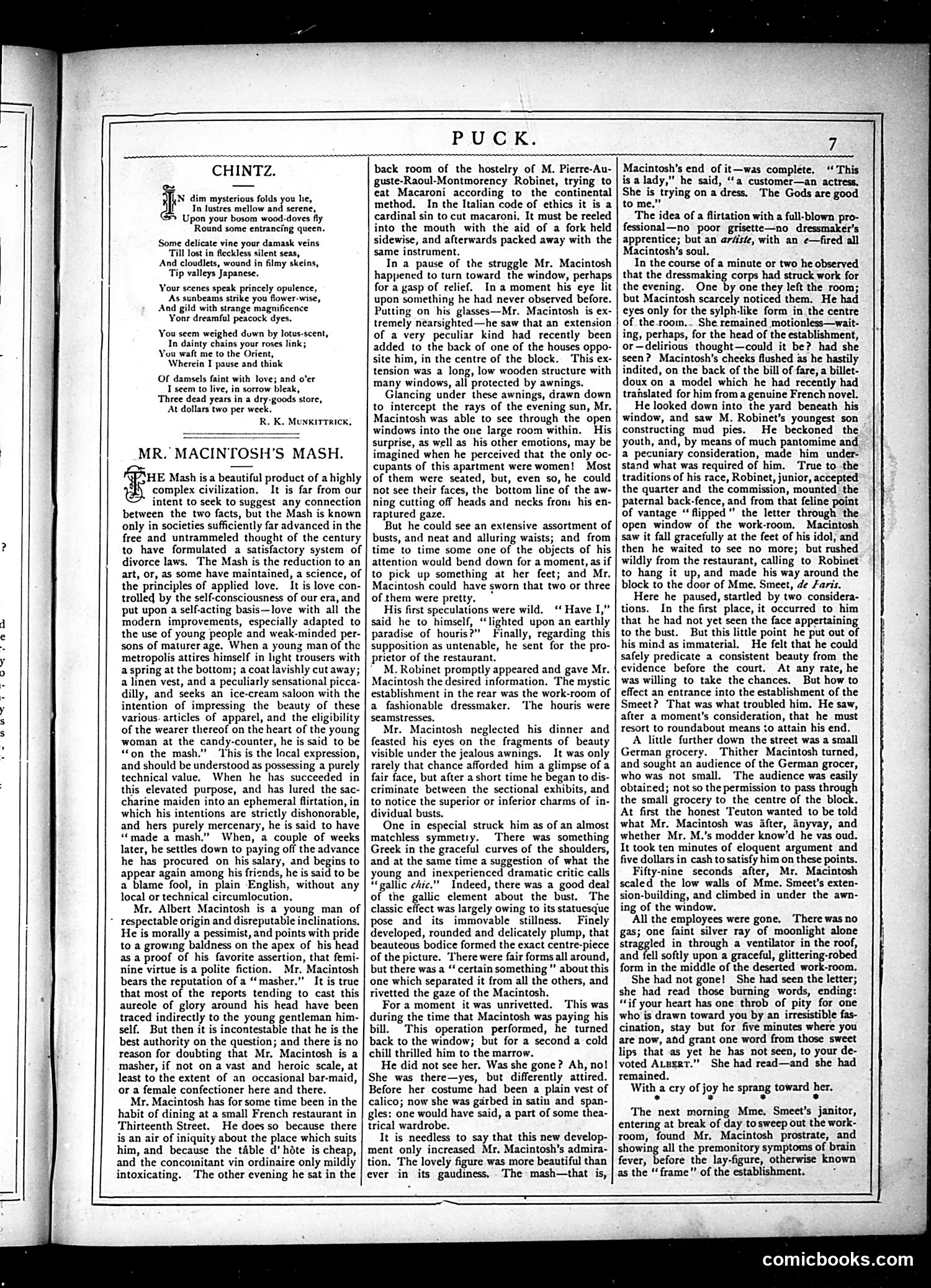
This page contains a satirical story about Mr. Macintosh, a wealthy gentleman visiting a fashionable dressmaker's establishment in Paris. The narrative mocks Victorian-era gender dynamics and male naiveté: Macintosh becomes entranced by the beautiful female dressmakers and busts, losing focus on practical matters while ostensibly conducting business. The satire targets male susceptibility to feminine charm and the pretensions of high society. The story portrays Macintosh as foolishly distracted by aesthetic beauty (both of women and artwork) when he should be focused on rational business dealings. The humor derives from his internal conflict between desire and propriety—a common theme in Victorian satirical humor about masculine weakness. The page also includes an unrelated poem, "Chintz," by R.K. Munkittrick.
📄 Transcribed text from this page (OCR, searchable)
Machine-transcribed from the original scan — historical spelling and the odd misread are preserved.
PUCK. 7 CHINTZ. hs dim mysterious folds you he, In lustres mellow and serene, Upon your bosom wood-doves fy Round some entrancing queen. Some delicate vine your damask veins Till lost in fleckless silent seas, And cloudlets, wound in filmy skeins, Tip valleys Japanese. Your scenes speak princely opulence, ‘As sunbeams strike you flower-wise, And gild with strange magnificence Yonr dreamful peacock dyes. You seem weighed duwn by lotus-scent, In dainty chains your roses link; You waft me to the Orient, Wherein I pause and think Of damsels faint with love; and o'er I seem to live, in sorrow bleak, Three dead years in a dry-goods store, At dollars two per week. R. K. Munkirrrick, MR. MACINTOSH’S MASH. HE Mash is a beat 1 product of a highly complex civilization. It is far from our intent to seek to suggest any connection between the two facts, but the Mash is known only in societies sufficiently far advanced in the free and untrammeled thought of the century to have formulated a satisfactory system of divorce laws. The Mash is the reduction to an art, or, as some have maintained, a science, of the principles of applied love. It is love con- trolled by the self-consciousness of our era, and put upon a self-acting basis—love with all the modern improvements, especially adapted to the use of young people and weak-minded per- sons of maturer age. When a young man of the metropolis attires himself in light trousers with a spring at the bottom; acoat lavishly cut away; a linen vest, and a peculiarly sensational picca- dilly, and seeks an ice-cream saloon with the intention of impressing the beauty of these various. articles of apparel, and the eligibility of the wearer thereof on the heart of the young woman at the candy-counter, he is said to be “on the mash.” This is the local expression, and should be understood as possessing a purely technical value. When he has succeeded in this elevated purpose, and has lured the sac- charine maiden into an ephemeral flirtation, in which his intentions are strictly dishonorable, and hers purely mercenary, he is said to have “made a mash.” When, a couple of weeks later, he settles down to paying off the advance he has procured on his salary, and begins to appear again among his friends, he is said to be a blame fool, in plain English, without any local or technical circumlocution. Mr. Albert Macintosh is a young man of ~ respectable origin and disreputabie inclinations. He is morally a pessimist, and points with pride to a growing baldness on the apex of his head as a proof of his favorite assertion, that femi- nine virtue is a polite fiction. Mr. Macintosh bears the reputation of a “masher.” It is true that most of the reports tending to cast this aureole of glory around his head have been traced indirectly to the young gentleman him- self. But then it is incontestable that he is the best authority on the question; and there is no reason for doubting that Mr. Macintosh is a masher, if not ona vast and heroic scale, at least to the extent of an occasional bar-maid, or a female confectioner here and there. Mr. Macintosh has for some time been in the habit of dining at a small French restaurant in Thirteenth Street. He does so because there is an air of iniquity about the place which suits him, and because the tAble d’ héte is cheap, and the conconnitant vin ordinaire only mildly intoxicating. The other evening he sat in the —— Ee back room of the hostelry of M. Pierre-Au- guste-Raoul-Montmorency Robinet, trying to eat Macaroni according to the continental method. In the Italian code of ethics it is a cardinal sin to cut macaroni. It must be reeled into the mouth with the aid of a fork held sidewise, and afterwards packed away with the same instrument. In a pause of the struggle Mr. Macintosh happened to turn toward the window, perhaps for a yasp of relief. In a moment his eye lit upon something he had never observed before. Putting on his glasses—Mr. Macintosh is ex- tremely nearsighted—he saw that an extension of a very peculiar kind had recently been added to the back of one of the houses oppo- site him, in the centre of the block. This ex- tension was a long, low wooden structure with many windows, all protected by awnings. Glancing under these awnings, drawn down to intercept the rays of the evening sun, Mr. Macintosh was able to see through the open windows into the one large room within. His surprise, as well as his other emotions, may be imagined when he perceived that the only oc- cupants of this apartment were women! Most of them were seated, but, even so, he could not see their faces, the bottom line of the aw- ning cutting off heads and necks from his en- raptured gaze. But he could see an extensive assortment of busts, and neat and alluring waists; and from time to time some one of the objects of his attention would bend down for a moment, as if to pick up something at her feet; and Mr. Macintosh could have sworn that two or three of them were pretty. His first speculations were wild. ‘‘ Have I,” said he to himself, “lighted upon an earthly of houris?” Finally, regarding this supposition as untenable, he sent for the pro- prietor of the restaurant. M. Robinet promptly appeared and gave Mr. Macintosh the desired information. The mystic establishment in the rear was the work-room of a fashionable dressmaker. The houris were seamstresses. Mr. Macintosh neglected his dinner and feasted his eyes on the fragments of beauty visible under the jealous awnings. It was only rarely that chance afforded him a glimpse of a fair face, but after a short time he began to dis- criminate between the sectional exhibits, and to notice the superior or inferior charms of in- dividual busts, One in especial struck him as of an almost matchless symmetry. There was something Greek in the graceful curves of the shoulders, and at the same time a suggestion of what the young and inexperienced dramatic critic calls ‘gallic chic.” Indeed, there was a good deal of the gallic element about the bust. The classic effect was largely owing to its statuesque pose and its immovable stillness. Finely developed, rounded and delicately plump, that beauteous bodice formed the exact centre-piece of the picture. ‘There were fair forms all around, but there was a “certain something " about this one which separated it from all the others, and rivetted the gaze of the Macintosh, For a moment it was unrivetted. This was during the time that Macintosh was paying his bill. This operation performed, he turned back to the window; but for a second a cold chill thrilled him to the marrow. He did not see her. Was she gone? Ah, no! She was there—yes, but differently attired. Before her costume had been a plain vest of calico; now she was garbed in satin and span- gles: one would have said, a part of some thea- trical wardrobe. It is needless to say that this new develop- ment only increased Mr, Macintosh’s admira- tion. The lovely figure was more beautiful than ever in its gaudiness, The mash—that is, Macintosh’s end of it—was complete. “ This is a lady,” he said, ‘a customer—an actress, She is trying on a dress. The Gods are good to me.” The idea of a flirtation with a full-blown pro- fessional—no poor grisette—no dressmaker’s apprentice; but an arfiste, with an e—fired all Macintosh’s soul. In the course of a minute or two he observed that the dressmaking corps had struck work for the evening. One by one they left the room; but Macintosh scarcely noticed them. He had eyes only for the sylph-like form in the centre of the.room.. She remained motionless—wait- ing, perhaps, for the head of the establishment, or—delirious thought—could it be? had she seen? Macintosh’s cheeks flushed as he hastily indited, on the back of the bill of fare, a billet- doux on a model which he had recently had translated for him from a genuine French novel. He looked down into the yard beneath his window, and saw M. Robinet’s youngest son constructing mud pies. He beckoned the youth, and, by means of much pantomime and a pecuniary consideration, made him under- stand what was required of him. True to the traditions of his race, Robinet, junior, accepted the quarter and the commission, mounted the paternal back-fence, and from that feline point of vantage “flipped” the letter through the open window of the work-room. Macintosh saw it fall gracefully at the feet of his idol, and then he waited to see no more; but rushed wildly from the restaurant, calling to Robinet to hang it up, and made his way around the block to the door of Mme, Smeet, de Faris. Here he paused, startled by two considera- tions. In the first place, it occurred to him that he had not yet seen the face appertaining to the bust. But this little point he put out of his mind as immaterial. He felt that he could safely predicate a consistent beauty from the evidence before the court. At any rate, he was willing to take the chances. But how to effect an entrance into the establishment of the Smeet? That was what troubled him. He saw, after a moment's consideration, that he must resort to roundabout means ¢o attain his end. A litle further down the street was a small German grocery. Thither Macintosh turned, and sought an audience of the German grocer, who was not small. The audience was easily obtained; not so the permission to pass through the small grocery to the centre of the block. At first the honest Teuton wanted to be told what Mr. Macintosh was After, inyvay, and whether Mr. M.’s modder know’d he vas oud. It took ten minutes of eloquent argument and five dollars in cash to satisfy him on these points. Fifty-nine seconds after, Mr. Macintosh scaled the low walls of Mme. Smeet’s exten- sion-building, and climbed in under the awn- ing of the window. All the employees were gone. There wasno gas; one faint silver ray of moonlight alone straggled in through a ventilator in the roof, and fell softly upon a graceful, glittering-robed form in the middle of the deserted work-room. She had not gone! She had seen the letter; she had read those burning words, ending: “if your heart has one throb of pity for one who is drawn toward you by an irresistible fas- cination, stay but for five minutes where you are now, and grant one word from those sweet lips that as yet he has not seen, to your de- voted ALgrt.” She had read—and she had remained. With a cry of joy he sprang toward her. * * . * The next morning Mme. Smeet’s janitor, entering at break of day to sweep out the work- room, found Mr. Macintosh prostrate, and showing all the premonitory symptoms of brain fever, before the lay-figure, otherwise known as the “frame” of the establishment, | Se comicbooks.com