
Puck, 1878-07-10 · page 4 of 16
Puck — July 10, 1878 — page 4: what you’re looking at
What you’re looking at
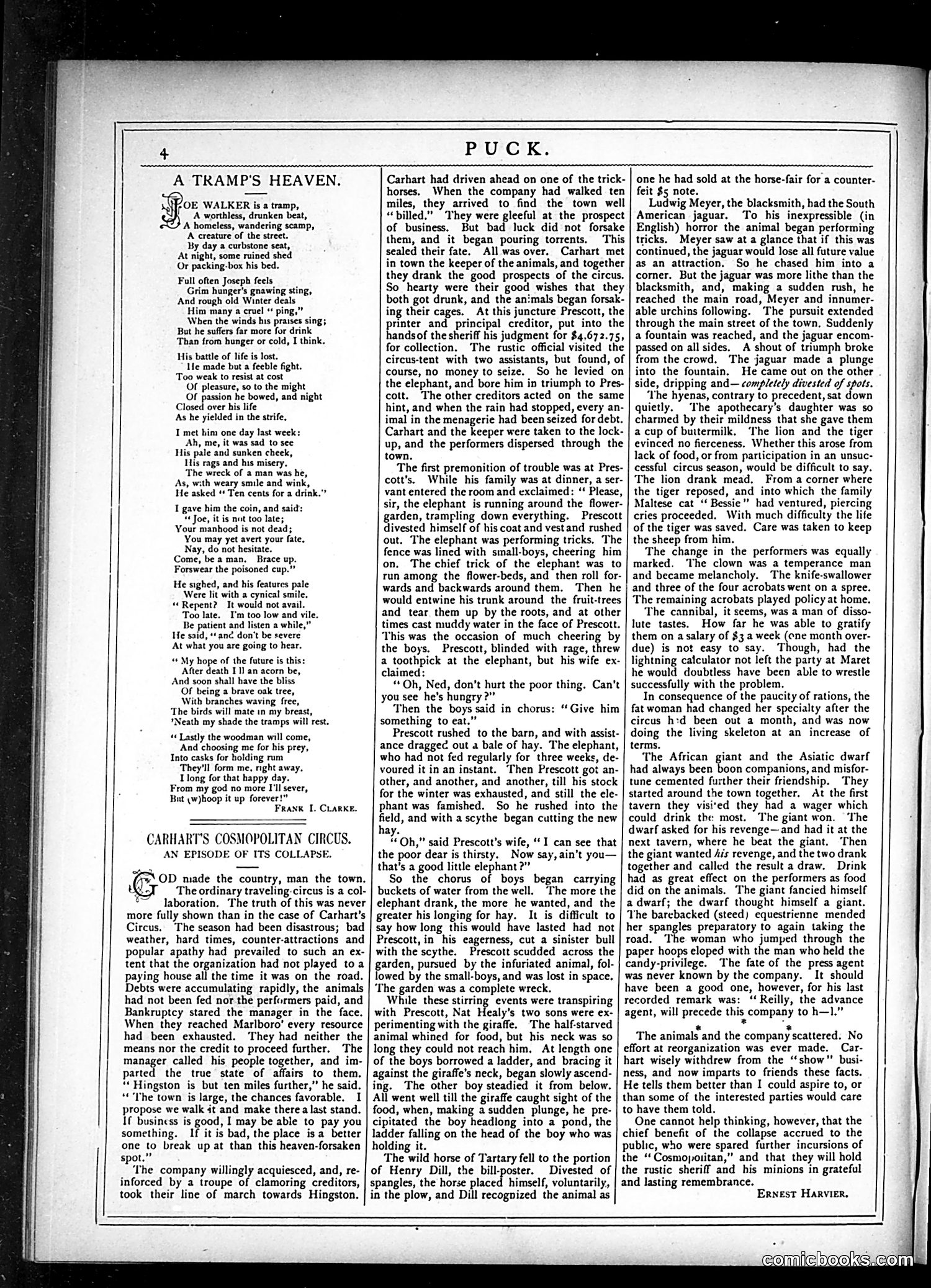
This page contains **two literary pieces**, not political cartoons: 1. **"A Tramp's Heaven"** — A sentimental poem by Joe Walker about a homeless man's dreams of comfort and rest, featuring typical late-19th-century sympathy toward vagrants. 2. **"Carhart's Cosmopolitan Circus"** — A satirical story by Ernest Havergal mocking a struggling circus company. The narrative ridicules the circus's financial collapse and the absurd behavior of its mismanaged animal acts (an unruly elephant, giraffe, and lion). The satire targets poor management, debt, and the desperation of traveling circuses during economic hardship. The page reflects Puck's characteristic mix of sentimental verse and satirical prose commentary on American social conditions and commercial failures of the era.
📄 Transcribed text from this page (OCR, searchable)
Machine-transcribed from the original scan — historical spelling and the odd misread are preserved.
4 PUCK. A TRAMP'S HEAVEN. E WALKER is a tramp, ‘A worthless, drunken beat, A homeless, wandering scamp, A creature of the street. By day a curbstone seat, At night, some ruined shed Or packing-box his bed. Full often Joseph feels Grim hunger's gnawing sting, ‘And rough old Winter deals Him many a cruel * ping,” When the winds his praises sing; But he suffers far more for drink ‘Than from hunger or cold, I think. His battle of life is lost. He made but a feeble fight. Too weak to resist at cost Of pleasure, so to the might Of passion he bowed, and night Closed over his life As he yielded in the strife, T met him one day last week: Ab, me, it was sad to see His pale and sunken cheek, His rags and his misery. ‘The wreck of a man was he, As, with weary smile and wink, He asked “Ten cents for a drink.” I gave him the coin, and said: + Joe, it is not too late; Your manhood is not dead; You may yet avert your fate, Nay, do not hesitate. Come, be a man. Brace up. Forswear the poisoned cup.” He sighed, and his features pale Were lit with a cynical smile, “Repent? It would not avail. Too late. I'm too low and vile. Be patient and listen a while,” He said, “* an don't be severe At what you are going to hear. “ My hope of the future is this: After death Ill an acorn be, And soon shall have the bliss Of being a brave oak tree, With branches waving free, ‘The birds will mate in my breast, ’Neath my shade the tramps will rest. “« Lastly the woodman will come, ‘And choosing me for his prey, Into casks for holding rum ‘They'll form me, right away. I long for that happy day. From my god no more I'll sever, But yw)hoop it up forever!” Fran I. CLARKE. CARHART'S COSMOPOLITAN CIRCUS. AN EPISODE OF ITS COLLAPSE. & OD made the country, man the town. The ordinary traveling-circus is a col- &" laboration. The truth of this was never more fully shown than in the case of Carhart’s Circus. The season had been disastrous; bad weather, hard times, counter-attractions and popular apathy had prevailed to such an ex- tent that the organization had not played toa paying house all the time it was on the road. Debts were accumulating rapidly, the animals had not been fed nor the performers paid, and Bankruptcy stared the manager in the face. When they reached Marlboro’ every resource had been exhausted. They had neither the means nor the credit to proceed further. The manager called his people together, and im- parted the true state of affairs to them. ‘Hingston is but ten miles further,” he said. “The town is large, the chances favorable. I propose we walk it and make there a last stand. If business is good, I may be able to pay you something. If it is bad, the place isa better one to break up at than this heaven-forsaken spot.” ‘The company willingly acquiesced, and, re- inforced by a troupe of clamoring creditors, took their line of march towards Hingston, Carhart had driven ahead on one of the trick- horses. When the company had walked ten miles, they arrived to find the town well “billed.” ‘They were gleeful at the prospect of business. But bad luck did not forsake them, and it began pouring torrents. This sealed their fate. All was over, Carhart met in town the keeper of the animals, and together they drank the good prospects of the circus. So hearty were their good wishes that they both got drunk, and the an‘mals began forsak- ing their cages. At this juncture Prescott, the printer and principal creditor, put into the handsof the sheriff his judgment for $4,672.75, for collection. The rustic official visited the circus-tent with two assistants, but found, of course, no money to seize. So he levied on the elephant, and bore him in triumph to Pres- cott. The other creditors acted on the same hint, and when the rain had stopped, every an- imal in the menagerie had been seized for debt. Carhart and the keeper were taken to the lock- up, and the performers dispersed through the town. The first premonition of trouble was at Pres- cott'’s. While his family was at dinner, a ser- vant entered the room and exclaimed: “ Please, sir, the elephant is running around the flower- garden, trampling down everything. Prescott divested himself of his coat and vestand rushed out. The elephant was performing tricks. ‘The fence was lined with small-boys, cheering him on, The chief trick of the elephant was to run among the flower-beds, and then roll for- wards and backwards around them. Then he would entwine his trunk around the fruit-trees and tear them up by the roots, and at other times cast muddy water in the face of Prescott. This was the occasion of much cheering by the boys. Prescott, blinded with rage, threw a toothpick at the elephant, but his wife ex- claimed: “Oh, Ned, don’t hurt the poor thing. Can't you see he’s hungry?” Then the boys said in chorus: “Give him something to eat.” Prescott rushed to the barn, and with assist- ance draggec out a bale of hay. The elephant, who had not fed regularly for three weeks, de- voured it in an instant. ‘Then Prescott got an- other, and another, and another, till his stock for the winter was exhausted, and still the ele- phant was famished. So he rushed into the field, and with a scythe began cutting the new ay. “Oh,” said Prescott’s wife, ‘I can see that the poor dear is thirsty. Now say, ain't you— that’s a good little elephant ?” So the chorus of boys began carrying buckets of water from the well, The more the elephant drank, the more he wanted, and the greater his longing for hay. It is difficult to say how long this would have lasted had not Prescott, in his eagerness, cut a sinister bull with the scythe. Prescott scudded across the garden, pursued by the infuriated animal, fol- lowed by the small-boys, and was lost in space. ‘The garden was a complete wreck. While these stirring events were transpiring with Prescott, Nat Healy's two sons were ex- perimenting with the giraffe. The half-starved animal whined for food, but his neck was so long they could not reach him, At length one of the boys borrowed a ladder, and bracing it against the giraffe’s neck, began slowly ascend- ing. The other boy steadied it from below. All went well till the giraffe caught sight of the food, when, making a sudden plunge, he pre- cipitated the boy headlong into a pond, the ladder falling on the head of the boy who was holding it. The wild horse of Tartary fell to the portion of Henry Dill, the bill-poster. Divested of spangles, the horse placed himself, voluntarily, in the plow, and Dill recognized the animal as one he had sold at the horse-fair for a counter- feit $5 note. Ludwig Meyer, the blacksmith, had the South American jaguar. To his inexpressible (in English) horror the animal began performing tricks. Meyer saw at a glance that if this was continued, the jaguar would lose all future value as an attraction. So he chased him into a corner. But the jaguar was more lithe than the blacksmith, and, making a sudden rush, he reached the main road, Meyer and innumer- able urchins following. The pursuit extended through the main street of the town. Suddenly a fountain was reached, and the jaguar encom- passed on all sides. A shout of triumph broke from the crowd, The jaguar made a plunge into the fountain, He came out on the other side, dripping and— completely divested of spots. ‘The hyenas, contrary to precedent, sat down quietly. ‘The apothecary’s daughter was so charmed by their mildness that she gave them a cup of buttermilk. ‘The lion and the tiger evinced no fierceness. Whether this arose from lack of food, or from participation in an unsuc- cessful circus season, would be difficult to say. The lion drank mead, From a corner where the tiger reposed, and into which the family Maltese cat “Bessie” had ventured, piercing cries proceeded. With much difficulty the life of the tiger was saved. Care was taken to keep the sheep from him. ‘The change in the performers was equally marked. ‘The clown was a temperance man and became melancholy. The knife-swallower and three of the four acrobats went on a spree. The remaining acrobats played policy at home. The cannibal, it seems, was a man of disso- lute tastes. How far he was able to gratify them on a salary of $3 a week (cne month over- due) is not easy to say. Though, had the lightning catculator not left the party at Maret he would doubtless have been able to wrestle successfully with the problem. In consequence of the paucity of rations, the fat woman had changed her specialty after the circus h:d been out a month, and was now doing the living skeleton at an increase of terms. The African giant and the Asiatic dwarf had always been boon companions, and misfor- tune cemented further their friendship. They started around the town together. At the first tavern they visited they had a wager which could drink the most. The giant won. ‘The dwarf asked for his revenge—and had it at the next tavern, where he beat the giant. Then the giant wanted Ais revenge, and the two drank together and called the result a draw. Drink had as great effect on the performers as food did on the animals. The giant fancied himself a dwarf; the dwarf thought himself a giant. ‘The barebacked (steed) equestrienne mended her spangles preparatory to again taking the road. ‘The woman who jumped through the paper hoops eloped with the man who held the candy-privilege. The fate of the press agent was never known by the company. It should have been a good one, however, for his last recorded remark was: “ Reilly, the advance agent, will precede this company to h—.” ‘The animals and the company scattered. No effort at reorganization was ever made. Car- hart wisely withdrew from the ‘‘show"’ busi- ness, and now imparts to friends these facts. He tells them better than I could aspire to, or than some of the interested parties would care to have them told. One cannot help thinking, however, that the chief benefit of the collapse accrued to the public, who were spared further incursions of the “Cosmopoiitan,” and that they will hold the rustic sheriff and his minions in grateful and lasting remembrance. Ernest HaRvIER.