
A complete issue · 16 pages · 1877
Puck — August 29, 1877
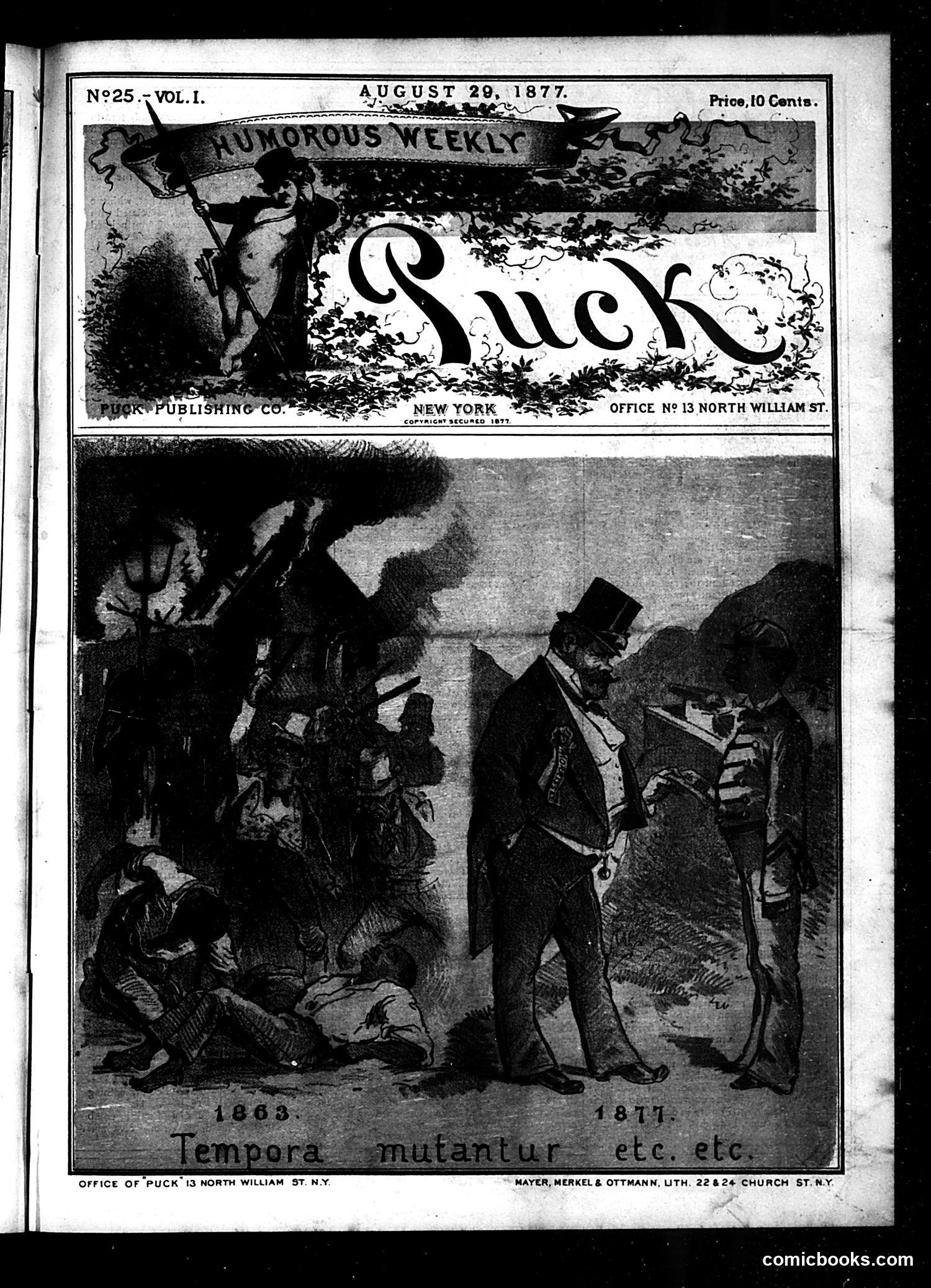
This satirical cartoon contrasts two time periods—1868 and 1877—with the Latin caption "Tempora mutantur etc. etc." ("Times change, etc."). The left panel (1868) depicts chaos and violence, likely referencing Reconstruction-era turmoil following the Civil War. The right panel (1877) shows a well-dressed gentleman in a top hat conversing with a military officer, suggesting order and reconciliation have been restored. The joke appears to criticize the dramatic shift from violent upheaval to peaceful accommodation—implying that nine years brought superficial civility while underlying problems remained unresolved. This likely comments on the Compromise of 1877, which ended Reconstruction by withdrawing federal troops from the South, effectively abandoning formerly enslaved people to white Southern control.
This page contains three distinct pieces: "The Two Republics" (editorial commentary on France and America), "Then and Now" (comparing New York's past race riots to present conditions), and "My Dip in the Sea" (a humorous personal narrative about a seaside trip). The political content criticizes Marshal MacMahon, President of the French Republic, arguing he represents authoritarian tendencies despite republican title. The piece contrasts American and French governance, suggesting both nations struggle with their stated ideals—America with racial justice, France with genuine democracy. "Then and Now" uses contemporary race relations to satirize social progress claims. The cartoons likely illustrate these contrasts visually, though specific caricatures aren't clearly identifiable in the image provided.
This page contains three distinct sections: 1. **"The Mystery of the Sea"** - An article discussing sea-sickness theories, debating whether it's a modern disease or misdiagnosed condition. It critiques physicians' competing explanations and remedies. 2. **"A Ballad of Brooklyn"** - A humorous poem about Mr. Huntington, a Brooklyn resident who forbids his wife from keeping poultry. The satire mocks domestic marital disputes and the absurdity of his ultimatum, using the dog-and-rooster conflict as comedic device. 3. **"Telephones - Latest from the Seat of War"** - Brief war dispatches referencing Turkish-Russian military movements and strategic positions, likely from World War I era conflicts. The page blends social commentary, domestic humor, and wartime news coverage typical of Puck's satirical format.
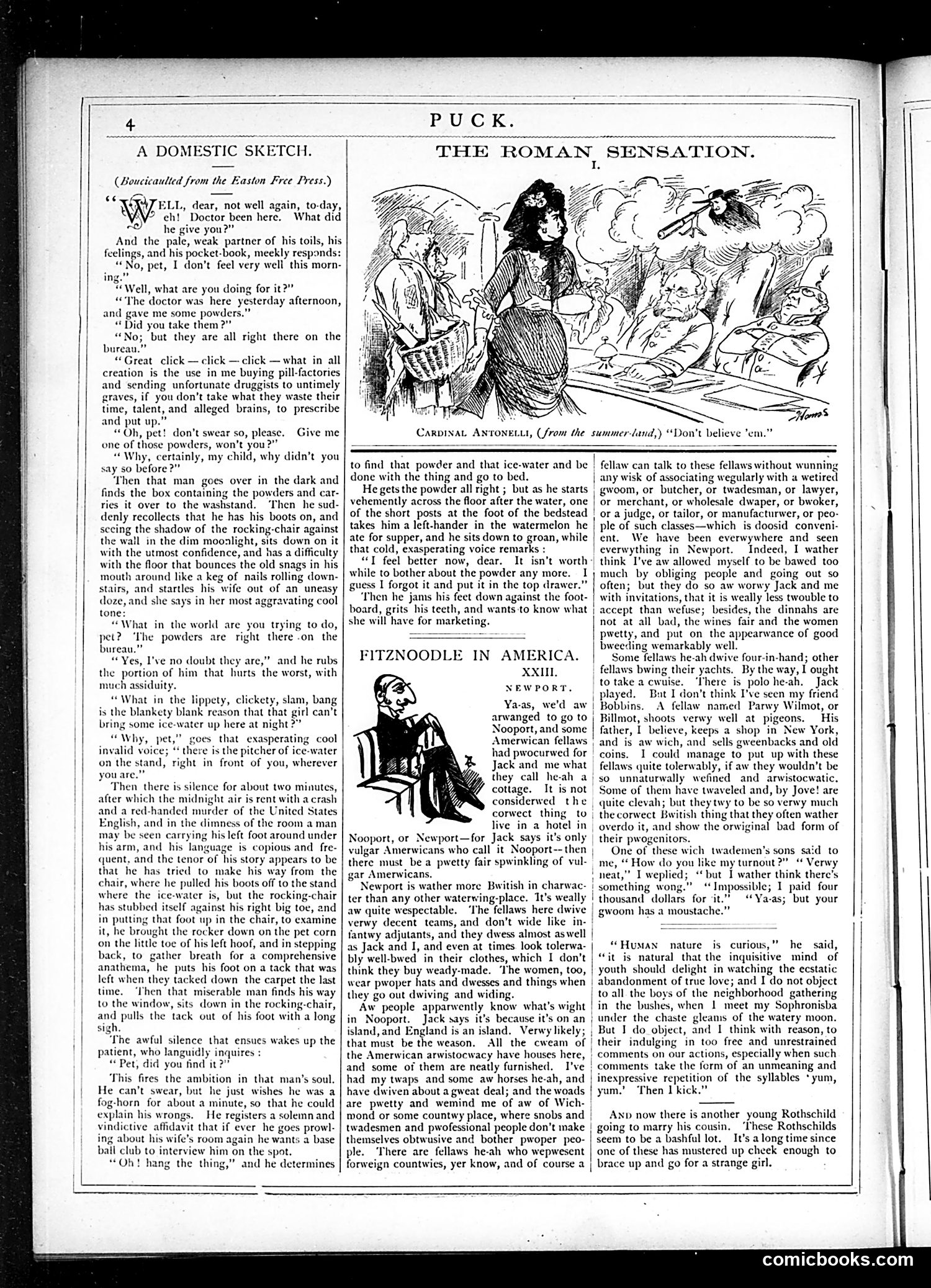
This page contains three separate pieces: 1. **"A Domestic Sketch"**: A humorous dialogue about a husband's mundane day—visiting the doctor for powders, encountering various urban annoyances—that ultimately reveals his wife's indifference to his complaints. 2. **"The Roman Sensation"**: A cartoon captioned "Don't believe 'em," showing Cardinal Antonelli dismissing claims by cherubs/angels above. The joke likely satirizes skepticism toward papal or Vatican pronouncements, though the specific historical reference is unclear without additional context. 3. **"Fitznoodle in America"**: A narrative sketch about an Englishman's impressions of Newport, Rhode Island as a fashionable resort. It satirizes American pretension, nouveau-riche behavior, and the contrasts between American and British social customs—a common Puck theme mocking both American vulgarity and British snobbery.
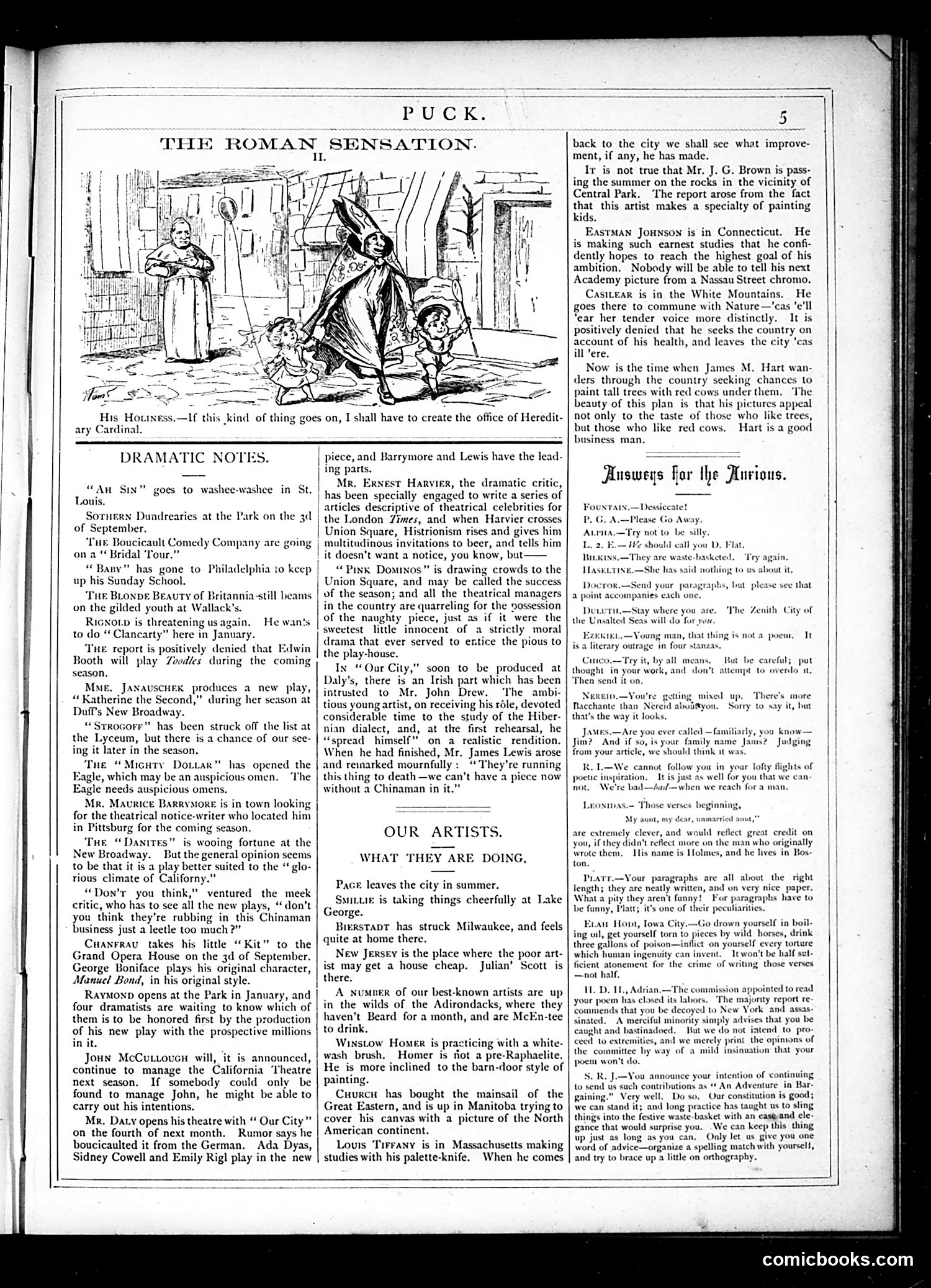
This cartoon satirizes a theatrical scandal involving a performer on horseback in an urban setting. The caption "His Holiness.—If this kind of thing goes on, I shall have to create the office of Hereditary Cardinal!" suggests the joke concerns someone of ecclesiastical authority (likely a Pope figure) reacting to increasingly outrageous theatrical performances. The image shows a mounted rider causing chaos in city streets, with pedestrians fleeing. The satire critiques both the sensationalism of contemporary theater productions and the Church's inability to regulate public morality. The "Roman Sensation" title indicates this involves a scandal with either Italian or ecclesiastical significance, though the specific theatrical production referenced is unclear from the image alone.
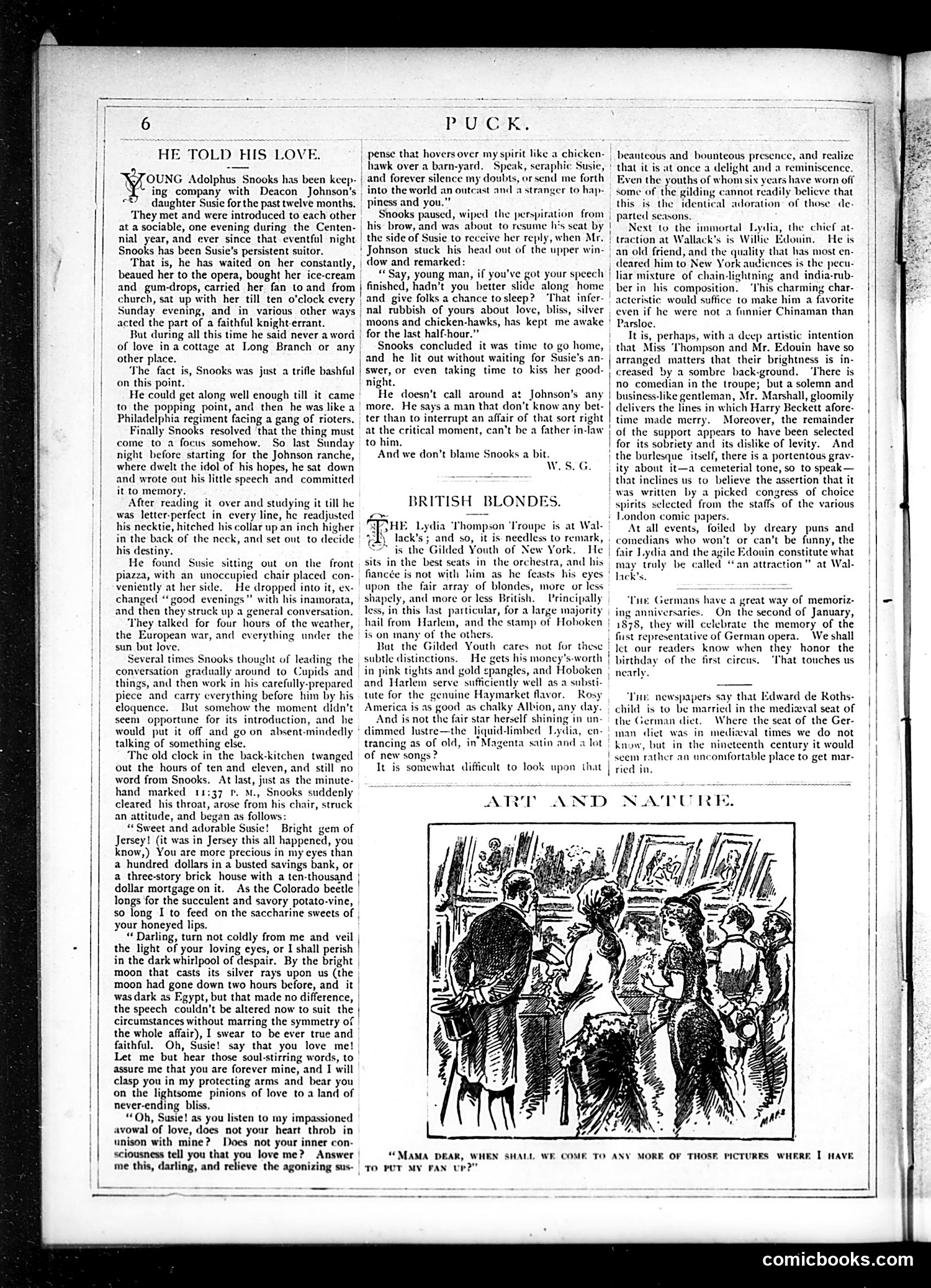
The page contains three distinct sections: **"He Told His Love"** (top left): A short story about a man named Snooks pursuing his love interest Susie, culminating in a romantic speech ending with "Sweet and adorable Susie!" **"British Blondes"** (middle): A theater review discussing the "Gilded Youth of New York" and comparing British and American performers, mentioning specific actors and theaters. **"Art and Nature"** (bottom): A cartoon showing what appears to be a well-dressed man and woman at what looks like an art gallery or museum. The caption reads: "MAMA DEAR, WHEN SHALL WE COME TO ANY MORE OF THOSE PICTURES WHERE I HAVE TO PUT MY FAN UP?" The cartoon humorously depicts a child asking about seeing more artwork of an embarrassing or scandalous nature, suggesting social commentary on propriety and changing artistic standards of the era.
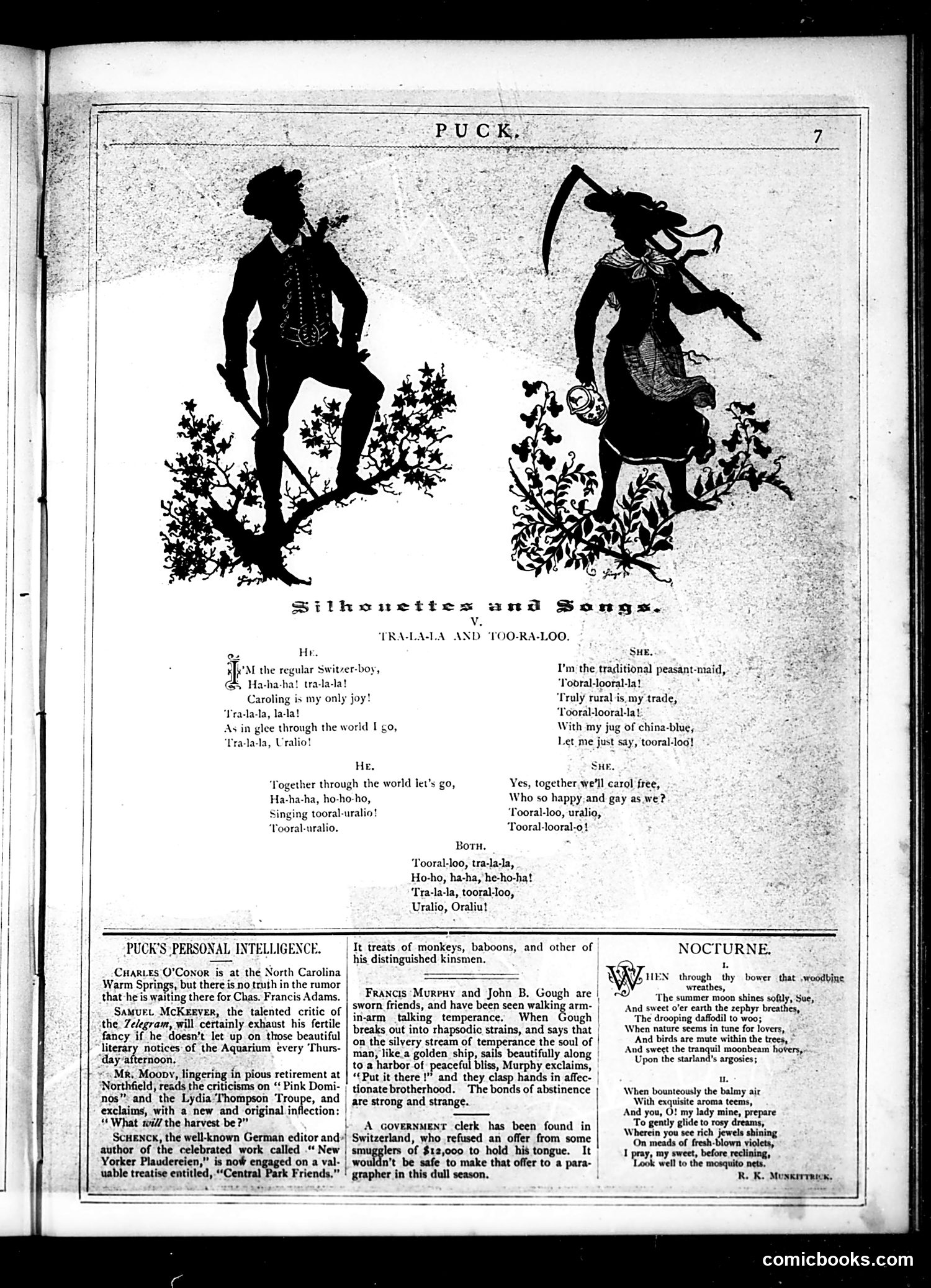
The page features two silhouette figures labeled "Tra-la-la and Too-ra-loo" performing a comic song-and-dance duet. The male figure (left) and female figure (right) exchange sung verses about being "traditional" peasants traveling the world together, with nonsense syllables as a refrain. This appears to be theatrical satire—likely mocking sentimental operetta or musical-comedy tropes popular in the era. The exaggerated silhouettes and absurdist lyrics parody the overwrought romanticism and false "folk authenticity" that characterized stage performances of the period. The page also includes gossipy items about theater figures and a poem titled "Nocturne." The overall content targets contemporary entertainment culture and its pretensions.
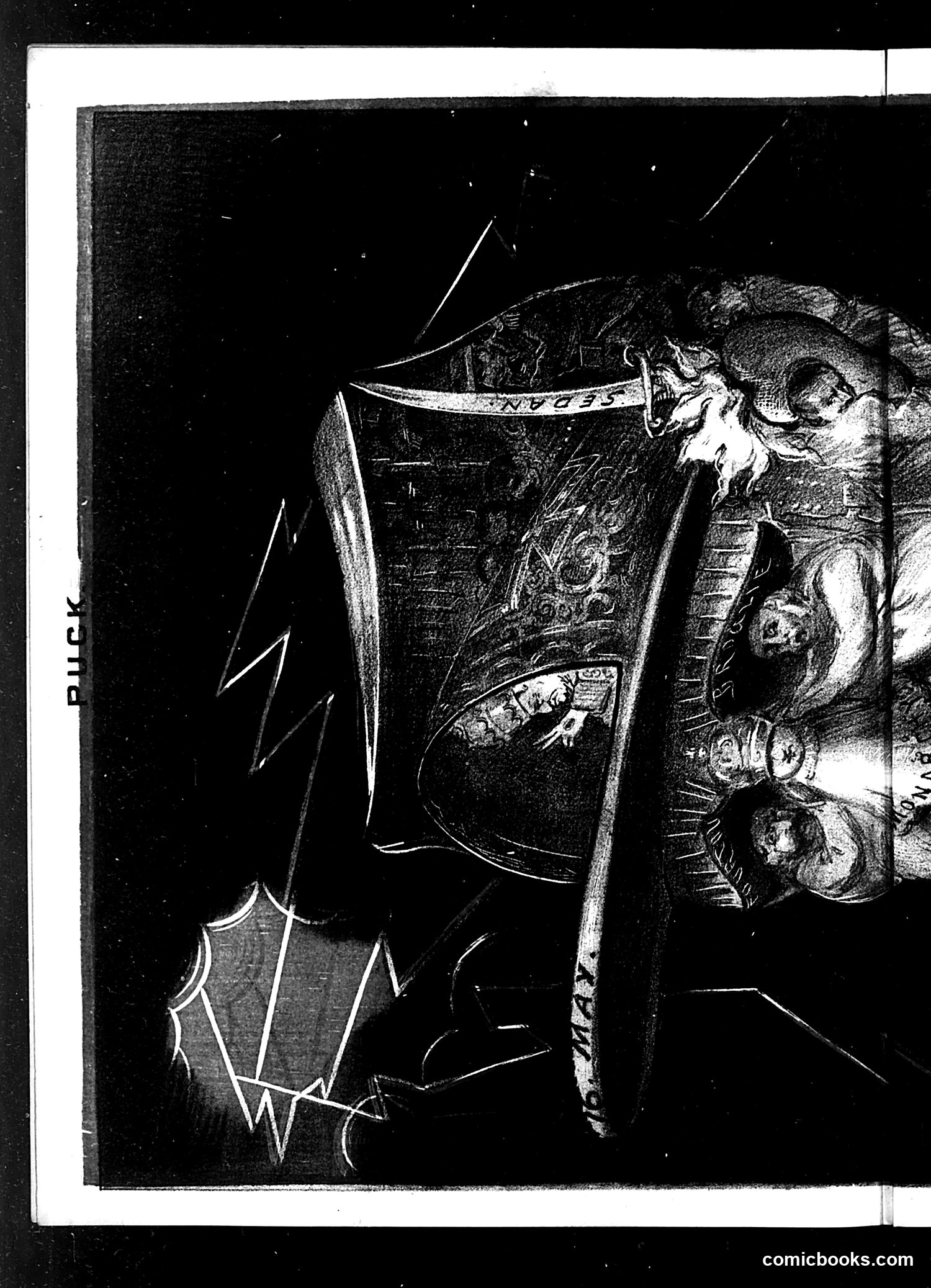
This appears to be a political cartoon from Puck magazine, though the OCR text provided doesn't contain readable content to pair with the image. The image itself shows what appears to be a caricatured figure (likely a political or public figure of the era) depicted with exaggerated features in a dark, dramatic style. The figure seems to be holding or associated with various objects that likely carry symbolic meaning—possibly including weapons or implements—suggesting commentary on militarism, power, or aggressive policies. Without legible accompanying text or clear identifying labels in the image, I cannot definitively identify which specific political figure is caricatured or what exact event or policy this satire addresses. The artistic style and technique are consistent with late 19th/early 20th-century Puck cartoons, but determining the precise satirical target requires either clearer OCR text or visible caption text.
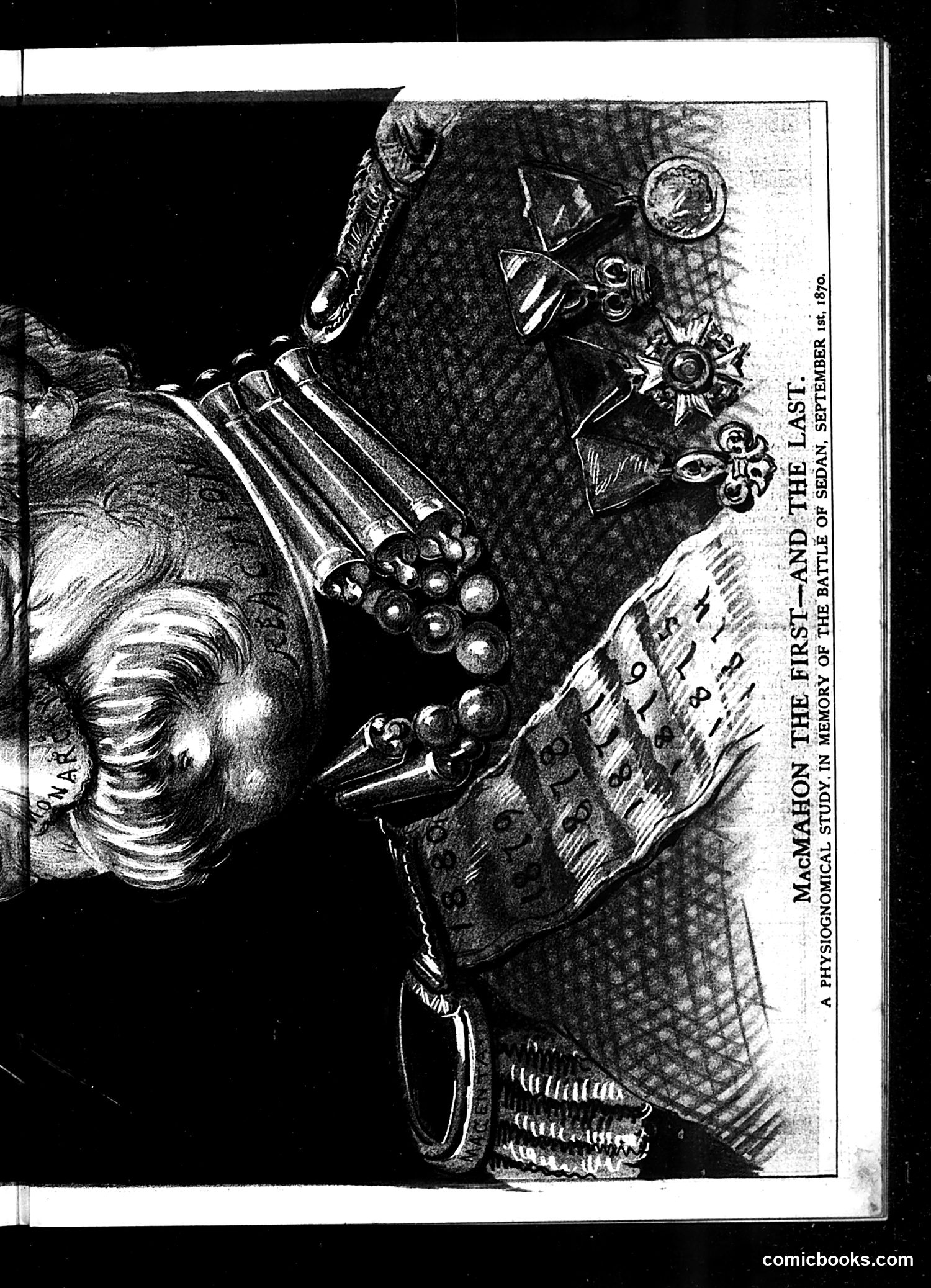
This political cartoon satirizes military aggression and its consequences. The image depicts a uniformed military figure (likely a general or emperor based on the ornate medals and regalia) wielding weapons—a sword and what appears to be a multi-chambered gun or revolver. The figure is shown in a aggressive, dominant pose. The caption "A Physiognomical Study in Memory of the Battle of Sedan, September 1st, 1870" references the Franco-Prussian War's decisive Battle of Sedan, where France suffered a catastrophic defeat. The subtitle suggests this represents the "first and last" such military action, likely criticizing militarism and predicting (or hoping for) an end to such devastating conflicts. The caricature style emphasizes the brutality inherent in military leadership and warfare.
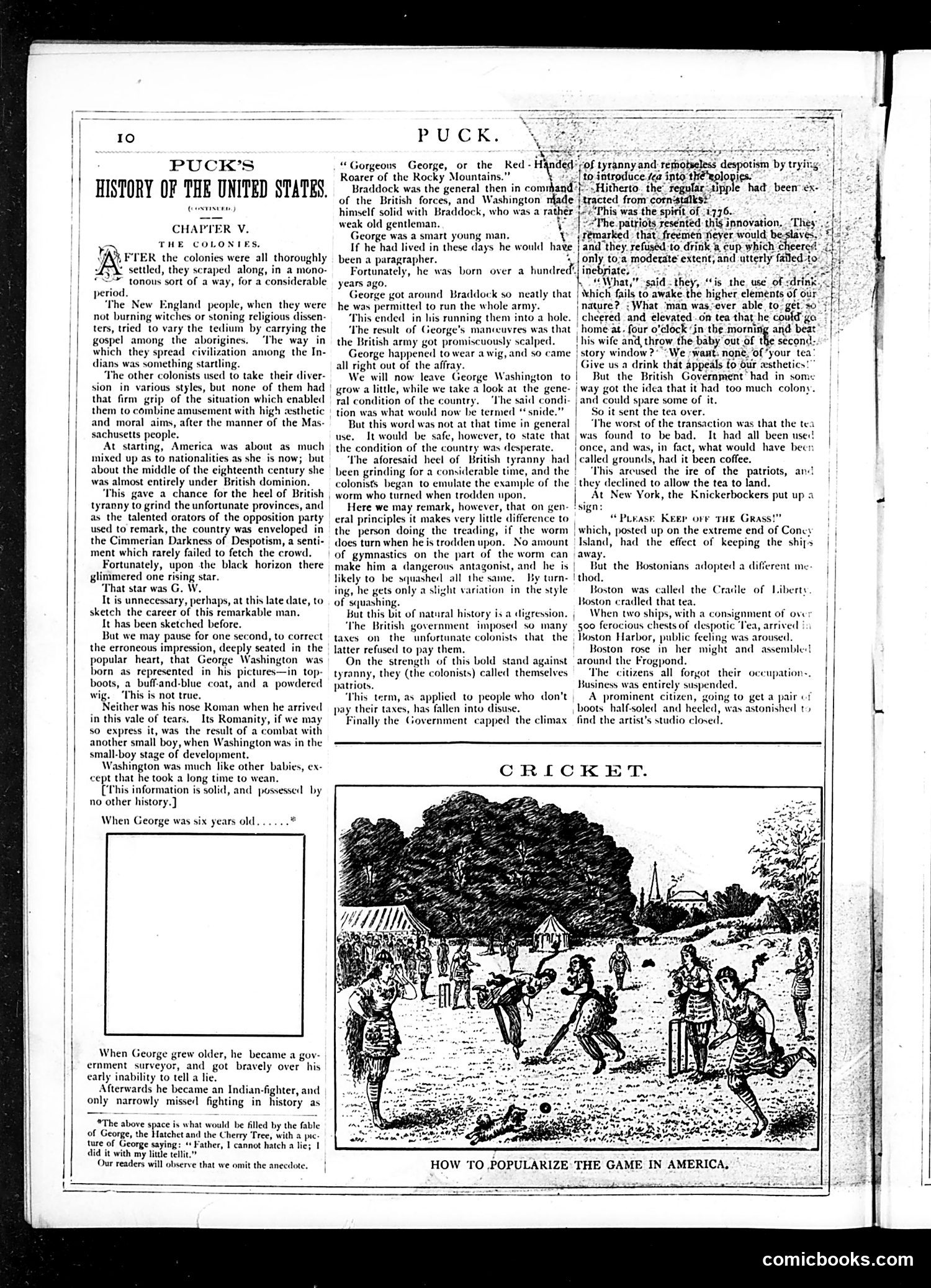
This is a satirical illustration about cricket, the British sport. The engraving shows people playing cricket in an American pastoral setting, with the caption suggesting how to make cricket popular in America. The satire likely mocks either: (1) British attempts to impose their cultural practices on Americans, or (2) American unfamiliarity with cricket as a "foreign" sport. The illustration depicts what appears to be civilized, leisure-class players in a genteel English countryside scene—incongruous with rougher American attitudes toward sports. The adjacent text discusses George Washington and colonial independence, suggesting the cartoon implies cricket represents residual British cultural influence that Americans had rejected along with political independence. The satire undermines cricket's refinement by presenting it as an absurd transplant to American soil.
This page is primarily **text content** rather than political cartoons. It contains a lengthy letter from "Silas Duffy" (dated November 23, 1857) discussing theatrical productions, particularly praising the McKee Rankin company's performance of "*Sandy M'Gee*" and "*The Danites*" at the Broadway Theatre. The letter critiques contemporary dramatic standards while defending the theatrical merit of these plays. There's a small illustration labeled "**THE DANITES**" showing what appears to be a figure in period costume. The content focuses on **theater criticism and promotion** rather than political satire. Without clearer visual satirical elements, this appears to be entertainment journalism typical of Puck's coverage of 1850s American theater rather than a political commentary page.
This page contains the text of "Two Knavos and a Queen," a serialized English story by Frank Barrett appearing in Chapter XXI. The narrative involves romantic and domestic complications among characters including Tom Reynolds, René (a woman of fortune), Mattie, and others. **There is no political cartoon visible on this page.** Rather, it consists entirely of prose fiction—a Victorian-era melodrama about infidelity, jealousy, and class dynamics. The "satire" is literary rather than visual or political. The story appears to mock romantic entanglements and the social pretenses of wealthy characters, typical of Puck's serialized fiction content. This page demonstrates that Puck, while famous for political satire, also published conventional entertainment alongside its satirical cartoons.
This page contains "Puck's Exchanges"—a satirical column of brief commentary on current events and human nature, rather than illustrated political cartoons. The small woodcut at the top shows figures in a classical scene, likely decorative. The exchanges mock various contemporary subjects: American architectural ruins, England's Turk exhibition, peanut vendors' profit margins, religious excitements at luggage-master stations, and fishing excuses. Later items reference a communist leader, Russian eagles, Turkish government, William Patterson's anti-slavery activism, and trade unions. The humor relies on wordplay and social observation rather than visual caricature. Without specific dates or attributions visible, the exact historical references remain unclear, though the tone suggests late 19th-century American middle-class sensibilities and concerns.
This page is primarily **textual content and advertisements** rather than political cartoons. The left column contains "The Republican Party" section with various brief satirical items mocking Republican figures and policies. Notable references include: - **Stanley Matthews** (likely the politician/judge) - criticized for name-dropping - **Senator Coolidge's** return from Europe - questioned about lack of "political experience" - Critiques of American foreign policy and tariffs The right side includes a poem titled "The Birth of the Cucumber" and advertisements for **patent covers for filing Puck** ($1.00 each) and back issues available for purchase. The overall tone is light political satire targeting Republican positions, though without visible illustrations, the specific cartoons cannot be analyzed. The page primarily functions as a news-opinion section with business notices.
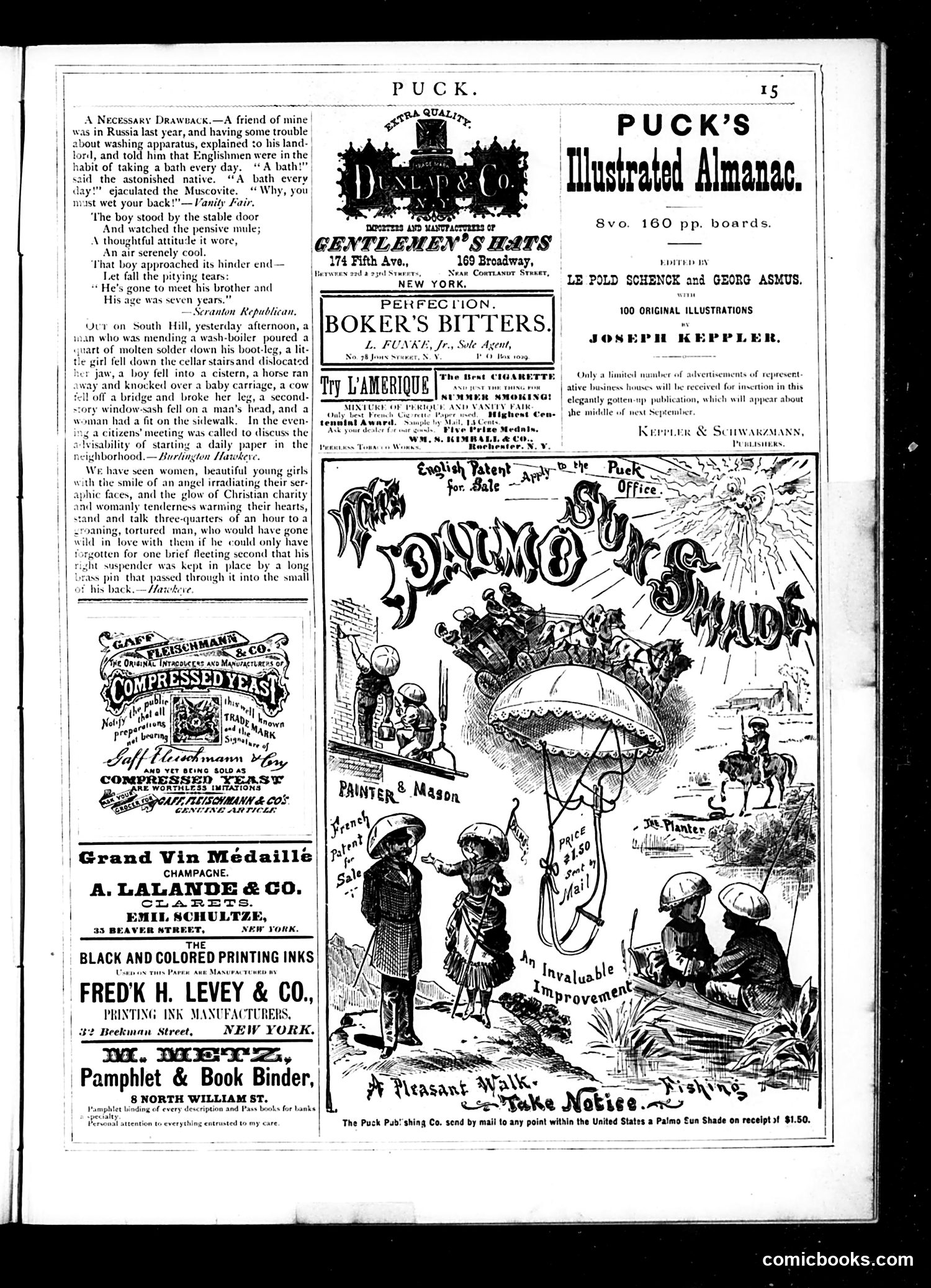
This page is primarily **advertising and promotional content** rather than political satire. The dominant feature is a large illustrated advertisement for "Puck's Illustrated Almanac" (160 pages, boards), edited by Le Fold Schenck and Georg Asmus, with 100 original illustrations by Joseph Keppler. The cartoon below shows children in various scenarios—with umbrellas, toys, and engaged in outdoor play—labeled with phrases like "An Invaluable Improvement" and "A Pleasant Walk." This appears to be **promotional artwork** showcasing the magazine's illustrated content rather than satirical commentary. The page also contains numerous advertisements for commercial products: compressed yeast, champagne, printing inks, and bookbinding services, typical of 19th-century magazine layouts.
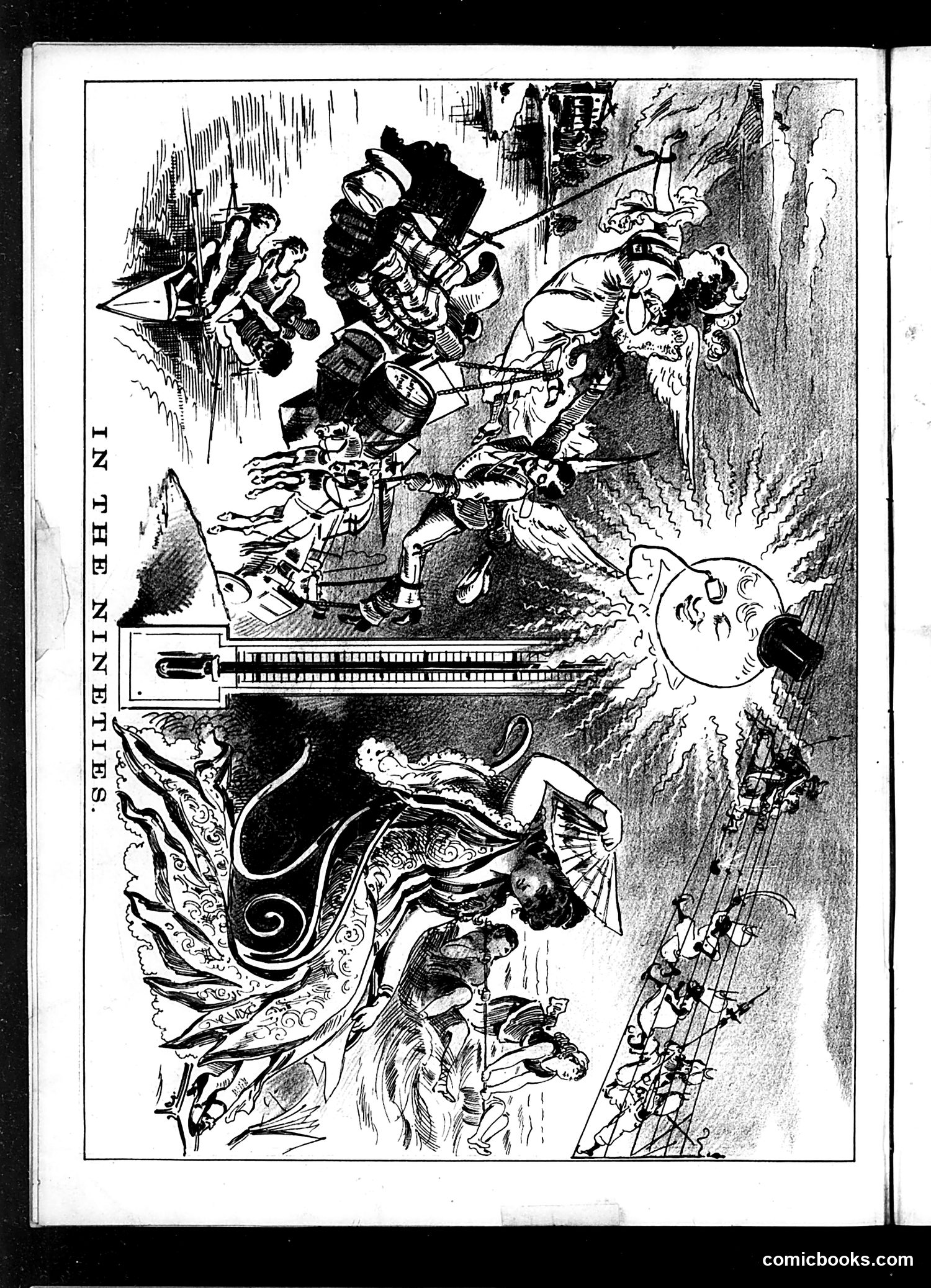
This cartoon satirizes the 1890s era through chaotic scenes of social and political disorder. The page shows caricatured figures engaged in various forms of mayhem—what appears to be violent confrontations, social upheaval, and general pandemonium. The title "IN THE NINETIES" suggests commentary on that decade's turbulent conditions. The imagery likely references labor unrest, political corruption, or social instability characteristic of the 1890s. The exaggerated, grotesque character drawings typical of Puck's style emphasize the satirical critique. However, without clearer identification of specific figures or events labeled on the page, the exact political targets remain unclear. The overall message appears to be mockery of the era's chaotic social conditions, though the specific references would benefit from additional historical context.